Author: Grimbard

  • October 31 Arrives September 23: A Folk-Horror Story for Every Night

    October 31 Arrives September 23: A Folk-Horror Story for Every Night

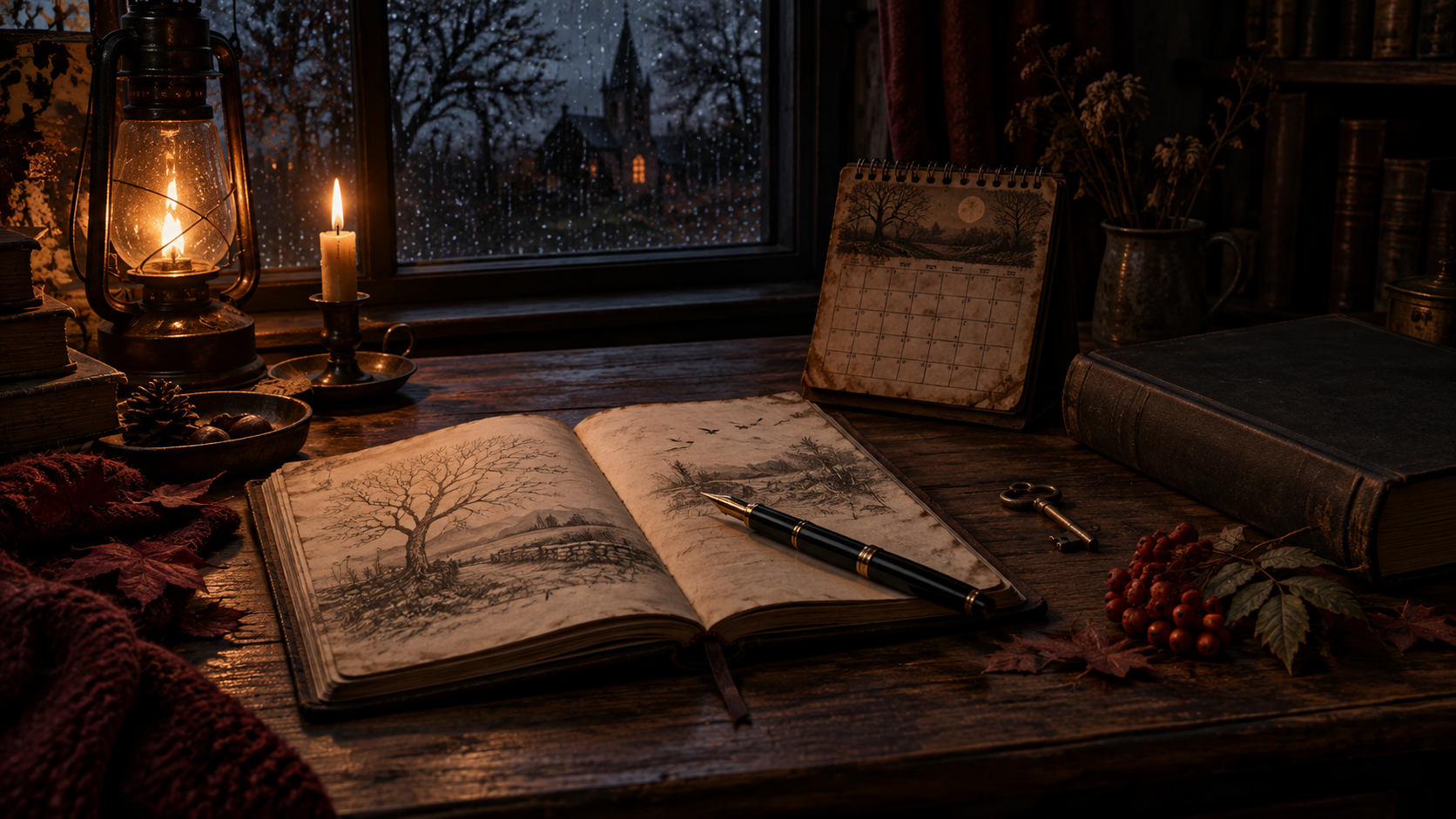
    A candlelit writing desk with a black notebook, autumn leaves, and an October calendar

    If you are looking for new folk horror books for Halloween 2026, October 31 arrives Wednesday, September 23. It is the newest volume in the There Be Monsters series: thirty-one standalone horror stories, each beginning on October 31 in a different year and place.

    The dates range across centuries. The people in these stories do not share a country, a religion, or even a common idea of Halloween. What they share is the moment when an inherited warning stops sounding quaint.

    Somebody hears the hoofbeats that were supposed to remain a story. Somebody brings home the wrong object from an estate sale. Somebody discovers that the household rule everyone mocked was not designed to control the living.

    That is the promise of the book: every warning was true once.

    **Get October 31 on Amazon →**

    Want the release news, new stories, and reading-room notes delivered before the season outruns you? Join the Grimbard mailing list →

    The rule behind all thirty-one stories

    Every story had to begin on October 31. That restriction turned out to be less limiting than it sounds.

    Halloween is not a single, frozen tradition. The date gathers customs, church calendars, harvest practices, migration, commerce, family habits, and stories that have changed whenever people carried them somewhere new. In one century, October 31 is a vigil. In another, it is an ordinary working night. In another, children are wearing plastic masks while an older rule waits behind the modern one.

    That allowed the book to move through very different kinds of darkness without abandoning its central shape. One account opens in a Carpathian farmhouse in 1897. Another begins in a Massachusetts village in 1653. There is a North Atlantic whaling ship, a plague-year London parish, a South Texas ranch in 1996, and a modern small-town diner after closing.

    The date stays fixed. Everything surrounding it changes.

    The result is not a single continuous novel. It is a collection of complete stories linked by a night, a field-report structure, and the idea that folklore often preserves a practical instruction inside the supernatural one.

    What kind of folk horror is inside?

    The book ranges beyond the familiar image of an isolated village and a harvest ritual. Folk horror can grow anywhere a community inherits rules about place, behavior, obligation, or danger.

    Some stories deal with recognizable beings: banshees, changelings, a strigoi, a golem, a household kobold, and the thing modern witnesses called the chupacabra. Others begin with customs that seem smaller: stopping a clock after a death, leaving payment for a favor, refusing to carry a particular object across a threshold, or remembering which words should never be spoken at sea.

    There are also stories built from historical pressures rather than a single named monster. Epidemic years change how a cemetery operates. Economic collapse changes what a scarecrow means to the person looking across a failing field. A new technology or popular film can revive an older fear and give it a different vocabulary.

    The supernatural elements are fiction. The beliefs, places, occupations, and historical tensions underneath them have been treated as seriously as the stories allow.

    That distinction matters. Folklore is not an unlimited box of atmospheric props. Some traditions belong to living communities. Some old beliefs were used to harm disabled people, religious minorities, grieving families, or anyone inconveniently different. A horror story can acknowledge that history without surrendering its mystery.

    The book ends with a Note on Sources explaining where the traditions came from, which details are documented, and what was invented for the fiction.

    How dark is October 31?

    Seven weathered story cards arranged in a circle beside a candle

    This is a book of dread, consequence, and close encounters with the impossible. It is not built around a contest to produce the most gore.

    Violence occurs, and some of the history behind the stories is grim. But the central pleasure is the instant when a sensible person realizes the rule was accurate. The characters still have to decide what to do with that knowledge. They can follow the warning, misunderstand it, exploit it, or decide that it no longer applies to them.

    Most of the terror lives in that decision.

    Readers who enjoy haunted history, regional legends, old houses, strange records, dangerous landscapes, and supernatural rules will find several ways into the collection. Readers who prefer atmosphere to graphic excess can approach it without being promised a bloodless book or ambushed by a book interested only in spectacle.

    Three ways to read the book

    You can read October 31 straight through, but the structure supports three different routes.

    Read one story every night in October

    The obvious method is also the one the book was designed to reward. Begin on October 1, read one story before bed, and arrive at the title story on Halloween.

    Each story opens with a dateline, so the month becomes a journey through changing places and periods rather than a sequence of interchangeable scares. The stories are standalone, which means missing a night will not break a larger plot. You can catch up without rereading half a novel.

    Follow the folklore

    Readers interested in belief and tradition can move through the collection by subject: restless dead, household spirits, protective materials, death customs, regional monsters, and warnings attached to particular landscapes.

    The companion articles appearing here through October will examine the real history and folklore behind those stories without spoiling them. They are designed to give readers more than a promotional summary. Each one answers a question the fiction raises: what a strigoi was before Dracula, why sailors kept rules that looked irrational on land, or how newspapers assembled the mummy’s curse from unrelated events.

    Build a single-night Halloween stack

    Not everyone wants a month-long challenge. Choose several stories by length or theme and make a Halloween-night reading stack. Begin with a historical account, move to a regional legend, and save the title story for last.

    That approach turns the anthology into something closer to a private late-night broadcast: different voices reporting from the same date, each unaware of what is happening elsewhere.

    Where the book fits in There Be Monsters

    October 31 stands alone. You do not need to read the earlier There Be Monsters volumes first.

    The series is connected by method rather than a continuing cast. Each volume takes old warnings seriously enough to ask why they survived. Then and Now pairs older horrors with modern echoes. Deep Down moves underground and below the waterline. Among the Dead follows the dead who refuse the arrangements made by the living.

    This volume turns toward Halloween itself—not only the modern holiday, but the older fears, obligations, and boundary nights gathered around it.

    New readers can begin here. Returning readers will recognize the datelines, the evidence-minded approach, and the kind of practical person who ends up confronting something no practical worldview prepared them for.

    You can also explore the complete There Be Monsters series or use the Grimbard Start Here page to choose a book by subject.

    The release and the October readalong

    October 31 releases in ebook on Wednesday, September 23, with print to follow. The Amazon page is live now.

    **Get October 31 on Amazon →**

    The 31 Nights readalong begins October 1. A free printable calendar tracks each night’s story and dateline. It is optional; the stories work in any order and at any pace. But if you enjoy giving October a structure, this one ends exactly where it should: with every warning sounding at once.

    Frequently asked questions

    What is October 31 by T. P. Grimbard about?

    October 31 is a collection of thirty-one standalone horror stories. Every story begins on October 31, but the settings span different centuries, countries, occupations, and folklore traditions.

    Is October 31 a novel or a short-story collection?

    It is a short-story anthology. The stories share a date, a field-report style, and the There Be Monsters approach, but each has its own characters and complete plot.

    Do I need to read the other There Be Monsters books first?

    No. Every volume and every story stands alone. Readers familiar with the series will recognize its methods and themes, but October 31 is also an entry point.

    Is October 31 extremely graphic?

    The book contains danger, death, and dark historical material, but it emphasizes atmosphere, folklore, consequence, and slow dread rather than continuous graphic violence.

    Can I use the book for an October reading challenge?

    Yes. The collection contains one story for every night in October. Reading one per night leads directly to the title story on Halloween.

    Thirty-one stories. One date. More warnings than anyone should hear at once.

    October 31 arrives September 23.
  • Horror Books About Sea Monsters: 9 Reads for Myth, Storms, and Deep Water

    Horror Books About Sea Monsters: 9 Reads for Myth, Storms, and Deep Water

    The best horror books about sea monsters understand that the creature is only part of the problem. The ocean removes witnesses, shortens supplies, ruins maps, and makes escape depend on a machine that can fail. A monster under the water is terrifying because it has the advantage before it appears: it lives in the element that keeps everyone else alive only provisionally.

    This list moves from ancient myth to modern maritime dread. Some entries are openly monstrous. Others use the sea itself as the thing that watches, waits, and refuses to explain. Start with the mood you want rather than trying to find one definitive “kraken book.”

    1. *Monsters of the Wine-Dark Sea* — for myth with teeth

    For readers who want the old monster routes first—Scylla, Charybdis, sirens, and the perilous logic of the ancient sea— Monsters of the Wine-Dark Sea is the direct Grimbard starting point. It follows the idea that mythology is not a museum case. It is a survival language for a world that will not hold still.

    2. *The Call of Cthulhu* by H. P. Lovecraft — for cosmic maritime dread

    Lovecraft’s 1928 story is a foundational weird-fiction sea read: cults, sailors, a drowned city, and a revelation too large for the people who discover it. Its influence is enormous, and so are its serious problems. Read it with awareness of Lovecraft’s racism and the genre’s long history of inheriting it. The useful lesson is structural: the sea lets the story keep its largest truth out of reach until the final approach.

    3. *The Kraken Wakes* by John Wyndham — for invasion by the deep

    Wyndham’s 1953 novel imagines an undersea invasion that begins as a mystery and becomes a global crisis. It is less interested in one tentacled encounter than in escalation: reports become patterns, patterns become policy failures, and policy failure becomes a transformed world.

    Choose it if you like sea horror that expands outward from a single alarming signal.

    4. *The Terror* by Dan Simmons — for ice, hunger, and what follows the ships

    Inspired by the Franklin expedition, The Terror turns a historical disaster into a long survival nightmare. The monster matters, but ice, hunger, leadership, and failing morale do as much of the work. Readers should know it is a fictionalized version of real loss, not a replacement for historical accounts.

    Choose it if you want the sea as a hostile system, even when it has frozen solid.

    5. *Into the Drowning Deep* by Mira Grant — for science meets mermaid horror

    Grant’s 2017 novel sends researchers toward the site of a vanished expedition and gives creature-feature energy an oceanographic frame. It is fast, violent in places, and interested in what happens when evidence-minded people find evidence that changes the category of the world.

    Choose it if you want the investigation as much as the attack.

    6. *The Deep* by Nick Cutter — for claustrophobia below the surface

    This novel sends a team into an extreme undersea environment in search of a cure, then makes the isolation itself unbearable. It is graphic and bleak, so it is a poor fit for readers looking for mythic adventure. It is a good fit for readers who want the ocean turned into a sealed psychological chamber.

    7. *The Swarm* by Frank Schätzing — for ecological scale

    Schätzing’s thriller imagines the ocean responding to human pressure through an intelligence that humanity did not know how to see. It is expansive rather than intimate. Its appeal is the growing realization that the sea has its own agency and that our usual assumptions about control are provincial.

    8. *Sphere* by Michael Crichton — for an impossible object underwater

    Sphere is science-fiction thriller more than pure horror, but it earns its place for readers who like a deep-sea premise that becomes a mind game. A team finds something impossible on the ocean floor, and every attempt to explain it makes the team less reliable.

    Choose it if you want a sea-monster mood without a conventional monster body.

    9. *The Fisherman* by John Langan — for mythic grief and dark water

    Langan’s novel uses fishing, grief, and a local legend to open into something much larger and stranger. It is patient, melancholy, and more folkloric than creature-feature fiction. Its water feels old, not merely deep.

    Choose it if what you want is an American folk-horror route to the sea.

    Choose by the fear you want

    | If you want | Start with | |—|—| | Greek myth and named monsters | Monsters of the Wine-Dark Sea | | A foundational cosmic sea story | The Call of Cthulhu | | Modern creature investigation | Into the Drowning Deep | | Historical survival horror | The Terror | | Underwater confinement | The Deep | | Ecological apocalypse | The Swarm | | Folkloric, grief-struck unease | The Fisherman |

    For the legend beneath the recommendation, revisit why sailors believed in sea monsters. If you want a quieter strange-light counterpart to maritime danger, what is will-o’-the-wisp? follows another old warning that turns uncertainty into a story.

    Why sea monsters remain so effective

    The sea makes a monster story efficient. A land creature must cross a room. A sea creature can touch the hull from below, vanish into a depth no light reaches, and leave the people aboard arguing about whether it was ever there. The ocean also turns scale against us. A whale, squid, current, fog bank, or storm can be real and still feel impossible at night.

    That is why maritime horror can work without pretending every sailor’s tale is literal. Monster stories record the feeling of dependence: a person on a ship survives because wood, weather, food, navigation, and other people continue to cooperate. The creature arrives when cooperation breaks.

    Make the next voyage a darker one

    For a book that begins with the monsters sailors named when the water had no mercy, visit Monsters of the Wine-Dark Sea. Or join The Grimbard Press for Dead Ship, the free illustrated Subscriber Archive Edition.

    Frequently asked questions

    What are the best horror books about sea monsters?

    The best choice depends on the kind of sea horror you want. Into the Drowning Deep suits creature-feature readers, The Terror suits historical survival horror, and Monsters of the Wine-Dark Sea suits readers who want mythic sea monsters.

    Are sea-monster books always creature features?

    No. Some use a literal creature; others make the ocean, isolation, or an unknowable underwater object the source of dread. Maritime horror often works through vulnerability and distance as much as teeth or tentacles.

    Is *The Terror* a true story?

    It is historical fiction inspired by the Franklin expedition, with supernatural elements added. It should not be used as a factual account of the expedition.

    Which sea-horror book is best for readers who dislike gore?

    Try Monsters of the Wine-Dark Sea, Sphere, or The Fisherman, then check individual content notes. Tone and intensity vary substantially across maritime horror.

    The water keeps the first secret

    Sea monsters last because the ocean refuses to make a complete witness of anyone. A ship can feel like a whole world until one sound strikes the hull from beneath. Then it becomes what it always was: a small, lit object floating above a country of darkness.

    Dark ocean scene used as a reading-retention image for the sea-monster horror guide.

  • 7 Victorian Horror Novels to Read If You Love Dracula

    7 Victorian Horror Novels to Read If You Love Dracula

    If you love Dracula, begin with books that share one of its real strengths: pressure. Bram Stoker’s novel is not just a vampire story. It is an accumulation of documents, warnings, professional expertise, private fear, and a threat that makes modern confidence look fragile. The best Victorian horror novels like Dracula do not all repeat that formula. Some offer intimate vampirism, some offer ambiguous ghosts, and some drift into forbidden knowledge so strange that the room around the reader begins to feel unreliable.

    Here are seven useful next reads, grouped by the kind of dread you want more of. The first is the closest Grimbard route; the remaining titles are included as reader recommendations, not sales links.

    1. *The Beetle: A Mystery* by Richard Marsh — for rival fin-de-siècle menace

    Published in 1897, the same year as Dracula, Richard Marsh’s The Beetle is a restless, strange novel of pursuit, transformation, class anxiety, and London dread. It is not a Dracula substitute. It is more unruly and, at times, more disorienting. That is precisely why readers who want another late-Victorian shock should try it.

    Richard Marsh’s career and the book’s publishing context are summarized by Encyclopedia.com. Read it with an eye for what the period’s sensational language reveals about its fears and prejudices, not as a timeless cultural authority.

    For the closest Grimbard edition, start with The Beetle: a Mystery Annotated. The annotations make room for the novel’s historical context without sanding away its strange momentum.

    2. *Carmilla* by J. Sheridan Le Fanu — for intimate vampire dread

    Carmilla predates Dracula and is smaller, quieter, and more intimate. Its vampire does not arrive as a grand invading force. She enters the household, becomes a companion, and lets affection become a source of danger. Choose this if the private, confessional feeling of Dracula mattered more to you than the chase.

    Choose a library, bookstore, or edition that suits the reading experience you want; the important part is the novella’s intimate, unsettling vampire logic.

    Why it fits: the book gives you a different vampire geometry—close rooms, whispered trust, and a threat that thrives by being welcome.

    3. *The Turn of the Screw* by Henry James — for uncertainty you cannot solve

    Henry James’s novella is the right next move if the documents and competing interpretations in Dracula made you want more uncertainty. Its governess sees figures at a country estate and becomes convinced that children are in danger. The story refuses to settle comfortably into “ghosts are real” or “the narrator is wrong.”

    Choose an edition with notes if you want help tracing the story’s competing readings; the ambiguity is the point, not a problem to solve.

    Why it fits: the fear is not a monster with a fixed rulebook. It is the possibility that perception itself has become a locked room.

    4. *The Great God Pan* by Arthur Machen — for forbidden knowledge

    Machen’s 1894 novella trades vampires for revelation. People learn or glimpse something that human beings may not be equipped to know, and the consequences spread through respectable society. It is compact, influential, and often more interested in implication than explanation.

    This is best approached as a short, intense descent into forbidden knowledge rather than a conventional haunted-house novel.

    Why it fits: like Dracula, it lets modern life brush against an older and more terrifying order. But its horror is less about invasion than contamination of the mind.

    5. *The King in Yellow* by Robert W. Chambers — for strange symbols and infected stories

    Published in 1895, Chambers’s collection moves toward weird fiction. Its linked early stories circle a forbidden play, a mysterious king, and an idea that changes people who get too close. Not every story is equally successful, but the atmosphere is singular: elegant rooms, artistic ambition, and a piece of culture that behaves like a disease.

    Look for a complete collection so the variety of Chambers’s strange, symbol-heavy stories can do its work.

    Why it fits: Dracula uses papers, letters, and records to build dread. Chambers asks what happens when the text itself is the danger.

    6. *The Picture of Dorian Gray* by Oscar Wilde — for beauty with a hidden bill

    Wilde’s 1890 novel is not a conventional monster tale, but it belongs on this list for readers interested in desire, secrecy, and corruption made physical. The portrait externalizes a moral cost that Dorian refuses to face. Like the best Victorian horror, it turns a social surface into a trapdoor.

    Why it fits: if the drawing-room texture of Dracula appealed to you, this gives you more wit and more rot beneath polish. It also shows how effectively horror can work when the supernatural element stays contained in one impossible object.

    7. *The Strange Case of Dr Jekyll and Mr Hyde* by Robert Louis Stevenson — for the monster inside respectability

    Stevenson’s 1886 novella is brief, direct, and still sharp. It makes public respectability itself the disguise. The terror is not only that Hyde exists; it is that the conditions that produce him are embedded in the man everyone trusts.

    Why it fits: readers who enjoy Dracula’s anxiety about hidden appetite will recognize the pressure. The difference is scale. Stoker sends the threat across borders. Stevenson puts it behind one man’s front door.

    How to choose your next Victorian horror read

    | If you want more of this | Start here | |—|—| | Vampires, intimacy, and unease | Carmilla | | Rival 1897 weirdness and London pursuit | The Beetle | | Ghosts you cannot prove | The Turn of the Screw | | Forbidden knowledge | The Great God Pan | | A dangerous text and proto-weird fiction | The King in Yellow | | Social polish hiding corruption | Dorian Gray | | A compact split-self nightmare | Jekyll and Hyde |

    For a focused comparison of the two 1897 shockers, read The Beetle vs. Dracula. If you are building a gentler route into the genre, start reading horror without gore before you choose by reputation alone.

    A note on old books and new readers

    Victorian fiction can contain racial, colonial, class, gender, and ableist assumptions that deserve context rather than a shrug. That does not make the books useless. It means a good reading guide should name the historical distance and let readers decide what they want from it. An annotated edition can help, especially when the book’s language is part of its difficulty.

    Take the stranger route

    If Dracula made you want another late-Victorian monster story, The Beetle: a Mystery Annotated is the sharpest next turn: related by era, not interchangeable in effect. For more reading routes, folklore, and carefully sourced horror context, join The Grimbard Press and receive Dead Ship free.

    Frequently asked questions

    What Victorian horror novel is most like *Dracula*?

    The Beetle: A Mystery is a strong companion because it was also published in 1897 and shares late-Victorian fears about invasion, transformation, urban life, and unstable identity. Its tone and plot are distinctly its own.

    Is *Carmilla* older than *Dracula*?

    Yes. J. Sheridan Le Fanu’s Carmilla was first published in 1872, decades before Dracula appeared in 1897.

    Are these books all horror novels?

    They sit across Gothic fiction, ghost stories, supernatural fiction, and early weird fiction. The list is organized by reader experience rather than forcing every title into one modern genre label.

    Where can I find these books?

    Use a library, local bookseller, or a trusted edition from a retailer you already use. If verified Amazon Associates links are later added, they should be created through the publisher’s active account and point to a specific, appropriate edition.

    The thing at the edge of the lamplight

    The Victorian horror shelf is larger than its most famous vampire. Its best books know that a sealed letter, a beautiful room, an administrative rule, or a familiar face can all become the first sign that the ordinary world has been negotiated away. Read Dracula again if you like. Then let The Beetle lead you somewhere less orderly.

    Victorian Gothic reading scene used as a retention image for the Dracula companion reading guide.

  • Why Does Workplace Horror Work? When the Shift, the Rules, and the Building Turn Hostile

    Why Does Workplace Horror Work? When the Shift, the Rules, and the Building Turn Hostile

    Workplace horror works because a job already comes with rules that can override instinct. You clock in, follow procedure, answer the call, finish the shift, and avoid making trouble. When a horror story turns one of those ordinary expectations against its worker, the reader immediately understands the trap. Leaving may cost rent money. Ignoring a supervisor may cost a reference. Breaking a rule may feel dangerous even before the rule becomes supernatural.

    The monster in workplace horror is often not the building itself. It is the system that makes a person stay in the building after the sensible thing would be to run.

    Familiarity is the first weapon

    Offices, warehouses, hospitals, hotels, stores, and security desks are not gothic castles. That is the point. They are places with fluorescent lighting, break rooms, badge readers, paperwork, and a person who will ask why you left early. Horror changes one small thing—a door that must never be opened after 2:00 a.m., a customer who cannot be acknowledged, an elevator that stops at a floor the building does not have—and the normal setting becomes a pressure chamber.

    Chicago Public Library’s workplace science-fiction and horror reading list points toward the breadth of the mode: work can be a laboratory, a corporate maze, a service counter, or a job that erodes the boundary between self and institution. The setting travels because labor is already intimate. It tells us when to wake, where to sit, what to wear, and how much of ourselves to perform.

    The rules are believable before they become sinister

    Rules horror succeeds when the first few instructions are plausible. Lock the rear entrance. Do not discuss customers outside the store. Call maintenance if the lights flicker. The reader recognizes workplace procedure and accepts it before the list turns strange.

    Then comes the line that changes everything: do not answer the intercom after the third ring. If a coworker asks you to cover the basement, confirm their name twice. If you see the manager in the north hall, do not let them know you saw them.

    The fear does not come from randomness. It comes from the implication that someone has learned these rules the hard way. A rule is a fossil of an earlier incident. Every instruction suggests a missing report, a previous worker, a consequence management has filed away instead of fixing.

    For a closer look at why warnings and prohibitions carry such force, see “The Craft of ‘Don’t Do X’: Why Rules Are the Most Powerful Tool in Folk Horror”. Workplace horror borrows that folk mechanism and gives it an employee handbook.

    Economic pressure makes “just leave” impossible

    Readers often ask why a character stays. Workplace horror has a built-in answer: people need the job. The strongest stories do not use that fact as an excuse for foolishness. They show the costs clearly. The worker has a lease, a family obligation, a bad employment history, no paid time off, or a manager who has trained everyone to accept the unacceptable.

    That does not mean every workplace story must become a social-realist lecture. It means the supernatural pressure is more convincing when it attaches to a real human calculation. A haunted factory is scary. A haunted factory where the night supervisor says payroll will be delayed if anyone reports an accident is scarier, because the lie has a recognizable shape.

    The genre can also make bureaucracy itself uncanny. A form asks for a date that has not happened. A password changes to a dead employee’s name. A disciplinary meeting is scheduled with no organizer. The institution speaks in a voice that is both impersonal and much too close.

    After-hours spaces remove the witnesses

    During the day, a workplace has noise, routine, and other people. At night, a familiar floor plan can become a map of places no one is watching. The vending machine hum becomes company. A security camera offers the comfort of surveillance until the worker realizes it is aimed in the wrong direction.

    That is why night shifts are scary even without a monster: the shift reverses the social world. You are awake when everyone else is unavailable, responsible for a building designed for crowds while almost entirely alone. Workplace horror takes that condition and asks what happens when the building starts treating the worker as its last remaining employee.

    The workplace monster is usually a bad manager in another mask

    There is a dark joke at the center of the genre. The monster may be ancient, but it still needs you to complete your tasks. It tracks compliance, punishes absence, and uses opaque language. In that sense, workplace horror is not an escape from ordinary dread; it is an exaggeration that reveals the ordinary dread’s outline.

    The best stories preserve ambiguity. Is the company hiding a creature? Is the creature simply what the company has always been? The reader should feel both possibilities working at once.

    Clock in carefully

    If the horror of rules, shifts, and places that want something from their workers is your preferred kind of dread, On the Clock, After Dark is the direct Grimbard route. It is for readers who know the worst line in an employee handbook is the one everyone pretends is normal.

    For more evidence-minded unease, join The Grimbard Press and get Dead Ship, the free illustrated Subscriber Archive Edition.

    Frequently asked questions

    Why is workplace horror so relatable?

    Most readers know what it feels like to follow rules, depend on a paycheck, and remain polite in an uncomfortable setting. Workplace horror exaggerates those familiar pressures until ordinary compliance becomes dangerous.

    What makes a rules-horror story work?

    The rules need to begin plausibly and imply a reason they exist. Specific consequences, a human cost for leaving, and a setting with real routines make strange instructions more frightening than random ones.

    Is workplace horror the same as office horror?

    Office horror is one form of workplace horror. The larger category includes hospitals, retail, factories, hotels, security jobs, restaurants, call centers, and any workplace whose systems can become threatening.

    Why are night shifts common in horror?

    Night shifts reduce witnesses and normal activity while leaving the worker responsible for a large, familiar place. That combination makes isolation feel contractual rather than accidental.

    The shift ends when it lets you go

    The workplace is frightening because it makes obedience feel like survival. Horror only needs to make the institution hungry. Once the lights dim and the rulebook starts protecting something other than the staff, the worker discovers the oldest after-hours problem: the building may have been waiting for someone to stay late.

    Fluorescent workplace corridor used as a retention image for an article about rules, shifts, and workplace horror.

  • Scylla and Charybdis Explained: The Sea Monsters That Made Every Route Dangerous

    Scylla and Charybdis Explained: The Sea Monsters That Made Every Route Dangerous

    Scylla and Charybdis are the paired sea dangers Odysseus must pass in Book 12 of Homer’s Odyssey. Scylla is a many-headed creature who snatches sailors from a cliff; Charybdis is a destructive whirlpool-like threat on the opposite side. They matter because Homer does not offer a clean victory. Odysseus is told to steer closer to Scylla and lose a few men rather than risk losing the whole ship to Charybdis.

    That is why “between Scylla and Charybdis” still means facing two bad options. The phrase is not about indecision. It is about navigating a passage where the sea has made safety impossible.

    What Homer actually puts in the strait

    In the Odyssey, Book 12, Circe warns Odysseus about the route ahead. Charybdis repeatedly draws in and disgorges the sea; Scylla lives in a cave high above the channel and takes six sailors, one for each head. Homer’s description is not a field guide. It is a piece of mythic geography, built to make the hero choose which terror he can survive.

    The details are deliberately uneven. Charybdis is a force of the water—mouth, swallow, surge. Scylla is a predatory body attached to rock and height. One threatens the ship as a whole; the other makes the crew watch individuals disappear. In horror terms, Charybdis is catastrophe. Scylla is selection.

    Were Scylla and Charybdis based on a real place?

    Later readers commonly connect the pair with the Strait of Messina between Sicily and mainland Italy, a narrow and historically challenging waterway with currents and dangerous coastal geography. That connection is useful context, not a proof that Homer was describing a modern hydrographic chart. Classical scholars continue to discuss the myth’s literary and geographical layers; an Oxford Academic overview treats the pair as part of a long and evolving tradition.

    The point is not that sailors saw literal six-headed beasts. The point is that real maritime peril needs a language. A current that can overturn a vessel and a cliff that can take a sailor out of reach are easier to remember when they have appetite, names, and a place in a story.

    Why Odysseus chooses Scylla

    Circe’s counsel is brutal: sail near Scylla. Odysseus cannot defeat her, and trying to fight may cost everyone. He arms himself anyway, then discovers that courage is not the same as control. Scylla strikes from above and takes six companions before the crew can answer.

    The scene is disturbing because it rejects the fantasy that the captain’s strength can save every person. Odysseus makes the better choice and still hears his men calling for him. Homer gives him survival without innocence.

    That is the real horror of the passage. A monster fight has rules: strike, flee, outwit. Scylla and Charybdis make the rules structural. The ship must go through. The sea will charge a price. The hero’s task is no longer to win but to decide what loss is survivable.

    The two monsters do different work

    | Danger | Form in the poem | What it threatens | Horror mechanism | |—|—|—|—| | Scylla | cliff-dwelling, many-headed predator | individual sailors | helpless witnessing | | Charybdis | devouring, surging sea force | the whole ship | mass catastrophe |

    This contrast explains their durability. They are not duplicates placed on opposite shores. One is the thing that reaches down; the other is the world opening underneath you. Between them, a crew discovers that a route can be a trap even when it is the only route available.

    What the monsters teach about navigation

    Ancient seafaring depended on accumulated local knowledge: seasonal weather, recognizable headlands, currents, harbors, and warnings passed from one crew to another. A story can preserve that kind of knowledge without pretending to be a modern manual. “Do not take the middle” or “do not mistake the calm side for the safe side” is memorable when a monster gives the warning a face.

    That helps explain why the episode keeps attracting readers outside classical studies. Scylla and Charybdis make geography moral. The passage asks a leader to choose, then denies the comfort of a harmless choice. In a disaster story, the villain may be overcome. In this kind of sea story, the map is the villain. The channel is narrow because the narrative needs the crew close enough to see both terrors at once.

    It is also worth resisting the temptation to flatten the myth into a simple proverb. Odysseus is not calmly weighing two abstract options. He is moving through water with exhausted people aboard, after other warnings have already proved deadly. The phrase survived because it describes a recurring human experience, but the poem remains harsher than the phrase: one choice is strategically better and emotionally unbearable.

    From maritime warning to monster tradition

    Sailors have always given danger a body. In our look at why sailors believed in sea monsters, the sea becomes a place where limited visibility, strange animals, and lives dependent on weather make stories practical as well as frightening. A named terror teaches a lesson: do not trust calm water, do not confuse distance with safety, do not assume the chart has finished explaining the world.

    Scylla and Charybdis also show why myth survives adaptation. A modern version can be a storm drain and a collapsing bridge, a corporate rule and an impossible deadline, a ship’s engine failure and a reef. The names endure because the shape of the problem endures: an approaching choice that makes every option feel like a betrayal.

    For a historical mystery of a different kind, the Mary Celeste offers another sea story where absence becomes the monster. The facts are stranger when they remain facts.

    Where to go after the strait

    If you want Greek monsters, maritime dread, and the old stories that taught sailors how little they controlled, Monsters of the Wine-Dark Sea is the natural next read.

    Or join The Grimbard Press for Dead Ship, the free illustrated Subscriber Archive Edition.

    Frequently asked questions

    What are Scylla and Charybdis?

    They are paired sea dangers in Homer’s Odyssey. Scylla is a cliffside monster who takes sailors, while Charybdis is a destructive swallowing force in the water opposite her.

    Did Odysseus fight Scylla?

    He prepares to fight, but he cannot prevent her attack. Circe’s advice is to pass closer to Scylla rather than risk the total destruction associated with Charybdis.

    Where were Scylla and Charybdis located?

    Later tradition often associates them with the Strait of Messina between Sicily and mainland Italy. That association should be treated as mythic and literary context, not as evidence for literal monsters.

    What does “between Scylla and Charybdis” mean?

    It means being forced to choose between two dangerous alternatives, especially when avoiding one danger brings you closer to another.

    The price of a passage

    Scylla and Charybdis last because they refuse a comforting ending. The sea does not reward good intentions. It does not pause for a plan. The ship passes only by accepting that a route can demand something back. That is a monster story with no need for a final blow—just water, stone, and six voices fading behind the stern.

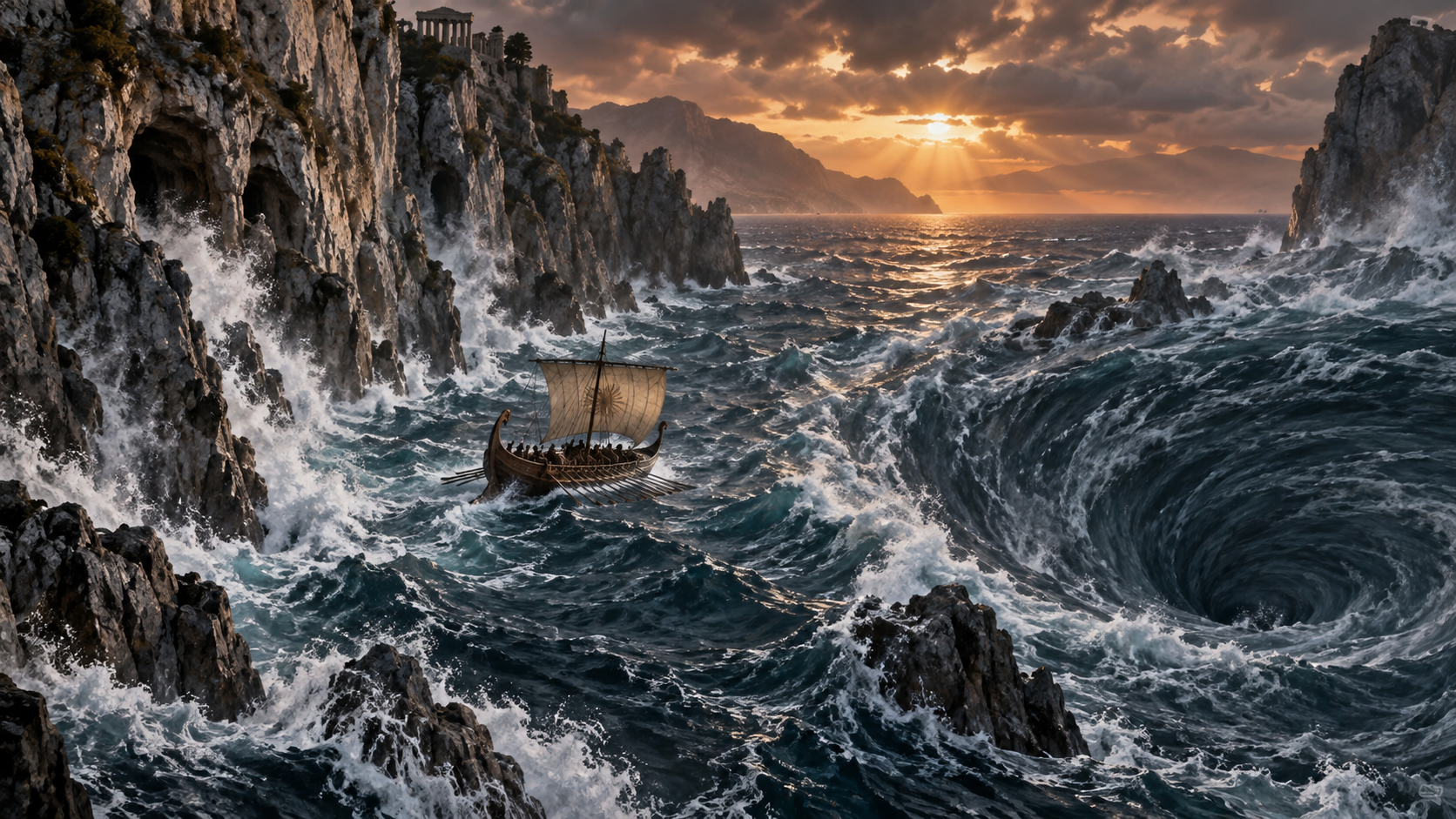
    Stormy strait and dangerous water used as a retention image for the Scylla and Charybdis myth guide.

  • Why Are Abandoned Mines So Scary? The Real Dangers Behind Underground Horror

    Why Are Abandoned Mines So Scary? The Real Dangers Behind Underground Horror

    Abandoned mines are scary because they combine a built environment with a landscape that does not forgive mistakes. A mine has tunnels, ladders, rails, shafts, tools, and evidence of human labor—but the people are gone. Underground, the usual safeguards of distance, daylight, and an easy exit disappear. The horror is not just claustrophobia. It is the sense of entering a machine that has been left running in the dark.

    There is a practical reason to keep that feeling at the mouth of the tunnel. The National Park Service warns that abandoned mine lands can contain unstable openings, hidden shafts, bad air, falling rock, and contaminated materials. Do not enter one for photographs, exploration, or a story. The most convincing mine horror begins with that fact: some places are frightening because they are genuinely unsafe.

    A mine is an industrial labyrinth, not a cave

    People often group mines and caves together because both are underground. The difference matters. A cave suggests geology: chambers, water, stone, and a landscape formed on a timescale too large to care about us. A mine suggests intention. Someone cut, blasted, reinforced, measured, and marked the route. Someone expected a shift to begin and end.

    That intention makes abandonment feel personal. A rail disappears around a bend. A timber support stands where a hand placed it decades ago. A rusting lunch pail, if it exists, is not evidence of a ghost; it is evidence of a worker who expected to come back. The mine becomes a record of labor interrupted.

    Our earlier article on why caves are so scary looks at darkness, confinement, and disorientation in natural spaces. An abandoned mine uses those same pressures, then adds industrial memory: schedules, machinery, ownership, accidents, and the uneasy knowledge that extraction always leaves something behind.

    Real hazards make the imagined ones stronger

    Horror works best in a mine when it does not wave away reality. The dangers are specific enough on their own.

    – Unstable ground and supports: timbers decay, roofs collapse, and openings may be concealed by vegetation or debris. – Vertical shafts: a level-looking floor can give way to a drop that cannot be seen in poor light. – Bad air: oxygen can be low, and gases can collect in confined spaces. – Water and contamination: flooded workings, drainage, and mine waste can be hazardous. – No reliable wayfinding: a wrong turn underground is not merely inconvenient when exits, signals, and visibility are limited.

    The NPS’s safety guidance is worth reading because it strips away the romance. A mine is not an abandoned amusement park with better scenery. It was a working industrial site, and its risks do not retire when the company does.

    That realism gives writers a useful discipline. Instead of adding a monster immediately, begin with the conditions that make a person hesitate: a map that ends at a sealed level, a radio that cannot reach the surface, footprints where dust should be undisturbed. The impossible becomes more effective when the possible is already bad enough.

    Why the silence feels wrong

    An active mine has noise: ventilation, water, engines, warning signals, boots, metal, voices. An abandoned one leaves the structures of that noise behind. Pipes remain. Doors remain. Cable may still trace a wall. The absence becomes audible.

    This is a different silence from a forest’s silence. A forest has birds, weather, insects, and the expectation of change. A mine can feel as though it has been sealed off from time. A drip repeats. A loose chain touches a wall. The sound has no obvious distance because darkness gives the ear nowhere to put it.

    Industrial horror often draws power from that imbalance: the place still appears to have a job, but there is no one assigned to do it. The conveyor has stopped. The shift board is empty. The rulebook remains, and nobody is alive enough to enforce it.

    Abandonment turns a workplace into evidence

    We tend to read abandoned places as stories. A boarded-up house asks who left. An abandoned hospital asks what failed. An abandoned mine asks a sharper question: what did this place take, and what did it cost?

    Mining communities contain labor history, pride, injury, grief, and environmental consequence. Treating every mine as a generic haunted tunnel flattens that history. A stronger story starts with specificity. What mineral was extracted? Was the site a company town? Which landscape was altered? Who was expected to descend, and who was allowed to own the result?

    That attention also keeps a writer from borrowing suffering as scenery. The mine does not need a sensationalized disaster to carry dread. A schedule, a rusted tag, and a blocked escape route can imply an entire institutional world.

    The mine and the abandoned amusement park share one fear

    There is a useful comparison with why abandoned amusement parks are scary. Both settings are designed systems that have lost their intended audience. A carnival ride without riders feels wrong because its function is pleasure. A mine without workers feels wrong because its function is labor.

    But a mine has less room for play. Its corridors were never built for wandering. The visitor is not simply outside the story; they are using the place against its design. That is why an old rail line or ventilation door can feel more ominous than a cave wall. It implies rules you do not know and an exit that may not belong to you.

    If underground horror is your route in

    If you like stories where isolation, pressure, and unseen depth do most of the work, There Be Monsters: Deep Down is the book route built for that descent. It is not a safety guide or a claim about real mines. It is a fiction shelf for readers who know that the dark below ground has its own weather.

    For another way into evidence-minded horror, join The Grimbard Press for Dead Ship, the free illustrated Subscriber Archive Edition.

    Frequently asked questions

    Why do abandoned mines feel scarier than caves?

    Mines add human intention to underground darkness. Their rails, supports, shafts, and machinery suggest labor interrupted, while their industrial layout can create hazards and confusing routes that natural caves do not share in the same way.

    Is it safe to explore an abandoned mine?

    No. Do not enter abandoned mine workings. Government safety guidance warns of hidden shafts, unstable structures, bad air, water, and contamination. View them only from permitted, safe areas or through guided, authorized interpretation.

    What makes a mine a good horror setting?

    A mine combines confinement, uncertain navigation, industrial history, real danger, and the unnerving absence of the people who built it. Good mine horror respects those realities instead of treating the setting as a generic tunnel.

    Are all abandoned mines underground?

    No. Mining landscapes can include open pits, waste piles, structures, rail lines, and drainage features. All may have hazards, even where no tunnel is visible.

    The tunnel was never meant for you

    An abandoned mine frightens because it is not empty in the comforting sense. It is full of purpose: routes, supports, rules, and risks left in place after the people who understood them have gone. The dark does not have to hide a creature. It only has to keep you from seeing which part of the machine still remembers how to work.

    Abandoned mine tunnel and decaying supports used as a retention image for the underground-horror guide.

  • Why Are Cemeteries Scary at Night? Death, Design, and the Fear of Being Watched

    Why Are Cemeteries Scary at Night? Death, Design, and the Fear of Being Watched

    Cemeteries feel frightening at night because darkness removes the social cues that normally make a public place legible. Graves become low obstacles, monuments become human-sized silhouettes, and every path seems to lead somewhere people do not go after dark. Add the fact that a cemetery is built around death, memory, and names that cannot answer back, and the mind starts supplying a watcher before it has evidence of one.

    That response is not proof that a cemetery is haunted. It is a precise collision of setting and expectation. The place asks us to remember the dead while the night makes it hard to see who—or what—is nearby.

    A cemetery was designed to be read slowly

    The modern American cemetery is not merely a storage place for graves. Nineteenth-century rural cemeteries were deliberately landscaped as places for walking, mourning, and instruction. The Smithsonian Folklife account of the rural cemetery movement describes a landscape of paths, trees, monuments, and family memory: a place that makes death visible within an ordered, living world. Read its history of cemeteries in the American landscape.

    That design can feel peaceful in daylight. At night, it creates a different kind of problem. A grid of stones is hard to scan. Trees interrupt sightlines. Statues are made to resemble bodies, angels, mourners, and guardians. A curving path denies the eye a clear end point. Horror does not need a supernatural event here; it only needs an environment that refuses to give quick reassurance.

    The same mechanism explains why a familiar backyard can feel alien after midnight. But a cemetery comes preloaded with heavier meaning. You are not just unable to identify a shape. You are unable to identify a shape among the dead.

    Darkness makes ambiguous shapes feel personal

    Human vision is excellent at catching motion and poor at resolving detail in low light. When information is thin, the brain makes fast guesses. A marble obelisk can resemble a standing figure. A flower arrangement can appear to move in a breeze. A distant lamp can become a face because the mind is built to find faces quickly, even when none are there.

    This is why the most effective cemetery scenes in horror often withhold the creature. The camera, or the prose, gives the reader a line of stones and a break in the hedge. The reader does the rest. The fear is not foolishness; it is a safety system working with incomplete data.

    There is another pressure at work: a cemetery is a public place where the usual public contract is absent. In a shop, park, or station, other people provide ordinary explanation. In a cemetery at night, there may be no one to ask whether a sound was a gate, an animal, or a person. Silence becomes a blank page.

    Death anxiety changes the stakes of a quiet place

    Being near graves can bring mortality to the surface without anyone saying a word. Psychologists study death anxiety as a real and variable response, not a single universal feeling. The Death Anxiety Scale is one early tool developed to measure differences in how people think and feel about death.

    You do not have to feel actively afraid of dying for a cemetery to get under your skin. The place condenses names, dates, families, and endings into a few acres. It interrupts the ordinary illusion that death happens somewhere else, to someone else, much later. At night, when distractions thin out, that interruption can feel sharper.

    This is also why cemetery horror should be written with care. A graveyard is not a prop emptied of human beings. It is a record of people who were loved, mourned, and often still visited. Respect makes the horror better: it gives the setting moral weight instead of treating the dead as décor.

    Why the fear of being watched arrives so quickly

    Many people describe the same sensation in a cemetery: not that something will attack, but that something is looking. The feeling comes from three overlapping features.

    1. Monuments resemble observers. Upright stones, statues, portraits, and angels occupy the visual height of a person. 2. The landscape hides observers. Trees, mausoleums, low walls, and uneven ground create pockets where a real person could stand unseen. 3. The subject matter invites personhood. A cemetery asks us to think of individual lives. When the mind sees a shape, it does not read it as a random object first; it reads it through the idea of a person who once existed.

    That is fertile ground for fiction, but it is also why a cautious visitor should not wander in after closing. The danger may be a broken path, an unsafe structure, wildlife, or another living person—not a revenant. The unease is atmospheric; basic safety is practical.

    The cemetery and the fear of premature burial

    Some older cemetery dread is historical rather than spectral. The nineteenth century produced vivid anxieties about being declared dead too soon, along with stories, patents, and alarm devices meant to answer them. Our earlier look at the subject, “The Fear of Being Buried Alive: History, Horror, and the Safety Coffin”, follows how medical uncertainty became a durable horror image.

    That fear survives because it turns the cemetery’s central promise inside out. A cemetery is meant to mark a final resting place. Premature-burial stories imagine the final place as a trap. Even readers who know the history only vaguely recognize the emotional logic: the terror of needing help in a place built for the unreachable.

    For a different Victorian route into grief, image, and memory, see the history of Victorian postmortem photography. It is a useful corrective to the idea that every historical encounter with death was gothic spectacle. Much of it was mourning made visible.

    Why cemeteries are such durable horror settings

    A cemetery lets horror writers put several fears in the same frame: isolation, uncertainty, mortality, guilt, inheritance, and the possibility that the past has not finished speaking. Crucially, it does so without requiring a monster. A locked gate, a name that appears twice, a familiar flower on the wrong grave, or the sound of someone walking where no path exists can carry a whole scene.

    The setting also permits restraint. The strongest cemetery story often leaves room for an ordinary explanation. Was that a groundskeeper? A fox? Wind in dry leaves? Or did the figure behind the mausoleum wait until the narrator turned away? Certainty ends the scene. A good cemetery lets uncertainty keep breathing.

    If you want the horror to follow you home

    For readers drawn to haunted settings, graveside dread, and the uneasy intimacy of the dead, There Be Monsters: Among the Dead is the natural next shelf. It stays with the question a cemetery raises at night: what if the boundary we rely on is thinner than it looks?

    Or join The Grimbard Press and receive Dead Ship, the free illustrated Subscriber Archive Edition. It is for readers who prefer their unease evidence-minded, atmospheric, and difficult to shake.

    Frequently asked questions

    Why are cemeteries scarier at night than during the day?

    At night, darkness reduces detail and makes monuments, trees, and paths ambiguous. Because cemeteries are already associated with death and memory, the brain is more likely to interpret ambiguous sights and sounds as meaningful or threatening.

    Are cemeteries designed to feel spooky?

    No. Many historic cemeteries were designed as landscaped places for mourning, walking, and remembrance. Features that feel uncanny after dark—curving paths, tall monuments, dense trees—often served beauty, privacy, and contemplation in daylight.

    Why do people feel watched in graveyards?

    Grave markers and statues can resemble human figures in low light, while the landscape contains many sightline breaks. The mind combines those ambiguous cues with the knowledge that the place commemorates individual people.

    Is it safe to visit a cemetery at night?

    Follow the cemetery’s posted rules and hours. After dark, uneven ground, damaged structures, wildlife, and isolation can create real risks. Respect for mourners and the site matters as much as the atmosphere.

    The last light on the path

    The cemetery is frightening at night because it makes absence feel occupied. The stones do not move. The names do not speak. Yet the place is arranged so carefully around human lives that silence can begin to sound like attention. That is the old trick: darkness does not add a ghost. It removes just enough certainty for one to stand beside you.

    Moonlit cemetery path and grave markers used as a retention image for an article about why cemeteries feel frightening at night.

  • Folklore vs. Urban Legend: What’s the Difference—and Why Both Still Spread?

    Folklore vs. Urban Legend: What’s the Difference—and Why Both Still Spread?

    An urban legend is a kind of folklore. The difference is not that folklore is old and urban legends are false.

    Folklore is a practice, not a museum shelf

    That is why the distinction matters to horror readers. A monster does not need to be ancient to be folklore. It only needs to become portable.

    Folklore is a practice, not a museum shelf

    People sometimes use “folklore” to mean old stories from a rural past: fireside tales, ruined castles, a creature in a wood that no longer exists. Folklorists use the word more broadly. Folklore is what groups make and carry together. It happens in offices, schools, online communities, military units, families, and neighborhoods as readily as it happens in a village.

    That does not make every repeated opinion folklore. A piece of folklore develops a recognizable form. It can be told again. It has a pattern people know how to complete. “Do not answer the voice outside after midnight” is more than a sentence once it has acquired consequences, variants, and a listener who knows not to test it.

    The useful question is not, “How old is this story?” It is, “What work does the story do for the people who repeat it?”

    Some stories teach caution. Some help people laugh at embarrassment before it happens to them. Some make a private fear public without asking anyone to confess it directly. Some turn a messy uncertainty into a creature with a face, a habit, and a place to stand.

    That last function is especially durable. What monsters represent in folklore is often less about a beast than about the boundary around a community: who belongs, what behavior crosses a line, and what happens after the warning is ignored.

    An urban legend wants to be believed for five minutes

    Urban legends usually arrive in a more realistic costume. They are often set in ordinary places and told with contemporary details: a specific brand, a particular road, a relative’s workplace, a screenshot, a photo that has been cropped just enough to keep the uncertainty alive.

    They also tend to favor what folklorists call a “friend of a friend” frame. The teller may not claim direct experience. That distance is not a weakness. It is a device. The story is close enough to matter and far enough away that the listener cannot easily check it.

    The Black-Eyed Children legend is a useful example. Its best-known modern form grew through late twentieth-century and internet-era retellings, not through a medieval village tradition. Yet its force comes from older patterns: a child at the door, hospitality turned dangerous, the threshold that cannot be crossed without permission. Read how the Black-Eyed Children urban legend learned to knock for the history of that particular story. The point here is that modern circulation did not make it less folkloric. It gave the legend a new route.

    An urban legend can be entirely invented, partly based on a real event, or built from several unrelated reports. Its factual status is not its defining feature. A legend is not a police report with worse paperwork. It is a story that asks: could this happen here?

    Why these stories spread even after correction

    Correction and circulation do not always move at the same speed. A factual correction has to explain dates, sources, context, and uncertainty. A legend has to make a clean impression.

    The story is shorter. It arrives ready for retelling. It offers the listener a role: the person cautious enough to warn someone else.

    That does not mean people who share legends are foolish. Most people are not conducting a field study when they repeat a story at midnight. They are signaling concern, amusement, identity, or the particular thrill of passing along a door that ought to stay closed.

    Digital platforms intensify the old process because images and captions travel together. A rumor can borrow the authority of a map pin, a grainy video, or an anonymous account that sounds official. But the basic movement is older than the feed: witness, retelling, embellishment, correction, new retelling.

    Folklore survives because it can accept the correction and keep the feeling. A story about a vanished hitchhiker can lose one location and gain another. A local ghost can move from a bridge to a highway exit. The name changes because the need for the story remains.

    The difference in one sentence

    Folklore is the broad set of traditions groups make and share. An urban legend is one modern form of folklore, usually told as a plausible warning about ordinary life.

    The line is useful, but it should not become a wall. Folklore is still being made around you. It has simply learned to carry a phone.

    When a story becomes a monster

    Horror understands something the fact-check rarely needs to say: a story can reveal a fear even when it does not document an event.

    The monster may not be the point. A monster gives the fear a body small enough to carry from one person to another. That is why the best legends do not end when a skeptic names the likely explanation. The explanation answers one question. The story is still asking another.

    If you like folklore that changes shape as it moves between centuries, There Be Monsters: Then and Now begins there: with creatures whose danger is tied to what people need them to mean.

    Follow the next warning. Join The Grimbard Press and receive Dead Ship, a free illustrated Subscriber Archive Edition, plus new monster lore and recovered stories.

    FAQs

    Is an urban legend the same as a myth?

    Not exactly. A myth often concerns sacred, cultural, or cosmological questions. An urban legend usually presents itself as a plausible modern incident. The categories can overlap in how they function, but they make different claims about setting and belief.

    Are urban legends always false?

    No. Some borrow from real events or recognizable dangers. Their defining feature is their patterned retelling, not a guaranteed factual status.

    Can internet stories become folklore?

    Yes. A story can become folklore when communities adapt, repeat, and recognize it beyond one original post or author.

    Why do scary legends use ordinary settings?

    Ordinary settings reduce distance. A monster in an inaccessible castle is contained. A stranger at an apartment door, a store parking lot, or a school hallway is not.Read What monsters represent in folklore for a related guide.

    Abstract early-internet message-board blocks in a dark room; no readable text.
  • The Beetle vs. Dracula: Why Richard Marsh’s Forgotten Horror Novel Outsold Stoker

    The Beetle vs. Dracula: Why Richard Marsh’s Forgotten Horror Novel Outsold Stoker

    The Beetle vs. Dracula: Why Richard Marsh's Forgotten Horror Novel Outsold Stoker

    Ask for a Gothic horror novel from 1897 and most readers will say Dracula. It is the vampire novel that escaped its century, acquired a thousand faces, and became so familiar that even people who have not read it recognize its luggage.

    But 1897 had another major horror success: Richard Marsh’s The Beetle: A Mystery. It arrived in the same year, moved through similar fin-de-siècle anxieties, and was initially the more popular book. It has since become the stranger name in the comparison.

    That reversal is the real mystery. The Beetle did not disappear because it lacked ambition or shocks. It is an unsettling, messy, multi-voiced novel about revenge, transformation, hypnotic control, London, Egypt, fear of invasion, and the unstable boundary between person and creature. It was a commercial force in its moment. But Dracula was adapted, simplified, remade, and reintroduced so often that it became a cultural machine. The Beetle remained harder to carry forward without its discomforts showing.

    Two 1897 Gothic novels, two different kinds of threat

    Both novels belong to the anxious atmosphere of late-Victorian Britain. Each brings an apparently foreign threat into English life. Each uses multiple documents or narrators. Each worries at the edges of class, gender, sexuality, science, empire, and the body.

    But the comparison should not flatten them into twins.

    Dracula is famously assembled from journals, letters, telegrams, newspaper clippings, and records. Its structure creates a team of witnesses trying to name and defeat a single enemy. The vampire becomes powerful partly because the group must coordinate information before it can act.

    The Beetle also moves through multiple narrators, but its story has a more fractured, feverish pressure. The title creature is associated with transformation, coercion, revenge, and a fear of boundaries losing their authority. The narrative is not simply about a monster arriving in London. It is about a society discovering that its categories—human and insect, masculine and feminine, respectable and compromised, private body and public identity—were never as stable as they claimed.

    Scholars have noted the books’ shared concerns while emphasizing that Marsh’s novel had its own publication route and form.[^1] The serial history matters. The Beetle did not appear as a pale follower arriving after Dracula had defined the market. Its serialization began before Stoker’s novel was published in book form.[^2]

    Illustration: four separate Victorian manuscript pages, a magnifying glass, and an insect-shadow, with no readable text.

    Illustration: both novels use fragments, but their fragments create different kinds of dread.

    Did The Beetle really outsell Dracula?

    The careful claim is that The Beetle was initially more commercially successful and reached more printings in its early life than Dracula. It is widely repeated by scholars and publishers because the contemporary evidence supports its status as a significant popular hit, even though exact sales comparisons can be repeated too confidently without their publication context.[^1]

    That is enough to correct the usual story. The Victorian Gothic market was not waiting for Dracula alone. Readers had several hungry, sensational, shape-changing books to choose from. Marsh’s novel was one of the biggest.

    So why did Dracula win the longer cultural war?

    Part of the answer is adaptation. A cape, fangs, a castle, and a named vampire are easy to translate into theatre, film, television, comics, costumes, and shorthand. The Count can be reduced without disappearing. The reduction becomes another version of the story.

    The Beetle resists that kind of clean extraction. Its most disturbing elements are tied to its period’s fears and prejudices. Its identity shifts are not a single marketable icon. Its Egypt is filtered through British imperial fantasy. Its sexuality and gender anxieties do not sit quietly behind a simple creature feature. The book asks to be read with more historical context because its power and its damage are entangled.

    The forgotten book is not a harmless book

    Calling a novel “forgotten” can make it sound like a lost toy someone should dust off without questions. The Beetle deserves a more serious return than that.

    Richard Marsh’s story uses racialized and imperial ideas that belong to the violence of its period. It draws on an imagined Egypt shaped by British colonial desire, fear, and extraction. It treats gender and bodily difference in ways that can be deliberately destabilizing but also cannot be separated from late-Victorian panic about who counts as fully legible or fully human.

    Those elements should not be polished away in a recommendation. Context does not make the book innocent. It makes the reader better equipped to see what the novel is doing, what it inherited, and what later horror inherited from it.

    The Library of Congress preserves a digitized 1915 edition of the text, a useful primary object for checking the work itself rather than relying on a chain of plot summaries.[^3] Scholarly reading then helps identify the historical pressures that a bare public-domain file may leave invisible.

    Illustration: wet Victorian pavement beneath a streetlamp, casting an insect-like shadow; no person visible.

    Illustration: the novel’s horror lives in unstable categories, not merely in an insect silhouette.

    Which should you read first?

    Read Dracula first if you want the enduring architecture of the modern vampire story: a dispersed record, a famous antagonist, a team of witnesses, and an icon so familiar that the text can still surprise you.

    If you are building a reading route rather than collecting a single classic, the horror anthology guide for folklore and monsters offers a gentler way into the wider shelf. For another Victorian-era mystery shaped by archaeology and a cursed object, see The Scarab.

    Read The Beetle first if you want a more unruly Gothic novel: multiple points of view, revenge that crosses borders, a creature whose instability is part of the threat, and a record of Victorian anxieties that needs a critical reader beside it.

    They are not substitutes. They are two ways a genre learned to fear that the modern city was connected to a world it had tried to control and describe from a distance.

    That is also why the comparison has lasted. Dracula became the cleanest possible monster icon. The Beetle remained the less obedient book—the one that keeps showing where the clean icon came from.

    The Grimbard edition

    The Beetle: a Mystery Annotated is a Grimbard Classics / Tyler P. James annotated edition of Richard Marsh’s public-domain novel. Richard Marsh is the original author. The value of an annotated edition is context: a reader should be able to see the historical references, publication setting, and difficult material rather than being handed a bare text and told that age has made it neutral.

    If you want original Grimbard gothic fiction after the comparison, The Scarab is the appropriate separate route. It is not a sequel to Marsh’s book, and the distinction matters.

    For an Archive-style free read before choosing either route, join The Grimbard Press for Dead Ship, a free illustrated Subscriber Archive Edition.

    FAQs

    Did The Beetle outsell Dracula?

    The Beetle was initially a major commercial success and is widely described by scholars as more popular than Dracula in its early publication life. Exact comparisons should be treated with publication context rather than as a slogan detached from sources.

    When were The Beetle and Dracula published?

    Both were published in 1897. The Beetle began serialization before Dracula appeared in book form.

    Is The Beetle public domain?

    Richard Marsh’s 1897 novel is public domain in the United States. Specific modern editions can still have copyrighted annotations, introductions, cover art, and formatting.

    Is The Beetle: a Mystery Annotated original T. P. Grimbard fiction?

    No. Richard Marsh wrote the original novel. The Grimbard edition is an annotated public-domain edition and should be credited accordingly.

    [^1]: Minna Vuohelainen, “Richard Marsh’s The Beetle (1897): a late-Victorian popular novel”.
    [^2]: Tim Youngs, “The Bat and the Beetle”, Oxford Academic.
    [^3]: Richard Marsh, The Beetle, Library of Congress digitization.

  • Looking for Horror Anthologies About Folklore and Monsters? Start Here

    Looking for Horror Anthologies About Folklore and Monsters? Start Here

    Looking for Horror Anthologies About Folklore and Monsters? Start Here

    If you are looking for horror anthology books about folklore and monsters, start by deciding what you want the stories to do to you.

    Do you want a creature that belongs to one landscape? A ghost story with the weather pressing against the windows? A modern story that treats an old legend as a live wire? Or do you want several kinds of dread in one book, because committing to a single monster for four hundred pages feels like a risky first date?

    An anthology is often the best answer. Short fiction lets a reader test a voice, setting, and fear mechanism without making a long-term promise. It also lets folklore behave as folklore does: not as one official canon, but as a set of variations. The monster can change with the witness, the county line, the century, or the person foolish enough to open the door.

    The right anthology is not necessarily the scariest one. It is the one whose kind of danger you want more of after the first story ends.

    Start with the fear, not the monster label

    “Folklore horror” and “monster horror” sound like clean categories until you start reading. A story about a black dog can be a regional legend, a grief story, a road story, or a warning about the person who recognizes the dog too late. A story about a sea creature can be maritime survival horror, classical myth, ecological dread, or a study of what people see when a horizon refuses to stay empty.

    So choose by pressure.

    If you want old stories in a modern landscape

    Look for tales that let a local rule survive into the present. The strongest versions do not simply move a folk creature into a suburb and call it adaptation. They ask what the original warning was doing—guarding a boundary, explaining a loss, naming a danger—and then find a modern place where that warning still has teeth.

    Start with the Archive’s black-dog legend and the documented history behind Spring-Heeled Jack to see why changing a legend is not the same as flattening it. Good folklore horror respects the fact that a story belonged to someone before it became atmosphere for someone else.

    If you want creatures that reveal people

    Monster stories work best when the creature changes the human question. A monster may be a literal threat, but it can also expose the rule a community has quietly been enforcing: who may enter, who may leave, who gets believed, who gets named as dangerous.

    That is why folklore and monsters belong together so naturally. Both arrive with histories. The reader meets a creature, but the creature is carrying every earlier version of itself in the room.

    Illustration: a set of dark archive folders arranged around a creature sketch and an old field notebook, with no readable labels.

    Illustration: an anthology works because each story opens a different file.

    If you want atmosphere without a marathon

    Anthologies are especially useful for readers who prefer atmosphere, ideas, and dread over a single relentless plot. One story can build a haunted shoreline. The next can move to an office after midnight. Another can put a strange object on a kitchen table and let the room change around it.

    The form gives you recovery time. It also gives writers permission to make a precise ending rather than stretch one premise until the monster has explained itself to death. A short story can leave a footprint in the hall and stop there.

    For a reader who wants a gentler entry point into the genre, How to Start Reading Horror If You Don’t Like Gore is a useful companion. “Not gory” does not mean “not disturbing,” but it can help you choose dread that suits your appetite.

    What to look for in a folklore-horror anthology

    The phrase “inspired by folklore” is not enough on its own. Before choosing a book, look for a few signs that the collection has thought about its material.

    • Specificity: Does the story name its place, people, and tradition accurately, or does it borrow a creature as generic scenery?
    • Variation: Does the anthology understand that legends have versions, rather than presenting one retelling as the official answer?
    • Consequence: Does the monster change the story’s moral weather, or is it only a decorative jump scare?
    • Range: Do the stories offer different forms of fear—body, place, family, work, history, landscape—or only repeat the same twist?
    • Permission: If a story draws from a living tradition, does it avoid treating belief as a costume rack?

    These questions do not make horror less fun. They make it stranger for longer. A creature with a real context has more ways to haunt a story than one that exists only to knock over a lamp.

    The Grimbard entry: There Be Monsters: Then and Now

    If you want an original anthology route through monsters and the stories that survive around them, begin with There Be Monsters: Then and Now.

    It is the first entry in the There Be Monsters series: original horror stories built around the idea that the most frightening monsters are often the ones closest to human. It is not presented as a definitive survey of world folklore, and it should not replace the communities and traditions that produced the legends it touches. It is a fiction collection for readers who want monster stories with consequence, unease, and the sense that a familiar rule has just stopped protecting anyone.

    The best way to use an anthology is to follow the story that stays with you. If you find yourself wanting more haunted history, move into There Be Monsters: Among the Dead. If the creature and its changing versions are what hold you, keep an eye on the Archive and the series page. Reading routes should widen, not trap you in a sales funnel disguised as a recommendation list.

    Illustration: a reading chair facing several shadowed book-spine silhouettes, warm lamp, no readable titles.

    Illustration: a good anthology gives a reader more than one door and does not force the same room behind each one.

    Why short stories are the right form for monster lore

    Legends themselves are compact. Someone saw something by the road. Someone failed to follow a rule. Someone came home with a story that did not fit in the house.

    That does not mean every folk narrative is short, but it does mean the short-story form understands the value of a pressure point. It can show the warning, the decision, and the cost without translating every shadow into an encyclopedia entry.

    The form also lets readers compare. One story may make the monster visible. The next may make absence the monster. By the end, the reader has not learned one correct definition of horror. They have learned what kind of uncertainty they want to open again.

    For free fiction with an Archive-file shape, join The Grimbard Press and receive Dead Ship, an illustrated Subscriber Archive Edition. If the anthology route feels like home, continue to There Be Monsters: Then and Now.

    FAQs

    What makes a horror anthology good for folklore fans?

    Look for stories that treat place, tradition, and variation with care. A good collection uses folklore to deepen the story’s stakes, not merely to supply a monster name.

    Are horror anthologies good for new horror readers?

    Yes. They let readers sample different voices and fear styles without committing to one long novel. They are especially helpful for learning whether you prefer creature stories, ghosts, psychological dread, or historical horror.

    Is There Be Monsters: Then and Now an original book?

    Yes. It is an original T. P. Grimbard horror anthology and the first entry in the There Be Monsters series.

    Do all folklore-horror stories need to be scary in the same way?

    No. Folklore can support dread, wonder, grief, revenge, warning, and mystery. Variety is one reason anthologies suit the material so well.