Author: Grimbard

  • Why Old Photographs Look Haunted

    Why Old Photographs Look Haunted

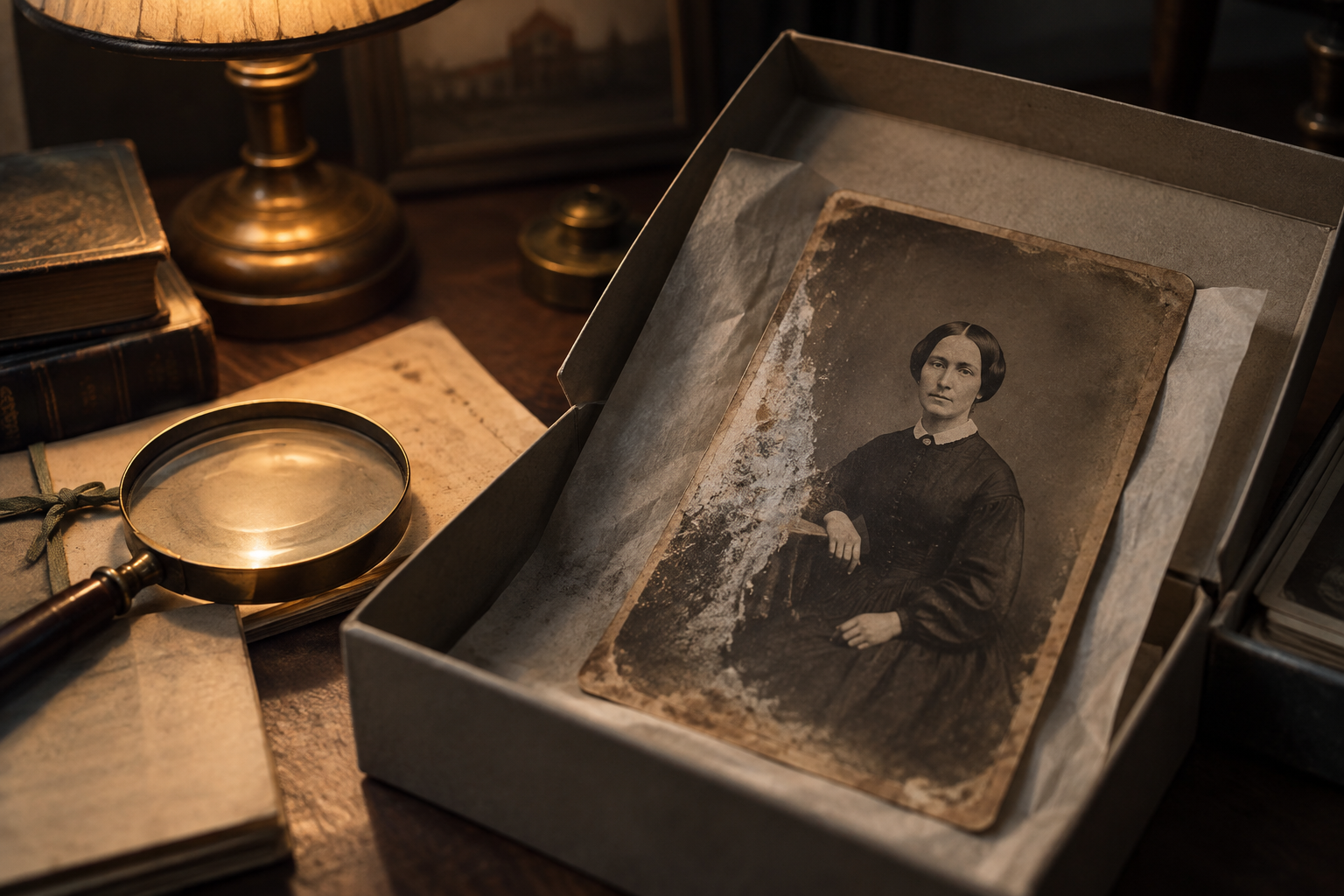
    Illustration of an aged portrait in an archival box under a soft reading lamp

    Old photographs can look creepy because they combine unfamiliar visual conventions with physical damage and missing context. A sitter holds an expression longer than we expect. A face has faded more quickly than a coat. A child is slightly blurred while the furniture remains sharp. We see the result without seeing the camera, the room, the photographer’s directions, or the years of handling that followed.

    The unsettling feeling is real. It is not evidence that the photograph recorded a ghost. The pleasure of looking closely lies in recognizing how a seemingly direct record was made—and how a century can edit it after the shutter closes.

    Why are the faces so serious?

    The familiar explanation says nobody smiled because early exposure times were too long. There is some truth in the technical part: early processes often required a subject to keep still. But it is too simple as a universal account. Camera technology changed throughout the nineteenth century, and expressions also followed the social conventions of portraiture. A formal photograph was an occasion; people did not necessarily want to perform the broad smile expected in today’s phone camera.

    The Metropolitan Museum of Art’s account of early portrait photography shows how photography widened access to likenesses. A portrait could be a treasured object made for family, not a casual record of an afternoon. Seriousness may signal dignity, concentration, or the conventions of the studio. It need not signal sorrow.

    This matters because the modern viewer often supplies a story to a face before learning its name. We meet an unknown person without their voice. The photograph feels intimate and inaccessible at the same time.

    Long exposure leaves strange evidence

    Movement during an exposure can blur a hand or face, especially in early photographs and particular artistic processes. A person who stepped into a scene briefly could leave a faint figure. The camera made a real record of light over time, not a single perfect instant. The Library of Congress explains that such effects could also be produced deliberately with composite images and double exposures.

    An uncanny figure in a photograph therefore requires investigation. What process was used? Is the image an original plate, a print, or a later scan? Has it been retouched? Is there a second negative or a known studio practice? The right answer may be technical, accidental, fraudulent, or still uncertain. “I cannot explain it from this copy” is a more honest conclusion than “therefore a spirit.”

    Damage makes familiar features unfamiliar

    Photographs are objects. Prints crease, silver images deteriorate, paper discolors, and albums expose some surfaces to light while sheltering others. A scratch through the eyes can give a face an impossible expression. Uneven fading can separate a head from its shoulders. The people who held the original may have seen an ordinary family likeness; we see a damaged survivor.

    Illustration comparing the same historic portrait before and after natural fading, scratches, and paper wear

    The damage is not meaningless, though. It records use. Someone carried the image, placed it in an album, moved house with it, or stored it badly. The mark that frightens us may be evidence that the photograph mattered enough to survive.

    The frame withholds almost everything

    A photograph seems precise because it preserves details. It is also a ruthless crop. We may know what a person wore and nothing about what they said after the sitting. We do not see the friend outside the frame, the props just behind the backdrop, or the ordinary morning waiting outside the studio. The less context we have, the more easily we convert an unfamiliar expression into a sinister one.

    That is why unlabeled flea-market photographs are such efficient horror objects. The image still proves that a person stood before a camera. It does not tell us why the photograph ended up among strangers. The gap invites fiction.

    Spirit photography was a real practice

    Nineteenth-century spiritualism gave some photographers a market for portraits with apparent apparitions. The Library of Congress notes that ghostly composites and double exposures were known techniques even while some viewers treated the resulting pictures as evidence of contact with the dead. The history is a mixture of technology, belief, grief, performance, and sometimes deception. It deserves more care than a quick “Victorians believed everything” joke.

    The Met’s exhibition on manipulated photography also makes a useful point: altering photographs did not begin with digital software. The camera’s reputation for truth and the photographer’s power to arrange an image have been in tension from the beginning.

    Illustration of a photographer’s nineteenth-century worktable with a glass plate, contact print, lens, and archival labels left blank

    How to examine a “haunted” photograph

    Begin with provenance. Where did the image come from, and is there a dated original? Then inspect the physical process: paper, plate, negative, or digital copy. Look for repeated shapes, edge artifacts, signs of movement, and later retouching. Search for the same image in a museum, library, or historical collection before trusting a caption that appears only on social media.

    If the image depicts a dead person or a grieving family, resist turning them into a prop for a convenient shiver. Many supposed “postmortem photographs” circulated online are ordinary portraits with speculative labels. An unnamed sitter cannot correct us. The least we can do is separate what the image shows from what we imagine.

    For more on why familiar objects become unsettling, see why dolls feel creepy and our guide to horror without gore. If photographs make you wonder what the dead leave behind, Among the Dead takes that question into fiction.

    Frequently asked questions

    Did people never smile in Victorian photographs?

    They sometimes did. Exposure times, studio practice, and portrait conventions all affected expression. The claim that smiling was impossible is too broad.

    Can a double exposure create a ghostly figure?

    Yes. A second exposure or a person moving through a long exposure can create an apparition-like form. That explains a photographic effect, not every individual image without examination.

    Are all “spirit photographs” deliberate frauds?

    No single judgment covers every image or every participant. Some effects were staged; some may reflect accidents or later misreadings; viewers could sincerely believe in what they saw. Investigate the specific object and its history.

    The next time a face in an album appears to stare past you, turn the photograph over. A date, an address, or a penciled name may change the story more than the shadow did. For new dispatches on haunted history and a free illustrated story, join The Grimbard Press.

    Sources

    • Library of Congress: A Ghostly Image
    • Metropolitan Museum of Art: Faking It

    • Metropolitan Museum of Art: Portraits

  • Haunted Dolls: Why We Keep Bringing Them Home from Estate Sales

    Haunted Dolls: Why We Keep Bringing Them Home from Estate Sales

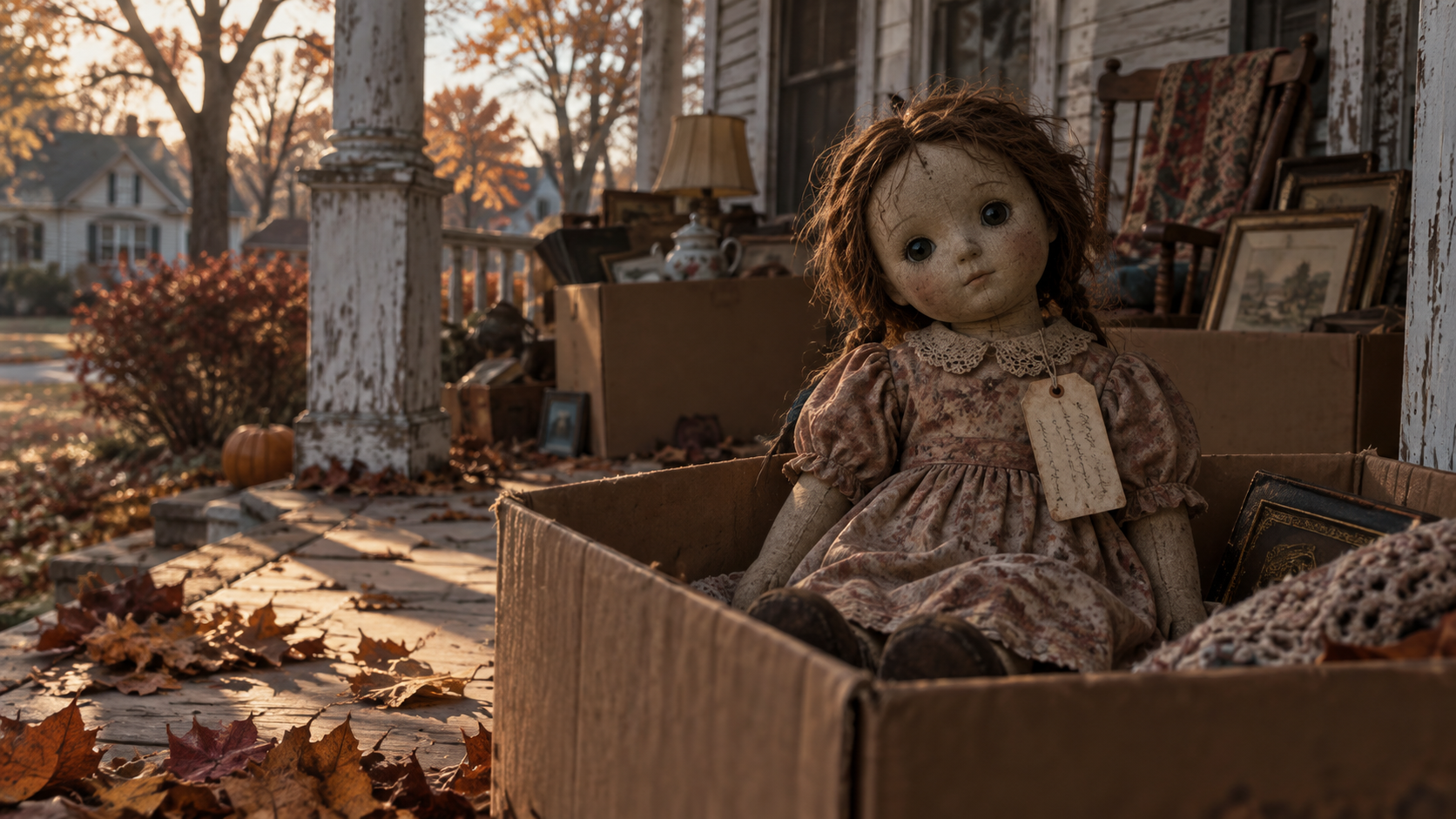
    Antique cloth doll in an estate-sale box on an autumn porch

    Go to enough estate sales and you’ll see it. There’s a box of dolls on the back porch, priced low, and nobody touches it. Someone in the family has already decided they don’t want the dolls in the house. They didn’t throw them out, either. They’re selling them, which means handing the problem to you.

    Of all the objects in folklore that are supposed to hold something, the doll is the one we can’t leave alone. We’re afraid of dolls, and we keep buying them.

    Why dolls, of all things

    Part of the answer is in the face. In 1970 the Japanese roboticist Masahiro Mori described what he called the uncanny valley: we warm to things as they look more human, until they get almost human, and then our comfort drops off a cliff. A doll lives at the bottom of that valley. It has eyes that don’t track, a mouth that never moves, and a face that is always exactly as happy as it was the day it was made.

    The older part of the answer is that dolls have always been stand-ins. Long before they were toys, human figures of wax, cloth, clay, and wood were used in ritual: as offerings, as substitutes for the dead, as proxies in charms meant to heal or harm a specific person. The poppet in English witchcraft cases was a doll made to represent someone. What happened to it was supposed to happen to them.

    A child’s doll inherits some of that. It’s carried everywhere, talked to, loved, held at night. And when the child grows up or dies, the doll stays. Everything about it says someone should still be there.

    The most famous haunted dolls

    Robert the Doll. In the early 1900s, a boy in Key West named Robert Eugene Otto, who grew up to be an artist known as Gene, was given a straw-stuffed doll in a sailor suit. He named it Robert, took it everywhere, and kept it into adulthood. The stories that grew around it are the classic set: the doll moved between rooms, it was heard giggling, and the family blamed it for things that went wrong. Today Robert sits in a case at the Fort East Martello Museum in Key West. Visitors are told to ask his permission before taking a photograph. The walls around him are covered in letters from people who didn’t ask, apologizing and asking him to lift whatever bad luck followed them home.

    Annabelle. The real Annabelle isn’t the porcelain nightmare from the films. It’s a Raggedy Ann, a soft, smiling rag doll with red yarn hair. According to the story popularized by the paranormal investigators Ed and Lorraine Warren, it was given to a nursing student around 1970. The doll was said to change position on its own and leave notes. The Warrens eventually kept it in a glass case in their museum, with a sign warning visitors not to open it. What makes the Annabelle story work is how harmless the doll looks. The object is cheerful. The warning is the frightening part.

    Okiku. In a temple in Hokkaido, Japan, there’s a doll whose black hair, according to the temple’s tradition, keeps growing and has to be trimmed. The story attached to it is the one attached to so many dolls: it belonged to a child who died young, and it was kept when she wasn’t.

    Dolls and the dead around the world

    An attic shelf holding an antique doll and labeled boxes

    The belief that a doll can hold something isn’t just an American campfire story. It turns up everywhere dolls do.

    In Japan, dolls that are no longer wanted aren’t simply thrown away. Temples and shrines hold ningyō kuyō, memorial services for dolls, where families bring old dolls to be blessed or burned so that whatever has gathered in them over the years can be released respectfully. The idea is that an object handled with love for a long time takes something on, and you owe it a proper send-off.

    In Mexico, on a canal island in Xochimilco south of Mexico City, a man named Julián Santana Barrera spent decades hanging dolls from the trees, reportedly to appease the spirit of a girl he believed had drowned nearby. The Isla de las Muñecas is now covered in weathered, sun-bleached dolls, some missing limbs and eyes, and it’s a tourist destination that most visitors describe as the most unsettling place they’ve ever been.

    European folklore has the poppet, the effigy, and the corn dolly, the last sheaf of harvest braided into a figure and kept in the house through winter for luck, then returned to the fields in spring. You didn’t throw a corn dolly away either.

    The pattern holds. A doll is a figure made in human shape, and people across the world have agreed that you don’t treat it like trash.

    The rules people follow

    Wherever there are haunted dolls, there are rules. Some are old, some were invented on internet forums last year, and all of them follow the logic of folklore:

    • Ask before you photograph it. (Robert.)
    • Don’t let it face the bed. Turn it to the wall at night.
    • Don’t give it a new name. It already has one.
    • If you’re going to get rid of it, don’t throw it away. Give it to someone, sell it, return it. Trash just sends it back.
    • Don’t take one that someone is too eager to sell.

    Online, “haunted doll” is its own category of listing. People sell dolls they swear are occupied, with backstories and warnings, and other people buy them on purpose. It’s partly a joke and partly not, which is the space most folklore lives in.

    Why we keep bringing them home

    The honest answer is that we like the risk. A haunted doll is a small, portable dare. It sits on a shelf and asks whether you believe in anything, and most of us would rather keep the question in the house than find out we threw away the answer.

    There’s also guilt. It’s hard to throw out a doll. It has a face. Somebody loved it. Selling it at the estate sale feels kinder, and that’s how the doll ends up on your back seat for four dollars.

    The story in October 31

    “Not Going Anywhere This Time” is the twenty-ninth story in October 31.

    > October 31st, 1970s — a suburb, USA.

    Paulette Whitfield paid four dollars for the doll because the woman selling it looked relieved when she picked it up.

    The sale was at the Kowalczyk place, the gray colonial on Birch with the crabapple tree nobody ever raked under. Check the list above. Paulette has already broken one of the rules, because she bought the doll somebody was too eager to sell.

    It’s one of the late stories in the book, and it’s placed there on purpose. By Night 29 the warnings are starting to pile up.

    Further reading

    If haunted objects are your thing, Scary Stories to Tell in the Dark is still the best collection of the folklore kind: short, strange, and pulled from real traditions. Find it on Amazon →

    As an Amazon Associate I earn from qualifying purchases. Links to my own books are never affiliate links.

    —

    Not Going Anywhere This Time is Night 29 of 31 in October 31, thirty-one folk horror stories set on Halloween night across six centuries. Read it on Amazon → · Free with Kindle Unlimited.

    Take the 31 Nights challenge. One story a night through October, with a free printable calendar. Get the calendar →

    Previous: The 1996 Chupacabra Panic: What Happened in South Texas · Next: The 31 Nights Challenge

  • 13 American Folklore Monsters Beyond Bigfoot

    13 American Folklore Monsters Beyond Bigfoot

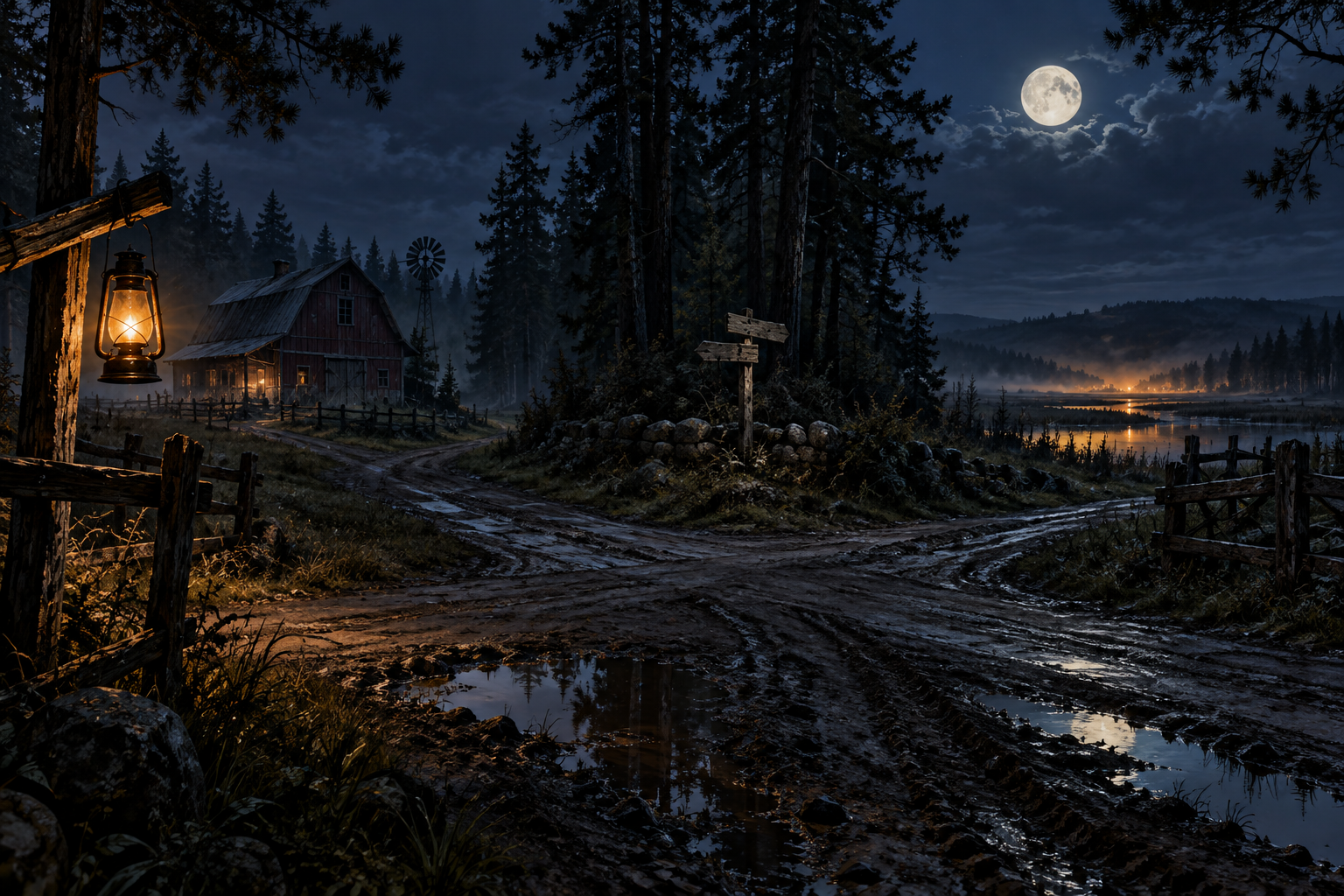
    A moonlit crossroads between pine woods and marsh, with hints of regional American monster tales

    An American folklore monsters list quickly becomes a map of different kinds of storytelling: something in a New Jersey pine barren, a creature reported off the Massachusetts coast, a lumber-camp exaggeration that grew teeth in print. Bigfoot dominates the souvenir shop, but it is only one branch of a much stranger family tree.

    The useful question is not whether every creature was “real.” Folklore records how communities explain danger, landscape, work, migration, and the pleasure of being frightened together. Some of the figures below are old regional tales; others are modern cryptids or deliberate tall-tale inventions. Keeping those categories distinct makes the stories better, not less magical.

    A quick guide to reading monster lore

    An old story is not automatically an ancient one. A newspaper may be the earliest surviving evidence, not the origin. A creature’s name may have been attached to a place long after the underlying warning existed. And a modern legend can still be meaningful without pretending it came from colonial America.

    Here are thirteen places to start.

    1. The Jersey Devil — New Jersey Pine Barrens

    The Jersey Devil is the region’s great shape-shifter: commonly described with wings, hooves, a horse-like head, or an inhuman cry. Later versions connect it to the Leeds family, but the legend has changed repeatedly through pamphlets, newspapers, civic rivalry, tourism, and horror culture. The Pine Barrens matter as much as the creature: a vast, sandy landscape can make a night sound travel farther than it should.

    For a fictional route through that terrain, see The Pine Barrens Incident.

    2. The Hodag — Rhinelander, Wisconsin

    The hodag is one of the most entertaining American examples of a monster becoming local identity. A black, horned, spined beast was promoted in nineteenth-century Wisconsin by Eugene Simeon Shepard, who staged photographs and a captured specimen. It is not an ancient woodland being, but a superb lesson in how a hoax can become folklore when a town adopts it with affection.

    3. The Wampus Cat — Appalachia and the Southeast

    “Wampus cat” has been used for different large-cat and boogeyman stories across the American South and Appalachia. That variety is the point: the name travels. It can mean an animal at the edge of the porch light, a warning for children, or a creature given a later fixed origin by retellings. Avoid reducing its many regional uses to one neat, supposedly authoritative myth.

    4. The Snallygaster — Maryland

    The snallygaster’s name is often connected to German-speaking settlers in Maryland, though the monster as most people know it was amplified through nineteenth-century newspaper stories. It was said to swoop down on livestock and people. The legend demonstrates the productive collision of immigrant language, local landscape, and newspaper spectacle.

    5. The Snallygaster — Maryland

    The snallygaster is a winged creature of Maryland lore whose reported shape has changed as stories passed through newspapers and local telling. The Library of Congress traces an especially important complication: versions of the legend were exploited for racist voter suppression. That history should be named, not turned into a harmless bit of monster trivia. The creature shows how a legend can be both an entertaining regional symbol and a tool used by real people for harm.

    An archival-style illustrated map of American monster regions

    6. The Hidebehind — North American logging lore

    The hidebehind is said to stay just out of sight behind the trunk you are about to inspect. It is an elegant forest monster because its rule is visual: you never see it directly. Whether invented for lumber-camp storytelling or adopted from older oral patterns, it turns a real workplace hazard—being alone in dense woods—into a creature with perfect tactics.

    7. The Squonk — Pennsylvania

    The squonk is the melancholy member of the lumberjack bestiary, a creature so ashamed of its appearance that it weeps constantly. Stories say it can dissolve into tears when captured. It is comic, but its endurance shows that monster lore does not always operate through aggression. Sometimes a region preserves a creature because it is odd, tender, and impossible to forget.

    8. The Mothman — Point Pleasant, West Virginia

    The Mothman reports of the 1960s belong to modern legend rather than old folk belief. Witnesses described a winged, red-eyed figure before the Silver Bridge collapse, and later writers assembled those reports into a larger omen narrative. Treat the tragedy and the witnesses with care: the creature’s cultural life is real, while claims of supernatural causation remain claims.

    9. The Flatwoods Monster — West Virginia

    In 1952, residents near Flatwoods reported a frightening figure after seeing an object cross the sky. Explanations have ranged from an owl and misperception to extraterrestrial encounter. Whatever happened, the episode shows how quickly a shared night, unusual light, local testimony, and national anxieties can become a durable monster.

    10. The Loveland Frog — Ohio

    The Loveland Frog is a modern roadside cryptid associated with Ohio reports of a large, upright frog-like figure. It belongs to a broad family of “the thing seen near a road at night” legends. Those stories work because a car gives a witness speed but not certainty: the sight is gone before the mind can arrange it.

    11. The Beast of Bladenboro — North Carolina

    In 1954, reports of animal attacks around Bladenboro drew press attention and a wave of hunting. The “beast” became larger and more mysterious in retelling. The historical record is a useful reminder that predation, fear, headlines, and community attention often enlarge one another.

    12. The Gloucester sea serpent — Massachusetts

    Nineteenth-century observers reported a long, sinuous creature off the Massachusetts coast, and the reports became a lively argument about what witnesses had seen. The Library of Congress recounts how sea-serpent reports intersected with a period when people hoped science might identify unfamiliar animals. Here the monster is also an information problem: a surface glimpse of an animal in moving water can resist confident identification.

    13. The sidehill gouger — lumber-camp tall tales

    The sidehill gouger is said to have legs shorter on one side, making it perfectly adapted to circle steep hills but hopeless on level ground. It belongs to the “fearsome critters” invented and retold around North American lumber camps. The joke is wonderfully practical: a strange slope becomes a creature’s entire anatomy. Like the hidebehind and squonk, it reminds us that a monster need not be solemn to be memorable. Workers could use absurdity to entertain one another and make an unfamiliar landscape feel narratable.

    A lantern at the edge of a deserted lumber camp in dark woods

    Folklore, fakelore, and cryptids are not enemies

    “Fakelore” describes traditions presented as old or authentic when their origins are known to be recent or manufactured. That does not mean they are worthless. The hodag is still meaningful to Rhinelander. A modern cryptid can still shape a town’s imagination. The key is honesty: say what is documented, say what is later, and let the story earn its own strangeness.

    For more regional dossiers, explore the Lost Boundary Archive and the broader There Be Monsters series.

    Frequently asked questions

    What is the most famous American folklore monster after Bigfoot?

    The Jersey Devil is among the best known because its legend has remained strongly tied to a specific region, the New Jersey Pine Barrens, while continually changing through print and popular culture.

    Are cryptids the same as folklore monsters?

    Not exactly. A cryptid is generally proposed as an undiscovered animal, while folklore monsters may be supernatural, symbolic, comic, or openly invented. The categories overlap in modern storytelling.

    Why did lumber camps invent so many monsters?

    Camp stories entertained workers, explained the strangeness of unfamiliar woods, and turned dangerous or lonely work into shared lore.

    Want one original warning for every night of October? October 31 is available on Amazon. For new lore, story announcements, and the free illustrated Dead Ship, join The Grimbard Press.

    Sources and further reading

    • Library of Congress: American cryptids and how their stories spread

    • Library of Congress: the great American sea serpent

    • Contemporary and archival reporting on Point Pleasant, Flatwoods, and Bladenboro; distinguish reports from supernatural conclusions

  • The 1996 Chupacabra Panic: What Happened in South Texas

    The 1996 Chupacabra Panic: What Happened in South Texas

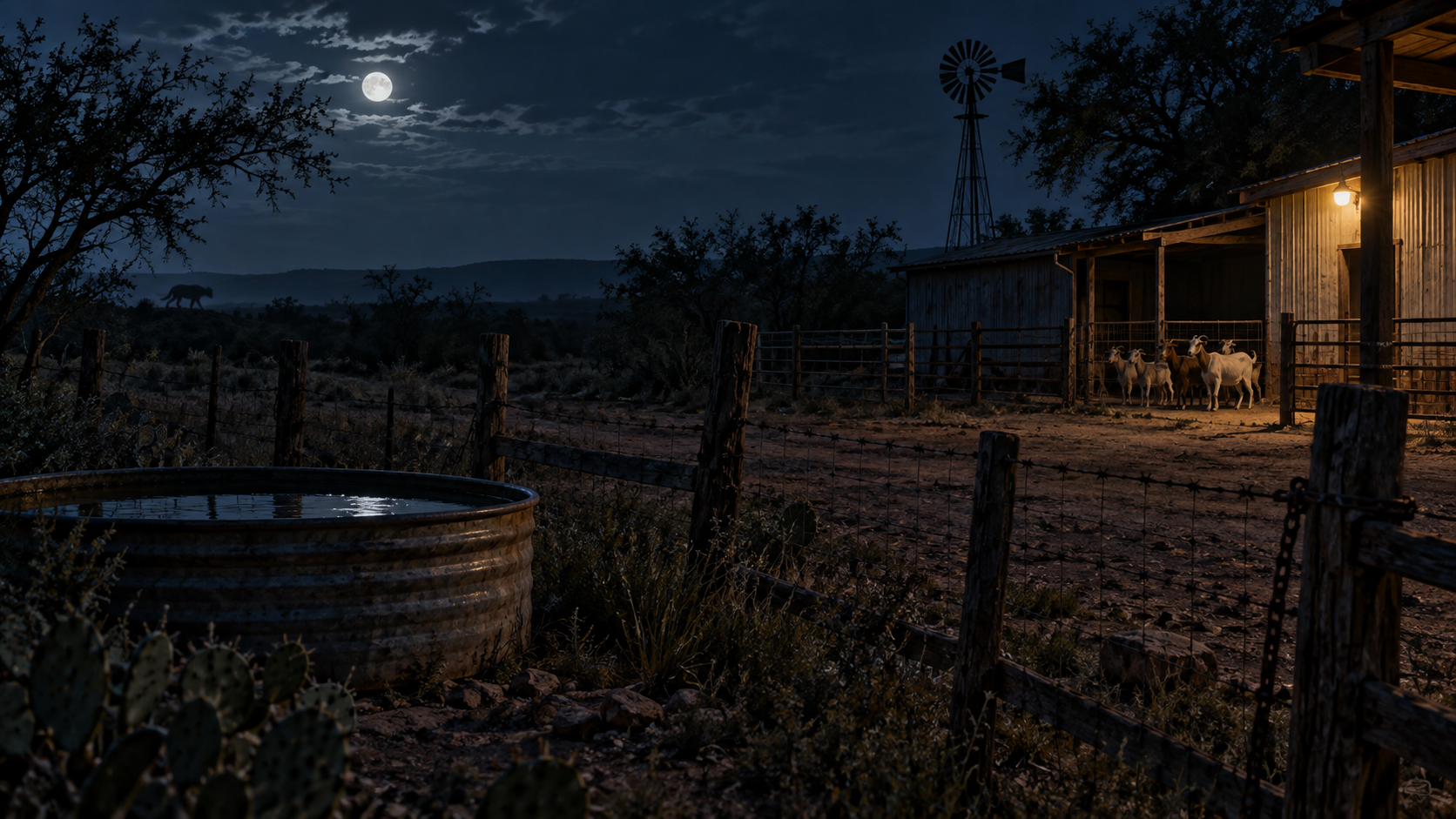
    South Texas ranch at night with goats near a barn and an ambiguous animal beyond the fence

    Most monsters in folklore are centuries old. The chupacabra is younger than the Macarena.

    It has an exact birthplace, Puerto Rico in 1995, and within a year it had crossed the Caribbean, gone viral on Spanish-language television, and turned up on ranches in Mexico, Florida, and South Texas. It is one of the few folk monsters whose whole life we can watch in the record. And it may be the best example we have of how a legend forms in real time.

    Puerto Rico, 1995

    In the spring and summer of 1995, farmers in Puerto Rico began finding livestock dead: goats, sheep, chickens, rabbits. What made the deaths strange was how they were killed. Reports described small puncture wounds, often in the neck, and animals that seemed to have been drained of blood. There was little sign of feeding.

    The island had seen something like it before. In the 1970s, a wave of livestock deaths around the town of Moca had been blamed on a creature the papers called el vampiro de Moca. But 1995 was bigger, and it happened in the television age.

    In August 1995, a woman in Canóvanas named Madelyne Tolentino described seeing the creature. Her account became the template: an upright thing about four feet tall, with large dark eyes, spines or quills down its back, and a way of hopping or moving like a kangaroo. A local comedian, Silverio Pérez, is generally credited with the name that stuck: chupacabras, the goat-sucker.

    Years later, the researcher Benjamin Radford traced the sighting and noticed that Tolentino’s description closely resembled the alien in the science-fiction film Species, which had been released that summer and which she had seen. That doesn’t mean she was lying. It means that when people meet something they can’t explain, they reach for the nearest shape they already have.

    1996: the goat-sucker goes north

    Ranch desk with a field notebook and moonlit window

    Through late 1995 and 1996, the chupacabra moved through the Spanish-speaking world at the speed of broadcast. Talk shows and news programs covered it. Reports came in from the Dominican Republic, from across Mexico, and from Central and South America. In March 1996, a series of animal deaths in Sweetwater, near Miami, was blamed on the creature. And along the Texas border, where ranching families watched the same broadcasts as their relatives in Mexico, the word began to come up whenever an animal was found dead and nobody could say what did it.

    To understand why it caught on in ranch country, forget the monster for a moment and think about the goat.

    On a small ranch, livestock isn’t background. It’s money, and sometimes it’s the margin between keeping the place and losing it. A predator that kills without eating is a disaster twice: you lose the animal, and you lose any way of understanding the threat. Coyotes you know. Feral dogs you know. Something that leaves the carcass whole with two holes in the neck is a problem you can’t budget for.

    The chupacabra filled that gap. It gave the loss a name.

    What the Texas chupacabras turned out to be

    The chupacabra also changed shape on the way north. By the 2000s the Texas version no longer looked like Tolentino’s spiny biped. It was four-legged, dog-like, hairless, with grey leathery skin and a pronounced spine. Ranchers shot them, hit them with trucks, and found them dead by the road. In 2007 a rancher near Cuero, Texas, found a carcass she believed was the animal that had been killing her chickens, and the story went national.

    This time there were bodies to test. Again and again, the Texas chupacabras came back as coyotes, dogs, or coyote-dog hybrids suffering from severe sarcoptic mange. Mange strips the fur, thickens and darkens the skin, and makes the spine and ribs stand out. It also weakens the animal, which is why a mangy coyote goes after easy prey near houses, chickens and penned goats, instead of hunting in the open.

    So the ranchers weren’t wrong. Something was coming in close and killing their animals. It was sick, it was desperate, and it looked like nothing they’d seen. The legend was a real observation with the wrong explanation attached.

    Before the chupacabra

    The chupacabra wasn’t the first livestock panic in the Americas, and it helps to see where it fits.

    In the 1970s, ranchers across the western United States reported cattle mutilations: carcasses found with organs, eyes, or tongues missing and the cuts described as surgically clean. Explanations ranged from cults to government experiments to aliens. Investigations by law enforcement and veterinarians mostly concluded that the wounds were consistent with scavengers and normal decomposition, which soften and retract tissue in ways that can look like precise cuts. The panic faded, and the theories never did.

    Puerto Rico’s own vampiro de Moca in the mid-1970s followed the same pattern: animals found dead with puncture wounds, a creature no one could catch, and an explanation the community reached for before the evidence was in.

    The chupacabra inherited all of that. It arrived at a moment when satellite television and talk shows could move a story across a whole language in weeks, and it became the first livestock monster of the media age.

    The chupacabra in popular culture

    It didn’t take long for the chupacabra to leave the ranch. In 1997 The X-Files built an episode around it. It turned up in cartoons, video games, beer labels, and B-movies. In Texas especially it became a kind of mascot: a monster people half-believe in and half-own, the way the Pacific Northwest owns Bigfoot.

    That affection is part of the story too. A monster that started as a real fear, a family watching its livelihood die in a pen, became a joke within a decade. For the ranchers who lived through the first wave, those two things never quite fit together.

    Why the word matters

    Here is what I find most interesting about the chupacabra, and what the story in October 31 is built on. For a stretch in the mid-1990s, saying the word out loud meant something. Saying it to the sheriff’s office meant you were willing to be laughed at. Saying it in front of your kids meant you’d decided they needed to be afraid.

    A legend isn’t only a creature. It’s a social decision: the moment someone chooses to use the frightening explanation instead of the reasonable one.

    The story in October 31

    “Ground Worth More Than Food” is the nineteenth story in October 31.

    > October 31st, 1996 — a ranch, South Texas.

    The third goat came up dead on the tank dam, and that was the one that got the sheriff’s office to send a deputy. Refugio Aguirre had called twice by then. On the second call he used the word.

    His daughter Araceli heard it through the screen door.

    That’s where the story starts: with a family that has already decided which explanation it’s going to say out loud, and a girl on the other side of the screen door who heard it. I won’t tell you what’s out past the tank dam.

    —

    Ground Worth More Than Food is Night 19 of 31 in October 31, thirty-one folk horror stories set on Halloween night across six centuries. Read it on Amazon → · Free with Kindle Unlimited.

    Take the 31 Nights challenge. One story a night through October, with a free printable calendar. Get the calendar →

    Previous: Witches’ Familiars: Cats, Courts, and Massachusetts Before Salem · Next: Haunted Dolls: Why We Keep Bringing Them Home from Estate Sales

  • Witches’ Familiars: Cats, Courts, and Massachusetts Before Salem

    Witches’ Familiars: Cats, Courts, and Massachusetts Before Salem

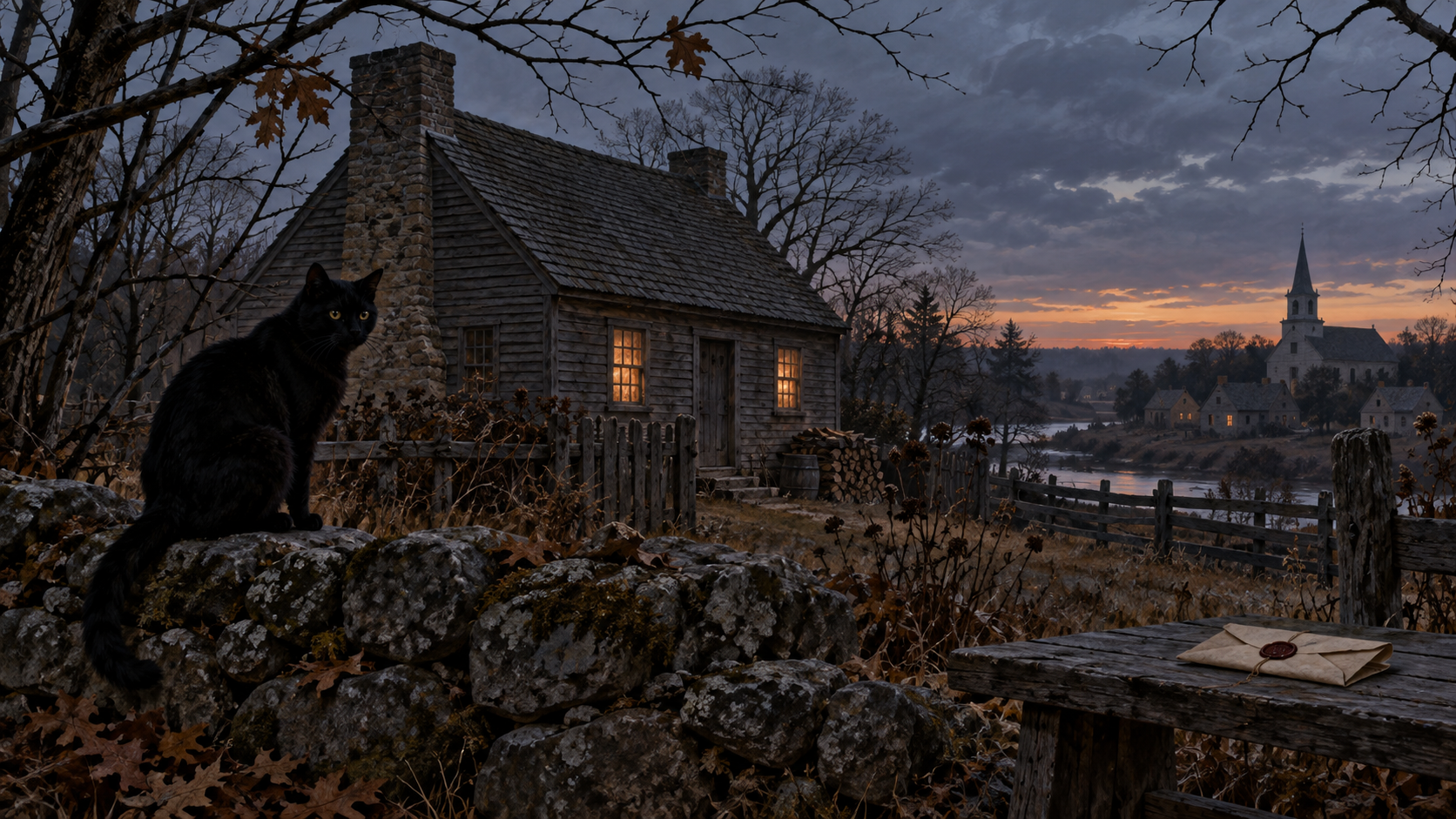
    Black cat on a stone wall before a seventeenth-century Massachusetts cottage and meetinghouse

    Salem gets the attention. The trials of 1692 produced the most executions, the most records, and eventually the most films, so they’ve come to stand in for the whole history of witchcraft in New England.

    But Salem was not the beginning. By the time the girls in Salem Village started having fits, Massachusetts Bay and its neighbors had been hanging accused witches for more than forty years. The ideas that drove those earlier cases came over on the same ships as the colonists, and one of the most important ideas was the familiar.

    The first executions

    The first person known to have been executed for witchcraft in the English colonies was Alse Young, hanged at Hartford in the Connecticut Colony in 1647. Almost nothing of her case survives except the fact of it.

    A year later Massachusetts Bay had its own. Margaret Jones of Charlestown was a healer and midwife, which was dangerous work in a century that couldn’t always tell a remedy from a spell. She was accused of having a “malignant touch,” meaning people she handled grew sick. Her remedies were said to work too well, or too strangely. Her body was searched for the marks thought to show a witch, and a witness claimed to have seen a small child run from her that then vanished, which the court read as an imp. She was hanged in Boston in June 1648. Governor John Winthrop recorded the case in his journal and noted, with some satisfaction, that a great storm struck Connecticut at the hour of her execution.

    In 1656 Boston hanged Ann Hibbins, the widow of a well-off merchant. She was sharp-tongued and quarrelsome, had been excommunicated from her church years earlier, and after her husband’s death had few friends left. A jury convicted her. The magistrates refused to accept the verdict, so the case went to the General Court, which convicted her again. Nathaniel Hawthorne later put her in The Scarlet Letter as Mistress Hibbins, the governor’s sister who keeps inviting Hester into the forest.

    These cases, and others in Springfield, Connecticut, and elsewhere through the 1650s and 1660s, are the colonial prologue to Salem. They are smaller, less documented, and in some ways more frightening for it. One neighbor’s word, one sick child, one marked body, and a single life ends in front of the whole village.

    The law of the familiar

    Seventeenth-century court papers and a quill beside a black cat silhouette

    To understand these cases you need the English law they grew out of.

    The Witchcraft Act of 1604, passed under James I, made it a felony to consult, covenant with, entertain, employ, feed or reward any evil and wicked spirit. It’s an odd list to find in a statute, and it tells you what the authorities were afraid of: not just spells, but relationships. A witch was someone who kept company with a spirit and paid it.

    That spirit was the familiar. English witch belief, more than the continental version, fixed on the idea that a witch kept a small demon in animal form, which she fed, sometimes from her own body. The “witch’s mark” that searchers looked for on suspects was supposed to be the place where the familiar suckled.

    The belief peaked in England in the 1640s, when Matthew Hopkins, the self-styled Witchfinder General, and his associates worked through East Anglia. Their methods included “watching”: keeping a suspect awake and under observation for days, waiting for her familiar to come to her. Suspects, exhausted, sometimes named their familiars. Records from those trials list cats, dogs, toads, mice, polecats, and creatures with no name at all.

    The colonists of Massachusetts Bay were English Puritans, many from exactly those eastern counties. They didn’t leave the familiar behind.

    How an accusation became a hanging

    It helps to picture how a case like Margaret Jones’s actually moved, because the process was more ordinary, and more frightening, than the films suggest.

    It usually began with a misfortune and a neighbor. A child sickened, a cow died, butter wouldn’t come in the churn, and someone remembered a quarrel. Complaints could collect over years before anyone went to a magistrate. When someone did, the accused was examined, questioned by magistrates who already suspected her, often in front of her accusers.

    Then came the search. A group of women examined the accused’s body for a mark: an unusual spot, growth, or teat that could be read as the place her familiar fed. Nearly every older body had something that could qualify.

    Evidence was collected from neighbors: what she had said in anger, who had fallen ill after she visited, what animals had been seen near her house. A small creature seen running from her door, as in the Jones case, was exactly the kind of testimony that mattered, because it pointed to a familiar.

    The case then went before a jury and the colony’s court. In Massachusetts Bay, witchcraft was a capital crime under the colony’s own laws, which cited scripture directly: Thou shalt not suffer a witch to live. Conviction was not automatic, and some accused people were acquitted or had verdicts overturned. But when the court did convict, the sentence was death by hanging, carried out in public.

    What made the earlier cases different from Salem was scale. They were usually one accused person at a time, in a small community where everyone knew everyone. Nobody needed a panic. A long memory was enough.

    Familiars beyond the courtroom

    Belief in familiars didn’t end with the trials. Through the eighteenth and nineteenth centuries, English and American folklore kept the idea alive in quieter forms: the cunning woman’s cat, the toad kept in a box, the black dog met on the road. Some of the rural healers who were accused in the 1600s had descendants in the 1800s who were still consulted for charms and cures, and still, sometimes, suspected.

    The cat is the version that survived into Halloween decorations. The history behind it is the history above.

    Why the cat

    The black cat’s reputation as a witch’s companion is a mix of older European suspicion of cats, the familiar trials, and the simple fact that an old woman living alone was likely to keep one. In the trial records the familiar could be almost any animal. In the popular imagination it became the cat.

    The cat also had a reputation for surviving. The saying that a cat has nine lives was already an English proverb by the mid-1500s. An animal that kept coming back, that watched and never seemed to age, was an animal people didn’t trust.

    The story in October 31

    “Nine Lives, All Spent” is the fifth story in October 31.

    > October 31st, 1653 — a village, Massachusetts Bay Colony.

    Temperance Ashcombe milked the goat that morning, the same as any morning. The goat knew nothing of hangings. It knew only that for eleven mornings the girl had done the tending, because the old woman who usually did it had been taken away.

    Then the meetinghouse bell starts. It isn’t the Sabbath ring, and it isn’t fire. One flat iron note, then the space for the whole village to hear it, then another. Come out. Come see a thing done.

    The cat is waiting on the doorstone. It has been old for as long as Temperance can remember, and it has never behaved old a day in its life. It’s black from nose to tail except for three white hairs under the chin, which her grandmother used to say proved God had nearly changed His mind.

    The village and the trial are fiction. The fear is taken from the record above.

    A note on the real dead

    It’s easy to turn this history into set dressing. The people hanged in Hartford and Boston were real, and nearly every one of them was a woman who was old, poor, argumentative, alone, or skilled at something her neighbors didn’t understand. In 2023 Connecticut formally exonerated the people it convicted of witchcraft in the 1600s. Work to clear the remaining names in Massachusetts has continued since.

    The story takes the folklore seriously. It takes the history more seriously still.

    —

    Nine Lives, All Spent is Night 5 of 31 in October 31, thirty-one folk horror stories set on Halloween night across six centuries. Read it on Amazon → · Free with Kindle Unlimited.

    Take the 31 Nights challenge. One story a night through October, with a free printable calendar. Get the calendar →

    Previous: Why Every Story in October 31 Happens on the Same Night · Next: The 1996 Chupacabra Panic: What Happened in South Texas

  • Why Every Story in October 31 Happens on the Same Night

    Why Every Story in October 31 Happens on the Same Night

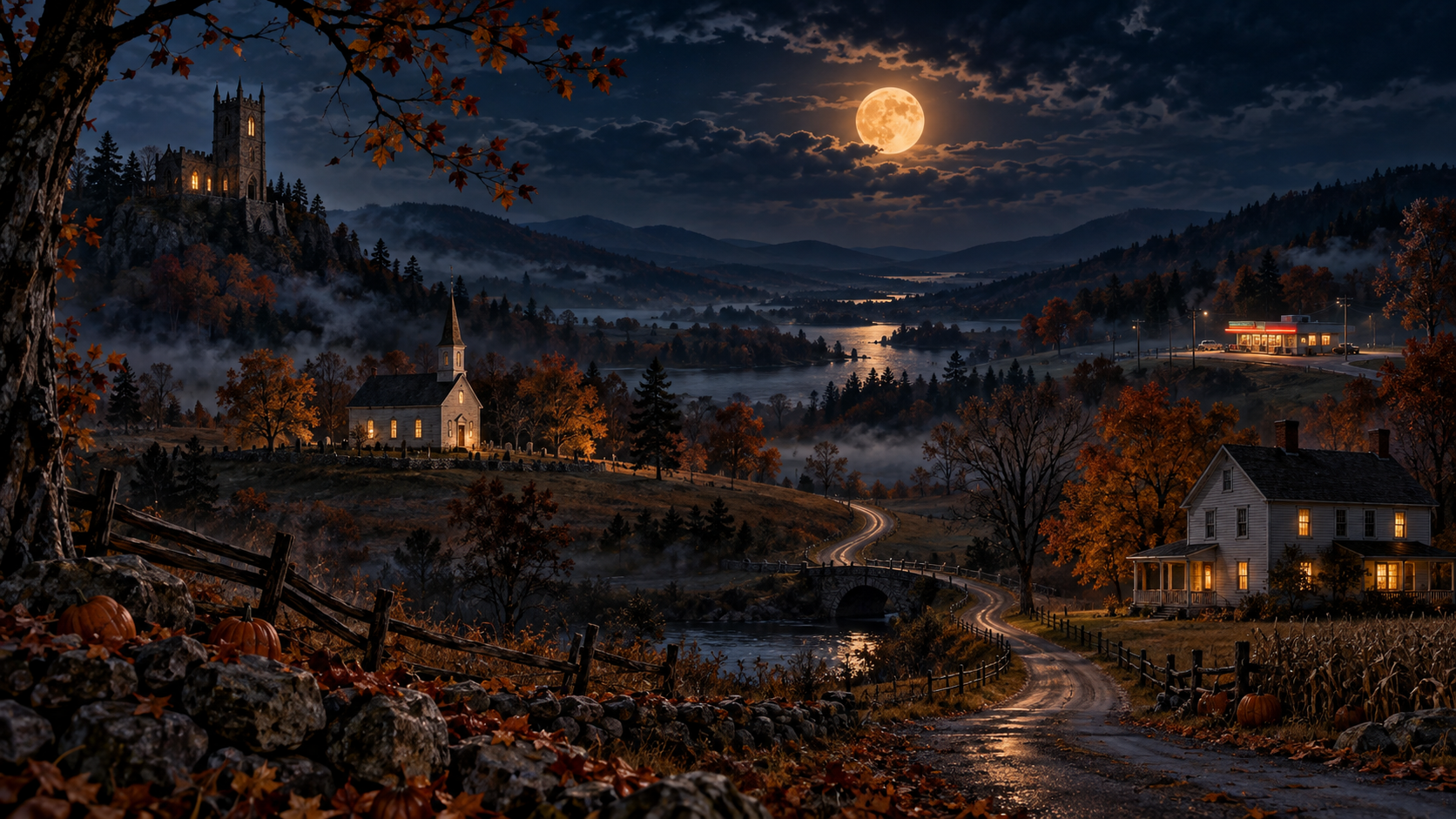
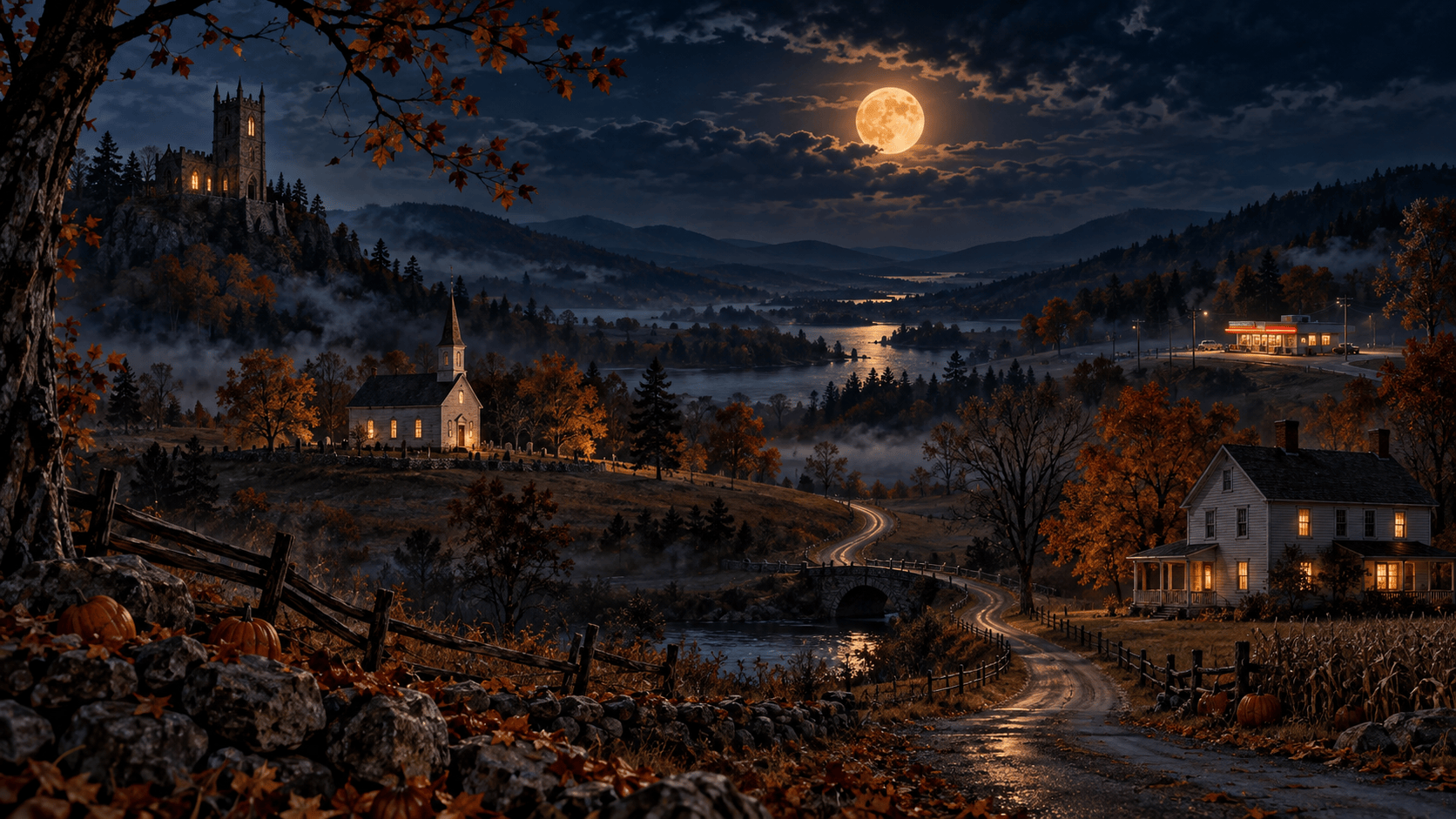
    Moonlit October valley connecting a medieval church, New England meetinghouse, farmhouse, and diner

    When I started October 31, I gave myself one rule: every story had to take place on the last night of October. Not the week of Halloween, and not “around the harvest.” The date, every time, printed at the top of the story like the heading on a field report.

    People have asked why. The short answer is that it’s a very old night, and it’s been a dangerous one for longer than anyone has called it Halloween.

    The night was busy long before the name

    In Ireland and Scotland, the night of October 31 opened Samhain, the turn from harvest into winter. It was understood as a hinge in the year, a night when the boundary between this world and the other one wore thin. Things crossed. People disguised themselves, kept fires, set food out, and thought hard about who they let through the door.

    The church laid its own calendar over the same days. November 1 became All Saints’ Day, or All Hallows. The night before it was All Hallows’ Eve, which is where Halloween comes from. November 2 is All Souls, the day for praying for the ordinary dead. For centuries, across Catholic Europe, the end of October was already the start of a season about the dead.

    Other things happened on that date too. On October 31, 1517, Martin Luther is said to have posted his ninety-five theses in Wittenberg, and Protestant countries still keep it as Reformation Day. In Mexico, the Days of the Dead begin as October ends. Different traditions, different reasons, and yet everyone seems to agree that the end of October is when you turn to face the dead.

    What the rule forced

    Writing thirty-one stories on the same date did something I didn’t expect. The date is constant, so everything else has to change. The century, the country, the language, the danger. Every story has to answer the same question differently: what does this night mean here, to these people?

    In 1653, in a Puritan village in Massachusetts Bay, the answer is nothing, officially. The Puritans didn’t keep saints’ days, so it’s an ordinary weekday. But a meetinghouse bell is ringing that isn’t the Sabbath ring, and a girl has to decide whether to walk out and watch.

    In 1665 London it’s the plague year, and the date means only that the weekly bill of the dead has come around again.

    In the 1830s it’s a date pressed into a whaling captain’s private chart, one he has been sailing back toward for nine years.

    In 1996 it’s a Thursday on a South Texas ranch, and the only thing anyone cares about is the third dead goat.

    In a few stories the date is the whole point: the banshee, Stingy Jack, the carnival that only runs one night a year. In others, the characters don’t even notice it’s October 31 until something makes them. That was the fun of it. Sometimes the date is the danger, and sometimes it just shows up on the calendar in the kitchen.

    The warnings are the thread

    Samhain table with candles and autumn fruit

    What ties the stories together is the thing the whole There Be Monsters series is built on: the old warnings.

    The book opens with a page called “The Warning.” Part of it reads:

    > The old warnings were rarely elegant. Do not answer. Do not look. Leave before dark. Feed it first. Count them twice. Keep your hands where the house can see them.

    >

    > They survive because somebody, somewhere, came home frightened enough to tell the next person what had worked.

    Every story is about one of those rules and the person who has to decide whether it’s true. A country doctor who trained in Vienna and doesn’t believe in the valley’s precautions. A woman in a 1544 household who set the bowl down wrong. A trapper who knows his partner always made a point of being under a roof with a fire going before dark on the last night of October, and never asked why.

    On October 31 the rules are strictest, so it’s the best night to find out who breaks them.

    Why thirty-one, and why in order

    Thirty-one stories, one for every night of the month. You can read October 31 in any order you like. Every story stands alone. But the order isn’t random. The early stories are quieter and the pressure builds through the month. The last story is the title story, set in the present, in a small town, and it’s the one where all the warnings in the book begin sounding at once. It’s meant to be read on Halloween.

    That’s what the 31 Nights challenge is: read one story each night in October and finish on the thirty-first. There’s a free printable calendar with every night’s dateline, and I’ll post a companion piece here for each story covering the real history or folklore behind it. Get the calendar →

    The date is the same for everyone

    That’s what I like most about the rule. Every character in the book, from the 1400s stonecutter to the waitress in the diner tonight, is standing on the same night of the year. None of them know about each other. All of them are listening for something.

    This year you’ll be standing on it too.

    Get October 31 on Amazon → · Free with Kindle Unlimited

    T. P. Grimbard

    —

    Previous: The Banshee Doesn’t Scream, She Keens · Next: Witches’ Familiars: Cats, Courts, and Massachusetts Before Salem

  • The Banshee Doesn’t Scream, She Keens: The Real Irish Legend

    The Banshee Doesn’t Scream, She Keens: The Real Irish Legend

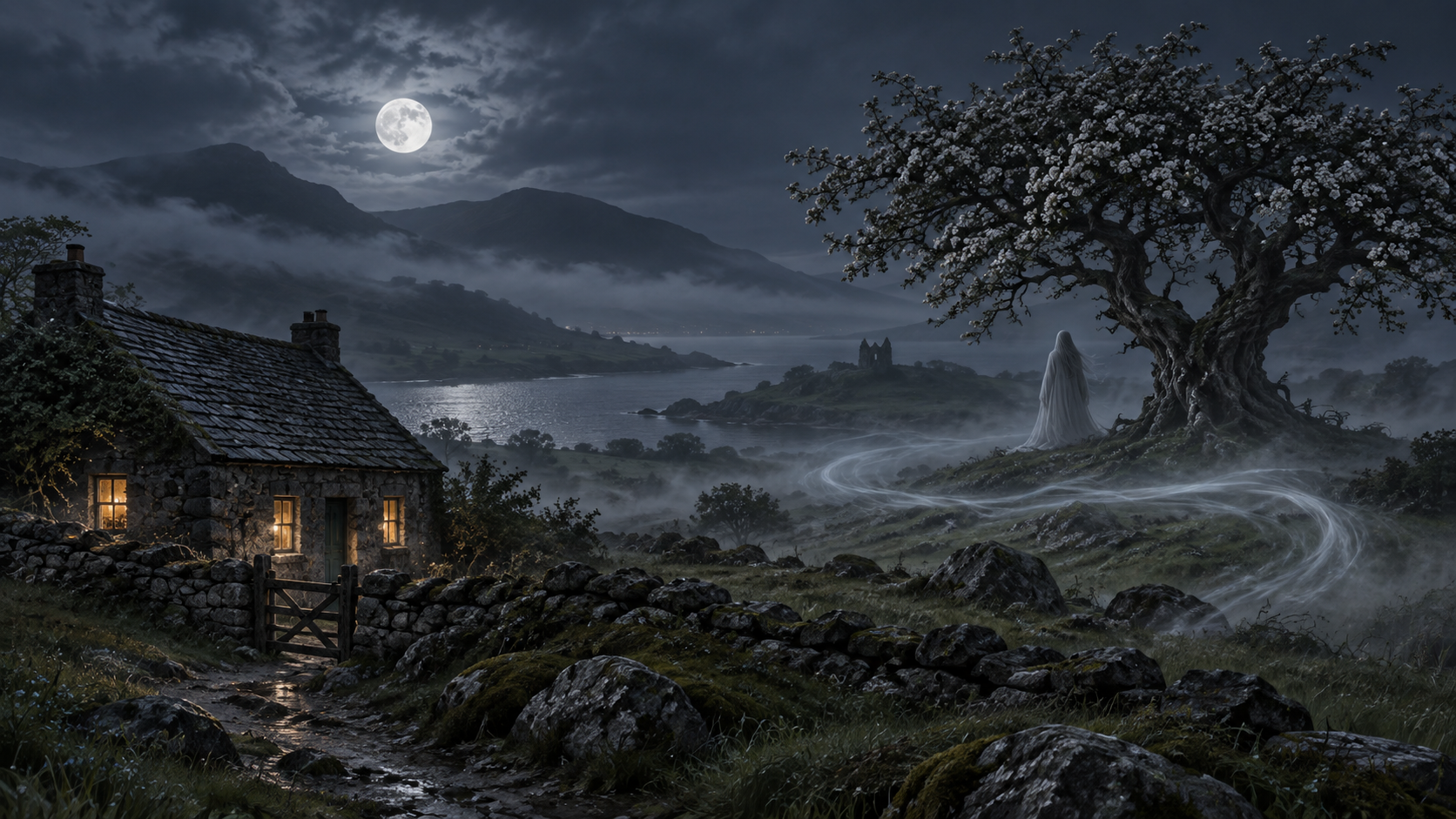
    Misty Irish cottage and hawthorn tree with a distant, face-obscured pale figure

    Horror films have made the banshee a screamer: a wailing woman who shows up and shrieks, and then something terrible happens. Irish tradition tells it differently, and the difference is the whole point.

    The banshee doesn’t cause a death. She mourns one before it happens.

    What “banshee” means

    The word comes from the Irish bean sídhe: bean is woman, and sídhe refers to the mounds, the old earthworks and hills where the otherworld was said to live. A woman of the mounds. She isn’t a ghost in the ordinary sense, and she isn’t a demon. She belongs to the older, stranger category of beings that shared the land with people and kept their own rules.

    Her one job is to announce a death. She’s heard at night, usually close to the house, sometimes for several nights before. Then someone in the family dies.

    The sound is a lament

    What people describe hearing isn’t random screaming. It’s keening.

    Keening (Irish caoineadh) was the formal lament women performed over the dead at wakes and funerals. It was a skilled practice. Some women were known for it and were asked to keen at wakes. The keen had structure, rising and falling, part song and part speech, calling out the dead person’s name and virtues and the family’s grief. The church spent a long time discouraging it as too pagan and too wild, and by the twentieth century it had mostly faded.

    So when people said the banshee was keening, they meant something specific. She was doing for the family what the keening women would do after the death. She was just early.

    That makes her something closer to a family retainer than a monster. She grieves with you. She simply knows first.

    Whose banshee?

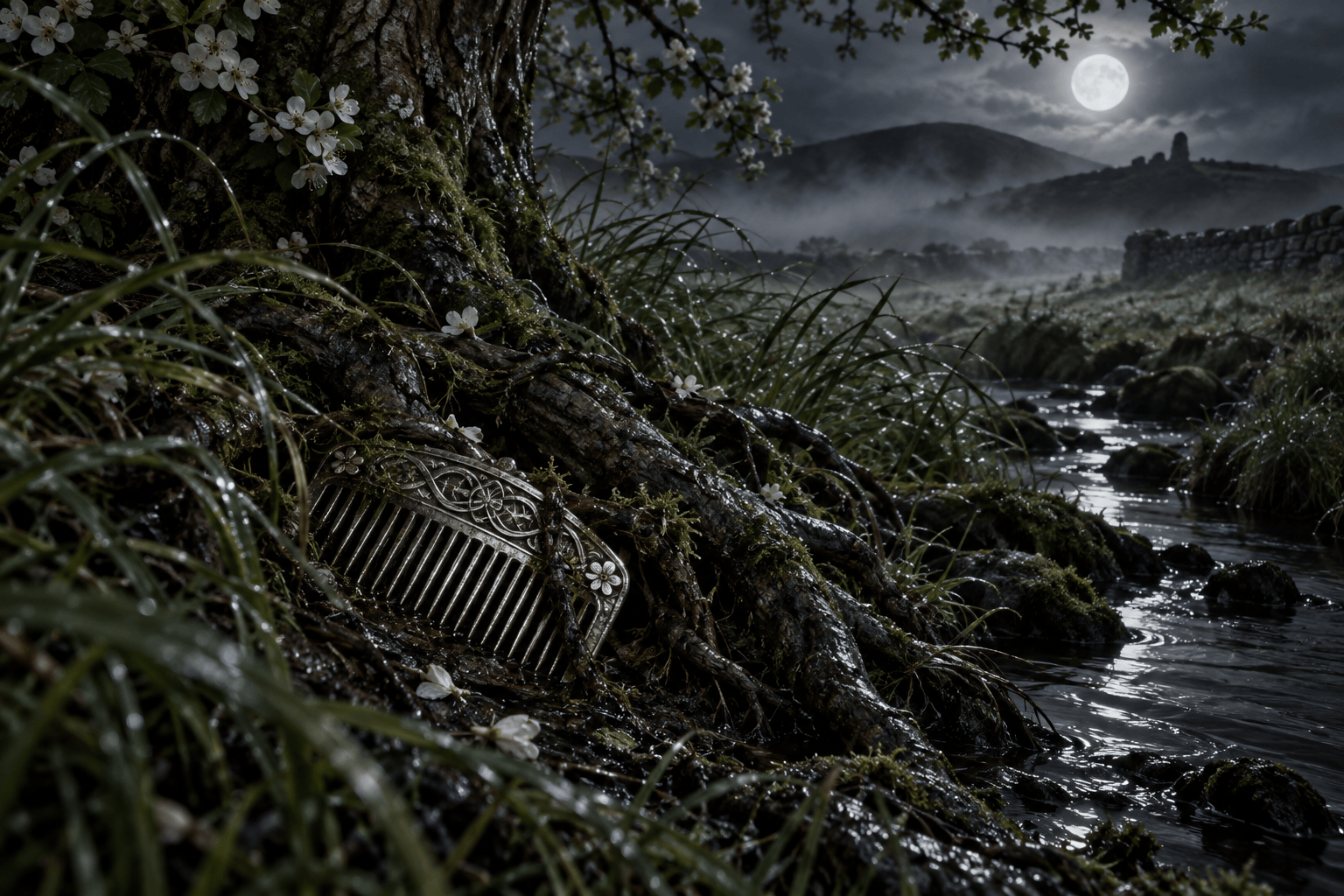
    An old comb on a windowsill inside an Irish cottage at night

    In the older tradition the banshee doesn’t come for just anyone. She attaches to particular families, the old Gaelic lines, the names that begin with Ó or Mac. Some tellings name specific families she was bound to, and there are local traditions all over Ireland about which families had one and what she sounded like.

    Families that emigrated said she went with them. There are accounts from America and Australia of Irish families hearing the keen far from home before word of a death arrived by letter weeks later.

    What she looks like

    Accounts vary, and the variety is part of the legend. She can appear as:

    • a young woman with long hair,
    • a pale, dignified matron,
    • or an old woman, bent and grey, wrapped in a cloak.

    Most of the time she’s heard and not seen. When she is seen, she’s often combing her long hair.

    Don’t pick up the comb

    This is the warning that has lasted longest, and you’ll still hear it in parts of Ireland. If you find a comb lying on the road, leave it. It may be hers, and she will come back for it.

    What happens to you if you take it depends on who’s telling the story. Some say she comes to the house for it. Some say you lose something you’d miss more. It’s a small rule, the kind that survives because it’s easy to follow: don’t take what isn’t yours from the side of the road on the wrong night.

    Her relatives

    Scotland has the bean nighe, the washer at the ford: a woman seen at a stream, washing the grave clothes of someone about to die. If you catch her you might get an answer from her, or a wish. Some scholars connect both figures to older war goddesses of Irish myth, the ones who appeared before battles to show who would fall. That connection is debated, but the pattern is clear. The Gaelic world pictured death announced in advance by a woman, and she’s usually doing women’s work around death: washing, mourning, keening.

    The other omens in an Irish house

    The banshee wasn’t the only warning. Irish and wider British tradition had a whole vocabulary of signs that a death was coming, and many families kept track of several at once:

    • Three knocks at the door or on the headboard, with nobody there.
    • A bird at the window, or a bird that gets into the house. Robins and magpies especially.
    • The death coach, the cóiste bodhar or “silent coach,” a black coach heard on the road at night, sometimes with a headless driver. If it stops at your door, it has come for someone inside.
    • The fetch, a double of a living person, seen where that person couldn’t be. Seen in the morning it meant long life. Seen in the evening it meant the opposite.
    • A picture falling from the wall for no reason.

    And once the death came, there were customs for the house itself. Someone opened a window so the soul could leave. The clocks were stopped at the hour of death. Mirrors were covered or turned to the wall so the soul wouldn’t be caught in the glass on its way out. The body was watched through the night of the wake and never left alone.

    Taken together, these customs show a culture that expected death to be announced and treated the days around it as dangerous ground. The banshee is just the most famous of the messengers.

    Hearing her in the twentieth century

    It’s tempting to treat the banshee as a medieval belief, and it isn’t one. Irish folklore collectors in the twentieth century, including the national Schools’ Collection of the 1930s, recorded banshee accounts from ordinary people describing what their parents and grandparents had heard, often naming the house, the road, and the family. For many rural families she was still a practical fact within living memory. That’s the world “Counting Them Out” is set in: 1948, electric light arriving slowly, and the old women still counting the boats.

    Why she’s frightening anyway

    She isn’t evil, and she’s still one of the most frightening figures in Irish folklore. The reason is simple: there’s nothing you can do.

    Most folklore monsters come with a defense. Salt, iron, running water, a cross cut into a tree. The banshee comes with none, because she isn’t the threat. She’s the news. By the time you hear her, the thing she’s mourning has already been decided.

    All you can do is count your family and wait.

    The story in October 31

    “Counting Them Out” is the third story in October 31.

    > October 31st, 1948 — a fishing village, County Clare.

    Aoife Nolan is working a splinter out of a neighbor’s palm when the sound comes through the cottage wall. Six boats went out that morning. The old women counted them out, the way they always do. Aoife has never once heard one of them count the boats back in where anyone could hear.

    And the keening coming up the harbour road is more voices than there are sons out on the water.

    If the legend above is what you believe, you already understand why that last detail matters. What Aoife does with that knowledge is the story.

    It’s also the story I’d point you to if you’ve never read anything of mine. It’s short, it’s quiet, and it’s the cleanest read-aloud in the book.

    —

    Counting Them Out is Night 3 of 31 in October 31, thirty-one folk horror stories set on Halloween night across six centuries. Read it on Amazon → · Free with Kindle Unlimited.

    Take the 31 Nights challenge. One story a night through October, with a free printable calendar. Get the calendar →

    Previous: Stingy Jack: The Real Irish Origin of the Jack-o’-Lantern · Next: Why Every Story in October 31 Happens on the Same Night

  • Stingy Jack: The Real Irish Origin of the Jack-o’-Lantern

    Carved turnip lantern glowing on an Irish cottage windowsill above a misty lane

    The pumpkin is the newcomer.

    For most of its history, the thing we now call a jack-o’-lantern was a turnip. In Ireland and Scotland people hollowed out turnips, mangelwurzels, and sometimes potatoes, cut faces into them, and set an ember or a stub of candle inside. The faces were not meant to be friendly. The lantern was carried on the road or left in a window on the last night of October, looking out.

    And the man it was named for didn’t carve it for fun. He was carrying it because he had nowhere else to go.

    The legend of Stingy Jack

    The story has a dozen versions, which is how you know it was told out loud for a long time before anyone wrote it down. The bones stay the same.

    Jack is a drinker, a cheat, and a man nobody in the village trusts with a debt. In some tellings he’s a blacksmith. In most he’s just Jack. One night he ends up drinking with the Devil, and when the bill comes Jack has no money, so he talks the Devil into turning himself into a coin to pay it.

    The Devil does it. Jack drops the coin into his pocket, next to a silver cross, and the Devil can’t change back.

    Jack lets him go on one condition: the Devil leaves him alone for a year. (In some versions it’s ten.) When the Devil comes back to collect, Jack talks him into climbing an apple tree for one last piece of fruit, then carves a cross into the bark so the Devil can’t climb down. This time the price of freedom is bigger. The Devil has to promise never to take Jack’s soul.

    Then Jack dies.

    Heaven won’t have him. He was exactly the man everyone said he was. He goes down to hell, and the Devil, who keeps his bargains even when he’d rather not, refuses him too. He turns Jack back into the dark with nothing but a single coal from the fires of hell to see by. Jack puts the ember in a hollowed turnip and walks.

    He’s still walking. That light you see out on the bog at night, the one that moves when you look at it: that’s Jack of the Lantern. Jack-o’-Lantern.

    Two meanings, one name

    The name was in English before the carving was. By the 1600s, “jack-o’-lantern” meant a man carrying a lantern, a night watchman, and it also meant the strange lights that hang over marshes and bogs after dark. English folklore calls those lights will-o’-the-wisp; scholars call them ignis fatuus, “foolish fire.” Every culture that has wetlands seems to have a story about them, and almost every story says the same thing: don’t follow the light.

    The Stingy Jack tale explains the light. The carved lantern came later and borrowed the name. Somewhere along the way the story and the object met. The face on the turnip became Jack’s face, or a face meant to scare Jack and anything else wandering on the last night of October.

    What Samhain has to do with it (and what it doesn’t)

    October 31 was already a serious night in Ireland long before anyone carved anything. Samhain marked the end of the harvest and the turn toward winter, and it was understood as a night when the boundary between the living and everything else wore thin. People went guising, in disguise, going door to door. They kept fires. They were careful about who they let in.

    You’ll read that the carved lantern goes back to the ancient Celts. Be skeptical of that. The written evidence for carved turnip lanterns in Ireland and Scotland is mostly from the 1800s, told by people who remembered doing it as children. The custom is old, but “ancient” is a guess. The honest version is more interesting anyway. The lantern is a folk practice that grew up around an older night, and it stuck because it did a job.

    The job was the warning. A face in the window, lit from inside, facing the road.

    Jack’s cousins around the world

    The lights Jack is blamed for show up almost everywhere people live near wetlands, and nearly every culture gave them a person.

    In England they were will-o’-the-wisp, Jack-o’-lantern, Hob-and-his-lantern, and Peg-a-lantern, a whole family of names for the same small moving flame. In Wales the canwyll corff, the corpse candle, was a light seen moving along the road a funeral would later take. In Scandinavia and Germany the lights were often the souls of people who had moved boundary stones in life and were condemned to walk the fields they had cheated. In parts of the American South the same lights were called jack-ma-lanterns and were said to lead travelers into the swamp until they drowned.

    The details change, and the core stays the same. The light belongs to someone who can’t rest. It wants company. Don’t follow it.

    Stingy Jack’s version is unusual because the soul isn’t punished for violence or murder. He’s punished for being clever. He beat the Devil twice and won exactly what he asked for, which was to be left alone. The joke of the story is that he got it.

    How to carve it the old way

    If you want to try the original, a turnip works, and a rutabaga (what the Scots and Irish often mean by “turnip”) works better because it’s bigger.

    • Cut the top off and keep it as a lid.
    • Hollow it with a sturdy spoon and a paring knife. This takes much longer than a pumpkin. The flesh is dense, and your wrist will know about it.
    • Leave the walls thick, about half an inch, or the face will split.
    • Carve the face small and mean. The old ones weren’t cute. Narrow eyes, a slit of a mouth.
    • Use a tealight, not an ember, and punch a small hole in the lid for the smoke.

    It will shrivel within a few days and start to look like a shrunken head, which, honestly, is the point.

    Across the Atlantic

    Irish and Scottish emigrants carried the custom to North America, and the great wave of Irish emigration during and after the Famine of the 1840s carried a lot of it. In America they found the pumpkin. Pumpkins are native to the Americas, they’re bigger than any turnip, and you can carve one in a quarter of the time. By the late 1800s the pumpkin lantern was a fixture of American Halloween, and the turnip was something your grandmother talked about.

    What didn’t travel as well was the story. Most people who carve a pumpkin this year won’t know there was ever a Jack, or that the face was supposed to be his.

    The story in October 31

    “Stingy Jack’s Lantern” is the fourteenth story in October 31, and its dateline doesn’t give a year:

    > October 31st — a porch in the Irish countryside, and long before that.

    It opens on an old man named Cormac with a pumpkin between his knees and the good knife in his hand, the one his late wife Maeve used to say would take his thumb off one day if age didn’t get there first. Age got there first, at least to Maeve. The knife remains undefeated.

    That’s all I’ll say about where it goes. The dateline tells you there are two times in this story, and the second one is much older than the porch. Knowing the legend above won’t tell you how it ends.

    Why the old version is scarier

    The modern jack-o’-lantern is decoration. The old one was a stance. It said: I know what walks tonight. I know the rules. Keep going.

    That’s what every story in October 31 is built on. The warnings came from people who had a reason for them. The turnip in the window wasn’t there to be admired. It was there because someone, once, had needed it.

    Carve your pumpkin this year. Put it where the road can see it.

    —

    Stingy Jack’s Lantern is Night 14 of 31 in October 31, thirty-one folk horror stories set on Halloween night across six centuries. Read it on Amazon → · Free with Kindle Unlimited.

    Take the 31 Nights challenge. One story a night through October, with a free printable calendar. Get the calendar →

    Next: The Banshee Doesn’t Scream, She Keens: The Real Irish Legend

  • October 31 Is Out: Thirty-One Warnings for the Darkest Night

    Cover of October 31, a There Be Monsters anthology of Halloween folk-horror stories

    Get October 31 on Amazon →

    Ebook $4.99 · free to read with Kindle Unlimited

    October 31 is live.

    It’s thirty-one stories, all of them set on the same night. The earliest is set in a French cathedral town in the 1400s, and the last one happens tonight. In between there’s a whaling ship, a plague year, a Prague attic, a trapline in the Ontario bush, a Louisiana funeral home, a Nebraska farm with a letter on the kitchen table that nobody wants to open.

    Every story runs on one idea. The old warnings (do not answer, leave before dark, feed it first, count them twice) were not superstition to the people who made them. They were instructions. Someone came home frightened enough to tell the next person what had worked. The stories in this book follow the people who have to decide, on the worst night of their lives, whether to believe them.

    Read the opening

    This is how the first story begins. It’s the page that shows up in Amazon’s Look Inside, so if it works for you, the rest of the book will.

    > In a Hand the Clerk Can Read

    > October 31st, 1897 — a farmhouse in the Carpathian foothills.

    >

    > The boy who came for Dr. Emil Coțofană did not knock. He threw stones at the shutters until one split, and by the time Emil had the window open he was already shouting up, winded. The bride would not wake right, and Vasile Petrescu was tearing the house apart after somebody who knew what to do.

    >

    > Emil dressed in the dark rather than spend a match and took up his father’s bag: lancets, quinine, the brown bottle of carbolic he had carried back from Vienna and never once opened here, because nobody in this valley trusted a wound cleaned with anything that did not smell of church.

    >

    > At the coat pegs he glanced at the calendar without meaning to, and the thought that arrived was not a physician’s thought. It was one flat word.

    >

    > Again.

    >

    > He could not have said what he meant by it. He put his hat on and went out and did not examine it, which was the most characteristic act of his professional life.

    The valley knows something Emil has spent nine years trying not to know. The story is about what happens when a trained man is the only one in the room who hasn’t read the rules.

    Who this book is for

    • You like horror that builds instead of horror that splatters.
    • You read the footnotes. There’s a Note on Sources at the back that says what’s recorded history, what’s folklore, and what I made up.
    • You want something to read one piece at a time. Stories run from about ten minutes to twenty-five.
    • You already know that the scariest word in a ghost story is usually again.

    If you want gore, this isn’t your book, and I’d rather tell you now than find out from a review.

    What’s in it

    Banshee, strigoi, changeling, golem. A kobold behind the hearthstone. A carnival that takes half your ticket. Stingy Jack and his lantern. A chupacabra panic on a South Texas ranch in 1996. A haunted doll bought for four dollars at an estate sale. A boarding house in Victorian London where someone is being fed on, and a maid who knows exactly where to put the salt and iron, and where to leave a gap.

    Each story stands alone. Read in order, they move toward the title story, the thirty-first, where all the warnings start sounding at once.

    Read it one night at a time

    Starting October 1, I’m running the 31 Nights challenge: one story a night through October, ending with the title story on Halloween. There’s a free printable calendar with every night’s dateline so you can track where you are. Get the calendar →

    I’ll also be posting a companion piece here for each story, covering the real folklore or history it’s built from, with no spoilers. The first one goes up tomorrow: the Irish legend of Stingy Jack, and why the jack-o’-lantern was never about pumpkins.

    Formats

    The ebook is out today and enrolled in Kindle Unlimited, so if you subscribe, it’s free to read. The paperback and hardcover are on their way for anyone who wants a copy on the shelf or plans to give one as a gift before Halloween. I’ll post here when they’re live.

    One ask

    If you read it, leave a review, even two lines. For a new book, reviews decide whether Amazon shows it to anyone else. An honest two-star review helps more than silence does.

    Get October 31 →

    Every warning was true once.

    T. P. Grimbard

    —

    Also in There Be Monsters: Then and Now · Deep Down · Among the Dead

  • 31 Stories, One Night: October 31 Is Coming

    Cover of October 31, a There Be Monsters anthology of Halloween folk-horror stories

    Here it is.

    October 31 is the next book in the There Be Monsters series, and it goes live tomorrow morning. Thirty-one stories. Every one of them takes place on the same date.

    That was the rule I wrote under. No story could happen on October 30 or November 1. Every account had to start on the last night of October, in whatever century and whatever country the story belonged to. Some are set on nights that nobody at the time would have called Halloween: a plague-year London parish, a medieval French cathedral town, a Puritan village where the word would have gotten you questioned. The date is the same. The people keeping it are not.

    What’s inside

    Each story opens with a dateline, the way a field report would. A few of them:

    • October 31st, 1897. A farmhouse in the Carpathian foothills. A country doctor is fetched in the dark for a bride who will not wake right.
    • October 31st, 1653. A village in the Massachusetts Bay Colony. The meetinghouse bell is ringing, and it isn’t the Sabbath ring.
    • October 31st, 1918. A trapline north of Hearst, Ontario. The first storm came early, and the man who knew the rules of the bush is gone.
    • October 31st, 1996. A ranch in South Texas. The third goat turned up dead on the tank dam, and that one got the sheriff’s office to send a deputy.
    • October 31st, present day. A diner in a small town. Hoofbeats cross an empty intersection after closing.

    There are banshees and changelings, a golem in a Prague attic, a house-spirit behind a German hearthstone who keeps careful count of what he is owed. There’s a carnival that only runs once. There’s a clock that someone has wound every Wednesday for longer than most marriages last.

    What it’s like to read

    This isn’t a gore book. If you’ve read Then and Now or Deep Down, you know what to expect: slow dread, real history, and people making practical decisions after the impossible has already walked in. The monsters come from the folklore our great-grandparents took seriously. Each one has rules. Most of the horror comes from someone deciding whether to follow them.

    The book closes with a Note on Sources that says where each tradition comes from and what I invented. Some of these beliefs belong to living cultures, and I’d rather be honest about the line between the record and the story than pretend there isn’t one.

    Why thirty-one

    One for every night in October. Read one before bed and you finish the book on Halloween. The last story is the title story, and it’s the one where every warning in the book starts sounding at once. Save it.

    I’ll be posting a companion piece here for every story through October: the real legend or piece of history behind it, without spoilers. The first few go up this week. Start with the jack-o’-lantern on Thursday. It was never about pumpkins.

    Where this sits in the series

    If you’re new here: There Be Monsters is an anthology series built on one line, every warning was true once. Each book follows ordinary people far enough past certainty to find out why a rule, a superstition, or a story existed in the first place.

    Then and Now paired horrors across time, the old version and the modern echo. Deep Down went below the water and under the ground. Among the Dead was about the dead who refuse to stay where the living put them. October 31 turns the series toward the night itself.

    You don’t need to have read the others. Every book, and every story, stands alone. But if you’ve been reading since the first one, you’ll recognize the voice, the datelines, and the kind of person who ends up alone in the dark trying to remember what their grandmother said.

    Why the datelines

    Every story opens the same way: October 31st, a year, a place. It’s the heading on a field report, and it does a job. Before the first sentence you already know where you’re standing, what century it is, and what the people around you are likely to believe. The dateline puts you in the room. The story makes you want to leave it.

    Tomorrow

    October 31 releases tomorrow in ebook, with print to follow. I’ll post the link here at 10 AM, along with the opening of the first story.

    If you want to read along with other people, the 31 Nights challenge starts October 1: one story a night, with a free printable calendar that tracks each night’s dateline. Get the calendar →

    Every warning was true once.

    T. P. Grimbard

    —

    Also in the series: Then and Now · Deep Down · Among the Dead