
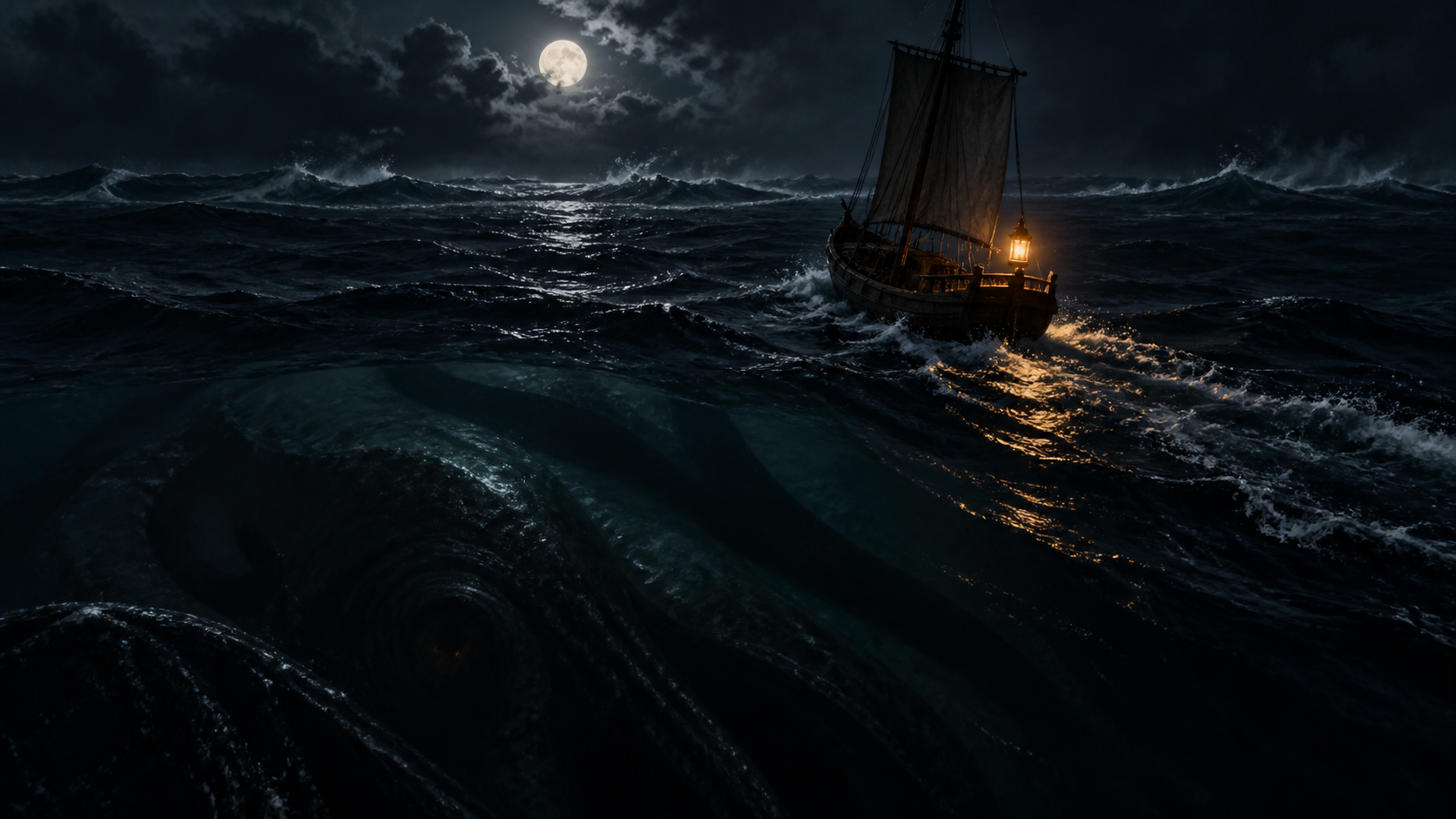
The best horror books about sea monsters understand that the creature is only part of the problem. The ocean removes witnesses, shortens supplies, ruins maps, and makes escape depend on a machine that can fail. A monster under the water is terrifying because it has the advantage before it appears: it lives in the element that keeps everyone else alive only provisionally.
This list moves from ancient myth to modern maritime dread. Some entries are openly monstrous. Others use the sea itself as the thing that watches, waits, and refuses to explain. Start with the mood you want rather than trying to find one definitive “kraken book.”
1. *Monsters of the Wine-Dark Sea* — for myth with teeth
For readers who want the old monster routes first—Scylla, Charybdis, sirens, and the perilous logic of the ancient sea— Monsters of the Wine-Dark Sea is the direct Grimbard starting point. It follows the idea that mythology is not a museum case. It is a survival language for a world that will not hold still.
2. *The Call of Cthulhu* by H. P. Lovecraft — for cosmic maritime dread
Lovecraft’s 1928 story is a foundational weird-fiction sea read: cults, sailors, a drowned city, and a revelation too large for the people who discover it. Its influence is enormous, and so are its serious problems. Read it with awareness of Lovecraft’s racism and the genre’s long history of inheriting it. The useful lesson is structural: the sea lets the story keep its largest truth out of reach until the final approach.
3. *The Kraken Wakes* by John Wyndham — for invasion by the deep
Wyndham’s 1953 novel imagines an undersea invasion that begins as a mystery and becomes a global crisis. It is less interested in one tentacled encounter than in escalation: reports become patterns, patterns become policy failures, and policy failure becomes a transformed world.
Choose it if you like sea horror that expands outward from a single alarming signal.
4. *The Terror* by Dan Simmons — for ice, hunger, and what follows the ships
Inspired by the Franklin expedition, The Terror turns a historical disaster into a long survival nightmare. The monster matters, but ice, hunger, leadership, and failing morale do as much of the work. Readers should know it is a fictionalized version of real loss, not a replacement for historical accounts.
Choose it if you want the sea as a hostile system, even when it has frozen solid.
5. *Into the Drowning Deep* by Mira Grant — for science meets mermaid horror
Grant’s 2017 novel sends researchers toward the site of a vanished expedition and gives creature-feature energy an oceanographic frame. It is fast, violent in places, and interested in what happens when evidence-minded people find evidence that changes the category of the world.
Choose it if you want the investigation as much as the attack.
6. *The Deep* by Nick Cutter — for claustrophobia below the surface
This novel sends a team into an extreme undersea environment in search of a cure, then makes the isolation itself unbearable. It is graphic and bleak, so it is a poor fit for readers looking for mythic adventure. It is a good fit for readers who want the ocean turned into a sealed psychological chamber.
7. *The Swarm* by Frank Schätzing — for ecological scale
Schätzing’s thriller imagines the ocean responding to human pressure through an intelligence that humanity did not know how to see. It is expansive rather than intimate. Its appeal is the growing realization that the sea has its own agency and that our usual assumptions about control are provincial.
8. *Sphere* by Michael Crichton — for an impossible object underwater
Sphere is science-fiction thriller more than pure horror, but it earns its place for readers who like a deep-sea premise that becomes a mind game. A team finds something impossible on the ocean floor, and every attempt to explain it makes the team less reliable.
Choose it if you want a sea-monster mood without a conventional monster body.
9. *The Fisherman* by John Langan — for mythic grief and dark water
Langan’s novel uses fishing, grief, and a local legend to open into something much larger and stranger. It is patient, melancholy, and more folkloric than creature-feature fiction. Its water feels old, not merely deep.
Choose it if what you want is an American folk-horror route to the sea.
Choose by the fear you want
| If you want | Start with | |—|—| | Greek myth and named monsters | Monsters of the Wine-Dark Sea | | A foundational cosmic sea story | The Call of Cthulhu | | Modern creature investigation | Into the Drowning Deep | | Historical survival horror | The Terror | | Underwater confinement | The Deep | | Ecological apocalypse | The Swarm | | Folkloric, grief-struck unease | The Fisherman |
For the legend beneath the recommendation, revisit why sailors believed in sea monsters. If you want a quieter strange-light counterpart to maritime danger, what is will-o’-the-wisp? follows another old warning that turns uncertainty into a story.
Why sea monsters remain so effective
The sea makes a monster story efficient. A land creature must cross a room. A sea creature can touch the hull from below, vanish into a depth no light reaches, and leave the people aboard arguing about whether it was ever there. The ocean also turns scale against us. A whale, squid, current, fog bank, or storm can be real and still feel impossible at night.
That is why maritime horror can work without pretending every sailor’s tale is literal. Monster stories record the feeling of dependence: a person on a ship survives because wood, weather, food, navigation, and other people continue to cooperate. The creature arrives when cooperation breaks.
Make the next voyage a darker one
For a book that begins with the monsters sailors named when the water had no mercy, visit Monsters of the Wine-Dark Sea. Or join The Grimbard Press for Dead Ship, the free illustrated Subscriber Archive Edition.
Frequently asked questions
What are the best horror books about sea monsters?
The best choice depends on the kind of sea horror you want. Into the Drowning Deep suits creature-feature readers, The Terror suits historical survival horror, and Monsters of the Wine-Dark Sea suits readers who want mythic sea monsters.
Are sea-monster books always creature features?
No. Some use a literal creature; others make the ocean, isolation, or an unknowable underwater object the source of dread. Maritime horror often works through vulnerability and distance as much as teeth or tentacles.
Is *The Terror* a true story?
It is historical fiction inspired by the Franklin expedition, with supernatural elements added. It should not be used as a factual account of the expedition.
Which sea-horror book is best for readers who dislike gore?
Try Monsters of the Wine-Dark Sea, Sphere, or The Fisherman, then check individual content notes. Tone and intensity vary substantially across maritime horror.
The water keeps the first secret
Sea monsters last because the ocean refuses to make a complete witness of anyone. A ship can feel like a whole world until one sound strikes the hull from beneath. Then it becomes what it always was: a small, lit object floating above a country of darkness.
