
The Beetle vs. Dracula: Why Richard Marsh's Forgotten Horror Novel Outsold Stoker
Ask for a Gothic horror novel from 1897 and most readers will say Dracula. It is the vampire novel that escaped its century, acquired a thousand faces, and became so familiar that even people who have not read it recognize its luggage.
But 1897 had another major horror success: Richard Marsh’s The Beetle: A Mystery. It arrived in the same year, moved through similar fin-de-siècle anxieties, and was initially the more popular book. It has since become the stranger name in the comparison.
That reversal is the real mystery. The Beetle did not disappear because it lacked ambition or shocks. It is an unsettling, messy, multi-voiced novel about revenge, transformation, hypnotic control, London, Egypt, fear of invasion, and the unstable boundary between person and creature. It was a commercial force in its moment. But Dracula was adapted, simplified, remade, and reintroduced so often that it became a cultural machine. The Beetle remained harder to carry forward without its discomforts showing.
Two 1897 Gothic novels, two different kinds of threat
Both novels belong to the anxious atmosphere of late-Victorian Britain. Each brings an apparently foreign threat into English life. Each uses multiple documents or narrators. Each worries at the edges of class, gender, sexuality, science, empire, and the body.
But the comparison should not flatten them into twins.
Dracula is famously assembled from journals, letters, telegrams, newspaper clippings, and records. Its structure creates a team of witnesses trying to name and defeat a single enemy. The vampire becomes powerful partly because the group must coordinate information before it can act.
The Beetle also moves through multiple narrators, but its story has a more fractured, feverish pressure. The title creature is associated with transformation, coercion, revenge, and a fear of boundaries losing their authority. The narrative is not simply about a monster arriving in London. It is about a society discovering that its categories—human and insect, masculine and feminine, respectable and compromised, private body and public identity—were never as stable as they claimed.
Scholars have noted the books’ shared concerns while emphasizing that Marsh’s novel had its own publication route and form.[^1] The serial history matters. The Beetle did not appear as a pale follower arriving after Dracula had defined the market. Its serialization began before Stoker’s novel was published in book form.[^2]

Illustration: both novels use fragments, but their fragments create different kinds of dread.
Did The Beetle really outsell Dracula?
The careful claim is that The Beetle was initially more commercially successful and reached more printings in its early life than Dracula. It is widely repeated by scholars and publishers because the contemporary evidence supports its status as a significant popular hit, even though exact sales comparisons can be repeated too confidently without their publication context.[^1]
That is enough to correct the usual story. The Victorian Gothic market was not waiting for Dracula alone. Readers had several hungry, sensational, shape-changing books to choose from. Marsh’s novel was one of the biggest.
So why did Dracula win the longer cultural war?
Part of the answer is adaptation. A cape, fangs, a castle, and a named vampire are easy to translate into theatre, film, television, comics, costumes, and shorthand. The Count can be reduced without disappearing. The reduction becomes another version of the story.
The Beetle resists that kind of clean extraction. Its most disturbing elements are tied to its period’s fears and prejudices. Its identity shifts are not a single marketable icon. Its Egypt is filtered through British imperial fantasy. Its sexuality and gender anxieties do not sit quietly behind a simple creature feature. The book asks to be read with more historical context because its power and its damage are entangled.
The forgotten book is not a harmless book
Calling a novel “forgotten” can make it sound like a lost toy someone should dust off without questions. The Beetle deserves a more serious return than that.
Richard Marsh’s story uses racialized and imperial ideas that belong to the violence of its period. It draws on an imagined Egypt shaped by British colonial desire, fear, and extraction. It treats gender and bodily difference in ways that can be deliberately destabilizing but also cannot be separated from late-Victorian panic about who counts as fully legible or fully human.
Those elements should not be polished away in a recommendation. Context does not make the book innocent. It makes the reader better equipped to see what the novel is doing, what it inherited, and what later horror inherited from it.
The Library of Congress preserves a digitized 1915 edition of the text, a useful primary object for checking the work itself rather than relying on a chain of plot summaries.[^3] Scholarly reading then helps identify the historical pressures that a bare public-domain file may leave invisible.

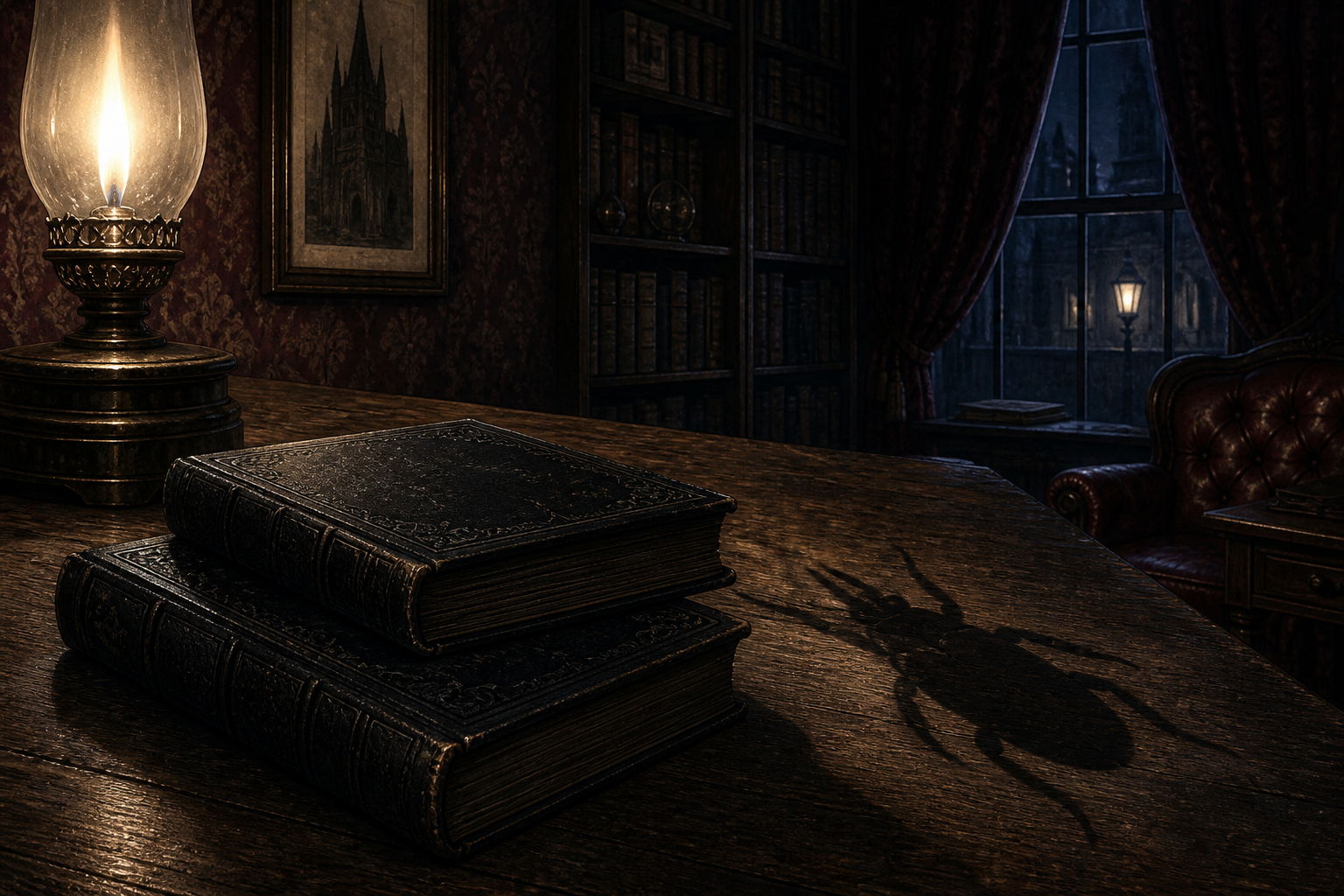
Illustration: the novel’s horror lives in unstable categories, not merely in an insect silhouette.
Which should you read first?
Read Dracula first if you want the enduring architecture of the modern vampire story: a dispersed record, a famous antagonist, a team of witnesses, and an icon so familiar that the text can still surprise you.
If you are building a reading route rather than collecting a single classic, the horror anthology guide for folklore and monsters offers a gentler way into the wider shelf. For another Victorian-era mystery shaped by archaeology and a cursed object, see The Scarab.
Read The Beetle first if you want a more unruly Gothic novel: multiple points of view, revenge that crosses borders, a creature whose instability is part of the threat, and a record of Victorian anxieties that needs a critical reader beside it.
They are not substitutes. They are two ways a genre learned to fear that the modern city was connected to a world it had tried to control and describe from a distance.
That is also why the comparison has lasted. Dracula became the cleanest possible monster icon. The Beetle remained the less obedient book—the one that keeps showing where the clean icon came from.
The Grimbard edition
The Beetle: a Mystery Annotated is a Grimbard Classics / Tyler P. James annotated edition of Richard Marsh’s public-domain novel. Richard Marsh is the original author. The value of an annotated edition is context: a reader should be able to see the historical references, publication setting, and difficult material rather than being handed a bare text and told that age has made it neutral.
If you want original Grimbard gothic fiction after the comparison, The Scarab is the appropriate separate route. It is not a sequel to Marsh’s book, and the distinction matters.
For an Archive-style free read before choosing either route, join The Grimbard Press for Dead Ship, a free illustrated Subscriber Archive Edition.
FAQs
Did The Beetle outsell Dracula?
The Beetle was initially a major commercial success and is widely described by scholars as more popular than Dracula in its early publication life. Exact comparisons should be treated with publication context rather than as a slogan detached from sources.
When were The Beetle and Dracula published?
Both were published in 1897. The Beetle began serialization before Dracula appeared in book form.
Is The Beetle public domain?
Richard Marsh’s 1897 novel is public domain in the United States. Specific modern editions can still have copyrighted annotations, introductions, cover art, and formatting.
Is The Beetle: a Mystery Annotated original T. P. Grimbard fiction?
No. Richard Marsh wrote the original novel. The Grimbard edition is an annotated public-domain edition and should be credited accordingly.
[^1]: Minna Vuohelainen, “Richard Marsh’s The Beetle (1897): a late-Victorian popular novel”.
[^2]: Tim Youngs, “The Bat and the Beetle”, Oxford Academic.
[^3]: Richard Marsh, The Beetle, Library of Congress digitization.
Comments
One response to “The Beetle vs. Dracula: Why Richard Marsh’s Forgotten Horror Novel Outsold Stoker”
[…] a focused comparison of the two 1897 shockers, read The Beetle vs. Dracula. If you are building a gentler route into the genre, start reading horror without gore before you […]