Spring-Heeled Jack: The Victorian Terror That Kept Leaping
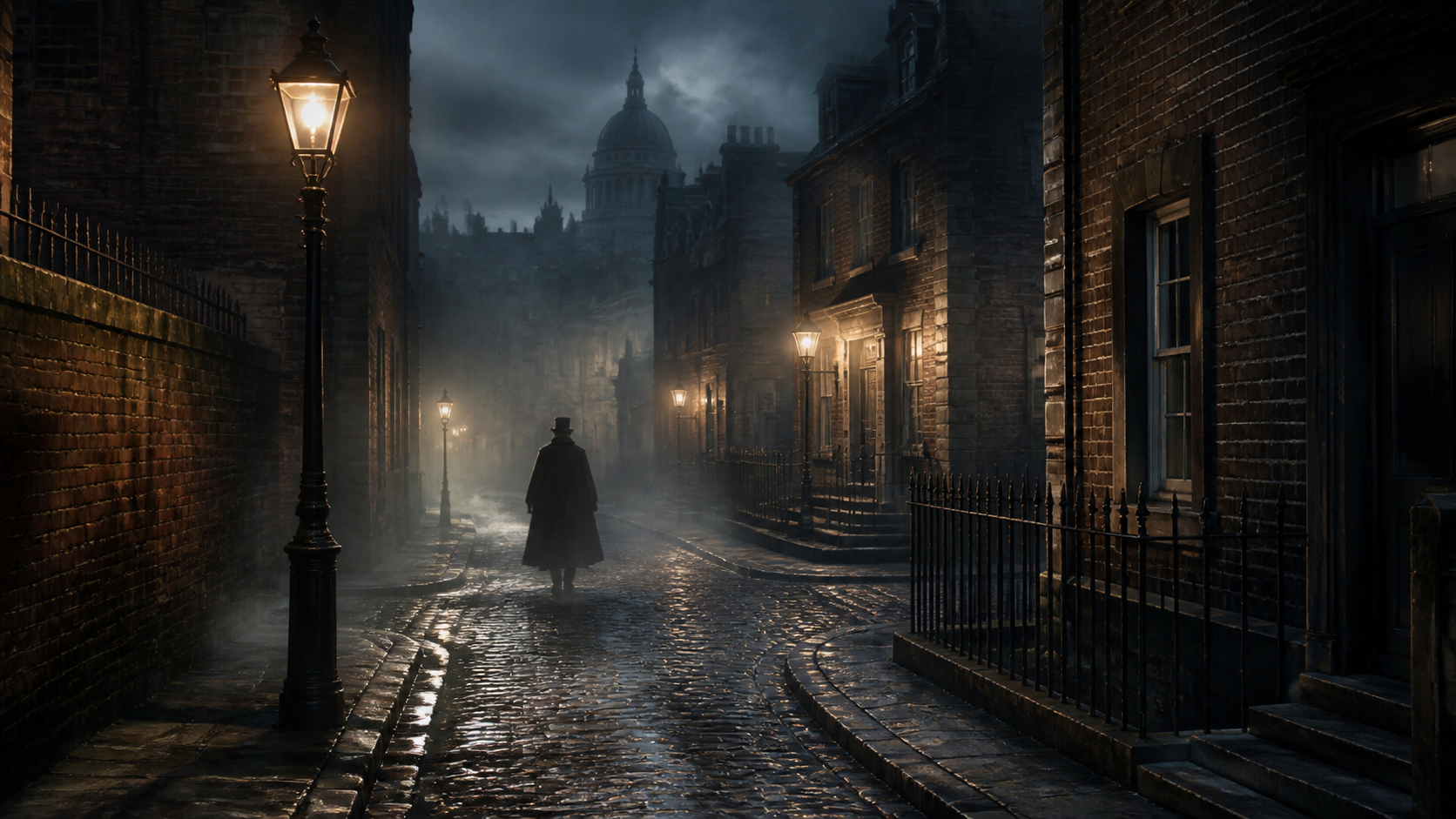
London did not wake up one morning to find a monster on its roofs. It woke up to letters, rumours, complaints, newspapers, and a name that could travel faster than any person wearing claws.
Spring-Heeled Jack is often described as a Victorian demon: a tall figure who attacked people, breathed fire, and escaped by jumping impossible walls. The safer historical answer is more interesting. The legend emerged from a cluster of reports and public alarm in London in 1838, then changed through newspaper repetition, later sightings, popular fiction, and the appetite for a villain who could appear wherever a dark street needed one.
The record supports a real public scare and reports of assaults. It does not establish a supernatural creature, a single culprit, or a tidy solution. Spring-Heeled Jack is a useful lesson in how an urban legend becomes durable: it does not need one stable body. It needs a city ready to recognize the same fear under new clothes.
The first thing to establish is the date
A scholarly study, The Legend of Spring-Heeled Jack: Victorian Urban Folklore and Popular Cultures, identifies 9 January 1838 as a crucial public moment. At a Mansion House session, the Lord Mayor of London addressed a complaint about a figure alarming women in suburban districts. Contemporary reporting and later retellings quickly made the story larger than any single letter.
That sequence matters. The earliest evidence is not a photograph of a leaping devil. It is a civic response to reports. The city was being asked to decide whether a set of frightening stories pointed to a criminal, a prank, a panic, or something stranger. The answer was never settled in a way that could close the file.
It is tempting to begin with the most cinematic details: luminous eyes, claws, a mouthful of flame. Resist that temptation. Such details became part of the legend, but the responsible question is always: which report says this, when was it printed, and how far is it from the alleged event?
Reports are evidence of fear, not automatic proof of every detail
Illustration: contemporaneous reports and later retellings carry different evidentiary weight.
In February 1838, newspapers reported alleged attacks associated with the name Spring-Heeled Jack, including the widely repeated account involving Jane Alsop. The British Newspaper Archive preserves searchable records for contemporary coverage, including March 1838 reporting that used the name. Those papers are invaluable, but they should be read as newspapers: documents of what was alleged, believed, sensationalized, and argued in public.
That does not make the people named in reports disposable. An allegation of assault is not a campfire accessory. It is a claim about harm. The legend has often swallowed the human scale of those reports because the monster is easier to remember than the frightened person at the door.
There may have been imitators. There may have been more than one offender. There may have been exaggeration, misidentification, or journalists improving a story to make it travel. A confident article has to leave room for all of those possibilities rather than choosing the most theatrical one as fact.
Why a leaping figure fit Victorian London
Spring-Heeled Jack belongs to a city of expanding suburbs, gaslit streets, crowded print, and uneven information. A stranger could be close enough to touch and still be impossible to identify. News could spread faster than verification. A creature who crossed walls and vanished at the edge of a lamp’s light gave those conditions a face.
The name itself does narrative work. “Jack” is familiar, almost casual. “Spring-heeled” is physical. It gives the unknown a method of escape. The figure can be pursued in every retelling because he is designed to get away.
That is different from an older monster rooted in one wood, cave, or churchyard. Spring-Heeled Jack is portable. He can be moved from London to another town, from a report to a penny dreadful, from a possible attacker to a mask for every attacker who comes after. The legend’s mobility is its survival mechanism.
The monster outlived the suspect
Illustration: the legend spread through reports, newspapers, and later fiction.
Popular retellings have tried to give Jack a title, an aristocratic identity, a mechanical explanation, or a supernatural anatomy. None has settled the history. A research bibliography compiled by Mike Dash is valuable mainly as a map of the many sources and claims that accumulated around the case; it is not permission to choose the flashiest claim and call it the answer.
The uncertainty did not weaken the story. It made it adaptable. A solved criminal case ends with a name and a sentence. An unresolved figure can reappear whenever a newspaper needs a fright, a writer needs a villain, or a neighbourhood needs a warning about the dark.
Modern folklore operates the same way. Slender Man’s birth in a Photoshop thread was unusually well documented, yet the character spread because different people could add their own fragments. Spring-Heeled Jack had nineteenth-century versions of that network: letters, papers, gossip, and cheap print.
An evidence ladder for Jack
The story becomes clearer if we sort its ingredients instead of blending them.
Documented public record: a January 1838 civic response; contemporary press coverage; reports made under the name Spring-Heeled Jack.
Reported events: individual encounters and alleged assaults described by witnesses or newspapers. These deserve careful language: “reported,” “alleged,” and “according to the account.”
Later legend: a fixed visual design, impossible leaps, particular identities, and a single continuous career extending across decades. Some parts may have roots in earlier reporting; none should be treated as one verified biography.
That ladder does not drain the story of dread. It restores the thing that makes it effective. The monster is not powerful because he can jump a wall. He is powerful because everyone is already looking over it.
The street is the monster’s natural habitat
There is a difference between a ghost that haunts one address and a figure who makes the walk home feel unstable. Spring-Heeled Jack transforms the ordinary route: the front door, the lane, the edge of a streetlamp. He makes the city’s promise of visibility fail at exactly the point where people rely on it.
That is why he belongs beside the Headless Horseman, though their landscapes differ. Both figures turn travel into an encounter with a story that arrives before the rider does. But Jack is sharper and more modern. He is the monster of a city learning that public information can make danger larger without making it clearer.
For legends that mutate with every generation, There Be Monsters: Then and Now follows the creatures that change because we need them to. And for future evidence-minded monster files, join The Grimbard Press and receive Dead Ship, a free illustrated Subscriber Archive Edition.
FAQs
Was Spring-Heeled Jack real?
The historical record shows real reports, public concern, and newspaper coverage in 1838. It does not prove that a supernatural being existed or identify one confirmed person behind every report.
When did the Spring-Heeled Jack legend begin?
The London public scare is closely associated with January 1838, when the Lord Mayor addressed complaints about a frightening figure. Reports and retellings grew rapidly afterward.
Did Spring-Heeled Jack really breathe fire?
Flame-like effects appear in later and contemporary descriptions, but the claim comes through reports and folklore rather than verified physical evidence. It should be presented as a reported detail, not a settled fact.
Why did the legend last so long?
The figure could be adapted to new streets, new newspapers, and new fears. Its uncertainty made it more reusable than a fully solved crime or a monster tied to one location.
The Fear of Being Buried Alive: Why Safety Coffins Haunted the Nineteenth Century
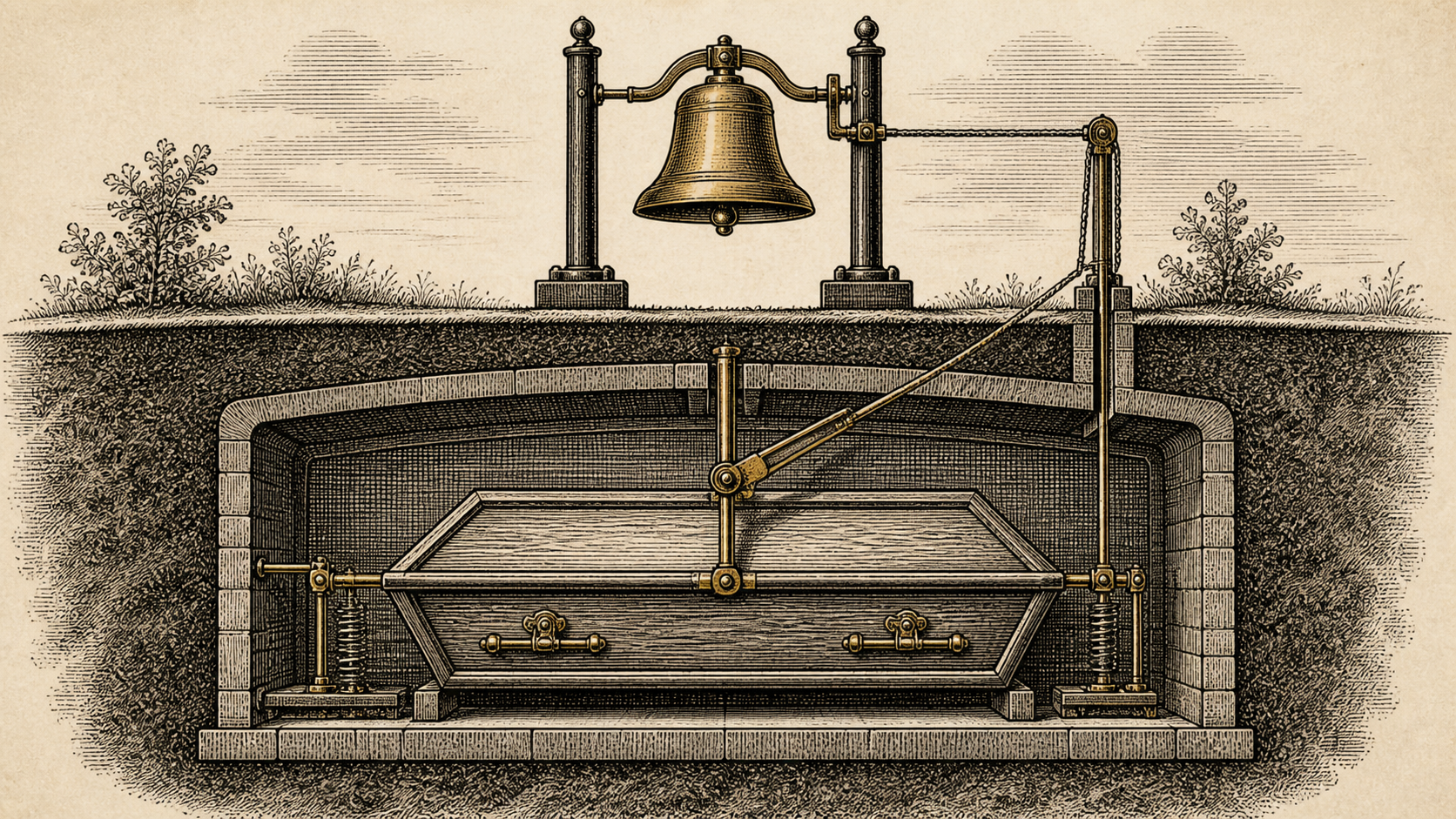
A bell above a grave is a clean piece of horror design. Someone below pulls a cord. Someone above hears it. Between them is dirt.
It is also easy to let that image do too much historical work. Safety coffins existed. They were patented, advertised, sketched, and argued over. They are evidence of an intense fear of premature burial. They are not, by themselves, evidence that graveyards were full of people saved by bells.
The nineteenth-century fear of being buried alive grew from a genuine uncertainty: determining death was harder before modern diagnostic methods and before many people had reliable access to trained medical care. That uncertainty produced waiting mortuaries, proposed alarm systems, and a long afterlife in gothic fiction. The history is frightening because it shows how much terror can gather around a boundary people cannot confidently see.
What “premature burial” means
Premature burial means burial of a person who is still alive. The possibility has haunted many cultures, but it took a particular grip on nineteenth-century Europe and North America, where newspapers, medical debate, patent culture, and popular literature fed one another.
In a 2016 history in History of Psychiatry, Marco Cascella notes that the Italian psychiatrist Enrico Morselli used the term taphophobia in 1891 for an extreme fear of being buried alive. The word is useful as historical vocabulary, but it should not be used casually to diagnose a reader who finds the idea upsetting. The fear needs no diagnosis to make sense. It places the body in the one location from which it cannot argue back.
The central problem was apparent death. A body might be cold, still, faintly breathing, or hard to rouse. Nineteenth-century medicine had methods of observation, but not the certainty later readers tend to imagine. When the fear became public, the most memorable answer was mechanical: build a coffin that lets the occupant send a signal.
The safety coffin was a solution to a nightmare
Illustration: apparent death, safety devices, and gothic fiction belong to different kinds of evidence.
The designs varied. Some used cords attached to bells. Some proposed breathing tubes, movable lids, flags, escape hatches, or mechanisms triggered by movement. A review in Forensic Sciences, Medicine and Pathology describes nineteenth-century security-coffin ideas that included alarms, pipes, and devices meant to allow survival until a rescue could occur.
That catalogue is more unnerving than any one design. It turns the grave into a machine with user instructions. Yet the same review supplies the necessary restraint: these devices were answers to fear, and claims about their practical success require separate proof. A bell might be set off by swelling, decomposition, or shifting material. A patent drawing is not a rescue record.
This distinction matters. Horror history is full of objects that become more dramatic every time they are repeated. The safety coffin is already dramatic enough. It shows that people could imagine the failure in precise, expensive detail.
Waiting mortuaries and the need to know
Some European communities tried another answer: delay burial and observe the recently dead until unmistakable changes appeared. The 2023 review “Premature burial” discusses holding mortuaries with resuscitation facilities, especially in continental Europe, as a response to uncertainty over death diagnosis.
This is the less famous image, perhaps because it lacks the bell and the grave. It may be the more revealing one. A waiting mortuary admits that the frightening thing is not burial alone. It is the interval before anyone can honestly say the body has crossed the threshold.
That interval is where gothic fiction lives. A locked coffin is frightening because it appears to settle a question permanently. A waiting room for the dead is frightening because it does not.
Poe understood the architecture of the fear
Illustration: a patented safety coffin does not prove a documented rescue.
Edgar Allan Poe did not invent the fear, but he gave it memorable rooms to occupy. His 1844 story “The Premature Burial” arrived in a century already interested in apparent death and safety devices. Poe’s contribution was not medical explanation. It was enclosure: narrow space, darkness, awakening, the mind turning every sensation into proof that it is too late.
That is why the trope survived advances in medicine. The literal risk can change while the symbolic fear remains useful. Being buried alive is fear of a false conclusion. Everyone else has decided the story is over. You are still inside it.
The same pressure sits beneath curse narratives. In the history behind the mummy’s curse, the sealed tomb becomes a warning about disturbing the dead. Premature-burial horror reverses the direction: the living person is sealed away as if already dead. Both stories make a door carry more certainty than the people on either side possess.
What the records do not let us say
The careful version of this history leaves several satisfying claims on the floor.
We cannot say that every safety-coffin patent was widely used. We cannot turn a rope-and-bell illustration into proof that someone woke beneath a cemetery. We cannot use exhumed remains, scratches, or a crooked body as a simple forensic answer centuries later. Bodies and graves change for many reasons.
We can say that the fear was culturally powerful. Physicians, inventors, writers, and mourners treated apparent death as a problem worth worrying over. That is enough to explain why the image kept returning.
Today, modern death determination is profoundly different from nineteenth-century practice, and the contemporary article in the source packet describes actual premature burial as rare where qualified medical care is available. This is history, not a reason to mistrust current medical professionals or to make decisions about death care from a horror blog.
The bell is still ringing because the question is not
The safety coffin endures because it offers a cruelly simple bargain: if you are alive, make a sound. The trouble is that the fantasy assumes someone is listening.
That is the darker half of the story. The bell above the grave promises connection, but it also imagines a world in which rescue depends on being heard through the earth. The invention does not defeat helplessness. It gives helplessness a cord to pull.
For fiction about death, rooms, and the presences that refuse their assigned category, There Be Monsters: Among the Dead is the natural next shelf. And if you like hauntings that migrate into modern systems, the ghost in the warehouse follows the fear after it leaves the graveyard.
> Join The Grimbard Press and receive Dead Ship, a free illustrated Subscriber Archive Edition, along with future archive files and monster lore.
FAQs
Were safety coffins real?
Yes. Nineteenth-century inventors patented and proposed coffins with alarms, breathing tubes, and escape mechanisms. Their existence documents concern about premature burial, not routine successful rescues.
Why did people fear being buried alive in the nineteenth century?
Death could be difficult to determine in some circumstances, and press stories, medical debate, inventions, and gothic fiction made the possibility culturally vivid.
Did bells on graves actually save people?
Popular stories often imply that they did, but a safety device or patent is not proof of a documented rescue. Claims about a specific event need a reliable contemporary record.
Is premature burial still common?
No. Modern medical practice has far more reliable methods for determining death. The historical fear should not be treated as a guide to present-day medical care.
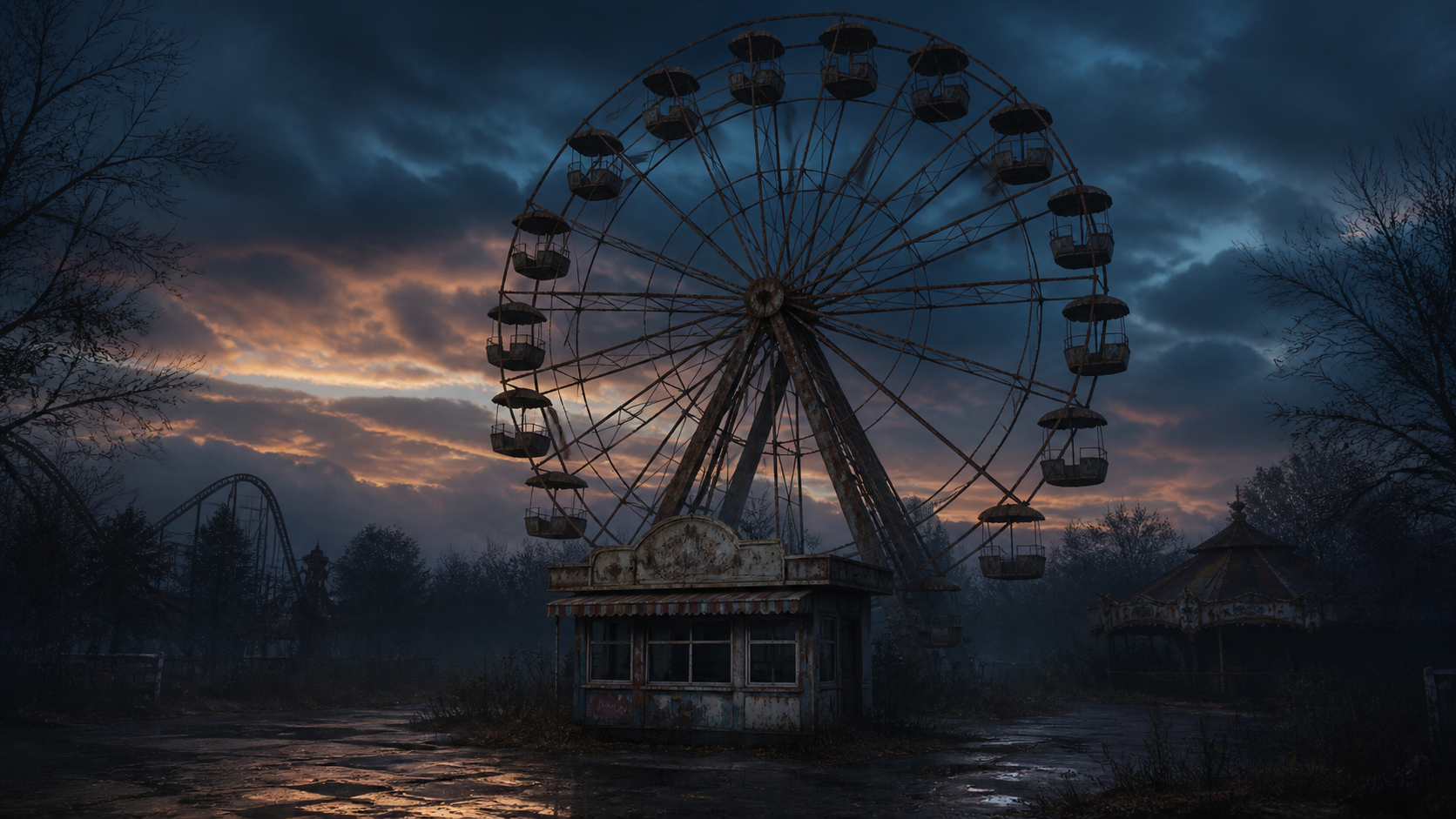
The Ferris wheel is still there. That is the problem.
If a building disappears, the mind can file it away as a finished thing. An abandoned amusement park refuses that convenience. Its gates remain shaped for arrivals. Its paths still lead toward rides. A ticket booth may stand with its little window intact, waiting for a hand that will never slide money beneath it. Everything speaks the language of a crowd, and there is no crowd to answer.
Abandoned amusement parks feel scary because they are designed to manage pleasure in public. They depend on motion, noise, queues, bright paint, staff, and the shared understanding that the machinery is being watched. When the people and the supervision vanish but the rides remain, familiar signals turn inside out. The place looks like it has kept performing after its audience left.
That response does not mean a closed park is haunted, cursed, or even dangerous. Many have ordinary histories of changing travel patterns, money, maintenance costs, and redevelopment. The fear comes from the mismatch between what the place promises and what it now shows.
An amusement park is a machine for being together
The first American parks were not invented as ruins. The National Park Service’s history of Glen Echo describes the rise of trolley and mechanical amusement parks as places where urban visitors could exchange routine for managed leisure. The rides mattered, but so did the contract surrounding them: someone sold the tickets, checked the restraints, played the music, swept the midway, and stood nearby when a child wanted to go home.
That contract is almost invisible while a park is alive. A carousel is painted as if it emerged fully formed from childhood. A roller coaster announces danger, then proves that danger has been measured down to bolts, brakes, and height restrictions. The visitor is allowed to feel afraid because the institution has made fear safe.
Remove the institution and the ride changes meaning. The roller coaster no longer says, you will be returned to the platform in two minutes. It says, someone once trusted this structure with their body. That is a much darker sentence.
This is why a rusting Ferris wheel can carry more dread than an empty office block. Offices are made for work and can look merely vacant when work stops. A Ferris wheel is made for people looking outward together, for small screams, photos, and the ridiculous certainty of being brought back down. When it is still, it preserves the shape of enjoyment without any enjoyment inside it.
Childhood symbols do not age politely
Illustration: a busy amusement park and an empty one use very different social cues.
Parks borrow from childhood even when their customers are adults. They use exaggerated scale, cartoon faces, colored lights, animal figures, sweets, music that repeats without consequence. Those things work because they assume a protected world. A mascot head looks harmless when an employee in a visible costume walks beside it. It feels wrong when it appears abandoned in a damp storage room, because the social frame has dropped away.
Decay adds another pressure. Nature does not understand the theme. Vines ignore the painted border. Rain takes the bright surface off a sign. A ride that was meant to move becomes a fixed object among weeds. The result is not simply “old.” It is two different calendars occupying one place: the park’s perpetual summer and the years that have actually passed.
That clash can be poignant rather than frightening. Closed parks are often tied to local jobs, family rituals, and complicated histories. The National Park Service’s broader recreation theme study is a useful corrective to ruin-porn: these sites can be historic places worth interpreting and preserving, not just backdrops for a spooky photograph.
Horror begins when the camera forgets that human history. It turns every empty ride into proof of catastrophe. Real places deserve more care than that.
The fear is uncertainty with a painted face
Psychology does not need to declare an abandoned park inherently terrifying to explain why it can unsettle us. Research on anxiety and uncertain threat, including a 2024 review by Blanchard and Canteras in Neuroscience & Biobehavioral Reviews, describes uncertainty as a condition that can intensify defensive attention. An empty park gives the eye plenty to monitor and very little to resolve. Is that building maintained? Is the floor sound? Is someone supposed to be here? Why does this scene look prepared for a crowd?
The visual cues are contradictory. A ride promises movement but does not move. A pathway asks to be followed but leads nowhere useful. A sign offers instruction but has lost the world in which the instruction mattered. Horror loves that kind of incomplete command. It puts the reader in a place that still has rules, then removes the person who could explain them.
That is also why abandoned parks make such efficient settings for fiction. They come with a ready-made map: entrance, midway, food stand, queue, exit. A writer can corrupt each familiar stop with minimal explanation. The terror does not require a monster behind every game booth. It may only require the ride attendant’s recorded voice to start speaking again.
Do not confuse an empty park with permission
Illustration: visual decay is not the same as permission to enter or a safety assessment.
Images of closed parks can make access look casual. It is not. Abandoned property can be structurally unsafe, contaminated, protected, occupied, or subject to trespass law. Sites attached to disasters carry further obligations; they are not generic stages for someone else’s thrill.
The better encounter is often a documented history, a preservation effort, or a photograph made with permission. Look long enough and the real stories are usually stranger than the fantasy of sneaking through a gate. A park may have closed because a rail line changed, because a town’s recreation moved elsewhere, because a storm rearranged the economics, or because maintenance outlasted the revenue. None of those explanations cancels the atmosphere. They give it weight.
The park keeps its part of the bargain
My own rule for this setting is simple: the strongest abandoned amusement-park horror does not treat decay as a monster costume. It treats the park as a promise that cannot admit it has failed.
The loudspeaker still has a voice. The turnstile still knows the direction of entry. The little painted horses still face the same way. The absence becomes frightening because the machinery has retained its manners.
That is the horror of a place built for joy. It has not become evil. It has become unanswered.
If places that keep their rules after closing time are your kind of horror, On the Clock, After Dark follows the dread that begins when an ordinary job refuses to end at the door. For a different kind of recovered place, The Backrooms are just a warehouse that won’t end follows the terror of architecture stripped of purpose; lighthouses make a useful contrast, built to remain awake on behalf of people far away.
> Join The Grimbard Press for Dead Ship, a free illustrated Subscriber Archive Edition, plus future dispatches on strange places and the things built to outlast us.
FAQs
Why do abandoned amusement parks feel more unsettling than other empty buildings?
They retain cues for crowds, safety, motion, and childhood pleasure. When those cues remain without people or maintenance, the mismatch makes the site feel like an interrupted public ritual.
Are abandoned amusement parks always dangerous?
Not automatically, but closed property can have unstable structures, environmental hazards, security risks, and legal restrictions. Do not treat a photograph online as evidence that a site is safe or open to visitors.
Why are Ferris wheels especially creepy when abandoned?
A Ferris wheel is designed to move people visibly through open space and return them safely to the ground. Its stillness preserves the expectation of motion while denying it.
What makes abandoned amusement parks useful in horror stories?
They provide familiar routes, visible rules, and objects associated with protected fun. A story can make those expectations fail without needing to explain an entirely new world.
The Horseman did not begin with a flaming pumpkin.
He began with a missing head, a road through the Hudson Valley, a dead soldier borrowed by local memory, and a storyteller who never tells us whether the ghost arrived at all.
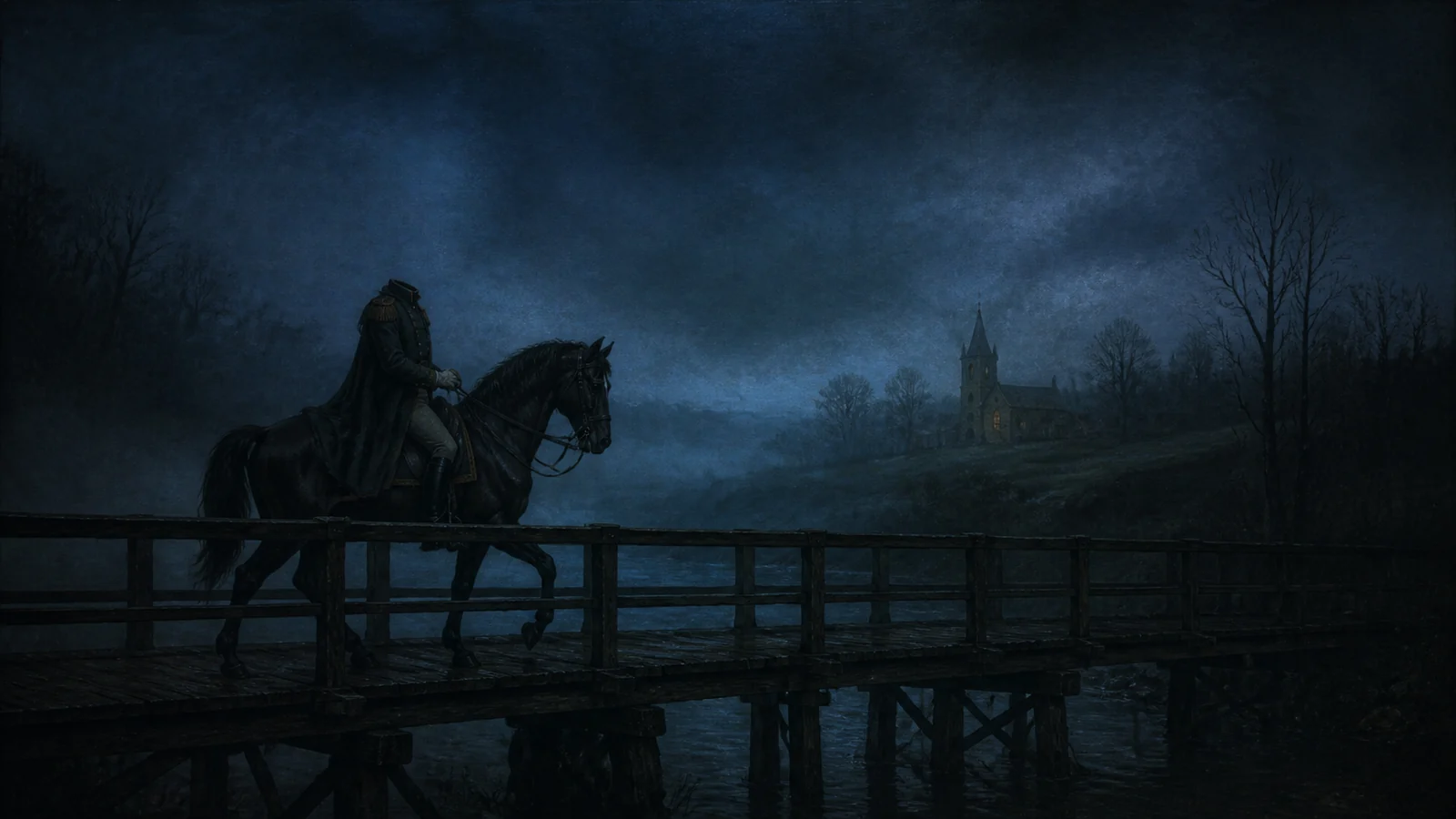
The best-known Headless Horseman comes from Washington Irving's “The Legend of Sleepy Hollow,” published in 1820. Irving describes the rider as the ghost of a Hessian soldier killed by a cannonball during the American Revolution. The figure also draws on older European traditions of headless riders and on Hudson Valley places and stories. Most importantly, Irving leaves open a practical explanation: Brom Bones may have disguised himself and chased Ichabod Crane with a pumpkin.
The monster popular culture remembers is literal.
Irving's is a question on horseback.
Who is the Headless Horseman in “The Legend of Sleepy Hollow”?
Sleepy Hollow's residents tell of a mounted Hessian whose head was carried away by a cannonball during “some nameless battle” of the Revolution. His body was buried in the churchyard. At night, he rides out in search of the missing head and must return before daybreak.
That is the local explanation.
The story reaches us through Washington Irving's layered narrator, Diedrich Knickerbocker, who collects community history, hearsay, jokes, and superstition without promising that every item belongs in the same file. Ichabod Crane then enters the Hollow already eager to believe frightening stories.
Ichabod is a schoolmaster, outsider, singer, reader, and opportunistic suitor. He wants Katrina Van Tassel and imagines the abundance of her father's farm becoming his. His rival, Brom Van Brunt—Brom Bones—is local, confident, physically capable, and known for practical jokes.
After a party at the Van Tassel farm, Ichabod rides home alone. The stories he heard earlier alter the road. A tree becomes dangerous because someone named its history. The churchyard becomes the Horseman's route. A dark mounted figure appears and pursues him toward the bridge.
The rider throws his “head.” Ichabod is struck. By morning, he is gone.
His hat lies near a shattered pumpkin.
Was the Horseman a real Hessian soldier?
Hessian soldiers were real. The term commonly refers to German troops hired by the British during the American Revolution, many from the state of Hesse-Cassel. They fought in campaigns across the colonies, including New York.
Irving's story uses that history. It does not identify a verifiable individual.
The headless soldier belongs to a landscape carrying the remains and memory of war. Roads, trees, farms, and churchyards are not empty background. They preserve stories about violence that newcomers do not fully understand.
The Smithsonian's account of the real places behind the story notes the Hudson Valley setting, the Old Dutch Church, and nearby Revolutionary history. The tale draws geography tightly enough that readers can still visit places associated with it.
That makes the rider historically grounded.
It does not make him a documented ghost.
Claims that one named soldier “was” the Headless Horseman should be treated cautiously unless supported by a clear chain of evidence from Irving or contemporary records. A candidate discovered after a character becomes famous is not automatically the source of the character.
What does Hessian mean in the story?
The Horseman is not simply a random dead soldier. To Irving's early American readers, a Hessian belonged to a recent war and to a force hired by Britain.
He is foreign and local at once.
His body lies in American ground, but his missing head leaves him incomplete. He rides through a Dutch-descended community remembered by an American author. The figure brings European warfare, colonial history, and local storytelling together in one body that cannot stay buried.
The missing head also removes speech and identity. A named dead man can be mourned. A headless uniform becomes a role that any rumor can occupy.
Did Washington Irving invent the Headless Horseman?
Irving created the version that became central to American popular culture. He did not invent the idea of a headless rider from nothing.
European folklore and literature contained headless revenants, spectral hunts, and riders before “Sleepy Hollow.” Scholars have also discussed the influence of Sir Walter Scott, whom Irving read and knew. Scott's work helped preserve and literary-shape supernatural material from Britain and Europe.
The responsible answer avoids a single-source trick.
Stories are rarely built like patent applications. Irving could draw on literary reading, oral tales, local landmarks, Revolutionary memory, and the needs of his own comic ghost story at the same time.
Ingredient
What it contributes
Older headless-rider traditions
A supernatural form already recognizable to audiences
Revolutionary history
A recent conflict capable of leaving an unnamed dead soldier
Hudson Valley geography
The churchyard, bridge, roads, farms, and enclosed Hollow
Dutch community storytelling
A local culture through which history becomes legend
Brom Bones
A rational suspect with motive, skill, and a taste for pranks
Irving's narration
Enough distance and irony to keep every explanation unstable
No ingredient works alone.
Why Sleepy Hollow?
Irving first visited the Tarrytown area as a teenager in 1798 while his family sought distance from yellow fever in New York City. A Smithsonian history connects that experience to the story's language of atmosphere and contagion.
Irving's Hollow does not merely contain supernatural beliefs. It produces them. The place seems to place residents and visitors under a “drowsy, dreamy influence.” Tales circulate until a newcomer begins to see the road through them.
Ichabod is especially vulnerable because he enjoys frightening material. He feeds on local stories, then pays for them during the ride home. Every landmark has been preloaded with a threat.
This is how monsters become guardians of boundaries. The Horseman belongs to a line between local and outsider, past and present, churchyard and road, story and evidence.
Ichabod crosses all of them after dark.
Follow the old road into the Archive:Join The Grimbard Press and receive Dead Ship, a free illustrated Subscriber Archive Edition.
Illustrated comparison of Irving's story ingredients; not a historical artifact.
Did the Headless Horseman carry a pumpkin?
This is the detail popular memory repairs too neatly.
In Irving's story, the pursuing figure appears to carry its head on the saddle. During the chase, it rises in the stirrups and throws the head at Ichabod. The next morning, searchers find Ichabod's hat and a shattered pumpkin.
The pumpkin is evidence for the prank explanation.
Irving does not present the rider cruising through Sleepy Hollow with a flaming jack-o'-lantern installed where a head should be. Later illustration, seasonal imagery, animation, film, and Halloween culture fused the pumpkin with the body until it became the monster's face.
That change improves the silhouette. A pumpkin head is visible, marketable, and instantly seasonal. Ambiguity is more difficult to place on a poster.
The adaptation replaces evidence with anatomy.
Did Brom Bones chase Ichabod?
Probably is not the same as proven.
Brom has motive. He wants Katrina. He has the horsemanship to perform the chase. He is known for jokes. After Ichabod disappears, Brom reportedly looks especially knowing whenever the pumpkin is mentioned.
The rational explanation fits.
But Irving does not close the case. Reports later place Ichabod alive elsewhere, having left the region and entered another career. The old women of the neighborhood maintain that he was carried away supernaturally. The schoolhouse becomes haunted by his voice.
Even if Brom staged the Horseman, the community continues producing ghosts.
That is the deeper joke. Solving the chase does not cure Sleepy Hollow of storytelling.
Why the Horseman survives adaptation
The figure has three durable advantages.
First, he is recognizable without a face. Horse, cloak, sword, missing head: the silhouette survives radical changes in costume and period.
Second, he is always moving. Many ghosts wait in a room. The Horseman pursues. His legend arrives with a built-in sequence: sighting, recognition, race, bridge, thrown object.
Third, he contains both answers. He can be a murdered soldier unable to rest or a living rival using local belief as a weapon.
Adaptations often choose the literal monster because action requires a visible opponent. Irving's story remains stronger for refusing to choose completely.
The Horseman is frightening.
The possibility that a man built the Horseman out of a frightened person's favorite stories is frightening in another direction.
Story versus popular image
In Irving's 1820 tale
In common later imagery
A Hessian ghost from the Revolution
Often a timeless demonic rider
A carried “head” that leaves a smashed pumpkin
A flaming jack-o'-lantern permanently replaces the head
A chase that may be Brom Bones's prank
A visibly supernatural attack
No Halloween setting
Strongly associated with Halloween
An ambiguous disappearance
Often a confirmed killing or supernatural abduction
The later Horseman is not wrong as adaptation.
It is a different creature.
Frequently asked questions
Is the Headless Horseman based on a true story?
The character is grounded in real Revolutionary history, real Hessian troops, Hudson Valley places, and older supernatural traditions. No single historical soldier has been proven to be Irving's ghost.
When was “The Legend of Sleepy Hollow” published?
It first appeared in 1820 as part of Washington Irving's The Sketch Book of Geoffrey Crayon, Gent.
Is Sleepy Hollow a real place?
Yes. The story is associated with the Tarrytown area of New York's Hudson Valley. North Tarrytown officially adopted the name Sleepy Hollow in 1996, and landmarks connected with Irving and the tale remain.
Did the Horseman have a pumpkin head in the original?
No. The rider appears to carry a head, and a shattered pumpkin is found after the chase. Irving leaves the pumpkin as evidence that a human prank may explain the encounter.
Was Brom Bones the Headless Horseman?
The story strongly suggests that possibility but never confirms it outright. Brom has motive and ability, and his reaction to the pumpkin is suspicious.
Is the story set on Halloween?
No. Irving does not set the tale on Halloween. Later culture attached the Horseman closely to the holiday.
Keep riding through the Archive
There Be Monsters: Then and Now follows old warnings into the new landscapes and audiences that keep changing them. The Headless Horseman survives because every generation gives him the head it needs.
It only needs to appear one safe step beyond the last patch of solid ground.
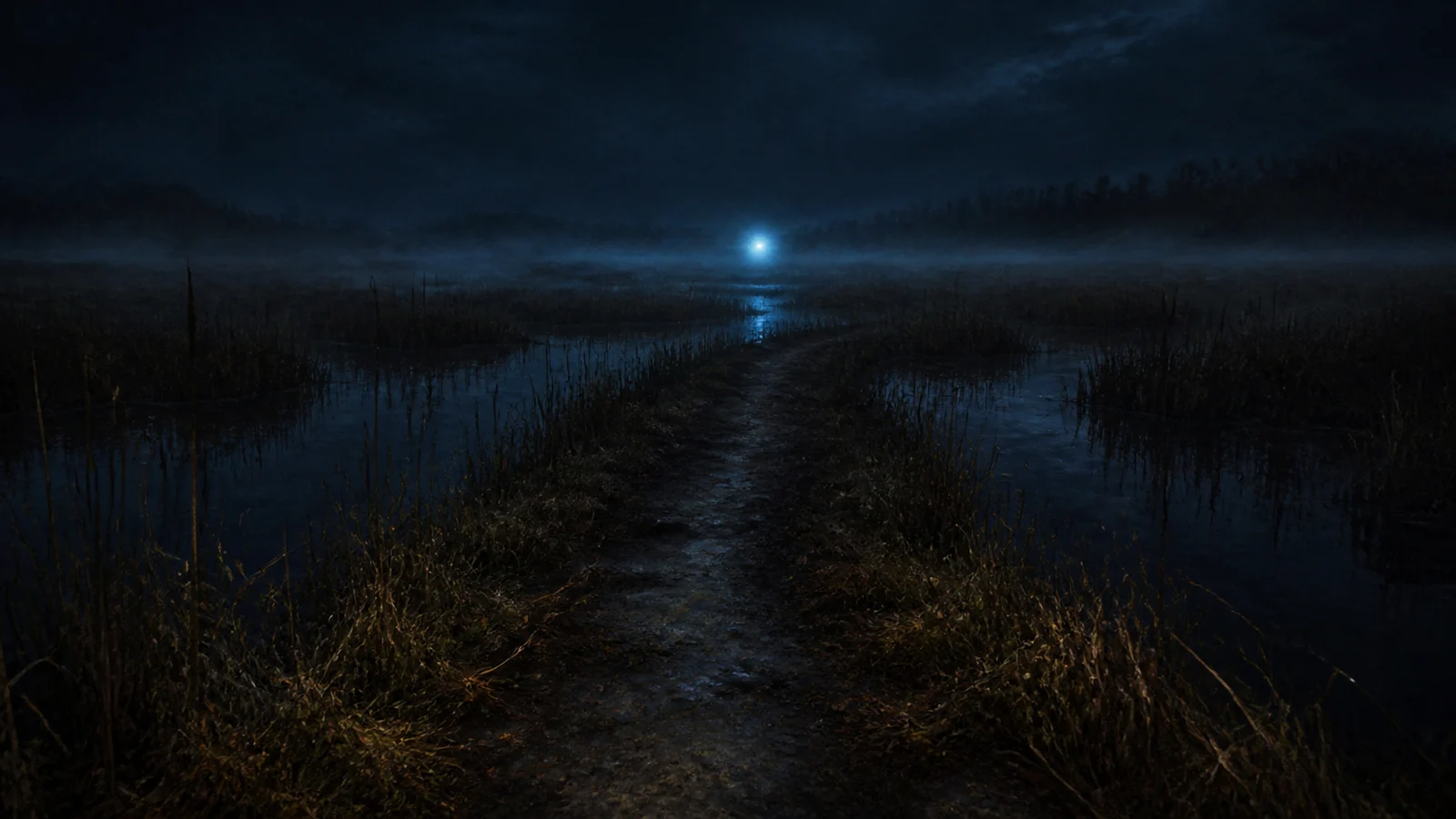
A will-o'-the-wisp is a legendary wandering light associated especially with marshes, bogs, wetlands, and graveyards. In folklore, it may be a spirit, soul, trickster, warning, or lure that leads travelers away from the road. Natural explanations have included distant lamps, bioluminescence, chemiluminescence, and gases produced by decay. A 2025 laboratory study added a new possibility: tiny electrical discharges between methane bubbles may provide the missing spark for a cool blue glow.
That result is exciting.
It is not a receipt proving what every frightened traveler saw.
What does “will-o'-the-wisp” mean?
The name imagines a person carrying a small burning bundle—a “Will” with a wisp of flame. It belongs to a family of names that turn an uncertain light into an agent.
The Latin phrase ignis fatuus means foolish fire. English traditions also use names such as jack-o'-lantern or friar's lantern. Other regions have their own lights, meanings, and beings.
Names that sound similar do not automatically identify one universal creature.
A light associated with treasure is not exactly the same warning as a light associated with an unquiet dead person. A corpse candle tied to death omens does different cultural work than a marsh trickster. A folklorist has to preserve those distinctions even when a modern encyclopedia places every entry on one page.
What repeats is the scene.
Night. Poor ground. A small light at a distance. The urge to follow.
Why does the wisp lead people off the path?
The most powerful part of the legend is not the light. It is movement.
A fixed glow can mark a house, fire, star, or lamp. A light that seems to retreat when approached becomes intentional. It is not merely over there. It is maintaining distance.
Human depth perception becomes less reliable at night when familiar scale and surface detail disappear. A small nearby light and a larger distant light can be difficult to distinguish. Fog scatters brightness. Uneven terrain changes the viewer's height. A traveler moves while the light's background shifts.
None of that proves a specific report was an illusion. It explains why distance itself can become uncertain.
Wetlands make that uncertainty dangerous. The safest route may be narrow, remembered rather than visible. Water reflects and duplicates light. Reeds conceal channels. Ground that appears solid can give way. A traveler who leaves the known path to reach a light may create the exact disaster the legend warned against.
Folklore turns landscape safety into a character:
Do not follow the light.
The rule survives even when the explanation changes.
What were wisps believed to be?
Will-o'-the-wisp traditions vary across place and time, but several broad interpretations recur.
The misleading dead: a wandering soul or spirit draws the living toward danger.
A trickster or fairy being: the light tests, mocks, or punishes the traveler.
A death sign: the light predicts a death or marks a route associated with burial.
Hidden treasure: the flame reveals where something valuable lies, often with rules that make claiming it dangerous.
A natural flame: observers describe a luminous event without assigning it a supernatural identity.
These categories overlap. They should not be forced into equivalence.
The same warning can take different shapes because monsters preserve boundaries. A wetland community does not need a chemistry lesson to know that leaving the path at night is a poor decision. A moving spirit gives the bad decision a face and motive.
The marsh-gas explanation had a missing step
Decaying organic material in oxygen-poor wet environments can produce methane and other gases. For centuries, writers and scientists proposed that these gases might cause ghostly lights.
The idea had a problem.
Methane does not simply decide to ignite at wetland temperatures. Explanations involving phosphine or related compounds attempted to supply ignition, but laboratory results and eyewitness descriptions did not always agree. Some experiments produced smoke, odor, or colors unlike traditional accounts. Other possibilities—luminous organisms, reflections, distant artificial lights—may explain some sightings but not a single unified phenomenon.
The honest position remained open: “swamp gas” named a possible ingredient more easily than it explained a self-starting flame.
That gap allowed the wisps to keep their fire.
Follow the safe light instead:Join The Grimbard Press and receive Dead Ship, a free illustrated Subscriber Archive Edition.
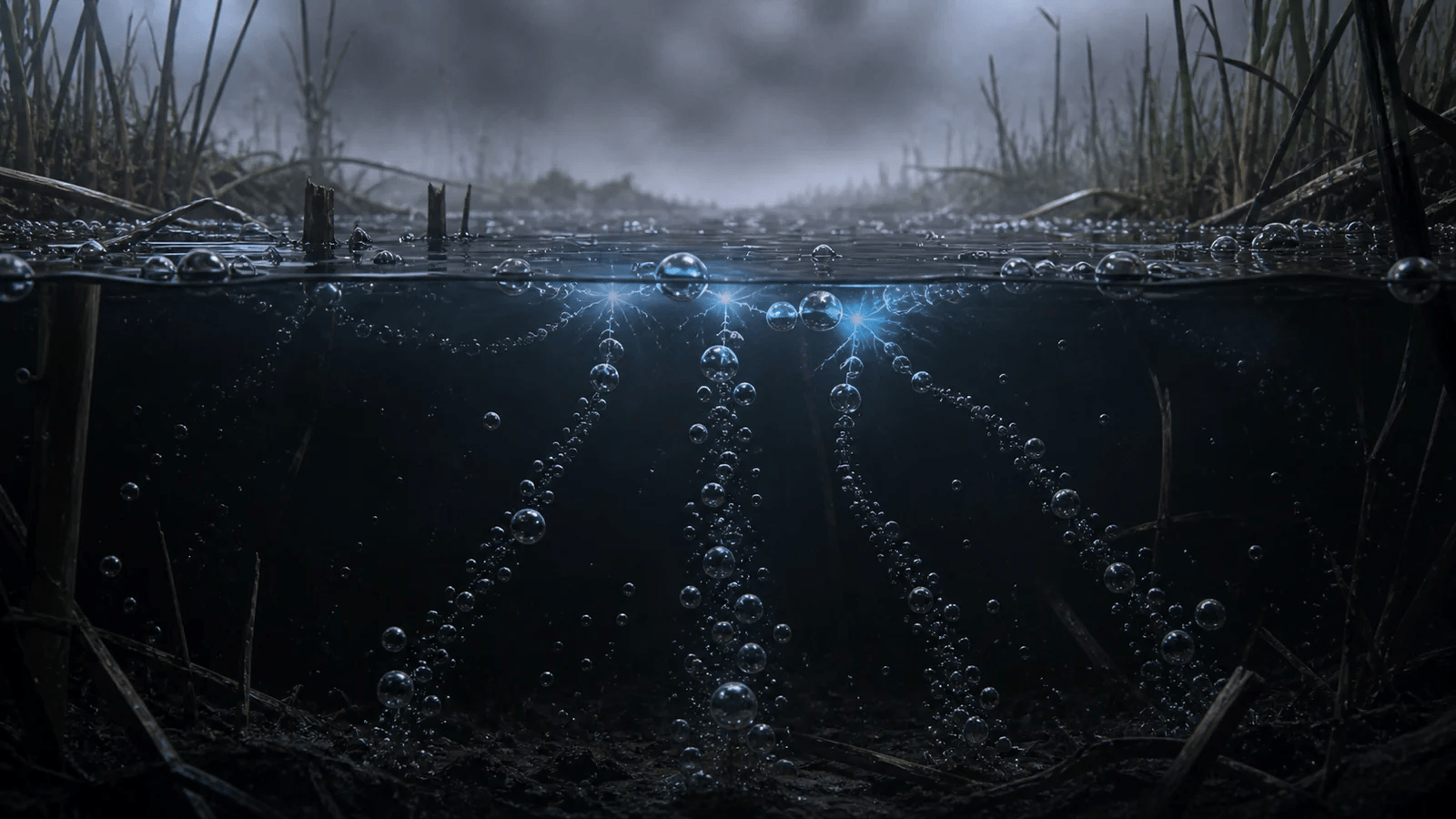
Scientific illustration of the proposed microlightning mechanism; not a photograph of a historical sighting.
A new proposal: microlightning between bubbles
In 2025, a team led by Stanford chemist Richard Zare published laboratory research on electrical discharge between methane microbubbles in water.
The researchers were not originally building a machine to summon folklore. They were studying unusual chemistry at the boundary between water and air. In dense bubbling conditions, high-speed imaging captured tiny flashes. Measurements indicated that bubbles could separate charge as they moved, merged, and split. Oppositely charged bubbles produced small electrical discharges—“microlightning”—that initiated nonthermal methane oxidation.
The Stanford Chemistry account describes cool blue light resembling traditional will-o'-the-wisp reports. The research appeared in the Proceedings of the National Academy of Sciences.
The proposal answers an important chemical question: where might the ignition come from?
It does not establish that every historical report involved methane bubbles. The experiment demonstrates a mechanism under laboratory conditions. Connecting that mechanism to a traveler in a particular marsh requires environmental evidence the old account usually does not preserve.
Folklore says; evidence allows
Claim
Responsible conclusion
A light appeared over wet ground
Possible, but the description alone does not identify its cause
The light moved away when followed
Perceived distance, viewer movement, atmospheric effects, or a moving source could contribute
Marsh gas caused every wisp
Unsupported as a universal claim
Methane bubbles can produce tiny electrical discharges
Demonstrated in recent laboratory research under studied conditions
The new mechanism solves every legend
No; it offers a plausible ignition pathway for some natural luminous events
The folklore is “false” if a chemical process exists
No; the warning, meaning, and tradition remain cultural facts
Science and folklore are answering different questions.
Chemistry asks how a glow could form.
Folklore asks why the light wants you to leave the path.
Why are will-o'-the-wisps rarely photographed?
Historical descriptions refer to brief, weak, unpredictable lights in dark wet places. Those are difficult conditions for observation, much less photography. Wetlands have also been drained, developed, channelized, and illuminated by artificial light, changing both the environment and the darkness in which a faint event would be visible.
The absence of a definitive image is not proof that no natural glow occurs. It does make overconfident identification difficult.
Modern “orb” photographs usually introduce a different problem. Flash can illuminate dust, insects, moisture, or objects close to a camera and make them appear as bright circles. Calling every orb a will-o'-the-wisp does not strengthen either category.
A useful report would need location, weather, duration, color, apparent movement, camera settings, distance estimates, nearby light sources, and ideally independent observation.
Old folklore rarely arrives with metadata.
Why one explanation cannot own every ghost light
The phrase ghost light gathers phenomena that may have nothing in common beyond being luminous and unexplained to the observer.
Possible sources include distant human lights, vehicles, trains, boats, atmospheric distortion, reflections, insects, fungi, electrical phenomena, combustion, deliberate hoaxes, memory error, and events not reconstructable from the report.
Ball lightning is not automatically a will-o'-the-wisp. A railway ghost light is not automatically marsh gas. A culturally specific spirit light is not merely a European wisp with a translated name.
The method used in the investigation of poisoned-water folklore applies here: compare the old warning with the modern mechanism without pretending the legend predicted a technical result.
The connection becomes meaningful when both point toward the same boundary.
The marsh can kill a person who follows the wrong light.
The chemistry does not make that rule less true.
Why the wisp remains frightening
Most monsters approach.
The will-o'-the-wisp makes the victim approach it.
That reversal preserves curiosity inside the fear. The traveler is not attacked while obeying the road. They choose the next step because the light promises rescue, treasure, company, or an answer.
The wisp also remains incomplete. It has no required body. No stable face. No footprint. It can become smaller as it moves away until the watcher cannot tell whether it vanished or simply crossed the limit of vision.
The creature is distance itself.
Frequently asked questions
Are will-o'-the-wisps real?
People have reported unusual lights over wetlands and similar places for centuries. Folklore gives those lights supernatural identities. Natural luminous phenomena are physically possible, but individual historical sightings often lack enough evidence to identify a cause.
Is a will-o'-the-wisp just swamp gas?
“Swamp gas” is an incomplete shortcut. Methane can be produced in wetlands, but ignition was a long-standing problem. Recent research proposes microlightning between bubbles as one possible ignition mechanism; that does not prove every report had that cause.
Are will-o'-the-wisps dangerous?
The light itself may not be the main danger. Following any uncertain light away from a known route in a marsh, bog, or other difficult terrain can be dangerous.
Is a will-o'-the-wisp the same as ball lightning?
No. They are separate categories with different typical descriptions and proposed mechanisms, though old reports may be too vague to classify confidently.
Why are they connected to graveyards?
Graveyards contributed associations with souls and death, and older burial grounds could be damp or poorly lit. Folklore also carried names and meanings between marshes, churchyards, and other liminal places.
The road ends in the wetlands
The Pine Barrens Incident follows a case into sand roads, dark water, partial evidence, and a landscape that does not need to move to make a person lost.
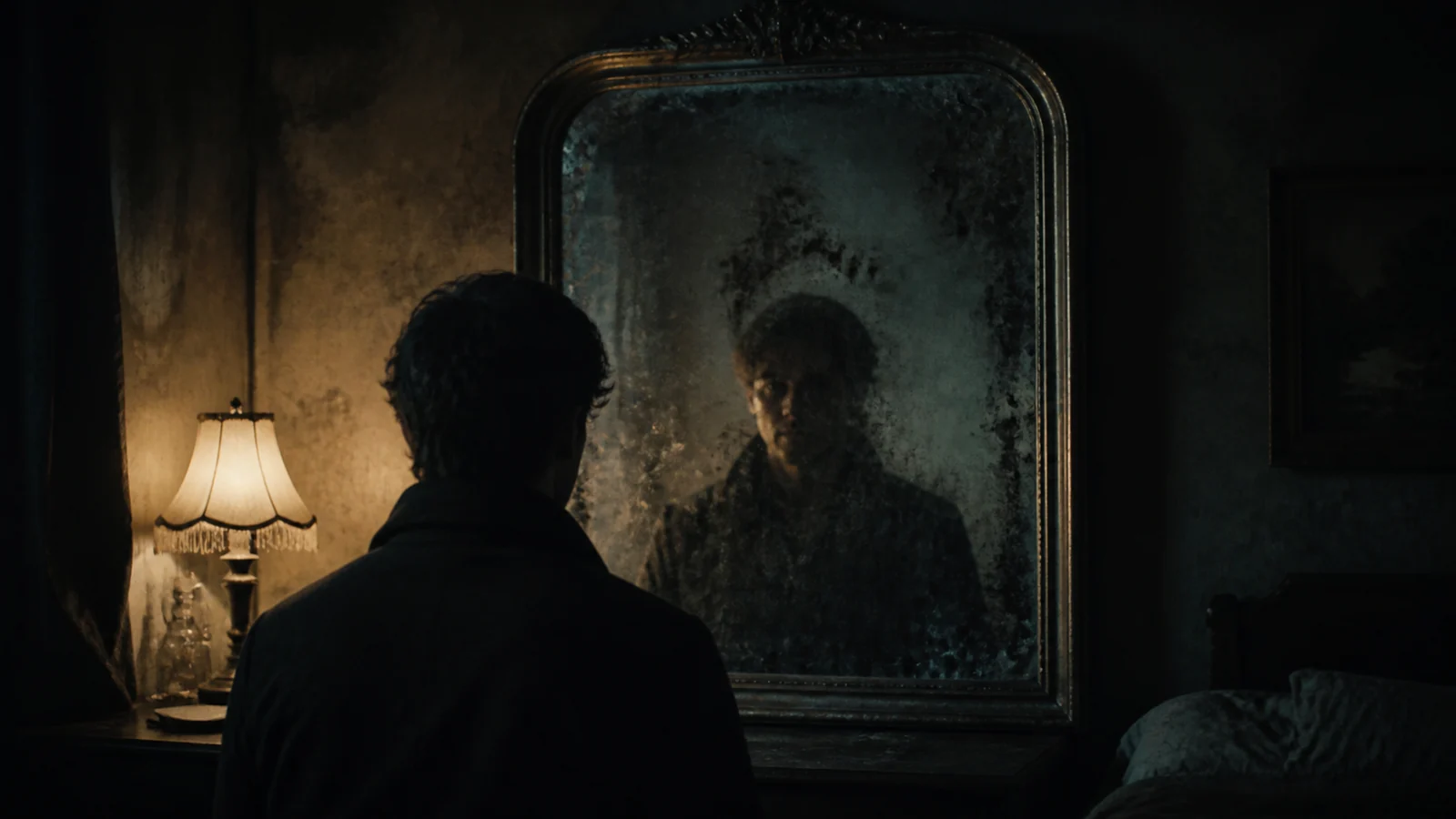
Stay in front of a dim mirror long enough and the face may begin to borrow features you did not bring with you.
The mouth loses its edges. One eye darkens. The skin changes color. For a moment, the reflection resembles a relative, an animal, a stranger, or something with no useful name.
Then you move, and your face returns.
In low light, prolonged fixation on a face can produce what researchers call a strange-face illusion. Features may seem distorted, fade, or appear to become another identity. A 2023 systematic review found that low illumination, face stimuli, and sustained fixation were important conditions, while also warning that study quality affected reported rates and that the mechanism remains unsettled.
The effect is real enough to study.
That does not make every explanation of it equally secure.
What is the strange-face-in-the-mirror illusion?
The term describes visual distortions reported when people gaze at their own reflection under low illumination for an extended period. Experimental reports have included changes in color or brightness, deformation of facial features, the impression of another identity, and—in some studies—animal or monstrous faces.
The mirror does not physically change the face. The visual experience changes while the external stimulus remains relatively stable.
That places the phenomenon among visual illusions, but the experience is more personal than a line appearing longer than an equal line. A face is not merely a shape. It is the visual anchor of identity.
When the reflection changes, the person does not simply see a distorted object.
They see me become not me.
What has research actually found?
The effect became widely discussed through experiments led by psychologist Giovanni Caputo. Participants gazed at faces under dim illumination and reported a range of strange transformations. The work expanded from mirror gazing to pairs of people looking at each other in low light.
Those early results were striking. Striking results need careful review.
In 2023, researchers published a systematic review and quality analysis of strange-face studies. They concluded that the illusions reliably appeared across mirror-gazing and interpersonal-gazing paradigms. They also found that higher-quality studies reported lower rates, and that reduced light, facial stimuli, and prolonged fixation mattered.
That produces a responsible two-part conclusion:
Strange-face illusions are a documented perceptual phenomenon.
The prevalence, strength, and mechanism should not be described with more confidence than the evidence supports.
What the research supports
What remains uncertain
Some observers report facial distortion under dim, prolonged fixation
How common strong identity changes are in ordinary settings
Low light and face stimuli are important conditions
One complete mechanism explaining every reported form
Study quality changes reported rates
Whether all folklore or ritual mirror experiences belong to this effect
The effect can occur in nonclinical participants
What any single experience means about an individual person
That final distinction deserves emphasis. A brief visual illusion under unusual viewing conditions should not be converted into an amateur diagnosis.
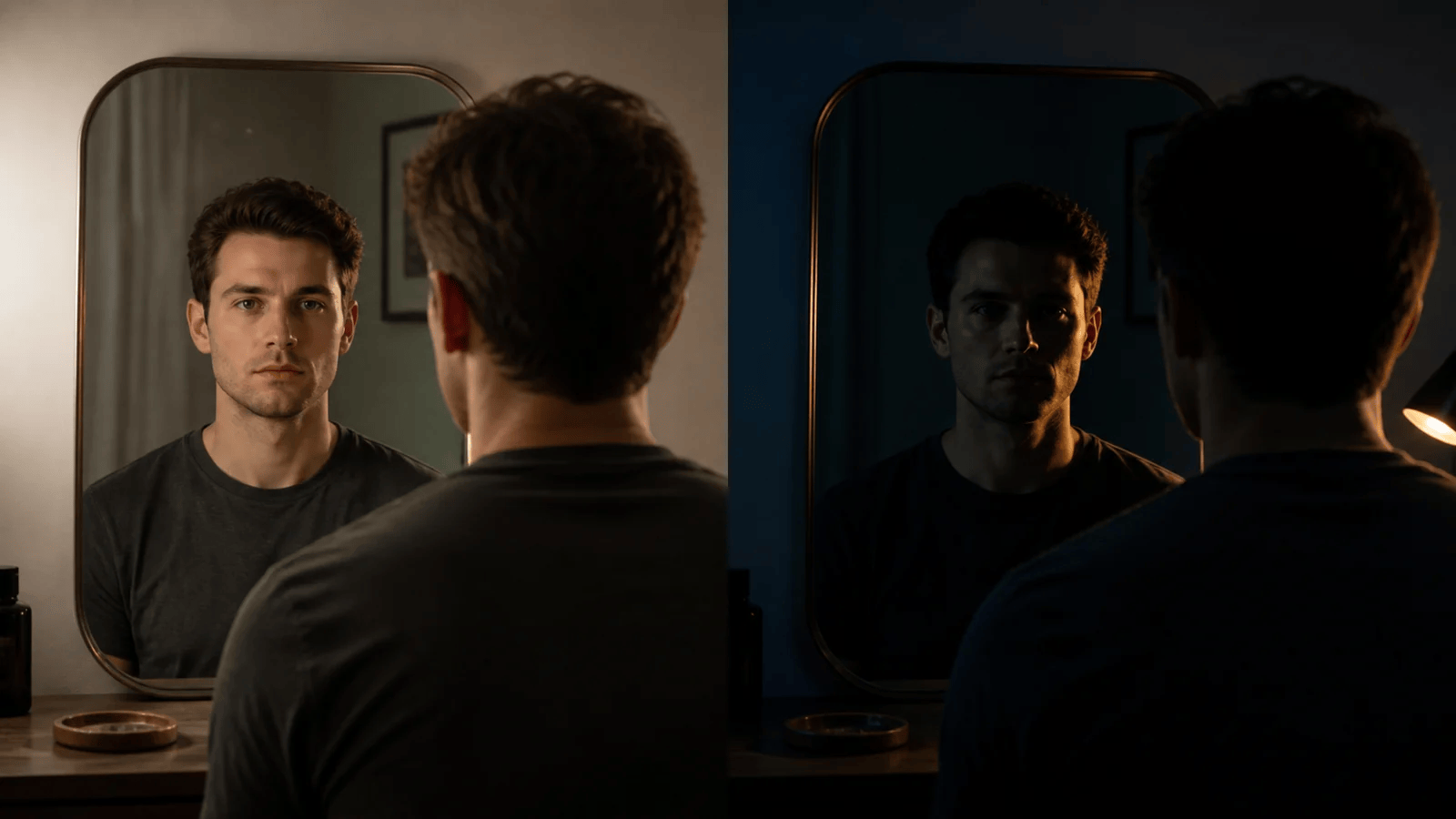
Why dim light matters
A face contains many small contrasts: the boundary of the lips, the whites of the eyes, the edges of nostrils, the shadow under the brow, the curve of cheek against background.
Dim light weakens those details.
When a person holds their gaze in one area, visual adaptation can make stable features fade or change in salience. Tiny eye movements, shifting shadows, asymmetry, and incomplete information give the visual system a face it cannot process in the usual lively way.
The result may involve several processes rather than one magic switch. Researchers have discussed perceptual adaptation, face processing, dissociation, identity representation, and other mechanisms. The systematic review's caution matters here: the existence of the illusion is clearer than a complete explanation of why it takes every reported form.
This is related to, but not identical with, seeing faces in ambiguous objects. Pareidolia finds a face where no face exists. The mirror illusion begins with a real face and makes its features unstable.
One constructs identity.
The other erodes it.
The same reflection under full and dim side lighting. Ordinary shadow removes facial information.
Why mirrors make the effect worse
A photograph shows a past face. A mirror appears to show a present one.
It responds immediately to movement. That responsiveness teaches the viewer to treat the image as trustworthy. Raise a hand, and the reflection raises one. Lean closer, and it approaches. The system seems perfectly coupled.
Horror needs only one apparent failure.
The reflection smiles late.
It keeps looking at the doorway after you turn back.
It appears tired when you are not.
Those fictional events violate the mirror's central promise: exact obedience.
The strange-face illusion is subtler. The reflection continues obeying movement while its identity becomes unstable. You retain control over the image and lose confidence in the person inside it.
Do not wait for the second face.Join The Grimbard Press and receive Dead Ship, a free illustrated Subscriber Archive Edition.
Mirrors already had rules before the laboratory
Mirror folklore did not wait for experimental psychology.
Mirrors have been treated as tools of divination, thresholds, traps for souls, signs of vanity, and vulnerable objects to cover after a death. The practices differ across culture and period. They should not be collapsed into one universal belief that “ancient people thought mirrors were portals.”
What many mirror traditions share is structure.
The participant changes the ordinary conditions of looking. The room becomes dark. A candle replaces general light. A phrase is repeated. A particular hour matters. The person waits for an image that should not be present.
The modern Bloody Mary ritual uses exactly that architecture. Versions vary, but the familiar form places a person before a dim mirror, requires repetition, and makes expectation part of the viewing condition.
The ritual does not need a supernatural result to produce fear. It prevents the viewer from glancing casually. They must keep looking while their vision becomes less reliable.
A scientific effect does not solve every mirror story
It would be convenient to file all mirror apparitions under low-light illusion and close the cabinet.
That would repeat the mistake of using one plausible mechanism as a universal explanation.
Some reports occur under different conditions. Some are memories shaped by fear. Some are folklore told as experience. Some involve reflections, sleep loss, suggestion, grief, substances, medical conditions, or details no outside reader can evaluate. A blog article cannot retroactively reproduce the scene.
The strange-face literature gives us one documented route by which a normal face can become visually unfamiliar.
It does not give us jurisdiction over every mirror.
That restraint is part of what visiting haunted places actually feels like. The responsible observer records the conditions, tests ordinary causes, and resists declaring victory in either direction when the evidence runs out.
Why horror keeps returning to the mirror
The mirror is inexpensive, universal, and intimate. It brings the impossible into a private room without requiring a creature to enter through a door.
It can produce four fears at once:
Duplication: another version of the self exists within reach.
Disobedience: the image stops matching the body.
Addition: someone or something appears behind the viewer.
Replacement: the face remains, but identity changes.
Most horror objects must be carried into the scene. The mirror is already mounted on the wall.
Every reader has practiced trusting it.
Frequently asked questions
Why does my face look distorted in a dark mirror?
Low illumination removes facial detail, and prolonged fixation can make stable features fade or change in salience. The visual system may then produce a strange-face illusion in which the reflection appears distorted or unfamiliar.
Is the strange-face illusion normal?
It has been reported in nonclinical research participants under unusual viewing conditions. One brief illusion does not, by itself, establish a disorder or diagnosis.
Does the mirror-gazing effect happen to everyone?
No. Reported rates vary considerably, and a systematic review found that study quality influenced them. The phenomenon should not be presented as guaranteed.
Does science prove the Bloody Mary legend?
No. Research helps explain why dim, prolonged mirror gazing can produce unsettling visual changes. It does not prove a supernatural figure appears or establish the origin of every ritual variant.
Why does moving make my face look normal again?
Movement changes the visual information, interrupts fixation, restores edges and contrast, and confirms the ordinary link between body and reflection.
The object beyond the reflection
The Scarab begins where a modern hand acquires an object carrying an older interpretation of reality. A mirror makes the same offer: trust the object, then discover the rules were never yours.
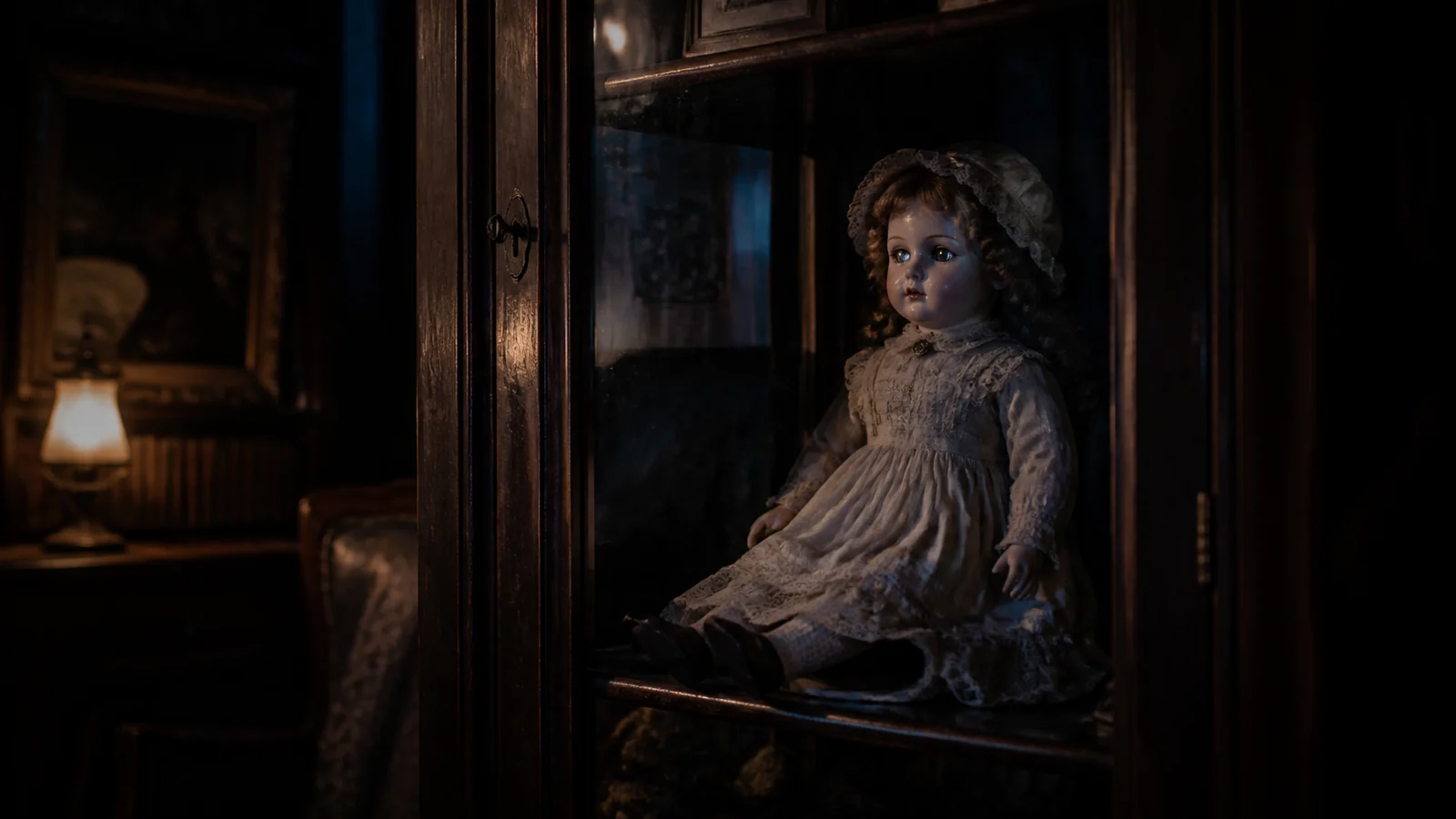
A doll has a face built to be recognized and eyes that cannot recognize you back.
It resembles a person precisely where resemblance matters, then fails every test of life. The mouth keeps one expression. The skin holds one temperature. The gaze never quite meets yours, yet never grants the relief of looking away.
Dolls can feel creepy because they occupy an uncertain boundary between person and object. Humanlike faces attract attention, while fixed expressions, stillness, glassy eyes, and mismatched realism make that familiarity fail. The uncanny valley offers one explanation, especially when lifelike and artificial features conflict, but it is not a universal law that explains every doll or every frightened viewer.
Sometimes the doll looks too human.
Sometimes it is worse because it does not look human enough.
The face arrives before the object
A doll may be cloth, wood, wax, porcelain, vinyl, or plastic. The material changes. The arrangement remains.
Eyes above a nose. A mouth below. A head placed on a body that repeats the human plan.
As discussed in why we see faces in the dark, the visual system gives faces unusual priority. A doll does not merely suggest a face through random marks. It presents one deliberately. The question is not whether the face will be detected. The question is what kind of face the brain believes it has found.
A living face changes continually. Muscles shift around the eyes and mouth. Attention moves. Breathing affects posture. Tiny asymmetries provide evidence of thought and response.
A doll offers the structure without the behavior.
That creates a social signal with nobody behind it.
What is the uncanny valley?
In 1970, Japanese roboticist Masahiro Mori proposed that people may respond more positively as an artificial figure becomes increasingly humanlike—until it becomes almost human. At that point, small imperfections can cause comfort to drop sharply into eeriness. That dip became known as the uncanny valley.
The idea has spread far beyond robotics. It is now applied to computer-generated characters, prosthetic hands, mannequins, wax figures, puppets, masks, and dolls.
The popular version is simple: things that look nearly human are creepy.
The research is less tidy.
Reviews of uncanny-valley studies have found that results depend on how human likeness is manipulated and measured. Some experiments support the effect strongly; others do not reproduce a neat valley. Evidence is particularly useful for perceptual mismatch—features that do not agree about how alive or realistic the figure should appear.
That matters more than the slogan.
A doll with painted features may look comfortably stylized. A highly realistic doll with rigid skin, oversized glass eyes, or an immobile mouth may create conflict. The face asks to be processed as human while individual features refuse to cooperate.
Mismatched realism makes the familiar unfamiliar
Research by Debaleena Chattopadhyay and Karl MacDorman examined what happens when realism becomes inconsistent across a humanlike character. Their work suggests that inconsistency can reduce familiarity and increase cold, eerie feelings in anthropomorphic figures.
Put plainly: the problem may not be realism itself. The problem may be that the eyes belong to one level of reality and the skin to another.
Porcelain dolls provide the classic arrangement. The face may be modeled with soft cheeks and detailed lips, but the surface reflects light like fired material. The eyes may imitate moisture while remaining hard. Painted lashes surround pupils that never contract. Hair looks organic until the edge of the wig becomes visible.
Each feature makes a promise the next feature breaks.
Doll feature
Human expectation
The mismatch
Glass eyes
Attention and moisture
Reflection without responsive gaze
Fixed smile
Changing emotion
Warmth that continues through every event
Jointed body
Purposeful movement
Limbs that move only when acted upon
Realistic skin tone
Warm living tissue
Hard, cool, uniform material
Human clothing
Social identity
A role without a person performing it
The result is not simply “almost human.” It is human and object at the same time.
Small mismatches between lifelike features and artificial materials can intensify unease.
Stillness becomes an unfinished action
A chair is allowed to remain still.
A body is not.
Even a sleeping person offers movement if watched closely enough. The chest rises. Eyes shift under lids. Fingers relax. A doll holds the posture of a body while refusing all involuntary evidence of life.
That stillness becomes more noticeable when the doll is posed as if an action has paused. It sits upright in a chair. It faces the doorway. One arm reaches forward. The head turns slightly more than the torso.
The viewer supplies the missing verb.
It was looking.
It has stopped moving.
It will move when the room is empty.
Horror depends on this expectation. The doll rarely needs to move in front of the audience. It only needs to occupy a different position after attention leaves it.
Showing the man checking the locks works for the same reason. Fear becomes visible through an attempt to establish continuity. A character photographs the shelf before bed. They mark the doll's chair. They close the cabinet. The next scene tests whether the record still agrees with the room.
The object is never where the manifest left it.Join The Grimbard Press and receive Dead Ship, a free illustrated Subscriber Archive Edition.
Why glass eyes feel watchful
Doll eyes do not need to track a viewer to feel intrusive.
Shiny curved surfaces catch highlights. A small point of reflected light makes an eye appear wet and therefore more alive. Because the gaze is fixed, a viewer moving across the room may not receive the normal social evidence that another person's attention has changed.
Some painted or inset eyes also create a familiar portrait effect: the gaze appears directed outward across a range of viewing positions. The doll is not following anyone. Its geometry and the viewer's interpretation produce the impression.
Knowing that can make the object easier to explain without making it pleasant to keep beside the bed.
The problem is not merely that the doll “looks at you.” It is that a face normally reveals where attention is going, and the doll offers no reliable answer.
Old dolls carry other people's stories
A new doll belongs to a store and a manufacturer.
An old doll belongs to everyone who may have held it.
Wear becomes evidence. A rubbed patch on the hand suggests repeated contact. A repaired dress implies care. One missing shoe creates a vanished pair. Cracks in a porcelain face resemble age or injury even though the material is not flesh.
Provenance can be known, partly known, or invented. Horror takes advantage of all three.
An inherited doll arrives with family rules. An antique-shop doll has no witness to contradict the seller. A toy found inside a wall appears to have been deliberately removed from ordinary circulation. The object has survived its owner, and survival begins to look like agency.
This resembles the fear inside changeling folklore: the face is familiar, but recognition no longer settles identity. The ethical history of changeling belief is far more serious than a creepy-toy story, and the traditions should not be flattened together. The shared mechanism is narrower. A familiar form becomes frightening when expected behavior does not arrive.
Horror taught us what dolls are supposed to do
Fiction did not invent discomfort around artificial people, but it gave that discomfort a library.
The haunted doll can contain a spirit. The killer doll can act directly. The prophetic doll announces harm by changing position. The duplicate doll resembles a child too closely. The dollhouse repeats a real building and changes before the building does.
Once those patterns become familiar, an ordinary doll inherits them. The viewer is no longer responding only to porcelain, paint, and glass. They are responding to every story in which those materials became patient.
This is one reason “I have always hated dolls” can feel older than any specific film. The person may not remember the first story that established the rule. The rule remains:
Do not place it where it can see the bed.
Creepiness is not exactly fear
Researchers do not always treat eerie, uncanny, creepy, fearful, and disgusting as interchangeable responses. A figure can feel wrong without producing immediate terror.
Creepiness often involves uncertainty about threat.
A snarling dog announces danger clearly. A doll announces nothing. It has a face, a body, and no visible intention. The observer continues monitoring it because the category remains unresolved.
Is it a harmless object?
Yes.
Why does it need a face?
Because that is what dolls are.
Why is it facing the door?
Someone placed it there.
Who?
The questions do not prove danger. They prevent dismissal.
Why some dolls are charming instead
Not every humanlike object falls into the valley.
Stylization can help. A cloth doll with button eyes does not promise anatomical realism. A cartoon figure establishes its own rules. Familiarity, positive memory, cultural practice, condition, context, and personal experience all shape the response.
The same antique doll may represent family continuity to one person and unbearable scrutiny to another.
That variation is evidence against one grand explanation. Perceptual mismatch matters. So do learning, setting, expectation, and story.
The doll in a bright museum case is an artifact.
The same doll sitting at the top of your stairs at midnight has acquired a scene.
Frequently asked questions
Why are porcelain dolls especially creepy?
Porcelain allows detailed human features while remaining hard, glossy, and immobile. Realistic coloring combined with reflective eyes and an unchanging expression can create a strong mismatch between human appearance and object behavior.
Is the uncanny valley scientifically proven?
Research supports uncanny responses under some conditions, particularly when humanlike features are inconsistent. The effect is context-sensitive, and studies do not support the simplified claim that every increasingly realistic figure produces one predictable valley.
Why do doll eyes seem to follow you?
Fixed outward-facing eyes and curved reflective surfaces can maintain the impression of directed gaze as the viewer moves. The doll is not tracking the viewer, but the face-processing system still interprets the gaze socially.
Is fear of dolls a real phobia?
The term pediophobia is often used for an intense fear of dolls. A blog article cannot diagnose a phobia. Clinically significant fear depends on severity, persistence, distress, and interference with a person's life.
Why do old dolls seem creepier than new ones?
Age adds cracks, stains, wear, repairs, missing history, and evidence of previous owners. Those details invite a story before anything supernatural occurs.
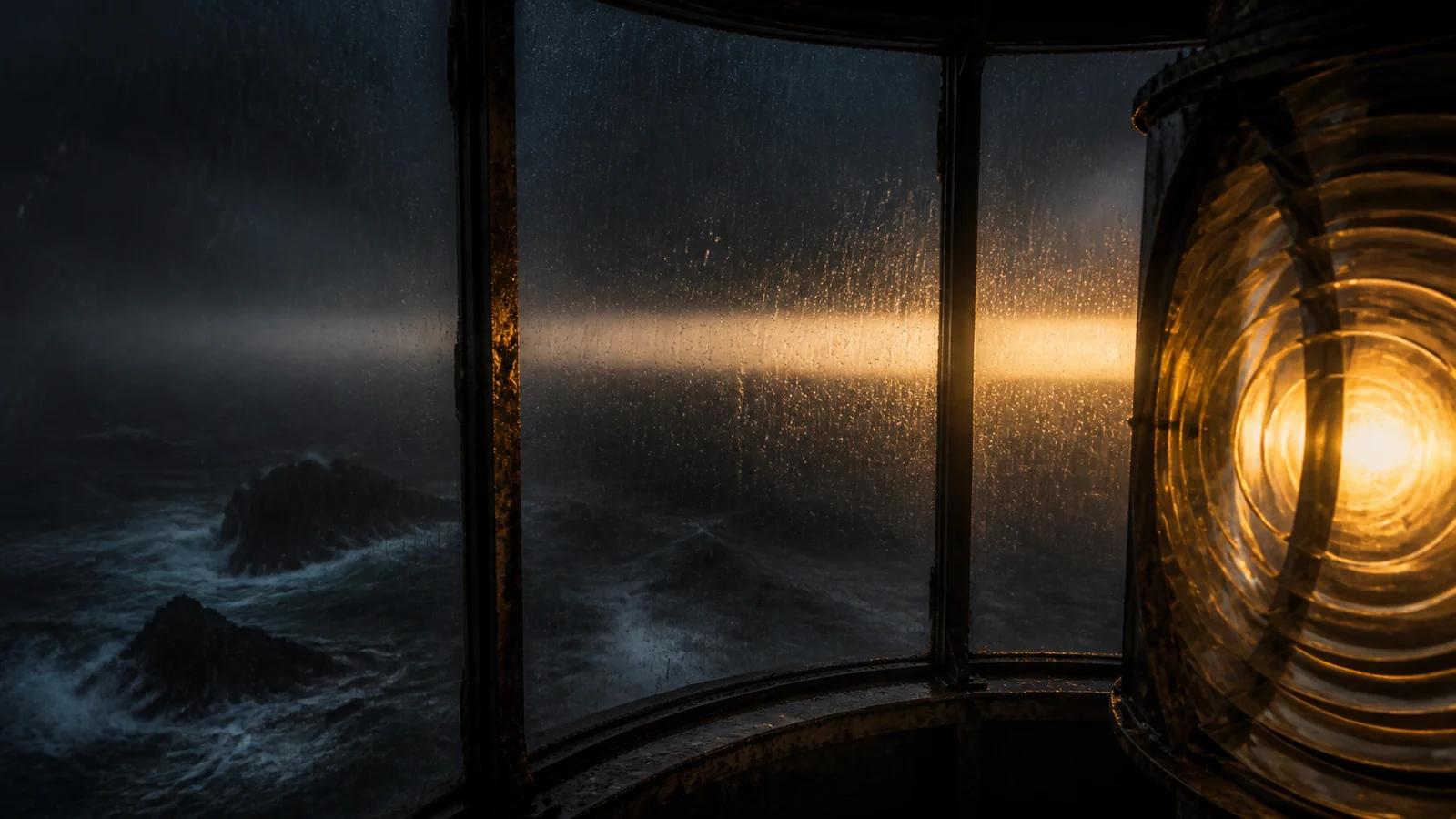
A lighthouse is a warning built in the place most likely to kill the person maintaining it.
The tower must stand where rock, shoal, fog, current, and storm make navigation dangerous. Its beam has to reach people who may never see the keeper. The light must continue whether the person tending it is lonely, exhausted, ill, or listening to something strike the rocks below.
Lighthouses feel frightening because they combine isolation, hazardous weather, repetitive night duty, limited escape, and responsibility for lives beyond the keeper's sight. The beam promises order to distant ships. Inside the tower, that order depends on a small number of people repeating exact tasks while darkness presses against every window.
The haunted house traps its occupants with a past.
The lighthouse traps them with a job.
A lighthouse begins as a boundary
Lighthouses do not mark comfortable places.
They identify a coast, reef, harbor entrance, or obstruction that a navigator needs to recognize before reaching it. A lighthouse says land is here, but the more urgent part of the message may be do not come closer.
That double meaning gives the structure its natural horror.
From the sea, the beam is reassurance. From the lantern room, it reveals how completely the tower is surrounded. Each sweep shows a portion of rock, water, fog, or rain and then removes it again. The light does not conquer the darkness. It visits one narrow section at a time.
The darkness has the longer shift.
This differs from why caves are frightening. A cave removes the entrance as a person goes deeper. A lighthouse keeps displaying the world outside, but offers no easy route into it. The keeper can see the storm. Seeing does not provide escape.
What did lighthouse keepers actually do?
The romantic image reduces the keeper to one melancholy man polishing a lens while the sea attempts to drive him mad.
The work was more practical and more demanding.
At Cape Hatteras, the National Park Service describes a principal keeper and two assistants who rotated four-hour night watches. Their duties included carrying fuel, tending the lamp, trimming wicks, polishing the lens and brass, maintaining the clockwork, keeping records, ordering supplies, painting buildings, watching shipping, and making repairs.
Point Reyes on the California coast provides an especially useful example. Its keepers had to wind the clockwork that rotated the Fresnel lens every two hours and twenty minutes through the night. The mechanism used a descending 170-pound weight. Daylight brought lens cleaning, brass polishing, repairs, and work on the fog signal.
The routine matters to horror because every task can fail.
A wick can burn poorly. A weight can stop. A lens can be damaged. A fog signal can go silent. A report can contain a time no one remembers writing. The building turns maintenance into ritual because the consequences of neglect exist somewhere beyond the visible circle.
Rules in folk horror create a boundary. Lighthouse duty creates a checklist.
Both become frightening when one item changes.
The keeper was not always alone
Many lighthouse stories depend on solitude. The historical record is less convenient.
The National Park Service notes that many keepers lived with families in attached or nearby quarters. Family members contributed to the work, and women sometimes inherited formal keeper positions after a husband or father died or became unable to serve. Some stations employed several keepers. African American workers served within lighthouse and lifesaving systems under changing and often unequal conditions before and after emancipation.
The solitary white man in a raincoat is an image, not a universal staffing model.
Correcting the image does not remove isolation. A family can be isolated together. Three keepers can still be days from help. A station may have company but no privacy, no reliable transport, and no refuge from the same machinery, weather, and sound.
Company also creates new forms of uncertainty.
Someone was supposed to wind the mechanism.
Someone was supposed to relieve the watch.
Someone is moving on the stairs, but everyone is already in the room.
Weather makes the building an instrument
At Point Reyes, fog can reduce visibility to hundreds of feet. The headlands project into a dangerous approach to San Francisco Bay. The lighthouse was built below the high fog line, 300 feet down a cliff, because the warning had to exist where ships might actually see it.
Wind, water, and metal do not remain quiet in such a place.
The tower hums. Windows rattle. Waves arrive as impacts without visible sources. Fog removes the horizon, leaving the keeper inside a white enclosure while the sea continues below. A fog signal repeats until it becomes part of the body, then stops suddenly enough to feel like an event.
Point Reyes recorded winds strong enough to force a keeper to crawl. The National Park Service lists a highest recorded speed of 133 miles per hour and notes that winds of 60 miles per hour are common. The station's isolation, work, wind, and fog made it an undesirable assignment.
Horror does not need to invent the pressure.
It only needs to wait until the familiar noise answers back.
**The light is still on aboard Dead Ship.** Join The Grimbard Press and receive the complete illustrated story free.
A keeper's night watch depended on lenses, clockwork, weights, fuel, and repeated maintenance.
Responsibility reaches beyond the beam
A haunted-house story asks whether the occupants can save themselves.
A lighthouse story adds strangers.
The keeper may never know the names of the people relying on the signal. A ship passes beyond sight. Another fails to appear. Wreckage arrives later. The light can operate perfectly and still be unable to save everyone.
That imbalance is essential. The keeper has enormous responsibility and limited power.
At Point Reyes, lighthouses and fog signals warned ships, but wrecks continued. A lifesaving station was established on the beach in 1890. Patrols watched for disasters and survivors in cold, powerful water. The warning system did not eliminate the need to recover people after warning failed.
Sailors believed in sea monsters partly because the ocean delivered evidence without context. The keeper experiences the reverse. The context is everywhere—dangerous water, poor visibility, a missing vessel—but the evidence may never arrive.
The empty horizon can mean everyone passed safely.
It can mean no one is left to signal.
The beam proves that time is passing
A rotating lighthouse lens creates a characteristic pattern. Mariners identify a station by how its light flashes. At Point Reyes, the mechanism produced one flash every five seconds.
To a keeper, repetition measures the night.
The beam crosses the window. Darkness returns. The weight descends. The mechanism needs winding. The same stairs wait. The same glass needs attention. A shift ends only when another person arrives to continue the sequence.
Repetition is normally reassuring because it confirms that the system works.
Horror changes one interval.
The beam returns early.
The mechanism is still turning after the weight reaches the bottom.
The flash appears from the wrong side of the tower.
The keeper sees another light at sea matching the station's pattern exactly.
Those ideas work because lighthouse time is not decorative. It is operational. A wrong flash is a wrong message sent into darkness.
Automation left an empty tower still performing its duty
Lighthouse automation removed much of the need for resident keepers. A current National Park Service history notes that U.S. lighthouses had become automated by the end of the twentieth century; Boston Light retained a keeper under federal authorization until the last civilian keeper retired in 2023.
Automation creates a different unease.
The abandoned house is frightening because the system stopped. Dust settles. Pipes fail. Nature enters.
The automated lighthouse remains active after the people leave.
The light continues to turn. Electronic equipment monitors what no person is present to see. The building performs occupancy without an occupant.
That is close to the fear inside the warehouse ghost. Modern systems keep logging, scanning, and signaling after the human witness has gone home. A process does not need to be alive to outlast the people who understand it.
Why lighthouses feel haunted
Lighthouses gather several kinds of fear in one vertical structure:
Element
What it promises
What horror changes
The beam
Orientation and warning
It illuminates something that should not be there
The tower
Refuge above dangerous water
It becomes a place with one narrow route out
The schedule
Reliable operation
One interval changes without explanation
The keeper
Human supervision
The duty continues after the watcher disappears
The fog signal
Identity when the light cannot be seen
Another signal answers from the wrong direction
The structure is not frightening because it is old.
It is frightening because it has a purpose precise enough to fail.
Frequently asked questions
Did lighthouse keepers live alone?
Some experienced severe solitude, but many stations had assistants, families, or nearby quarters. Staffing varied by station and period. The lone-keeper image should not be treated as universal history.
Why did lighthouses need constant attention?
Before automation, lamps, fuel, wicks or mantles, lenses, clockwork, windows, fog signals, and buildings required regular operation and maintenance. Severe weather could make continuous monitoring especially important.
Are lighthouses still staffed?
Modern aids to navigation are generally automated. Historic sites may have rangers, caretakers, volunteers, museum staff, or other personnel, but not traditional resident keepers tending a flame through rotating watches.
Why does fog make a lighthouse scarier?
Fog removes distance and the horizon while preserving sound. The tower's warning may become audible rather than visible, and the keeper can know danger is near without being able to see it.
How is lighthouse horror different from haunted-house horror?
A haunted house usually contains a past intrusion. A lighthouse adds public duty: the person inside must keep the warning operating for people outside, even when staying becomes dangerous.
Sail beyond the light
Monsters of the Wine-Dark Sea follows the old fear that the water contains more than distance. The lighthouse marks the last fixed point before that uncertainty begins.
Tennessee's most famous witch was not a witch at all.
Not at first.
It was a knocking under the floor. An animal that vanished before it could be named. A voice in a farmhouse. A family story repeated until an unseen presence acquired a personality, a grievance, and the familiar name Kate.
Then print got hold of it.
The Bell Witch is a haunting legend associated with John and Lucy Bell's family near present-day Adams, Tennessee, beginning around 1816 or 1817. The story says an invisible entity struck family members, spoke in different voices, tormented John Bell, and claimed responsibility for his death in 1820. What survives most clearly, however, is not contemporary proof of a supernatural attack. It is the history of a legend growing through oral tradition, later books, newspapers, radio, stage performances, tourism, and repeated attempts to make the Witch return on schedule.
The ghost is difficult to verify.
Its publication history is not.
Who were the Bell family?
John Bell and Lucy Williams Bell moved from North Carolina to Robertson County, Tennessee, in 1804. According to the Tennessee Encyclopedia, they established a prosperous farm along the Red River and spent more than a decade living an apparently ordinary frontier life.
The place matters. Early nineteenth-century Middle Tennessee was not the empty wilderness later versions sometimes require. It was a growing agricultural region shaped by migration, churches, family networks, enslaved labor, and the difficult transformation of Indigenous land into American property. The Bell story emerged inside a community where reputation traveled person to person before it reached a printing press.
The reported disturbances began around 1816. Strange animals appeared. Knocking and scraping sounds entered the house. Bedcovers were pulled away. Members of the family were allegedly slapped or pinched. The activity concentrated increasingly around John Bell and his daughter Betsy.
Eventually, the presence spoke.
That is the turn that separates the Bell Witch from a house with unexplained noises. A voice can answer questions. It can repeat gossip. It can choose favorites. It can become cruel to one person and affectionate toward another. The Tennessee Encyclopedia describes the spirit as kind to Lucy Bell while tormenting other members of the household.
An unexplained sound is an event.
A voice is a character.
Why is it called the Bell Witch?
The entity came to be called “Kate,” often connected in later accounts to a neighbor named Kate Batts. Versions of the story assign her a land dispute or other grievance against John Bell. The details vary, and the temptation to turn one living woman into the solved identity of the ghost exceeds the documentation.
The word witch also misleads modern readers. The Bell Witch was not primarily described as a woman practicing magic in the familiar trial-era sense. It behaved more like a talking spirit or what later audiences would call a poltergeist. Even a Library of Congress dramatization made the distinction directly: the Bell Witch was “not a witch at all but a haunt, a spirit.”
Names make stories portable. “The Bell family disturbances” require explanation. “The Bell Witch” arrives already shaped.
Once the presence had a name, every noise could belong to it.
What was the Witch said to do?
The mature legend gives Kate an extraordinary range.
She could knock, scratch, sing hymns, quote Scripture, repeat sermons heard in distant churches, imitate local voices, reveal private conversations, predict events, attack Betsy Bell, and debate visitors. She supposedly interfered with Betsy's relationship with Joshua Gardner. She tormented John Bell as his health failed.
When Bell died on December 20, 1820, the story attached his death to a mysterious vial found in the house. The entity allegedly claimed it had poisoned him. A small amount of the liquid was said to have been tested on a cat, which died.
Those are elements of the legend. The language must remain precise.
A later account saying that a supernatural voice confessed to murder is not equivalent to a contemporary medical record establishing poison. A reported animal test is not a preserved toxicology result. The difference is not pedantry. It is the line between examining folklore and laundering it into history.
That same line matters in the history of the Jersey Devil. A claim can be culturally important even when the surviving evidence cannot carry the literal event.
Did Andrew Jackson visit the Bell farm?
The most famous visitor is Andrew Jackson.
The popular episode sends Jackson and several men to investigate. Their wagon stops on the road as if held by an invisible force. The Witch announces itself from the brush and allows them to proceed. During the visit, one boastful “witch layer” is allegedly beaten or tormented. Jackson leaves impressed enough to prefer fighting the British again over facing the Bell Witch.
It is a magnificent scene.
It is also not established merely because it has been repeated often.
The historical Andrew Jackson lived in Tennessee and knew prominent families across the region. That makes a visit possible. Possibility is not documentation. The episode belongs to the legend unless a traceable contemporary source can be produced. Its vivid dialogue and perfect comic structure should increase caution, not reduce it.
Later stories often recruit famous witnesses because fame transfers authority. A local ghost becomes harder to dismiss once a president-to-be has supposedly met it.
Receive the next recovered file:Join The Grimbard Press and receive Dead Ship, a free illustrated Subscriber Archive Edition.
When did the story enter print?
This is where the evidence ladder becomes useful.
Date
Event or source
What it establishes
1804
The Bells move from North Carolina to Tennessee
Historical family and geographic setting
c. 1816–1820
Traditional period of the disturbances
The dates attached to the oral legend
1820
John Bell dies
A historical death later interpreted within the legend
1894
Martin V. Ingram publishes An Authenticated History of the Famous Bell Witch
The first major full-length printed version commonly cited by later tellers
1934
Charles Bailey Bell publishes a family account
Renewed public attention from a descendant
1937
Newspapers, radio, and stage productions promote a predicted return
A documented revival that shows media actively reshaping the legend
The distance between the alleged events and the fullest printed narratives does not prove that nothing happened. Oral traditions can preserve real memories. It does mean every polished scene must be dated by its source rather than quietly carried backward to 1817.
Martin V. Ingram's 1894 book is central to the familiar story. It gathered family tradition, testimony attributed to earlier participants, and narrative detail into an “authenticated” history. The title makes a claim about reliability; it does not settle that claim.
By the time later writers inherited the Witch, they inherited Ingram too.
Illustration of the Bell Witch evidence trail from family story to later print and media revival.
The Witch learned how to return
A good ghost never needs to return physically if a newspaper can do it on her behalf.
The Tennessee Historical Society's account of 1937 shows exactly how this works. Journalist T. H. Alexander publicized a prediction that the Bell Witch would return that year. The arithmetic itself was unstable. Different versions placed the spirit's departure and promised return on different dates.
Alexander was skeptical, but he understood the market for a ghost story.
The publicity produced new reports: noises near the cave, household disturbances, blackouts, missing corn, scattered feathers, and a supposed sighting that turned out to be a stone. A magician planned an investigation. Nashville radio station WSM aired a dramatization with a large cast. A stage production followed on Halloween.
People in Adams did not respond as one superstitious crowd. Some feared the Witch. Some enjoyed the attention. Others objected. A descendant of Betsy Bell asked the newspaper to stop publishing what he called rubbish.
By December, the promised return had supplied no proof of a supernatural visitor.
It had supplied stories, audiences, and tickets.
The Bell Witch had returned through distribution.
What about the Bell Witch Cave?
The cave near Adams is now inseparable from the public legend. It gives visitors a place to enter, photograph, and remember. A haunting attached to a vanished or altered farmhouse needs a surviving threshold, and the cave provides one.
That does not make the cave the original cause of the disturbances. Later geography can become more important than early geography because it remains accessible. The site belongs to the legend's continuing cultural life, but claims about specific supernatural events inside it should be sourced individually.
This is common in place-based folklore. Mothman became bound to a bridge and its later tragedy. The Jersey Devil became inseparable from the Pine Barrens even though the legend's print history is more complicated than a creature born cleanly in the woods.
A place gives a story somewhere to wait.
Was the Bell Witch real?
If real means that the surviving record proves an invisible intelligence poisoned John Bell, attacked his daughter, stopped Andrew Jackson's wagon, and returned according to schedule, the evidence does not establish that conclusion.
If real means a Tennessee legend with identifiable people, a specific landscape, a long publication history, family conflict over its telling, recurring public revivals, and the power to shape the identity of Adams, the Bell Witch is real in abundance.
The most responsible answer keeps four categories separate:
Documented: the Bell family, Robertson County setting, John Bell's death, later books, articles, broadcasts, performances, markers, and tourism.
Traditional: the disturbances dated to the late 1810s, the speaking spirit, Kate's attacks, prophecies, and return promises.
Reported: statements attributed to family members, neighbors, and visitors, filtered through later preservation.
Unverified: a supernatural cause, poison administered by an entity, and famous dialogue repeated without a contemporary record.
Keeping the files separate does not kill the Witch.
It shows how she survived.
Frequently asked questions
Was the Bell Witch a real woman?
The entity was sometimes connected to a neighbor named Kate Batts, but the legend's “Kate” should not be treated as a proven identification of a living woman. The Bell Witch behaves primarily as a spirit in the story.
Did the Bell Witch kill John Bell?
John Bell died in 1820. The legend says the entity confessed to poisoning him, but surviving evidence does not establish supernatural murder or provide a verifiable toxicology record.
Did Andrew Jackson investigate the Bell Witch?
The visit is one of the legend's best-known episodes, but it is not securely established by contemporary documentation. Present it as a popular traditional account, not a settled event.
Is the Bell Witch Cave the original haunted site?
The Bell farm and household are central to the early legend. The nearby cave became an important physical destination in the tradition's later life, but that does not prove it caused the original reports.
Why is the Bell Witch important?
The story is one of Tennessee's best-known haunting traditions. It shows how family memory, oral storytelling, print, mass media, tourism, and skepticism can all participate in keeping a ghost alive.
Open the next case file
The Pine Barrens Incident takes another regional legend out of the souvenir case and returns it to roads, wetlands, reports, and people who cannot agree on what the evidence means.
The coat on the chair becomes a person after the lights go out.
Nothing has moved. The sleeves still hang where you left them. The pale shape above the collar is still a receipt on the dresser behind it. In daylight, the scene contains fabric, furniture, and the mild evidence of a room that needs cleaning.
At 2:13 a.m., it contains shoulders and a face.
We see faces in the dark because the human visual system is unusually ready to detect them, even in incomplete or ambiguous patterns. That false perception is called face pareidolia. Low light strips away detail, leaving coarse arrangements of shadow and contrast for the brain to interpret. Sometimes it chooses the most socially important possibility first: someone is there.
The explanation is ordinary. The experience is not.
What is face pareidolia?
Pareidolia occurs when a meaningful shape appears in random or ambiguous visual information. A face in a cloud is the familiar example. So are the “eyes” of a wall outlet, a tree trunk that seems to scowl, or two lit windows above a dark doorway.
Face pareidolia is the face-specific version of that effect. The object is real. The face is an interpretation.
That distinction matters because people often use pareidolia, illusion, and hallucination as though they describe the same event. They do not.
Experience
What is present
What happens
Pareidolia
An ambiguous real pattern
The pattern is interpreted as something meaningful, such as a face
Visual illusion
A real visual stimulus
Its size, shape, color, position, or identity is misperceived
Hallucination
No corresponding external stimulus is required
A person has a sensory experience that is not caused by an object currently present
A curtain crease mistaken for a profile is pareidolia. A shadow that makes a stationary object appear to move is an illusion. Neither event, by itself, says anything alarming about the person who noticed it.
The brain is not failing when it finds a face where none exists. It is making a fast decision with bad evidence.
Your brain gives faces priority
Faces are not ordinary objects to a social animal.
A face can reveal identity, attention, emotion, health, age, and possible intent. It tells us whether someone has noticed us. It may tell us whether to approach, answer, comfort, submit, or run. A visual system that treats faces as important is not indulging a hobby. It is monitoring other minds.
Research on face pareidolia suggests that face-like objects recruit parts of the visual system also involved in processing actual faces. A study available through the National Library of Medicine describes activity in occipito-temporal regions, including the fusiform face area, when people view real faces and face-like nonface images. Other work has found that pareidolic faces can receive prioritized attention.
The practical consequence appears whenever three marks arrange themselves in roughly the correct order: two above, one below. The arrangement does not need skin. It does not need a head. It does not even need to be symmetrical. It only needs to pass the first crude inspection.
That is why a house can look surprised.
It is also why the shape at the end of a hallway can become a person before you can name the objects forming it.
Darkness removes the evidence that would correct you
In good light, the coat loses quickly.
You see the weave of the fabric, the empty space beneath the sleeve, the chair leg, and the receipt. Each detail argues against a body. The scene becomes easy to classify because the eye has enough information to test its first impression.
Darkness removes those corrections.
Edges soften. Color becomes less dependable. Depth is harder to judge. Small objects disappear into larger masses. The scene does not become completely invisible; it becomes incomplete. That may be worse.
The visual system has to assemble a useful world from limited evidence. It draws on familiar shapes and expectations. If you woke because you heard a noise, the expectation has already changed. You are no longer asking, “What objects are in my bedroom?” You are asking, “Is someone in here?”
The same shadows now sit inside a different question.
This is one reason showing fear through behavior is more convincing than merely announcing that a room feels wrong. A frightened person turns on the lamp, checks the corner, counts the windows, and looks twice at the coat. The action reveals that the first glance did not settle the matter.
The same ambiguous scene becomes ordinary as additional visual detail returns.
A false alarm can be cheaper than a missed face
It is tempting to explain pareidolia with a neat evolutionary sentence: humans see faces everywhere because missing a real watcher would have been more costly than inventing one.
That idea is plausible. It is also broader than the evidence allows us to prove in one clean story.
What research supports more directly is that face detection is fast, faces attract attention, and very simple face-like configurations can activate face-processing responses. The evolutionary reason for that sensitivity is an interpretation built around those findings, not a fossilized record of one ancestral decision.
Still, the false-alarm logic is useful.
Suppose the shape beside the tree is only a broken branch. Looking again costs a second. Suppose it is a person standing motionless beyond the yard. Refusing to look again could cost more.
The brain does not need certainty to request another glance.
Horror lives inside that request.
Follow what appears next:Join The Grimbard Press and receive Dead Ship, a free illustrated Subscriber Archive Edition, followed by new monster lore and recovered files.
Why the face often feels like a watcher
A face in a toaster may be funny. A face in an upstairs window is not.
The difference is not only visual. It is narrative.
Location supplies intent. A face-like pattern above a church door belongs to architecture. The same pattern half-hidden behind a curtain occupies a place where a conscious observer could stand. The brain does not merely detect two eyes and a mouth. It places the possible face inside a situation.
Distance contributes too. Nearby objects can be inspected. Faraway shapes resist correction. Glass adds reflections. Fog weakens edges. A dark tree line offers more candidate faces than a blank wall because it contains endless partial arrangements and few decisive details.
Once the pattern becomes a watcher, every moment of stillness begins to mean something.
Why has it not moved?
Why is it facing this way?
How long was it there before you noticed?
The visual error takes less than a second. The story arrives immediately afterward.
Folklore gives the uncertain shape a name
Pareidolia does not explain monsters away.
It explains one of the ways an uncertain shape can enter human attention. Culture still decides what the shape means.
A dark figure beside a road may become a ghost, an omen, a trespasser, a saint, a witch, or a cryptid depending on who sees it and which stories are available. Monsters in folklore do more than provide anatomy. They preserve rules about places, dangers, strangers, weather, illness, and forbidden behavior.
The eye supplies a candidate. The local tradition supplies a file.
That is why similar shadows do not produce identical stories everywhere. The human tendency to detect faces may be widespread. The Black Dog, the watcher at the window, and the figure in the corn are not interchangeable cultural decorations. Each belongs to a different landscape and history.
Modern internet monsters use the same machinery at a different speed. Slender Man began in a manipulated-image forum thread, but the image worked because an elongated figure half-seen behind children felt as if it had been discovered rather than placed. The visual uncertainty gave the fiction room to masquerade as evidence.
Horror keeps the second look from resolving the first
In ordinary life, the lamp turns on and the watcher collapses into laundry.
Horror delays that relief.
The light switch fails. The figure is gone when the character looks back. The photograph shows a shape no one noticed at the time. The window reflects the room but includes one face too many. Each device prevents inspection from closing the case.
The most effective version does not show the monster more clearly with every look. It changes the quality of the uncertainty.
First, the character thinks the shape may be a person.
Then they prove it is a coat.
Then the coat is hanging somewhere else.
The fear no longer comes from misidentifying an object. It comes from discovering that the ordinary explanation has been moved.
This is the bridge from perception into story. A real cognitive tendency opens the door, but fiction decides what walks through it.
Knowing the effect does not make you immune
You can know the word pareidolia and still turn on the lamp.
Knowledge arrives after detection. The first impression can be fast, bodily, and unpleasant. Your explanation then competes with the shape instead of preventing it from appearing.
That does not mean instinct has defeated reason. Turning on the lamp is reason. Looking again is how the nervous system gathers better evidence.
The important question is not whether you can force yourself to stop seeing a face. It is whether the face survives inspection.
Usually, it does not.
The room returns. The receipt becomes paper. The sleeve becomes cloth. You may even laugh at the arrangement once the false person is gone.
But for one moment, before the evidence arrived, the room contained somebody else.
That moment is enough for horror.
Frequently asked questions
Is face pareidolia normal?
Yes. Seeing face-like patterns in objects, buildings, shadows, or natural forms is a common feature of human perception. An isolated experience of pareidolia is not the same as a hallucination or diagnosis.
Why do I see faces more often at night?
Low light reduces detail and makes edges, depth, and color less reliable. Ambiguous shapes leave more room for the visual system to complete a familiar pattern, especially when you are already alert for another person.
Why are the faces sometimes frightening?
Context matters. A face-like outlet is harmless because its source is obvious. A vague face in a window could belong to a watcher. Uncertainty about animacy, attention, and intent gives the pattern social danger.
Is pareidolia the same as seeing ghosts?
Pareidolia can explain some misidentified shapes in photographs or dark places, but it cannot evaluate every reported ghost experience. It describes a perceptual mechanism, not a universal verdict about every account.
Can writers use pareidolia without explaining it?
Absolutely. Let the character notice an arrangement that almost resolves into a person, then give them a practical reason to look again. The explanation becomes more frightening when it works once—and fails the next time.
The next shape in the Archive
There Be Monsters: Then and Now follows creatures that survive by changing with the people who see them. Pareidolia supplies one way a shape is noticed. Warning, memory, and retelling decide whether it becomes a monster.