The Fear of Being Buried Alive: Why Safety Coffins Haunted the Nineteenth Century
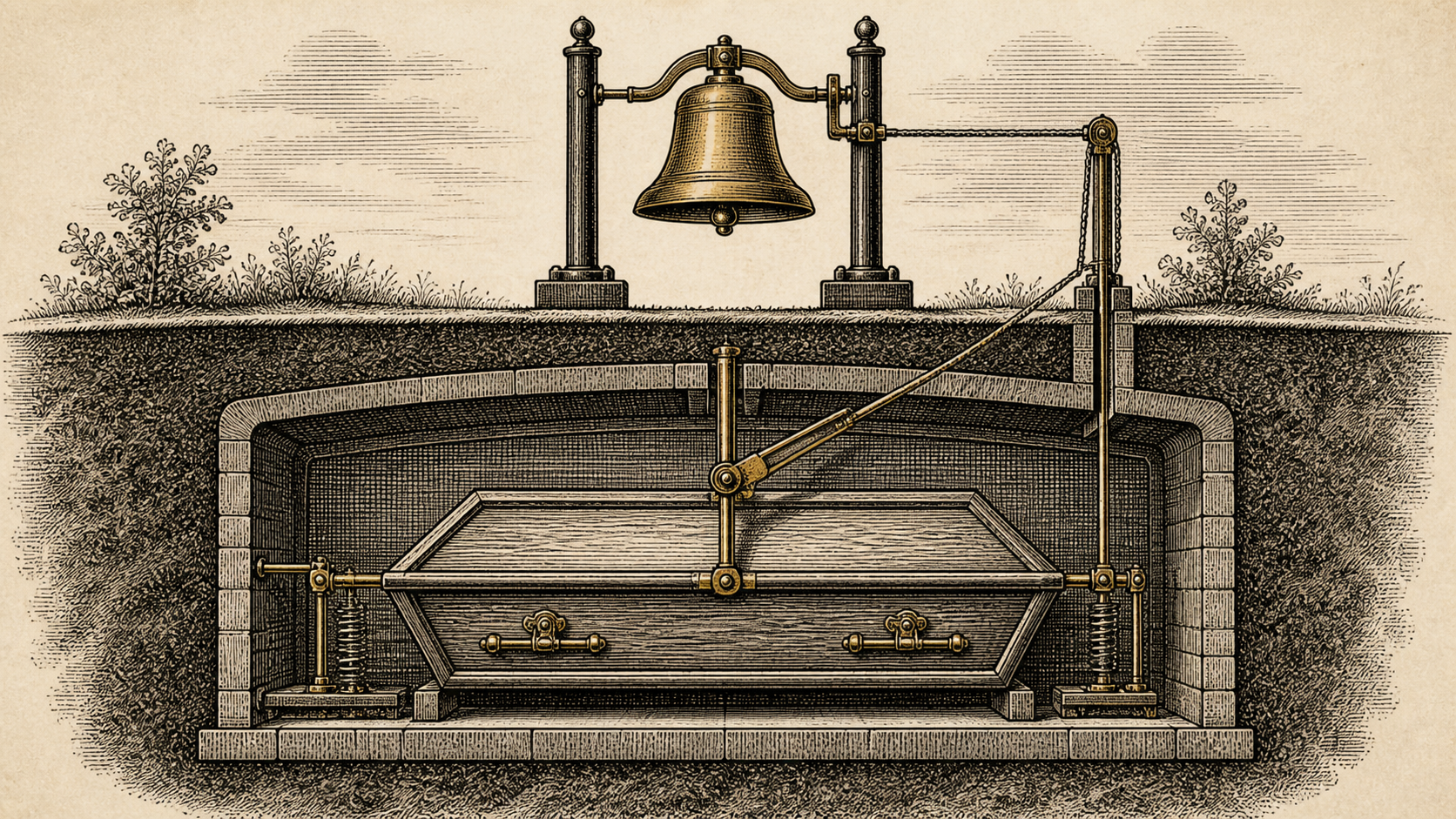
A bell above a grave is a clean piece of horror design. Someone below pulls a cord. Someone above hears it. Between them is dirt.
It is also easy to let that image do too much historical work. Safety coffins existed. They were patented, advertised, sketched, and argued over. They are evidence of an intense fear of premature burial. They are not, by themselves, evidence that graveyards were full of people saved by bells.
The nineteenth-century fear of being buried alive grew from a genuine uncertainty: determining death was harder before modern diagnostic methods and before many people had reliable access to trained medical care. That uncertainty produced waiting mortuaries, proposed alarm systems, and a long afterlife in gothic fiction. The history is frightening because it shows how much terror can gather around a boundary people cannot confidently see.
What “premature burial” means
Premature burial means burial of a person who is still alive. The possibility has haunted many cultures, but it took a particular grip on nineteenth-century Europe and North America, where newspapers, medical debate, patent culture, and popular literature fed one another.
In a 2016 history in History of Psychiatry, Marco Cascella notes that the Italian psychiatrist Enrico Morselli used the term taphophobia in 1891 for an extreme fear of being buried alive. The word is useful as historical vocabulary, but it should not be used casually to diagnose a reader who finds the idea upsetting. The fear needs no diagnosis to make sense. It places the body in the one location from which it cannot argue back.
The central problem was apparent death. A body might be cold, still, faintly breathing, or hard to rouse. Nineteenth-century medicine had methods of observation, but not the certainty later readers tend to imagine. When the fear became public, the most memorable answer was mechanical: build a coffin that lets the occupant send a signal.
The safety coffin was a solution to a nightmare
Illustration: apparent death, safety devices, and gothic fiction belong to different kinds of evidence.
The designs varied. Some used cords attached to bells. Some proposed breathing tubes, movable lids, flags, escape hatches, or mechanisms triggered by movement. A review in Forensic Sciences, Medicine and Pathology describes nineteenth-century security-coffin ideas that included alarms, pipes, and devices meant to allow survival until a rescue could occur.
That catalogue is more unnerving than any one design. It turns the grave into a machine with user instructions. Yet the same review supplies the necessary restraint: these devices were answers to fear, and claims about their practical success require separate proof. A bell might be set off by swelling, decomposition, or shifting material. A patent drawing is not a rescue record.
This distinction matters. Horror history is full of objects that become more dramatic every time they are repeated. The safety coffin is already dramatic enough. It shows that people could imagine the failure in precise, expensive detail.
Waiting mortuaries and the need to know
Some European communities tried another answer: delay burial and observe the recently dead until unmistakable changes appeared. The 2023 review “Premature burial” discusses holding mortuaries with resuscitation facilities, especially in continental Europe, as a response to uncertainty over death diagnosis.
This is the less famous image, perhaps because it lacks the bell and the grave. It may be the more revealing one. A waiting mortuary admits that the frightening thing is not burial alone. It is the interval before anyone can honestly say the body has crossed the threshold.
That interval is where gothic fiction lives. A locked coffin is frightening because it appears to settle a question permanently. A waiting room for the dead is frightening because it does not.
Poe understood the architecture of the fear
Illustration: a patented safety coffin does not prove a documented rescue.
Edgar Allan Poe did not invent the fear, but he gave it memorable rooms to occupy. His 1844 story “The Premature Burial” arrived in a century already interested in apparent death and safety devices. Poe’s contribution was not medical explanation. It was enclosure: narrow space, darkness, awakening, the mind turning every sensation into proof that it is too late.
That is why the trope survived advances in medicine. The literal risk can change while the symbolic fear remains useful. Being buried alive is fear of a false conclusion. Everyone else has decided the story is over. You are still inside it.
The same pressure sits beneath curse narratives. In the history behind the mummy’s curse, the sealed tomb becomes a warning about disturbing the dead. Premature-burial horror reverses the direction: the living person is sealed away as if already dead. Both stories make a door carry more certainty than the people on either side possess.
What the records do not let us say
The careful version of this history leaves several satisfying claims on the floor.
We cannot say that every safety-coffin patent was widely used. We cannot turn a rope-and-bell illustration into proof that someone woke beneath a cemetery. We cannot use exhumed remains, scratches, or a crooked body as a simple forensic answer centuries later. Bodies and graves change for many reasons.
We can say that the fear was culturally powerful. Physicians, inventors, writers, and mourners treated apparent death as a problem worth worrying over. That is enough to explain why the image kept returning.
Today, modern death determination is profoundly different from nineteenth-century practice, and the contemporary article in the source packet describes actual premature burial as rare where qualified medical care is available. This is history, not a reason to mistrust current medical professionals or to make decisions about death care from a horror blog.
The bell is still ringing because the question is not
The safety coffin endures because it offers a cruelly simple bargain: if you are alive, make a sound. The trouble is that the fantasy assumes someone is listening.
That is the darker half of the story. The bell above the grave promises connection, but it also imagines a world in which rescue depends on being heard through the earth. The invention does not defeat helplessness. It gives helplessness a cord to pull.
For fiction about death, rooms, and the presences that refuse their assigned category, There Be Monsters: Among the Dead is the natural next shelf. And if you like hauntings that migrate into modern systems, the ghost in the warehouse follows the fear after it leaves the graveyard.
> Join The Grimbard Press and receive Dead Ship, a free illustrated Subscriber Archive Edition, along with future archive files and monster lore.
FAQs
Were safety coffins real?
Yes. Nineteenth-century inventors patented and proposed coffins with alarms, breathing tubes, and escape mechanisms. Their existence documents concern about premature burial, not routine successful rescues.
Why did people fear being buried alive in the nineteenth century?
Death could be difficult to determine in some circumstances, and press stories, medical debate, inventions, and gothic fiction made the possibility culturally vivid.
Did bells on graves actually save people?
Popular stories often imply that they did, but a safety device or patent is not proof of a documented rescue. Claims about a specific event need a reliable contemporary record.
Is premature burial still common?
No. Modern medical practice has far more reliable methods for determining death. The historical fear should not be treated as a guide to present-day medical care.
[…] with stories, patents, and alarm devices meant to answer them. Our earlier look at the subject, “The Fear of Being Buried Alive: History, Horror, and the Safety Coffin”, follows how medical uncertainty became a durable horror […]



Comments
One response to “The Fear of Being Buried Alive: Why Safety Coffins Haunted the Nineteenth Century”
[…] with stories, patents, and alarm devices meant to answer them. Our earlier look at the subject, “The Fear of Being Buried Alive: History, Horror, and the Safety Coffin”, follows how medical uncertainty became a durable horror […]