
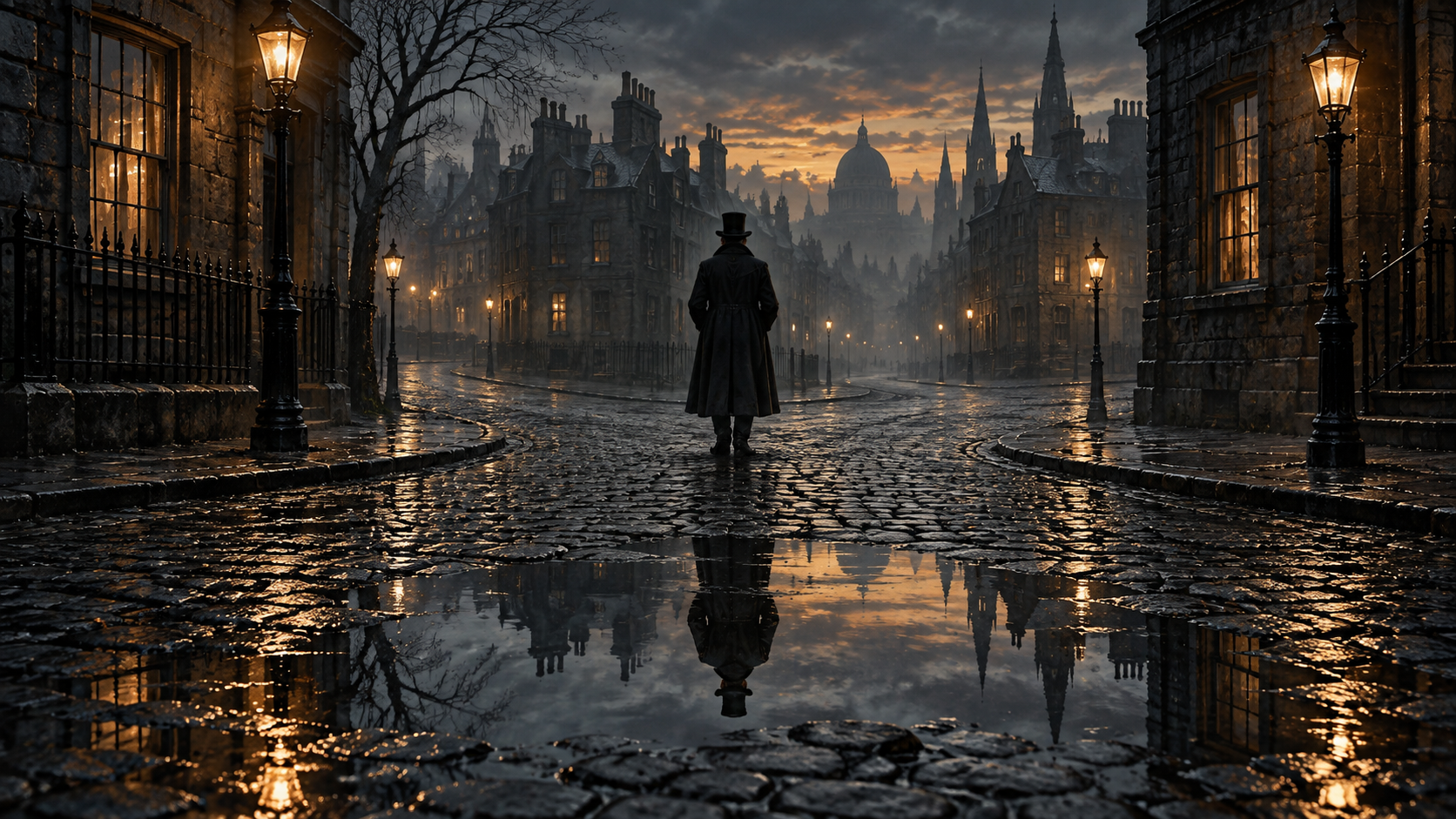

There’s a particular kind of fear that doesn’t need a monster in it. Someone you know walks past you on the road and doesn’t answer when you call. You find out later they were forty miles away.
Nothing attacked. Nobody was hurt. And everyone who hears the story knows it’s bad.
The word is newer than the belief
Doppelgänger is German and means, plainly, “double-goer.” The writer Jean Paul coined it in the 1790s. The belief it names had been around for centuries in half of Europe under other names.
In Ireland the double is the fetch, and the tradition comes with a rule that I find more unsettling than the apparition itself: the hour decides the meaning. See a person’s fetch in the morning and they’ll have a long life. See it in the evening and they won’t. Same sight, same person, opposite verdict, and nothing you can do to change which one you got.
In Norway the vardøger works in reverse. You hear someone arrive before they arrive: footsteps on the porch, a key in the lock, a coat hung up. Then, a few minutes later, they do all of it again for real. The vardøger isn’t usually a death omen. It’s a spirit that runs ahead of its person, and people who grew up with it talk about it almost fondly.
Scottish tradition has the co-walker, a double that keeps company with a living person and can be seen by those with the sight. Robert Kirk, a Scottish minister, wrote about that world in the 1690s in a manuscript now known as The Secret Commonwealth. Germanic tradition also has the fylgja and the wraith, and the meanings blur where the traditions meet.
The famous sightings

The literature of doubles is mostly literary men reporting on themselves, which is worth keeping in mind.
Goethe described riding away from a meeting with a lover and seeing himself coming the other way on the road, dressed in clothes he did not own. Eight years later, he said, he rode that road again in exactly those clothes.
Percy Shelley, in the weeks before he drowned in 1822, was reported to have seen a figure of himself who asked how long he meant to be content. Mary Shelley recorded the account after his death.
Abraham Lincoln’s friend Ward Hill Lamon recorded Lincoln describing a double image of his own face in a mirror, one healthy, one pale, and Mary Lincoln reading it as a sign he would not survive a second term.
The most detailed story, the one about the schoolteacher Emilie Sagée whose double appeared in front of a classroom of girls in the 1840s, was published by Robert Dale Owen in 1860 and has never been traced to any independent record. Treat it as folklore that arrived in the shape of a case study.
Why the double is so frightening
Most folklore monsters want something: blood, a child, a bargain, a debt. The double wants nothing. It doesn’t speak, chase, or bargain. It does what you do, badly, somewhere you aren’t.
The threat it carries is that your identity is not a thing you own. Someone else can be you, in front of people who know you, and be believed. Every subsequent version of this story, the changeling that takes your child’s face, the thing in the ice wearing your friend’s coat, runs on that same fuel. The horror is not that something is out there. It’s that you can no longer prove which one of you is the real one, and neither can your friends.
What the folklore says to do
Not much, and that’s consistent. There is no salt or iron for this one.
- Don’t follow it.
- Don’t speak to it.
- Don’t let it know you saw it.
- Note the hour. In the fetch tradition, the hour is the whole message.
When a belief’s only advice is “note the time,” what it’s really telling you is that the outcome was decided before you looked up.
The story in October 31
“Two of Everything” is the second story in October 31.
> October 31st, present day — a research station, the ice.
Adaeze Okoye keeps her mug on the left side of the desk because she’s left-handed and the desk isn’t. It’s the kind of small accommodation you make when you live somewhere built by other people, and it’s the kind of detail that starts to matter when the crew begins asking each other where everyone was at six in the morning.
By then nobody wants to say the obvious thing out loud, and the alibis are useless: everyone was alone, the way everyone is alone at a research station in the off hours.
The station has a crew, a schedule and a floor plan, all of which assume each person is one person. The story is about what happens to that arithmetic when it stops holding.
—
Two of Everything is Night 2 of 31 in October 31, thirty-one folk horror stories set on Halloween night across six centuries. Read it on Amazon → · Free with Kindle Unlimited.
Take the 31 Nights challenge. One story a night through October, with a free printable calendar. Get the calendar →
Previous: What Was a Strigoi? · Tomorrow night: The Banshee Doesn’t Scream, She Keens