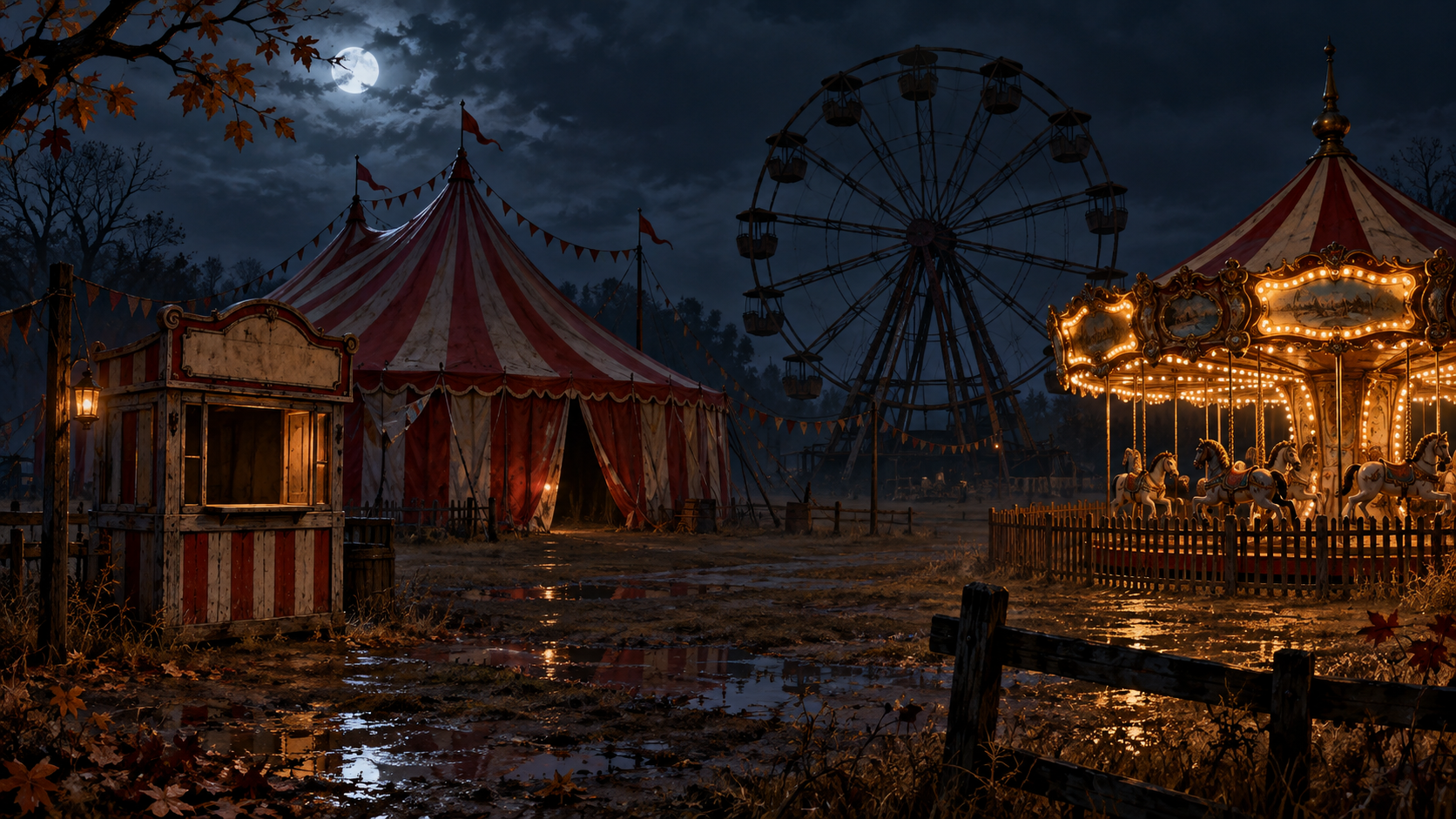

A carnival arrives in a field outside town, which nobody uses, and is running by dark. It takes money, hands out prizes that cost less than the money, and leaves before anyone thinks too hard about it. In the morning there’s flattened grass and a smell of fryer oil.
That’s a real business, and it’s also one of the most reliable horror engines we have. Here’s why.
The lot has its own laws
Travelling shows in America built a whole culture that outsiders weren’t invited into, starting with the language. Show people had their own slang: the lot for the ground the show stands on, a mark for the customer, a grind show for the one that runs continuously, a joint for a game booth, with it for belonging to the show. Some of it came from older travelling traditions, some was invented on the road, and its purpose was practical: talk in front of the customer without the customer following along.
Add the rest of the arrangement. The show is temporary. It’s staffed by people the town doesn’t know and won’t see again. It runs at night, on a site with no permanent structures. The games are built so the house wins. Nobody in town can name a single person on the lot.
Every one of those is a fair description of a small business. Every one is also the setup for a folktale about a bargain you shouldn’t take.
The old bargain stories
Long before midways there were fair-day stories, and the shape is always similar. A stranger arrives at the market or the crossroads. He offers a trade that’s too good. The victim accepts, because the price sounds like nothing, and then finds out what the small print meant.
Folk tradition is full of them. The devil who buys a soul for seven years of luck. The fiddler who plays better than he should after a night on the road. Stingy Jack, who wins his bargain twice and is punished with exactly what he asked for. In every version the loser is not innocent. He wanted something for less than it cost.
Carnivals inherited that story wholesale, because a midway is a place where you hand over money for a chance at a thing worth more than the money. It’s a bargain booth with lights on it.
What the customer never sees

Carnival horror also runs on a second engine: the parts of the show that are real and unsettling on their own.
There’s the history of the sideshow, in which people with disabilities and differences were displayed for money, sometimes with a degree of control over their own act and income, often without it. There’s the tent that’s dark inside and cheap outside. There’s the machinery, assembled overnight by tired men and disassembled the same way. There’s the fact that the person taking your ticket is in costume, and that you will never know what’s underneath.
Writers have worked this ground for a century, from carnival noir to Ray Bradbury’s autumn show in Something Wicked This Way Comes. The reason it keeps working isn’t that carnivals are sinister. It’s that they’re temporary, and anything temporary can leave with something of yours.
The rules people keep anyway
Midway superstition is real, some of it borrowed from theatre and the circus:
- Don’t say a performer’s act will go well. Say almost anything else.
- Don’t whistle backstage in some traditions, don’t wear certain colors in others.
- Don’t ask a show person where they were before this stop.
- Don’t be the last one on the lot after the lights go off.
That last one isn’t superstition so much as sense. The show is packing. You’re not with it.
The story in October 31
“The Show Only Runs Once” is the fourth story in October 31.
> October 31st, 1954 — a traveling carnival, somewhere off the highway.
Wendell Pace has been three weeks on the lot, and in three weeks he’s learned exactly one rule that matters: do not ask where the crew came from before this stop. He asked twice. The first time, a roustabout named Lomax laughed it off.
Then there’s the second ring of the evening, the one the audience doesn’t realize is for them.
The title is the promise the show makes, and like every bargain in this kind of story, it’s true in a way the customer didn’t consider. I’ll leave the rest where it is. If you’ve ever stood on a midway at closing and felt the whole thing start to fold itself up around you, the story will land.
—
The Show Only Runs Once is Night 4 of 31 in October 31, thirty-one folk horror stories set on Halloween night across six centuries. Read it on Amazon → · Free with Kindle Unlimited.
Take the 31 Nights challenge. One story a night through October, with a free printable calendar. Get the calendar →
Previous: The Banshee Doesn’t Scream, She Keens · Tomorrow night: Witches’ Familiars: Cats, Courts, and Massachusetts Before Salem