
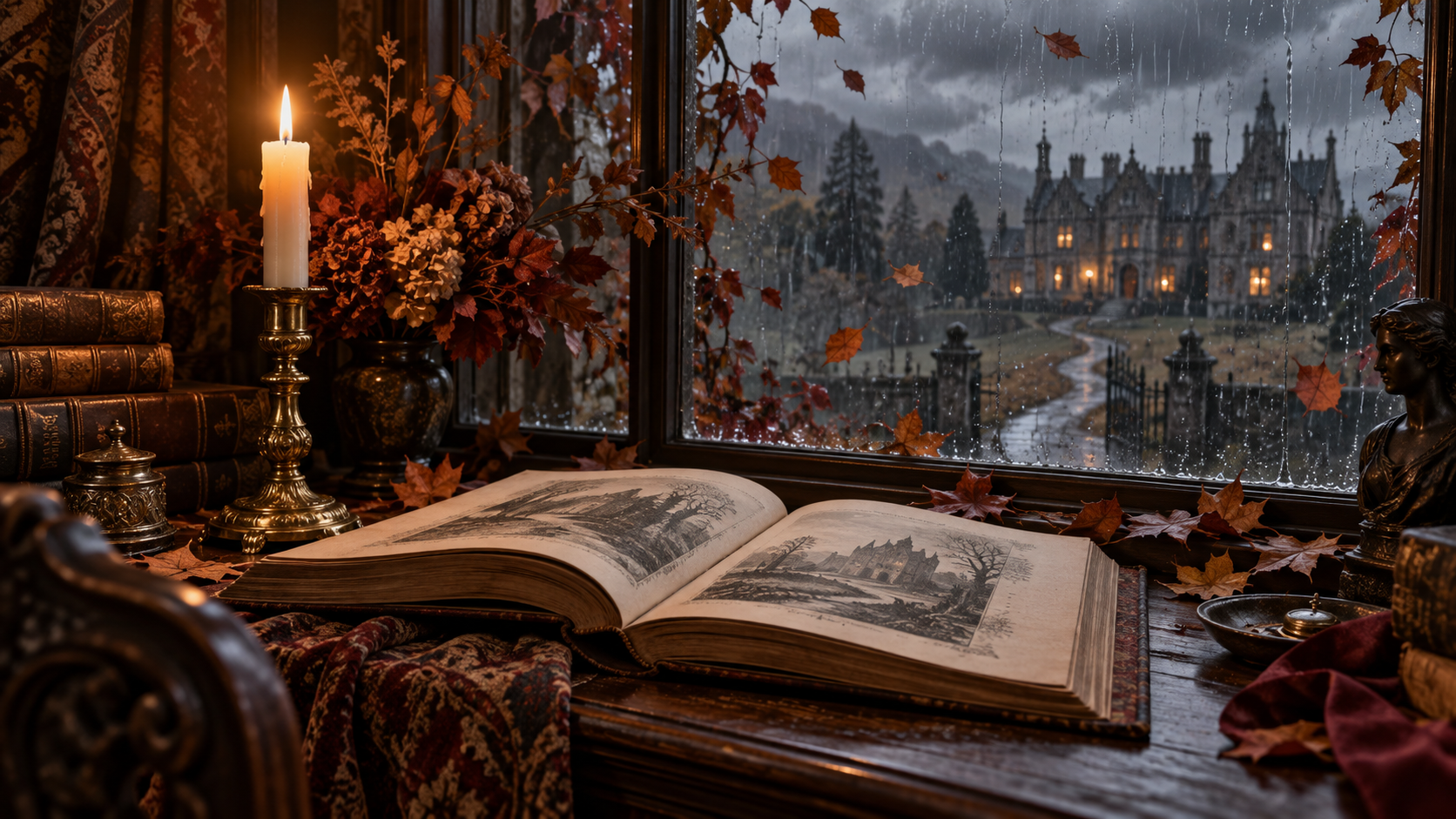

The best gothic horror books for autumn do more than supply a decaying mansion. They make a place feel burdened by history, then ask what the living will sacrifice to keep that history hidden. If you want a practical reading path, start with a short, psychologically sharp house story, move to an older novel of secrets and inheritance, and finish with a book that lets the uncanny spread beyond the walls.
This is a path, not a ranking. Choose the branch that matches how much time and supernatural certainty you want. A ruined estate is only one version of the Gothic; isolation, family power, obsession, and the uneasy return of the past are the real architecture.
First, what makes a book Gothic?
Gothic fiction often gives emotion a physical address. A corridor conceals information; an inherited property embodies an inherited obligation; a storm turns a decision into an ordeal. It can contain ghosts, but a haunting is not required. The pressure may come from secrecy, coercion, grief, or a narrator whose account cannot be trusted.
That distinction helps when searching for an autumn read. “Gothic” does not promise a jump scare on every page. It promises atmosphere with consequences. If you prefer an early guide to the neighboring genres, read our dark fantasy, horror, and Gothic comparison.
Stop 1: a haunted house you can finish quickly
Start with Shirley Jackson’s The Haunting of Hill House if you want the house to be both a setting and a question. Eleanor enters a group investigation carrying her own loneliness; the novel refuses to make every perception easy to sort. Its power lies partly in the gap between what happens and what can be proved. The Library of America edition identifies the novel among Jackson’s essential works, alongside We Have Always Lived in the Castle.
Choose We Have Always Lived in the Castle instead if you want a smaller domestic world and a voice that seems to know more than it tells. The Blackwood home is not a tourist attraction. It is a fortress of routine, resentment, and selective memory. Both books reward a slow evening, but neither requires a month-long commitment.

Stop 2: inheritance, desire, and the rooms no one mentions
If you have a weekend, try Daphne du Maurier’s Rebecca. Its house, Manderley, is a monument to an absent woman whose influence does not depend on appearing as a literal ghost. The unnamed narrator has to negotiate social rank, marriage, memory, and the unsettling fact that a room can preserve somebody’s power. The publisher description makes the central marriage and Manderley’s shadow clear without needing to spoil its turns.
For a longer, nineteenth-century route, Charlotte Brontë’s Jane Eyre offers a governess, a grand house, moral independence, and a secret whose treatment still invites debate. It is not interchangeable with a modern horror novel. Its romance and social critique are central. But the atmosphere of Thornfield Hall shows how suspense can grow from unequal power and incomplete knowledge. You can enjoy the locked-room intrigue while also asking whose point of view the book privileges.
The choice between these two depends on pace. Rebecca is the more direct autumn suspense read; Jane Eyre asks for a longer stay and gives more space to its narrator’s convictions.
Stop 3: the castle as a trap
Bram Stoker’s Dracula is a useful next move because its opening turns hospitality into captivity. Jonathan Harker travels to a remote castle on business and gradually learns that every practical exit has closed. Later, the novel changes form and location through letters, diaries, and records. That documentary structure can feel surprisingly modern: people assemble evidence while the danger outruns their explanations.
Read it if you like a large cast, a slow-building threat, and an older text whose assumptions deserve critical attention. If the length feels intimidating, read the castle opening as a self-contained test. You will know quickly whether its rhythm works for you. Avoid reducing the whole book to one image of a cloaked count; its fear also lives in logistics, communication, and the struggle to be believed.
Mary Shelley’s Frankenstein offers a different kind of ruin. Its Gothic pressure comes less from a house than from an act of creation and a refusal of responsibility. The framing narratives ask who gets to tell the story and whose suffering counts. It is especially good for readers who want an autumn book that leaves them with a moral argument as well as an image.
Stop 4: when the ruin becomes a landscape
Once you have visited the manor and castle, take the Gothic outdoors. A shore, empty field, burial mound, or village can hold the same withheld history as a locked room. This is where Gothic reading meets folk horror: the place appears to remember an agreement the newcomer never made. Our guide to folk horror in books explains that shift from private architecture to collective belief.
For a Grimbard path, The Scarab is a route toward cursed-object suspense, while October 31 lets you sample multiple shades of seasonal dread in shorter sittings. Check the book descriptions before choosing; a collection is a different reading commitment from a single sustained novel. A useful experiment is to alternate an older Gothic chapter with one contemporary story, noting what each makes you wait to learn.

Choose your route in five minutes
If you have one evening, pick The Haunting of Hill House or We Have Always Lived in the Castle. If you have a weekend and want romantic suspense, pick Rebecca. If you want a long classic with a strong first-person voice, pick Jane Eyre. For monsters and assembled documents, pick Dracula. For a moral argument under storm clouds, pick Frankenstein.
You do not have to finish every station in October. Two books with contrasting moods may teach you more about your taste than a checklist of ten. Keep a note of the moment the setting stops being background and begins to demand a decision. That is often the point where Gothic atmosphere becomes Gothic story.
FAQ
Does Gothic horror have to include a ghost? No. A secret, power imbalance, or obsession can haunt a book without a supernatural event.
Are Gothic and dark fantasy the same? They overlap, but Gothic names a mode of atmosphere and buried history; dark fantasy usually gives greater room to an imagined or supernatural world.
Which book should a newcomer try first? For a concise modern entry, start with The Haunting of Hill House. For a larger romantic mystery, try Rebecca.
For a monthly dose of folklore and dark reading paths, join The Grimbard Press. If you want a book built for the season itself, explore October 31.
Source notes: Library of America on Shirley Jackson; HarperCollins on Rebecca. Descriptions and reading guidance are editorial judgments, not claims about current pricing or availability.
Comments
2 responses to “Gothic Horror Books for Autumn: A Reading Path from Manor to Ruin”
[…] distinct endings. If you want to understand why her houses and families remain so influential, our Gothic autumn reading path offers a route to her longer […]
[…] Gothic reading path explores how fiction turns architecture into pressure. For a Grimbard route through places whose […]