
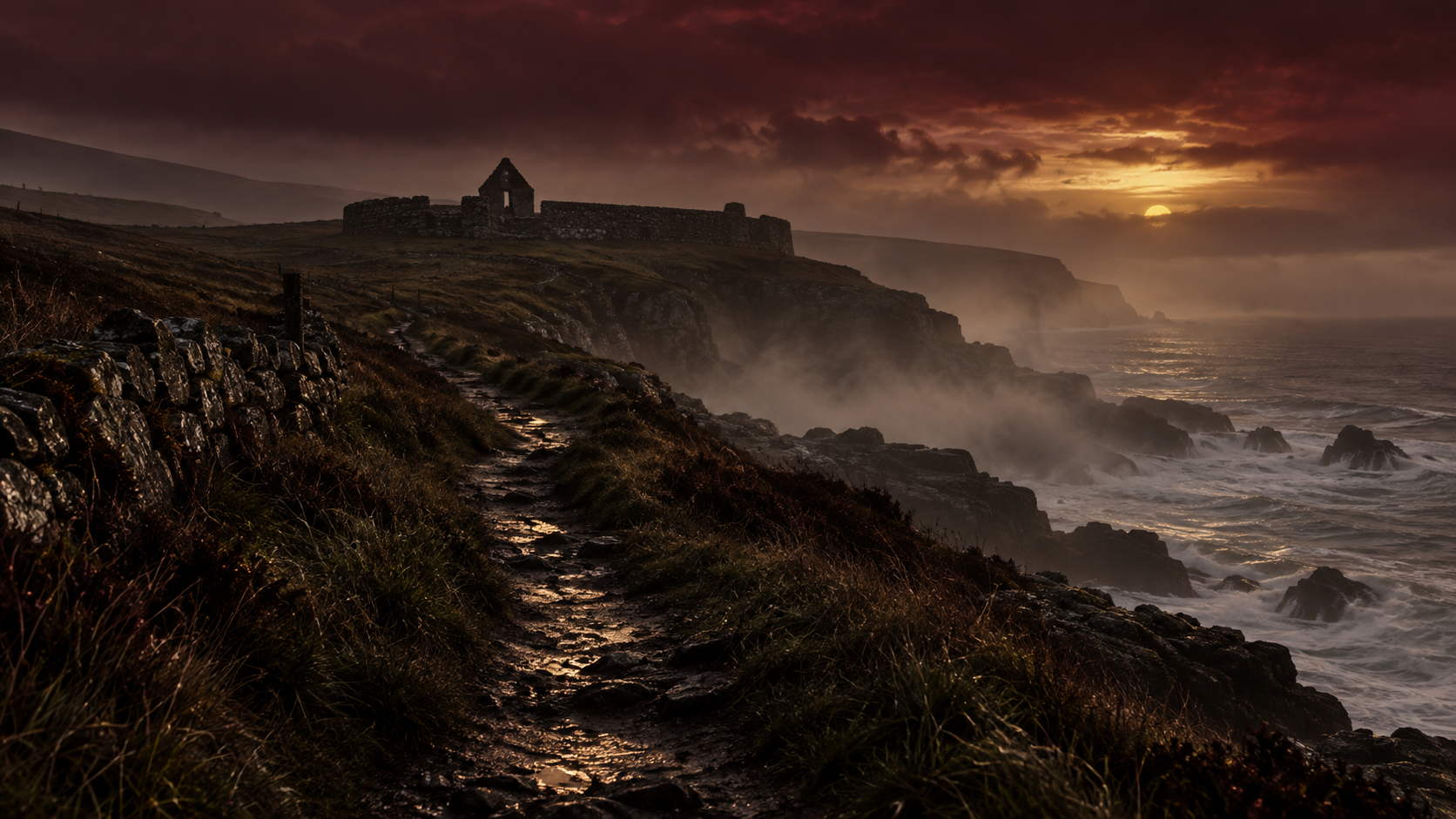

A “thin place” usually means a location where the boundary between ordinary life and the spiritual or otherworldly feels unusually near. People often connect the phrase to Celtic tradition, especially the landscapes of Ireland and Scotland. The careful answer is that the phrase is prominent in modern Celtic spirituality, while older Irish and Scottish stories contain many distinct ideas about the Otherworld, sacred sites, seasonal crossings, and beings associated with particular places. Those are related conversations, not proof that every ancient community used one shared category called a thin place.
That distinction matters if you love folklore. It lets a hill, well, island, or path have its own story instead of turning every location into a generic portal. It also keeps a useful modern metaphor from being mistaken for a documented ancient quotation.
What does “thin place” mean today?
In contemporary writing, a thin place may be a landscape where prayer feels easier, a site where the past seems present, or a moment when a person feels close to something beyond their usual account of the world. The language is flexible. Some writers mean God; others mean ancestors, fairies, memory, ecological attention, or simply awe.
A study of Celtic pilgrimage describes “thin places” as a theme in contemporary expressions of Celtic Christianity. That phrasing is more precise than saying the phrase is an unbroken ancient Celtic teaching. Another scholarly discussion of Iona traces the influential language of a “thin” boundary through modern religious and literary contexts, including George MacLeod’s descriptions of the island.
None of this makes the experience false. It changes what kind of claim we are making. “This place feels thin to me” is an account of experience. “Ancient Celts taught that this exact site was a thin place” is a historical assertion that needs a much more specific source.
What do older place traditions actually give us?
Irish tradition offers stories of the aos sí and places associated with them, including earthen forts and mounds. It offers encounters that turn on hospitality, trespass, time, and the rules of a place. Scottish, Welsh, and Breton traditions are not interchangeable variations of one Irish map. Each has its own languages, records, local practices, and later retellings.
Heritage Ireland’s account of Samhain describes Irish folklore in which the boundary between this world and the supernatural draws thin at the seasonal turning. It also notes stories of the aos sí associated with underground or otherwise hidden domains. That is a valuable connection to make, but Samhain is a calendar occasion; a holy well is a site; a fairy fort is a place embedded in a community’s rules. We lose detail when we flatten all three into the same label.

Is the phrase itself ancient?
It is safest not to present the English phrase as an ancient Celtic term. The scholarship above shows its strong modern life, especially around Iona and Celtic Christian practice. That does not prove no earlier person ever used a similar image. It does mean a blog post should not claim a single ancient origin without evidence. “Celtic” is also broad: it names languages and cultures across several places and periods, not one timeless belief system.
Writers sometimes say that a veil between worlds is thinnest at Samhain. This is a familiar and evocative modern explanation, and Heritage Ireland uses similar language when introducing the holiday’s folklore. But a neat one-line formula is still an explanation, not a substitute for the particular source, date, and community behind a given story.
The practical test is simple. Ask: Which tradition? Which place? Which recorded account? What does the storyteller say is there, and what is a later interpreter adding? A legend about a mound that must not be disturbed differs from a pilgrim’s account of prayer on Iona, even if both leave a reader feeling that ordinary categories are insufficient.
Why do thresholds work so well in stories?
A threshold joins two conditions without making them the same. Shorelines are land and not-land. Dusk is day and not-day. A cemetery is part of a living town but organized around the dead. A ruined building belongs to the present while visibly carrying an earlier use. These places naturally invite stories about uncertainty, permission, and return.
The strongest fiction does not merely announce that the “veil is thin.” It gives the crossing a cost. Perhaps a traveler must answer a question honestly; perhaps a path can be found only once; perhaps somebody takes a gift without understanding the obligation attached. The rules create tension because the reader can see how a good intention might still lead to harm.
For a neighboring tradition in which an encounter carries a clear social warning, see our banshee post. For a wider introduction to landscape and communal belief in fiction, see what folk horror means in books.

How to visit a meaningful place without turning it into a prop
You do not need to believe in a literal portal to approach a site with care. Check whether it is public, private, sacred, or protected. Stay on permitted paths. Do not take stones or offerings, leave candles, climb fragile ruins, or treat a living community’s practice as a spooky backdrop. Read the local interpretation before inventing a story about the place.
Then pay attention to more than atmosphere. Who maintains the site? What language appears in its name? Has its meaning changed through worship, tourism, conservation, or loss? An attentive visit can be more unsettling—and more respectful—than a staged midnight photograph.
If a local guide or community source offers a different account from the one you read online, do not immediately force the two into a single “authentic” version. Traditions can coexist, conflict, and change. Note who is speaking and when. Folklore is a record of relationships among people and places, not a list of supernatural properties assigned to scenery.
FAQ
Are thin places part of Celtic folklore? The modern phrase is commonly associated with Celtic spirituality. Older Celtic-language traditions include many stories about significant places and otherworldly encounters, but should not be treated as one uniform “thin places” doctrine.
Is Samhain a thin place? Samhain is a seasonal festival, not a location. Some Irish folklore and modern retellings describe the boundary between worlds as more permeable then.
Does a thin place have to be frightening? No. The phrase may describe wonder, prayer, grief, or closeness as readily as dread.
If carefully sourced folklore is your sort of autumn reading, join The Grimbard Press. For stories that let place shape the danger, browse October 31.
Sources: Celtic pilgrimage study; folklore scholarship on Iona; Heritage Ireland on Samhain.