Tag: death omens

  • Doppelgängers and the Fetch: Why Seeing Your Double Meant Death

    Doppelgängers and the Fetch: Why Seeing Your Double Meant Death

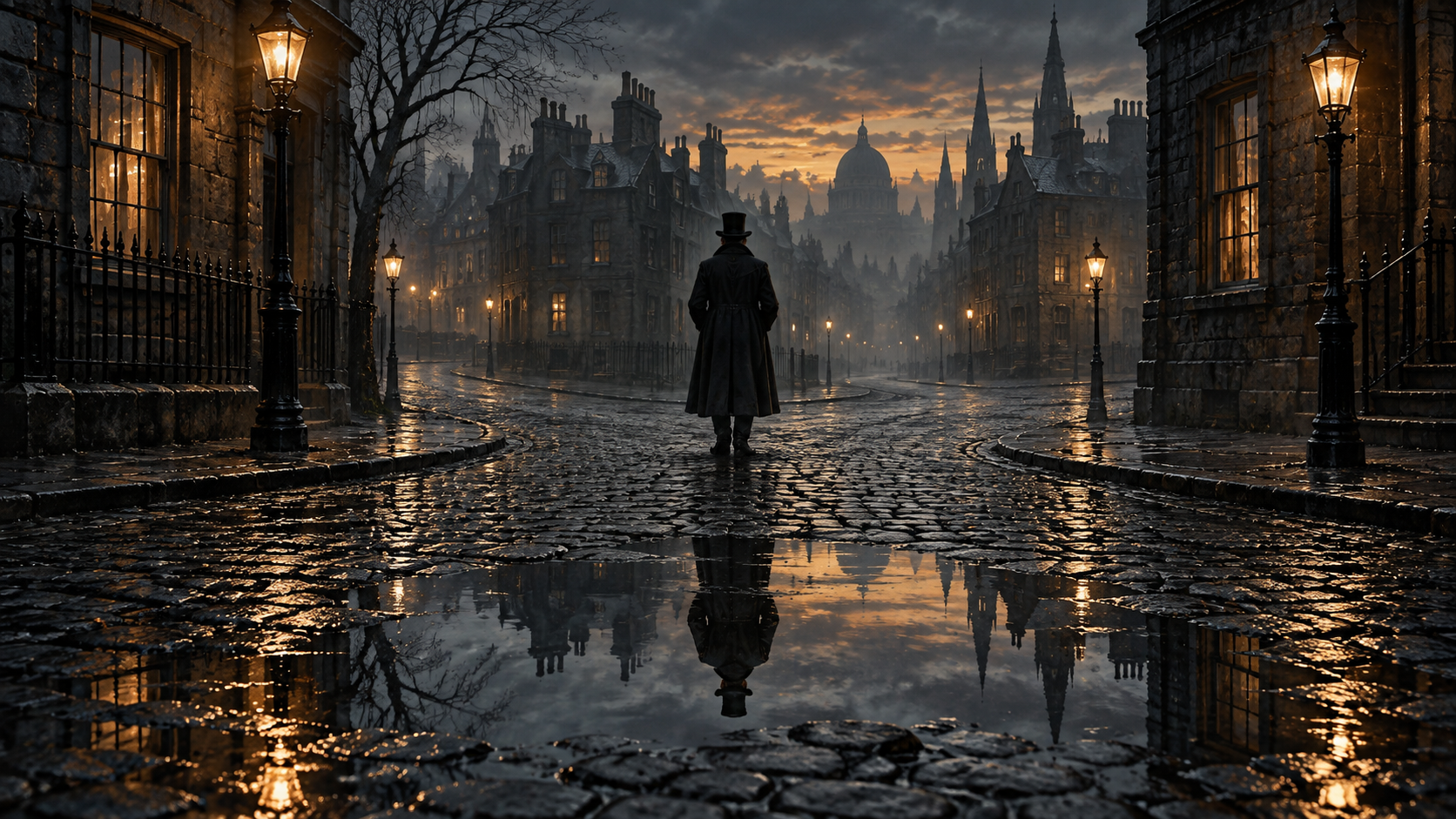
    Rainy Victorian crossroads where a puddle reflection faces the wrong way

    There’s a particular kind of fear that doesn’t need a monster in it. Someone you know walks past you on the road and doesn’t answer when you call. You find out later they were forty miles away.

    Nothing attacked. Nobody was hurt. And everyone who hears the story knows it’s bad.

    The word is newer than the belief

    Doppelgänger is German and means, plainly, “double-goer.” The writer Jean Paul coined it in the 1790s. The belief it names had been around for centuries in half of Europe under other names.

    In Ireland the double is the fetch, and the tradition comes with a rule that I find more unsettling than the apparition itself: the hour decides the meaning. See a person’s fetch in the morning and they’ll have a long life. See it in the evening and they won’t. Same sight, same person, opposite verdict, and nothing you can do to change which one you got.

    In Norway the vardøger works in reverse. You hear someone arrive before they arrive: footsteps on the porch, a key in the lock, a coat hung up. Then, a few minutes later, they do all of it again for real. The vardøger isn’t usually a death omen. It’s a spirit that runs ahead of its person, and people who grew up with it talk about it almost fondly.

    Scottish tradition has the co-walker, a double that keeps company with a living person and can be seen by those with the sight. Robert Kirk, a Scottish minister, wrote about that world in the 1690s in a manuscript now known as The Secret Commonwealth. Germanic tradition also has the fylgja and the wraith, and the meanings blur where the traditions meet.

    The famous sightings

    A tarnished mirror reflecting a shadowed Victorian hallway

    The literature of doubles is mostly literary men reporting on themselves, which is worth keeping in mind.

    Goethe described riding away from a meeting with a lover and seeing himself coming the other way on the road, dressed in clothes he did not own. Eight years later, he said, he rode that road again in exactly those clothes.

    Percy Shelley, in the weeks before he drowned in 1822, was reported to have seen a figure of himself who asked how long he meant to be content. Mary Shelley recorded the account after his death.

    Abraham Lincoln’s friend Ward Hill Lamon recorded Lincoln describing a double image of his own face in a mirror, one healthy, one pale, and Mary Lincoln reading it as a sign he would not survive a second term.

    The most detailed story, the one about the schoolteacher Emilie Sagée whose double appeared in front of a classroom of girls in the 1840s, was published by Robert Dale Owen in 1860 and has never been traced to any independent record. Treat it as folklore that arrived in the shape of a case study.

    Why the double is so frightening

    Most folklore monsters want something: blood, a child, a bargain, a debt. The double wants nothing. It doesn’t speak, chase, or bargain. It does what you do, badly, somewhere you aren’t.

    The threat it carries is that your identity is not a thing you own. Someone else can be you, in front of people who know you, and be believed. Every subsequent version of this story, the changeling that takes your child’s face, the thing in the ice wearing your friend’s coat, runs on that same fuel. The horror is not that something is out there. It’s that you can no longer prove which one of you is the real one, and neither can your friends.

    What the folklore says to do

    Not much, and that’s consistent. There is no salt or iron for this one.

    • Don’t follow it.
    • Don’t speak to it.
    • Don’t let it know you saw it.
    • Note the hour. In the fetch tradition, the hour is the whole message.

    When a belief’s only advice is “note the time,” what it’s really telling you is that the outcome was decided before you looked up.

    The story in October 31

    “Two of Everything” is the second story in October 31.

    > October 31st, present day — a research station, the ice.

    Adaeze Okoye keeps her mug on the left side of the desk because she’s left-handed and the desk isn’t. It’s the kind of small accommodation you make when you live somewhere built by other people, and it’s the kind of detail that starts to matter when the crew begins asking each other where everyone was at six in the morning.

    By then nobody wants to say the obvious thing out loud, and the alibis are useless: everyone was alone, the way everyone is alone at a research station in the off hours.

    The station has a crew, a schedule and a floor plan, all of which assume each person is one person. The story is about what happens to that arithmetic when it stops holding.

    —

    Two of Everything is Night 2 of 31 in October 31, thirty-one folk horror stories set on Halloween night across six centuries. Read it on Amazon → · Free with Kindle Unlimited.

    Take the 31 Nights challenge. One story a night through October, with a free printable calendar. Get the calendar →

    Previous: What Was a Strigoi? · Tomorrow night: The Banshee Doesn’t Scream, She Keens
  • The Banshee Doesn’t Scream, She Keens: The Real Irish Legend

    The Banshee Doesn’t Scream, She Keens: The Real Irish Legend

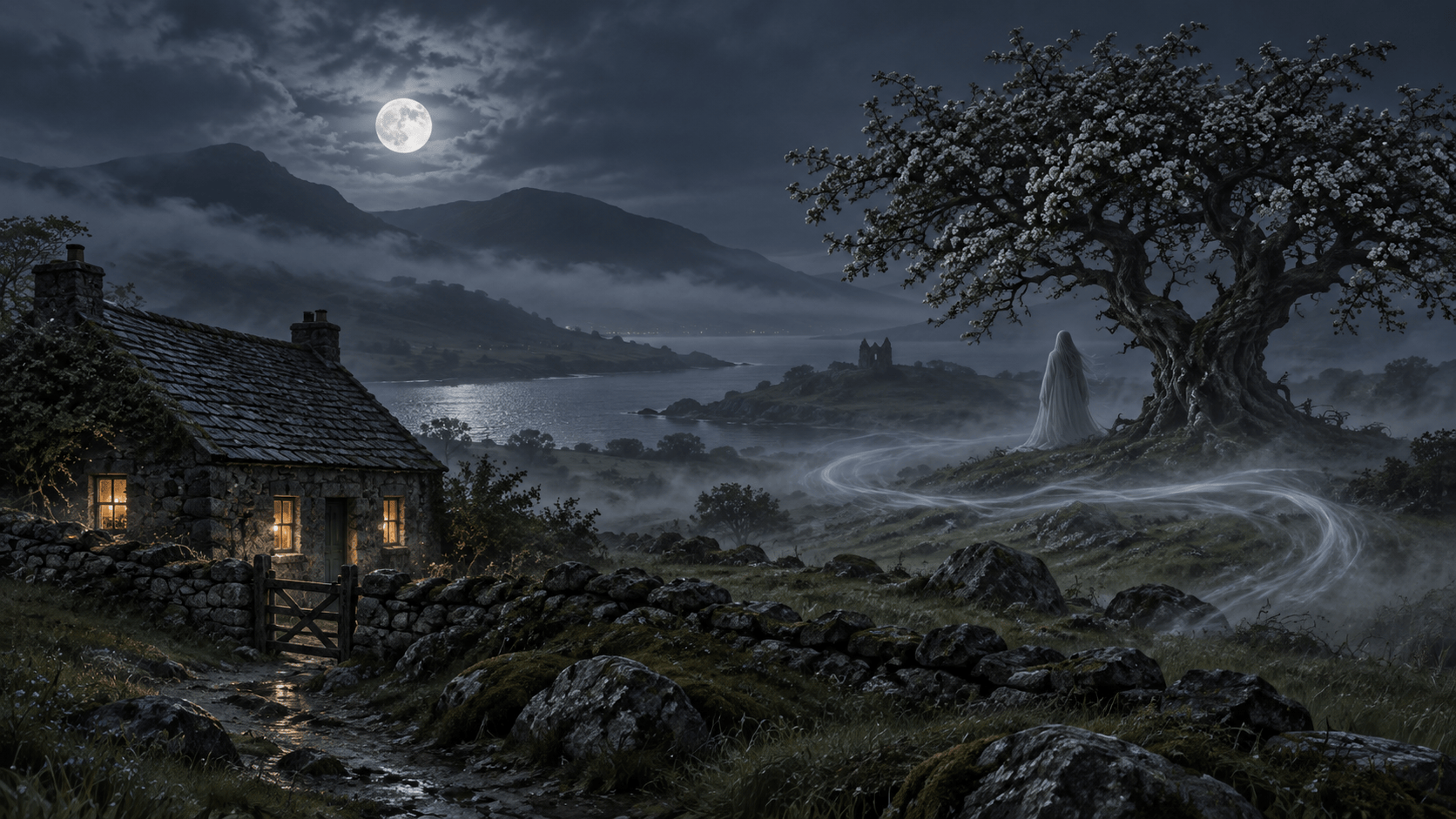
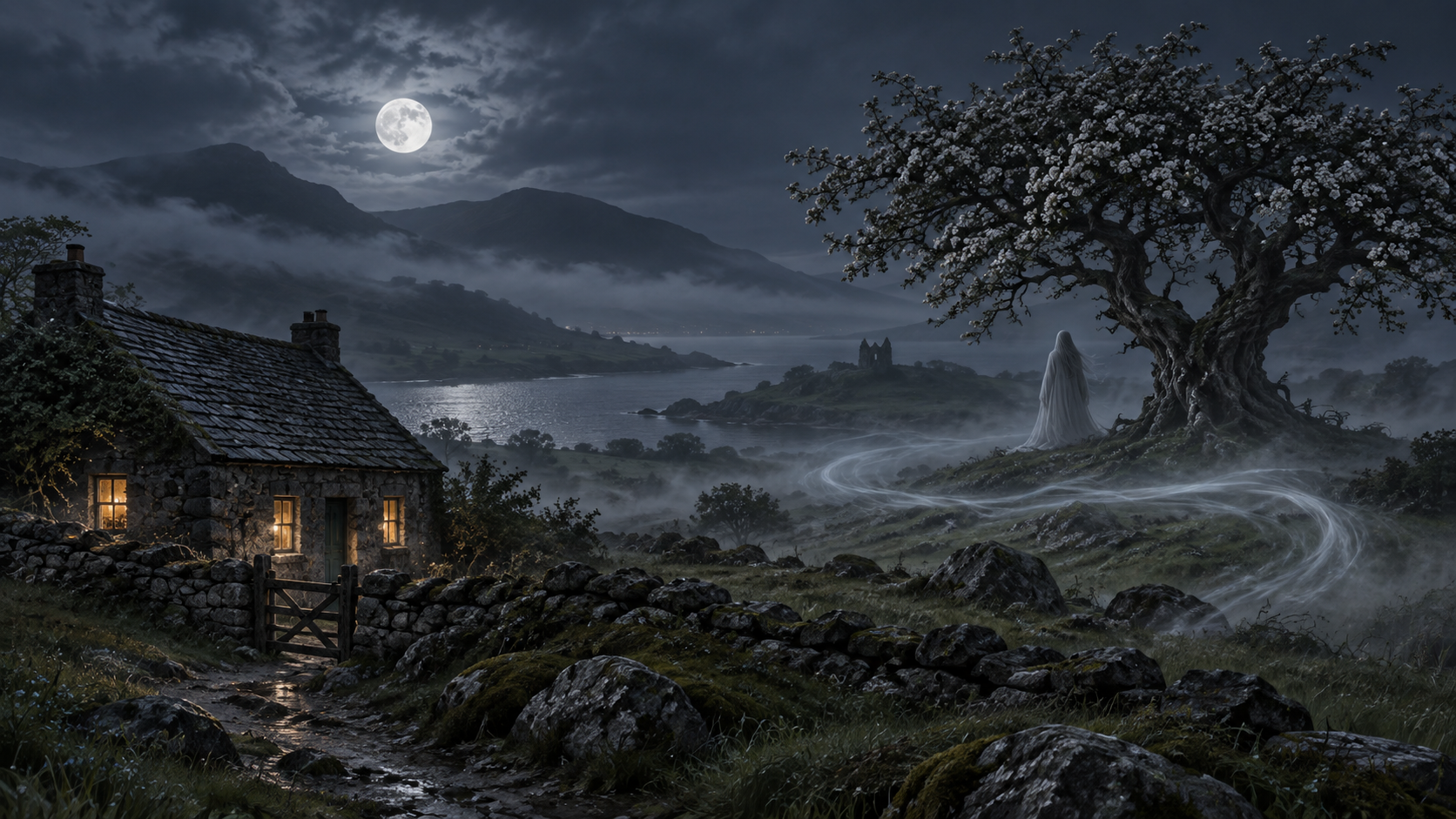
    Misty Irish cottage and hawthorn tree with a distant, face-obscured pale figure

    Horror films have made the banshee a screamer: a wailing woman who shows up and shrieks, and then something terrible happens. Irish tradition tells it differently, and the difference is the whole point.

    The banshee doesn’t cause a death. She mourns one before it happens.

    What “banshee” means

    The word comes from the Irish bean sídhe: bean is woman, and sídhe refers to the mounds, the old earthworks and hills where the otherworld was said to live. A woman of the mounds. She isn’t a ghost in the ordinary sense, and she isn’t a demon. She belongs to the older, stranger category of beings that shared the land with people and kept their own rules.

    Her one job is to announce a death. She’s heard at night, usually close to the house, sometimes for several nights before. Then someone in the family dies.

    The sound is a lament

    What people describe hearing isn’t random screaming. It’s keening.

    Keening (Irish caoineadh) was the formal lament women performed over the dead at wakes and funerals. It was a skilled practice. Some women were known for it and were asked to keen at wakes. The keen had structure, rising and falling, part song and part speech, calling out the dead person’s name and virtues and the family’s grief. The church spent a long time discouraging it as too pagan and too wild, and by the twentieth century it had mostly faded.

    So when people said the banshee was keening, they meant something specific. She was doing for the family what the keening women would do after the death. She was just early.

    That makes her something closer to a family retainer than a monster. She grieves with you. She simply knows first.

    Whose banshee?

    An old comb on a windowsill inside an Irish cottage at night

    In the older tradition the banshee doesn’t come for just anyone. She attaches to particular families, the old Gaelic lines, the names that begin with Ó or Mac. Some tellings name specific families she was bound to, and there are local traditions all over Ireland about which families had one and what she sounded like.

    Families that emigrated said she went with them. There are accounts from America and Australia of Irish families hearing the keen far from home before word of a death arrived by letter weeks later.

    What she looks like

    Accounts vary, and the variety is part of the legend. She can appear as:

    • a young woman with long hair,
    • a pale, dignified matron,
    • or an old woman, bent and grey, wrapped in a cloak.

    Most of the time she’s heard and not seen. When she is seen, she’s often combing her long hair.

    Don’t pick up the comb

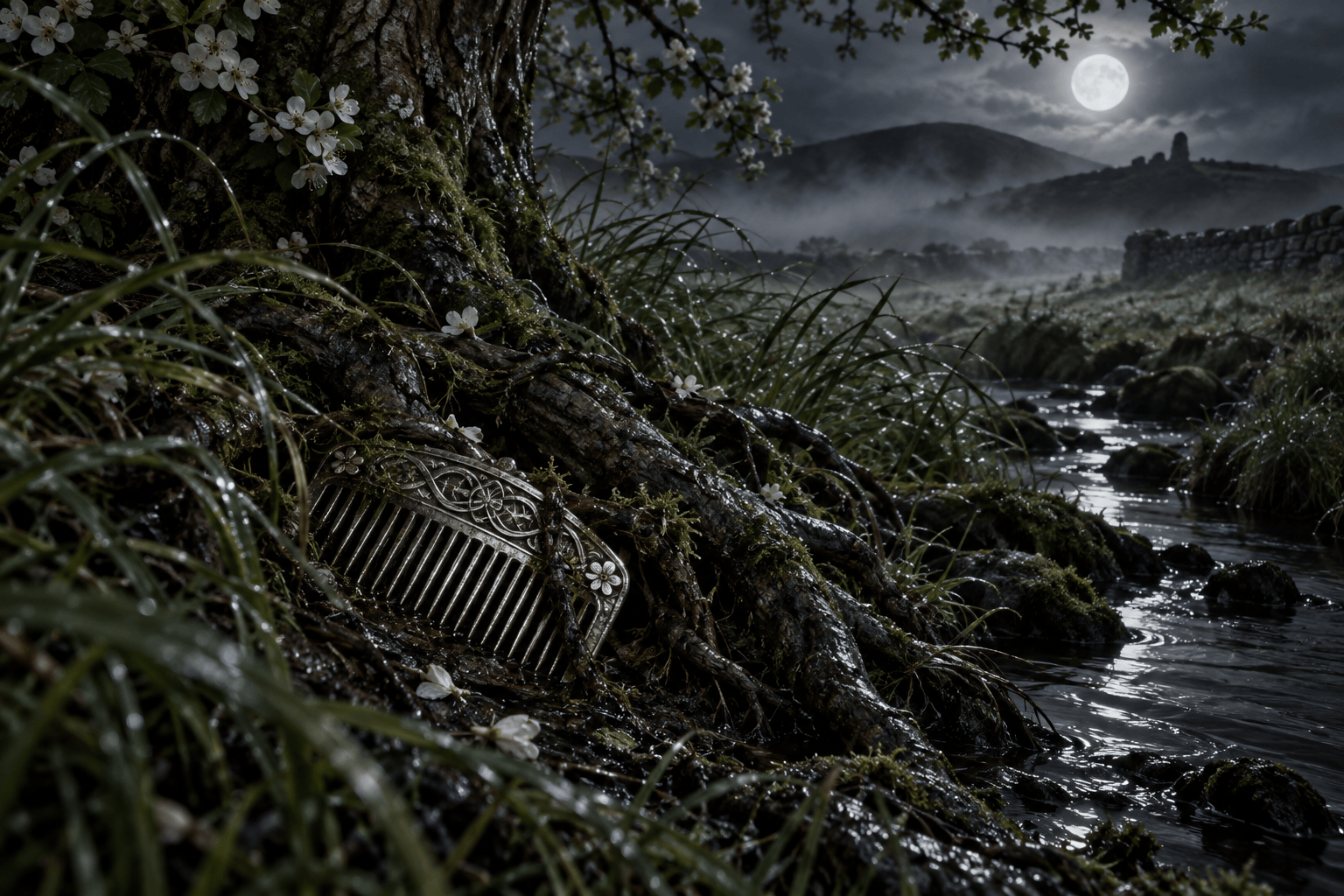
    This is the warning that has lasted longest, and you’ll still hear it in parts of Ireland. If you find a comb lying on the road, leave it. It may be hers, and she will come back for it.

    What happens to you if you take it depends on who’s telling the story. Some say she comes to the house for it. Some say you lose something you’d miss more. It’s a small rule, the kind that survives because it’s easy to follow: don’t take what isn’t yours from the side of the road on the wrong night.

    Her relatives

    Scotland has the bean nighe, the washer at the ford: a woman seen at a stream, washing the grave clothes of someone about to die. If you catch her you might get an answer from her, or a wish. Some scholars connect both figures to older war goddesses of Irish myth, the ones who appeared before battles to show who would fall. That connection is debated, but the pattern is clear. The Gaelic world pictured death announced in advance by a woman, and she’s usually doing women’s work around death: washing, mourning, keening.

    The other omens in an Irish house

    The banshee wasn’t the only warning. Irish and wider British tradition had a whole vocabulary of signs that a death was coming, and many families kept track of several at once:

    • Three knocks at the door or on the headboard, with nobody there.
    • A bird at the window, or a bird that gets into the house. Robins and magpies especially.
    • The death coach, the cóiste bodhar or “silent coach,” a black coach heard on the road at night, sometimes with a headless driver. If it stops at your door, it has come for someone inside.
    • The fetch, a double of a living person, seen where that person couldn’t be. Seen in the morning it meant long life. Seen in the evening it meant the opposite.
    • A picture falling from the wall for no reason.

    And once the death came, there were customs for the house itself. Someone opened a window so the soul could leave. The clocks were stopped at the hour of death. Mirrors were covered or turned to the wall so the soul wouldn’t be caught in the glass on its way out. The body was watched through the night of the wake and never left alone.

    Taken together, these customs show a culture that expected death to be announced and treated the days around it as dangerous ground. The banshee is just the most famous of the messengers.

    Hearing her in the twentieth century

    It’s tempting to treat the banshee as a medieval belief, and it isn’t one. Irish folklore collectors in the twentieth century, including the national Schools’ Collection of the 1930s, recorded banshee accounts from ordinary people describing what their parents and grandparents had heard, often naming the house, the road, and the family. For many rural families she was still a practical fact within living memory. That’s the world “Counting Them Out” is set in: 1948, electric light arriving slowly, and the old women still counting the boats.

    Why she’s frightening anyway

    She isn’t evil, and she’s still one of the most frightening figures in Irish folklore. The reason is simple: there’s nothing you can do.

    Most folklore monsters come with a defense. Salt, iron, running water, a cross cut into a tree. The banshee comes with none, because she isn’t the threat. She’s the news. By the time you hear her, the thing she’s mourning has already been decided.

    All you can do is count your family and wait.

    The story in October 31

    “Counting Them Out” is the third story in October 31.

    > October 31st, 1948 — a fishing village, County Clare.

    Aoife Nolan is working a splinter out of a neighbor’s palm when the sound comes through the cottage wall. Six boats went out that morning. The old women counted them out, the way they always do. Aoife has never once heard one of them count the boats back in where anyone could hear.

    And the keening coming up the harbour road is more voices than there are sons out on the water.

    If the legend above is what you believe, you already understand why that last detail matters. What Aoife does with that knowledge is the story.

    It’s also the story I’d point you to if you’ve never read anything of mine. It’s short, it’s quiet, and it’s the cleanest read-aloud in the book.

    —

    Counting Them Out is Night 3 of 31 in October 31, thirty-one folk horror stories set on Halloween night across six centuries. Read it on Amazon → · Free with Kindle Unlimited.

    Take the 31 Nights challenge. One story a night through October, with a free printable calendar. Get the calendar →

    Previous: Stingy Jack: The Real Irish Origin of the Jack-o’-Lantern · Next: Why Every Story in October 31 Happens on the Same Night

  • The Black Dog: Britain’s Deadliest Omen That Followed the Settlers

    The Black Dog: Britain’s Deadliest Omen That Followed the Settlers


    There’s a creature that made the Atlantic crossing intact.

    Folklore does not travel unchanged. Stories brought by immigrants met new landscapes, new neighbors, and new conditions; they were retold, translated, and sometimes folded into local traditions. Any account of that process needs care, especially where it touches distinct Indigenous traditions that should not be treated as a single backdrop for settler folklore.

    Black-dog stories are one recurring example: familiar British and Irish motifs appear in later North American storytelling, alongside local variations that deserve to be read on their own terms.

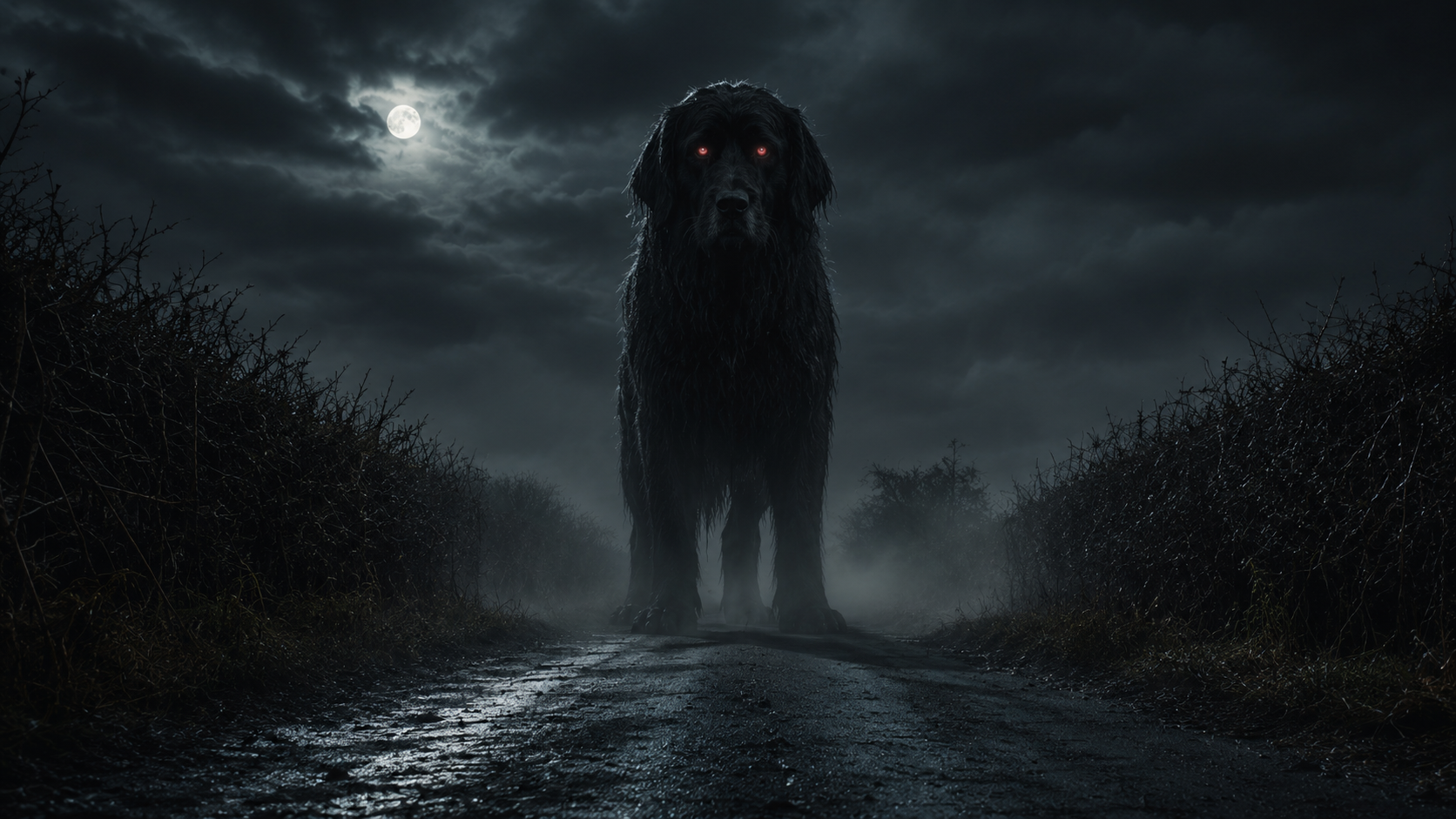
    It arrived in Appalachia looking exactly the way it had looked in Suffolk and Yorkshire and Wales. Large. Black. Eyes that were either red or yellow depending on the account, but always luminous. Moving silently on roads and lane-edges, appearing at crossroads and bridges, and meaning exactly one thing.

    Death is coming for someone you know.


    The British Originals

    The Black Dog tradition in Britain is ancient enough that establishing a single origin is probably impossible. What exists instead is a family of related regional beliefs, each with their own name and specific behavior, all sharing the central omen function.

    Black Shuck haunts the coastal areas of East Anglia. His name derives from the Old English scucca, meaning “demon” or “shadow creature.” He is enormous — descriptions range from the size of a calf to the size of a horse — and his appearances are concentrated on the lanes and shorelines of Norfolk and Suffolk. A detailed historical record of his appearance exists: on August 4, 1577, Black Shuck is said to have entered the churches at Bungay and Blythburgh during a violent thunderstorm, killing several people and leaving scorch marks on the church door at Blythburgh that are still visible.

    The scorch marks are genuinely there. They predate the legend’s first recorded appearance in print. I find this detail persistently interesting.

    The Grim is a variant that specifically haunts churchyards. In British tradition, the first person buried in a new churchyard would be obliged to haunt it and protect it from the devil — and a dog buried there in their place (a documented historical practice) would become the Grim instead. The Grim appears to those about to die. It does not cause the death. It announces it.

    In Wales, the Cwn Annwn — the Hounds of Annwn — are a pack rather than a single creature, the spectral hunting dogs of the underworld deity Arawn. Their appearance heralds death on a larger scale. In Devon, the Yeth Hounds perform the same function, sometimes ridden by headless horsemen for added context.

    The family resemblance is consistent across all of them: large, black, supernatural, ominous. Not evil in the conventional sense. Present.


    The Appalachian Persistence

    What’s remarkable about the Black Dog tradition in Appalachia is how completely it survived the transplant.

    Stories of spectral dogs appear in many North American regions, including parts of Appalachia. Some share details with British black-dog traditions—roads at night, crossroads, luminous eyes, and an encounter that feels ominous—while other versions differ in meaning and origin. A family resemblance is not proof of one uninterrupted tradition; oral stories change with every community that keeps them alive.

    In these accounts, the dog may accompany a traveler briefly, vanish, or be remembered as an omen after a loss. That retrospective connection is part of the folklore’s power, not a documented prediction.

    What I find genuinely interesting is that the Appalachian Black Dog almost never represents the traveler’s own death. It’s almost always a harbinger of death nearby. The creature is telling you something about someone else. It chose to show you. The question of why you were chosen is one the tradition doesn’t answer, which is part of what keeps it uncomfortable.


    The Dog That Watches

    There are two types of death-omen traditions in folklore, roughly speaking. The type that comes as an announcement — the banshee’s wail, the three knocks — and the type that comes as a witness.

    The Black Dog is a witness. It doesn’t perform grief. It doesn’t make noise. It simply appears and looks at you, with those luminous eyes, from the shoulder of the road.

    This is more disturbing than the announcement type, and I think it’s worth understanding why. The announcement implies a kind of relationship between the omen and the bereaved — you were specifically called to, warned, given information. The witness implies something different: that the death was already in motion, and something came to observe it, and you happened to be there.

    The witness doesn’t care about you. The witness is watching something you can’t see yet.


    Why the Crossing Mattered

    Most folklore scholars identify the Black Dog as one of the most geographically distributed supernatural traditions in Europe, appearing in some form across almost every regional tradition from Scandinavia through the British Isles and into the Iberian Peninsula. This distribution suggests the tradition is old enough that the individual national versions are regional expressions of a single archetype, not independent inventions.

    The fact that it survived the crossing to Appalachia intact, in communities that were otherwise highly adaptive with their imported folklore, suggests something specific about the Black Dog: it was too useful to change. Communities under stress need a way to talk about death’s approach. A creature that observes, that witnesses, that appears on the road between where you are and where the dead are going — that is a useful symbolic technology. It survived because it was doing real cultural work.

    It’s still doing it. Appalachian Black Dog accounts are still collected regularly in contemporary folklorist interviews. The creature hasn’t retired.

    If you’re driving the mountain roads after dark, keep your eyes on the roadside.

    If you see something large and black looking at you from the shoulder with luminous eyes, keep driving.

    And when you get home, call the people you love.


    Folklore deep dives like this one go into the research that feeds my fiction. If you want the stories themselves: There Be Monsters: Then and Now.

    For weekly folklore, dark tourism, and new horror fiction: join the Grimbard list.