The Mary Celeste Mystery: What We Know About the Empty Ship
An empty ship makes a particular demand on the imagination. A house can be left because its occupants moved. A vessel at sea is a smaller world with fewer exits. When the people are gone and the ship remains, the question is not simply where they went. It is what convinced them to leave the one thing keeping them alive.
The Mary Celeste was found adrift near the Azores in December 1872 by the crew of the Dei Gratia. Its captain, his family, and crew were absent. The ship’s abandonment was real; a final certain explanation is not. The mystery has gathered a thick skin of ghost-ship details over the years, so the responsible version starts by separating the historical record from the story people wish it told.
The discovery was documented
Royal Museums Greenwich reports that the Dei Gratia sighted the brigantine adrift in the Atlantic near the Azores on 4 December 1872. The ship had departed New York for Genoa the previous month. The Historical Association’s account places the abandonment sometime between 25 November and 4 December and notes a damaged or disordered deck, open hatches, and worn rigging.
Those facts are already enough. A commercial vessel was found without the people who had been aboard it. The rescue vessel had to decide what it was seeing, how to bring the ship in, and how to account for a situation that would become a salvage inquiry.
The word mystery does not mean no evidence exists. It means the evidence does not force one conclusion.
The popular story has added furniture
Illustration: documented facts and unproven Mary Celeste theories should remain separate.
You may have heard that the Mary Celeste carried a hot meal left on the table, a cat alive below deck, or every possession intact as though the crew had stepped away for a minute. Those images are good fiction. They should not be treated as the core historical record without a source from the investigation or a reliable maritime archive.
This is the trouble with a famous absence. It invites props. Every added detail makes the room more theatrical and the mystery more certain-looking. But a properly told Mary Celeste story is not a locked-room puzzle with one missing clue. It is an incomplete maritime record whose missing people cannot clarify it.
That incompleteness is the entire engine.
Why would anyone leave a seaworthy ship?
Any explanation has to reckon with the basic terror of the decision. The sea is not an empty road. A lifeboat or small boat is a worse shelter than a brigantine unless the people aboard believe remaining is immediately more dangerous.
Several ideas have been proposed: fear of weather, problems with navigation or pumps, a temporary evacuation, concerns about alcohol vapour from the cargo, or some combination of pressure and misjudgment. None becomes fact merely by being plausible. A hypothesis may explain one feature of the scene and fail another.
The best article therefore ranks, rather than crowns. A weather-based explanation is a reconstruction of conditions. A cargo-vapour theory is a reconstruction of perceived danger. Fraud and violence are claims that require stronger evidence than their melodrama supplies. Supernatural explanations are part of the legend’s afterlife, not evidence from the ship.
Before publication, every specific statement about the lifeboat, cargo, chronometer, pump, logbook, and salvage hearing should be checked against an archival or court source. The point is not to make the story less readable. It is to stop readability from borrowing the authority of a document we have not inspected.
Ghost ships are machines for making absence visible
Illustration: the voyage, discovery, and Gibraltar salvage inquiry form the documented timeline.
A sea monster gives fear a body. A ghost ship gives fear a vacancy.
That distinction explains why sailors’ sea-monster beliefs and the Mary Celeste sit beside one another without being the same story. The monster is something seen at the edge of knowledge. The empty ship is a record of people who saw something—or feared something, or made a choice—and are not available to tell us which.
The ship itself becomes a witness with no language. Its deck, rigging, cargo, and log offer fragments. They can show condition. They cannot report motive. Horror understands this instinctively. The more an object appears to know, the more unbearable it is when the object cannot speak.
Why no final answer is the honest ending
The Mary Celeste has lasted because it refuses the kind of ending readers often demand. We want a culprit, a wave, a leak, a betrayal, a creature. The record gives us competing reconstructions instead.
That does not make all explanations equal. It means the final sentence must stay proportionate to the evidence. The crew disappeared. The ship was found. The rest is argument.
That is enough to make the vessel frightening. A ship is built around collective dependence. Ten people can endure bad weather, bad food, cramped quarters, and fear because the ship gives them a shared task: keep it afloat. The Mary Celeste is the nightmare of finding the task still in progress after the people have vanished.
An unsolved history is not an invitation to invent whatever answer fits the mood. It raises the standard for every detail we retain. A strong account marks the boundary between document and inference, then leaves that boundary visible. On a dark sea, certainty is not improved by shouting into it.
For maritime myth and the monsters people imagined beyond the chart’s edge, Monsters of the Wine-Dark Sea is the natural next voyage. For an original story about a vessel that keeps perfect time without its passengers, join The Grimbard Press and receive Dead Ship, the free illustrated Subscriber Archive Edition.
FAQs
When was the Mary Celeste found?
The Dei Gratia sighted the Mary Celeste adrift near the Azores on 4 December 1872.
Was the Mary Celeste completely undamaged?
No simple version is accurate. Historical accounts describe a vessel that could be brought in but also record signs of disorder and weathering. Specific conditions should be traced to the salvage record.
What happened to the Mary Celeste crew?
No definitive explanation has been established. Proposed explanations include weather, navigation problems, perceived danger from cargo, and temporary evacuation.
Is the Mary Celeste a true ghost ship?
It is often called a ghost ship because it was found abandoned, but there is no evidence that a supernatural event caused the disappearance.
Victorian Postmortem Photography: What These Images Were Actually For
Old photographs have acquired a bad reputation on the internet. A child sits too still. A woman’s face is severe. Someone sees a stand behind a shoulder and announces that the subject must be dead.
Usually, that confidence is borrowed from a myth.
Victorian postmortem photography was real. It was a mourning practice in which a deceased person was photographed, sometimes because the family had no image of them from life. But it does not follow that every unsmiling nineteenth-century portrait is postmortem, that a posing stand proves death, or that families were staging some elaborate performance of the uncanny. The historical image deserves better attention than a viral diagnosis.
Postmortem photographs were made to remember and mourn the dead. They can feel disturbing now because early photography, death, intimacy, and stillness meet in a form that modern viewers often encounter without its original context.
The photograph was sometimes the only likeness
Photography changed what a family could keep. In the early decades after the daguerreotype’s invention in 1839, a portrait could be costly and uncommon. The Smithsonian’s National Museum of American History notes that a postmortem daguerreotype might be the only photograph that existed of a deceased person. That fact alters the emotional temperature of the image.
It was not made primarily to frighten a future stranger. It was made because a person had died and someone wanted a visible record of their face.
The Library of Congress defines postmortem photographs as pictures of deceased people or pets, often posed in a lifelike or resting manner and preserved as keepsakes. Its wording is carefully limited. It does not say that all portraits from the period are postmortem. Nor should we.
Stillness is not a diagnosis
Illustration: visual clues in old portraits are not automatic proof of postmortem photography.
Long photographic exposures required sitters to hold very still. That alone explains a great deal of the stern posture modern viewers mistake for death. Posing stands, clamps, and other supports helped living people remain steady during a portrait session. They are not corpse stands.
The same warning applies to closed eyes, blurred hands, pale skin, or an unfamiliar expression. An old photograph has technical limits and social conventions. It may show fatigue, grief, formal posing, motion, damage, or a person who simply did not smile for the camera. Treating every ambiguity as evidence of a dead subject says more about our appetite for a secret than it does about the picture.
This is not an argument that postmortem images are imaginary. Collections label known examples, and the practice is well documented. The University of Michigan’s Clements Library describes how such photographs could preserve the memory of a loved one, especially a child who had not been photographed while alive. The useful distinction is between an identified object in a collection and an internet guess.
Mourning was visible, not hidden
Nineteenth-century death occurred more often in the home than it does for many people today. Mourning customs were public and material: clothing, hairwork, memorial cards, funeral rituals, framed photographs. The Met describes postmortem portraiture as a final visual record able to preserve the image held in the mind.
That does not make the photographs cheerful. It makes them legible. A family could hold love and grief in the same image without treating the dead person as an object of spectacle. Modern discomfort may partly come from the fact that we encounter the image detached from that relationship, circulated as a curiosity with its original name and mourners stripped away.
The difference matters. “Creepy” is often a word we use when someone else’s intimacy arrives without an invitation. It should not be the only word we have.
The real horror is what context removes
Illustration: early photography and mourning practices need their historical context.
An unidentified image can become a haunted prop in seconds. Someone crops it, adjusts the contrast, adds a claim about a corpse propped in a chair, and sends it through the same channels that spread ghost stories. The audience receives a puzzle rather than a person.
That process is related to why mirrors, dolls, and old recordings work in horror. A familiar human signal arrives with something missing: movement, voice, context, a reply. In the dark-mirror illusion, the brain tries to resolve incomplete visual information. In an unlabeled old portrait, the culture does something similar. We fill a historical silence with whatever story we already know.
The responsible response is slower. Check the archive label. Look for a photographer, date, collection record, and provenance. Distinguish a memorial photograph from a living portrait. Do not repost identifiable deceased people as decorative mood boards. And do not assume that a family’s photograph exists for our entertainment.
Photography made the boundary visible
The camera’s unsettling promise is that it preserves a face while time keeps moving. Postmortem photography makes that promise unusually direct. The person cannot return the gaze, but their image remains available to it.
That is why the practice belongs near gothic fiction. The image seems to keep someone present, while reminding the viewer that presence is not the same as life. The Scarab has room for that kind of old, intimate unease: objects that carry more history than their owners can bear.
The final courtesy is simple. Let the photograph be a record of mourning before it becomes a piece of horror aesthetics. It will still be unsettling. It may become more so, because then the absence belongs to someone real.
> Join The Grimbard Press for Dead Ship, a free illustrated Subscriber Archive Edition, and evidence-minded visits to the stranger shelves of history.
FAQs
Was Victorian postmortem photography real?
Yes. Archives and museums hold labelled examples of photographs made after death as keepsakes or memorials.
Does a posing stand prove a person in an old photograph was dead?
No. Long exposures often required supports for living sitters. A stand, stiff pose, or serious expression is not enough to identify a postmortem portrait.
Why were postmortem photographs made?
Early photographs could be rare and expensive. For some families, a postmortem image was the only visual record they had of a loved one.
Should historic postmortem photographs be shared as horror images?
Only with strong context, appropriate rights, and respect for the deceased and their family. They are records of mourning, not generic spooky decorations.
The Fear of Being Buried Alive: Why Safety Coffins Haunted the Nineteenth Century
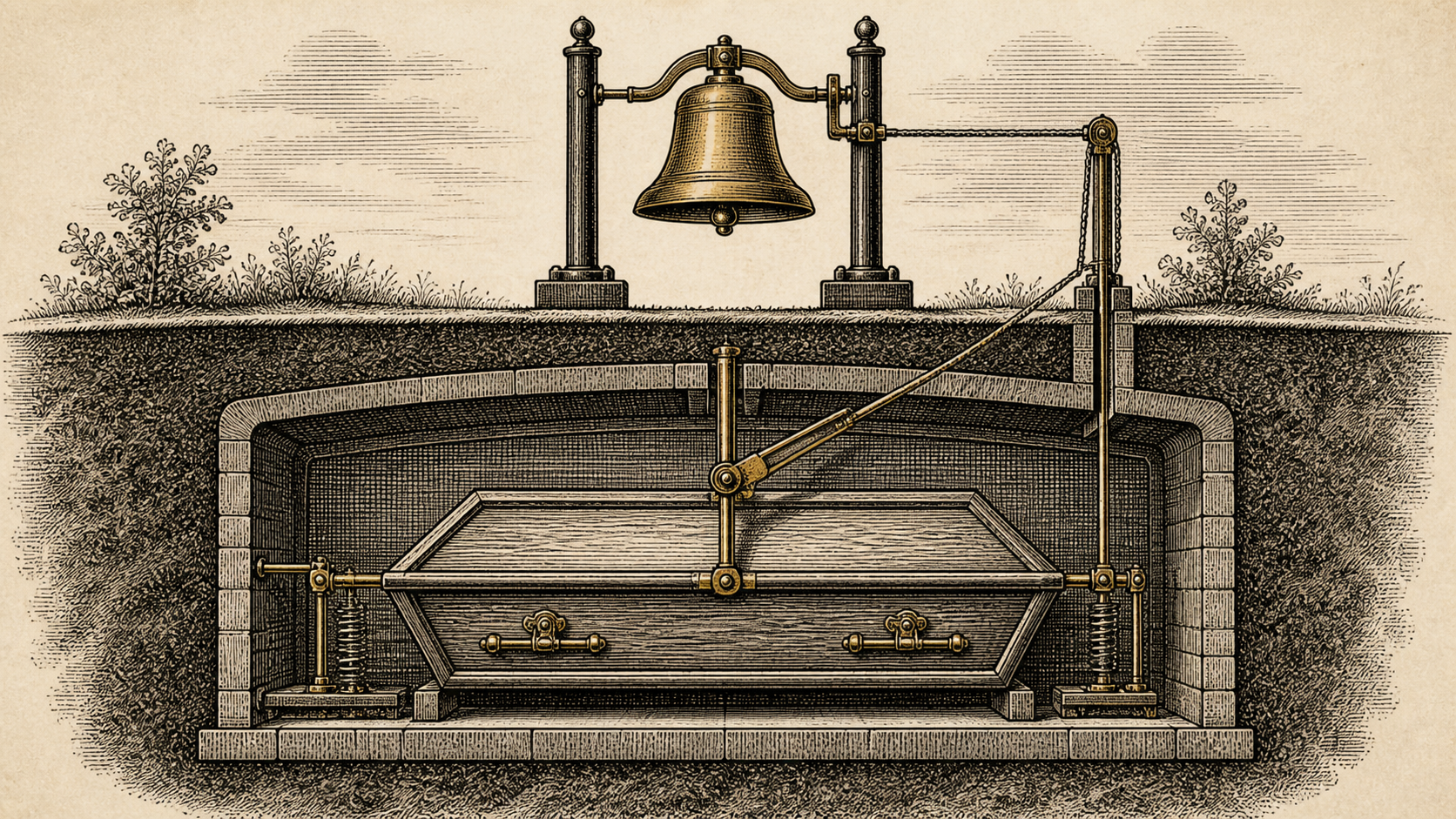
A bell above a grave is a clean piece of horror design. Someone below pulls a cord. Someone above hears it. Between them is dirt.
It is also easy to let that image do too much historical work. Safety coffins existed. They were patented, advertised, sketched, and argued over. They are evidence of an intense fear of premature burial. They are not, by themselves, evidence that graveyards were full of people saved by bells.
The nineteenth-century fear of being buried alive grew from a genuine uncertainty: determining death was harder before modern diagnostic methods and before many people had reliable access to trained medical care. That uncertainty produced waiting mortuaries, proposed alarm systems, and a long afterlife in gothic fiction. The history is frightening because it shows how much terror can gather around a boundary people cannot confidently see.
What “premature burial” means
Premature burial means burial of a person who is still alive. The possibility has haunted many cultures, but it took a particular grip on nineteenth-century Europe and North America, where newspapers, medical debate, patent culture, and popular literature fed one another.
In a 2016 history in History of Psychiatry, Marco Cascella notes that the Italian psychiatrist Enrico Morselli used the term taphophobia in 1891 for an extreme fear of being buried alive. The word is useful as historical vocabulary, but it should not be used casually to diagnose a reader who finds the idea upsetting. The fear needs no diagnosis to make sense. It places the body in the one location from which it cannot argue back.
The central problem was apparent death. A body might be cold, still, faintly breathing, or hard to rouse. Nineteenth-century medicine had methods of observation, but not the certainty later readers tend to imagine. When the fear became public, the most memorable answer was mechanical: build a coffin that lets the occupant send a signal.
The safety coffin was a solution to a nightmare
Illustration: apparent death, safety devices, and gothic fiction belong to different kinds of evidence.
The designs varied. Some used cords attached to bells. Some proposed breathing tubes, movable lids, flags, escape hatches, or mechanisms triggered by movement. A review in Forensic Sciences, Medicine and Pathology describes nineteenth-century security-coffin ideas that included alarms, pipes, and devices meant to allow survival until a rescue could occur.
That catalogue is more unnerving than any one design. It turns the grave into a machine with user instructions. Yet the same review supplies the necessary restraint: these devices were answers to fear, and claims about their practical success require separate proof. A bell might be set off by swelling, decomposition, or shifting material. A patent drawing is not a rescue record.
This distinction matters. Horror history is full of objects that become more dramatic every time they are repeated. The safety coffin is already dramatic enough. It shows that people could imagine the failure in precise, expensive detail.
Waiting mortuaries and the need to know
Some European communities tried another answer: delay burial and observe the recently dead until unmistakable changes appeared. The 2023 review “Premature burial” discusses holding mortuaries with resuscitation facilities, especially in continental Europe, as a response to uncertainty over death diagnosis.
This is the less famous image, perhaps because it lacks the bell and the grave. It may be the more revealing one. A waiting mortuary admits that the frightening thing is not burial alone. It is the interval before anyone can honestly say the body has crossed the threshold.
That interval is where gothic fiction lives. A locked coffin is frightening because it appears to settle a question permanently. A waiting room for the dead is frightening because it does not.
Poe understood the architecture of the fear
Illustration: a patented safety coffin does not prove a documented rescue.
Edgar Allan Poe did not invent the fear, but he gave it memorable rooms to occupy. His 1844 story “The Premature Burial” arrived in a century already interested in apparent death and safety devices. Poe’s contribution was not medical explanation. It was enclosure: narrow space, darkness, awakening, the mind turning every sensation into proof that it is too late.
That is why the trope survived advances in medicine. The literal risk can change while the symbolic fear remains useful. Being buried alive is fear of a false conclusion. Everyone else has decided the story is over. You are still inside it.
The same pressure sits beneath curse narratives. In the history behind the mummy’s curse, the sealed tomb becomes a warning about disturbing the dead. Premature-burial horror reverses the direction: the living person is sealed away as if already dead. Both stories make a door carry more certainty than the people on either side possess.
What the records do not let us say
The careful version of this history leaves several satisfying claims on the floor.
We cannot say that every safety-coffin patent was widely used. We cannot turn a rope-and-bell illustration into proof that someone woke beneath a cemetery. We cannot use exhumed remains, scratches, or a crooked body as a simple forensic answer centuries later. Bodies and graves change for many reasons.
We can say that the fear was culturally powerful. Physicians, inventors, writers, and mourners treated apparent death as a problem worth worrying over. That is enough to explain why the image kept returning.
Today, modern death determination is profoundly different from nineteenth-century practice, and the contemporary article in the source packet describes actual premature burial as rare where qualified medical care is available. This is history, not a reason to mistrust current medical professionals or to make decisions about death care from a horror blog.
The bell is still ringing because the question is not
The safety coffin endures because it offers a cruelly simple bargain: if you are alive, make a sound. The trouble is that the fantasy assumes someone is listening.
That is the darker half of the story. The bell above the grave promises connection, but it also imagines a world in which rescue depends on being heard through the earth. The invention does not defeat helplessness. It gives helplessness a cord to pull.
For fiction about death, rooms, and the presences that refuse their assigned category, There Be Monsters: Among the Dead is the natural next shelf. And if you like hauntings that migrate into modern systems, the ghost in the warehouse follows the fear after it leaves the graveyard.
> Join The Grimbard Press and receive Dead Ship, a free illustrated Subscriber Archive Edition, along with future archive files and monster lore.
FAQs
Were safety coffins real?
Yes. Nineteenth-century inventors patented and proposed coffins with alarms, breathing tubes, and escape mechanisms. Their existence documents concern about premature burial, not routine successful rescues.
Why did people fear being buried alive in the nineteenth century?
Death could be difficult to determine in some circumstances, and press stories, medical debate, inventions, and gothic fiction made the possibility culturally vivid.
Did bells on graves actually save people?
Popular stories often imply that they did, but a safety device or patent is not proof of a documented rescue. Claims about a specific event need a reliable contemporary record.
Is premature burial still common?
No. Modern medical practice has far more reliable methods for determining death. The historical fear should not be treated as a guide to present-day medical care.
Between 1958 and 1962, somewhere between thirty and forty-five million people starved to death in China. The estimates vary by scholar — Frank Dikötter puts it around forty-five million, Yang Jisheng’s meticulous accounting lands near thirty-six — and the uncertainty spans more human beings than lived in most countries on earth at the time. It is, by a wide margin, the deadliest famine in recorded history, and quite possibly the deadliest single event humans have ever inflicted on themselves.
Almost none of the people who caused it wanted anyone to die. That’s the sentence I can’t get past, and it’s why the Great Chinese Famine belongs in any honest conversation about the shape of real horror. The catastrophe wasn’t driven by a lust for killing. It was driven by a vision, a set of quotas, and a bureaucracy too frightened to report the truth. The corpses came from the paperwork.
The Vision Was the Weapon
The Great Leap Forward was supposed to be a miracle. Mao Zedong’s plan was to vault China from a peasant economy into industrial superpower status in a matter of years, through sheer mobilized human will. Peasants were herded into vast people’s communes. Private farming was abolished. And two ideas at the center of the plan turned a hard project into a mass grave.
The first was steel. Mao decreed that China would out-produce Britain, and to do it, peasants across the country built hundreds of thousands of “backyard furnaces,” small smelters in which they melted down their own pots, tools, and farm implements to produce steel. The steel was almost entirely useless, brittle pig iron of no industrial value. But producing it consumed the labor of the harvest season and the very tools needed to farm. Fields went unharvested because the entire village was tending a furnace making garbage metal to hit a number sent down from Beijing.
The second idea was agricultural fantasy. The regime embraced the pseudoscientific theories of the Soviet agronomist Lysenko — close planting, deep plowing, the rejection of established biology in favor of ideologically pleasing nonsense. Peasants were ordered to plant seeds so densely the crops choked and died, to plow so deep they ruined the soil. And then there was the campaign against the “four pests,” one of which was the sparrow, blamed for eating grain. The nation was mobilized to kill sparrows — banging pots to keep them flying until they dropped dead from exhaustion, tens of millions of them. The sparrows had also been eating locusts and insects. With the birds gone, the insect populations exploded, and the locusts ate what the bad farming hadn’t already destroyed. An entire ecosystem’s pest control was dismantled by decree, and the fields paid for it.
The Lie That Killed the Most
Here is the mechanism that turned failure into mass death, and it’s the most important part, because it’s the part that recurs. It’s not unique to Mao or to communism. It’s a property of a certain kind of system.
The commune officials had to report their harvests up the chain. Reporting a bad harvest was politically dangerous — it looked like failure, like insufficient revolutionary zeal, like sabotage. So officials inflated the numbers. They reported harvests that hadn’t happened, yields that were physically impossible, grain that existed only on the form. And the reports were believed, or at least acted upon, because the whole system was built to reward good news and punish bad. The next level up added its own optimism and passed it higher.
Then the state calculated its grain requisition — the amount it would seize from each region to feed the cities and to export — as a percentage of the reported harvest. The reported harvest was fiction. The requisition was real. So the state came to the villages and took a share of a phantom crop, which in practice meant taking the actual food that existed, all of it, down to the seed grain, because the paperwork said there was a surplus that had never grown. The grain was shipped out of starving regions. China went on exporting grain during the famine to maintain the appearance of the Leap’s success and to service its image abroad. People starved to death sitting on top of the country’s food, because a form said the food was somewhere else.
That’s the horror engine. Not cruelty. A quota, a punishment for honesty, and a requisition calculated from a lie. Each official was doing the locally rational thing — inflate your numbers or be purged — and the sum of all those locally rational lies was a famine that killed tens of millions.
What the Clinical Reality Looked Like
I won’t dwell on the worst of it at length, because there’s a line between bearing witness and rubbernecking, and the survivor testimonies and the county archives that Yang Jisheng and Dikötter worked from deserve to be treated as evidence, not spectacle. But the record has to be stated plainly or the abstraction of “thirty-six million” does its own kind of erasing.
People ate the seed grain, then the tree bark, then a white clay called “Guanyin soil” that filled the stomach and killed by intestinal blockage. Families died in sequence in their homes. There is documented cannibalism in the archives — people driven past the last edge of what a human being can be reduced to. Cadres who requisitioned too zealously beat and tortured peasants suspected of hiding grain, and in some counties the local violence became its own atrocity layered on top of the starvation. This was not a drought, though drought and flood in some regions made it worse. It was, in its essential structure, a policy famine — a catastrophe manufactured by decisions, executed through a bureaucracy, and sustained by everyone’s fear of telling the truth upward.
Why “Deadliest Dictator” Is Almost the Wrong Frame
We rank the deadly regimes — Mao, Stalin, Hitler, Leopold — and there’s value in the accounting. But the ranking can smuggle in a comforting error: the idea that these death tolls flowed from the personal evil of a single monstrous will, and that the solution is therefore to keep monsters off thrones.
Mao was responsible. He set the vision, he silenced the officials who tried to tell him the truth — at the 1959 Lushan Conference, the defense minister Peng Dehuai raised the alarm about the famine and was purged for it, a signal to everyone else to keep lying — and he prioritized his ideological project over tens of millions of lives. The responsibility is his and it’s enormous. But the mechanism wasn’t his personal sadism. It was a system that had made honesty fatal and optimism mandatory, running on quotas that couldn’t be questioned and reports that couldn’t be true. Mao pointed the machine. The machine was built out of ordinary people making the safe choice at every level, and the safe choice, aggregated, was murder.
That’s the reframe, and it’s the one I think matters most, because it’s portable. A death toll driven by a monster is a rare event; you need the monster. A death toll driven by a system that punishes bad news and calculates real consequences from fake data is a structure, and structures recur. Every institution that rewards the person who reports success and buries the person who reports the problem is running a small, non-lethal version of the same engine. The famine is the extreme case that shows you what the engine does when nothing stops it.
The Thing I Take From It as a Writer
I write horror, and the deepest fear I know isn’t the creature in the dark. It’s the system that has no malice and kills anyway — the quota that can’t be questioned, the report that has to be optimistic, the distance between the person who decides and the person who dies. Leopold ran it from a desk with a ledger. The Great Leap ran it through a bureaucracy so frightened of the truth that it starved its own people on paper before it starved them in fact.
Thirty-six million is not a number the mind can hold, which is precisely the problem — it’s why the horror slides off. So hold one instead: a single official, at a single commune, sitting with a form, knowing the real harvest was a fraction of the quota, knowing his neighbors will go hungry if he lies and knowing he’ll be purged if he doesn’t. He writes the higher number. Multiply that one small, frightened, understandable choice across a nation and across four years, and you have the deadliest thing our species has ever done to itself. No demon required. Just the form, and the fear of filling it out honestly.
That’s the monster I keep writing toward. It doesn’t have teeth. It has a signature line.
We hand these stories to children as if they’re fun. The giant lumberjack with the blue ox who dug the Grand Canyon by accident. The gentle wanderer scattering apple seeds across the frontier. The steel-driving man who raced a steam drill and won. Big, warm, national bedtime stories about how the continent got built.
Read them as an adult and they’re something else entirely. They’re the propaganda of a conquest, and in at least one case they’re a death that the country decided to celebrate rather than mourn. American tall tales are not innocent. They’re the folklore a nation invents to feel good about what it did to get where it is, and the horror in them is right there on the surface once you stop reading them to a five-year-old.
What the John Henry Ballad May Preserve
Start with the darkest one, because it’s the one we’ve sanded smoothest. The John Henry ballad is sung as a triumph — the mighty man who took his hammer against the steam drill and drove more steel than the machine, proving flesh could beat the coming industrial age.
He wins the race. And then he dies. “He laid down his hammer and he died.” That’s the ending. We sing it to kids as a victory and the victory is a corpse.
There’s serious historical work — most notably Scott Reynolds Nelson’s — arguing that John Henry was a real man: likely a Black laborer, quite possibly a convict leased out under the brutal post-Civil-War system that worked prisoners to death on railroad and tunnel projects. The Big Bend Tunnel on the Chesapeake and Ohio line, in the 1870s, is the leading candidate for where he swung his hammer. Convict laborers in those tunnels died in numbers, from rockfalls, from accidents, and from silicosis — the lungs filling with rock dust from exactly the kind of drilling the ballad describes.
The steam drill didn’t need to beat John Henry. The tunnel killed the men whether they beat the machine or not.
So the real story underneath the triumphant folk song is this: a Black man, possibly unfree, was worked against a machine in a lethal environment, and he may have won the contest and died of the winning, and America took that and turned it into a rousing anthem about the dignity of labor. The dignity of labor. He was leased convict labor in a tunnel that was eating men alive, and we made it a sing-along. That’s not folklore softening a hard truth. That’s folklore replacing a hard truth with its own opposite, which is a much more sinister thing for a story to do.
Johnny Appleseed Was a Land Speculator’s Dream
Now the gentle one. Johnny Appleseed — barefoot, saintly, wandering the wilderness scattering seeds so the frontier would bloom with fruit for the settlers to come. It’s the softest image in the whole American canon.
The real John Chapman existed, and he really did plant apple trees across Ohio, Indiana, and Illinois. But he wasn’t scattering seeds for pies. Apples grown from seed are mostly inedible — sour, hard “spitters” good for one thing: hard cider and applejack. Chapman was, in effect, planting the alcohol supply of the frontier. And the deeper mechanism is the one the myth erases entirely: under frontier land law, planting an orchard was a way to establish an improvement claim on a piece of land. Chapman would move ahead of the settlement line, plant a nursery on land at the edge of what was being taken, and sell the trees — and sometimes the claim — to the settlers arriving behind him.
Which means the barefoot saint was an advance agent of the settlement frontier itself. He walked ahead of the wave of dispossession, and the trees he planted were markers of the land changing hands, land that was being taken from the people who already lived on it. The apple trees were a frontier being staked. The myth turned an instrument of expansion into a children’s saint, and in doing so it made the whole process of taking the continent look like a man kindly planting fruit.
Paul Bunyan Was Literally an Advertisement
At least John Henry and Johnny Appleseed started with real men. Paul Bunyan barely did. There were scraps of genuine lumber-camp tall tales, but the Paul Bunyan we know — the giant, Babe the Blue Ox, the whole merchandised mythology — was substantially built by an ad man. William Laughead wrote him up in promotional pamphlets for the Red River Lumber Company starting in 1916. The folk hero of American logging is, to a significant degree, a corporate mascot, invented to sell an industry to itself and to the public.
And what an industry to mythologize. The Bunyan stories are comedies of destruction: he clears whole forests in an afternoon, he flattens mountains, he creates lakes by dragging his tools. The joke is the scale of the devastation. We took the industrial-scale deforestation of the American continent — the erasure of the white pine forests of the upper Midwest, one of the largest ecological transformations in the country’s history — and we gave it a jolly giant and told it as a story about how big and strong and funny we were while we did it. Bunyan is the ecological catastrophe rewritten as a tall tale, with a corporation holding the pen.
Why a Nation Builds These
Here’s the argument, and it’s arguable, which is how you know it’s worth making. Every one of these tales performs the same operation: it takes a genuine horror of the expansion — worked-to-death labor, dispossession of native peoples, ecological annihilation — and reprocesses it into a folk story that makes the horror feel like a virtue. That’s not incidental. That’s the function. A conquering society needs a mythology that lets it not look directly at the conquest, and folklore is the softest, most durable, most transmissible form that mythology can take, because you install it in people before they’re old enough to ask questions.
Manifest Destiny — the belief that the expansion across the continent was divinely ordained and inherently good — needed a folk canon to feel true at the level of the gut, not just the sermon. So it got one. The steel-driving man made the deadly labor heroic. The seed-planting saint made the land-taking gentle. The giant lumberjack made the deforestation a joke. Together they form a national bedtime story that lets the country sleep, and the fact that we still tell them to children mostly untroubled is evidence of how well the machinery worked.
I’m not arguing we should stop telling them. I’m arguing we should tell them whole. John Henry is a far greater story when you know he might have been a convict dying of rock dust, because then his race against the machine becomes what it actually was — not a celebration of human strength but an indictment of a system that made a man prove his worth by killing himself faster than the drill could. That version is horror. It’s also true. And it respects him more than the sing-along ever did.
The Postcolonial Turn
The useful move — the one that makes this more than a debunking — is to ask who’s missing from each tale. In the John Henry story, it’s the other convicts, the ones who didn’t get a ballad, who just died. In Johnny Appleseed, it’s the native nations whose land the orchards were staking. In Paul Bunyan, it’s the forest itself and everything that lived in it. Every American tall tale is a photograph carefully cropped, and the horror is in what got cropped out of the frame to make the picture cheerful.
That’s the same instinct that runs through everything I write: the belief that the true story is usually the one standing just outside the edge of the version we were handed, and that the folklore isn’t lying to us so much as arranging us, so we look at the strong man and never at the tunnel that killed him.
Sing the ballad. But know that when John Henry laid down his hammer, the country picked it up and used it to build a story that let it stop grieving him. That’s the real American tall tale. It’s about how good we are at not looking.
I write horror that goes looking for what got cropped out of the frame. Get the free story here — the true version’s usually standing just off to the side.
King Leopold II of Belgium never set foot in the Congo. Not once. He owned it — not Belgium, him, personally, as private property, the way a man owns an estate — and he ran it from a desk in Brussels for twenty-three years, and in that time something on the order of millions of people died under his administration. He extracted a fortune from a place he never saw, populated by people he never met, whose hands were being cut off in his name while he attended galas and funded the beautification of his capital.
I write horror, and I’ve read a great deal of the folklore of evil rulers — the dark king, the tyrant in the tower, the sorcerer who feeds on his own people. Leopold is the one who taught me that the archetype is not an exaggeration. It’s a sanitized version. The real thing is worse, and the worst part is how ordinary the machinery was.
How He Got It
The seizure was, on paper, a diplomatic triumph. In the 1880s the European powers were carving up Africa, and Leopold, ruler of a small country with no colonial holdings, wanted in. He couldn’t compete militarily, so he competed rhetorically. He founded an organization with a humanitarian-sounding name, framed his ambitions as philanthropy and anti-slavery and the spread of civilization, and at the Berlin Conference of 1884–85, the powers granted him personal sovereignty over a territory roughly seventy-five times the size of Belgium. They called it the Congo Free State. The word “Free” is doing more grotesque work in that name than in almost any phrase I know.
There was no free state. There was a single man’s business venture with a flag, and its business, once the demand arrived, was rubber.
The Quota and the Hands
When the bicycle boom and then the automobile created a global appetite for rubber, the Congo’s wild rubber vines became Leopold’s engine of wealth, and the system built to extract them is the part that should be taught in every school and mostly isn’t.
Rubber collection was forced labor, enforced through terror by a private army, the Force Publique. Each village was assigned a quota. To guarantee the men went into the forest to bleed the vines — dangerous, exhausting work — soldiers took the women and children of the village hostage and held them until the rubber came in. If the quota fell short, the hostages could be killed. And because ammunition was expensive and the officers didn’t trust their soldiers not to waste bullets hunting or trading, they instituted a system of accounting that has become the defining image of the whole horror: soldiers had to prove that every cartridge they’d been issued had been used on a human being. The proof required was a hand. A severed right hand, smoked to preserve it, presented to the officer as a receipt.
So the hands were collected. Baskets of them. And once a hand became currency, the logic ran the way that logic always runs — soldiers who had missed, or who had used their bullets hunting, cut the hands off the living to make their count. Children’s hands. There are photographs. A missionary named Alice Harris took one in 1904 of a father named Nsala staring at the small hand and foot of his five-year-old daughter, laid out on his porch, all that the soldiers had left of her after his village failed its quota. It is one of the most important photographs ever taken, and it is exactly what it looks like.
The Death Toll and the Honest Uncertainty
I want to be careful here, because precision matters more, not less, when the subject is this grave. We do not have a census. The most widely cited figure, from Adam Hochschild’s King Leopold’s Ghost, is that the population of the region fell by roughly ten million between 1885 and 1908 — through murder, starvation, exhaustion, disease driven through weakened and displaced populations, and a collapse in the birth rate as a society was torn apart. That number is an estimate, and historians genuinely debate it; some argue lower, some argue the demographic catastrophe was even larger. The uncertainty is real and I won’t pretend it away.
But here’s the thing about the debate: it’s a debate about whether the number is closer to five million or fifteen. It is not a debate about whether a demographic catastrophe of world-historical scale occurred. It did. The uncertainty is in the magnitude of an atrocity, not its existence. And I think there’s something instructive in how the fog around the exact figure has been used, over a century, to soften the whole event into vagueness — as if a crime you can’t count to the person is a crime that didn’t quite happen. It happened. The archive of severed-hand photographs alone would settle it if the demography didn’t.
The Dark Ruler Was a Bureaucrat
Here’s the reframe, and it’s the reason I keep Leopold close when I think about how to write evil convincingly.
The folklore version of the tyrant is theatrical. He revels. He sits on a throne of bones and laughs. He is present at the suffering, feeding on it, monstrous in his body. And that image, comforting in its way, lets us believe that evil announces itself — that we’d recognize it, that it would look like something.
Leopold looked like a distinguished elderly monarch with a magnificent beard. He was, by all accounts, charming, intelligent, and cultured. He never witnessed a single severed hand. He experienced the entire Congo as a column of figures — rubber tonnage in, revenue out — and he used the revenue to build arches and museums and grand public works in Belgium, monuments that still stand, financed by an accountancy of atrocity conducted at a distance of four thousand miles.
The horror wasn’t a man gloating over bodies. It was a man reading a ledger, satisfied that the numbers were up, insulated by geography and paperwork from the physical reality of what the numbers were made of.
That’s the true shape of systemic cruelty, and it’s why it’s so much harder to fight than the theatrical kind. It doesn’t require monsters. It requires a quota, a chain of command, a mechanism for converting human beings into a resource, and enough distance that no single participant has to look at the whole of what they’re doing. The soldier saw only his cartridge count. The officer saw only his quota. The shipping agent saw only tonnage. Leopold saw only revenue. Each link in the chain could tell himself he was doing a small, defensible thing, and the sum of all those small defensible things was one of the largest crimes of the modern age.
Why It Ended, and Why That Matters
It didn’t end because Leopold repented. It ended because a few people refused the distance. A shipping clerk named E.D. Morel noticed that ships leaving the Congo were full of rubber and ivory while ships returning carried mostly guns and chains — which meant nothing was being bought from the Congolese, which meant the rubber was being taken by force. He did the arithmetic that the whole system depended on no one doing, and he would not stop saying it out loud. Roger Casement, a British consul, went and documented the atrocities on the ground in careful, unbearable detail. Missionaries like Harris brought back the photographs. Together they built the Congo Reform Association, one of the first mass human-rights campaigns in history, and the pressure eventually forced Leopold to hand the territory over to the Belgian state in 1908.
He burned the archives before he did. Furnaces going for days. He said the Congo was his and no one else had the right to know what he’d done there. That, too, is the dark ruler being more banal and more frightening than the myth — not defiant, just tidying up, destroying the evidence with a clerk’s diligence.
The reason I think this belongs on a horror writer’s shelf next to the folklore is that it corrects the folklore. If you want to write evil that actually frightens, don’t write the throne of bones. Write the ledger. Write the quota. Write the charming man at the distant desk who never once has to see the hand in the basket, and the long chain of ordinary people between him and the forest, each convinced their own link is small enough to forgive.
The fiction this thinking feeds is There Be Monsters: Then and Now. If you want the Victorian-imperial dread that this era produced in fiction, I annotated and reissued The Beetle, 1897 — a nightmare about an ancient horror loose in the heart of the empire.
The legend is efficient, and that’s exactly the problem with it. A Hungarian countess, obsessed with her own fading beauty, discovers that the blood of young virgins keeps her skin youthful. She has her servants drain girl after girl into a tub and bathes in it, for years, in a remote mountain castle, until someone finally catches her. Six hundred and fifty victims. A vampire countess, centuries before Dracula gave the myth a name.
It’s one of the most reproduced horror stories in Europe, and almost none of it survives contact with the trial record.
What actually happened to Elizabeth Báthory is a different kind of horror — slower, more bureaucratic, and in some ways more damning of the century that produced it than any bathtub of blood could be.
What the Trial Record Actually Contains
Elizabeth Báthory was born in 1560 into one of the most powerful noble families in the Kingdom of Hungary — wealthier and better connected, by most accounts, than the royal family that eventually ruled on her. She married Ferenc Nádasdy, a soldier known across Europe as “the Black Knight,” and after his death in 1604 she became a widow controlling an enormous, largely independent estate centered on Csejte Castle, in what’s now Slovakia.
In December 1610, the palatine of Hungary, György Thurzó, led a raid on the castle. He and his men later testified they found a dead girl and several injured ones. Four of Báthory’s servants — a nurse, two other female attendants, and a manservant — were arrested, interrogated under torture, and put on trial in January 1611. Three were executed almost immediately: two by having their fingers torn off before being burned alive, one beheaded. Their confessions, extracted under torture, are the primary source for almost everything we think we know about what happened inside that castle.
Báthory herself was never tried. There was no trial, no formal verdict, no sentence handed down by a court. She was simply walled into a set of rooms in her own castle, left with small openings for food, and died there in 1614, four years after the raid, having never once had the chance to answer the charges against her in open court.
Read that again. The most famous female serial killer in European history was convicted of nothing, by no court, in a proceeding she was never part of. Everything else — the number, the blood baths, the vanity, the six hundred and fifty — comes from somewhere other than a courtroom.
Where the Six Hundred and Fifty Comes From
The number gets repeated as if it were forensic. It isn’t. It comes from a single piece of witness testimony at the servants’ trial — a claim that a woman named Susannah, a court servant, kept a private diary recording the deaths and that the diary listed 650 names. No such diary has ever been produced. No one at the trial, including the accusers, could independently verify it. It was hearsay about a document nobody could show anyone.
The documented, corroborated cases — the ones with named victims, witnesses, and physical evidence referenced across multiple testimonies — number in the dozens, not the hundreds. That is still a horrifying total. It is not 650, and the gap between those two numbers isn’t a rounding error; it’s the difference between a documented crime and a manufactured legend.
The blood-bathing detail is even shakier. It appears nowhere in the 1611 trial documents. The earliest known written account of Báthory bathing in blood to preserve her youth comes from a Jesuit priest, László Turóczi, writing in 1729 — more than a century after her death. By then the story had been circulating orally for generations, accumulating the kind of vivid, memorable detail that oral legends always accumulate, and Turóczi wrote down the version that had survived the trip. The vampire countess wasn’t a description of a crime. She was folklore filling a gap the trial record had left wide open, because the trial record was never allowed to become public and complete in the first place.
The Motive Nobody Wants to Talk About
Here’s the part of the story that the vampire legend conveniently erases: Elizabeth Báthory’s accuser had a financial reason to destroy her.
King Matthias II owed the Báthory-Nádasdy estate an enormous, well-documented debt — money borrowed from Ferenc Nádasdy during his military campaigns that the crown had never repaid. György Thurzó, who orchestrated the raid, the arrests, and the extrajudicial imprisonment, was also positioned to benefit directly from the seizure of Báthory’s lands, and Báthory’s own relatives had reason to want her estate redistributed before it could pass entirely out of their branch of the family. A formal, public trial would have required proving specific charges with specific evidence, would have given Báthory a chance to defend herself, and — crucially — would have forced an accounting of the debts the crown owed her family. Walling her up quietly, with no trial and no public accounting, made all of those problems disappear at once.
None of this means Báthory was innocent. The documented testimony — consistent across multiple servants, describing beatings, burnings, exposure to winter cold, and the deaths of servant girls and lower-gentry girls sent to her household to be educated — is specific enough, and corroborated enough, that most historians who’ve worked the primary sources believe real abuse and real killing happened. Kimberly Craft, whose research is the closest thing to a modern forensic reconstruction of the case, puts the credible number of deaths in the range of dozens, inflicted primarily on servant girls who had essentially no one to protect them and no legal standing to accuse a countess of anything.
What the evidence doesn’t support is the version that made her famous. Not the number. Not the blood. Not a trial that never happened. The countess who’s been retold for four hundred years as a vampire was, underneath the retelling, something else: a genuinely cruel aristocrat whose real crimes became useful raw material for men who had entirely separate reasons to want her gone, and who had every incentive to let the story get as monstrous as it needed to get so that no one would ask too many questions about the money.
The Victims the Legend Erases Twice
There’s a specific cruelty in how this story gets told that I want to name directly, because it’s the part that made me want to write about it.
The girls who died in that castle were mostly servants and minor gentry — poor, young, female, and entirely without power in a system built to protect exactly no one like them. They were killed once, by a woman who faced no trial for it. And then they were killed again, in a sense, by the legend that replaced them: a story so focused on the glamorous horror of a vampire countess bathing in blood that the actual victims barely register as people. Ask someone to name a single one of Báthory’s victims. Almost no one can. Ask them to describe the blood bath. Most people can do it in detail. The myth kept the monster and lost the girls.
That’s a pattern worth sitting with, because it isn’t unique to this case. Sensational, supernatural versions of real atrocities are, more often than we’d like to admit, a way of making the crime more entertaining and the victims less real at the same time. A vampire countess is a character. A dozen or more servant girls killed by a woman who was never held to public account, in a system where their deaths barely required an explanation, is an indictment — of the class structure, the gender politics, and the legal machinery of the era. One of those versions makes a better costume. The other one is the actual historical wound, and it never healed because it was never really examined; it was walled up, just like she was.
Why the Grounded Version Belongs Next to Holmes and Leopold
I keep coming back to this shape of story because it teaches the same lesson from a different angle each time. H.H. Holmes wasn’t a gothic architect of death; he was a fraudster who killed people close to him for insurance money, and the legend gave him a castle so we wouldn’t have to look at how ordinary his methods were. Leopold II wasn’t a raving tyrant; he was a bureaucrat who never saw a single severed hand, and the distance is what let the atrocity scale. Báthory isn’t a vampire; she’s a case study in how a real, documented pattern of abuse against powerless people can be simultaneously true and also buried under four centuries of embellishment that served the political and financial interests of the men who told the story afterward.
In every one of these cases, the sensational myth and the mundane truth point in opposite directions, and the mundane truth is the one that implicates the system rather than just the monster. A vampire countess is a supernatural aberration, safely contained in one castle, in one century, explainable by evil alone. A wealthy widow who could torture servant girls for years with functional impunity, until men with a financial motive decided her crimes were useful, is not contained anywhere. That’s a description of how unaccountable power works, and it’s a description that’s been true in a lot of centuries that had nothing to do with blood baths.
I write horror that keeps the myth and the record in the same frame, because the gap between them is usually where the real story is hiding. Get the free story here — I promise the truth is stranger than the vampire.
Everyone knows the story. During the 1893 World’s Fair, a doctor named H.H. Holmes built a hotel three blocks long with a soundproof vault, a chute to the basement, a dissection table, a kiln, and rooms that filled with gas at the turn of a valve. He lured young women there, killed dozens — some say two hundred — and processed the bodies into skeletons he sold to medical schools. The building was called the Murder Castle.
Almost none of that survives contact with the primary record. And the reason I want to walk through what actually happened is that the truth is a better horror story than the myth — just not the kind that fits on a true-crime thumbnail.
Start With What’s Documented
His name was Herman Webster Mudgett. He was born in New Hampshire in 1861, trained in medicine at the University of Michigan, and by his late twenties had reinvented himself in Chicago as Dr. Henry Howard Holmes. What he actually was, top to bottom, was a swindler. Insurance fraud, mortgage fraud, defaulting on suppliers, bigamy, stolen inventory, forged notes. The man ran cons the way other people breathe. The building at 63rd and Wallace in Englewood, the one the press would later christen the Castle, started as a drugstore with apartments and rented rooms above it. He built it on credit he never intended to repay, which is the single most H.H. Holmes fact about the entire enterprise.
Here is the part the legend depends on and the record does not support: there is no reliable evidence that the building was designed as a purpose-built killing machine. The gas chambers, the trapdoors, the greased body-chute, the surgical table with drains — these come overwhelmingly from newspaper accounts published after his arrest, in 1895, during a circulation war between Chicago and Philadelphia papers that had every commercial incentive to make each edition more lurid than the last. The building burned in 1895, conveniently, before anything could be carefully examined, and it was demolished in 1938. No one ever documented a working gas chamber. No one produced the vats. The floor plan that gets passed around is, in large part, a penny-dreadful.
He was convicted of exactly one murder. He confessed to twenty-seven. Several of the people on his confession list turned up alive.
The Confession Is the Con
This is where it gets genuinely interesting, and genuinely dark, and it’s the detail that most retellings skip because it complicates the monster.
While awaiting execution, Holmes sold his confession to the Hearst papers for a reported thousands of dollars. In it he claimed twenty-seven killings and described himself as physically transforming into something devilish. “I was born with the devil in me,” the famous line goes. It reads like a man who understood, better than his prosecutors did, that a monster is worth more than a fraudster. He had spent his whole life selling people a version of events that paid. His final and most successful con was selling the public his own damnation. The confession made him immortal. It also can’t be trusted for a single figure in it, because the author was, by his own lifelong practice, a professional liar being paid by the word to be as frightening as possible.
Modern researchers who actually went back to the sources — Adam Selzer’s work reconstructing the real timeline is the standard here — can confirm a much smaller number of probable victims. Somewhere around nine is defensible. The rest is smoke: names that reappear in city directories after their supposed deaths, “victims” who were relatives writing letters home, a body count that grew with every retelling until it detached from arithmetic entirely.
So the honest headline isn’t “Holmes killed two hundred people.” It’s “Holmes killed a handful of people, defrauded a great many more, and then successfully convinced a century of readers that he was Satan, and we’ve been paying him royalties ever since.”
The Murders We Can Actually Stand On
Strip away the invented ones and what remains is worse in the way that real things are worse than invented ones, because it’s small and intimate and driven by money.
The killing he hanged for was Benjamin Pitezel — a business associate and accomplice, a man who trusted him. The plan was insurance fraud: fake Pitezel’s death, collect the ten-thousand-dollar policy, split it. Holmes simply skipped the “fake” step and killed the man for real, then kept the whole payout. And then, methodically, over the following weeks, he murdered three of Pitezel’s children — Alice, Nellie, and Howard, ages fifteen, eleven, and eight — while traveling around the country with them, staying a step ahead of the Pinkerton detective and the suspicious widow, telling the surviving family the children were alive and safe. He killed two of the girls with gas in a rented house and buried them in a cellar in Toronto. He killed the boy and burned the remains in a stove in Indianapolis. The detective, Frank Geyer, followed the trail of rented rooms across two countries and found the children one grave at a time.
That’s the actual H.H. Holmes. Not an architect of a death-machine hotel. A charming, plausible, unremarkable-looking man who killed a family he had access to, for an insurance policy, while lying warmly to everyone involved. No gas chamber required. Just a rented house, a length of pipe, and a total absence of the thing that stops the rest of us.
Why the Grounded Version Is the Scarier One
The Murder Castle is a comforting story, and I mean that precisely. A purpose-built death palace is contained. It’s exceptional. It’s a place you could avoid by simply never checking into a suspicious three-block hotel run by a man with wild eyes. The architecture externalizes the evil into a building, and once the building burns down, the threat is over.
The real Holmes offers no such comfort, because the real Holmes didn’t need special architecture. He needed a friendly manner, a plausible profession, and other people’s trust. He killed with proximity and paperwork. The horror of him isn’t the trapdoor; it’s that everyone who met him found him likable right up until the moment they became a line item. His victims didn’t walk into a fortress of murder. They walked into a business relationship, a marriage, a shared insurance scheme — the ordinary machinery of trust — and the machinery had a man like Holmes inside it.
This is the thing early forensic investigation was only beginning to grapple with in the 1890s: that the most dangerous predator doesn’t look like a predator. Geyer’s pursuit of the Pitezel children is arguably one of the first great pieces of American detective work precisely because it required imagining that the warm, respectable Dr. Holmes had done something the era had no framework for. There was no term “serial killer” yet. There was barely a criminal psychology to reach for. Geyer solved it by treating Holmes not as a devil but as a man leaving a paper trail — rental agreements, train tickets, the small logistics of moving three children you intend to kill — and following the logistics to the graves.
What Holmes Actually Teaches
I keep the Holmes case close when I write because it’s a clean illustration of a rule I trust: the sensational version of a horror is usually a way of not looking at it. The gas chamber and the body chute let us stare at Holmes without ever feeling implicated, because none of us runs a murder hotel. The real story — a con man who killed for insurance money and then sold the public a better story than the truth — asks a harder question, which is how many warm, plausible, unremarkable people we extend trust to on exactly the evidence Holmes’s victims had.
He got the last laugh, in a sense. He wanted to be remembered as the devil, and he was willing to lie under a death sentence to guarantee it. We gave him what he wanted. The least we can do now is read the actual file.