
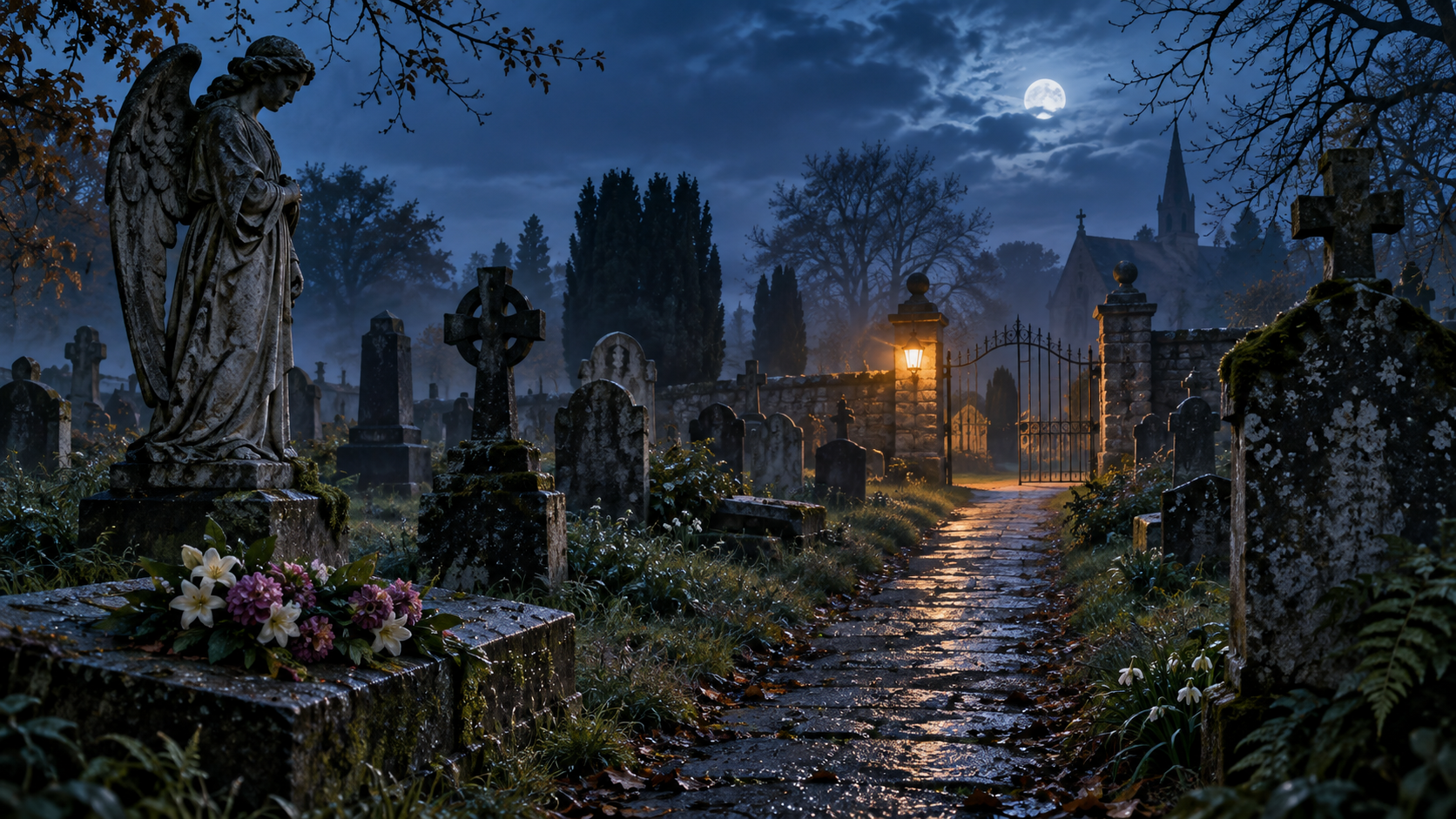
Cemeteries feel frightening at night because darkness removes the social cues that normally make a public place legible. Graves become low obstacles, monuments become human-sized silhouettes, and every path seems to lead somewhere people do not go after dark. Add the fact that a cemetery is built around death, memory, and names that cannot answer back, and the mind starts supplying a watcher before it has evidence of one.
That response is not proof that a cemetery is haunted. It is a precise collision of setting and expectation. The place asks us to remember the dead while the night makes it hard to see who—or what—is nearby.
A cemetery was designed to be read slowly
The modern American cemetery is not merely a storage place for graves. Nineteenth-century rural cemeteries were deliberately landscaped as places for walking, mourning, and instruction. The Smithsonian Folklife account of the rural cemetery movement describes a landscape of paths, trees, monuments, and family memory: a place that makes death visible within an ordered, living world. Read its history of cemeteries in the American landscape.
That design can feel peaceful in daylight. At night, it creates a different kind of problem. A grid of stones is hard to scan. Trees interrupt sightlines. Statues are made to resemble bodies, angels, mourners, and guardians. A curving path denies the eye a clear end point. Horror does not need a supernatural event here; it only needs an environment that refuses to give quick reassurance.
The same mechanism explains why a familiar backyard can feel alien after midnight. But a cemetery comes preloaded with heavier meaning. You are not just unable to identify a shape. You are unable to identify a shape among the dead.
Darkness makes ambiguous shapes feel personal
Human vision is excellent at catching motion and poor at resolving detail in low light. When information is thin, the brain makes fast guesses. A marble obelisk can resemble a standing figure. A flower arrangement can appear to move in a breeze. A distant lamp can become a face because the mind is built to find faces quickly, even when none are there.
This is why the most effective cemetery scenes in horror often withhold the creature. The camera, or the prose, gives the reader a line of stones and a break in the hedge. The reader does the rest. The fear is not foolishness; it is a safety system working with incomplete data.
There is another pressure at work: a cemetery is a public place where the usual public contract is absent. In a shop, park, or station, other people provide ordinary explanation. In a cemetery at night, there may be no one to ask whether a sound was a gate, an animal, or a person. Silence becomes a blank page.
Death anxiety changes the stakes of a quiet place
Being near graves can bring mortality to the surface without anyone saying a word. Psychologists study death anxiety as a real and variable response, not a single universal feeling. The Death Anxiety Scale is one early tool developed to measure differences in how people think and feel about death.
You do not have to feel actively afraid of dying for a cemetery to get under your skin. The place condenses names, dates, families, and endings into a few acres. It interrupts the ordinary illusion that death happens somewhere else, to someone else, much later. At night, when distractions thin out, that interruption can feel sharper.
This is also why cemetery horror should be written with care. A graveyard is not a prop emptied of human beings. It is a record of people who were loved, mourned, and often still visited. Respect makes the horror better: it gives the setting moral weight instead of treating the dead as décor.
Why the fear of being watched arrives so quickly
Many people describe the same sensation in a cemetery: not that something will attack, but that something is looking. The feeling comes from three overlapping features.
1. Monuments resemble observers. Upright stones, statues, portraits, and angels occupy the visual height of a person. 2. The landscape hides observers. Trees, mausoleums, low walls, and uneven ground create pockets where a real person could stand unseen. 3. The subject matter invites personhood. A cemetery asks us to think of individual lives. When the mind sees a shape, it does not read it as a random object first; it reads it through the idea of a person who once existed.
That is fertile ground for fiction, but it is also why a cautious visitor should not wander in after closing. The danger may be a broken path, an unsafe structure, wildlife, or another living person—not a revenant. The unease is atmospheric; basic safety is practical.
The cemetery and the fear of premature burial
Some older cemetery dread is historical rather than spectral. The nineteenth century produced vivid anxieties about being declared dead too soon, along with stories, patents, and alarm devices meant to answer them. Our earlier look at the subject, “The Fear of Being Buried Alive: History, Horror, and the Safety Coffin”, follows how medical uncertainty became a durable horror image.
That fear survives because it turns the cemetery’s central promise inside out. A cemetery is meant to mark a final resting place. Premature-burial stories imagine the final place as a trap. Even readers who know the history only vaguely recognize the emotional logic: the terror of needing help in a place built for the unreachable.
For a different Victorian route into grief, image, and memory, see the history of Victorian postmortem photography. It is a useful corrective to the idea that every historical encounter with death was gothic spectacle. Much of it was mourning made visible.
Why cemeteries are such durable horror settings
A cemetery lets horror writers put several fears in the same frame: isolation, uncertainty, mortality, guilt, inheritance, and the possibility that the past has not finished speaking. Crucially, it does so without requiring a monster. A locked gate, a name that appears twice, a familiar flower on the wrong grave, or the sound of someone walking where no path exists can carry a whole scene.
The setting also permits restraint. The strongest cemetery story often leaves room for an ordinary explanation. Was that a groundskeeper? A fox? Wind in dry leaves? Or did the figure behind the mausoleum wait until the narrator turned away? Certainty ends the scene. A good cemetery lets uncertainty keep breathing.
If you want the horror to follow you home
For readers drawn to haunted settings, graveside dread, and the uneasy intimacy of the dead, There Be Monsters: Among the Dead is the natural next shelf. It stays with the question a cemetery raises at night: what if the boundary we rely on is thinner than it looks?
Or join The Grimbard Press and receive Dead Ship, the free illustrated Subscriber Archive Edition. It is for readers who prefer their unease evidence-minded, atmospheric, and difficult to shake.
Frequently asked questions
Why are cemeteries scarier at night than during the day?
At night, darkness reduces detail and makes monuments, trees, and paths ambiguous. Because cemeteries are already associated with death and memory, the brain is more likely to interpret ambiguous sights and sounds as meaningful or threatening.
Are cemeteries designed to feel spooky?
No. Many historic cemeteries were designed as landscaped places for mourning, walking, and remembrance. Features that feel uncanny after dark—curving paths, tall monuments, dense trees—often served beauty, privacy, and contemplation in daylight.
Why do people feel watched in graveyards?
Grave markers and statues can resemble human figures in low light, while the landscape contains many sightline breaks. The mind combines those ambiguous cues with the knowledge that the place commemorates individual people.
Is it safe to visit a cemetery at night?
Follow the cemetery’s posted rules and hours. After dark, uneven ground, damaged structures, wildlife, and isolation can create real risks. Respect for mourners and the site matters as much as the atmosphere.
The last light on the path
The cemetery is frightening at night because it makes absence feel occupied. The stones do not move. The names do not speak. Yet the place is arranged so carefully around human lives that silence can begin to sound like attention. That is the old trick: darkness does not add a ghost. It removes just enough certainty for one to stand beside you.
