Category: Horror Psychology

  • Why Abandoned Places Feel Haunted Before Anything Happens

    Why Abandoned Places Feel Haunted Before Anything Happens

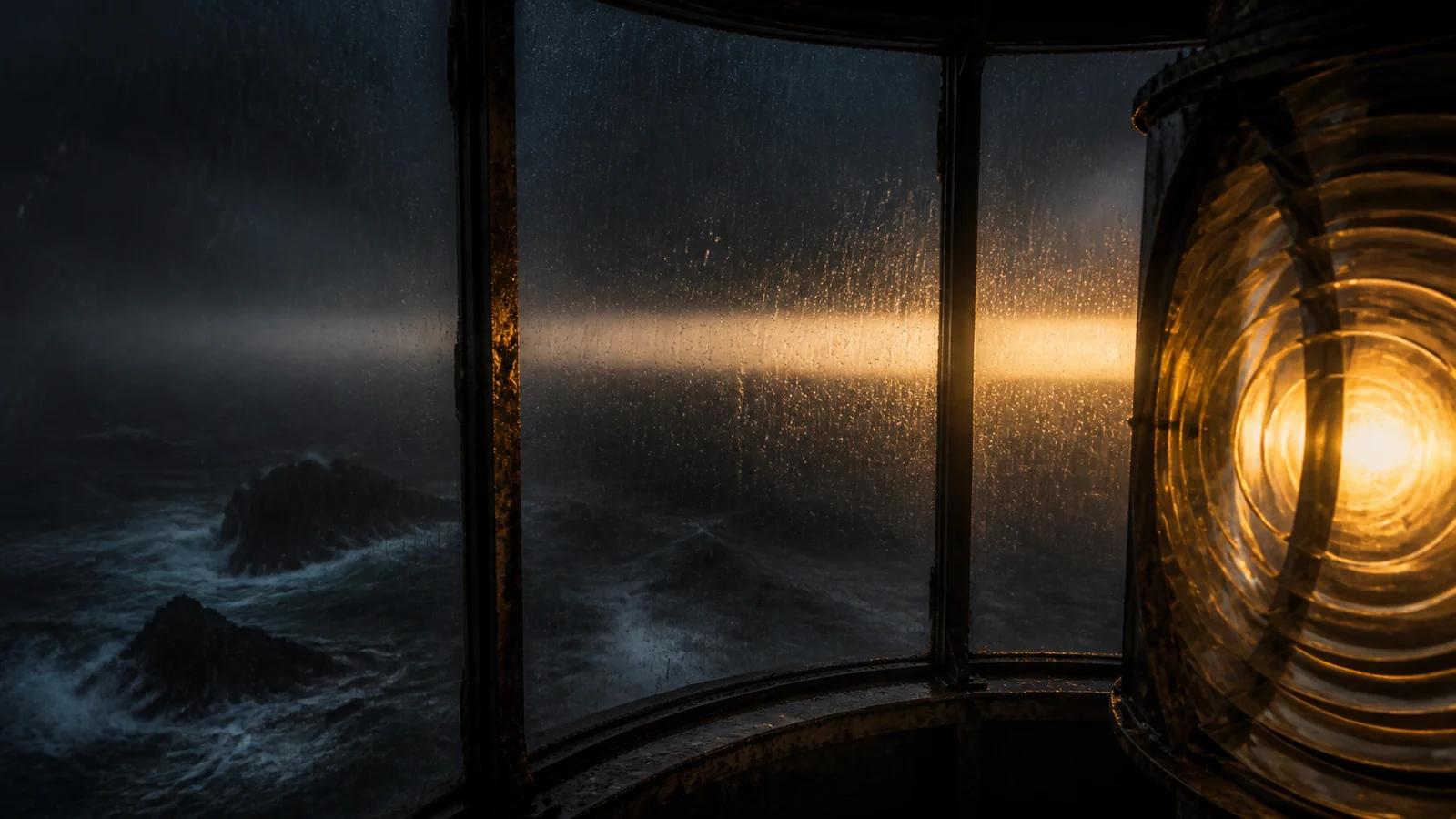
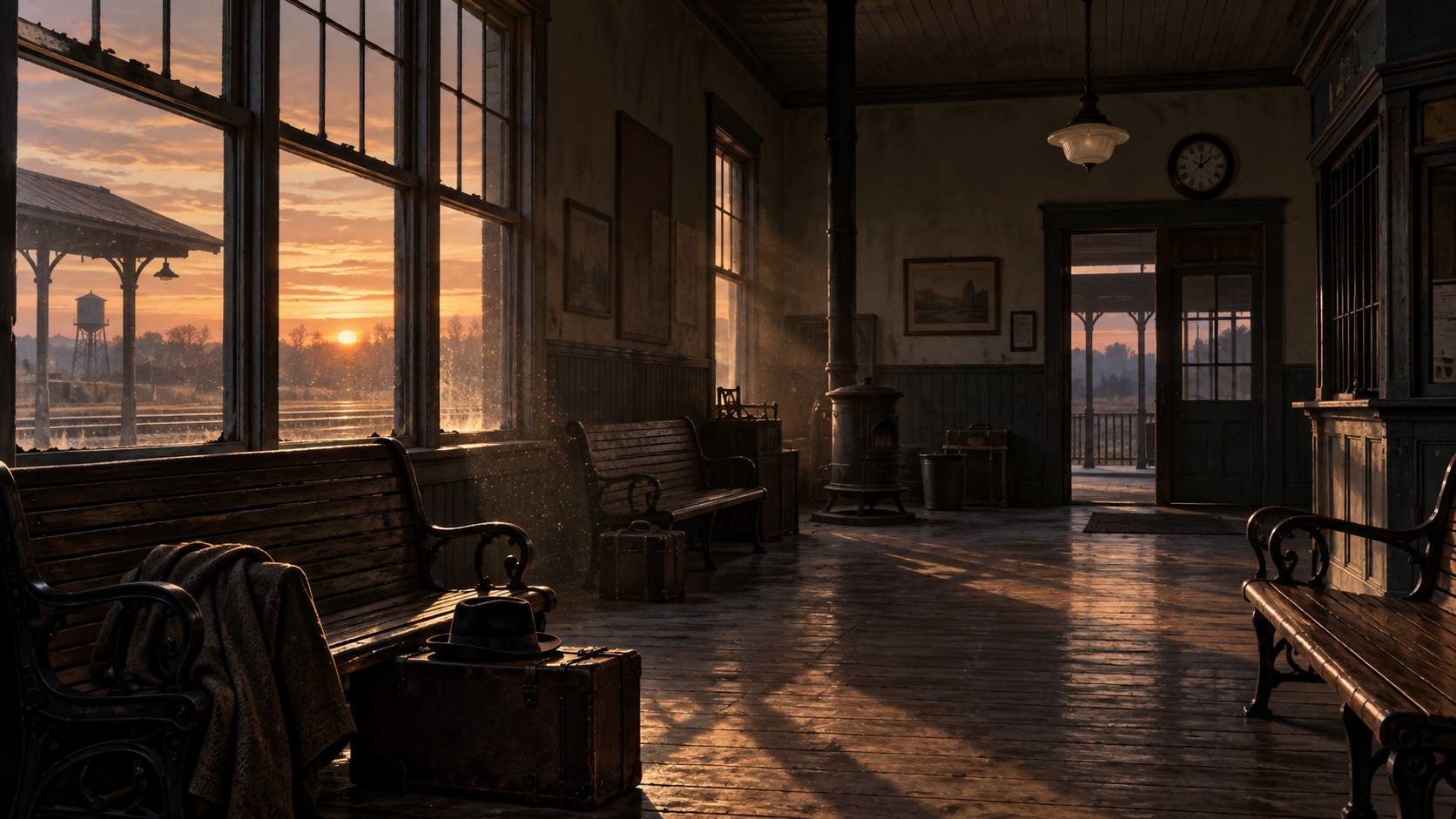
    A deserted railway waiting room at dusk, dust in the last window light

    Abandoned places feel haunted because they violate a familiar expectation: a room built for people is suddenly missing them, while the evidence of their presence remains. A chair faces a table. A calendar hangs where somebody once checked a date. Wind moves through a corridor that was designed to be quiet. Your mind supplies the absent occupants and begins asking why they left. No ghost has to appear for that question to feel urgent.

    This is not proof of a paranormal event, and there is no single scientific mechanism that explains every uneasy visit. It is a useful way to describe an experience many people recognize. Architecture gives us clues about human activity; decay scrambles them; uncertainty invites a story.

    The building still tells you what should be happening

    A school corridor implies bells, footsteps, and children changing rooms. A hotel desk implies a person ready to answer a question. An empty factory implies machinery that should be loud enough to drown out thought. When the building keeps its shape but loses its routine, expectation and reality no longer match.

    That mismatch is more effective than simple darkness. An empty field at night may be frightening, but it does not present the same precise absence. A place designed for occupancy seems to be waiting for someone. Even if you know its closure was ordinary—costs, relocation, redevelopment—the rooms can make the absence feel personal.

    This is why an abandoned site in a story should not be described only as “creepy.” What was it for? What behavior did it organize? Show the reader the missing action. A row of numbered hooks with no coats can do more work than a paragraph about shadowy energy.

    Traces make strangers feel almost present

    The most powerful objects are usually ordinary. A cup, a handwritten sign, a worn stair tread, or an outline left by a removed picture tells us somebody used the place repeatedly. These are traces, not messages. We do not know the person, but the object helps us imagine a gesture: the cup lifted, the stair climbed, the picture straightened.

    The temptation is to invent a complete biography from one clue. That is good fuel for fiction and poor historical method. A child’s shoe does not tell you why a building closed. An unmade bed does not prove a sudden flight. If you are writing about a real site, separate what records establish from what your imagination proposes. If you are writing fiction, use the gap deliberately; make the reader aware of how little the protagonist actually knows.

    A dusty table with one intact teacup and a square of unfaded wallpaper

    Silence changes the scale of small sounds

    People often describe an abandoned building as silent, but the silence is full of low-level activity. Water drips. Metal expands or contracts. Leaves scrape a broken pane. A distant vehicle sounds closer through open rooms. Because there is no ordinary human activity to absorb those noises, each one seems to ask for an explanation.

    In a horror scene, the strongest sequence is often simple: establish a repeated sound, let the character explain it, then change one part of the pattern. A drip stops when the character enters. A door taps three times after the wind dies. The reader is frightened by a failed explanation, not necessarily by volume.

    For another look at how stories exploit incomplete sensory evidence, read why forests feel scarier at night. The setting differs, but the practical question is the same: how much can you know from limited cues?

    Decay lets two times occupy one room

    A ruin is a visible disagreement between past purpose and present condition. Wallpaper still marks a home; moss now crosses the floor. A sign still promises a service; the business is gone. That double exposure makes it easy to imagine a past scene running underneath the present one. Gothic stories have relied on this effect for centuries, but modern offices, malls, and transit stations can produce it too.

    The effect is not merely nostalgia. A building can preserve evidence of exclusion, labor, failed promises, or environmental damage. The question “Who lived here?” should sometimes become “Who worked here?” or “Who was not allowed in?” History gives the atmosphere weight. A generic ruin can feel decorative; a place with a documented use can become morally difficult.

    Our Gothic reading path explores how fiction turns architecture into pressure. For a Grimbard route through places whose boundaries seem unreliable, browse the Lost Boundary Archive.

    A long empty hallway where daylight reveals layers of paint and water damage

    How to appreciate a ruin without entering it

    The romance of abandoned places must not obscure their real risks. The National Park Service warns that abandoned mine sites may contain unstable structures, hidden shafts, unsafe water, and dangerous air. Other derelict buildings can present different structural, environmental, or legal hazards. Do not enter a closed site for a photograph or a story prompt.

    There are safer ways to study the effect. Visit a publicly accessible historic site, take a guided tour, use a local archive’s photographs, or observe a building from a lawful public viewpoint. Read municipal or preservation records before deciding what happened there. The facts may be less sensational than a ghost story and more compelling.

    If you are a writer, make a field note in three columns: what you can see, what you can reasonably infer, and what you are inventing. That division protects real people’s histories while leaving plenty of room for fiction. It also gives your imagined haunting a stronger foundation: the reader senses where the evidence ends and dread begins.

    For readers, the same exercise changes how you look at photographs of deserted sites. Ask when the photograph was made, who owns the property, and what might have been moved out of frame. A dramatic image can be an invitation to research, but it is not a complete history. That little pause makes the eventual story you tell about the place more interesting and more honest.

    FAQ

    Does feeling haunted mean a place is paranormal? No. An uneasy feeling can arise from expectation, unfamiliar sounds, traces of former use, and uncertainty. It does not settle a supernatural question.

    Why are abandoned schools and hospitals especially unsettling? They are buildings with strong expectations of routine, care, and human presence. Their emptiness is therefore unusually legible.

    Is it safe to explore abandoned buildings? Do not assume so. Access may be prohibited, and deterioration can conceal serious hazards. Choose authorized visits and public archives instead.

    For more grounded explorations of eerie places, join The Grimbard Press. If you want the unsettling place to cross fully into fiction, explore the Grimbard books.

    Source: U.S. National Park Service, abandoned mineral lands hazards and safety. The article’s psychological framework is interpretive, not a clinical diagnosis.
  • Why Old Photographs Look Haunted

    Why Old Photographs Look Haunted

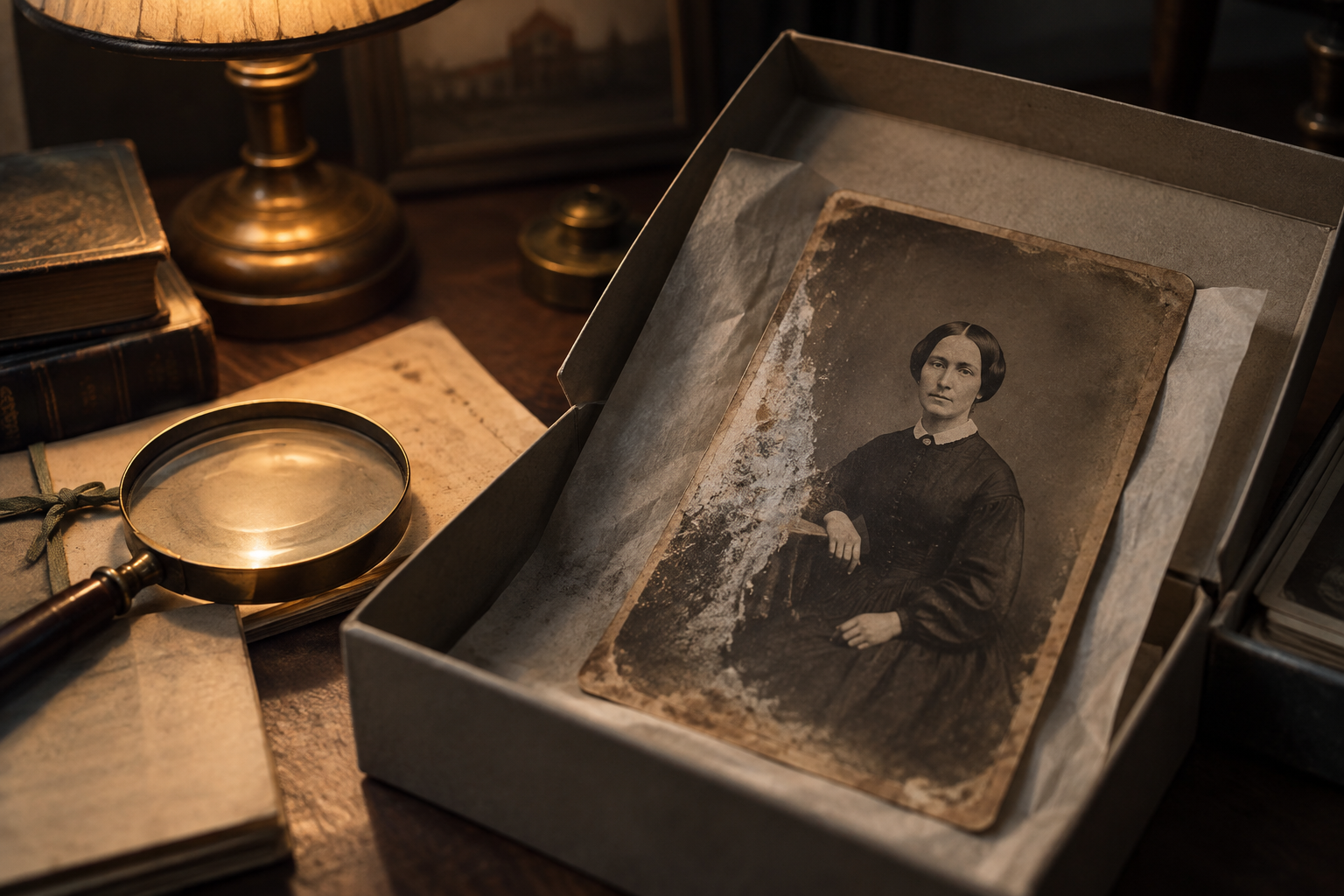
    Illustration of an aged portrait in an archival box under a soft reading lamp

    Old photographs can look creepy because they combine unfamiliar visual conventions with physical damage and missing context. A sitter holds an expression longer than we expect. A face has faded more quickly than a coat. A child is slightly blurred while the furniture remains sharp. We see the result without seeing the camera, the room, the photographer’s directions, or the years of handling that followed.

    The unsettling feeling is real. It is not evidence that the photograph recorded a ghost. The pleasure of looking closely lies in recognizing how a seemingly direct record was made—and how a century can edit it after the shutter closes.

    Why are the faces so serious?

    The familiar explanation says nobody smiled because early exposure times were too long. There is some truth in the technical part: early processes often required a subject to keep still. But it is too simple as a universal account. Camera technology changed throughout the nineteenth century, and expressions also followed the social conventions of portraiture. A formal photograph was an occasion; people did not necessarily want to perform the broad smile expected in today’s phone camera.

    The Metropolitan Museum of Art’s account of early portrait photography shows how photography widened access to likenesses. A portrait could be a treasured object made for family, not a casual record of an afternoon. Seriousness may signal dignity, concentration, or the conventions of the studio. It need not signal sorrow.

    This matters because the modern viewer often supplies a story to a face before learning its name. We meet an unknown person without their voice. The photograph feels intimate and inaccessible at the same time.

    Long exposure leaves strange evidence

    Movement during an exposure can blur a hand or face, especially in early photographs and particular artistic processes. A person who stepped into a scene briefly could leave a faint figure. The camera made a real record of light over time, not a single perfect instant. The Library of Congress explains that such effects could also be produced deliberately with composite images and double exposures.

    An uncanny figure in a photograph therefore requires investigation. What process was used? Is the image an original plate, a print, or a later scan? Has it been retouched? Is there a second negative or a known studio practice? The right answer may be technical, accidental, fraudulent, or still uncertain. “I cannot explain it from this copy” is a more honest conclusion than “therefore a spirit.”

    Damage makes familiar features unfamiliar

    Photographs are objects. Prints crease, silver images deteriorate, paper discolors, and albums expose some surfaces to light while sheltering others. A scratch through the eyes can give a face an impossible expression. Uneven fading can separate a head from its shoulders. The people who held the original may have seen an ordinary family likeness; we see a damaged survivor.

    Illustration comparing the same historic portrait before and after natural fading, scratches, and paper wear

    The damage is not meaningless, though. It records use. Someone carried the image, placed it in an album, moved house with it, or stored it badly. The mark that frightens us may be evidence that the photograph mattered enough to survive.

    The frame withholds almost everything

    A photograph seems precise because it preserves details. It is also a ruthless crop. We may know what a person wore and nothing about what they said after the sitting. We do not see the friend outside the frame, the props just behind the backdrop, or the ordinary morning waiting outside the studio. The less context we have, the more easily we convert an unfamiliar expression into a sinister one.

    That is why unlabeled flea-market photographs are such efficient horror objects. The image still proves that a person stood before a camera. It does not tell us why the photograph ended up among strangers. The gap invites fiction.

    Spirit photography was a real practice

    Nineteenth-century spiritualism gave some photographers a market for portraits with apparent apparitions. The Library of Congress notes that ghostly composites and double exposures were known techniques even while some viewers treated the resulting pictures as evidence of contact with the dead. The history is a mixture of technology, belief, grief, performance, and sometimes deception. It deserves more care than a quick “Victorians believed everything” joke.

    The Met’s exhibition on manipulated photography also makes a useful point: altering photographs did not begin with digital software. The camera’s reputation for truth and the photographer’s power to arrange an image have been in tension from the beginning.

    Illustration of a photographer’s nineteenth-century worktable with a glass plate, contact print, lens, and archival labels left blank

    How to examine a “haunted” photograph

    Begin with provenance. Where did the image come from, and is there a dated original? Then inspect the physical process: paper, plate, negative, or digital copy. Look for repeated shapes, edge artifacts, signs of movement, and later retouching. Search for the same image in a museum, library, or historical collection before trusting a caption that appears only on social media.

    If the image depicts a dead person or a grieving family, resist turning them into a prop for a convenient shiver. Many supposed “postmortem photographs” circulated online are ordinary portraits with speculative labels. An unnamed sitter cannot correct us. The least we can do is separate what the image shows from what we imagine.

    For more on why familiar objects become unsettling, see why dolls feel creepy and our guide to horror without gore. If photographs make you wonder what the dead leave behind, Among the Dead takes that question into fiction.

    Frequently asked questions

    Did people never smile in Victorian photographs?

    They sometimes did. Exposure times, studio practice, and portrait conventions all affected expression. The claim that smiling was impossible is too broad.

    Can a double exposure create a ghostly figure?

    Yes. A second exposure or a person moving through a long exposure can create an apparition-like form. That explains a photographic effect, not every individual image without examination.

    Are all “spirit photographs” deliberate frauds?

    No single judgment covers every image or every participant. Some effects were staged; some may reflect accidents or later misreadings; viewers could sincerely believe in what they saw. Investigate the specific object and its history.

    The next time a face in an album appears to stare past you, turn the photograph over. A date, an address, or a penciled name may change the story more than the shadow did. For new dispatches on haunted history and a free illustrated story, join The Grimbard Press.

    Sources

    • Library of Congress: A Ghostly Image

    • Metropolitan Museum of Art: Faking It

    • Metropolitan Museum of Art: Portraits

  • Why Does Workplace Horror Work? When the Shift, the Rules, and the Building Turn Hostile

    Why Does Workplace Horror Work? When the Shift, the Rules, and the Building Turn Hostile

    Workplace horror works because a job already comes with rules that can override instinct. You clock in, follow procedure, answer the call, finish the shift, and avoid making trouble. When a horror story turns one of those ordinary expectations against its worker, the reader immediately understands the trap. Leaving may cost rent money. Ignoring a supervisor may cost a reference. Breaking a rule may feel dangerous even before the rule becomes supernatural.

    The monster in workplace horror is often not the building itself. It is the system that makes a person stay in the building after the sensible thing would be to run.

    Familiarity is the first weapon

    Offices, warehouses, hospitals, hotels, stores, and security desks are not gothic castles. That is the point. They are places with fluorescent lighting, break rooms, badge readers, paperwork, and a person who will ask why you left early. Horror changes one small thing—a door that must never be opened after 2:00 a.m., a customer who cannot be acknowledged, an elevator that stops at a floor the building does not have—and the normal setting becomes a pressure chamber.

    Chicago Public Library’s workplace science-fiction and horror reading list points toward the breadth of the mode: work can be a laboratory, a corporate maze, a service counter, or a job that erodes the boundary between self and institution. The setting travels because labor is already intimate. It tells us when to wake, where to sit, what to wear, and how much of ourselves to perform.

    The rules are believable before they become sinister

    Rules horror succeeds when the first few instructions are plausible. Lock the rear entrance. Do not discuss customers outside the store. Call maintenance if the lights flicker. The reader recognizes workplace procedure and accepts it before the list turns strange.

    Then comes the line that changes everything: do not answer the intercom after the third ring. If a coworker asks you to cover the basement, confirm their name twice. If you see the manager in the north hall, do not let them know you saw them.

    The fear does not come from randomness. It comes from the implication that someone has learned these rules the hard way. A rule is a fossil of an earlier incident. Every instruction suggests a missing report, a previous worker, a consequence management has filed away instead of fixing.

    For a closer look at why warnings and prohibitions carry such force, see “The Craft of ‘Don’t Do X’: Why Rules Are the Most Powerful Tool in Folk Horror”. Workplace horror borrows that folk mechanism and gives it an employee handbook.

    Economic pressure makes “just leave” impossible

    Readers often ask why a character stays. Workplace horror has a built-in answer: people need the job. The strongest stories do not use that fact as an excuse for foolishness. They show the costs clearly. The worker has a lease, a family obligation, a bad employment history, no paid time off, or a manager who has trained everyone to accept the unacceptable.

    That does not mean every workplace story must become a social-realist lecture. It means the supernatural pressure is more convincing when it attaches to a real human calculation. A haunted factory is scary. A haunted factory where the night supervisor says payroll will be delayed if anyone reports an accident is scarier, because the lie has a recognizable shape.

    The genre can also make bureaucracy itself uncanny. A form asks for a date that has not happened. A password changes to a dead employee’s name. A disciplinary meeting is scheduled with no organizer. The institution speaks in a voice that is both impersonal and much too close.

    After-hours spaces remove the witnesses

    During the day, a workplace has noise, routine, and other people. At night, a familiar floor plan can become a map of places no one is watching. The vending machine hum becomes company. A security camera offers the comfort of surveillance until the worker realizes it is aimed in the wrong direction.

    That is why night shifts are scary even without a monster: the shift reverses the social world. You are awake when everyone else is unavailable, responsible for a building designed for crowds while almost entirely alone. Workplace horror takes that condition and asks what happens when the building starts treating the worker as its last remaining employee.

    The workplace monster is usually a bad manager in another mask

    There is a dark joke at the center of the genre. The monster may be ancient, but it still needs you to complete your tasks. It tracks compliance, punishes absence, and uses opaque language. In that sense, workplace horror is not an escape from ordinary dread; it is an exaggeration that reveals the ordinary dread’s outline.

    The best stories preserve ambiguity. Is the company hiding a creature? Is the creature simply what the company has always been? The reader should feel both possibilities working at once.

    Clock in carefully

    If the horror of rules, shifts, and places that want something from their workers is your preferred kind of dread, On the Clock, After Dark is the direct Grimbard route. It is for readers who know the worst line in an employee handbook is the one everyone pretends is normal.

    For more evidence-minded unease, join The Grimbard Press and get Dead Ship, the free illustrated Subscriber Archive Edition.

    Frequently asked questions

    Why is workplace horror so relatable?

    Most readers know what it feels like to follow rules, depend on a paycheck, and remain polite in an uncomfortable setting. Workplace horror exaggerates those familiar pressures until ordinary compliance becomes dangerous.

    What makes a rules-horror story work?

    The rules need to begin plausibly and imply a reason they exist. Specific consequences, a human cost for leaving, and a setting with real routines make strange instructions more frightening than random ones.

    Is workplace horror the same as office horror?

    Office horror is one form of workplace horror. The larger category includes hospitals, retail, factories, hotels, security jobs, restaurants, call centers, and any workplace whose systems can become threatening.

    Why are night shifts common in horror?

    Night shifts reduce witnesses and normal activity while leaving the worker responsible for a large, familiar place. That combination makes isolation feel contractual rather than accidental.

    The shift ends when it lets you go

    The workplace is frightening because it makes obedience feel like survival. Horror only needs to make the institution hungry. Once the lights dim and the rulebook starts protecting something other than the staff, the worker discovers the oldest after-hours problem: the building may have been waiting for someone to stay late.

    Fluorescent workplace corridor used as a retention image for an article about rules, shifts, and workplace horror.

  • Why Are Abandoned Mines So Scary? The Real Dangers Behind Underground Horror

    Why Are Abandoned Mines So Scary? The Real Dangers Behind Underground Horror

    Abandoned mines are scary because they combine a built environment with a landscape that does not forgive mistakes. A mine has tunnels, ladders, rails, shafts, tools, and evidence of human labor—but the people are gone. Underground, the usual safeguards of distance, daylight, and an easy exit disappear. The horror is not just claustrophobia. It is the sense of entering a machine that has been left running in the dark.

    There is a practical reason to keep that feeling at the mouth of the tunnel. The National Park Service warns that abandoned mine lands can contain unstable openings, hidden shafts, bad air, falling rock, and contaminated materials. Do not enter one for photographs, exploration, or a story. The most convincing mine horror begins with that fact: some places are frightening because they are genuinely unsafe.

    A mine is an industrial labyrinth, not a cave

    People often group mines and caves together because both are underground. The difference matters. A cave suggests geology: chambers, water, stone, and a landscape formed on a timescale too large to care about us. A mine suggests intention. Someone cut, blasted, reinforced, measured, and marked the route. Someone expected a shift to begin and end.

    That intention makes abandonment feel personal. A rail disappears around a bend. A timber support stands where a hand placed it decades ago. A rusting lunch pail, if it exists, is not evidence of a ghost; it is evidence of a worker who expected to come back. The mine becomes a record of labor interrupted.

    Our earlier article on why caves are so scary looks at darkness, confinement, and disorientation in natural spaces. An abandoned mine uses those same pressures, then adds industrial memory: schedules, machinery, ownership, accidents, and the uneasy knowledge that extraction always leaves something behind.

    Real hazards make the imagined ones stronger

    Horror works best in a mine when it does not wave away reality. The dangers are specific enough on their own.

    – Unstable ground and supports: timbers decay, roofs collapse, and openings may be concealed by vegetation or debris. – Vertical shafts: a level-looking floor can give way to a drop that cannot be seen in poor light. – Bad air: oxygen can be low, and gases can collect in confined spaces. – Water and contamination: flooded workings, drainage, and mine waste can be hazardous. – No reliable wayfinding: a wrong turn underground is not merely inconvenient when exits, signals, and visibility are limited.

    The NPS’s safety guidance is worth reading because it strips away the romance. A mine is not an abandoned amusement park with better scenery. It was a working industrial site, and its risks do not retire when the company does.

    That realism gives writers a useful discipline. Instead of adding a monster immediately, begin with the conditions that make a person hesitate: a map that ends at a sealed level, a radio that cannot reach the surface, footprints where dust should be undisturbed. The impossible becomes more effective when the possible is already bad enough.

    Why the silence feels wrong

    An active mine has noise: ventilation, water, engines, warning signals, boots, metal, voices. An abandoned one leaves the structures of that noise behind. Pipes remain. Doors remain. Cable may still trace a wall. The absence becomes audible.

    This is a different silence from a forest’s silence. A forest has birds, weather, insects, and the expectation of change. A mine can feel as though it has been sealed off from time. A drip repeats. A loose chain touches a wall. The sound has no obvious distance because darkness gives the ear nowhere to put it.

    Industrial horror often draws power from that imbalance: the place still appears to have a job, but there is no one assigned to do it. The conveyor has stopped. The shift board is empty. The rulebook remains, and nobody is alive enough to enforce it.

    Abandonment turns a workplace into evidence

    We tend to read abandoned places as stories. A boarded-up house asks who left. An abandoned hospital asks what failed. An abandoned mine asks a sharper question: what did this place take, and what did it cost?

    Mining communities contain labor history, pride, injury, grief, and environmental consequence. Treating every mine as a generic haunted tunnel flattens that history. A stronger story starts with specificity. What mineral was extracted? Was the site a company town? Which landscape was altered? Who was expected to descend, and who was allowed to own the result?

    That attention also keeps a writer from borrowing suffering as scenery. The mine does not need a sensationalized disaster to carry dread. A schedule, a rusted tag, and a blocked escape route can imply an entire institutional world.

    The mine and the abandoned amusement park share one fear

    There is a useful comparison with why abandoned amusement parks are scary. Both settings are designed systems that have lost their intended audience. A carnival ride without riders feels wrong because its function is pleasure. A mine without workers feels wrong because its function is labor.

    But a mine has less room for play. Its corridors were never built for wandering. The visitor is not simply outside the story; they are using the place against its design. That is why an old rail line or ventilation door can feel more ominous than a cave wall. It implies rules you do not know and an exit that may not belong to you.

    If underground horror is your route in

    If you like stories where isolation, pressure, and unseen depth do most of the work, There Be Monsters: Deep Down is the book route built for that descent. It is not a safety guide or a claim about real mines. It is a fiction shelf for readers who know that the dark below ground has its own weather.

    For another way into evidence-minded horror, join The Grimbard Press for Dead Ship, the free illustrated Subscriber Archive Edition.

    Frequently asked questions

    Why do abandoned mines feel scarier than caves?

    Mines add human intention to underground darkness. Their rails, supports, shafts, and machinery suggest labor interrupted, while their industrial layout can create hazards and confusing routes that natural caves do not share in the same way.

    Is it safe to explore an abandoned mine?

    No. Do not enter abandoned mine workings. Government safety guidance warns of hidden shafts, unstable structures, bad air, water, and contamination. View them only from permitted, safe areas or through guided, authorized interpretation.

    What makes a mine a good horror setting?

    A mine combines confinement, uncertain navigation, industrial history, real danger, and the unnerving absence of the people who built it. Good mine horror respects those realities instead of treating the setting as a generic tunnel.

    Are all abandoned mines underground?

    No. Mining landscapes can include open pits, waste piles, structures, rail lines, and drainage features. All may have hazards, even where no tunnel is visible.

    The tunnel was never meant for you

    An abandoned mine frightens because it is not empty in the comforting sense. It is full of purpose: routes, supports, rules, and risks left in place after the people who understood them have gone. The dark does not have to hide a creature. It only has to keep you from seeing which part of the machine still remembers how to work.

    Abandoned mine tunnel and decaying supports used as a retention image for the underground-horror guide.

  • Why Are Cemeteries Scary at Night? Death, Design, and the Fear of Being Watched

    Why Are Cemeteries Scary at Night? Death, Design, and the Fear of Being Watched

    Cemeteries feel frightening at night because darkness removes the social cues that normally make a public place legible. Graves become low obstacles, monuments become human-sized silhouettes, and every path seems to lead somewhere people do not go after dark. Add the fact that a cemetery is built around death, memory, and names that cannot answer back, and the mind starts supplying a watcher before it has evidence of one.

    That response is not proof that a cemetery is haunted. It is a precise collision of setting and expectation. The place asks us to remember the dead while the night makes it hard to see who—or what—is nearby.

    A cemetery was designed to be read slowly

    The modern American cemetery is not merely a storage place for graves. Nineteenth-century rural cemeteries were deliberately landscaped as places for walking, mourning, and instruction. The Smithsonian Folklife account of the rural cemetery movement describes a landscape of paths, trees, monuments, and family memory: a place that makes death visible within an ordered, living world. Read its history of cemeteries in the American landscape.

    That design can feel peaceful in daylight. At night, it creates a different kind of problem. A grid of stones is hard to scan. Trees interrupt sightlines. Statues are made to resemble bodies, angels, mourners, and guardians. A curving path denies the eye a clear end point. Horror does not need a supernatural event here; it only needs an environment that refuses to give quick reassurance.

    The same mechanism explains why a familiar backyard can feel alien after midnight. But a cemetery comes preloaded with heavier meaning. You are not just unable to identify a shape. You are unable to identify a shape among the dead.

    Darkness makes ambiguous shapes feel personal

    Human vision is excellent at catching motion and poor at resolving detail in low light. When information is thin, the brain makes fast guesses. A marble obelisk can resemble a standing figure. A flower arrangement can appear to move in a breeze. A distant lamp can become a face because the mind is built to find faces quickly, even when none are there.

    This is why the most effective cemetery scenes in horror often withhold the creature. The camera, or the prose, gives the reader a line of stones and a break in the hedge. The reader does the rest. The fear is not foolishness; it is a safety system working with incomplete data.

    There is another pressure at work: a cemetery is a public place where the usual public contract is absent. In a shop, park, or station, other people provide ordinary explanation. In a cemetery at night, there may be no one to ask whether a sound was a gate, an animal, or a person. Silence becomes a blank page.

    Death anxiety changes the stakes of a quiet place

    Being near graves can bring mortality to the surface without anyone saying a word. Psychologists study death anxiety as a real and variable response, not a single universal feeling. The Death Anxiety Scale is one early tool developed to measure differences in how people think and feel about death.

    You do not have to feel actively afraid of dying for a cemetery to get under your skin. The place condenses names, dates, families, and endings into a few acres. It interrupts the ordinary illusion that death happens somewhere else, to someone else, much later. At night, when distractions thin out, that interruption can feel sharper.

    This is also why cemetery horror should be written with care. A graveyard is not a prop emptied of human beings. It is a record of people who were loved, mourned, and often still visited. Respect makes the horror better: it gives the setting moral weight instead of treating the dead as décor.

    Why the fear of being watched arrives so quickly

    Many people describe the same sensation in a cemetery: not that something will attack, but that something is looking. The feeling comes from three overlapping features.

    1. Monuments resemble observers. Upright stones, statues, portraits, and angels occupy the visual height of a person. 2. The landscape hides observers. Trees, mausoleums, low walls, and uneven ground create pockets where a real person could stand unseen. 3. The subject matter invites personhood. A cemetery asks us to think of individual lives. When the mind sees a shape, it does not read it as a random object first; it reads it through the idea of a person who once existed.

    That is fertile ground for fiction, but it is also why a cautious visitor should not wander in after closing. The danger may be a broken path, an unsafe structure, wildlife, or another living person—not a revenant. The unease is atmospheric; basic safety is practical.

    The cemetery and the fear of premature burial

    Some older cemetery dread is historical rather than spectral. The nineteenth century produced vivid anxieties about being declared dead too soon, along with stories, patents, and alarm devices meant to answer them. Our earlier look at the subject, “The Fear of Being Buried Alive: History, Horror, and the Safety Coffin”, follows how medical uncertainty became a durable horror image.

    That fear survives because it turns the cemetery’s central promise inside out. A cemetery is meant to mark a final resting place. Premature-burial stories imagine the final place as a trap. Even readers who know the history only vaguely recognize the emotional logic: the terror of needing help in a place built for the unreachable.

    For a different Victorian route into grief, image, and memory, see the history of Victorian postmortem photography. It is a useful corrective to the idea that every historical encounter with death was gothic spectacle. Much of it was mourning made visible.

    Why cemeteries are such durable horror settings

    A cemetery lets horror writers put several fears in the same frame: isolation, uncertainty, mortality, guilt, inheritance, and the possibility that the past has not finished speaking. Crucially, it does so without requiring a monster. A locked gate, a name that appears twice, a familiar flower on the wrong grave, or the sound of someone walking where no path exists can carry a whole scene.

    The setting also permits restraint. The strongest cemetery story often leaves room for an ordinary explanation. Was that a groundskeeper? A fox? Wind in dry leaves? Or did the figure behind the mausoleum wait until the narrator turned away? Certainty ends the scene. A good cemetery lets uncertainty keep breathing.

    If you want the horror to follow you home

    For readers drawn to haunted settings, graveside dread, and the uneasy intimacy of the dead, There Be Monsters: Among the Dead is the natural next shelf. It stays with the question a cemetery raises at night: what if the boundary we rely on is thinner than it looks?

    Or join The Grimbard Press and receive Dead Ship, the free illustrated Subscriber Archive Edition. It is for readers who prefer their unease evidence-minded, atmospheric, and difficult to shake.

    Frequently asked questions

    Why are cemeteries scarier at night than during the day?

    At night, darkness reduces detail and makes monuments, trees, and paths ambiguous. Because cemeteries are already associated with death and memory, the brain is more likely to interpret ambiguous sights and sounds as meaningful or threatening.

    Are cemeteries designed to feel spooky?

    No. Many historic cemeteries were designed as landscaped places for mourning, walking, and remembrance. Features that feel uncanny after dark—curving paths, tall monuments, dense trees—often served beauty, privacy, and contemplation in daylight.

    Why do people feel watched in graveyards?

    Grave markers and statues can resemble human figures in low light, while the landscape contains many sightline breaks. The mind combines those ambiguous cues with the knowledge that the place commemorates individual people.

    Is it safe to visit a cemetery at night?

    Follow the cemetery’s posted rules and hours. After dark, uneven ground, damaged structures, wildlife, and isolation can create real risks. Respect for mourners and the site matters as much as the atmosphere.

    The last light on the path

    The cemetery is frightening at night because it makes absence feel occupied. The stones do not move. The names do not speak. Yet the place is arranged so carefully around human lives that silence can begin to sound like attention. That is the old trick: darkness does not add a ghost. It removes just enough certainty for one to stand beside you.

    Moonlit cemetery path and grave markers used as a retention image for an article about why cemeteries feel frightening at night.

  • Why Are Emergency Broadcasts So Scary? When a Warning Becomes Horror

    Why Are Emergency Broadcasts So Scary? When a Warning Becomes Horror

    Why Are Emergency Broadcasts So Scary? When a Warning Becomes Horror

    The sound arrives before the explanation. A television program cuts out. A tone claims the room. A plain voice delivers a few compressed sentences as though somebody, somewhere, has already decided that you need to know this now.

    That is why emergency broadcasts can feel frightening even when they are only tests. They are built to interrupt routine, borrow institutional authority, and turn attention into action. Analog horror does not invent that machinery. It takes the machinery seriously enough to ask what happens when the warning is vague, corrupted, or more confident than it should be.

    Real alerts exist to deliver life-saving information. In the United States, the Emergency Alert System and related warning channels are designed to distribute official public-safety messages from authorized sources.[^1] If you receive a real alert, follow the instructions from official local, state, or federal emergency authorities. The horror version is fiction precisely because it breaks the rules that make a real warning useful.

    An alert does not ask permission to enter the room

    Most media waits to be chosen. You pick a program, open a tab, start a video, or press play. An emergency interruption reverses that relationship. It enters an activity you already trusted and declares that the existing activity no longer matters.

    That reversal is unsettling because it changes the status of the screen. A television is usually furniture. A radio is background. A phone notification can be ignored until you decide otherwise. During an alert, the device becomes a mouth for an authority outside the room.

    The message is brief because brevity is useful in a real emergency. It may identify a hazard, a place, a time, and an action. But that compression also creates a powerful horror tool. It provides information without the comfort of a full story. You learn that something is wrong before you learn how wrong it is.

    Analog horror leans into that gap. The frightening broadcast is often not a monster speaking. It is a system speaking in the calm, procedural language meant to make danger manageable—and failing to explain the one thing the audience needs most.

    Illustration: radio microphone and emergency binder on an empty municipal desk.

    Illustration: authority is frightening in horror when the desk is empty but the message keeps arriving.

    Authority becomes dread when it cannot be checked

    An official warning works because the listener has reasons to trust its source. There are recognizable agencies, procedures, locations, and channels. The message should be clear enough to act on and specific enough to verify.

    The unease resembles the discomfort behind why a face can look strange in a dark mirror: a familiar signal is still present, but the normal clues that let you interpret it have gone unreliable. With a broadcast, the missing clue is whether the message can be verified before the danger arrives.

    Horror reverses each condition. The logo is almost familiar. The voice is too calm. The date is missing. The instruction is precise but the hazard is not. A warning tells people to avoid a place nobody has heard of, or to remain indoors for a reason it refuses to name.

    The dread does not come from a grainy screen by itself. It comes from a familiar format behaving just slightly outside its jurisdiction. Something has learned the grammar of public safety and is using it without accepting the responsibility that usually comes with it.

    That is why a generic “DO NOT PANIC” screen is weaker than a message that sounds operationally plausible but contains one impossible fracture. Horror needs the audience to feel the promise of reliable information before it can show the promise failing.

    Film scholar Annette Davison describes analog horror as a contemporary folk form that circulates recurring motifs: emergency broadcasts, hijacked messages, confidential warnings, uncanny faces, and doubles.[^2] Those motifs endure because they are already shared cultural shorthand. We know what a warning is supposed to do. The horror begins when it performs the shape of a warning without giving us a safe action.

    The fear of incomplete instructions

    Good emergency communication tells people what happened, where it matters, and what to do next. The fact that official alert systems work through designated authorities and multiple dissemination routes is not bureaucratic decoration; it is part of the safety design.[^1]

    Analog horror uses the opposite. It makes an instruction impossible to follow.

    Stay inside—but not in any room with a window. Do not answer the door—but do not let them know you are home. If a family member calls, do not use their name. The command has the brisk certainty of a safety notice, but no real public authority would leave people with an uncheckable rule and no reliable source.

    The viewer’s mind starts filling in the missing hazard. That is cheaper and more frightening than showing it. The story makes the audience perform the investigation while denying them the tools an investigator would need.

    This is why analog horror overlaps with night-shift horror. Both make a familiar system feel unreliable: a character inherits a record or routine that has lost the part explaining whether anyone is still in control.

    Illustration: a late-night television in a dark room with an abstract warning triangle and no readable text.

    Illustration: real alerts should be clear and actionable; horror turns clarity into a missing person.

    Why old technology adds pressure

    Analog horror often chooses CRT televisions, weather radios, local-access graphics, VHS tapes, and public-service announcements. Nostalgia is part of the effect, but it is not the whole effect.

    Older media feels bounded. A tape has an end. A broadcast has a station. A local channel has a place in a community. When something impossible appears there, the intrusion feels physical: it is not simply somewhere online. It has entered a device that belongs in a room.

    The roughness of the image can help because it withholds detail. Static, low resolution, and damaged audio create room for inference. But a VHS filter is not an automatic scare. If the message could just as easily be an email, the old equipment is costume rather than form.

    The best analog horror asks why this particular message came through this particular channel. It gives the medium a job. Maybe the broadcast is the last system still reaching a town. Maybe the old tape is the only record that has not been overwritten. Maybe the fake authority needs a medium people are trained to obey.

    How to use the device without faking a real alert

    Writers and creators should be careful here. Real emergency systems are not props for a prank. Do not reproduce operational alert text, official logos, or instructions in a way that could be mistaken for an actual warning. Do not imitate a local emergency message and circulate it without unmistakable fictional framing.

    The safer creative move is also the better one: invent a clearly fictional institution, avoid realistic operating details, and make the story’s logic visible around the message. Give the audience a reason to know they are watching fiction even as the characters do not.

    The Grimbard reading is simple. An emergency broadcast is scary because it assumes the world has changed before you have had time to agree. It offers a voice with enough authority to interrupt your life and just enough information to make you fear the next sentence.

    For more horror about incomplete evidence and the damage a record can do, join The Grimbard Press for Dead Ship, a free illustrated Subscriber Archive Edition.

    FAQs

    Why do emergency alert sounds feel scary?

    They are designed to seize attention quickly during urgent situations. The sudden interruption and association with possible danger can produce a strong emotional response, even during a test.

    Are emergency broadcasts part of analog horror?

    They are a common analog-horror motif. The genre uses the authority and interruption of warning formats to create uncertainty, but it should not be confused with real public-safety communication.

    What makes an analog-horror broadcast effective?

    It needs a believable reason for the medium, a recognizable authority structure, and one carefully controlled failure of information. Static alone is not a story.

    What should I do if I receive a real emergency alert?

    Follow the instructions in the alert and check official local, state, or federal emergency sources for updates. Do not rely on fictional-media conventions for real safety decisions.

    [^1]: FEMA, Integrated Public Alert and Warning System glossary.
    [^2]: Annette Davison, “The Surprising Folklore of Analog Horror”, Film Quarterly (2026).

  • Why Are Clowns Scary? The Psychology Behind Coulrophobia

    Why Are Clowns Scary? The Psychology Behind Coulrophobia

    Why Are Clowns Scary? The Psychology Behind Coulrophobia

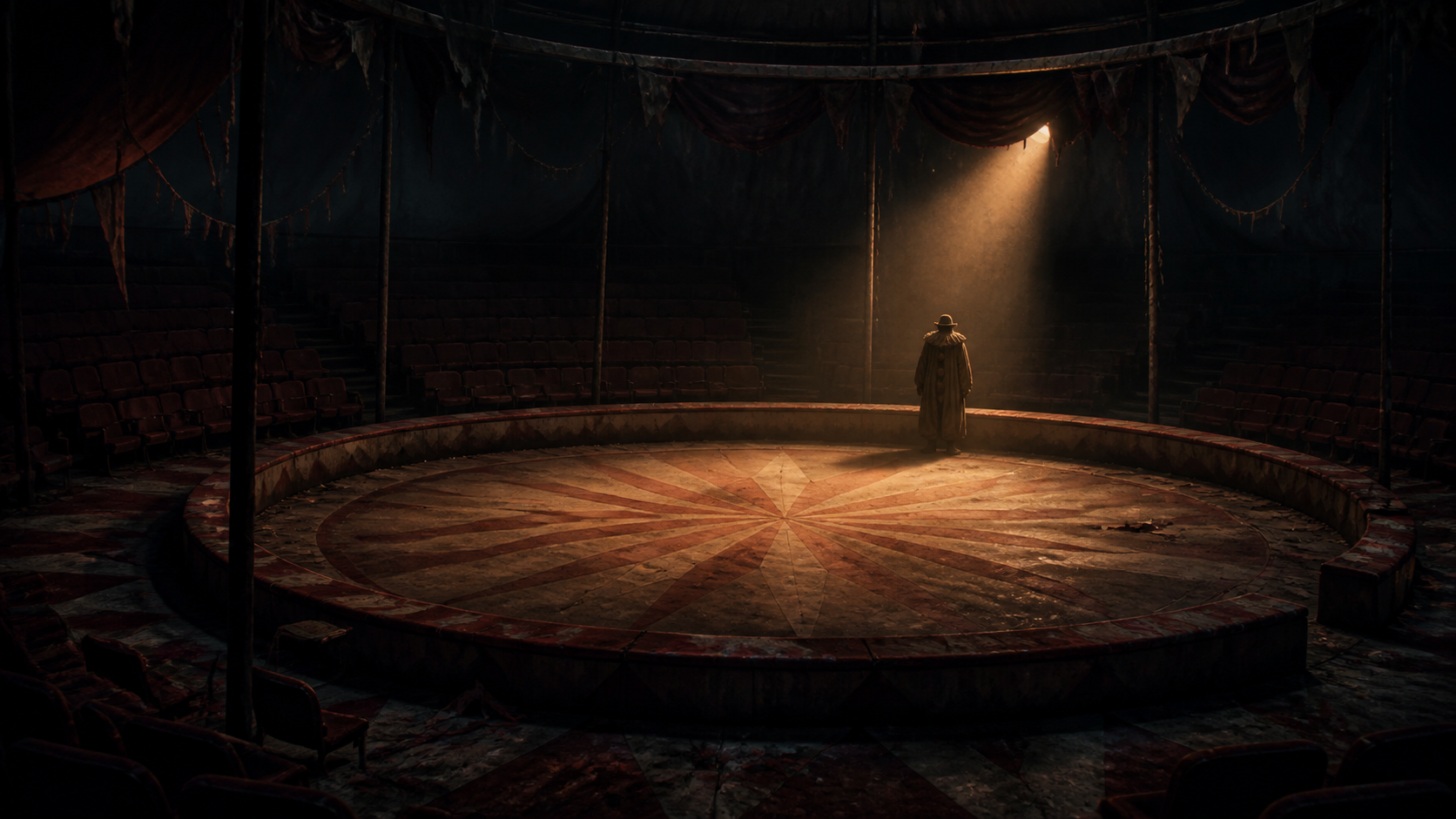
    Clowns are supposed to make their intentions easy to read. The grin is huge. The clothes are loud. Every movement is made to cross a room. Yet many people find the costume unsettling before it does anything remotely threatening.

    The short answer is that a clown can make ordinary social reading fail. The painted face displays a permanent emotion while hiding the real face beneath it. The behavior may be exaggerated or erratic. The body is familiar, but the signals it normally sends are altered. Horror has spent more than a century learning how useful that mismatch can be.

    That does not mean every dislike of clowns is a clinical phobia, or that there is one explanation for everyone. The fear commonly called coulrophobia is better understood as a cluster of possible pressures: masked expression, uncertain intent, surprise, media associations, and individual experience. A 2023 study of people who reported clown fear found several of those factors mattered, especially uncertainty about harmful intent, portrayals in media, and unpredictable behavior.[^1]

    A smile that cannot answer you

    Human faces are not decoration. We use them constantly to decide whether a person is amused, embarrassed, irritated, bored, or safe to approach. The clues are tiny: an eye movement, a mouth that changes before speech, a look that does not match a laugh.

    A clown replaces those moving clues with a fixed design. White makeup can flatten ordinary skin cues. An oversized painted mouth stays cheerful when the performer is silent. Red marks around the eyes can make attention look permanent. The costume does not merely hide identity; it supplies an emotion in advance and refuses to revise it.

    That is why the usual claim that clowns are frightening because they look “not quite human” is too crude. The problem is not that a clown is less human. It is that the costume gives a human body a face that behaves unlike a face. You are looking at a social signal that cannot participate in the conversation.

    The same pressure appears in quieter forms elsewhere in horror. A porcelain doll has eyes that seem alert but never focus back. A reflection in dim light can look unfamiliar because the face stops providing stable information. In why dolls are creepy, the fear comes from a familiar form that cannot complete recognition. A clown adds motion, proximity, and a demand to react.

    Illustration: circus makeup, gloves, and an obscured mirror reflection on a dressing table.

    Illustration: the costume creates an emotion before the performer has expressed one.

    The costume also changes the rules

    Clowning is allowed to violate small social rules. A clown may stare too long, invade personal space, fall down on purpose, pull an impossible object from a pocket, or pretend not to understand a direct question. In a circus or a party, those violations have a frame: this is a performance, people are watching, someone else is in charge.

    Outside that frame, the same behavior can feel like a breach. The costume says play, while the setting says why are you here? Horror does not need to add a weapon to make that tension useful. It only needs to remove the audience, the ring, or the scheduled ending.

    That is one reason a clown in a bright daytime parade and a clown in an empty parking lot do not produce the same reaction. The image is not doing all the work. Context decides whether the exaggeration feels licensed.

    This is also why treating every clown fear as an “uncanny valley” example misses the human part of it. The uncanny valley is often used as a catch-all phrase for anything vaguely human that feels wrong. But clown fear can be more specific: a person is present, the person is performing happiness, and you cannot reliably read what they want from you.

    Horror did not invent the fear—but it gave it a costume department

    Modern horror did not create every uneasy response to painted faces. Masks, comic performers, carnival inversion, and public spectacle all have longer histories. What horror did was turn the clown’s social permission into a threat.

    The standard sinister-clown image borrows a useful contradiction. A clown is expected to lower the stakes. It belongs around children, celebrations, and managed foolishness. When that figure becomes dangerous, the comfort is not simply removed. It is used as camouflage.

    That is why the most effective clown horror rarely depends on a single monstrous reveal. The painted smile is already a kind of locked door. The story becomes frightening when someone must decide whether to trust the figure behind it.

    The same mechanism appears in why a face can look strange in a dark mirror: the mind dislikes a familiar signal that will not settle. A clown turns that instability outward. It is another person carrying a face that cannot answer your face.

    Illustration: a stylized painted smile divided by a dark theater curtain.

    Illustration: the unsettling part is not the smile itself, but the fact that it never changes.

    Why children and adults can react differently

    Children may have fewer established rules for separating costumes from ordinary social behavior. They can also be more sensitive to voices, size, volume, and unpredictable movement. But adults are not immune because they are “too rational” for the costume. Adults bring additional associations: a childhood scare, a film character, a news cycle, an awkward party, or the awareness that the painted expression is an intentional mask.

    The study of clown fear is useful here because it does not reduce the response to one embarrassing weakness. Participants described different pathways. Some linked the fear to a frightening personal experience. Others emphasized the inability to read the clown’s expression or anticipate its behavior. Media exposure mattered for many, but it was not the whole explanation.[^1]

    That variety is worth preserving. A reader can dislike clowns without needing a diagnostic label, and a writer can use clown imagery without assuming the costume is universally frightening. Fear becomes sharper when the story identifies the exact promise that has failed.

    The Grimbard reading: a clown is an instruction that will not explain itself

    The face says: laugh. The body says: watch. The setting may provide no answer about whether either instruction is safe.

    That is the enduring horror of the clown. It is not simply a monster in bright colors. It is a public signal that demands trust while withholding the ordinary evidence that trust is deserved.

    For more evidence-minded horror, join The Grimbard Press and receive Dead Ship, a free illustrated Subscriber Archive Edition. It begins with a recovered record, not a painted grin—and it is very clear that nobody in the file is asking to be let in.

    FAQs

    What is coulrophobia?

    Coulrophobia is the commonly used term for a fear of clowns. It can range from mild unease to a strong phobic response, but only a qualified professional can assess a clinical phobia.

    Why do clown faces feel unsettling?

    Makeup can hide normal facial cues while displaying a fixed emotion. That makes it harder to read intention in the fast, ordinary way people usually read one another.

    Are clowns scary because of the uncanny valley?

    Sometimes uncanny feelings may contribute, but clown fear also involves context, behavior, social unpredictability, personal experience, and horror-media associations. It is not explained by one concept alone.

    Did horror movies create fear of clowns?

    No. Horror amplified and shaped a pre-existing unease around masks, performance, and unpredictability. Film and television can make those associations stronger for some viewers.

    [^1]: R. A. R. et al., “Fear of clowns: An investigation into the aetiology of coulrophobia”, Frontiers in Psychology (2023).

  • Why Does Your Face Look Strange in a Dark Mirror?

    Why Does Your Face Look Strange in a Dark Mirror?

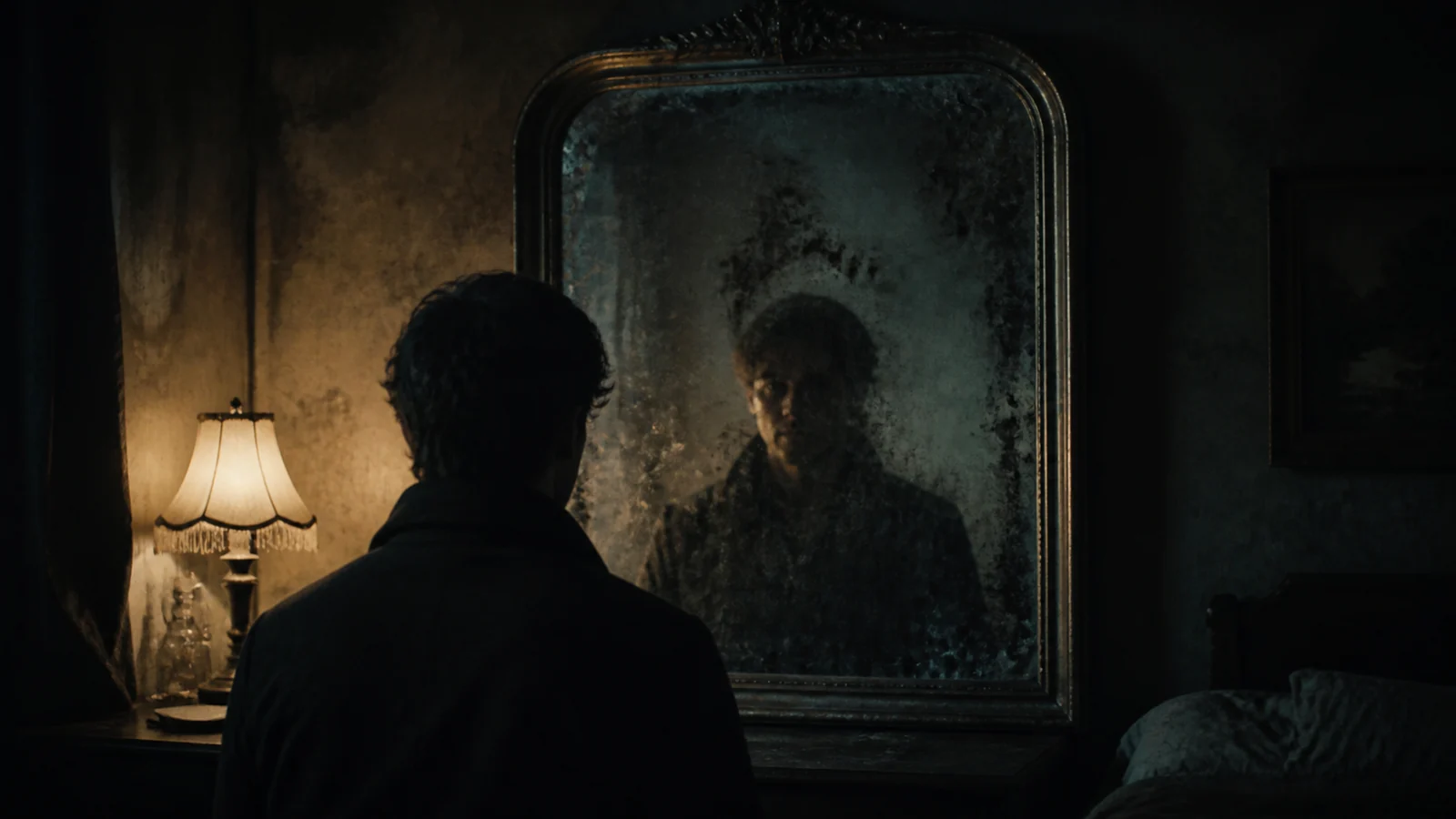
    Stay in front of a dim mirror long enough and the face may begin to borrow features you did not bring with you.

    The mouth loses its edges. One eye darkens. The skin changes color. For a moment, the reflection resembles a relative, an animal, a stranger, or something with no useful name.

    Then you move, and your face returns.

    In low light, prolonged fixation on a face can produce what researchers call a strange-face illusion. Features may seem distorted, fade, or appear to become another identity. A 2023 systematic review found that low illumination, face stimuli, and sustained fixation were important conditions, while also warning that study quality affected reported rates and that the mechanism remains unsettled.

    The effect is real enough to study.

    That does not make every explanation of it equally secure.

    What is the strange-face-in-the-mirror illusion?

    The term describes visual distortions reported when people gaze at their own reflection under low illumination for an extended period. Experimental reports have included changes in color or brightness, deformation of facial features, the impression of another identity, and—in some studies—animal or monstrous faces.

    The mirror does not physically change the face. The visual experience changes while the external stimulus remains relatively stable.

    That places the phenomenon among visual illusions, but the experience is more personal than a line appearing longer than an equal line. A face is not merely a shape. It is the visual anchor of identity.

    When the reflection changes, the person does not simply see a distorted object.

    They see me become not me.

    What has research actually found?

    The effect became widely discussed through experiments led by psychologist Giovanni Caputo. Participants gazed at faces under dim illumination and reported a range of strange transformations. The work expanded from mirror gazing to pairs of people looking at each other in low light.

    Those early results were striking. Striking results need careful review.

    In 2023, researchers published a systematic review and quality analysis of strange-face studies. They concluded that the illusions reliably appeared across mirror-gazing and interpersonal-gazing paradigms. They also found that higher-quality studies reported lower rates, and that reduced light, facial stimuli, and prolonged fixation mattered.

    That produces a responsible two-part conclusion:

    1. Strange-face illusions are a documented perceptual phenomenon.
    2. The prevalence, strength, and mechanism should not be described with more confidence than the evidence supports.
    What the research supports What remains uncertain
    Some observers report facial distortion under dim, prolonged fixation How common strong identity changes are in ordinary settings
    Low light and face stimuli are important conditions One complete mechanism explaining every reported form
    Study quality changes reported rates Whether all folklore or ritual mirror experiences belong to this effect
    The effect can occur in nonclinical participants What any single experience means about an individual person

    That final distinction deserves emphasis. A brief visual illusion under unusual viewing conditions should not be converted into an amateur diagnosis.

    Why dim light matters

    A face contains many small contrasts: the boundary of the lips, the whites of the eyes, the edges of nostrils, the shadow under the brow, the curve of cheek against background.

    Dim light weakens those details.

    When a person holds their gaze in one area, visual adaptation can make stable features fade or change in salience. Tiny eye movements, shifting shadows, asymmetry, and incomplete information give the visual system a face it cannot process in the usual lively way.

    The result may involve several processes rather than one magic switch. Researchers have discussed perceptual adaptation, face processing, dissociation, identity representation, and other mechanisms. The systematic review's caution matters here: the existence of the illusion is clearer than a complete explanation of why it takes every reported form.

    This is related to, but not identical with, seeing faces in ambiguous objects. Pareidolia finds a face where no face exists. The mirror illusion begins with a real face and makes its features unstable.

    One constructs identity.

    The other erodes it.

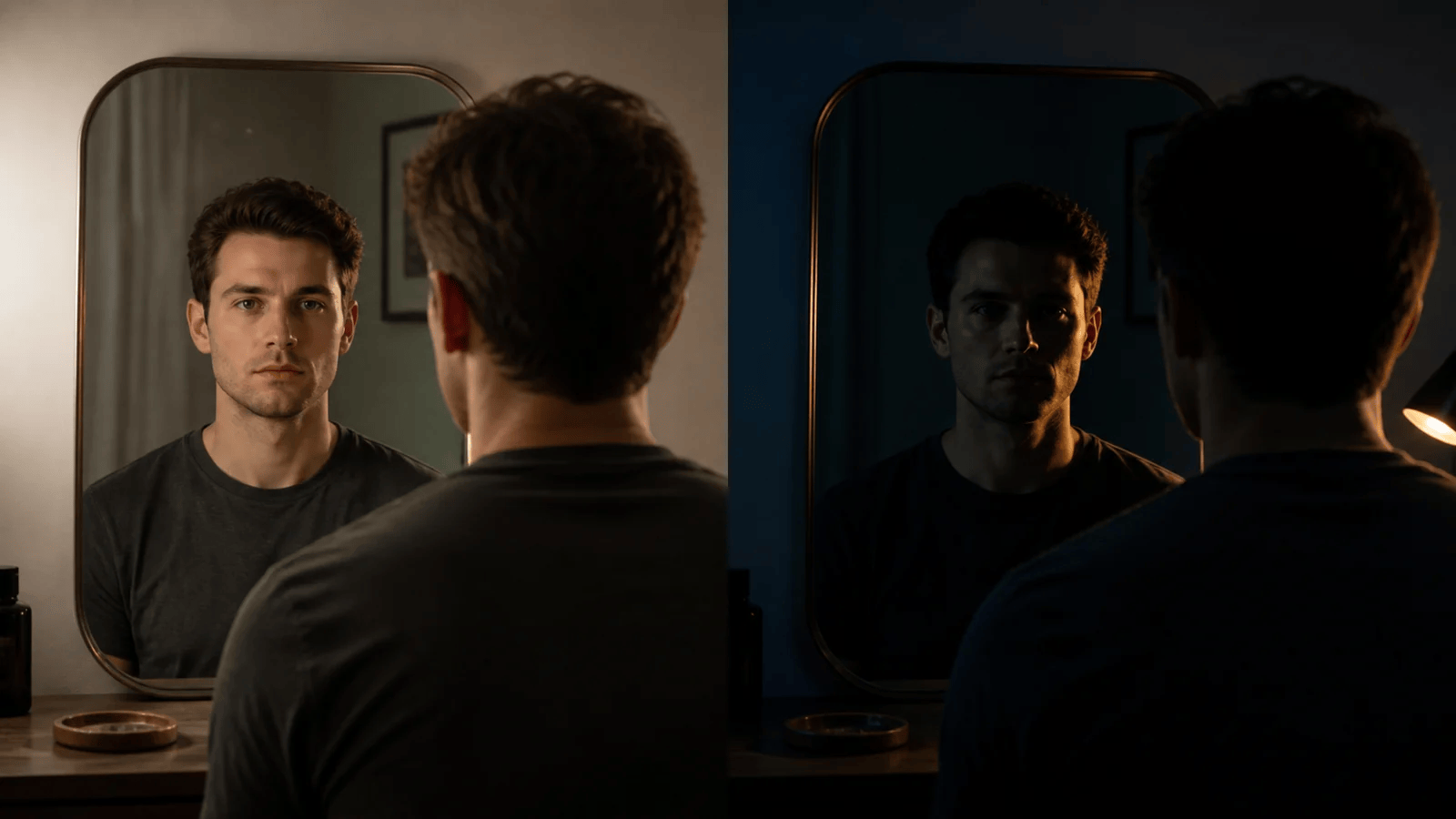
    The same face reflected under full light and dim side lighting, showing how shadows change visible features.
    The same reflection under full and dim side lighting. Ordinary shadow removes facial information.

    Why mirrors make the effect worse

    A photograph shows a past face. A mirror appears to show a present one.

    It responds immediately to movement. That responsiveness teaches the viewer to treat the image as trustworthy. Raise a hand, and the reflection raises one. Lean closer, and it approaches. The system seems perfectly coupled.

    Horror needs only one apparent failure.

    The reflection smiles late.

    It keeps looking at the doorway after you turn back.

    It appears tired when you are not.

    Those fictional events violate the mirror's central promise: exact obedience.

    The strange-face illusion is subtler. The reflection continues obeying movement while its identity becomes unstable. You retain control over the image and lose confidence in the person inside it.

    Do not wait for the second face. Join The Grimbard Press and receive Dead Ship, a free illustrated Subscriber Archive Edition.

    Mirrors already had rules before the laboratory

    Mirror folklore did not wait for experimental psychology.

    Mirrors have been treated as tools of divination, thresholds, traps for souls, signs of vanity, and vulnerable objects to cover after a death. The practices differ across culture and period. They should not be collapsed into one universal belief that “ancient people thought mirrors were portals.”

    What many mirror traditions share is structure.

    The participant changes the ordinary conditions of looking. The room becomes dark. A candle replaces general light. A phrase is repeated. A particular hour matters. The person waits for an image that should not be present.

    The modern Bloody Mary ritual uses exactly that architecture. Versions vary, but the familiar form places a person before a dim mirror, requires repetition, and makes expectation part of the viewing condition.

    The ritual does not need a supernatural result to produce fear. It prevents the viewer from glancing casually. They must keep looking while their vision becomes less reliable.

    The rule against doing one specific thing creates the desire to test it. The mirror adds a witness who looks exactly like the person breaking the rule.

    A scientific effect does not solve every mirror story

    It would be convenient to file all mirror apparitions under low-light illusion and close the cabinet.

    That would repeat the mistake of using one plausible mechanism as a universal explanation.

    Some reports occur under different conditions. Some are memories shaped by fear. Some are folklore told as experience. Some involve reflections, sleep loss, suggestion, grief, substances, medical conditions, or details no outside reader can evaluate. A blog article cannot retroactively reproduce the scene.

    The strange-face literature gives us one documented route by which a normal face can become visually unfamiliar.

    It does not give us jurisdiction over every mirror.

    That restraint is part of what visiting haunted places actually feels like. The responsible observer records the conditions, tests ordinary causes, and resists declaring victory in either direction when the evidence runs out.

    Why horror keeps returning to the mirror

    The mirror is inexpensive, universal, and intimate. It brings the impossible into a private room without requiring a creature to enter through a door.

    It can produce four fears at once:

    • Duplication: another version of the self exists within reach.
    • Disobedience: the image stops matching the body.
    • Addition: someone or something appears behind the viewer.
    • Replacement: the face remains, but identity changes.

    Most horror objects must be carried into the scene. The mirror is already mounted on the wall.

    Every reader has practiced trusting it.

    Frequently asked questions

    Why does my face look distorted in a dark mirror?

    Low illumination removes facial detail, and prolonged fixation can make stable features fade or change in salience. The visual system may then produce a strange-face illusion in which the reflection appears distorted or unfamiliar.

    Is the strange-face illusion normal?

    It has been reported in nonclinical research participants under unusual viewing conditions. One brief illusion does not, by itself, establish a disorder or diagnosis.

    Does the mirror-gazing effect happen to everyone?

    No. Reported rates vary considerably, and a systematic review found that study quality influenced them. The phenomenon should not be presented as guaranteed.

    Does science prove the Bloody Mary legend?

    No. Research helps explain why dim, prolonged mirror gazing can produce unsettling visual changes. It does not prove a supernatural figure appears or establish the origin of every ritual variant.

    Why does moving make my face look normal again?

    Movement changes the visual information, interrupts fixation, restores edges and contrast, and confirms the ordinary link between body and reflection.

    The object beyond the reflection

    The Scarab begins where a modern hand acquires an object carrying an older interpretation of reality. A mirror makes the same offer: trust the object, then discover the rules were never yours.

    Explore The Scarab or join The Grimbard Press and receive Dead Ship free.

    Sources and further reading

  • Why Are Dolls Creepy? The Psychology Behind Their Uncanny Faces

    Why Are Dolls Creepy? The Psychology Behind Their Uncanny Faces

    A doll has a face built to be recognized and eyes that cannot recognize you back.

    It resembles a person precisely where resemblance matters, then fails every test of life. The mouth keeps one expression. The skin holds one temperature. The gaze never quite meets yours, yet never grants the relief of looking away.

    Dolls can feel creepy because they occupy an uncertain boundary between person and object. Humanlike faces attract attention, while fixed expressions, stillness, glassy eyes, and mismatched realism make that familiarity fail. The uncanny valley offers one explanation, especially when lifelike and artificial features conflict, but it is not a universal law that explains every doll or every frightened viewer.

    Sometimes the doll looks too human.

    Sometimes it is worse because it does not look human enough.

    The face arrives before the object

    A doll may be cloth, wood, wax, porcelain, vinyl, or plastic. The material changes. The arrangement remains.

    Eyes above a nose. A mouth below. A head placed on a body that repeats the human plan.

    As discussed in why we see faces in the dark, the visual system gives faces unusual priority. A doll does not merely suggest a face through random marks. It presents one deliberately. The question is not whether the face will be detected. The question is what kind of face the brain believes it has found.

    A living face changes continually. Muscles shift around the eyes and mouth. Attention moves. Breathing affects posture. Tiny asymmetries provide evidence of thought and response.

    A doll offers the structure without the behavior.

    That creates a social signal with nobody behind it.

    What is the uncanny valley?

    In 1970, Japanese roboticist Masahiro Mori proposed that people may respond more positively as an artificial figure becomes increasingly humanlike—until it becomes almost human. At that point, small imperfections can cause comfort to drop sharply into eeriness. That dip became known as the uncanny valley.

    The idea has spread far beyond robotics. It is now applied to computer-generated characters, prosthetic hands, mannequins, wax figures, puppets, masks, and dolls.

    The popular version is simple: things that look nearly human are creepy.

    The research is less tidy.

    Reviews of uncanny-valley studies have found that results depend on how human likeness is manipulated and measured. Some experiments support the effect strongly; others do not reproduce a neat valley. Evidence is particularly useful for perceptual mismatch—features that do not agree about how alive or realistic the figure should appear.

    That matters more than the slogan.

    A doll with painted features may look comfortably stylized. A highly realistic doll with rigid skin, oversized glass eyes, or an immobile mouth may create conflict. The face asks to be processed as human while individual features refuse to cooperate.

    Mismatched realism makes the familiar unfamiliar

    Research by Debaleena Chattopadhyay and Karl MacDorman examined what happens when realism becomes inconsistent across a humanlike character. Their work suggests that inconsistency can reduce familiarity and increase cold, eerie feelings in anthropomorphic figures.

    Put plainly: the problem may not be realism itself. The problem may be that the eyes belong to one level of reality and the skin to another.

    Porcelain dolls provide the classic arrangement. The face may be modeled with soft cheeks and detailed lips, but the surface reflects light like fired material. The eyes may imitate moisture while remaining hard. Painted lashes surround pupils that never contract. Hair looks organic until the edge of the wig becomes visible.

    Each feature makes a promise the next feature breaks.

    Doll feature Human expectation The mismatch
    Glass eyes Attention and moisture Reflection without responsive gaze
    Fixed smile Changing emotion Warmth that continues through every event
    Jointed body Purposeful movement Limbs that move only when acted upon
    Realistic skin tone Warm living tissue Hard, cool, uniform material
    Human clothing Social identity A role without a person performing it

    The result is not simply “almost human.” It is human and object at the same time.

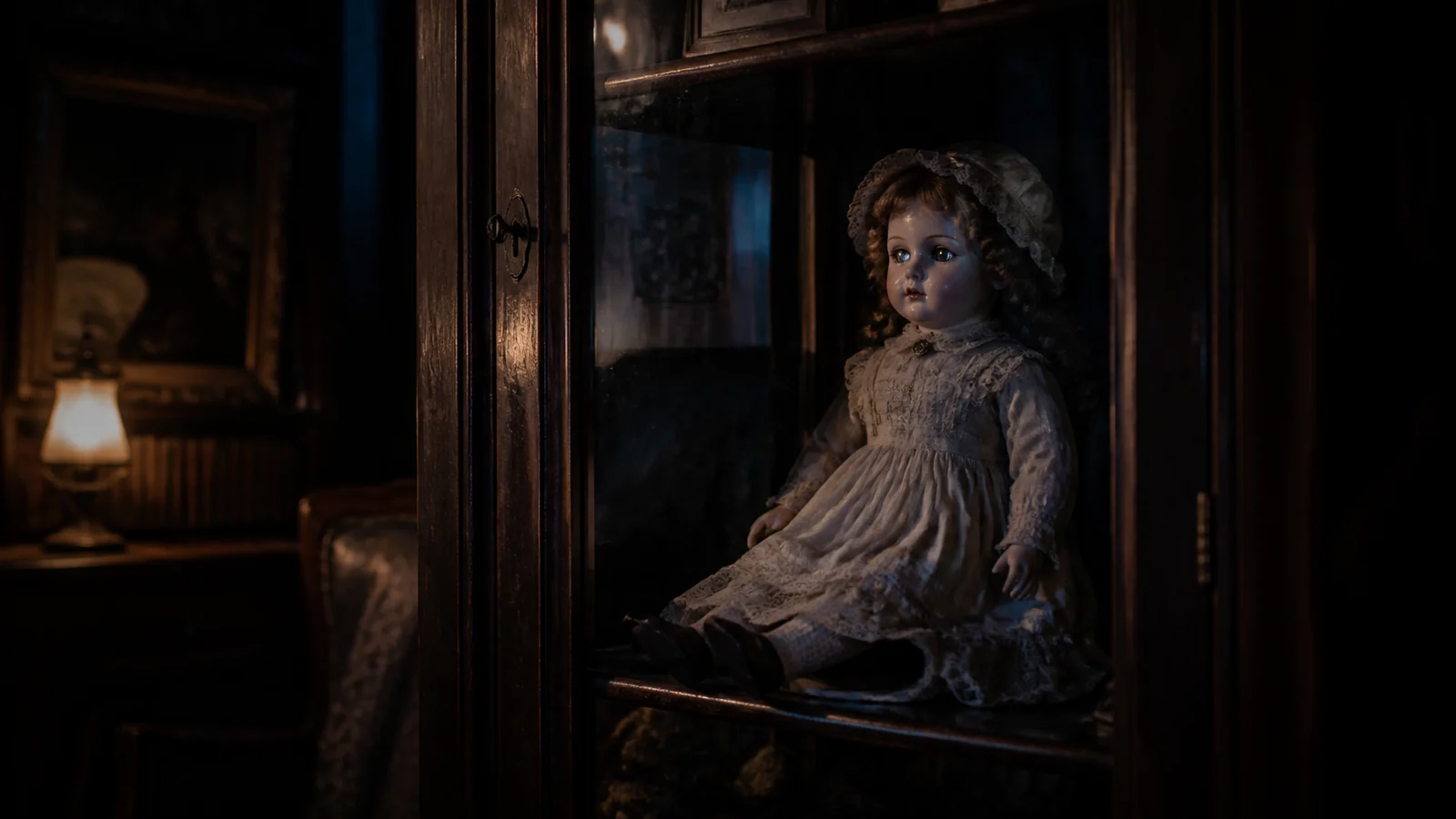
    A close view of a porcelain doll showing a glass eye, painted lips, aged facial surface, and the edge of its wig.
    Small mismatches between lifelike features and artificial materials can intensify unease.

    Stillness becomes an unfinished action

    A chair is allowed to remain still.

    A body is not.

    Even a sleeping person offers movement if watched closely enough. The chest rises. Eyes shift under lids. Fingers relax. A doll holds the posture of a body while refusing all involuntary evidence of life.

    That stillness becomes more noticeable when the doll is posed as if an action has paused. It sits upright in a chair. It faces the doorway. One arm reaches forward. The head turns slightly more than the torso.

    The viewer supplies the missing verb.

    It was looking.

    It has stopped moving.

    It will move when the room is empty.

    Horror depends on this expectation. The doll rarely needs to move in front of the audience. It only needs to occupy a different position after attention leaves it.

    Showing the man checking the locks works for the same reason. Fear becomes visible through an attempt to establish continuity. A character photographs the shelf before bed. They mark the doll's chair. They close the cabinet. The next scene tests whether the record still agrees with the room.

    The object is never where the manifest left it. Join The Grimbard Press and receive Dead Ship, a free illustrated Subscriber Archive Edition.

    Why glass eyes feel watchful

    Doll eyes do not need to track a viewer to feel intrusive.

    Shiny curved surfaces catch highlights. A small point of reflected light makes an eye appear wet and therefore more alive. Because the gaze is fixed, a viewer moving across the room may not receive the normal social evidence that another person's attention has changed.

    Some painted or inset eyes also create a familiar portrait effect: the gaze appears directed outward across a range of viewing positions. The doll is not following anyone. Its geometry and the viewer's interpretation produce the impression.

    Knowing that can make the object easier to explain without making it pleasant to keep beside the bed.

    The problem is not merely that the doll “looks at you.” It is that a face normally reveals where attention is going, and the doll offers no reliable answer.

    Old dolls carry other people's stories

    A new doll belongs to a store and a manufacturer.

    An old doll belongs to everyone who may have held it.

    Wear becomes evidence. A rubbed patch on the hand suggests repeated contact. A repaired dress implies care. One missing shoe creates a vanished pair. Cracks in a porcelain face resemble age or injury even though the material is not flesh.

    Provenance can be known, partly known, or invented. Horror takes advantage of all three.

    An inherited doll arrives with family rules. An antique-shop doll has no witness to contradict the seller. A toy found inside a wall appears to have been deliberately removed from ordinary circulation. The object has survived its owner, and survival begins to look like agency.

    This resembles the fear inside changeling folklore: the face is familiar, but recognition no longer settles identity. The ethical history of changeling belief is far more serious than a creepy-toy story, and the traditions should not be flattened together. The shared mechanism is narrower. A familiar form becomes frightening when expected behavior does not arrive.

    Horror taught us what dolls are supposed to do

    Fiction did not invent discomfort around artificial people, but it gave that discomfort a library.

    The haunted doll can contain a spirit. The killer doll can act directly. The prophetic doll announces harm by changing position. The duplicate doll resembles a child too closely. The dollhouse repeats a real building and changes before the building does.

    Once those patterns become familiar, an ordinary doll inherits them. The viewer is no longer responding only to porcelain, paint, and glass. They are responding to every story in which those materials became patient.

    This is one reason “I have always hated dolls” can feel older than any specific film. The person may not remember the first story that established the rule. The rule remains:

    Do not place it where it can see the bed.

    Creepiness is not exactly fear

    Researchers do not always treat eerie, uncanny, creepy, fearful, and disgusting as interchangeable responses. A figure can feel wrong without producing immediate terror.

    Creepiness often involves uncertainty about threat.

    A snarling dog announces danger clearly. A doll announces nothing. It has a face, a body, and no visible intention. The observer continues monitoring it because the category remains unresolved.

    Is it a harmless object?

    Yes.

    Why does it need a face?

    Because that is what dolls are.

    Why is it facing the door?

    Someone placed it there.

    Who?

    The questions do not prove danger. They prevent dismissal.

    Why some dolls are charming instead

    Not every humanlike object falls into the valley.

    Stylization can help. A cloth doll with button eyes does not promise anatomical realism. A cartoon figure establishes its own rules. Familiarity, positive memory, cultural practice, condition, context, and personal experience all shape the response.

    The same antique doll may represent family continuity to one person and unbearable scrutiny to another.

    That variation is evidence against one grand explanation. Perceptual mismatch matters. So do learning, setting, expectation, and story.

    The doll in a bright museum case is an artifact.

    The same doll sitting at the top of your stairs at midnight has acquired a scene.

    Frequently asked questions

    Why are porcelain dolls especially creepy?

    Porcelain allows detailed human features while remaining hard, glossy, and immobile. Realistic coloring combined with reflective eyes and an unchanging expression can create a strong mismatch between human appearance and object behavior.

    Is the uncanny valley scientifically proven?

    Research supports uncanny responses under some conditions, particularly when humanlike features are inconsistent. The effect is context-sensitive, and studies do not support the simplified claim that every increasingly realistic figure produces one predictable valley.

    Why do doll eyes seem to follow you?

    Fixed outward-facing eyes and curved reflective surfaces can maintain the impression of directed gaze as the viewer moves. The doll is not tracking the viewer, but the face-processing system still interprets the gaze socially.

    Is fear of dolls a real phobia?

    The term pediophobia is often used for an intense fear of dolls. A blog article cannot diagnose a phobia. Clinically significant fear depends on severity, persistence, distress, and interference with a person's life.

    Why do old dolls seem creepier than new ones?

    Age adds cracks, stains, wear, repairs, missing history, and evidence of previous owners. Those details invite a story before anything supernatural occurs.

    The objects waiting farther inside

    There Be Monsters: Among the Dead enters the space where bodies, objects, and presences refuse the categories assigned to them.

    Explore the collection or join The Grimbard Press and receive Dead Ship free.

    Sources and further reading

  • Why Are Lighthouses Scary? Isolation, Storms, and the Unbroken Watch

    Why Are Lighthouses Scary? Isolation, Storms, and the Unbroken Watch

    A lighthouse is a warning built in the place most likely to kill the person maintaining it.

    The tower must stand where rock, shoal, fog, current, and storm make navigation dangerous. Its beam has to reach people who may never see the keeper. The light must continue whether the person tending it is lonely, exhausted, ill, or listening to something strike the rocks below.

    Lighthouses feel frightening because they combine isolation, hazardous weather, repetitive night duty, limited escape, and responsibility for lives beyond the keeper's sight. The beam promises order to distant ships. Inside the tower, that order depends on a small number of people repeating exact tasks while darkness presses against every window.

    The haunted house traps its occupants with a past.

    The lighthouse traps them with a job.

    A lighthouse begins as a boundary

    Lighthouses do not mark comfortable places.

    They identify a coast, reef, harbor entrance, or obstruction that a navigator needs to recognize before reaching it. A lighthouse says land is here, but the more urgent part of the message may be do not come closer.

    That double meaning gives the structure its natural horror.

    From the sea, the beam is reassurance. From the lantern room, it reveals how completely the tower is surrounded. Each sweep shows a portion of rock, water, fog, or rain and then removes it again. The light does not conquer the darkness. It visits one narrow section at a time.

    The darkness has the longer shift.

    This differs from why caves are frightening. A cave removes the entrance as a person goes deeper. A lighthouse keeps displaying the world outside, but offers no easy route into it. The keeper can see the storm. Seeing does not provide escape.

    What did lighthouse keepers actually do?

    The romantic image reduces the keeper to one melancholy man polishing a lens while the sea attempts to drive him mad.

    The work was more practical and more demanding.

    At Cape Hatteras, the National Park Service describes a principal keeper and two assistants who rotated four-hour night watches. Their duties included carrying fuel, tending the lamp, trimming wicks, polishing the lens and brass, maintaining the clockwork, keeping records, ordering supplies, painting buildings, watching shipping, and making repairs.

    Point Reyes on the California coast provides an especially useful example. Its keepers had to wind the clockwork that rotated the Fresnel lens every two hours and twenty minutes through the night. The mechanism used a descending 170-pound weight. Daylight brought lens cleaning, brass polishing, repairs, and work on the fog signal.

    The routine matters to horror because every task can fail.

    A wick can burn poorly. A weight can stop. A lens can be damaged. A fog signal can go silent. A report can contain a time no one remembers writing. The building turns maintenance into ritual because the consequences of neglect exist somewhere beyond the visible circle.

    Rules in folk horror create a boundary. Lighthouse duty creates a checklist.

    Both become frightening when one item changes.

    The keeper was not always alone

    Many lighthouse stories depend on solitude. The historical record is less convenient.

    The National Park Service notes that many keepers lived with families in attached or nearby quarters. Family members contributed to the work, and women sometimes inherited formal keeper positions after a husband or father died or became unable to serve. Some stations employed several keepers. African American workers served within lighthouse and lifesaving systems under changing and often unequal conditions before and after emancipation.

    The solitary white man in a raincoat is an image, not a universal staffing model.

    Correcting the image does not remove isolation. A family can be isolated together. Three keepers can still be days from help. A station may have company but no privacy, no reliable transport, and no refuge from the same machinery, weather, and sound.

    Company also creates new forms of uncertainty.

    Someone was supposed to wind the mechanism.

    Someone was supposed to relieve the watch.

    Someone is moving on the stairs, but everyone is already in the room.

    Weather makes the building an instrument

    At Point Reyes, fog can reduce visibility to hundreds of feet. The headlands project into a dangerous approach to San Francisco Bay. The lighthouse was built below the high fog line, 300 feet down a cliff, because the warning had to exist where ships might actually see it.

    Wind, water, and metal do not remain quiet in such a place.

    The tower hums. Windows rattle. Waves arrive as impacts without visible sources. Fog removes the horizon, leaving the keeper inside a white enclosure while the sea continues below. A fog signal repeats until it becomes part of the body, then stops suddenly enough to feel like an event.

    Point Reyes recorded winds strong enough to force a keeper to crawl. The National Park Service lists a highest recorded speed of 133 miles per hour and notes that winds of 60 miles per hour are common. The station's isolation, work, wind, and fog made it an undesirable assignment.

    Horror does not need to invent the pressure.

    It only needs to wait until the familiar noise answers back.

    **The light is still on aboard Dead Ship.** Join The Grimbard Press and receive the complete illustrated story free.

    A lighthouse's Fresnel lens and clockwork mechanism lit by a keeper's lamp during the night watch.
    A keeper's night watch depended on lenses, clockwork, weights, fuel, and repeated maintenance.

    Responsibility reaches beyond the beam

    A haunted-house story asks whether the occupants can save themselves.

    A lighthouse story adds strangers.

    The keeper may never know the names of the people relying on the signal. A ship passes beyond sight. Another fails to appear. Wreckage arrives later. The light can operate perfectly and still be unable to save everyone.

    That imbalance is essential. The keeper has enormous responsibility and limited power.

    At Point Reyes, lighthouses and fog signals warned ships, but wrecks continued. A lifesaving station was established on the beach in 1890. Patrols watched for disasters and survivors in cold, powerful water. The warning system did not eliminate the need to recover people after warning failed.

    Sailors believed in sea monsters partly because the ocean delivered evidence without context. The keeper experiences the reverse. The context is everywhere—dangerous water, poor visibility, a missing vessel—but the evidence may never arrive.

    The empty horizon can mean everyone passed safely.

    It can mean no one is left to signal.

    The beam proves that time is passing

    A rotating lighthouse lens creates a characteristic pattern. Mariners identify a station by how its light flashes. At Point Reyes, the mechanism produced one flash every five seconds.

    To a keeper, repetition measures the night.

    The beam crosses the window. Darkness returns. The weight descends. The mechanism needs winding. The same stairs wait. The same glass needs attention. A shift ends only when another person arrives to continue the sequence.

    Repetition is normally reassuring because it confirms that the system works.

    Horror changes one interval.

    The beam returns early.

    The mechanism is still turning after the weight reaches the bottom.

    The flash appears from the wrong side of the tower.

    The keeper sees another light at sea matching the station's pattern exactly.

    Those ideas work because lighthouse time is not decorative. It is operational. A wrong flash is a wrong message sent into darkness.

    Automation left an empty tower still performing its duty

    Lighthouse automation removed much of the need for resident keepers. A current National Park Service history notes that U.S. lighthouses had become automated by the end of the twentieth century; Boston Light retained a keeper under federal authorization until the last civilian keeper retired in 2023.

    Automation creates a different unease.

    The abandoned house is frightening because the system stopped. Dust settles. Pipes fail. Nature enters.

    The automated lighthouse remains active after the people leave.

    The light continues to turn. Electronic equipment monitors what no person is present to see. The building performs occupancy without an occupant.

    That is close to the fear inside the warehouse ghost. Modern systems keep logging, scanning, and signaling after the human witness has gone home. A process does not need to be alive to outlast the people who understand it.

    Why lighthouses feel haunted

    Lighthouses gather several kinds of fear in one vertical structure:

    Element What it promises What horror changes
    The beam Orientation and warning It illuminates something that should not be there
    The tower Refuge above dangerous water It becomes a place with one narrow route out
    The schedule Reliable operation One interval changes without explanation
    The keeper Human supervision The duty continues after the watcher disappears
    The fog signal Identity when the light cannot be seen Another signal answers from the wrong direction

    The structure is not frightening because it is old.

    It is frightening because it has a purpose precise enough to fail.

    Frequently asked questions

    Did lighthouse keepers live alone?

    Some experienced severe solitude, but many stations had assistants, families, or nearby quarters. Staffing varied by station and period. The lone-keeper image should not be treated as universal history.

    Why did lighthouses need constant attention?

    Before automation, lamps, fuel, wicks or mantles, lenses, clockwork, windows, fog signals, and buildings required regular operation and maintenance. Severe weather could make continuous monitoring especially important.

    Are lighthouses still staffed?

    Modern aids to navigation are generally automated. Historic sites may have rangers, caretakers, volunteers, museum staff, or other personnel, but not traditional resident keepers tending a flame through rotating watches.

    Why does fog make a lighthouse scarier?

    Fog removes distance and the horizon while preserving sound. The tower's warning may become audible rather than visible, and the keeper can know danger is near without being able to see it.

    How is lighthouse horror different from haunted-house horror?

    A haunted house usually contains a past intrusion. A lighthouse adds public duty: the person inside must keep the warning operating for people outside, even when staying becomes dangerous.

    Sail beyond the light

    Monsters of the Wine-Dark Sea follows the old fear that the water contains more than distance. The lighthouse marks the last fixed point before that uncertainty begins.

    Explore the book or join The Grimbard Press and receive Dead Ship before it reaches shore.

    Sources and further reading