Tag: Irish folklore

  • What Are Thin Places in Celtic Tradition?

    What Are Thin Places in Celtic Tradition?

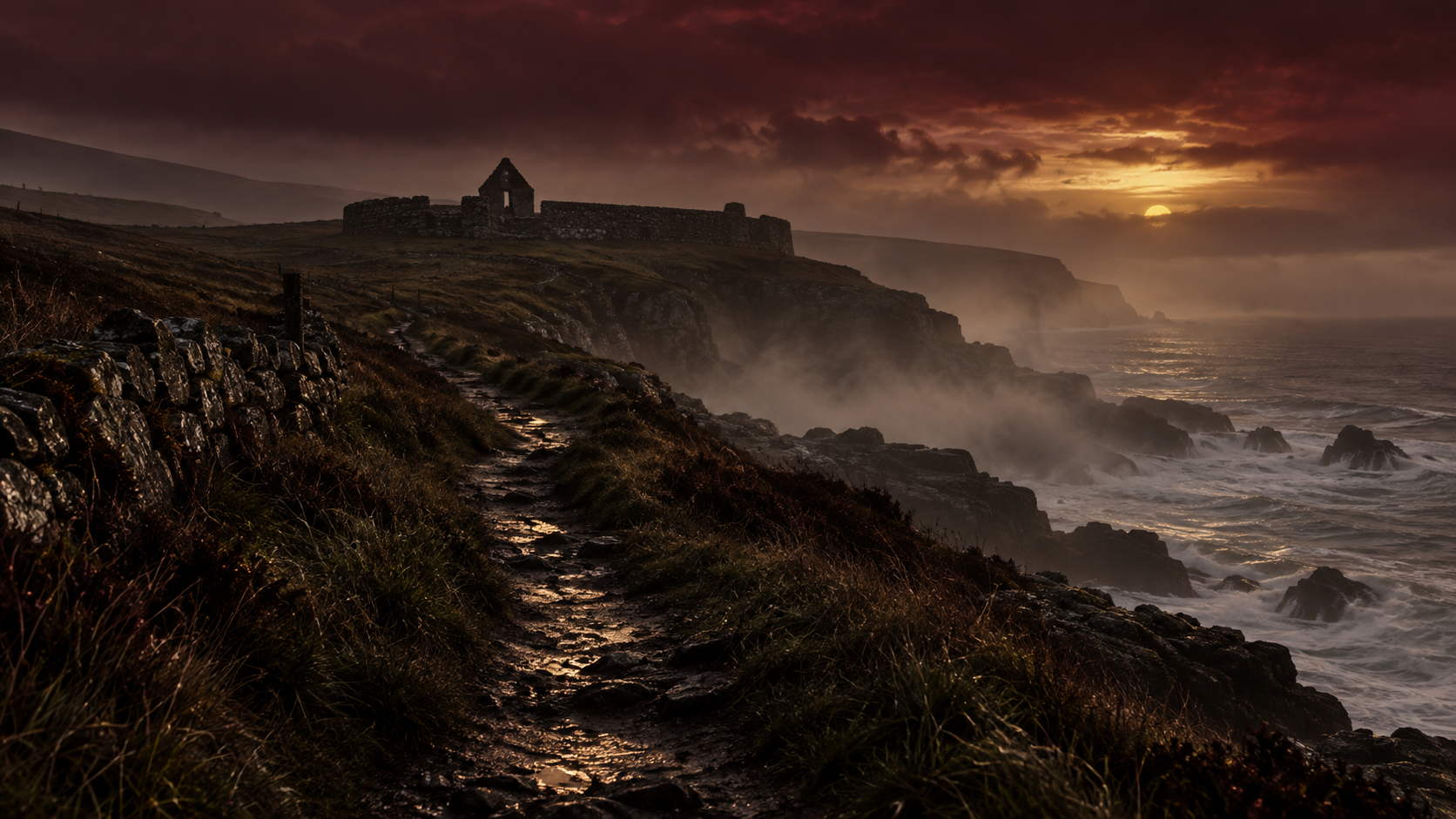
    An Irish coastal path between dark grass and sea mist at twilight

    A “thin place” usually means a location where the boundary between ordinary life and the spiritual or otherworldly feels unusually near. People often connect the phrase to Celtic tradition, especially the landscapes of Ireland and Scotland. The careful answer is that the phrase is prominent in modern Celtic spirituality, while older Irish and Scottish stories contain many distinct ideas about the Otherworld, sacred sites, seasonal crossings, and beings associated with particular places. Those are related conversations, not proof that every ancient community used one shared category called a thin place.

    That distinction matters if you love folklore. It lets a hill, well, island, or path have its own story instead of turning every location into a generic portal. It also keeps a useful modern metaphor from being mistaken for a documented ancient quotation.

    What does “thin place” mean today?

    In contemporary writing, a thin place may be a landscape where prayer feels easier, a site where the past seems present, or a moment when a person feels close to something beyond their usual account of the world. The language is flexible. Some writers mean God; others mean ancestors, fairies, memory, ecological attention, or simply awe.

    A study of Celtic pilgrimage describes “thin places” as a theme in contemporary expressions of Celtic Christianity. That phrasing is more precise than saying the phrase is an unbroken ancient Celtic teaching. Another scholarly discussion of Iona traces the influential language of a “thin” boundary through modern religious and literary contexts, including George MacLeod’s descriptions of the island.

    None of this makes the experience false. It changes what kind of claim we are making. “This place feels thin to me” is an account of experience. “Ancient Celts taught that this exact site was a thin place” is a historical assertion that needs a much more specific source.

    What do older place traditions actually give us?

    Irish tradition offers stories of the aos sí and places associated with them, including earthen forts and mounds. It offers encounters that turn on hospitality, trespass, time, and the rules of a place. Scottish, Welsh, and Breton traditions are not interchangeable variations of one Irish map. Each has its own languages, records, local practices, and later retellings.

    Heritage Ireland’s account of Samhain describes Irish folklore in which the boundary between this world and the supernatural draws thin at the seasonal turning. It also notes stories of the aos sí associated with underground or otherwise hidden domains. That is a valuable connection to make, but Samhain is a calendar occasion; a holy well is a site; a fairy fort is a place embedded in a community’s rules. We lose detail when we flatten all three into the same label.

    An old stone well in a quiet grove, with no figures or supernatural effects

    Is the phrase itself ancient?

    It is safest not to present the English phrase as an ancient Celtic term. The scholarship above shows its strong modern life, especially around Iona and Celtic Christian practice. That does not prove no earlier person ever used a similar image. It does mean a blog post should not claim a single ancient origin without evidence. “Celtic” is also broad: it names languages and cultures across several places and periods, not one timeless belief system.

    Writers sometimes say that a veil between worlds is thinnest at Samhain. This is a familiar and evocative modern explanation, and Heritage Ireland uses similar language when introducing the holiday’s folklore. But a neat one-line formula is still an explanation, not a substitute for the particular source, date, and community behind a given story.

    The practical test is simple. Ask: Which tradition? Which place? Which recorded account? What does the storyteller say is there, and what is a later interpreter adding? A legend about a mound that must not be disturbed differs from a pilgrim’s account of prayer on Iona, even if both leave a reader feeling that ordinary categories are insufficient.

    Why do thresholds work so well in stories?

    A threshold joins two conditions without making them the same. Shorelines are land and not-land. Dusk is day and not-day. A cemetery is part of a living town but organized around the dead. A ruined building belongs to the present while visibly carrying an earlier use. These places naturally invite stories about uncertainty, permission, and return.

    The strongest fiction does not merely announce that the “veil is thin.” It gives the crossing a cost. Perhaps a traveler must answer a question honestly; perhaps a path can be found only once; perhaps somebody takes a gift without understanding the obligation attached. The rules create tension because the reader can see how a good intention might still lead to harm.

    For a neighboring tradition in which an encounter carries a clear social warning, see our banshee post. For a wider introduction to landscape and communal belief in fiction, see what folk horror means in books.

    A twilight footpath dividing a village field from a misted woodland

    How to visit a meaningful place without turning it into a prop

    You do not need to believe in a literal portal to approach a site with care. Check whether it is public, private, sacred, or protected. Stay on permitted paths. Do not take stones or offerings, leave candles, climb fragile ruins, or treat a living community’s practice as a spooky backdrop. Read the local interpretation before inventing a story about the place.

    Then pay attention to more than atmosphere. Who maintains the site? What language appears in its name? Has its meaning changed through worship, tourism, conservation, or loss? An attentive visit can be more unsettling—and more respectful—than a staged midnight photograph.

    If a local guide or community source offers a different account from the one you read online, do not immediately force the two into a single “authentic” version. Traditions can coexist, conflict, and change. Note who is speaking and when. Folklore is a record of relationships among people and places, not a list of supernatural properties assigned to scenery.

    FAQ

    Are thin places part of Celtic folklore? The modern phrase is commonly associated with Celtic spirituality. Older Celtic-language traditions include many stories about significant places and otherworldly encounters, but should not be treated as one uniform “thin places” doctrine.

    Is Samhain a thin place? Samhain is a seasonal festival, not a location. Some Irish folklore and modern retellings describe the boundary between worlds as more permeable then.

    Does a thin place have to be frightening? No. The phrase may describe wonder, prayer, grief, or closeness as readily as dread.

    If carefully sourced folklore is your sort of autumn reading, join The Grimbard Press. For stories that let place shape the danger, browse October 31.

    Sources: Celtic pilgrimage study; folklore scholarship on Iona; Heritage Ireland on Samhain.
  • The Banshee Doesn’t Scream, She Keens: The Real Irish Legend

    The Banshee Doesn’t Scream, She Keens: The Real Irish Legend

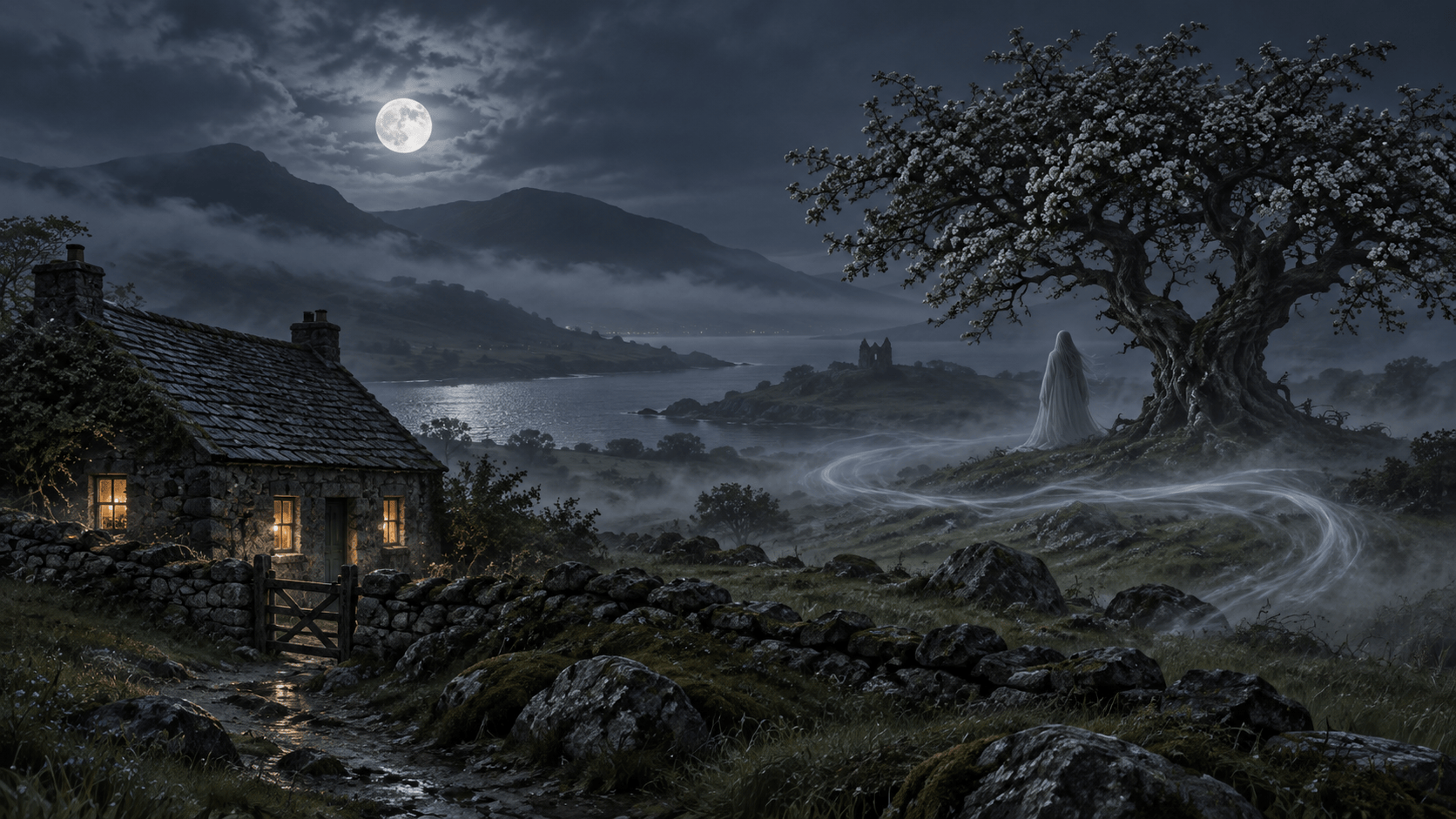
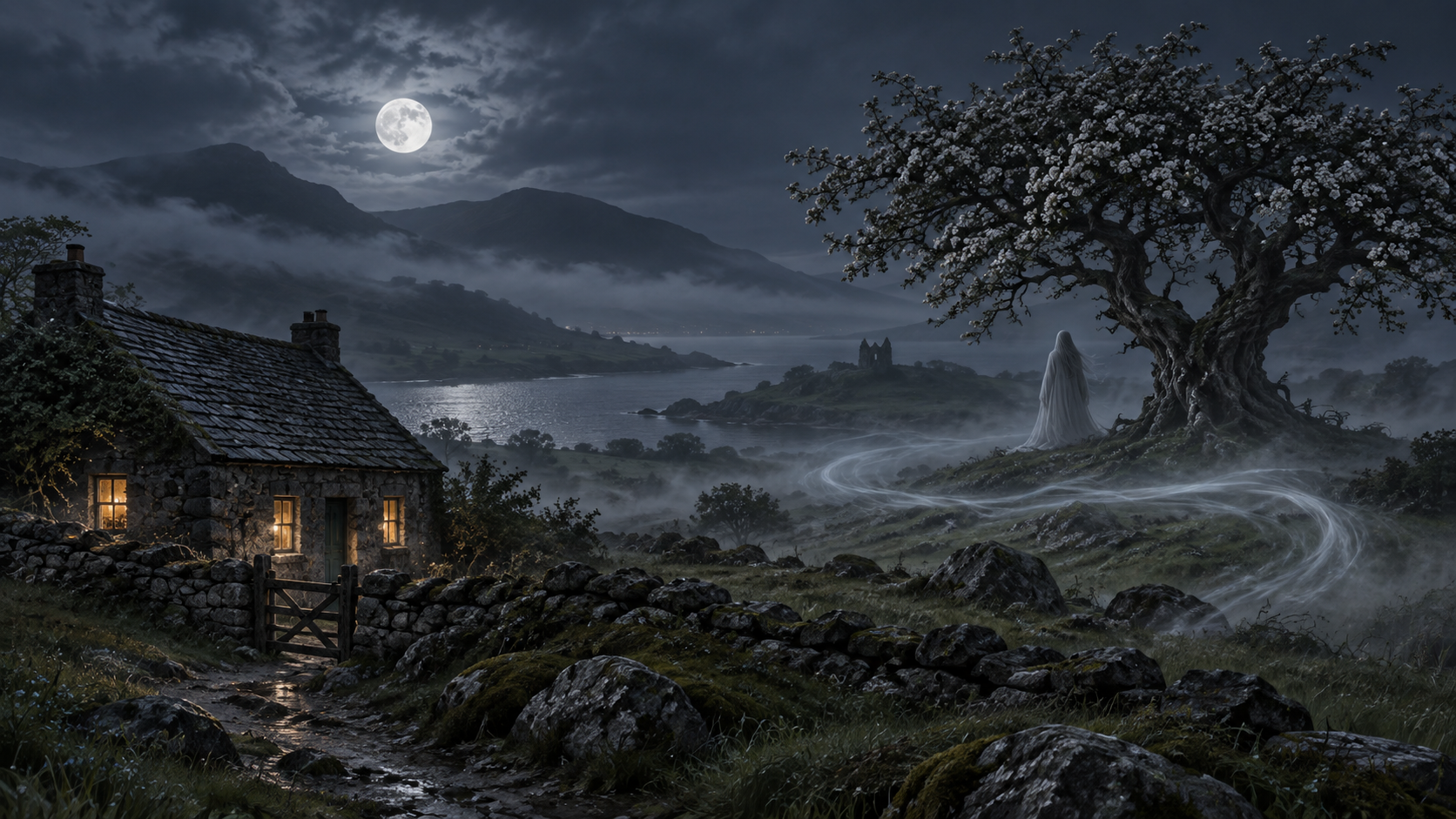
    Misty Irish cottage and hawthorn tree with a distant, face-obscured pale figure

    Horror films have made the banshee a screamer: a wailing woman who shows up and shrieks, and then something terrible happens. Irish tradition tells it differently, and the difference is the whole point.

    The banshee doesn’t cause a death. She mourns one before it happens.

    What “banshee” means

    The word comes from the Irish bean sídhe: bean is woman, and sídhe refers to the mounds, the old earthworks and hills where the otherworld was said to live. A woman of the mounds. She isn’t a ghost in the ordinary sense, and she isn’t a demon. She belongs to the older, stranger category of beings that shared the land with people and kept their own rules.

    Her one job is to announce a death. She’s heard at night, usually close to the house, sometimes for several nights before. Then someone in the family dies.

    The sound is a lament

    What people describe hearing isn’t random screaming. It’s keening.

    Keening (Irish caoineadh) was the formal lament women performed over the dead at wakes and funerals. It was a skilled practice. Some women were known for it and were asked to keen at wakes. The keen had structure, rising and falling, part song and part speech, calling out the dead person’s name and virtues and the family’s grief. The church spent a long time discouraging it as too pagan and too wild, and by the twentieth century it had mostly faded.

    So when people said the banshee was keening, they meant something specific. She was doing for the family what the keening women would do after the death. She was just early.

    That makes her something closer to a family retainer than a monster. She grieves with you. She simply knows first.

    Whose banshee?

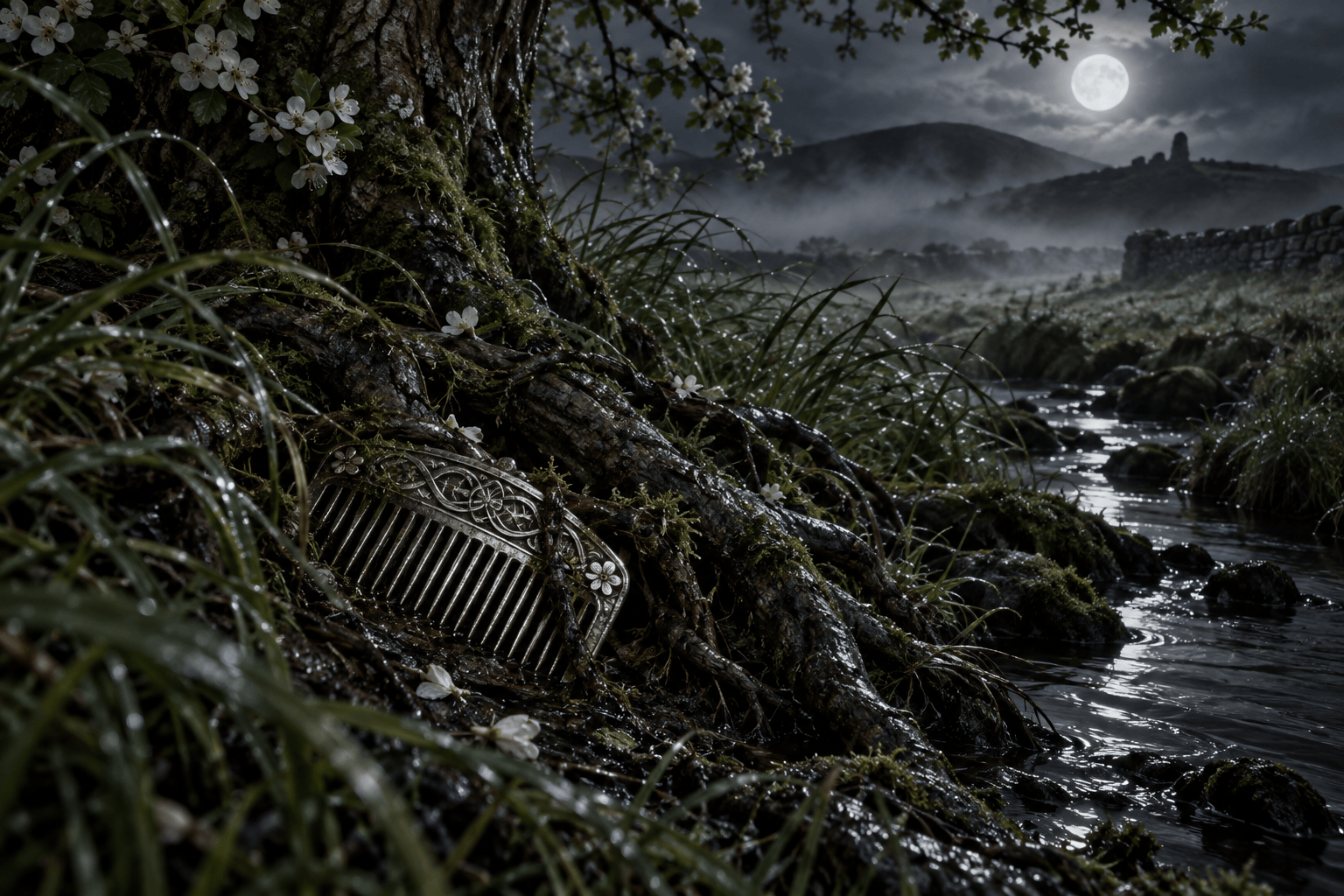
    An old comb on a windowsill inside an Irish cottage at night

    In the older tradition the banshee doesn’t come for just anyone. She attaches to particular families, the old Gaelic lines, the names that begin with Ó or Mac. Some tellings name specific families she was bound to, and there are local traditions all over Ireland about which families had one and what she sounded like.

    Families that emigrated said she went with them. There are accounts from America and Australia of Irish families hearing the keen far from home before word of a death arrived by letter weeks later.

    What she looks like

    Accounts vary, and the variety is part of the legend. She can appear as:

    • a young woman with long hair,
    • a pale, dignified matron,
    • or an old woman, bent and grey, wrapped in a cloak.

    Most of the time she’s heard and not seen. When she is seen, she’s often combing her long hair.

    Don’t pick up the comb

    This is the warning that has lasted longest, and you’ll still hear it in parts of Ireland. If you find a comb lying on the road, leave it. It may be hers, and she will come back for it.

    What happens to you if you take it depends on who’s telling the story. Some say she comes to the house for it. Some say you lose something you’d miss more. It’s a small rule, the kind that survives because it’s easy to follow: don’t take what isn’t yours from the side of the road on the wrong night.

    Her relatives

    Scotland has the bean nighe, the washer at the ford: a woman seen at a stream, washing the grave clothes of someone about to die. If you catch her you might get an answer from her, or a wish. Some scholars connect both figures to older war goddesses of Irish myth, the ones who appeared before battles to show who would fall. That connection is debated, but the pattern is clear. The Gaelic world pictured death announced in advance by a woman, and she’s usually doing women’s work around death: washing, mourning, keening.

    The other omens in an Irish house

    The banshee wasn’t the only warning. Irish and wider British tradition had a whole vocabulary of signs that a death was coming, and many families kept track of several at once:

    • Three knocks at the door or on the headboard, with nobody there.
    • A bird at the window, or a bird that gets into the house. Robins and magpies especially.
    • The death coach, the cóiste bodhar or “silent coach,” a black coach heard on the road at night, sometimes with a headless driver. If it stops at your door, it has come for someone inside.
    • The fetch, a double of a living person, seen where that person couldn’t be. Seen in the morning it meant long life. Seen in the evening it meant the opposite.
    • A picture falling from the wall for no reason.

    And once the death came, there were customs for the house itself. Someone opened a window so the soul could leave. The clocks were stopped at the hour of death. Mirrors were covered or turned to the wall so the soul wouldn’t be caught in the glass on its way out. The body was watched through the night of the wake and never left alone.

    Taken together, these customs show a culture that expected death to be announced and treated the days around it as dangerous ground. The banshee is just the most famous of the messengers.

    Hearing her in the twentieth century

    It’s tempting to treat the banshee as a medieval belief, and it isn’t one. Irish folklore collectors in the twentieth century, including the national Schools’ Collection of the 1930s, recorded banshee accounts from ordinary people describing what their parents and grandparents had heard, often naming the house, the road, and the family. For many rural families she was still a practical fact within living memory. That’s the world “Counting Them Out” is set in: 1948, electric light arriving slowly, and the old women still counting the boats.

    Why she’s frightening anyway

    She isn’t evil, and she’s still one of the most frightening figures in Irish folklore. The reason is simple: there’s nothing you can do.

    Most folklore monsters come with a defense. Salt, iron, running water, a cross cut into a tree. The banshee comes with none, because she isn’t the threat. She’s the news. By the time you hear her, the thing she’s mourning has already been decided.

    All you can do is count your family and wait.

    The story in October 31

    “Counting Them Out” is the third story in October 31.

    > October 31st, 1948 — a fishing village, County Clare.

    Aoife Nolan is working a splinter out of a neighbor’s palm when the sound comes through the cottage wall. Six boats went out that morning. The old women counted them out, the way they always do. Aoife has never once heard one of them count the boats back in where anyone could hear.

    And the keening coming up the harbour road is more voices than there are sons out on the water.

    If the legend above is what you believe, you already understand why that last detail matters. What Aoife does with that knowledge is the story.

    It’s also the story I’d point you to if you’ve never read anything of mine. It’s short, it’s quiet, and it’s the cleanest read-aloud in the book.

    —

    Counting Them Out is Night 3 of 31 in October 31, thirty-one folk horror stories set on Halloween night across six centuries. Read it on Amazon → · Free with Kindle Unlimited.

    Take the 31 Nights challenge. One story a night through October, with a free printable calendar. Get the calendar →

    Previous: Stingy Jack: The Real Irish Origin of the Jack-o’-Lantern · Next: Why Every Story in October 31 Happens on the Same Night

  • Stingy Jack: The Real Irish Origin of the Jack-o’-Lantern

    Carved turnip lantern glowing on an Irish cottage windowsill above a misty lane

    The pumpkin is the newcomer.

    For most of its history, the thing we now call a jack-o’-lantern was a turnip. In Ireland and Scotland people hollowed out turnips, mangelwurzels, and sometimes potatoes, cut faces into them, and set an ember or a stub of candle inside. The faces were not meant to be friendly. The lantern was carried on the road or left in a window on the last night of October, looking out.

    And the man it was named for didn’t carve it for fun. He was carrying it because he had nowhere else to go.

    The legend of Stingy Jack

    The story has a dozen versions, which is how you know it was told out loud for a long time before anyone wrote it down. The bones stay the same.

    Jack is a drinker, a cheat, and a man nobody in the village trusts with a debt. In some tellings he’s a blacksmith. In most he’s just Jack. One night he ends up drinking with the Devil, and when the bill comes Jack has no money, so he talks the Devil into turning himself into a coin to pay it.

    The Devil does it. Jack drops the coin into his pocket, next to a silver cross, and the Devil can’t change back.

    Jack lets him go on one condition: the Devil leaves him alone for a year. (In some versions it’s ten.) When the Devil comes back to collect, Jack talks him into climbing an apple tree for one last piece of fruit, then carves a cross into the bark so the Devil can’t climb down. This time the price of freedom is bigger. The Devil has to promise never to take Jack’s soul.

    Then Jack dies.

    Heaven won’t have him. He was exactly the man everyone said he was. He goes down to hell, and the Devil, who keeps his bargains even when he’d rather not, refuses him too. He turns Jack back into the dark with nothing but a single coal from the fires of hell to see by. Jack puts the ember in a hollowed turnip and walks.

    He’s still walking. That light you see out on the bog at night, the one that moves when you look at it: that’s Jack of the Lantern. Jack-o’-Lantern.

    Two meanings, one name

    The name was in English before the carving was. By the 1600s, “jack-o’-lantern” meant a man carrying a lantern, a night watchman, and it also meant the strange lights that hang over marshes and bogs after dark. English folklore calls those lights will-o’-the-wisp; scholars call them ignis fatuus, “foolish fire.” Every culture that has wetlands seems to have a story about them, and almost every story says the same thing: don’t follow the light.

    The Stingy Jack tale explains the light. The carved lantern came later and borrowed the name. Somewhere along the way the story and the object met. The face on the turnip became Jack’s face, or a face meant to scare Jack and anything else wandering on the last night of October.

    What Samhain has to do with it (and what it doesn’t)

    October 31 was already a serious night in Ireland long before anyone carved anything. Samhain marked the end of the harvest and the turn toward winter, and it was understood as a night when the boundary between the living and everything else wore thin. People went guising, in disguise, going door to door. They kept fires. They were careful about who they let in.

    You’ll read that the carved lantern goes back to the ancient Celts. Be skeptical of that. The written evidence for carved turnip lanterns in Ireland and Scotland is mostly from the 1800s, told by people who remembered doing it as children. The custom is old, but “ancient” is a guess. The honest version is more interesting anyway. The lantern is a folk practice that grew up around an older night, and it stuck because it did a job.

    The job was the warning. A face in the window, lit from inside, facing the road.

    Jack’s cousins around the world

    The lights Jack is blamed for show up almost everywhere people live near wetlands, and nearly every culture gave them a person.

    In England they were will-o’-the-wisp, Jack-o’-lantern, Hob-and-his-lantern, and Peg-a-lantern, a whole family of names for the same small moving flame. In Wales the canwyll corff, the corpse candle, was a light seen moving along the road a funeral would later take. In Scandinavia and Germany the lights were often the souls of people who had moved boundary stones in life and were condemned to walk the fields they had cheated. In parts of the American South the same lights were called jack-ma-lanterns and were said to lead travelers into the swamp until they drowned.

    The details change, and the core stays the same. The light belongs to someone who can’t rest. It wants company. Don’t follow it.

    Stingy Jack’s version is unusual because the soul isn’t punished for violence or murder. He’s punished for being clever. He beat the Devil twice and won exactly what he asked for, which was to be left alone. The joke of the story is that he got it.

    How to carve it the old way

    If you want to try the original, a turnip works, and a rutabaga (what the Scots and Irish often mean by “turnip”) works better because it’s bigger.

    • Cut the top off and keep it as a lid.
    • Hollow it with a sturdy spoon and a paring knife. This takes much longer than a pumpkin. The flesh is dense, and your wrist will know about it.
    • Leave the walls thick, about half an inch, or the face will split.
    • Carve the face small and mean. The old ones weren’t cute. Narrow eyes, a slit of a mouth.
    • Use a tealight, not an ember, and punch a small hole in the lid for the smoke.

    It will shrivel within a few days and start to look like a shrunken head, which, honestly, is the point.

    Across the Atlantic

    Irish and Scottish emigrants carried the custom to North America, and the great wave of Irish emigration during and after the Famine of the 1840s carried a lot of it. In America they found the pumpkin. Pumpkins are native to the Americas, they’re bigger than any turnip, and you can carve one in a quarter of the time. By the late 1800s the pumpkin lantern was a fixture of American Halloween, and the turnip was something your grandmother talked about.

    What didn’t travel as well was the story. Most people who carve a pumpkin this year won’t know there was ever a Jack, or that the face was supposed to be his.

    The story in October 31

    “Stingy Jack’s Lantern” is the fourteenth story in October 31, and its dateline doesn’t give a year:

    > October 31st — a porch in the Irish countryside, and long before that.

    It opens on an old man named Cormac with a pumpkin between his knees and the good knife in his hand, the one his late wife Maeve used to say would take his thumb off one day if age didn’t get there first. Age got there first, at least to Maeve. The knife remains undefeated.

    That’s all I’ll say about where it goes. The dateline tells you there are two times in this story, and the second one is much older than the porch. Knowing the legend above won’t tell you how it ends.

    Why the old version is scarier

    The modern jack-o’-lantern is decoration. The old one was a stance. It said: I know what walks tonight. I know the rules. Keep going.

    That’s what every story in October 31 is built on. The warnings came from people who had a reason for them. The turnip in the window wasn’t there to be admired. It was there because someone, once, had needed it.

    Carve your pumpkin this year. Put it where the road can see it.

    —

    Stingy Jack’s Lantern is Night 14 of 31 in October 31, thirty-one folk horror stories set on Halloween night across six centuries. Read it on Amazon → · Free with Kindle Unlimited.

    Take the 31 Nights challenge. One story a night through October, with a free printable calendar. Get the calendar →

    Next: The Banshee Doesn’t Scream, She Keens: The Real Irish Legend

  • Your Kid Came Back Wrong: Changelings and the Oldest Fear in the House

    Your Kid Came Back Wrong: Changelings and the Oldest Fear in the House


    A mother in the west of Ireland looks at her four-year-old across the kitchen and knows, with a certainty she can’t defend, that it is not her son.

    He looks like her son. He has the same freckle under the left ear, the same cowlick, the same gap where the tooth came out. But he doesn’t laugh the way he laughed a month ago. He’s stopped meeting her eyes. He’s stopped eating, or he eats and eats and stays thin as a rail. He’s gone quiet, or he’s gone strange, and when she picks him up he feels wrong in her arms in a way she could never explain to the priest or the doctor. The old women in the village have a word for what has happened. The real child has been taken. What’s sitting at her table is a changeling — a thing left in his place by the Faey, wearing his skin badly.

    We flinch at what the folklore prescribes next, and we should. But before we congratulate ourselves for outgrowing it, we should be honest about what the changeling belief actually was. It was a diagnosis. A wrong one, arrived at without the tools to do better — but a diagnosis, aimed at a real and terrible thing that parents were watching happen to their children.

    An empty highchair in a quiet kitchen with soft shadows

    The Valley Was Always in the Nursery

    There’s a concept in robotics called the uncanny valley. A robot that looks fifty percent human is fine; we read it as a machine. But a robot that looks ninety-eight percent human triggers revulsion, because our threat-detection system is exquisitely tuned to the last two percent. Something that is almost a person reads as a corpse, or a predator wearing a person, and the body sounds an alarm the conscious mind can’t override.

    That system didn’t evolve for robots. It evolved for exactly the situation the Irish mother is in. The human brain runs a continuous, unconscious model of the people it loves — their micro-expressions, their gait, the specific music of their voice. When the model and the person stop matching, the alarm fires before you can articulate why. You don’t decide something is wrong. You feel it, and then you spend the next month building a case for a verdict your nervous system already reached.

    The changeling myth is the uncanny valley pointed at your own child. And the reason it’s the most durable horror premise there is — the reason it keeps getting remade, from The Exorcist to Hereditary to every possession film you’ve flinched through — is that it doesn’t require a monster to enter the house. It requires the person you love most to become subtly, unmistakably not themselves while staying in the same body. The intruder and the beloved are the same object. There’s nowhere to point the fear.


    What the Changeling Was Actually Describing

    Some changeling accounts have been interpreted in relation to childhood illness, disability, developmental difference, grief, and the frightening changes a family may not have had language or care to understand. That is a historical interpretation, not a diagnosis that can be made from folklore alone.

    The stories often dwell on altered appetite, illness, withdrawal, or behavior adults could not explain. Those details can echo real experiences, but they must not be used to frame disabled or neurodivergent children as replacements, burdens, or less themselves. People deserve care and dignity; the changeling story records the fear and confusion of its tellers, not a truth about the child.

    That distinction is essential because changeling beliefs sometimes fed cruelty. The folklore gives us a way to study how fear can become a story and how a story can shape harmful choices. It does not excuse those choices or turn a family’s distress into a supernatural diagnosis.

    The horror is not that a person becomes less human. It is that uncertainty, grief, and inadequate support can make people search for an explanation that harms the person who needs care.


    The Ones That Come at Twilight

    The Faey who did the swapping weren’t the gauzy Victorian fairies. Older Celtic and Orcadian lore is genuinely vicious about them. The Sluagh — the host of the restless dead — came at dusk from the west, a flock of the unforgiven that flew in through any window left open on the wrong side of the house, and Highland families still latched their west-facing windows against them within living memory. The Nuckelavee, up in Orkney, was a skinless horror of the sea whose breath blighted crops and sickened livestock, a walking plague with the anatomy left on the outside.

    Notice the through-line. These aren’t villains with grievances. They’re the personified edge of the survivable world — the twilight, the western window, the sea, the marsh. The threat is always ambient, always positional, always waiting for the moment your guard drops and the window stays open. The changeling is the domestic version of the same dread: the boundary of your safe house was breached while you slept, and the proof is sitting at your table asking for more bread.


    Why I Keep Coming Back to This One

    The reframe I’d offer is this: we didn’t leave the changeling behind when we got the neurology. We just moved the fear.

    Every parent who has watched a bright child dim knows the imposter feeling from the inside. Every family touched by dementia knows it from the other end of life — the person is present and absent at once, and the grief has nowhere to land because the funeral won’t come for years. The uncanny valley never closed. We just stopped blaming the Faey and started blaming synapses, which is more accurate and not one degree less frightening.

    The old mother wasn’t stupid. She was pattern-matching against a real signal with a broken instrument. The signal was true. The instrument told her to do something monstrous with it.

    That gap — between the accuracy of the fear and the horror of what people do with it — is the most human thing I know. It’s where I set most of my stories, because it’s the place where the folklore and the case file turn out to be describing the same event from two directions.


    I write the kind of horror that starts in the nursery and ends in the records room — where the old belief and the clinical file turn out to be the same story. Grab the free story and come sit at the strange table.

    The anthology this thinking feeds is There Be Monsters: Then and Now. If you want to give the fear to the next generation on purpose, the Scary Stories to Tell in the Dark collection did more to build my nerve for this than anything else on the shelf.