Category: Folk Horror and Myth

  • What Are Thin Places in Celtic Tradition?

    What Are Thin Places in Celtic Tradition?

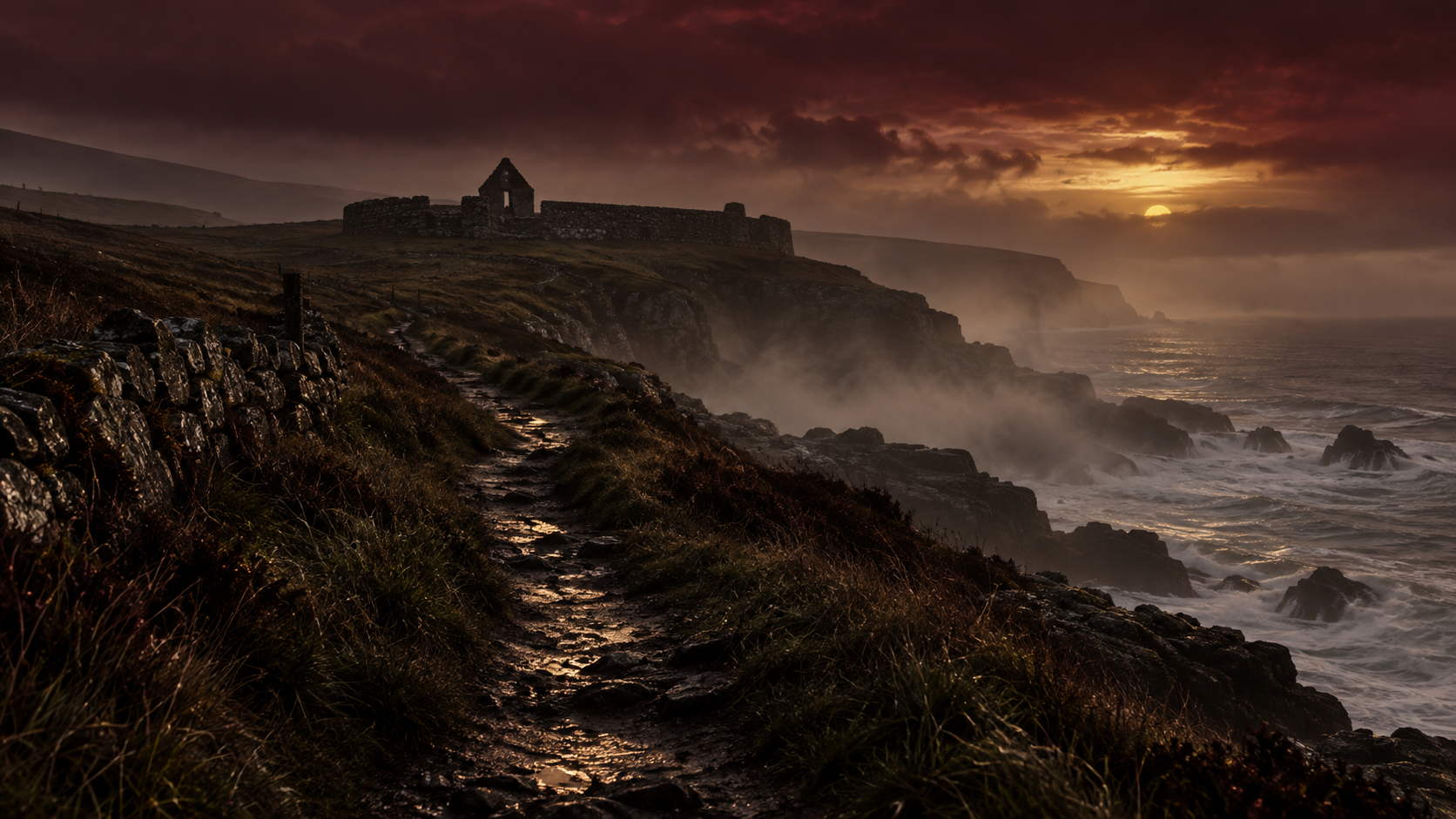
    An Irish coastal path between dark grass and sea mist at twilight

    A “thin place” usually means a location where the boundary between ordinary life and the spiritual or otherworldly feels unusually near. People often connect the phrase to Celtic tradition, especially the landscapes of Ireland and Scotland. The careful answer is that the phrase is prominent in modern Celtic spirituality, while older Irish and Scottish stories contain many distinct ideas about the Otherworld, sacred sites, seasonal crossings, and beings associated with particular places. Those are related conversations, not proof that every ancient community used one shared category called a thin place.

    That distinction matters if you love folklore. It lets a hill, well, island, or path have its own story instead of turning every location into a generic portal. It also keeps a useful modern metaphor from being mistaken for a documented ancient quotation.

    What does “thin place” mean today?

    In contemporary writing, a thin place may be a landscape where prayer feels easier, a site where the past seems present, or a moment when a person feels close to something beyond their usual account of the world. The language is flexible. Some writers mean God; others mean ancestors, fairies, memory, ecological attention, or simply awe.

    A study of Celtic pilgrimage describes “thin places” as a theme in contemporary expressions of Celtic Christianity. That phrasing is more precise than saying the phrase is an unbroken ancient Celtic teaching. Another scholarly discussion of Iona traces the influential language of a “thin” boundary through modern religious and literary contexts, including George MacLeod’s descriptions of the island.

    None of this makes the experience false. It changes what kind of claim we are making. “This place feels thin to me” is an account of experience. “Ancient Celts taught that this exact site was a thin place” is a historical assertion that needs a much more specific source.

    What do older place traditions actually give us?

    Irish tradition offers stories of the aos sí and places associated with them, including earthen forts and mounds. It offers encounters that turn on hospitality, trespass, time, and the rules of a place. Scottish, Welsh, and Breton traditions are not interchangeable variations of one Irish map. Each has its own languages, records, local practices, and later retellings.

    Heritage Ireland’s account of Samhain describes Irish folklore in which the boundary between this world and the supernatural draws thin at the seasonal turning. It also notes stories of the aos sí associated with underground or otherwise hidden domains. That is a valuable connection to make, but Samhain is a calendar occasion; a holy well is a site; a fairy fort is a place embedded in a community’s rules. We lose detail when we flatten all three into the same label.

    An old stone well in a quiet grove, with no figures or supernatural effects

    Is the phrase itself ancient?

    It is safest not to present the English phrase as an ancient Celtic term. The scholarship above shows its strong modern life, especially around Iona and Celtic Christian practice. That does not prove no earlier person ever used a similar image. It does mean a blog post should not claim a single ancient origin without evidence. “Celtic” is also broad: it names languages and cultures across several places and periods, not one timeless belief system.

    Writers sometimes say that a veil between worlds is thinnest at Samhain. This is a familiar and evocative modern explanation, and Heritage Ireland uses similar language when introducing the holiday’s folklore. But a neat one-line formula is still an explanation, not a substitute for the particular source, date, and community behind a given story.

    The practical test is simple. Ask: Which tradition? Which place? Which recorded account? What does the storyteller say is there, and what is a later interpreter adding? A legend about a mound that must not be disturbed differs from a pilgrim’s account of prayer on Iona, even if both leave a reader feeling that ordinary categories are insufficient.

    Why do thresholds work so well in stories?

    A threshold joins two conditions without making them the same. Shorelines are land and not-land. Dusk is day and not-day. A cemetery is part of a living town but organized around the dead. A ruined building belongs to the present while visibly carrying an earlier use. These places naturally invite stories about uncertainty, permission, and return.

    The strongest fiction does not merely announce that the “veil is thin.” It gives the crossing a cost. Perhaps a traveler must answer a question honestly; perhaps a path can be found only once; perhaps somebody takes a gift without understanding the obligation attached. The rules create tension because the reader can see how a good intention might still lead to harm.

    For a neighboring tradition in which an encounter carries a clear social warning, see our banshee post. For a wider introduction to landscape and communal belief in fiction, see what folk horror means in books.

    A twilight footpath dividing a village field from a misted woodland

    How to visit a meaningful place without turning it into a prop

    You do not need to believe in a literal portal to approach a site with care. Check whether it is public, private, sacred, or protected. Stay on permitted paths. Do not take stones or offerings, leave candles, climb fragile ruins, or treat a living community’s practice as a spooky backdrop. Read the local interpretation before inventing a story about the place.

    Then pay attention to more than atmosphere. Who maintains the site? What language appears in its name? Has its meaning changed through worship, tourism, conservation, or loss? An attentive visit can be more unsettling—and more respectful—than a staged midnight photograph.

    If a local guide or community source offers a different account from the one you read online, do not immediately force the two into a single “authentic” version. Traditions can coexist, conflict, and change. Note who is speaking and when. Folklore is a record of relationships among people and places, not a list of supernatural properties assigned to scenery.

    FAQ

    Are thin places part of Celtic folklore? The modern phrase is commonly associated with Celtic spirituality. Older Celtic-language traditions include many stories about significant places and otherworldly encounters, but should not be treated as one uniform “thin places” doctrine.

    Is Samhain a thin place? Samhain is a seasonal festival, not a location. Some Irish folklore and modern retellings describe the boundary between worlds as more permeable then.

    Does a thin place have to be frightening? No. The phrase may describe wonder, prayer, grief, or closeness as readily as dread.

    If carefully sourced folklore is your sort of autumn reading, join The Grimbard Press. For stories that let place shape the danger, browse October 31.

    Sources: Celtic pilgrimage study; folklore scholarship on Iona; Heritage Ireland on Samhain.

  • Folklore vs. Urban Legend: What’s the Difference—and Why Both Still Spread?

    Folklore vs. Urban Legend: What’s the Difference—and Why Both Still Spread?

    An urban legend is a kind of folklore. The difference is not that folklore is old and urban legends are false.

    Folklore is a practice, not a museum shelf

    That is why the distinction matters to horror readers. A monster does not need to be ancient to be folklore. It only needs to become portable.

    Folklore is a practice, not a museum shelf

    People sometimes use “folklore” to mean old stories from a rural past: fireside tales, ruined castles, a creature in a wood that no longer exists. Folklorists use the word more broadly. Folklore is what groups make and carry together. It happens in offices, schools, online communities, military units, families, and neighborhoods as readily as it happens in a village.

    That does not make every repeated opinion folklore. A piece of folklore develops a recognizable form. It can be told again. It has a pattern people know how to complete. “Do not answer the voice outside after midnight” is more than a sentence once it has acquired consequences, variants, and a listener who knows not to test it.

    The useful question is not, “How old is this story?” It is, “What work does the story do for the people who repeat it?”

    Some stories teach caution. Some help people laugh at embarrassment before it happens to them. Some make a private fear public without asking anyone to confess it directly. Some turn a messy uncertainty into a creature with a face, a habit, and a place to stand.

    That last function is especially durable. What monsters represent in folklore is often less about a beast than about the boundary around a community: who belongs, what behavior crosses a line, and what happens after the warning is ignored.

    An urban legend wants to be believed for five minutes

    Urban legends usually arrive in a more realistic costume. They are often set in ordinary places and told with contemporary details: a specific brand, a particular road, a relative’s workplace, a screenshot, a photo that has been cropped just enough to keep the uncertainty alive.

    They also tend to favor what folklorists call a “friend of a friend” frame. The teller may not claim direct experience. That distance is not a weakness. It is a device. The story is close enough to matter and far enough away that the listener cannot easily check it.

    The Black-Eyed Children legend is a useful example. Its best-known modern form grew through late twentieth-century and internet-era retellings, not through a medieval village tradition. Yet its force comes from older patterns: a child at the door, hospitality turned dangerous, the threshold that cannot be crossed without permission. Read how the Black-Eyed Children urban legend learned to knock for the history of that particular story. The point here is that modern circulation did not make it less folkloric. It gave the legend a new route.

    An urban legend can be entirely invented, partly based on a real event, or built from several unrelated reports. Its factual status is not its defining feature. A legend is not a police report with worse paperwork. It is a story that asks: could this happen here?

    Why these stories spread even after correction

    Correction and circulation do not always move at the same speed. A factual correction has to explain dates, sources, context, and uncertainty. A legend has to make a clean impression.

    The story is shorter. It arrives ready for retelling. It offers the listener a role: the person cautious enough to warn someone else.

    That does not mean people who share legends are foolish. Most people are not conducting a field study when they repeat a story at midnight. They are signaling concern, amusement, identity, or the particular thrill of passing along a door that ought to stay closed.

    Digital platforms intensify the old process because images and captions travel together. A rumor can borrow the authority of a map pin, a grainy video, or an anonymous account that sounds official. But the basic movement is older than the feed: witness, retelling, embellishment, correction, new retelling.

    Folklore survives because it can accept the correction and keep the feeling. A story about a vanished hitchhiker can lose one location and gain another. A local ghost can move from a bridge to a highway exit. The name changes because the need for the story remains.

    The difference in one sentence

    Folklore is the broad set of traditions groups make and share. An urban legend is one modern form of folklore, usually told as a plausible warning about ordinary life.

    The line is useful, but it should not become a wall. Folklore is still being made around you. It has simply learned to carry a phone.

    When a story becomes a monster

    Horror understands something the fact-check rarely needs to say: a story can reveal a fear even when it does not document an event.

    The monster may not be the point. A monster gives the fear a body small enough to carry from one person to another. That is why the best legends do not end when a skeptic names the likely explanation. The explanation answers one question. The story is still asking another.

    If you like folklore that changes shape as it moves between centuries, There Be Monsters: Then and Now begins there: with creatures whose danger is tied to what people need them to mean.

    Follow the next warning. Join The Grimbard Press and receive Dead Ship, a free illustrated Subscriber Archive Edition, plus new monster lore and recovered stories.

    FAQs

    Is an urban legend the same as a myth?

    Not exactly. A myth often concerns sacred, cultural, or cosmological questions. An urban legend usually presents itself as a plausible modern incident. The categories can overlap in how they function, but they make different claims about setting and belief.

    Are urban legends always false?

    No. Some borrow from real events or recognizable dangers. Their defining feature is their patterned retelling, not a guaranteed factual status.

    Can internet stories become folklore?

    Yes. A story can become folklore when communities adapt, repeat, and recognize it beyond one original post or author.

    Why do scary legends use ordinary settings?

    Ordinary settings reduce distance. A monster in an inaccessible castle is contained. A stranger at an apartment door, a store parking lot, or a school hallway is not.Read What monsters represent in folklore for a related guide.

    Abstract early-internet message-board blocks in a dark room; no readable text.
  • Mercy Brown and the New England Vampire Panic

    Mercy Brown and the New England Vampire Panic

    Mercy Brown and the New England Vampire Panic

    Mercy Brown has been called an American vampire often enough that the phrase begins to sound like a fact. It is not. She was a young woman in Exeter, Rhode Island, who died in 1892 amid a devastating tuberculosis crisis in her family. After her death, her body was exhumed in a practice now folded into the phrase “New England vampire panic.”

    The story is horrifying without pretending Mercy Brown was anything but human. It shows what illness looks like before it has an explanation people can use, and what grief can make a community attempt when ordinary care has failed. The vampire language came later, and it can blur the local practices, the medical terror, and the dignity owed to the dead.

    The Mercy Brown case was a response to tuberculosis, folk belief, and desperation in nineteenth-century Rhode Island. It belongs to a wider regional pattern of anti-vampire exhumation practices, but it should not be treated as proof that New Englanders believed in a familiar Dracula-shaped creature.

    The illness was real before the monster was named

    Tuberculosis—then commonly called consumption—could move through a household slowly and visibly. It took breath, weight, strength, and sometimes several members of the same family. Before antibiotics and before the germ theory of disease became practical, everyday medical knowledge did not offer a reliable cure. The pattern of one person sickening after another made a supernatural explanation emotionally available: perhaps the dead were not resting. Perhaps they were taking life from the living.

    That belief was not a substitute for intelligence. It was an attempt to act in the face of powerlessness. Folklore often supplies a procedure when medicine cannot yet supply a cure. The procedure may be wrong and painful; it can still make sense as a human response to terror.

    The City of Providence’s historical material on Rhode Island cemetery lore notes that rural Rhode Island and Connecticut saw several exhumation incidents now associated with vampire banishment practices, and identifies Mercy Brown as the best-known Rhode Island case. The Science History Institute’s account of the wider panic likewise stresses that the record includes folk history, oral history, and official history—different kinds of evidence that must not be forced into one clean narrative.

    What happened in Exeter needs careful language

    Illustration connecting tuberculosis, grief, and folklore in nineteenth-century New England.
    Illustration: illness, grief, and folklore shaped the wider context of the Mercy Brown case.

    The established outline is limited but stark. Mercy Lena Brown died in Exeter in January 1892. Her family had suffered tuberculosis, and her brother Edwin was ill. Community members believed a deceased relative might be harming the living. Mercy’s body was exhumed, and her heart was removed and burned as part of an attempted remedy.

    Before publication, this article needs a final check against contemporary 1892 Rhode Island reporting for every exact date, name, quotation, and sequence of events. That is not a technicality. Later accounts often absorb one another’s details until a scene feels fully documented when it is actually a patchwork of memory, journalism, and retelling.

    What can be said now is enough: a real family was in crisis; a real young woman’s grave was opened; and a community made an intervention it hoped would stop a disease. No supernatural conclusion is required.

    “Vampire panic” is useful, but it is also blunt

    The label helps modern readers find a regional history. It can also flatten it. In Eastern European vampire traditions, the word can carry specific beliefs, rituals, and local histories. In nineteenth-century New England, the practices grouped under the phrase were shaped by their own cultural conditions: Protestant communities, tuberculosis, burial customs, local stories, and the pressure of watching relatives die.

    Calling every case “vampire hunting” turns a varied record into a movie genre. It can also turn the people involved into caricatures. The better question is not, “Did they believe in vampires exactly as we imagine them?” It is, “What did they think the dead were doing, and what did they hope their action would change?”

    That question keeps the horror where it belongs: in the gap between need and knowledge. The Brown family did not need a gothic villain. They had an illness that would not release its hold.

    The dead deserve more than a mascot role

    Illustrated timeline separating the Mercy Brown record from later vampire retellings.
    Illustration: distinguish the Mercy Brown record from later vampire retellings.

    Mercy Brown is sometimes marketed as “America’s last vampire.” The phrase is catchy, but it makes a dead teenager into a roadside attraction. It also encourages readers to linger on bodily details that do not deepen the history.

    The essential fact is more unsettling: when people cannot name the force hurting them, they may give it a body. In this case, the body belonged to someone who had already suffered the same disease.

    Grimbard’s interest in legends is not an excuse to repeat their cruellest framing. Evidence-minded horror should be capable of saying that a story is compelling and that part of its circulation is wrong. The Bell Witch offers a different example of how a family account becomes a large public legend; the Blood Countess story shows how repetition can turn a historical woman into a more convenient monster.

    Why this story persists

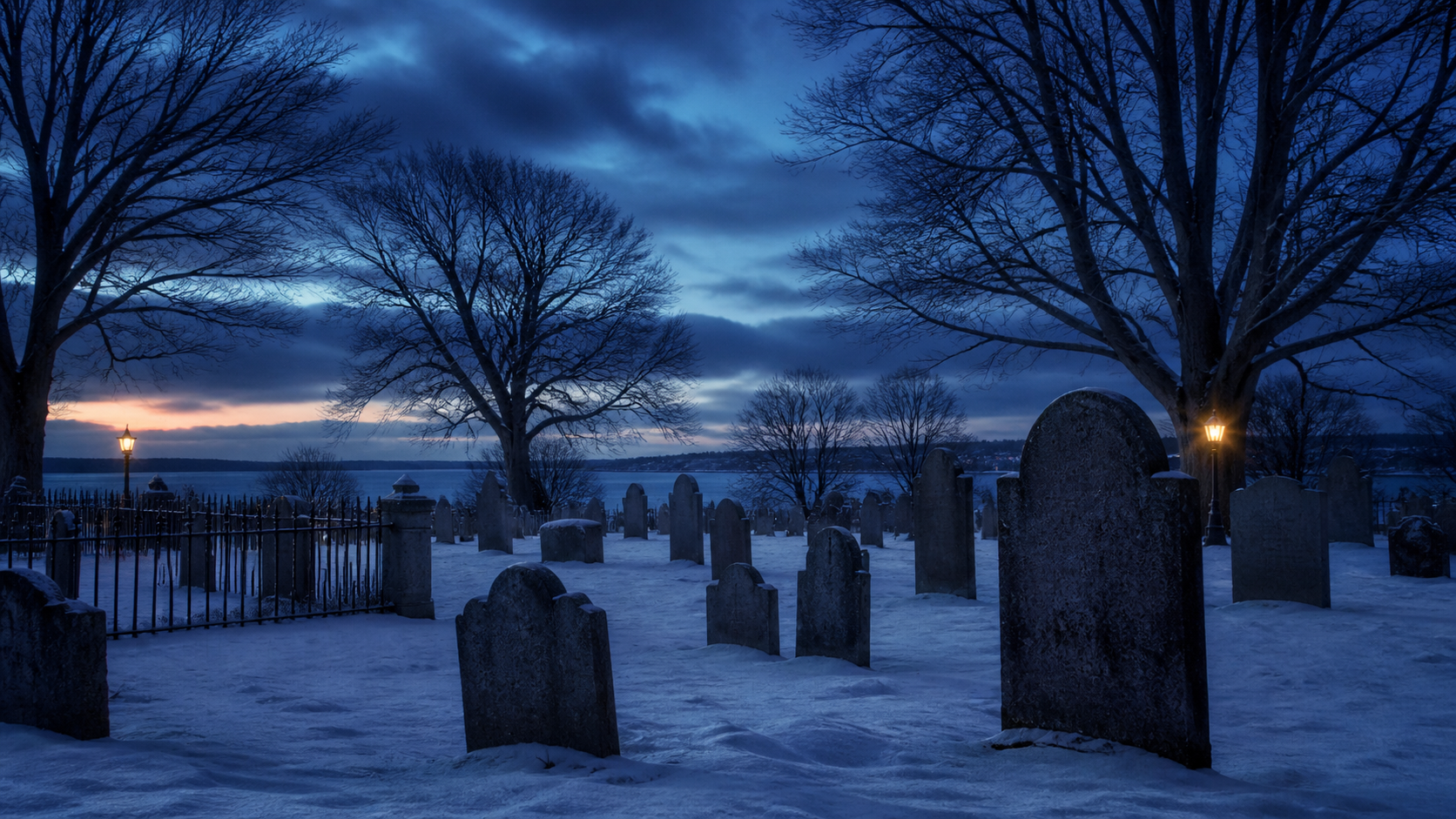
    The Mercy Brown case survives because it has a perfect horror shape: snow, a cemetery, a sickbed, a hidden cause, a desperate rite. But the shape arrived after the fact. The human core is a family living through an epidemic before the tools to stop it existed.

    That is the durable lesson. Folklore does not only produce monsters to frighten people. Sometimes it produces monsters because people are already frightened and need an enemy they can confront.

    There Be Monsters: Among the Dead follows that unstable border between bodies, stories, and the meanings we force onto both. Join The Grimbard Press for Dead Ship, a free illustrated Subscriber Archive Edition, and future files that keep the legend and the record in separate columns.

    FAQs

    Who was Mercy Brown?

    Mercy Lena Brown was a young woman from Exeter, Rhode Island, who died of tuberculosis in 1892 and was later exhumed during a family health crisis.

    What was the New England vampire panic?

    It is a modern label for several eighteenth- and nineteenth-century New England exhumation practices connected to tuberculosis and beliefs that the dead might harm the living.

    Was Mercy Brown believed to be a literal vampire?

    Later accounts use vampire language, but the historical practices and beliefs should not be collapsed into a modern fictional vampire template. The exact local terms and meanings require careful source checking.

    Why is tuberculosis central to the story?

    Tuberculosis could devastate families before effective treatment existed. The pattern of illness created pressure for an explanation and an intervention, even when neither could cure the disease.

    Sources

    – Providence historical material on Rhode Island vampire lore – Science History Institute: Vampire Panic – Contemporary Rhode Island newspaper verification required before publication.

  • What Do Monsters Represent in Folklore? The Work Monsters Do

    What Do Monsters Represent in Folklore? The Work Monsters Do

    The road changes after midnight.

    Nothing has moved. The pavement is the same pavement. The trees have not crept closer, though the headlights make it seem that way. A ditch that meant nothing at noon becomes a place where something could crouch. The last occupied house falls behind you. The radio loses its station. Then an old story returns: a black dog on the road, a woman beside the water, a shape that follows travelers who should have been home before dark.

    The monster has arrived before anything appears.

    That is part of what monsters do. They give uncertainty a body. In folklore, monsters can warn people away from danger, guard a physical or social boundary, carry the memory of violence, and embody whatever a community finds difficult to name. But no creature has one permanent meaning. A monster belongs to the time, place, and people telling its story—and its meaning changes when the story changes hands.

    The monster waits at the line

    Folklore rarely leaves its monsters standing in the middle of a well-lit room with nothing to do.

    They wait at the edge of the village. They live under the bridge, inside the forest, beyond the last safe channel, or at the bottom of the water. They appear at midnight, at a crossroads, during a funeral, or in the uneasy interval between childhood and adulthood. Even monsters that enter the home often begin by violating a line: the locked door opens, the grave gives something back, or the familiar child no longer seems familiar.

    That placement is not accidental. A boundary is where one set of rules gives way to another. Roads end. Light fails. The living approach the dead. The known world meets the part of the map built from rumor.

    The 2024 introduction to The Oxford Handbook of Monsters in Classical Myth describes many monsters as transgressors of literal or metaphorical boundaries. It also makes an important correction: monsters are not merely obstacles placed in front of heroes, and they are not simple attempts to explain a confusing natural world. They reveal wider cultural concerns. Where a story puts its monster—and whom the monster is allowed to threaten—can tell us what its tellers believed needed defending.

    This is why so many classical monsters occupy caves, cliffs, marshes, islands, mountains, and hostile seas. Those places lay outside settled order. The wilderness did not need to be empty to feel uncertain. It only needed to resist the rules people carried from home.

    The same mechanism survives in modern horror. The edge of the village becomes the closed floor of a hospital. The forest becomes an unlit warehouse. The sea becomes a dead zone where the phone has no signal. We replace the landscape, but we keep the line.

    Danger becomes easier to remember when it has teeth

    Some monster stories attach themselves to real hazards. Dangerous water gains a resident. A road known for disappearances acquires an omen. A cave that can kill the unprepared becomes an entrance to somewhere no one should go.

    It is tempting to treat this as a code and solve every creature the same way: the monster is only a warning sign invented before printed signs existed. That explanation is neat. Folklore usually is not.

    A water spirit may warn children away from a dangerous bank, but the story can also carry religious meaning, local history, entertainment, and a community’s relationship with the landscape. It may acquire new features every time it travels. The practical warning can be part of the story without being the whole story—or even its original purpose.

    What the monster adds is memory.

    “Do not go near that water” is an instruction. The sentence may be forgotten or challenged. “Something in that water knows your name” creates an image. It recruits curiosity, fear, and the imagination. It can survive the person who first gave the warning.

    That survival has a darker side. A legend can preserve a danger after people forget what made the place dangerous. The Welsh story of the Ceffyl Dŵr, a supernatural water horse, becomes especially unsettling beside modern accounts of contaminated water. In the Archive’s examination of the skinless horse and PFAS, the old creature does not “predict” industrial pollution. The connection works because both stories give poisoned water a shape people cannot easily dismiss.

    The monster is not a primitive substitute for science. It is a way of making danger difficult to look away from.

    From the Archive: If you like folklore with the evidence left in, join The Grimbard Press and receive Dead Ship, a free illustrated Subscriber Archive Edition, followed by new monster lore, recovered files, and book news.

    Monsters enforce rules—but whose rules?

    A creature at the boundary does more than keep danger out. Sometimes it keeps people in.

    Monster stories can teach children not to wander, warn travelers not to accept an invitation, or punish the person who breaks a taboo. The structure is simple and durable: here is the rule; here is what happens when you cross it.

    That is one reason prohibition works so well in folk horror. The rule makes the border visible. It also creates the desire to cross. As discussed in why “Don’t Do X” is one of folk horror’s most powerful tools, a warning immediately raises the question the story needs: what could be bad enough to require this rule?

    But rules are never neutral simply because they are old.

    A monster can defend a community’s idea of acceptable behavior. It can also turn an outsider into a threat, portray illness or disability as corruption, punish a woman for refusing the role assigned to her, or make difference itself look dangerous. Stories about monstrous peoples at the edge of the known world often reveal more about the observer’s prejudice than about the people supposedly being described.

    That does not make monster stories useless. It makes them evidence.

    When the creature always comes from elsewhere, ask who drew the map. When it punishes only one kind of disobedience, ask who benefits from the rule. When a body is called monstrous, ask what the storyteller has decided a normal body must be.

    The monster may guard the boundary. The more revealing question is who hired the guard.

    Some monsters live inside the house

    The wilderness is not the only border people fear. A home has doors, bloodlines, names, and expectations. It can be violated without a window breaking.

    The changeling story begins with an unbearable suspicion: the child in the cradle looks like your child, but something is wrong. Across European traditions, versions of the story offered supernatural explanations for illness, disability, unusual behavior, developmental differences, or the ordinary distress of caring for a child who could not be soothed. The details vary by region and source, and no single explanation covers them all.

    The story’s emotional machinery is brutally clear. It moves the monster into the smallest possible distance between recognition and doubt. The danger is not outside the household. It wears a loved one’s face.

    That is why changeling folklore must be handled with care. Such beliefs could be used to explain genuine fear and grief, but they could also justify cruelty toward vulnerable people. The Archive’s changeling article follows that oldest fear in the house without treating the harm done in its name as quaint tradition.

    Here the monster performs two opposite jobs. It gives frightened people a story for what they cannot understand. Then the story can make their response more dangerous than the thing they feared.

    Folklore is full of that reversal. The monster is supposed to show us where evil lives. Sometimes it shows how quickly people can move it into another person’s body.

    Monsters carry what a community refuses to bury

    Not every monster exists to prevent a future mistake. Some return because of an old one.

    Ghosts demand burial. Avengers pursue an unpunished killer. A creature appears on the anniversary of a disaster. A cursed place remembers the act that polite history has reduced to a plaque—or omitted entirely.

    In Greek tradition, the Erinyes, better known in English as the Furies, pursue grave offenses, especially violence within a family. They do not behave like a modern police force, and their meanings shift across ancient sources. What makes them endure is the terror of an obligation that cannot be talked down. Authority may forgive. A court may fail. The guilty may rename what happened. The Furies continue coming.

    That gives the monster a function institutions often fail to perform: it refuses closure.

    The Archive’s account of the Furies connects that ancient pursuit to a modern fear—the evidence waiting to be found. The supernatural avenger and the recovered record work differently, but they press on the same wound. A secret is not the same as an erased act.

    This is also why monsters collect around mines, battlefields, abandoned institutions, and poisoned landscapes. A story can keep an event emotionally present after its witnesses are dead. It may distort facts. It may combine several events. It may accuse the wrong person. Folklore is not a court transcript.

    Still, the haunting tells us where people kept looking.

    A monster reveals who has been made “other”

    The word monster is not harmless.

    In a story, it can describe a many-headed serpent or a dead thing that will not stay buried. Outside a story, people have used monstrous language against enemies, foreigners, minorities, disabled people, and anyone whose body or behavior violated a preferred category. Once a person becomes a monster, ordinary obligations toward that person become easier to abandon.

    This is one reason monsters should not be read as a universal set of symbols. A creature called monstrous by one culture might be a guardian, ancestor, deity, or ordinary part of the sacred world in another. Even within the same culture, meanings compete. The monster in a priest’s warning may not be the monster in a grandmother’s story. The tourist-shop version may have almost nothing left of either one.

    Nor should every frightening being be pulled from a living tradition and filed under cryptid. That label can turn a culturally specific figure into an animal waiting for an amateur investigator to prove it exists. The Archive’s article on the Skinwalker keeps the subject within its Diné context rather than treating it as another roadside creature to rank beside Bigfoot.

    The question “What does this monster represent?” must therefore be followed by several others: According to whom? In which version? At what time? Told for what audience?

    Without those questions, interpretation becomes another form of taking.

    Monsters change when they travel

    A monster is rarely still.

    Stories cross borders with migrants, sailors, soldiers, books, newspapers, radio, film, and now social media. The creature keeps recognizable features, loses others, and learns the fears of its new home.

    Black-dog folklore offers a useful example. Britain contains numerous traditions of uncanny black dogs associated with roads, churchyards, storms, death, or particular regions. They are not one standardized creature. When settlers carried related stories to North America, the landscape and local concerns changed around them. The Archive traces how the black dog followed settlers and became part of a different geography.

    Print can freeze one version long enough to make it look definitive. Tourism can give a creature a mascot-ready silhouette. Film can replace local variations with a design recognized worldwide. The internet can build a monster in public, with witnesses arriving after the first image instead of before it.

    None of this makes the newer form false folklore. The Library of Congress describes legends as stories of extraordinary events that invite listeners to believe, doubt, or debate whether they happened. That social act survives online. The campfire has a comment section now.

    What changes is speed. A regional creature once altered over generations. An internet monster can acquire a biography, rules, eyewitness accounts, and rival explanations before the week is over.

    The old work continues. The monster absorbs what people fear, tests the boundary of belief, and returns wearing the details its audience supplied.

    What the monster tells us

    The easiest reading of a monster is that it represents fear. That is true in the same way that saying water is wet is true. It does not take us far enough.

    The better question is: what has the fear been made to do?

    Does it keep children from the river? Does it defend an institution? Does it remember a murder? Does it turn a stranger into an enemy? Does it give grief a shape? Does it allow a community to speak about a danger it cannot yet explain—or one it understands perfectly well but does not want to name?

    Monsters can perform several of these jobs at once. They can protect and persecute. They can preserve memory and corrupt it. They can warn against the dark and make the darkness irresistible.

    That contradiction is why they survive. A monster is not only the thing beyond the line. It is the argument over where the line should be.

    The road at midnight has not changed. We have. Daylight removed the possibilities; darkness returns them. Somewhere between the last house and the failed radio signal, the landscape stops explaining itself.

    That is where the monster goes to work.

    Continue through the Archive

    Where the old monsters meet the new

    There Be Monsters: Then and Now begins with the same problem folklore never settled: the thing at the boundary, and the person who crosses it anyway.

    Explore There Be Monsters: Then and Now or join The Grimbard Press to receive Dead Ship, a free illustrated Subscriber Archive Edition and future dispatches.

    Sources and further reading

    Continue exploring Grimbard

  • The Skinless Horse-Demon That Poisoned the Water Was Real. We Call It PFAS.

    The Skinless Horse-Demon That Poisoned the Water Was Real. We Call It PFAS.


    Of all the monsters the old world built, the Nuckelavee is the one I’d least want to meet, and it’s because of the anatomy. The Orkney islanders described a creature that came out of the sea with no skin at all. You could see the black blood moving through its yellow veins, the raw red muscle, the white sinew flexing as it moved. It was fused — a horse’s body with a rider that wasn’t separate from it, one long neck, a head that rolled, a mouth like a whale’s. And its breath was the weapon. Wherever the Nuckelavee’s breath fell, crops withered, livestock sickened, and people died. The islanders blamed it for the mortasheen, an epidemic that swept their animals.

    A windblown, blighted marsh field under an overcast sky

    It couldn’t cross fresh running water. That was the only defense: get a stream between you and it.

    The Nuckelavee is not a record of a chemical exposure. It is a folklore figure shaped by local memory, fear, weather, animal illness, and the meanings later tellers gave it. It can still be a powerful lens for modern environmental horror, as long as the comparison stays a comparison rather than a retrospective diagnosis.


    Read the Monster as a Symptom Report

    Take the Nuckelavee apart the way you’d take apart a witness statement.

    It comes from the sea — poison that arrives from the water, from outside the community, from a direction the people can’t control. Its breath, not its bite, does the killing — an invisible, airborne, ambient agent, not a discrete attack. It blights crops and sickens animals before it touches people — bioaccumulation up the food chain, the classic signature of a contaminant that enters through soil and water and works its way toward the top. It has no skin — the horror of a thing with no barrier between its poison and the world, nothing to contain what it carries. And it cannot cross fresh, clean, running water — the single most sophisticated detail, because it encodes a real and correct piece of environmental knowledge: that clean flowing water is protective, and stagnant or contaminated water is where the danger lives.

    That’s not a fairy tale structure. That’s a toxicology profile rendered as a creature. The islanders couldn’t see the pathogen or the pollutant, so they gave the pattern a body. And the pattern they described — invisible, waterborne, airborne, bioaccumulating, skinless, unstoppable except by pure water — is a startlingly good sketch of the modern forever chemical.


    A modern parallel, not an ancient prediction

    PFAS are a large group of manufactured chemicals used in many industrial and consumer products. Many break down slowly and can build up in people, animals, and the environment. That persistence makes them a legitimate subject for environmental horror—but it does not mean that an Orkney legend predicted PFAS centuries in advance.

    The Parkersburg, West Virginia, contamination story shows why communities need clear information about water, industry, and accountability. The health effects of exposure depend on the specific PFAS, level and route of exposure, individual factors, and ongoing research. Public-health agencies describe associations for some well-studied chemicals while continuing to study many others.

    That uncertainty is not a reason to minimize contamination. It is a reason to use precise language: folklore can help readers feel the stakes of an environmental story, while public-health guidance and local testing are what people should use to make decisions about water and exposure.


    Why Folklore Beats the Press Release

    Here’s the position I’ll defend. When a corporation poisons a watershed, the language it uses is designed to make the poison abstract: “legacy compounds,” “below actionable thresholds,” “no conclusive causal link,” “parts per trillion.” Every one of those phrases is built to keep you from picturing anything. You cannot fear a part per trillion. You cannot lie awake over an “actionable threshold.”

    Folklore does the opposite, and that’s its power. The Nuckelavee makes you picture the yellow veins and the black blood and the breath rolling across the field. It refuses abstraction. It insists that the poison has a body, a direction, an intent — and while the intent part is technically false (the chemical wants nothing), it’s emotionally true in the only way that gets people to act. A community that believes a skinless demon is breathing on its fields will do something. A community told its water is “within regulatory guidance” will boil the kettle.

    I’m not arguing we should return to blaming demons. I’m arguing that the demon and the data are describing the same event, and that the demon was, in one crucial respect, the more honest account — because it never once pretended the thing wasn’t there.


    The Part That Should Keep You Up

    The Nuckelavee could be escaped. You put a running stream between yourself and it and you were safe. The islanders had a defense, crude but real.

    We’ve removed the defense. PFAS are in the running water now. They’re in the rain — recent measurements of rainwater in remote parts of the world exceed the levels regulators consider safe for drinking. The one barrier the old lore identified as protective, the clean flowing stream, is the exact thing the modern Nuckelavee has already crossed. There’s no fresh water to hide behind, because the poison got into the fresh water first and it doesn’t leave.

    A stream of tap water pouring into a glass

    The old islanders looked at their dying fields and imagined the worst thing they could: a creature with no skin, breathing death, that clean water could hold back. They were wrong about only one detail. They thought clean water would always be there to hold it back. They couldn’t have imagined a horror patient enough, and permanent enough, to get into the water and simply stay.

    We built that one ourselves, and then we named it something no one would ever be afraid of.


    I write horror where the old monster turns out to have been a toxicology report all along. Get the free story here and I’ll keep sending the strange from the waterline.

    The fiction this research feeds is There Be Monsters: Then and Now. For the cosmic, contaminated end of the horror shelf, Laird Barron’s The Beautiful Thing That Awaits Us All is the one I keep pressing on people.

    Continue exploring Grimbard
  • The Forest Has a Landlord, and He Moves the Trees

    The Forest Has a Landlord, and He Moves the Trees


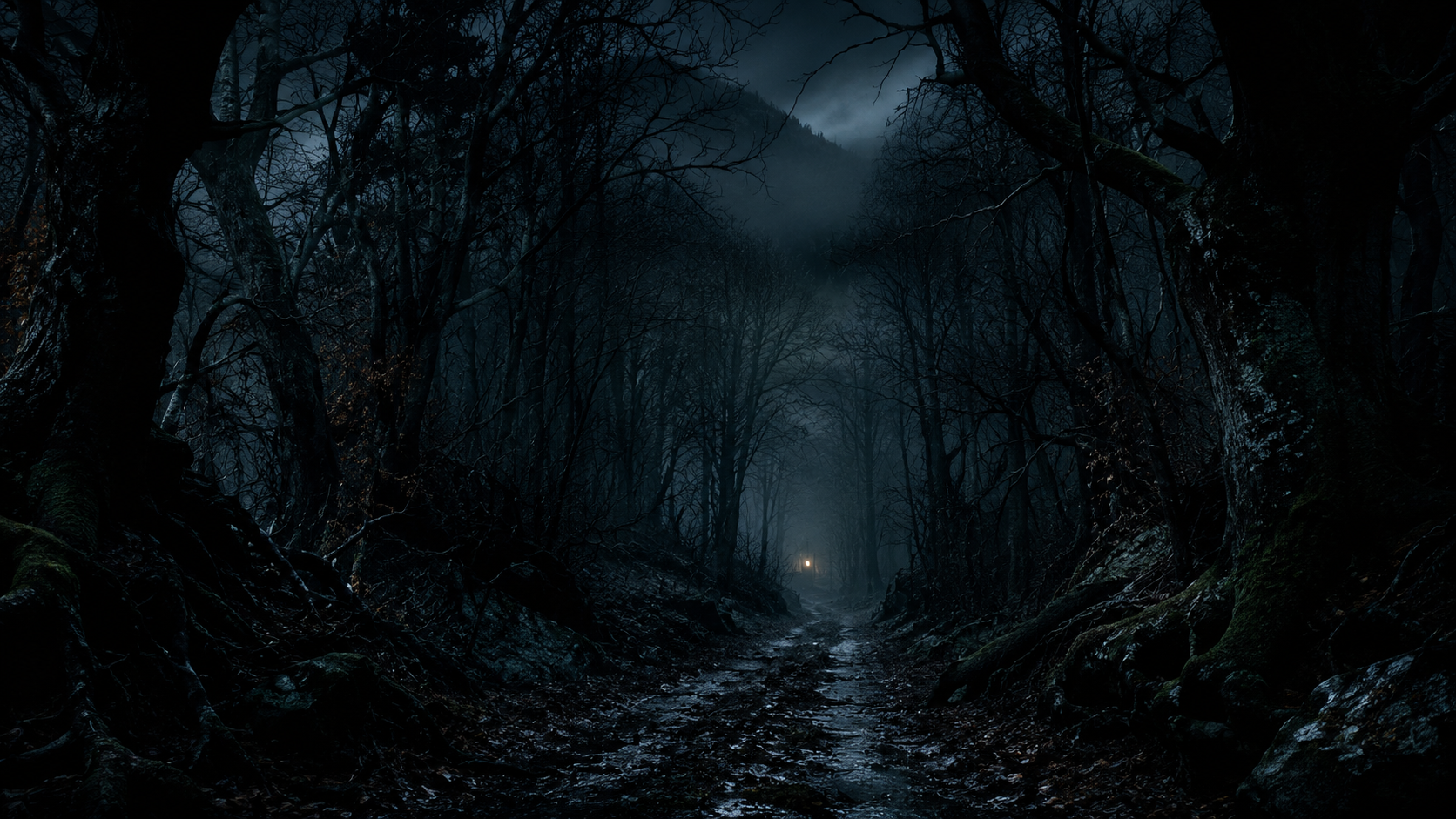
    There’s a piece of advice in old Slavic peasant lore for anyone who realizes they’re lost in the deep woods. Turn your clothes inside out. Put your left shoe on your right foot. Do it, and the confusion lifts, and you find the path.

    It sounds like nonsense until you understand what it’s a countermeasure against. The lore says that when you can’t find your way out of a forest you know — when the same clearing keeps appearing, when the trail you walked in on has closed behind you, when your sense of direction has simply stopped working — you haven’t gotten lost. You’ve been led. The Leshy has you. The forest’s owner is walking you in circles, and turning your clothes inside out is a way of telling him you know it’s him.

    The story is compelling because it gives disorientation a deliberate shape. That is a literary reading, not proof that a particular belief was a wilderness-safety manual. Real navigation failures and exposure are serious risks outdoors; folklore offers a different kind of map—one of attention, fear, and respect for a place beyond human control.


    The Leshy Is What Disorientation Feels Like From the Inside

    The Leshy is the master of the forest — tall, sometimes towering above the canopy, sometimes indistinguishable from a peasant until you notice his shoes are on the wrong feet or his eyes glow green or he casts no shadow. He isn’t malevolent by default. He’s territorial. The forest is his, governed by his rules, and your safety depends entirely on whether you’ve observed the courtesies of a guest. Transgress — take too much, make too much noise, wander off the path you were given — and he withdraws his protection. He doesn’t attack. He simply lets the forest do to you what the forest does to anyone who is no longer being kept safe. He makes you lost.

    Now here’s what actually happens to a disoriented human in wilderness, from the search-and-rescue literature. People who lose the trail don’t walk in straight lines, even when they’re certain they are. Absent a visible landmark, humans veer — consistently, in loops, often returning to the same spot without recognizing it. Panic degrades this further. The lost person’s time sense collapses. Their decision-making narrows to the next twenty feet. They will walk past their own tracks. They will, in documented cases, walk within a hundred yards of a road or a search line and never register it, because the part of the brain that builds the map has gone offline.

    That is the Leshy. Not metaphorically — descriptively. The old lore looked at the phenomenon of a competent person becoming fatally lost in familiar terrain and correctly identified that it feels, from the inside, like being deliberately manipulated by the place itself. The forest seems to move. The path seems to close. Your own senses seem to have been turned against you. The peasants weren’t wrong about the experience. They were only wrong about who was doing it, and I’m not fully convinced “the forest itself” is even the wrong answer.

    Foggy forest of silent, towering trees

    The Anomaly Files

    Stories about missing people in parks often accumulate details that are difficult to verify and easy to sensationalize. Search and rescue is complicated: terrain, weather, water, visibility, and the time between a disappearance and a search all affect what can be found. A case that remains unresolved is not evidence of an anomalous force.

    The real horror is already enough: wilderness can be unforgiving when navigation, weather, injury, or preparation fails. Folklore turns that vulnerability into a landlord because a landlord gives the unknown a face. The result is not a survival protocol; it is a story about humility, limits, and the feeling of being a guest in a place that does not need you.


    The Water Has an Owner Too

    The forest isn’t the only domain with a proprietor. The Vodyanoy owns the rivers and mill-ponds — a bloated, algae-bearded old man who drags the careless and the disrespectful under and keeps them. The Rusalka haunts the water’s edge, the spirit of a woman who drowned, beautiful and luring and lethal, pulling swimmers down into the reeds.

    Same architecture. Water is a domain with its own laws, and the myths that grew up around it are, functionally, a catalog of how water kills. Cold shock that stops the strongest swimmer’s muscles in seconds. Undertow and mill-race hydraulics that hold a body down at the base of a weir. The specific danger of the beautiful, still, inviting stretch of river that happens to sit above a drop-off. The Rusalka is what it feels like to be lured — the water looks safe, looks lovely, and the safety is the bait. Eco-tourism sells exactly that bait, glossy and frictionless, and every summer the water collects on the invoice.

    A moody, cinematic dusk landscape over still water

    What the Old Lore Got Right That the Trailhead Sign Doesn’t

    The reframe I keep landing on is that we’ve made wilderness feel administered, and it isn’t. A national park has a gift shop, a ranger station, a laminated map, a cell tower on the ridge. All of that signals: this place is managed, this place is safe, this place belongs to us now. The Slavic peasant never made that mistake. He knew the forest belonged to the forest, that his permission to be there was conditional and could be revoked without warning, and that the correct posture toward the deep woods was not ownership but guesthood.

    The Leshy isn’t superstition we’ve outgrown. He’s the accurate emotional model of a true fact: you are not the apex thing in the wilderness. You are a soft, disorientable animal that the place will happily lose, and the moment you forget that is the moment you step off the path to get a better photo.

    Turn your clothes inside out. It won’t work. But the instinct behind it — the recognition that you’ve crossed a boundary and the landlord has noticed — might be the most useful thing the old world ever wrote down.


    I write horror set in the boundary zone, where the trailhead sign runs out and the older jurisdiction begins. Get the free story and the field notes here.

    The anthology this research feeds is There Be Monsters: Then and Now — thirteen monsters, each one rooted in a real place that doesn’t want you there. For more folklore done with teeth, The Collected Strange Stories has kept me company through a lot of these deep dives.

  • Your Kid Came Back Wrong: Changelings and the Oldest Fear in the House

    Your Kid Came Back Wrong: Changelings and the Oldest Fear in the House


    A mother in the west of Ireland looks at her four-year-old across the kitchen and knows, with a certainty she can’t defend, that it is not her son.

    He looks like her son. He has the same freckle under the left ear, the same cowlick, the same gap where the tooth came out. But he doesn’t laugh the way he laughed a month ago. He’s stopped meeting her eyes. He’s stopped eating, or he eats and eats and stays thin as a rail. He’s gone quiet, or he’s gone strange, and when she picks him up he feels wrong in her arms in a way she could never explain to the priest or the doctor. The old women in the village have a word for what has happened. The real child has been taken. What’s sitting at her table is a changeling — a thing left in his place by the Faey, wearing his skin badly.

    We flinch at what the folklore prescribes next, and we should. But before we congratulate ourselves for outgrowing it, we should be honest about what the changeling belief actually was. It was a diagnosis. A wrong one, arrived at without the tools to do better — but a diagnosis, aimed at a real and terrible thing that parents were watching happen to their children.

    An empty highchair in a quiet kitchen with soft shadows

    The Valley Was Always in the Nursery

    There’s a concept in robotics called the uncanny valley. A robot that looks fifty percent human is fine; we read it as a machine. But a robot that looks ninety-eight percent human triggers revulsion, because our threat-detection system is exquisitely tuned to the last two percent. Something that is almost a person reads as a corpse, or a predator wearing a person, and the body sounds an alarm the conscious mind can’t override.

    That system didn’t evolve for robots. It evolved for exactly the situation the Irish mother is in. The human brain runs a continuous, unconscious model of the people it loves — their micro-expressions, their gait, the specific music of their voice. When the model and the person stop matching, the alarm fires before you can articulate why. You don’t decide something is wrong. You feel it, and then you spend the next month building a case for a verdict your nervous system already reached.

    The changeling myth is the uncanny valley pointed at your own child. And the reason it’s the most durable horror premise there is — the reason it keeps getting remade, from The Exorcist to Hereditary to every possession film you’ve flinched through — is that it doesn’t require a monster to enter the house. It requires the person you love most to become subtly, unmistakably not themselves while staying in the same body. The intruder and the beloved are the same object. There’s nowhere to point the fear.


    What the Changeling Was Actually Describing

    Some changeling accounts have been interpreted in relation to childhood illness, disability, developmental difference, grief, and the frightening changes a family may not have had language or care to understand. That is a historical interpretation, not a diagnosis that can be made from folklore alone.

    The stories often dwell on altered appetite, illness, withdrawal, or behavior adults could not explain. Those details can echo real experiences, but they must not be used to frame disabled or neurodivergent children as replacements, burdens, or less themselves. People deserve care and dignity; the changeling story records the fear and confusion of its tellers, not a truth about the child.

    That distinction is essential because changeling beliefs sometimes fed cruelty. The folklore gives us a way to study how fear can become a story and how a story can shape harmful choices. It does not excuse those choices or turn a family’s distress into a supernatural diagnosis.

    The horror is not that a person becomes less human. It is that uncertainty, grief, and inadequate support can make people search for an explanation that harms the person who needs care.


    The Ones That Come at Twilight

    The Faey who did the swapping weren’t the gauzy Victorian fairies. Older Celtic and Orcadian lore is genuinely vicious about them. The Sluagh — the host of the restless dead — came at dusk from the west, a flock of the unforgiven that flew in through any window left open on the wrong side of the house, and Highland families still latched their west-facing windows against them within living memory. The Nuckelavee, up in Orkney, was a skinless horror of the sea whose breath blighted crops and sickened livestock, a walking plague with the anatomy left on the outside.

    Notice the through-line. These aren’t villains with grievances. They’re the personified edge of the survivable world — the twilight, the western window, the sea, the marsh. The threat is always ambient, always positional, always waiting for the moment your guard drops and the window stays open. The changeling is the domestic version of the same dread: the boundary of your safe house was breached while you slept, and the proof is sitting at your table asking for more bread.


    Why I Keep Coming Back to This One

    The reframe I’d offer is this: we didn’t leave the changeling behind when we got the neurology. We just moved the fear.

    Every parent who has watched a bright child dim knows the imposter feeling from the inside. Every family touched by dementia knows it from the other end of life — the person is present and absent at once, and the grief has nowhere to land because the funeral won’t come for years. The uncanny valley never closed. We just stopped blaming the Faey and started blaming synapses, which is more accurate and not one degree less frightening.

    The old mother wasn’t stupid. She was pattern-matching against a real signal with a broken instrument. The signal was true. The instrument told her to do something monstrous with it.

    That gap — between the accuracy of the fear and the horror of what people do with it — is the most human thing I know. It’s where I set most of my stories, because it’s the place where the folklore and the case file turn out to be describing the same event from two directions.


    I write the kind of horror that starts in the nursery and ends in the records room — where the old belief and the clinical file turn out to be the same story. Grab the free story and come sit at the strange table.

    The anthology this thinking feeds is There Be Monsters: Then and Now. If you want to give the fear to the next generation on purpose, the Scary Stories to Tell in the Dark collection did more to build my nerve for this than anything else on the shelf.

  • The Black Dog: Britain’s Deadliest Omen That Followed the Settlers

    The Black Dog: Britain’s Deadliest Omen That Followed the Settlers


    There’s a creature that made the Atlantic crossing intact.

    Folklore does not travel unchanged. Stories brought by immigrants met new landscapes, new neighbors, and new conditions; they were retold, translated, and sometimes folded into local traditions. Any account of that process needs care, especially where it touches distinct Indigenous traditions that should not be treated as a single backdrop for settler folklore.

    Black-dog stories are one recurring example: familiar British and Irish motifs appear in later North American storytelling, alongside local variations that deserve to be read on their own terms.

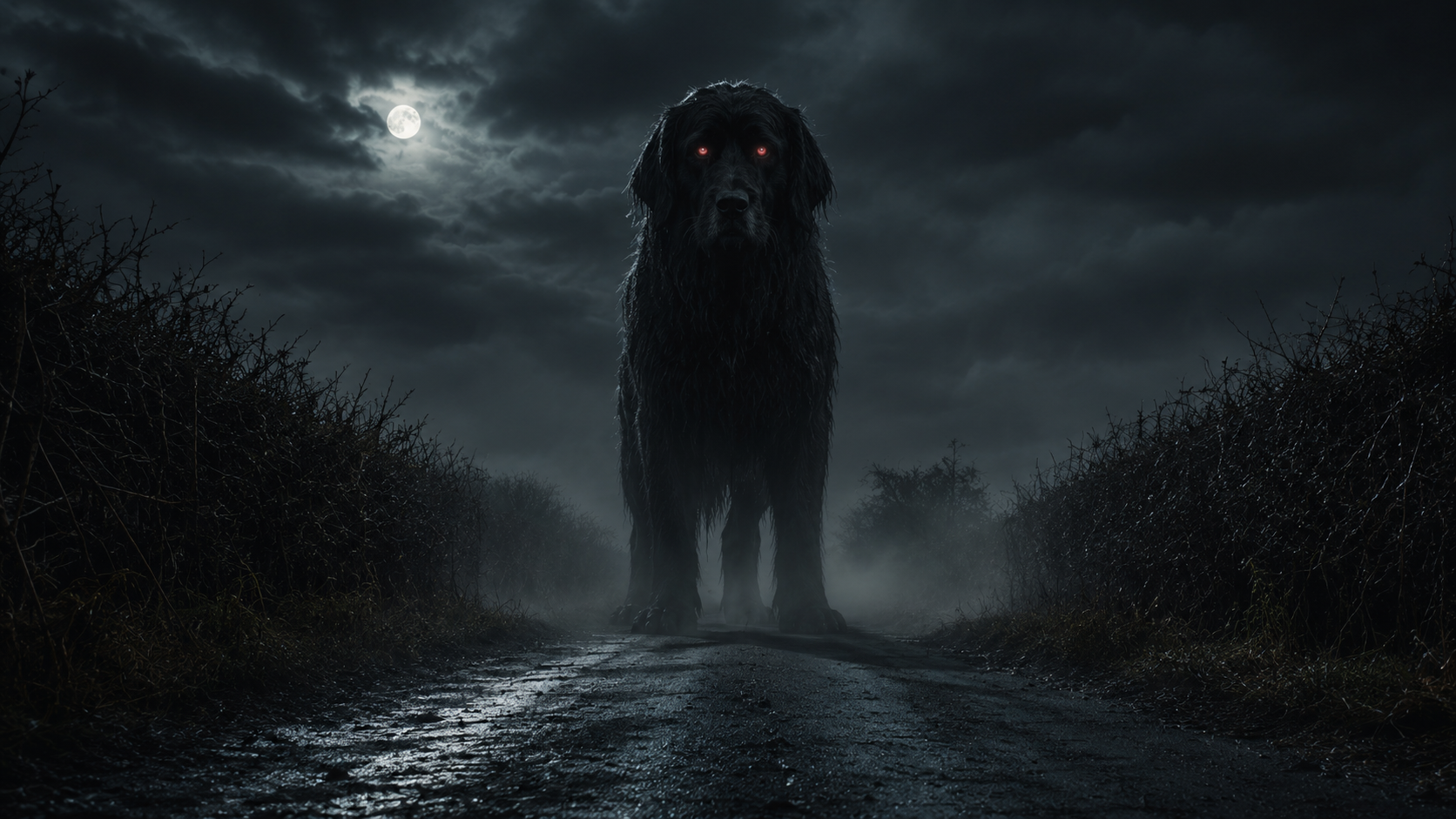
    It arrived in Appalachia looking exactly the way it had looked in Suffolk and Yorkshire and Wales. Large. Black. Eyes that were either red or yellow depending on the account, but always luminous. Moving silently on roads and lane-edges, appearing at crossroads and bridges, and meaning exactly one thing.

    Death is coming for someone you know.


    The British Originals

    The Black Dog tradition in Britain is ancient enough that establishing a single origin is probably impossible. What exists instead is a family of related regional beliefs, each with their own name and specific behavior, all sharing the central omen function.

    Black Shuck haunts the coastal areas of East Anglia. His name derives from the Old English scucca, meaning “demon” or “shadow creature.” He is enormous — descriptions range from the size of a calf to the size of a horse — and his appearances are concentrated on the lanes and shorelines of Norfolk and Suffolk. A detailed historical record of his appearance exists: on August 4, 1577, Black Shuck is said to have entered the churches at Bungay and Blythburgh during a violent thunderstorm, killing several people and leaving scorch marks on the church door at Blythburgh that are still visible.

    The scorch marks are genuinely there. They predate the legend’s first recorded appearance in print. I find this detail persistently interesting.

    The Grim is a variant that specifically haunts churchyards. In British tradition, the first person buried in a new churchyard would be obliged to haunt it and protect it from the devil — and a dog buried there in their place (a documented historical practice) would become the Grim instead. The Grim appears to those about to die. It does not cause the death. It announces it.

    In Wales, the Cwn Annwn — the Hounds of Annwn — are a pack rather than a single creature, the spectral hunting dogs of the underworld deity Arawn. Their appearance heralds death on a larger scale. In Devon, the Yeth Hounds perform the same function, sometimes ridden by headless horsemen for added context.

    The family resemblance is consistent across all of them: large, black, supernatural, ominous. Not evil in the conventional sense. Present.


    The Appalachian Persistence

    What’s remarkable about the Black Dog tradition in Appalachia is how completely it survived the transplant.

    Stories of spectral dogs appear in many North American regions, including parts of Appalachia. Some share details with British black-dog traditions—roads at night, crossroads, luminous eyes, and an encounter that feels ominous—while other versions differ in meaning and origin. A family resemblance is not proof of one uninterrupted tradition; oral stories change with every community that keeps them alive.

    In these accounts, the dog may accompany a traveler briefly, vanish, or be remembered as an omen after a loss. That retrospective connection is part of the folklore’s power, not a documented prediction.

    What I find genuinely interesting is that the Appalachian Black Dog almost never represents the traveler’s own death. It’s almost always a harbinger of death nearby. The creature is telling you something about someone else. It chose to show you. The question of why you were chosen is one the tradition doesn’t answer, which is part of what keeps it uncomfortable.


    The Dog That Watches

    There are two types of death-omen traditions in folklore, roughly speaking. The type that comes as an announcement — the banshee’s wail, the three knocks — and the type that comes as a witness.

    The Black Dog is a witness. It doesn’t perform grief. It doesn’t make noise. It simply appears and looks at you, with those luminous eyes, from the shoulder of the road.

    This is more disturbing than the announcement type, and I think it’s worth understanding why. The announcement implies a kind of relationship between the omen and the bereaved — you were specifically called to, warned, given information. The witness implies something different: that the death was already in motion, and something came to observe it, and you happened to be there.

    The witness doesn’t care about you. The witness is watching something you can’t see yet.


    Why the Crossing Mattered

    Most folklore scholars identify the Black Dog as one of the most geographically distributed supernatural traditions in Europe, appearing in some form across almost every regional tradition from Scandinavia through the British Isles and into the Iberian Peninsula. This distribution suggests the tradition is old enough that the individual national versions are regional expressions of a single archetype, not independent inventions.

    The fact that it survived the crossing to Appalachia intact, in communities that were otherwise highly adaptive with their imported folklore, suggests something specific about the Black Dog: it was too useful to change. Communities under stress need a way to talk about death’s approach. A creature that observes, that witnesses, that appears on the road between where you are and where the dead are going — that is a useful symbolic technology. It survived because it was doing real cultural work.

    It’s still doing it. Appalachian Black Dog accounts are still collected regularly in contemporary folklorist interviews. The creature hasn’t retired.

    If you’re driving the mountain roads after dark, keep your eyes on the roadside.

    If you see something large and black looking at you from the shoulder with luminous eyes, keep driving.

    And when you get home, call the people you love.


    Folklore deep dives like this one go into the research that feeds my fiction. If you want the stories themselves: There Be Monsters: Then and Now.

    For weekly folklore, dark tourism, and new horror fiction: join the Grimbard list.

  • Why Appalachian Horror Hits Different

    Why Appalachian Horror Hits Different


    There’s a scene I keep coming back to, not from any book or film, but from a conversation I had with an older man at a ghost tour in western North Carolina a few years back. He’d lived in the same holler his whole life. Someone on the tour asked him if he believed in the things we’d been hearing about — the lights in the woods, the shape that walked the ridge at night.

    He looked at them the way you look at someone who’s just asked if you believe in roads.

    “Believe in it,” he said. “I’ve seen it.”

    That exchange is, in miniature, what Appalachian horror is. Not atmosphere. Not aesthetic. Witness.


    The Geography Does Something

    Mountains do specific things to human psychology over generations. They cut off. They contain. They create what sociologists call “geographic isolation” but what feels, from inside it, more like the world forgetting you exist.

    The Appalachian range runs roughly 1,500 miles from Alabama to Newfoundland, with the densest cultural concentration in a band stretching from northern Georgia through West Virginia. The settlements that took hold there in the 18th and 19th centuries were often cut off from the nearest towns by terrain that made travel genuinely dangerous for significant portions of the year.

    That isolation does two things that matter for horror.

    First, it concentrates tradition. The oral histories, the rules, the stories that would have diluted over generations in more connected communities stayed intact. Practices that died elsewhere survived. Beliefs that modernized away in cities held their shape in places where modernity arrived late and partially.

    Second, it means the community becomes the authority. When there’s no external institution to appeal to — no sheriff an hour away, no hospital, no court — the community develops its own mechanisms for managing fear, conflict, and the things that happen in the dark that nobody has a good explanation for.

    Both of those conditions produce folklore with teeth.


    The Things That Live Here

    Appalachian folk horror has a specific creature catalog, and what’s striking about it is how local it is. The Wampus Cat. The Tailypo. The Bell Witch — not a ghost so much as a presence, a force, something that understood the Bell family well enough to hate them specifically. The Booger. The Raw Head. These aren’t imports. They’re not Greek mythology dressed in new clothes. They grew from this place.

    They’re also not uniform. The Tailypo legend varies significantly from county to county. What the creature wants, what it looks like, whether there’s any way to survive encountering it — these change based on who’s telling it and where. That variability is a sign of living tradition. Dead traditions calcify. Living ones adapt.

    The Wampus Cat is a good example. In some versions it’s a pre-contact shapeshifter, a woman transformed by the Cherokee as punishment for witnessing a sacred ceremony. In others it’s simply a mountain lion that has been wrong for too long, something that started natural and became something else by accumulation of wrongness. The two versions are doing different cultural work, but they share an anxiety: things here can change into what they are not, and you won’t know until it’s too late.


    What Hollywood Gets Wrong

    Most Appalachian horror films make the same mistake. They treat the mountains as backdrop for urban people to suffer in. The locals are either villains or props. The horror is generated by the gap between the sophistication of the protagonists and the otherness of the place.

    This is not Appalachian horror. It’s tourism horror — horror about what happens when you leave your comfort zone. The mountains are incidental.

    Real Appalachian horror is horror about the place — the way the land holds memory, the way communities deal with what they can’t explain, the way the isolation creates both tight bonds and the kind of silence that lets bad things persist. It’s the difference between a story set in the mountains and a story that could only be set in the mountains.

    The gold standard is still the oral tradition itself. Second to that, look at what writers like Ron Rash and Wiley Cash do with the region in their fiction — not explicitly horror, but working with the same raw material.


    Why It’s Having a Moment

    Appalachian horror has been mainstream-adjacent for a few years now, and I don’t think that’s coincidental. We’re in a cultural moment when a lot of people are asking questions about what gets preserved, what gets lost, what survives in communities that were cut off or overlooked, and what that survival cost.

    Appalachian folk tradition has answers to those questions. They’re not comfortable answers. They’re the kind of answers that involve the lights in the woods and the shape on the ridge and the old man who looks at you like you asked about roads.

    But they’re real answers, from people who were paying attention.

    That’s what the best horror has always been.


    My fiction lives in this territory — folk horror, creature stories, the kind of dark that grows in isolated places. There Be Monsters: Then and Now collects thirteen of them. Start there.

    For more folklore, regional legends, and the horror that feels like it came from somewhere — get on the list.


    Read Appalachian horror with care

    “Appalachian” is not a single voice, aesthetic, or belief system. The region spans many states, nations, communities, and family histories; a respectful story begins with a specific place and people rather than treating the mountains as a shortcut for isolation or menace. Folklore also changes as it moves between tellers, so it is worth asking who is telling a version, where they learned it, and what context may be missing.

    That precision is what gives regional horror its force. For a wider look at how place and inherited rules shape the genre, read what makes folk horror different. For a shorter fictional entry point, “Rabbit Season” uses a winter warning and family pressure rather than a generic “backwoods” stereotype.

    What makes a story Appalachian horror?

    • Specificity: a real sense of terrain, labor, weather, and community—not a borrowed mountain backdrop.
    • Living tradition: beliefs and stories with local roots, handled as culture rather than exotic decoration.
    • Consequences: the land, memory, and relationships shape what characters can ignore—and what they cannot.