
Why Are Clowns Scary? The Psychology Behind Coulrophobia
Clowns are supposed to make their intentions easy to read. The grin is huge. The clothes are loud. Every movement is made to cross a room. Yet many people find the costume unsettling before it does anything remotely threatening.
The short answer is that a clown can make ordinary social reading fail. The painted face displays a permanent emotion while hiding the real face beneath it. The behavior may be exaggerated or erratic. The body is familiar, but the signals it normally sends are altered. Horror has spent more than a century learning how useful that mismatch can be.
That does not mean every dislike of clowns is a clinical phobia, or that there is one explanation for everyone. The fear commonly called coulrophobia is better understood as a cluster of possible pressures: masked expression, uncertain intent, surprise, media associations, and individual experience. A 2023 study of people who reported clown fear found several of those factors mattered, especially uncertainty about harmful intent, portrayals in media, and unpredictable behavior.[^1]
A smile that cannot answer you
Human faces are not decoration. We use them constantly to decide whether a person is amused, embarrassed, irritated, bored, or safe to approach. The clues are tiny: an eye movement, a mouth that changes before speech, a look that does not match a laugh.
A clown replaces those moving clues with a fixed design. White makeup can flatten ordinary skin cues. An oversized painted mouth stays cheerful when the performer is silent. Red marks around the eyes can make attention look permanent. The costume does not merely hide identity; it supplies an emotion in advance and refuses to revise it.
That is why the usual claim that clowns are frightening because they look “not quite human” is too crude. The problem is not that a clown is less human. It is that the costume gives a human body a face that behaves unlike a face. You are looking at a social signal that cannot participate in the conversation.
The same pressure appears in quieter forms elsewhere in horror. A porcelain doll has eyes that seem alert but never focus back. A reflection in dim light can look unfamiliar because the face stops providing stable information. In why dolls are creepy, the fear comes from a familiar form that cannot complete recognition. A clown adds motion, proximity, and a demand to react.

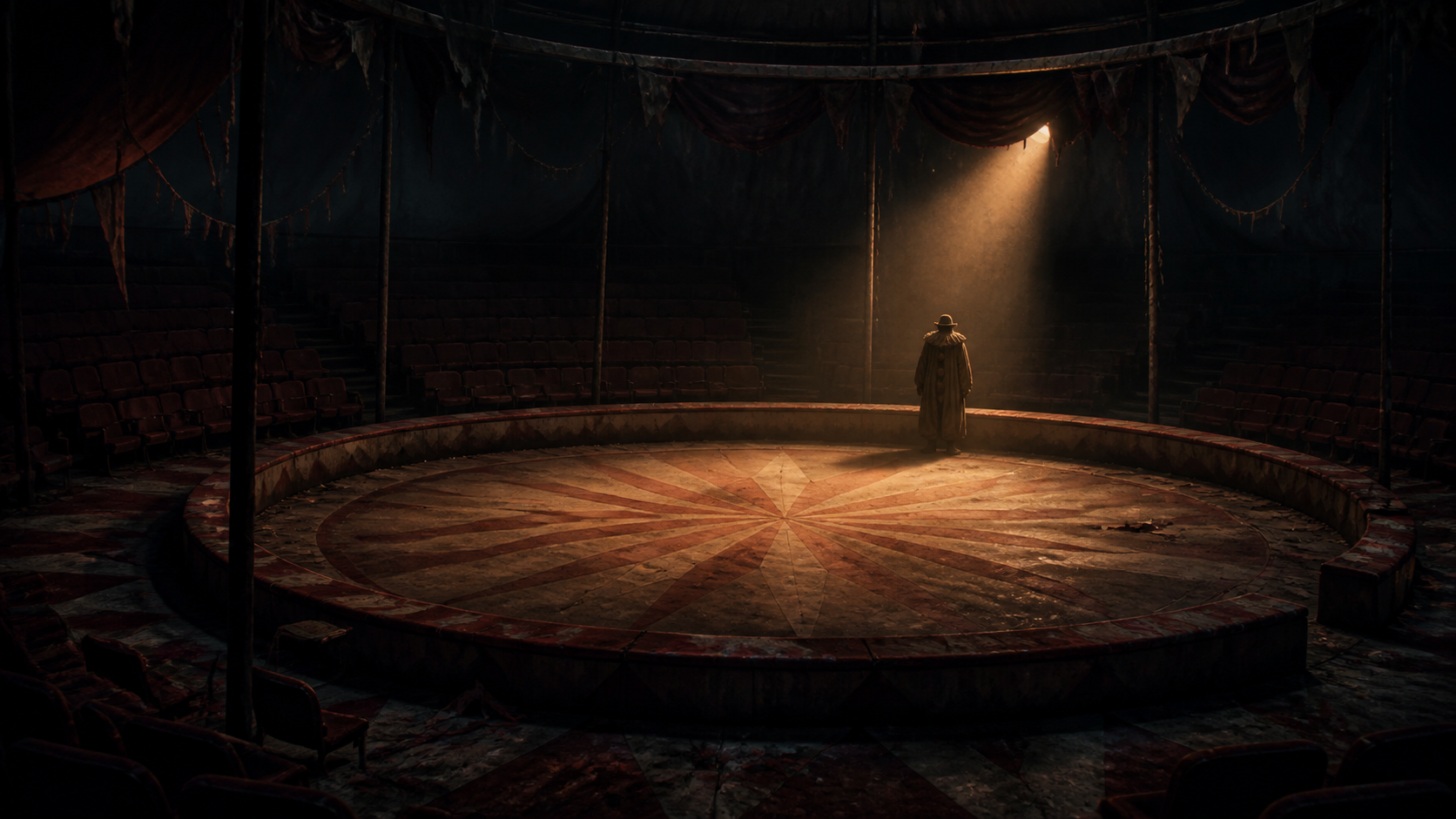
Illustration: the costume creates an emotion before the performer has expressed one.
The costume also changes the rules
Clowning is allowed to violate small social rules. A clown may stare too long, invade personal space, fall down on purpose, pull an impossible object from a pocket, or pretend not to understand a direct question. In a circus or a party, those violations have a frame: this is a performance, people are watching, someone else is in charge.
Outside that frame, the same behavior can feel like a breach. The costume says play, while the setting says why are you here? Horror does not need to add a weapon to make that tension useful. It only needs to remove the audience, the ring, or the scheduled ending.
That is one reason a clown in a bright daytime parade and a clown in an empty parking lot do not produce the same reaction. The image is not doing all the work. Context decides whether the exaggeration feels licensed.
This is also why treating every clown fear as an “uncanny valley” example misses the human part of it. The uncanny valley is often used as a catch-all phrase for anything vaguely human that feels wrong. But clown fear can be more specific: a person is present, the person is performing happiness, and you cannot reliably read what they want from you.
Horror did not invent the fear—but it gave it a costume department
Modern horror did not create every uneasy response to painted faces. Masks, comic performers, carnival inversion, and public spectacle all have longer histories. What horror did was turn the clown’s social permission into a threat.
The standard sinister-clown image borrows a useful contradiction. A clown is expected to lower the stakes. It belongs around children, celebrations, and managed foolishness. When that figure becomes dangerous, the comfort is not simply removed. It is used as camouflage.
That is why the most effective clown horror rarely depends on a single monstrous reveal. The painted smile is already a kind of locked door. The story becomes frightening when someone must decide whether to trust the figure behind it.
The same mechanism appears in why a face can look strange in a dark mirror: the mind dislikes a familiar signal that will not settle. A clown turns that instability outward. It is another person carrying a face that cannot answer your face.

Illustration: the unsettling part is not the smile itself, but the fact that it never changes.
Why children and adults can react differently
Children may have fewer established rules for separating costumes from ordinary social behavior. They can also be more sensitive to voices, size, volume, and unpredictable movement. But adults are not immune because they are “too rational” for the costume. Adults bring additional associations: a childhood scare, a film character, a news cycle, an awkward party, or the awareness that the painted expression is an intentional mask.
The study of clown fear is useful here because it does not reduce the response to one embarrassing weakness. Participants described different pathways. Some linked the fear to a frightening personal experience. Others emphasized the inability to read the clown’s expression or anticipate its behavior. Media exposure mattered for many, but it was not the whole explanation.[^1]
That variety is worth preserving. A reader can dislike clowns without needing a diagnostic label, and a writer can use clown imagery without assuming the costume is universally frightening. Fear becomes sharper when the story identifies the exact promise that has failed.
The Grimbard reading: a clown is an instruction that will not explain itself
The face says: laugh. The body says: watch. The setting may provide no answer about whether either instruction is safe.
That is the enduring horror of the clown. It is not simply a monster in bright colors. It is a public signal that demands trust while withholding the ordinary evidence that trust is deserved.
For more evidence-minded horror, join The Grimbard Press and receive Dead Ship, a free illustrated Subscriber Archive Edition. It begins with a recovered record, not a painted grin—and it is very clear that nobody in the file is asking to be let in.
FAQs
What is coulrophobia?
Coulrophobia is the commonly used term for a fear of clowns. It can range from mild unease to a strong phobic response, but only a qualified professional can assess a clinical phobia.
Why do clown faces feel unsettling?
Makeup can hide normal facial cues while displaying a fixed emotion. That makes it harder to read intention in the fast, ordinary way people usually read one another.
Are clowns scary because of the uncanny valley?
Sometimes uncanny feelings may contribute, but clown fear also involves context, behavior, social unpredictability, personal experience, and horror-media associations. It is not explained by one concept alone.
Did horror movies create fear of clowns?
No. Horror amplified and shaped a pre-existing unease around masks, performance, and unpredictability. Film and television can make those associations stronger for some viewers.
[^1]: R. A. R. et al., “Fear of clowns: An investigation into the aetiology of coulrophobia”, Frontiers in Psychology (2023).