
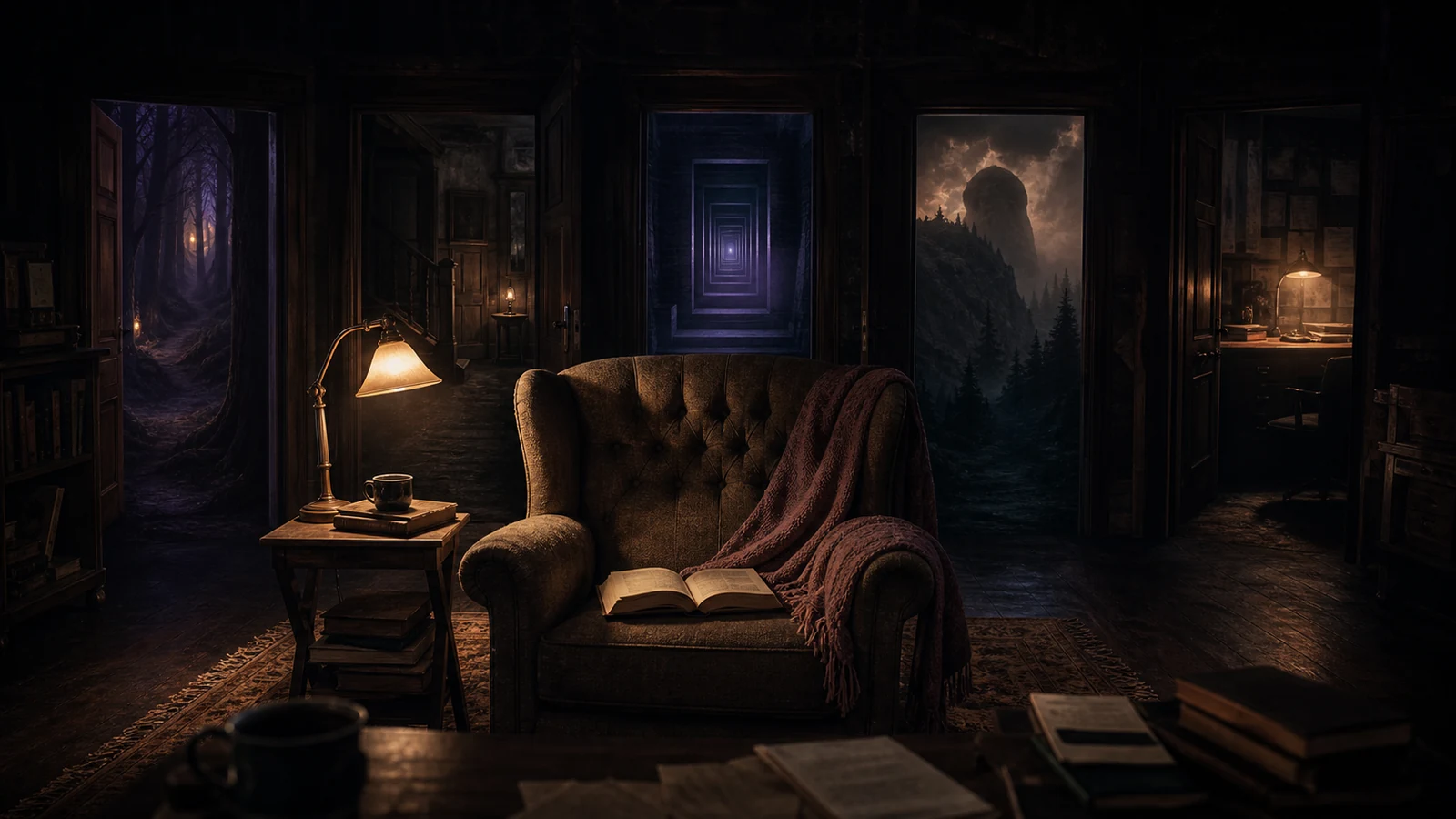
You can want the locked door without wanting to see what happened to the person behind it.
That is not a contradiction. Horror is a large house. Graphic violence occupies some of its rooms, but so do haunted places, impossible choices, old warnings, guilty families, creatures seen at a distance, and the quiet certainty that someone has been standing outside longer than anyone wants to admit.
If you want to start reading horror but do not like gore, choose the kind of fear before you choose a title. Look for atmosphere, supernatural dread, gothic mystery, folklore, psychological unease, or restrained creature fiction. Then check content notes for the individual book. “Not gory” does not mean emotionally gentle, and no single recommendation is safe for every reader.
First, separate gore from fear
Readers often use scary, violent, disturbing, and gory as though they mean the same thing. They do not.
A book can contain little graphic violence and still be emotionally brutal. A ghost story may involve grief, suicide, harm to children, or psychological collapse. A gothic romance may avoid blood while centering coercion or abuse. A creature novel may be bloody but emotionally straightforward.
Before asking whether a book is “too much,” decide which dimension matters:
- Graphic violence: How much physical injury appears on the page, and how much detail does the author provide?
- Body horror: Does the story focus on transformation, disease, infestation, or loss of control over the body?
- Dread: How long does the book keep the reader expecting something bad?
- Emotional intensity: Does it center grief, cruelty, abuse, isolation, or harm involving children or animals?
- Startle versus atmosphere: Does it move through sudden attacks, or build fear through place and implication?
These categories are more useful than a single “scariness” score. A reader who dislikes anatomical detail may love sustained dread. Someone else may tolerate a quick violent scene but hate the helplessness of a child-in-danger plot.
There is no prize for forcing yourself through the wrong book.
If you like old warnings, begin with folklore
Folklore horror often builds fear from a rule: stay off the road after dark, leave the offering where it belongs, do not answer the voice from the water.
The pleasure comes from recognizing the boundary before the character crosses it. The creature may remain mostly unseen. History and landscape do much of the work.
Start by reading about what monsters represent in folklore and what makes folk horror different from regular horror. Those articles let you test the territory before committing to a novel.
For classic fiction, M. R. James’s ghost stories are compact exercises in objects, manuscripts, rooms, and old offenses returning. Some contain disturbing images, but they usually depend more on implication than prolonged anatomical detail. Susan Hill’s The Woman in Black is another atmosphere-first route, though readers should check its themes and content notes rather than assume “not gory” means mild.
Within the Grimbard catalog, There Be Monsters: Then and Now is the thematic route into legends that survive by changing. It should receive a verified story-by-story content profile before this article describes it as lower-gore.
If you like rooms with histories, try gothic and haunted-house fiction
The gothic mode makes architecture carry emotion. A house remembers a marriage. A corridor preserves a family secret. The locked room is frightening because everyone agrees not to discuss it.
This route suits readers who want mood, unreliable perception, social pressure, and the past pressing on the present. The threat may remain ambiguous for much of the book.
Shirley Jackson’s The Haunting of Hill House is a natural starting point for psychological and architectural dread. Daphne du Maurier’s Rebecca leans toward gothic suspense rather than conventional supernatural horror, but it shows how a dead person can dominate a house without walking through it. Henry James’s The Turn of the Screw offers ambiguity and a demanding older prose style; that uncertainty is the point, not a defect to solve.
None of these books should be sold as universally comfortable. Content notes still matter, and older works may handle class, disability, gender, or mental health in ways a modern reader wants to know about first.
The Grimbard route enters through The Scarab, The Beetle: A Mystery—Annotated, and It Walks by Night—Annotated. Choose among them by whether you want original modern gothic fiction, a strange Victorian invasion novel, or an annotated rediscovery—not by an unverified promise about gore.
Find the next door: Join The Grimbard Press for Dead Ship, a free illustrated Subscriber Archive Edition, monster lore, recovered files, and book news.
If scale frightens you, choose impossible places
Some readers are less interested in a killer than a setting that removes escape.
A cave, ship, forest, hotel, or endless workplace can produce horror before a creature appears. The story tightens distance, light, weather, and time until ordinary choices stop working.
Why caves are so scary explains how underground spaces remove the senses and routes people use to feel safe. If that kind of fear appeals to you, look for summaries emphasizing isolation, exploration, liminal space, or survival rather than splatter, extreme horror, or visceral body transformation.
This route still requires content checking. Survival stories can become physically graphic even when the setting is the main threat. Read the publisher’s description, sample the first pages, and consult more than one content-note source when a specific trigger matters.
There Be Monsters: Deep Down is Grimbard’s direct underground route. Its anthology structure also offers a practical advantage: a reader can try one story without committing to a full novel. The final article should include a story-level content note or point to one before making a lower-gore recommendation.
If you want a creature, decide how close it should come
Creature horror ranges from a shadow across the road to a detailed transformation of the human body. “Monster book” says almost nothing about graphic intensity.
Ask where the story’s attention goes.
- Folkloric creature: The interest is often the rule, history, or landscape around the being.
- Cryptid story: Sightings, evidence, pursuit, and regional identity may matter more than attack scenes.
- Sea or expedition monster: Scale, isolation, and the unknown can carry the fear.
- Body-transformation monster: Physical change may be the central experience and is more likely to trouble readers avoiding body horror.
- Predator story: Suspense may alternate with direct attacks; check the level of detail.
For regional legend and pursuit, begin with the documented history behind the Jersey Devil before deciding whether The Pine Barrens Incident is your route. For mythic scale, read why sailors believed in sea monsters and consider Monsters of the Wine-Dark Sea or The Odyssey Annotated: A Horror Reader’s Edition.
Again, those are thematic matches. The content profile must be checked separately.
If ordinary life turning wrong scares you, work the late shift
Workplace horror begins with familiar rules and removes the people who normally make them reasonable.
The register must remain staffed. The door must stay locked. The camera shows a person where no person should be. The employee cannot leave because leaving has a cost before the monster ever appears.
Why night shifts are so scary is a good test. If the fluorescent corridor and unexplained checklist work on you, continue to the warehouse ghost and the Backrooms as a warehouse that will not end.
The Grimbard book route is On the Clock, After Dark, followed by There Be Monsters: Among the Dead for readers who want the dead closer. On the Clock, After Dark is not currently enrolled in KDP Select, so availability copy should not promise Kindle Unlimited access.
Use the sample as a pressure test
A recommendation tells you what worked for someone else. A sample tells you how the book enters your head.
Read five to ten pages before buying when a sample is available. Do not ask only whether violence has occurred yet. Notice what the prose watches. Does it linger on wounds? Does it make the body the main source of disgust? Does it signal cruelty toward an animal or child? Does the atmosphere feel invitingly tense or simply exhausting?
Then check content notes. Useful notes identify events without turning them into moral judgments. They distinguish presence from detail and, when possible, indicate whether material occurs briefly or drives the story.
Avoid depending on a single crowd-sourced label. One reader’s “mild” may be another reader’s reason to stop. When the boundary matters, compare the publisher, author, library reviews, and reader-created databases. Ask a bookseller or librarian for atmosphere-first horror and name the content you want to avoid.
Starting with a novella, anthology story, or classic short story also reduces the cost of a mismatch. Horror does not require a six-hundred-page initiation.
You are allowed to stop
The worst way to begin reading horror is to choose the most extreme title you can find and treat endurance as proof that you belong in the genre.
Close a book that is giving you the wrong experience. Skip a scene. Read a plot summary. Continue in daylight. Spoil the ending if uncertainty is the part you dislike. None of those choices makes the reading less legitimate.
Fear in fiction is consensual. The reader decides how close the thing may come.
That control is one of horror’s pleasures. A book can open the locked room and still let you close it. Over time, you may discover that your boundary moves. You may also discover that it does not.
Both are useful knowledge.
Choose your first door
Begin with the fear that already interests you:
- Old warnings and folklore: There Be Monsters: Then and Now
- Buried places and isolation: There Be Monsters: Deep Down
- Gothic mystery: The Scarab
- Regional cryptid horror: The Pine Barrens Incident
- After-hours rules: On the Clock, After Dark
Before publication, each choice should display four separate content indicators: dread, graphic violence, body horror, and emotional intensity. Until those are verified, the routes above describe themes, not guarantees.
Join The Grimbard Press for Dead Ship, a free illustrated Subscriber Archive Edition and the next dispatch. You do not have to enter every room. You only need the right first door.