The camera shakes. Someone says they heard something downstairs. The image breaks apart at the exact moment you would like it to become useful.
Found-footage horror works because it does not present itself as a finished story. It presents itself as evidence with a hole in it. The viewer is not merely asked to watch a character make a mistake. The viewer is asked to inspect the record afterward, to notice the shadow at the edge of the frame, and to live with the fact that the camera stopped before it answered the only question that mattered.
Found footage feels real because the frame is restricted, the recorder is inside the danger, and the evidence arrives without an all-knowing narrator. It uses limitation as a source of dread. The audience has to supply the explanation, and audiences are exceptionally good at supplying a bad one.
The camera is a witness, not a window
In conventional film language, the camera is often invisible. It can be anywhere, cut away from danger, show us the threat, then show us the reaction. Found footage changes the contract. The camera belongs to someone in the story. It has a reason to be there, a person holding it, a battery that can fail, and blind spots created by fear.
That makes every decision about the frame meaningful. Why are they still recording? Why did they pan left? Why did they not look behind them? The camera does not have to be realistic in a documentary sense to be effective, but it has to have a story role. A device held by a character is a promise that somebody may later find what it recorded.
The promise is cruel. It turns survival into an editing question.
Evidence is scarier when it is incomplete
Illustration: found-footage horror turns evidence, limitation, and refusal into tension.
The form’s best trick is refusing to show enough. A sound occurs offscreen. A face appears for two frames. A message is interrupted. The viewer receives a piece of information that demands interpretation but cannot support a stable one.
This is different from withholding information because a story has not decided what it means. Good found footage withholds with precision. The gap has shape. We know what kind of answer is missing: who opened the door, what was moving in the treeline, why the speaker suddenly stops using a name.
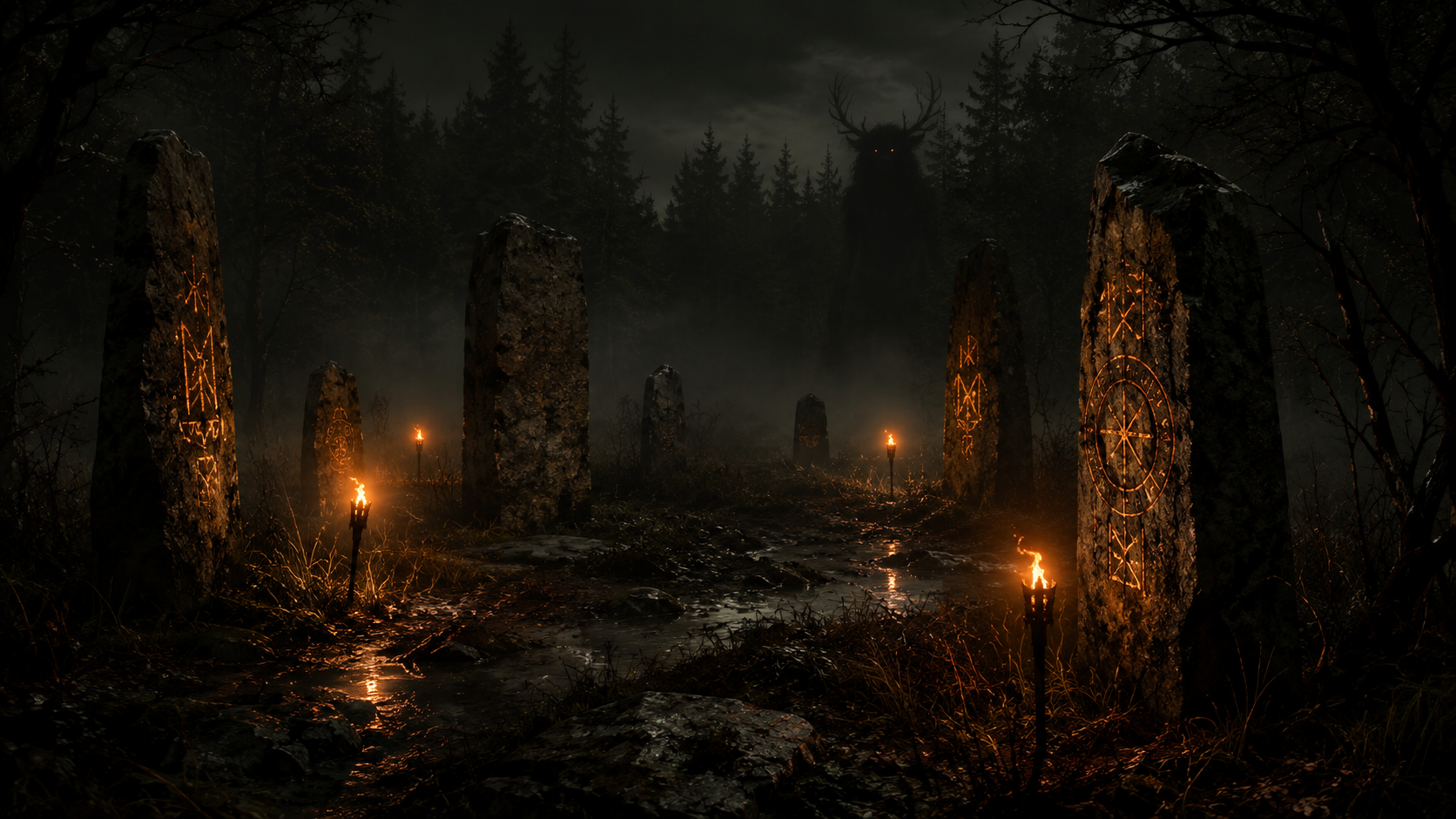
That is close to the power of a folk-horror rule. In the craft of “don’t do X”, a prohibition is frightening because it reveals a system without fully explaining it. Found footage turns the system into a damaged file. The rule may be written in the margins, and the person who knew it is already gone.
The frame forces the viewer to participate
A wide, polished horror shot can be beautiful. A found-footage shot is often narrow, badly lit, and late to the important thing. That inconvenience is not a flaw when the film understands it. The viewer starts scanning the edges of the image, listening for a sound beneath dialogue, and doubting whether a glitch was an accident.
The audience becomes a co-investigator. It performs the labor normally done by exposition: matching timestamps, reading background objects, wondering whether the narrator is reliable. The form creates fear by making attention feel necessary. If you stop looking, you might miss the clue. If you keep looking, you may see it.
Writers can borrow this without copying a handheld-camera aesthetic. A recovered voicemail, an incident report with redactions, a security log, or an email thread can all behave like found footage. The key is not distortion. The key is evidence that has a point of view and a limit.
Glitches are punctuation, not plot
Illustration: frame edges and offscreen space create found-footage tension.
Bad found footage mistakes technical noise for dread. A corrupted image is not automatically frightening. It becomes frightening when corruption takes something specific away.
Let the audio fail after a name is spoken. Let a camera drop its signal during the one moment a witness turns toward the door. Let the automatic timestamp continue after everyone has left the room. Each interruption should sharpen the question rather than decorate the scene.
This is where the form resembles a room that feels wrong. The reader does not need to be told that the atmosphere is uncanny. Give them the bad detail: the security camera has a blind spot exactly where the employee badge reader is; the footage restarts with the door open; the report’s author has crossed out their own name.
Evidence, limitation, refusal
My working framework for found-footage horror has three parts.
Evidence: The file contains something the audience can examine. It must be concrete enough to invite judgment.
Limitation: The file cannot see, hear, or preserve everything. The limitation should arise from the device or narrator, not from the author hiding behind fog.
Refusal: The story denies total closure. It leaves a remaining fact that cannot be reconciled without making the horror smaller.
That last part is the hardest. A refusal is not a random ending. It is an ending that understands exactly what answer it is withholding and why an answer would betray the form. The best final image does not say, “Nothing was explained.” It says, “This was all the explanation anyone got.”
The file stays open
Found footage is not realistic because cameras make things true. It is realistic because cameras make people believe there ought to be an answer. We trust the recording, then discover the recording has needs, blind spots, and fear of its own.
The final terror is not that the footage is fake. It is that it may be genuine and still useless when you need it most.
For after-hours horror built from ordinary systems that refuse to behave, On the Clock, After Dark is the next file to open. Join The Grimbard Press for Dead Ship, a free illustrated Subscriber Archive Edition, and more stories that leave just enough evidence behind.
FAQs
Why does found-footage horror feel more realistic than ordinary horror?
It frames events as incomplete evidence recorded by someone inside the story. Limited vision, imperfect sound, and missing context make viewers actively interpret what they see.
Does found footage need a shaky camera?
No. The defining feature is a story-world recording with limits and a reason to exist. Security footage, voice notes, screen recordings, and recovered documents can use the same principle.
What makes a found-footage glitch scary?
A glitch works when it removes or distorts a meaningful piece of evidence. Random static becomes repetitive quickly; an interruption at the wrong moment creates a specific unanswered question.
How can writers use found-footage techniques in prose?
Use a document or recording with a clear author, purpose, and limitation. Let its omissions arise naturally, then leave one crucial fact unresolved rather than explaining every anomaly.
Sources and further reading
This is a craft analysis. Verify all credits, dates, and plot details against the original film or its distributor before naming a specific work in the published version.
The Ferris wheel is still there. That is the problem.
If a building disappears, the mind can file it away as a finished thing. An abandoned amusement park refuses that convenience. Its gates remain shaped for arrivals. Its paths still lead toward rides. A ticket booth may stand with its little window intact, waiting for a hand that will never slide money beneath it. Everything speaks the language of a crowd, and there is no crowd to answer.
Abandoned amusement parks feel scary because they are designed to manage pleasure in public. They depend on motion, noise, queues, bright paint, staff, and the shared understanding that the machinery is being watched. When the people and the supervision vanish but the rides remain, familiar signals turn inside out. The place looks like it has kept performing after its audience left.
That response does not mean a closed park is haunted, cursed, or even dangerous. Many have ordinary histories of changing travel patterns, money, maintenance costs, and redevelopment. The fear comes from the mismatch between what the place promises and what it now shows.
An amusement park is a machine for being together
The first American parks were not invented as ruins. The National Park Service’s history of Glen Echo describes the rise of trolley and mechanical amusement parks as places where urban visitors could exchange routine for managed leisure. The rides mattered, but so did the contract surrounding them: someone sold the tickets, checked the restraints, played the music, swept the midway, and stood nearby when a child wanted to go home.
That contract is almost invisible while a park is alive. A carousel is painted as if it emerged fully formed from childhood. A roller coaster announces danger, then proves that danger has been measured down to bolts, brakes, and height restrictions. The visitor is allowed to feel afraid because the institution has made fear safe.
Remove the institution and the ride changes meaning. The roller coaster no longer says, you will be returned to the platform in two minutes. It says, someone once trusted this structure with their body. That is a much darker sentence.
This is why a rusting Ferris wheel can carry more dread than an empty office block. Offices are made for work and can look merely vacant when work stops. A Ferris wheel is made for people looking outward together, for small screams, photos, and the ridiculous certainty of being brought back down. When it is still, it preserves the shape of enjoyment without any enjoyment inside it.
Childhood symbols do not age politely
Illustration: a busy amusement park and an empty one use very different social cues.
Parks borrow from childhood even when their customers are adults. They use exaggerated scale, cartoon faces, colored lights, animal figures, sweets, music that repeats without consequence. Those things work because they assume a protected world. A mascot head looks harmless when an employee in a visible costume walks beside it. It feels wrong when it appears abandoned in a damp storage room, because the social frame has dropped away.
Decay adds another pressure. Nature does not understand the theme. Vines ignore the painted border. Rain takes the bright surface off a sign. A ride that was meant to move becomes a fixed object among weeds. The result is not simply “old.” It is two different calendars occupying one place: the park’s perpetual summer and the years that have actually passed.
That clash can be poignant rather than frightening. Closed parks are often tied to local jobs, family rituals, and complicated histories. The National Park Service’s broader recreation theme study is a useful corrective to ruin-porn: these sites can be historic places worth interpreting and preserving, not just backdrops for a spooky photograph.
Horror begins when the camera forgets that human history. It turns every empty ride into proof of catastrophe. Real places deserve more care than that.
The fear is uncertainty with a painted face
Psychology does not need to declare an abandoned park inherently terrifying to explain why it can unsettle us. Research on anxiety and uncertain threat, including a 2024 review by Blanchard and Canteras in Neuroscience & Biobehavioral Reviews, describes uncertainty as a condition that can intensify defensive attention. An empty park gives the eye plenty to monitor and very little to resolve. Is that building maintained? Is the floor sound? Is someone supposed to be here? Why does this scene look prepared for a crowd?
The visual cues are contradictory. A ride promises movement but does not move. A pathway asks to be followed but leads nowhere useful. A sign offers instruction but has lost the world in which the instruction mattered. Horror loves that kind of incomplete command. It puts the reader in a place that still has rules, then removes the person who could explain them.
That is also why abandoned parks make such efficient settings for fiction. They come with a ready-made map: entrance, midway, food stand, queue, exit. A writer can corrupt each familiar stop with minimal explanation. The terror does not require a monster behind every game booth. It may only require the ride attendant’s recorded voice to start speaking again.
Do not confuse an empty park with permission
Illustration: visual decay is not the same as permission to enter or a safety assessment.
Images of closed parks can make access look casual. It is not. Abandoned property can be structurally unsafe, contaminated, protected, occupied, or subject to trespass law. Sites attached to disasters carry further obligations; they are not generic stages for someone else’s thrill.
The better encounter is often a documented history, a preservation effort, or a photograph made with permission. Look long enough and the real stories are usually stranger than the fantasy of sneaking through a gate. A park may have closed because a rail line changed, because a town’s recreation moved elsewhere, because a storm rearranged the economics, or because maintenance outlasted the revenue. None of those explanations cancels the atmosphere. They give it weight.
The park keeps its part of the bargain
My own rule for this setting is simple: the strongest abandoned amusement-park horror does not treat decay as a monster costume. It treats the park as a promise that cannot admit it has failed.
The loudspeaker still has a voice. The turnstile still knows the direction of entry. The little painted horses still face the same way. The absence becomes frightening because the machinery has retained its manners.
That is the horror of a place built for joy. It has not become evil. It has become unanswered.
If places that keep their rules after closing time are your kind of horror, On the Clock, After Dark follows the dread that begins when an ordinary job refuses to end at the door. For a different kind of recovered place, The Backrooms are just a warehouse that won’t end follows the terror of architecture stripped of purpose; lighthouses make a useful contrast, built to remain awake on behalf of people far away.
> Join The Grimbard Press for Dead Ship, a free illustrated Subscriber Archive Edition, plus future dispatches on strange places and the things built to outlast us.
FAQs
Why do abandoned amusement parks feel more unsettling than other empty buildings?
They retain cues for crowds, safety, motion, and childhood pleasure. When those cues remain without people or maintenance, the mismatch makes the site feel like an interrupted public ritual.
Are abandoned amusement parks always dangerous?
Not automatically, but closed property can have unstable structures, environmental hazards, security risks, and legal restrictions. Do not treat a photograph online as evidence that a site is safe or open to visitors.
Why are Ferris wheels especially creepy when abandoned?
A Ferris wheel is designed to move people visibly through open space and return them safely to the ground. Its stillness preserves the expectation of motion while denying it.
What makes abandoned amusement parks useful in horror stories?
They provide familiar routes, visible rules, and objects associated with protected fun. A story can make those expectations fail without needing to explain an entirely new world.
You can want the locked door without wanting to see what happened to the person behind it.
That is not a contradiction. Horror is a large house. Graphic violence occupies some of its rooms, but so do haunted places, impossible choices, old warnings, guilty families, creatures seen at a distance, and the quiet certainty that someone has been standing outside longer than anyone wants to admit.
If you want to start reading horror but do not like gore, choose the kind of fear before you choose a title. Look for atmosphere, supernatural dread, gothic mystery, folklore, psychological unease, or restrained creature fiction. Then check content notes for the individual book. “Not gory” does not mean emotionally gentle, and no single recommendation is safe for every reader.
First, separate gore from fear
Readers often use scary, violent, disturbing, and gory as though they mean the same thing. They do not.
A book can contain little graphic violence and still be emotionally brutal. A ghost story may involve grief, suicide, harm to children, or psychological collapse. A gothic romance may avoid blood while centering coercion or abuse. A creature novel may be bloody but emotionally straightforward.
Before asking whether a book is “too much,” decide which dimension matters:
Graphic violence: How much physical injury appears on the page, and how much detail does the author provide?
Body horror: Does the story focus on transformation, disease, infestation, or loss of control over the body?
Dread: How long does the book keep the reader expecting something bad?
Emotional intensity: Does it center grief, cruelty, abuse, isolation, or harm involving children or animals?
Startle versus atmosphere: Does it move through sudden attacks, or build fear through place and implication?
These categories are more useful than a single “scariness” score. A reader who dislikes anatomical detail may love sustained dread. Someone else may tolerate a quick violent scene but hate the helplessness of a child-in-danger plot.
There is no prize for forcing yourself through the wrong book.
If you like old warnings, begin with folklore
Folklore horror often builds fear from a rule: stay off the road after dark, leave the offering where it belongs, do not answer the voice from the water.
The pleasure comes from recognizing the boundary before the character crosses it. The creature may remain mostly unseen. History and landscape do much of the work.
For classic fiction, M. R. James’s ghost stories are compact exercises in objects, manuscripts, rooms, and old offenses returning. Some contain disturbing images, but they usually depend more on implication than prolonged anatomical detail. Susan Hill’s The Woman in Black is another atmosphere-first route, though readers should check its themes and content notes rather than assume “not gory” means mild.
Within the Grimbard catalog, There Be Monsters: Then and Now is the thematic route into legends that survive by changing. It should receive a verified story-by-story content profile before this article describes it as lower-gore.
If you like rooms with histories, try gothic and haunted-house fiction
The gothic mode makes architecture carry emotion. A house remembers a marriage. A corridor preserves a family secret. The locked room is frightening because everyone agrees not to discuss it.
This route suits readers who want mood, unreliable perception, social pressure, and the past pressing on the present. The threat may remain ambiguous for much of the book.
Shirley Jackson’s The Haunting of Hill House is a natural starting point for psychological and architectural dread. Daphne du Maurier’s Rebecca leans toward gothic suspense rather than conventional supernatural horror, but it shows how a dead person can dominate a house without walking through it. Henry James’s The Turn of the Screw offers ambiguity and a demanding older prose style; that uncertainty is the point, not a defect to solve.
None of these books should be sold as universally comfortable. Content notes still matter, and older works may handle class, disability, gender, or mental health in ways a modern reader wants to know about first.
The Grimbard route enters through The Scarab, The Beetle: A Mystery—Annotated, and It Walks by Night—Annotated. Choose among them by whether you want original modern gothic fiction, a strange Victorian invasion novel, or an annotated rediscovery—not by an unverified promise about gore.
Find the next door:Join The Grimbard Press for Dead Ship, a free illustrated Subscriber Archive Edition, monster lore, recovered files, and book news.
If scale frightens you, choose impossible places
Some readers are less interested in a killer than a setting that removes escape.
A cave, ship, forest, hotel, or endless workplace can produce horror before a creature appears. The story tightens distance, light, weather, and time until ordinary choices stop working.
Why caves are so scary explains how underground spaces remove the senses and routes people use to feel safe. If that kind of fear appeals to you, look for summaries emphasizing isolation, exploration, liminal space, or survival rather than splatter, extreme horror, or visceral body transformation.
This route still requires content checking. Survival stories can become physically graphic even when the setting is the main threat. Read the publisher’s description, sample the first pages, and consult more than one content-note source when a specific trigger matters.
There Be Monsters: Deep Down is Grimbard’s direct underground route. Its anthology structure also offers a practical advantage: a reader can try one story without committing to a full novel. The final article should include a story-level content note or point to one before making a lower-gore recommendation.
If you want a creature, decide how close it should come
Creature horror ranges from a shadow across the road to a detailed transformation of the human body. “Monster book” says almost nothing about graphic intensity.
Ask where the story’s attention goes.
Folkloric creature: The interest is often the rule, history, or landscape around the being.
Cryptid story: Sightings, evidence, pursuit, and regional identity may matter more than attack scenes.
Sea or expedition monster: Scale, isolation, and the unknown can carry the fear.
Body-transformation monster: Physical change may be the central experience and is more likely to trouble readers avoiding body horror.
Predator story: Suspense may alternate with direct attacks; check the level of detail.
Again, those are thematic matches. The content profile must be checked separately.
If ordinary life turning wrong scares you, work the late shift
Workplace horror begins with familiar rules and removes the people who normally make them reasonable.
The register must remain staffed. The door must stay locked. The camera shows a person where no person should be. The employee cannot leave because leaving has a cost before the monster ever appears.
The Grimbard book route is On the Clock, After Dark, followed by There Be Monsters: Among the Dead for readers who want the dead closer. On the Clock, After Dark is not currently enrolled in KDP Select, so availability copy should not promise Kindle Unlimited access.
Use the sample as a pressure test
A recommendation tells you what worked for someone else. A sample tells you how the book enters your head.
Read five to ten pages before buying when a sample is available. Do not ask only whether violence has occurred yet. Notice what the prose watches. Does it linger on wounds? Does it make the body the main source of disgust? Does it signal cruelty toward an animal or child? Does the atmosphere feel invitingly tense or simply exhausting?
Then check content notes. Useful notes identify events without turning them into moral judgments. They distinguish presence from detail and, when possible, indicate whether material occurs briefly or drives the story.
Avoid depending on a single crowd-sourced label. One reader’s “mild” may be another reader’s reason to stop. When the boundary matters, compare the publisher, author, library reviews, and reader-created databases. Ask a bookseller or librarian for atmosphere-first horror and name the content you want to avoid.
Starting with a novella, anthology story, or classic short story also reduces the cost of a mismatch. Horror does not require a six-hundred-page initiation.
You are allowed to stop
The worst way to begin reading horror is to choose the most extreme title you can find and treat endurance as proof that you belong in the genre.
Close a book that is giving you the wrong experience. Skip a scene. Read a plot summary. Continue in daylight. Spoil the ending if uncertainty is the part you dislike. None of those choices makes the reading less legitimate.
Fear in fiction is consensual. The reader decides how close the thing may come.
That control is one of horror’s pleasures. A book can open the locked room and still let you close it. Over time, you may discover that your boundary moves. You may also discover that it does not.
Before publication, each choice should display four separate content indicators: dread, graphic violence, body horror, and emotional intensity. Until those are verified, the routes above describe themes, not guarantees.
Join The Grimbard Press for Dead Ship, a free illustrated Subscriber Archive Edition and the next dispatch. You do not have to enter every room. You only need the right first door.
At 3:17 a.m., the building makes a sound it has never made before.
Not a crash. Nothing useful. A small metal complaint comes from beyond the fluorescent light, somewhere near the loading bay or the locked room beside it. The security monitor shows four empty angles. The checklist says the doors were tested at 2:00.
There is still almost half a shift left.
Night shifts are frightening because ordinary places lose the people and daylight that make them feel ordinary. Darkness limits what can be checked. Fatigue makes uncertainty harder to dismiss. Empty rooms amplify mechanical sounds, and the worker cannot simply leave without abandoning the job. Workplace horror turns that obligation into a trap: the rules remain after the witnesses go home.
Daylight is full of witnesses
A store, hospital, office, plant, warehouse, or hotel contains more than walls during the day. It contains social proof.
People move through the halls. Someone laughs behind a door. A phone rings and is answered. If a sound comes from the stockroom, three other people may hear it. If a light turns off, someone knows which switch was used.
The crowd continuously confirms that the building is behaving normally.
At night, the structure remains while the explanation thins out. The same refrigeration system cycles on. Pipes knock. Metal contracts. Elevators answer automated instructions. A building can be mechanically active while appearing socially dead.
That distinction is perfect for horror. The worker knows that most noises have ordinary causes. The worker may even know exactly which machine produces which hum. Fear begins when one sound fails to match the catalog.
It is not loud enough to demand an emergency response. It is only wrong enough to require attention.
Workplace horror lives in that requirement. A character in a haunted house may choose not to inspect the basement. A night employee may be responsible for whatever is down there.
Night and darkness are not quite the same fear
Darkness removes visual information. Night adds time, expectation, and the knowledge that the larger human schedule has moved elsewhere.
A 2015 study indexed by PubMed examined night and darkness as distinct influences on fearful responses. Its results suggested that both environmental darkness and the biological day-night cycle matter in fear-related processing. That does not mean everyone becomes irrational after sunset. It means a dark room at noon and the same dark room at midnight are not necessarily experienced as identical.
Night carries a social meaning. Most offices are supposed to be empty. Most schools are supposed to be silent. The locked storefront tells the street that no one is available inside.
This makes the night worker visible and isolated at the same time. The lit booth, register, nurse’s station, or guard desk becomes a small occupied island. Anyone approaching can see the worker before the worker can identify them.
Artificial light does not abolish the dark. It draws a border around it.
The body is working against the clock
Night work is ordinary, necessary labor. It is also labor performed against cues that shape sleep and alertness.
The National Heart, Lung, and Blood Institute explains that the body’s circadian rhythm is influenced by light, darkness, and other environmental signals. Sleep pressure also builds the longer a person remains awake. A schedule can require attention at the same hours when the body expects something else.
That mismatch has measurable effects. A NIOSH analysis of 6,338 U.S. workers found sleep problems across schedules, with night-shift workers showing the highest risks in the study. The researchers reported higher prevalence of short sleep, difficulty falling asleep, poor sleep quality, excessive daytime sleepiness, and insomnia among night workers than day workers on several measures.
Those findings should not be used to dismiss a worker’s perception. “You were tired” is not proof that a sound, person, or hazard was imaginary. Fatigue can coexist with a real threat.
For horror, the uncertainty is more useful than hallucination. A small experimental study of sleep deprivation and fear conditioning found increased subjective threat expectations after a sleepless night, while some physiological measures did not change in the same way. The authors urged caution in interpreting the results. The valuable narrative point is simple: after lost sleep, previously safe signals may be harder to trust.
The exit alarm has always chirped once before resetting.
Tonight it chirped twice.
Read the next after-hours dispatch:Join The Grimbard Press for Dead Ship, a free illustrated Subscriber Archive Edition, recovered files, monster lore, and book news.
Artificial light creates islands
Daylight fills a space. Workplace lighting divides it.
Fluorescent fixtures illuminate the aisle but not the steel behind the shelves. A parking-lot lamp creates a circle and leaves every parked vehicle with a dark side. A security monitor offers several bright rectangles while proving how many corners the cameras do not cover.
The employee works from island to island.
That movement gives night-shift horror its visual grammar: leave the booth, cross the dark floor, reach the next switch. The character may control the light and still be unable to illuminate everything at once. Turning on one zone can make the windows reflective. Looking into a bright monitor reduces awareness of the room behind it.
Technology adds information without guaranteeing reassurance. Motion sensors announce movement but not its cause. Cameras show an empty hallway a few seconds after something was heard there. A digital access log records that a door opened under a credential belonging to the person reading the log.
The old haunted house had candles. The modern workplace has diagnostics.
Both fail at the exact moment proof is needed.
Every job has rules that can become horror rules
Do not leave the register unattended. Walk the floor once an hour. Never prop open the fire door. Record every temperature. Answer the room call. Check the animal enclosure. Confirm the freezer alarm in person.
Ordinary rules create extraordinary pressure when followed at night.
The rule tells the character where to go. It removes “stay somewhere safe” as an option. More importantly, a written procedure implies that the situation has happened before. If the checklist contains an instruction that makes no sense, someone had a reason to add it.
This is why rules horror fits the workplace so naturally. Employment already contains explicit duties, restricted areas, chains of authority, uniforms, badges, incident reports, and consequences for leaving. The supernatural does not need to invent control. It only needs to enter the existing system.
The craft of “Don’t Do X” explains why a prohibition creates fear before it is broken. Workplace horror adds the paycheck. The character may believe the warning is ridiculous and still need the job badly enough to obey it.
The best rule is not “do not summon the demon.” It is something almost reasonable:
If the north stairwell door is open after 2:00 a.m., close it without looking inside.
Now the building has a history. Management knows part of it. The worker knows less.
Different workplaces create different ghosts
A warehouse offers distance, repetition, stacked concealment, and machinery large enough to move without looking alive. The ghost has left the house for the warehouse because the modern logistics building can hide an entire event behind identical doors.
A hospital never truly sleeps. Its night fear comes from partial occupancy: care continues while administrative layers vanish. Empty waiting rooms sit beside urgent rooms. Elevators connect public floors to service spaces most visitors never see.
A hotel has strangers asleep behind numbered doors and an employee expected to answer when one of those rooms calls. A convenience store is all window, making the clerk visible from the parking lot. A school after hours preserves evidence of daytime life—names, drawings, small chairs—without the people who gave it scale.
An office becomes uncanny through repetition. Every cubicle is almost the same. The Backrooms resemble a warehouse that refuses to end because repetition destroys proof of progress. Walk far enough and the familiar becomes an accusation: you have passed this place before.
Each setting produces its own monster because each job creates its own kind of vulnerability.
The worker cannot simply leave
“Why don’t they get out?” ruins many horror stories because the answer is not strong enough.
Night-shift horror begins with the answer already clocked in.
Leaving may mean abandoning a patient, animal, coworker, security post, or process that cannot safely stop. It may mean losing a job. The doors may be locked against outsiders in a way that also slows escape. A supervisor may be asleep, unreachable, or unwilling to believe a report that contains no obvious emergency.
Responsibility holds the character in place before any supernatural force needs to.
This gives the workplace ghost an advantage the traditional ghost may lack. It does not have to seal the exits. It only has to make the employee choose between danger and duty.
“Stop Telling Me the Room Felt Wrong” makes fear visible through action. The night worker supplies those actions naturally: recount the keys, check the feed, call the supervisor, write the time in the log, return to the door that should not be open.
At 3:17 a.m., the sound comes again.
The checklist has a blank line waiting for it.
Stay on the clock
On the Clock, After Dark is built from the moment an ordinary duty becomes the rule keeping someone inside. The book is available from Amazon and is not currently enrolled in KDP Select, so this article should not use Kindle Unlimited language.
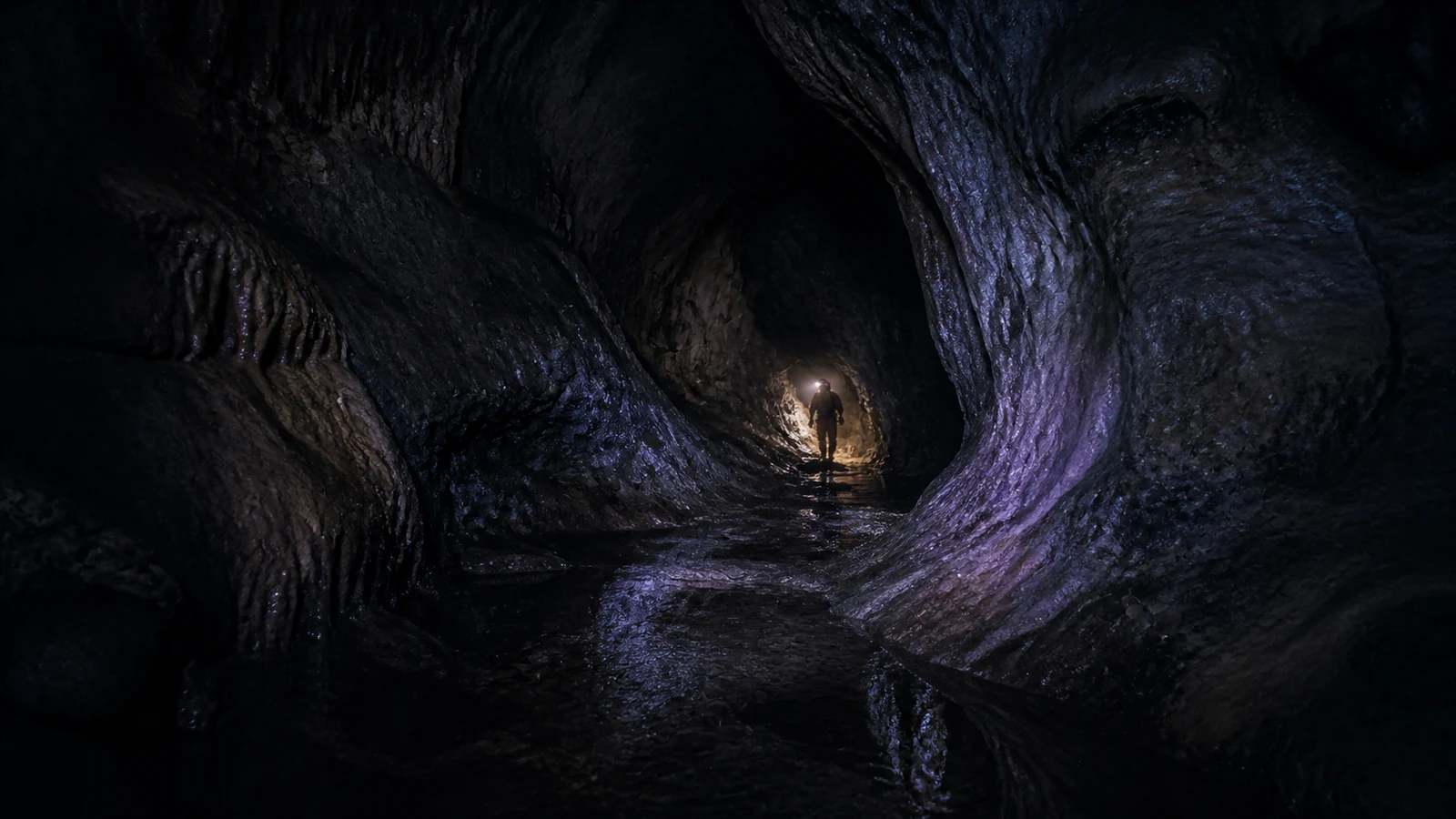
The entrance is the last generous thing a cave gives you.
It frames the daylight. It shows you where the surface is. For a while, you can turn around and see the exact shape of your escape. Then the passage bends. The entrance disappears, and every direction becomes a version of deeper.
That is when a cave stops being a hole in the ground and becomes a world.
Caves are frightening because they remove the senses and choices people use to feel safe. Natural darkness erases distance. Stone limits movement and escape. Sound behaves strangely, landmarks repeat, and the route home can depend on a light small enough to hold in one hand. Underground horror takes those real conditions and adds one question: what if the cave is not empty?
A cave breaks the ordinary agreement between you and a room
Most human spaces tell us how to leave them.
Doors have handles. Hallways lead somewhere. Windows prove that an outside still exists. Even a basement belongs to a building whose shape we understand. A natural cave makes no such promise. Its passages were not designed for a human body, and its walls do not care whether the route feels sensible.
That indifference is the first source of dread.
A corridor made by people suggests intention. Someone decided its width, its height, and where it would end. In a cave, the passage may narrow without warning or open into a chamber too large for your light to explain. It can split. It can descend. It can circle back through rock that looks almost—but not quite—the same.
Horror depends on the gap between what a character can perceive and what the audience imagines. A cave creates that gap naturally. The headlamp reveals ten feet of wet stone. The mind supplies everything beyond it.
This is one reason underground horror does not require an elaborate creature. The setting already behaves like an antagonist. It controls sight, movement, time, and information. Put something alive inside it and the thing inherits every advantage.
Darkness becomes physical underground
Night outdoors is rarely absolute. There may be stars, reflected city light, a pale road, or the silhouette of a tree against the sky. Cave darkness is different. Beyond the entrance zone, switch off every light and there may be no visual information at all.
Not very little. None.
In that darkness, a flashlight does not restore the normal world. It creates a small temporary one. Whatever sits inside the beam exists. Everything else becomes possibility.
That makes light more than a tool in cave horror. It is a clock.
A battery has a life. A bulb can fail. A dropped lamp can fall where a hand cannot reach it. The National Park Service advises cave visitors to carry multiple independent light sources; some park guidance specifies three. That is practical safety advice, but it reads like the first rule in a horror story because it makes the danger measurable. Three lights mean there are three chances for the dark to win.
Sound does not compensate cleanly. Water drips out of sight. A scrape travels through stone. Echoes make distance unreliable. The noise behind a person may be falling gravel, another member of the group, or an animal that has already learned the passage.
The eye wants to confirm. The cave refuses.
Confinement is about escape, not square footage
People often describe cave fear as claustrophobia, but the words should not be treated as interchangeable. A person can find a cave frightening without having a clinical phobia, and a vast cavern can feel imprisoning despite its size.
The common element is escape.
The National Library of Medicine’s clinical overview defines claustrophobia as a fear of enclosed spaces and notes that people may fear what could happen there—restriction, loss of control, or the possibility of not getting enough air. The feeling is not determined only by how close the walls are. A locked aircraft cabin is larger than an elevator. It can still produce the same intolerable fact: leaving is not immediately possible.
A cave multiplies that fact. The exit may be physically open and still be hours away. A person can stand in a chamber the size of a cathedral while knowing that every route to the surface passes through one narrow crawl.
Underground horror uses this distinction well. A tight passage creates immediate pressure. A huge chamber creates scale without freedom. One says, your body may not fit. The other says, your body does not matter.
Go farther underground:Join The Grimbard Press for Dead Ship, a free illustrated Subscriber Archive Edition, new monster lore, and recovered files from beyond the safe boundary.
The danger is not imaginary
Caves are not frightening merely because people misunderstand them. They are environments with real hazards, and responsible caving depends on preparation rather than bravado.
National Park Service cave-safety guidance warns visitors about uneven surfaces, low ceilings, fragile formations, and the need to tell someone where they are going. El Malpais National Monument emphasizes cold conditions, difficult footing, route-finding, proper equipment, and redundant light. These are not proofs that every cave is a death trap. They are reminders that underground mistakes are harder to correct.
On the surface, a twisted ankle is an injury. Deep in a cave, it also changes the problem of distance. A storm above can alter water below. Cold drains energy. A familiar passage looks different on the return trip. The person who says, “I remember this turn,” may be wrong by only one opening.
Horror takes that chain of ordinary consequences and tightens it. The monster need not attack. It can wait while fatigue, cold, and uncertainty do the work.
This matters because the best cave horror does not use the underground as a painted backdrop. The cave determines what decisions are available. It makes rescue slow. It makes separation plausible. It turns every extra pound of equipment into a negotiation and every noise into a reason to stop moving.
The setting does not simply contain the story. It writes the rules.
The underworld was crowded long before modern horror
Humans have been telling stories about descents below the earth for a very long time. The details differ radically across cultures, and “the underworld” is not one universal place. Still, caves and openings in the ground repeatedly serve as thresholds because they make an invisible realm physically imaginable.
In Greek myth, entrances to the realm of the dead could be located in the living landscape. Odysseus approaches the dead through ritual at the edge of Ocean in Book 11 of The Odyssey. Orpheus descends and is given a rule for returning: do not look back. The story makes the journey upward as dangerous as the descent. Escape fails at the point when proof becomes irresistible.
Other cave traditions treat underground spaces as sacred, ancestral, protective, dangerous, or all of these at once. Calling them merely “creepy” can strip away the beliefs that give the place meaning. A horror article should not collect sacred caves from around the world as set decoration.
What can be said carefully is that a cave makes a powerful threshold. It is an actual opening into an unseen world. It changes temperature, light, sound, and direction within a few steps. It gives the storyteller a door that did not need to be built.
Once the dead, a god, an animal, or a forbidden people are placed beyond that door, the cave acquires another danger: entering may change the person who returns.
Underground horror takes away the horizon
Consider what disappears when a story goes underground.
There is no weather to read at a glance. No sun to measure direction. No distant landmark. The horizon—the line that tells us the world continues—vanishes completely.
That loss changes narrative time. A character cannot look out a window and discover morning. Minutes stretch because nothing in the setting moves except the people, the water, and whatever may be following them. A dead watch becomes plausible. A missed turn can consume an hour without covering much distance.
The cave also reverses the usual meaning of progress. In most journeys, forward movement approaches a destination. Underground, every step forward may increase the cost of retreat. Discovery and danger become the same direction.
This is where cave horror earns its dread. The characters do not merely wonder what lies ahead. They calculate what remains behind them: two lights, half the water, one injured knee, four hours to the entrance.
The arithmetic is scarier than a growl.
“Stop Telling Me the Room Felt Wrong—Show Me the Man Checking the Locks” argues that fear becomes convincing through behavior. Cave horror offers behavior everywhere: testing a rope twice, marking a wall, counting batteries, turning sideways to breathe, listening for the missing person who was supposed to be directly behind you.
The setting gives fear something to do.
What waits below does not need to chase you
The simplest cave monster is the one adapted to the place better than you are.
It does not need a lamp. It knows which passage narrows. It hears movement through stone. It may be slow because there is nowhere else for its prey to go.
That imbalance is the heart of underground creature horror. On the surface, people can run in several directions. In a cave, escape becomes a single route that must remain open. The creature only needs to stand between a person and daylight.
Sometimes the cave itself fills that role. A collapse closes the mouth. Water rises through the floor. The map becomes wrong. A chamber that should connect to the surface does not. The difference between “trapped with a monster” and “trapped inside one” grows very small.
The entrance was generous because it let you believe leaving would be the same journey in reverse.
It rarely is.
Read deeper
There Be Monsters: Deep Down contains thirteen stories about buried places, narrowing choices, and what waits where daylight cannot follow.
Here is the single worst sentence in amateur horror, and I’ve read it ten thousand times in ten thousand costumes: A sense of dread filled the room.
It fails for a reason worth understanding, because the reason is the whole craft. That sentence asks the reader to feel something by naming the feeling. It’s a label where an experience should be. And a label produces nothing — the reader’s eye slides across “a sense of dread” the same way it slides across “the weather was bad,” registering the category without generating the sensation. You told me there was dread. You did not give me any.
Grounded horror is the discipline of never once naming the fear, and building it so precisely out of physical evidence that the reader supplies it themselves, unprompted, and can’t quite say when it started.
Fear Lives in Behavior, Not Adjectives
Watch a genuinely frightened person sometime. They don’t emote in adjectives. They do things. They check the lock twice and then a third time and hate themselves for the third. They leave a light on they’d normally turn off.
They stop talking mid-sentence and listen. They put their back to the wall in a restaurant. They keep the volume on the TV low so they can hear the rest of the house. The fear is entirely legible, and not one word of it is the word “afraid.”
That’s the first tool and it’s the one that changes everything: render emotion as behavior. Don’t write “she was terrified of the basement.” Write that she’d started carrying laundry down two loads at a time so she’d have to make the trip less often, and that she did it during the day now, and that she’d stopped humming on the stairs without deciding to. I never told you she was scared. You know exactly how scared she is, and better — you built the fear yourself out of the evidence I handed you, which means it’s yours now, and you can’t argue with it.
This is why the behavioral tell beats the stated emotion every time. A stated emotion is something you can disagree with. “She was terrified” — was she, though? I only have your word. But a woman rationing her trips to the basement is a fact, and facts don’t ask for your belief. They just accumulate until you look up and realize the room got cold while you were reading.
The Simile Test: Point at Things, Not Abstractions
Bad horror reaches for the cosmic and the poetic when it wants to escalate. “The darkness was ancient and hungry.” “An evil older than time itself.” “A malevolence that defied comprehension.” All abstraction, all air. The reader can’t see any of it, because there’s nothing to see. These phrases point at concepts, and concepts don’t have edges.
My rule, and it’s non-negotiable in my own drafts: a comparison has to point at a thing the reader has physically encountered. Not “a scream that embodied pure terror” but “a sound like a dog makes when a car has already hit it and hasn’t finished.” Not “an unnatural stillness” but “the quiet of a house where the refrigerator has just cut out and you didn’t know how much noise it was making until it stopped.” The simile should be mundane on one end — a dog, a refrigerator, a smell you know — so that the horror on the other end has something ordinary to stand on. Abstraction floats away. A specific, non-poetic, slightly-too-familiar comparison drives a nail through the sentence and pins it to the reader’s own memory.
Test every simile in your draft against this: could the reader draw it? If the answer is no — if it’s “a shadow like living malice” — cut it. Malice isn’t a shape. A dog with its back legs not working is a shape, and it will do more to a reader than every “ancient evil” ever printed.
Horror Is Made of Silence and Missing Information
The instinct of the beginner is to add. More description, more adjectives, more explanation of what the monster is and why it’s terrible and how it came to be. Every addition makes it less frightening, because dread is a function of what the reader doesn’t have.
The scariest unit in horror is the thing that’s described completely except for the one detail your mind needs most. The figure at the end of the hall, rendered in full — the coat, the posture, the way it’s standing too still — except you’re never told about the face, and so your own mind, which is a far better horror writer than I am, builds the face, and builds it worse than anything I could have written. Restraint isn’t holding back out of politeness. It’s understanding that the reader’s imagination is the actual engine, and your job is to feed it precise fuel and then get out of its way.
This is also why silence does the heaviest lifting. Not “an eerie silence descended” — that’s the dread-label failure again. I mean the functional use of the missing sound. The dog that always barks at the mail and doesn’t today. The child who’s usually impossible to get to bed, asleep already, too early, when you come up. The specific absence of a noise you’d expect. Horror is frequently just an inventory of the world behaving normally with exactly one thing subtracted, and the subtraction left unexplained. You don’t write the fear. You write the world, correctly, and then you quietly remove one true thing from it, and you never mention that you did.
The Body Keeps the Score, So Write the Body
Adult horror — and I mean the register that unsettles grown people who’ve stopped believing in the closet monster — works through the body, not the mind. Not “he was overcome with terror” but the concrete physical facts of a frightened animal: the mouth going dry so that swallowing makes a sound, the specific need to urinate that fear produces, the way the hands get clumsy and drop the keys, the heat in the face, the legs that feel wrong. These aren’t decoration. They’re the most honest evidence a scene has, because the body reacts before the conscious mind has caught up, and a reader recognizes their own physiology instantly.
But render it through evidence, never through clinical narration. Not “her heart rate elevated and adrenaline flooded her system.” That’s a lab report. Write that she noticed she’d been holding the same forkful of food for a while and couldn’t remember deciding to stop eating. Same physiology. One is a chart; the other is a person, from the inside, catching up to their own fear a half-second late — which is exactly how fear actually arrives. Never on cue. Always a beat behind, discovered rather than announced.
What This Costs, and Why It’s Worth It
I’ll be honest about the trade. This approach is slower and less immediately gratifying to write than the adjective method. “A wave of primal dread crashed over him” takes four seconds and feels productive. Working out the exact behavioral tell — what would this specific person do, in this house, that would reveal fear without naming it — takes real thought and a lot of cutting. Most of the words you write in this mode, you delete, because most attempts at a concrete tell are slightly off and the slightly-off ones have to go.
But it’s the only version that lasts. The adjective horror evaporates on contact; the reader forgets it by the next paragraph. The behavioral, evidentiary, restraint-first version installs itself, because the reader did the assembly and you can’t forget a fear you built with your own hands. That’s the entire fingerprint of what I try to do across the There Be Monsters work — thirteen stories where I try never to tell you the room felt wrong, and instead show you the man checking the locks, and let you arrive at the wrongness yourself, a little too late to put it down.
The craft is subtraction. Name nothing. Point at real things. Remove one true detail from an ordinary world and refuse to explain the gap. Do that well enough and you’ll never have to write “a sense of dread filled the room” again, because the room will be full of it, and you won’t have said a word.
If you write horror, or want to, this is the machinery I actually use. Get on the list and I’ll send the free story plus the working notes behind the method.
The full application of all of this is in There Be Monsters: Then and Now — read it as a craft text if you want, and reverse-engineer the tells.
A few tools that earn their place on my desk, if you’re building a horror-writing practice: Stephen King’s On Writing is still the one book I’d hand a beginner. I draft the ugly first passes longhand in a Moleskine hardcover, edit under a BenQ reading lamp because eye strain kills more late-night sessions than writer’s block does, and I cut everything else out with a pair of Sony noise-canceling headphones. None of it will write the sentence for you. All of it makes it easier to sit there until you do.
The whole thing started with one photograph and one paragraph. In 2019, someone posted an image to a 4chan thread about unsettling places: an empty office space, yellowed wallpaper, damp carpet, fluorescent lights, no windows, no people.
Anonymous captioned it. If you’re not careful and you noclip out of reality in the wrong areas, you’ll end up in the Backrooms — six hundred million square miles of empty rooms, the hum of the lights, the smell of old carpet, and the sound of something else moving around, far off, that has heard you.
That’s it. No monster described. No exit. Just an infinite, uniform interior and the implication that you are not alone in it.
It became one of the biggest horror franchises of the decade, and I think it’s because it accidentally described something we all already recognize but had never named: the dread of infrastructure that has outlived its purpose and kept running.
The Old Fear Wore Stone
The Backrooms feel new, but the bones are ancient. Go back to the oldest architectural horror we have: the Labyrinth. Daedalus built it for King Minos to hold the Minotaur — a maze so complex that its own designer barely escaped it, a structure whose entire function was to make sure that whoever went in could not find the way out. The horror of the Labyrinth was never really the bull-headed thing at the center. It was the walls. It was the certainty that the building itself was your adversary, that every corridor was a decision you’d get wrong, that the architecture was designed by an intelligence specifically to defeat yours.
The Minotaur is what people remember, but the Minotaur is almost a mercy — at least it’s a thing you can fight, a center you can reach. The genuinely modern horror is the version with no center and no monster at all. Just the maze. Just the walls, going on past any reason for walls to go on, built by a logic that no longer has a purpose but hasn’t stopped executing.
That’s the Backrooms. The Labyrinth with the Minotaur removed and the corridors set to infinite.
Why Empty Infrastructure Reads as Threat
There’s real cognitive science under the liminal-space aesthetic, and it’s worth naming because it explains why a photo of an empty hallway can raise your heart rate.
Human environments carry implicit information about other humans. A hallway is for getting between rooms that people use. An office is for people working. A stairwell is for movement between floors. When you encounter one of these spaces completely emptied of the people it was built for — the school at 3 a.m., the mall after closing, the parking structure with no cars — your brain registers a mismatch. The space is shaped by human intention but contains no humans. And the oldest part of your threat-detection asks the obvious question: where did everyone go, and what’s the reason I shouldn’t be here?
The fluorescent hum makes it worse. It’s the sound of a building that is still powered, still maintained, still running — for no one. The lights are on because a system somewhere decided the lights should be on, and that system doesn’t know or care that the people are gone. That’s the specific flavor of Backrooms dread: not abandonment, which at least implies release, but operation without occupancy. The machine is still going. It just isn’t going for you anymore. You’re inside it, and it has no setting for you.
The Version That’s Already Real
Here’s the reframe I actually care about. The Backrooms are described as a supernatural elsewhere you “noclip” into. But the aesthetic is drawn entirely from real places, and the real places are getting more numerous, not less.
Walk through a modern automated distribution hub in the off-hours. Miles of racking under identical lighting, no windows, no clear sightline to an exit, aisles labeled in a coordinate system meaningful only to the routing software. It is a purpose-built maze whose organizing logic is not human-legible — you cannot navigate it by intuition, only by being told, node to node, where to go next. The lights and conveyors run on a schedule set by a model. If you were left in there after the shift ended, with no scanner telling you where to go, you would be, functionally, in the Backrooms: inside a vast, humming, uniform interior, built by intention but not for you, unable to find the edge.
Or consider the grid dead-zone — the growing set of places where the infrastructure of connectivity, navigation, and monitoring simply fails. The tunnel where GPS dies. The stretch of the megastructure where no signal reaches. We’ve wrapped ourselves so completely in systems that tell us where we are that the places those systems can’t see have become a new category of frightening. Not wilderness — wilderness is honest about being wild. Something worse: built environment that the network has forgotten, infrastructure that exists on no accessible map, corridors the routing software doesn’t route. You can be lost inside human construction now, which the Labyrinth understood was the deepest kind of lost.
What the Monster Would Actually Be
The Backrooms lore eventually did what all lore does and started adding monsters — “entities,” numbered and cataloged. Most of them are the weakest part of the mythos, because the moment you can see the thing hunting you, the infinite corridor becomes finite: a level with an enemy on it, a problem with a shape.
If I were writing the true version, the monster wouldn’t have a body. It would be the building’s own logic. The thing that moves you deeper. The routing that never resolves to an exit because “exit” was never a state the system was designed to reach — only “next location.” The horror mechanism of a warehouse that won’t end isn’t a creature in the aisles. It’s that the aisles are the creature: a mechanical intelligence with no malice and no off state, that will keep assigning you a next node forever, because assigning next nodes is the only thing it knows how to do, and it has confused you for cargo.
The Minotaur could be killed. The Labyrinth had a center. What we’ve built has neither. Just the hum, the carpet, and a system that will route you until you stop, and then route the next thing that noclips in.
I write horror set in the spaces the map forgot — the humming interior that’s still running for no one. Get the free story here; I promise there’s an exit.
The Japanese ghost has rules. That’s the thing Western horror never quite copied when it started importing the aesthetics.
A Yūrei — the pale, black-haired, white-robed figure you’ve seen bleached through a dozen remakes — isn’t a random spook. It’s a person who died with something unresolved. A wrong that wasn’t righted. A grief that wasn’t allowed to complete. Under the older logic of kaidan, the ghost story, the dead don’t linger because they’re evil. They linger because a process was interrupted, and they cannot move on until the process finishes. They are trapped inside an unclosed loop. And the terror of them isn’t that they’ll leap out at you. It’s that they will follow the loop, exactly, forever, and you have walked into its path.
I’ve come to think that’s the most modern monster in the whole global bestiary. Not because of the ghost. Because of the loop.
Onryō and the Logic of the Unresolved
The specific class of vengeful Yūrei is the onryō — the wronged dead, usually someone betrayed or killed unjustly, who returns not to haunt a person but to execute a kind of grievance-procedure. The onryō doesn’t choose its targets out of malice so much as jurisdiction. You entered the house. You bought the tape. You moved into the apartment. The curse isn’t personal; it’s positional. It attaches to a location or an object and processes everyone who crosses the threshold, with the flat indifference of a machine that was set running a long time ago and never given a stop command.
That’s the detail I want to sit on, because it’s the one that maps.
There’s also the ikiryō — the living ghost, the projection of a person’s rage or obsession that detaches and acts on its own while the person is still alive, sometimes without their knowledge. And the Gashadokuro, the giant skeleton assembled from the bones of people who died of starvation and neglect, mass death compacted into a single walking consequence. Both are the same idea from different angles: harm that was done to people gets stored, accumulates, and comes back with the impersonal momentum of a system.
Hold that phrase. The impersonal momentum of a system. Now walk into a modern fulfillment center.
The Warehouse Is a Haunted House With Better Uptime
Here’s the reframe. We think of algorithmic horror as a future problem — the AI that turns on us, the robot uprising. But the actual dread of the automated workplace is already here, and it’s structurally identical to the onryō.
Consider what it’s like to work inside a system that routes you by handheld scanner. The device tells you where to go, how many seconds you have to get there, and whether your rate is acceptable. You don’t see the person who designed the target. There may not be a single person who did; the number is an emergent output of a model optimizing throughput. When you fall behind, the correction doesn’t arrive as a manager’s decision. It arrives as a notification. The system processes you the way the curse processes whoever crosses the threshold — without malice, without exception, without the possibility of appeal to something that can be reasoned with.
The spatial entrapment is literal. You are inside a building the size of a small town, and your movement through it is not yours. It’s assigned. The aisles are a maze whose solution is computed and handed to you one node at a time, and you never see the map. You are following a loop you didn’t design, cannot see the whole of, and cannot exit until the process releases you. That is the exact architecture of the Yūrei’s haunting. The ghost walks its path because the path is what it is now. The worker walks the assigned route because the route is what the shift is.
The onryō’s victims did nothing wrong. They crossed a threshold that had a process attached to it. The horror of the algorithmic workplace is that this is now a description of employment. You didn’t sin. You clocked in.
Why Historical Trauma Is the Right Frame
The Gashadokuro is made of the bones of the neglected dead. That origin matters. It’s not a random monster; it’s a debt. Suffering that was inflicted and never accounted for reassembles itself into a body and comes walking. The Japanese tradition is unusually clear-eyed about this — that unresolved harm doesn’t dissipate. It’s conserved. It waits, it compounds, and it eventually takes a shape.
The black-box logistics system runs on the same conservation law, just faster. Every efficiency the model extracts has to come from somewhere, and where it comes from is a human body being routed slightly harder than it was yesterday. The strain doesn’t vanish. It accumulates in wrists and backs and sleep debt, in the specific exhaustion of being managed by a thing that cannot be spoken to. Nothing about it is dramatic. That’s what makes it work as horror. The Yūrei was never dramatic either. She just appeared at the end of the hall, in the same white robe, walking the same path she’d walk tomorrow, and the worst part was always how patient she was.
The old ghost couldn’t stop because a process wasn’t finished. The new one runs the process itself, and it has no interest in finishing, because finishing was never the point. Optimization has no terminal state. It only has next quarter.
The Version That Actually Scares Me
I don’t find the killer-robot future frightening. It’s too loud, too legible, too easy to root against. What I find frightening is the quiet version we’re already living in: a system with no face, no cruelty, and no off switch, that routes human beings through a space they can’t see the edges of, correcting them without ever hating them.
The Yūrei understood this centuries before we built the warehouse. The scariest thing in the hallway was never a creature with teeth. It was a set of rules that couldn’t be argued with, wearing the shape of a person who used to be able to feel.
## The Craft of “Don’t Do X”: Why Rules Are the Most Powerful Tool in Folk Horror
– **Post ID**: 754
– **Status**: publish
– **Type**: post
– **Word Count**: 1004
### Content
Three rules. That’s all the setup my story “Rabbit Season” needed.
Bank the fire before you sleep. Don’t drink the spring water in May. Don’t shoot the white ones in winter.
And underneath: DON’T BRING IT HOME. 1903.
By the time a reader reaches the actual horror in that story, they’ve already done most of the work themselves. The rules told them something was out there. The rules implied a history of people who learned what they knew the hard way. And the rules established a logic — which means, in the reader’s mind, that violating them has consequences. The horror becomes almost secondary. The anticipation of violation does most of the damage.
This is not an accident. Rules are the most powerful structural tool in folk horror, and I think about them more than almost anything else when I’m plotting.
Why Rules Work
The rule implies the failure.
That’s it. That’s the whole mechanism. When you tell a reader “don’t open the door at midnight,” you have just created, in the reader’s imagination, a vivid image of someone opening the door at midnight. You’ve created the dread before the action. The rule functions as foreshadowing compressed into an imperative.
What makes folk horror rules specifically effective — versus, say, rules in a haunted-house thriller — is that folk horror rules come attached to community. They were taught. Which means someone taught them for a reason. Which means someone, probably multiple someones, found out the hard way what happens when you don’t follow them.
The rule is a compression of suffering. When a grandmother passes down “don’t look at the lights in the woods,” she is summarizing a trauma. The reader feels the weight of that compression even if they never see the original event. The rule carries the past with it.
The Three Components of a Good Horror Rule
After a lot of trial and error, I’ve landed on three things a horror rule needs to work.
It has to be specific without explaining itself.
“Don’t go into the woods at night” is weak. It’s too broad. It doesn’t have the texture of something real. “Don’t whistle after dark in October” is better. It’s specific enough to feel like it comes from somewhere — someone, at some point, whistled in October and received a consequence — but it doesn’t explain what. The specificity implies the knowledge. The silence implies the dread.
It has to be possible to break.
This sounds obvious but it’s the mistake most writers make. If the rule is impossible to violate in practice, it doesn’t generate tension. “Don’t fly to the moon” is a rule with no teeth in a contemporary setting. The rule has to be something a reasonable person could break under pressure, by accident, or because they don’t believe it. The more plausible the violation, the more the reader worries.
It has to cost something visible when broken.
The consequence doesn’t need to be immediate and it doesn’t need to be fully explained. But the reader has to sense that breaking the rule matters. This is often established through the rule itself — “don’t bring it home” implies that bringing something home has happened before and the result was bad enough that someone carved the warning into wood.
The Rules Conversation as Exposition
One technique I use repeatedly: the scene where an older character explains the rules to a younger one, and the younger one doesn’t fully believe them.
This accomplishes three things simultaneously. It delivers the rules naturally, without the author simply listing them. It establishes the intergenerational structure of folk knowledge — the fact that someone who lived through the consequences is passing this down. And it creates dramatic irony: the reader understands the rules are real while watching the character who will eventually violate them dismiss them as superstition.
The conversation also lets you calibrate the older character’s delivery. Are they frightened? Matter-of-fact? Resigned? The emotional register tells the reader how seriously to take the threat. The best folk horror rule deliveries are calm. Not dramatic. Not pleading. Calm and specific, the way you explain not to touch a hot stove — because the person explaining it has accepted that there’s no way to make someone understand until they’ve been burned, and they’re trying anyway.
What Not to Do
The mistake I see most often: explaining the rule.
“Don’t open the cellar door because the thing in there will kill you” is not a rule. It’s a warning. It has already evacuated the mystery. The reader knows what’s in the cellar. The dread is gone.
The rule should always know more than it says. The best rules feel like the summary of a longer story that the story itself never quite tells. You’re always building on implied history, never on explicit history.
The second mistake: too many rules. If you have six rules in the first chapter, the reader can’t hold them all as live threats. Three is the traditional structure — it’s not arbitrary. Three is about the limit of what a reader can track simultaneously as specific sources of dread. If you need more, introduce them in sequence as the story goes deeper, not all at once at the front.
Rules as Character
There’s one more thing rules can do that I’ve been using more lately: they can characterize the community that made them.
A community that has a rule against looking at the lights implies a community that believes the lights are watching back. A community that has a rule against naming certain things implies a community that believes names have power. A community that has a rule about the spring water in May implies a community that keeps records, that noticed a pattern, that did the work of encoding the survival knowledge in transmissible form.
The rules, read carefully, tell you who these people were. What they feared and what they took seriously and what they refused to let die.
That’s the part that keeps me coming back to this structure. The rules are a horror device. But they’re also a portrait.
“Rabbit Season” is available now — find it on Amazon as part of There Be Monsters. More folk horror fiction coming soon.