
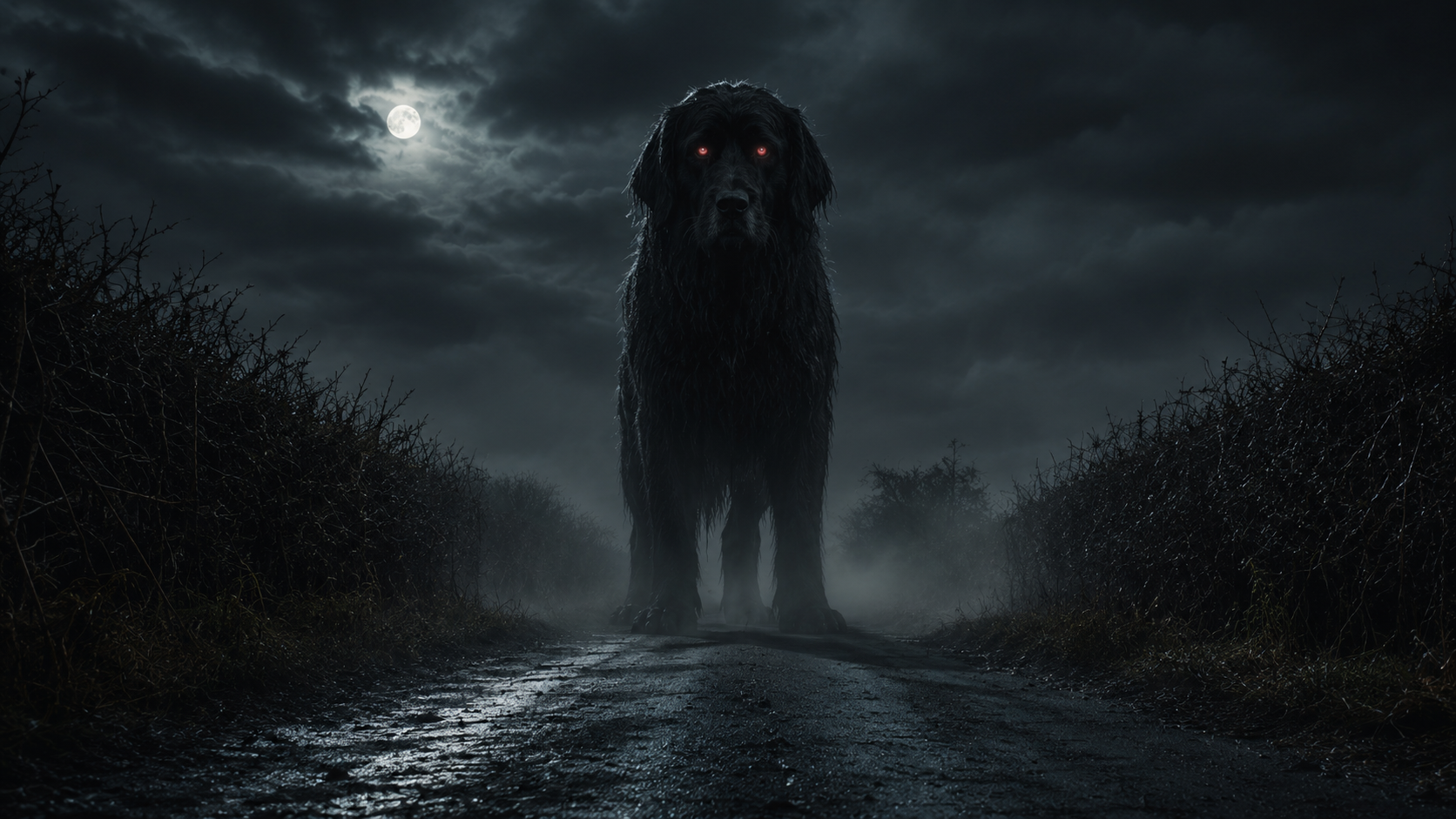
There’s a creature that made the Atlantic crossing intact.
Folklore does not travel unchanged. Stories brought by immigrants met new landscapes, new neighbors, and new conditions; they were retold, translated, and sometimes folded into local traditions. Any account of that process needs care, especially where it touches distinct Indigenous traditions that should not be treated as a single backdrop for settler folklore.
Black-dog stories are one recurring example: familiar British and Irish motifs appear in later North American storytelling, alongside local variations that deserve to be read on their own terms.
It arrived in Appalachia looking exactly the way it had looked in Suffolk and Yorkshire and Wales. Large. Black. Eyes that were either red or yellow depending on the account, but always luminous. Moving silently on roads and lane-edges, appearing at crossroads and bridges, and meaning exactly one thing.
Death is coming for someone you know.
The British Originals
The Black Dog tradition in Britain is ancient enough that establishing a single origin is probably impossible. What exists instead is a family of related regional beliefs, each with their own name and specific behavior, all sharing the central omen function.
Black Shuck haunts the coastal areas of East Anglia. His name derives from the Old English scucca, meaning “demon” or “shadow creature.” He is enormous — descriptions range from the size of a calf to the size of a horse — and his appearances are concentrated on the lanes and shorelines of Norfolk and Suffolk. A detailed historical record of his appearance exists: on August 4, 1577, Black Shuck is said to have entered the churches at Bungay and Blythburgh during a violent thunderstorm, killing several people and leaving scorch marks on the church door at Blythburgh that are still visible.
The scorch marks are genuinely there. They predate the legend’s first recorded appearance in print. I find this detail persistently interesting.
The Grim is a variant that specifically haunts churchyards. In British tradition, the first person buried in a new churchyard would be obliged to haunt it and protect it from the devil — and a dog buried there in their place (a documented historical practice) would become the Grim instead. The Grim appears to those about to die. It does not cause the death. It announces it.
In Wales, the Cwn Annwn — the Hounds of Annwn — are a pack rather than a single creature, the spectral hunting dogs of the underworld deity Arawn. Their appearance heralds death on a larger scale. In Devon, the Yeth Hounds perform the same function, sometimes ridden by headless horsemen for added context.
The family resemblance is consistent across all of them: large, black, supernatural, ominous. Not evil in the conventional sense. Present.
The Appalachian Persistence
What’s remarkable about the Black Dog tradition in Appalachia is how completely it survived the transplant.
Stories of spectral dogs appear in many North American regions, including parts of Appalachia. Some share details with British black-dog traditions—roads at night, crossroads, luminous eyes, and an encounter that feels ominous—while other versions differ in meaning and origin. A family resemblance is not proof of one uninterrupted tradition; oral stories change with every community that keeps them alive.
In these accounts, the dog may accompany a traveler briefly, vanish, or be remembered as an omen after a loss. That retrospective connection is part of the folklore’s power, not a documented prediction.
What I find genuinely interesting is that the Appalachian Black Dog almost never represents the traveler’s own death. It’s almost always a harbinger of death nearby. The creature is telling you something about someone else. It chose to show you. The question of why you were chosen is one the tradition doesn’t answer, which is part of what keeps it uncomfortable.
The Dog That Watches
There are two types of death-omen traditions in folklore, roughly speaking. The type that comes as an announcement — the banshee’s wail, the three knocks — and the type that comes as a witness.
The Black Dog is a witness. It doesn’t perform grief. It doesn’t make noise. It simply appears and looks at you, with those luminous eyes, from the shoulder of the road.
This is more disturbing than the announcement type, and I think it’s worth understanding why. The announcement implies a kind of relationship between the omen and the bereaved — you were specifically called to, warned, given information. The witness implies something different: that the death was already in motion, and something came to observe it, and you happened to be there.
The witness doesn’t care about you. The witness is watching something you can’t see yet.
Why the Crossing Mattered
Most folklore scholars identify the Black Dog as one of the most geographically distributed supernatural traditions in Europe, appearing in some form across almost every regional tradition from Scandinavia through the British Isles and into the Iberian Peninsula. This distribution suggests the tradition is old enough that the individual national versions are regional expressions of a single archetype, not independent inventions.
The fact that it survived the crossing to Appalachia intact, in communities that were otherwise highly adaptive with their imported folklore, suggests something specific about the Black Dog: it was too useful to change. Communities under stress need a way to talk about death’s approach. A creature that observes, that witnesses, that appears on the road between where you are and where the dead are going — that is a useful symbolic technology. It survived because it was doing real cultural work.
It’s still doing it. Appalachian Black Dog accounts are still collected regularly in contemporary folklorist interviews. The creature hasn’t retired.
If you’re driving the mountain roads after dark, keep your eyes on the roadside.
If you see something large and black looking at you from the shoulder with luminous eyes, keep driving.
And when you get home, call the people you love.
Folklore deep dives like this one go into the research that feeds my fiction. If you want the stories themselves: There Be Monsters: Then and Now.
For weekly folklore, dark tourism, and new horror fiction: join the Grimbard list.