
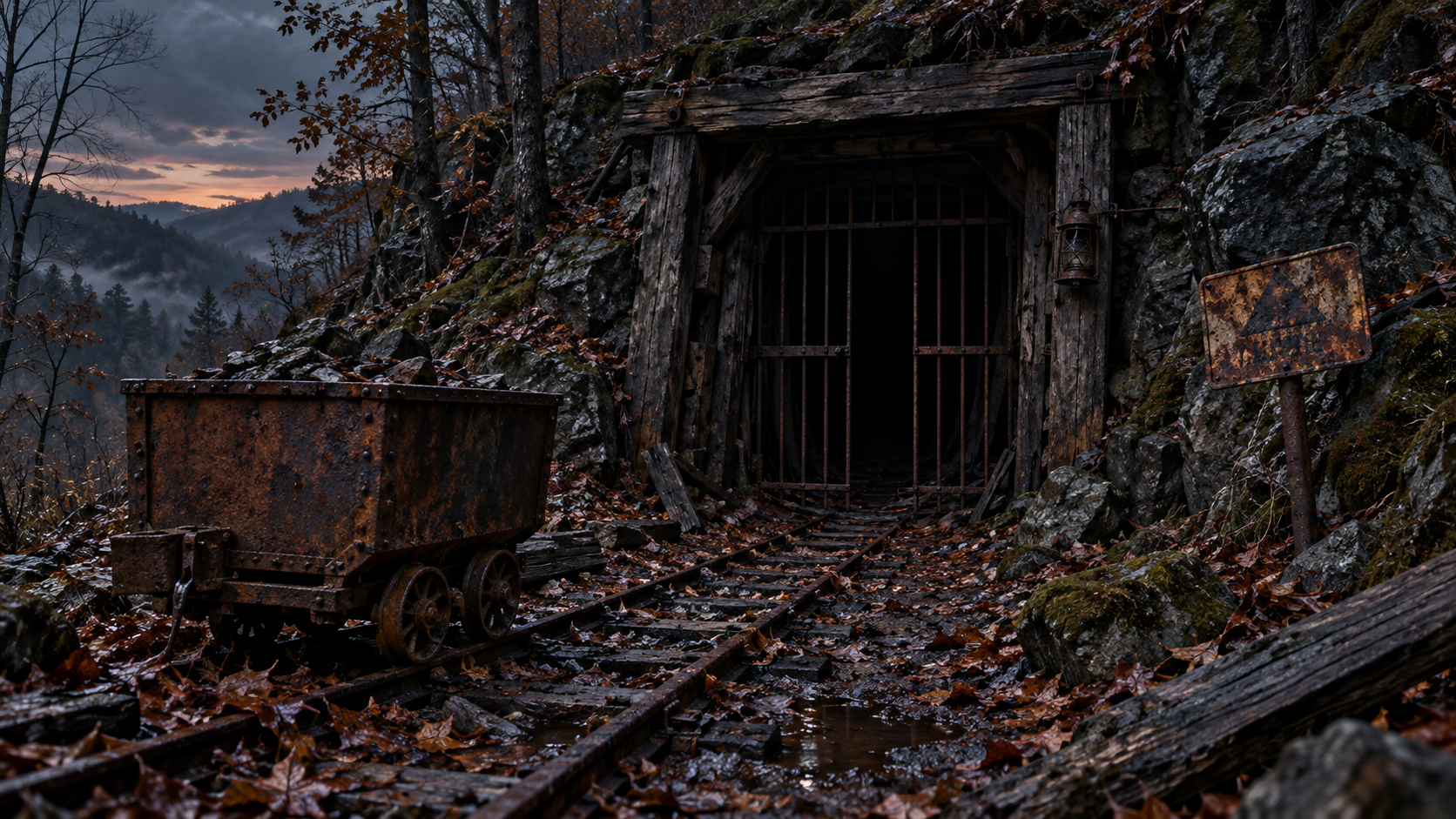
Abandoned mines are scary because they combine a built environment with a landscape that does not forgive mistakes. A mine has tunnels, ladders, rails, shafts, tools, and evidence of human labor—but the people are gone. Underground, the usual safeguards of distance, daylight, and an easy exit disappear. The horror is not just claustrophobia. It is the sense of entering a machine that has been left running in the dark.
There is a practical reason to keep that feeling at the mouth of the tunnel. The National Park Service warns that abandoned mine lands can contain unstable openings, hidden shafts, bad air, falling rock, and contaminated materials. Do not enter one for photographs, exploration, or a story. The most convincing mine horror begins with that fact: some places are frightening because they are genuinely unsafe.
A mine is an industrial labyrinth, not a cave
People often group mines and caves together because both are underground. The difference matters. A cave suggests geology: chambers, water, stone, and a landscape formed on a timescale too large to care about us. A mine suggests intention. Someone cut, blasted, reinforced, measured, and marked the route. Someone expected a shift to begin and end.
That intention makes abandonment feel personal. A rail disappears around a bend. A timber support stands where a hand placed it decades ago. A rusting lunch pail, if it exists, is not evidence of a ghost; it is evidence of a worker who expected to come back. The mine becomes a record of labor interrupted.
Our earlier article on why caves are so scary looks at darkness, confinement, and disorientation in natural spaces. An abandoned mine uses those same pressures, then adds industrial memory: schedules, machinery, ownership, accidents, and the uneasy knowledge that extraction always leaves something behind.
Real hazards make the imagined ones stronger
Horror works best in a mine when it does not wave away reality. The dangers are specific enough on their own.
– Unstable ground and supports: timbers decay, roofs collapse, and openings may be concealed by vegetation or debris. – Vertical shafts: a level-looking floor can give way to a drop that cannot be seen in poor light. – Bad air: oxygen can be low, and gases can collect in confined spaces. – Water and contamination: flooded workings, drainage, and mine waste can be hazardous. – No reliable wayfinding: a wrong turn underground is not merely inconvenient when exits, signals, and visibility are limited.
The NPS’s safety guidance is worth reading because it strips away the romance. A mine is not an abandoned amusement park with better scenery. It was a working industrial site, and its risks do not retire when the company does.
That realism gives writers a useful discipline. Instead of adding a monster immediately, begin with the conditions that make a person hesitate: a map that ends at a sealed level, a radio that cannot reach the surface, footprints where dust should be undisturbed. The impossible becomes more effective when the possible is already bad enough.
Why the silence feels wrong
An active mine has noise: ventilation, water, engines, warning signals, boots, metal, voices. An abandoned one leaves the structures of that noise behind. Pipes remain. Doors remain. Cable may still trace a wall. The absence becomes audible.
This is a different silence from a forest’s silence. A forest has birds, weather, insects, and the expectation of change. A mine can feel as though it has been sealed off from time. A drip repeats. A loose chain touches a wall. The sound has no obvious distance because darkness gives the ear nowhere to put it.
Industrial horror often draws power from that imbalance: the place still appears to have a job, but there is no one assigned to do it. The conveyor has stopped. The shift board is empty. The rulebook remains, and nobody is alive enough to enforce it.
Abandonment turns a workplace into evidence
We tend to read abandoned places as stories. A boarded-up house asks who left. An abandoned hospital asks what failed. An abandoned mine asks a sharper question: what did this place take, and what did it cost?
Mining communities contain labor history, pride, injury, grief, and environmental consequence. Treating every mine as a generic haunted tunnel flattens that history. A stronger story starts with specificity. What mineral was extracted? Was the site a company town? Which landscape was altered? Who was expected to descend, and who was allowed to own the result?
That attention also keeps a writer from borrowing suffering as scenery. The mine does not need a sensationalized disaster to carry dread. A schedule, a rusted tag, and a blocked escape route can imply an entire institutional world.
The mine and the abandoned amusement park share one fear
There is a useful comparison with why abandoned amusement parks are scary. Both settings are designed systems that have lost their intended audience. A carnival ride without riders feels wrong because its function is pleasure. A mine without workers feels wrong because its function is labor.
But a mine has less room for play. Its corridors were never built for wandering. The visitor is not simply outside the story; they are using the place against its design. That is why an old rail line or ventilation door can feel more ominous than a cave wall. It implies rules you do not know and an exit that may not belong to you.
If underground horror is your route in
If you like stories where isolation, pressure, and unseen depth do most of the work, There Be Monsters: Deep Down is the book route built for that descent. It is not a safety guide or a claim about real mines. It is a fiction shelf for readers who know that the dark below ground has its own weather.
For another way into evidence-minded horror, join The Grimbard Press for Dead Ship, the free illustrated Subscriber Archive Edition.
Frequently asked questions
Why do abandoned mines feel scarier than caves?
Mines add human intention to underground darkness. Their rails, supports, shafts, and machinery suggest labor interrupted, while their industrial layout can create hazards and confusing routes that natural caves do not share in the same way.
Is it safe to explore an abandoned mine?
No. Do not enter abandoned mine workings. Government safety guidance warns of hidden shafts, unstable structures, bad air, water, and contamination. View them only from permitted, safe areas or through guided, authorized interpretation.
What makes a mine a good horror setting?
A mine combines confinement, uncertain navigation, industrial history, real danger, and the unnerving absence of the people who built it. Good mine horror respects those realities instead of treating the setting as a generic tunnel.
Are all abandoned mines underground?
No. Mining landscapes can include open pits, waste piles, structures, rail lines, and drainage features. All may have hazards, even where no tunnel is visible.
The tunnel was never meant for you
An abandoned mine frightens because it is not empty in the comforting sense. It is full of purpose: routes, supports, rules, and risks left in place after the people who understood them have gone. The dark does not have to hide a creature. It only has to keep you from seeing which part of the machine still remembers how to work.
