
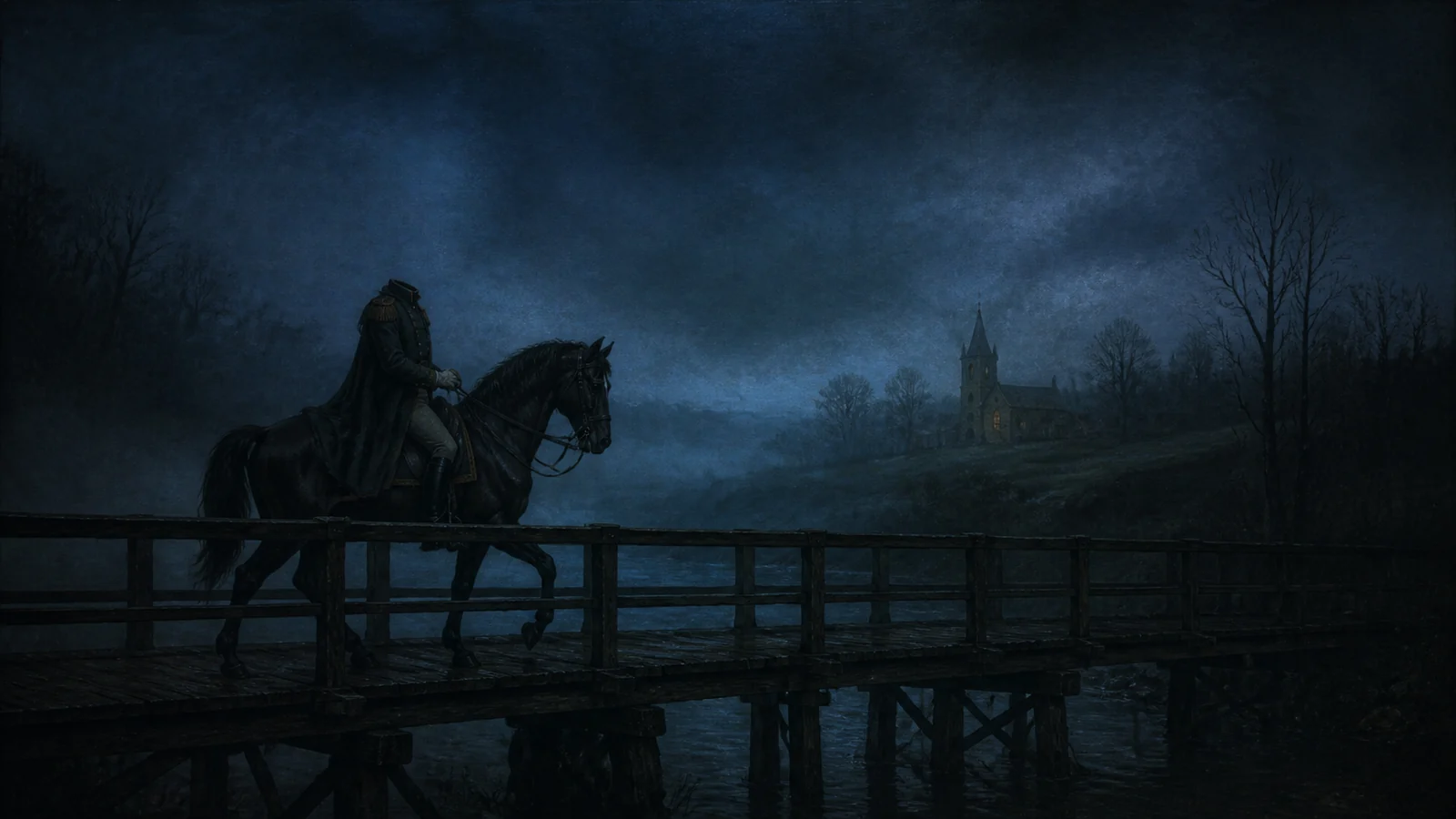
The Horseman did not begin with a flaming pumpkin.
He began with a missing head, a road through the Hudson Valley, a dead soldier borrowed by local memory, and a storyteller who never tells us whether the ghost arrived at all.
The best-known Headless Horseman comes from Washington Irving's “The Legend of Sleepy Hollow,” published in 1820. Irving describes the rider as the ghost of a Hessian soldier killed by a cannonball during the American Revolution. The figure also draws on older European traditions of headless riders and on Hudson Valley places and stories. Most importantly, Irving leaves open a practical explanation: Brom Bones may have disguised himself and chased Ichabod Crane with a pumpkin.
The monster popular culture remembers is literal.
Irving's is a question on horseback.
Who is the Headless Horseman in “The Legend of Sleepy Hollow”?
Sleepy Hollow's residents tell of a mounted Hessian whose head was carried away by a cannonball during “some nameless battle” of the Revolution. His body was buried in the churchyard. At night, he rides out in search of the missing head and must return before daybreak.
That is the local explanation.
The story reaches us through Washington Irving's layered narrator, Diedrich Knickerbocker, who collects community history, hearsay, jokes, and superstition without promising that every item belongs in the same file. Ichabod Crane then enters the Hollow already eager to believe frightening stories.
Ichabod is a schoolmaster, outsider, singer, reader, and opportunistic suitor. He wants Katrina Van Tassel and imagines the abundance of her father's farm becoming his. His rival, Brom Van Brunt—Brom Bones—is local, confident, physically capable, and known for practical jokes.
After a party at the Van Tassel farm, Ichabod rides home alone. The stories he heard earlier alter the road. A tree becomes dangerous because someone named its history. The churchyard becomes the Horseman's route. A dark mounted figure appears and pursues him toward the bridge.
The rider throws his “head.” Ichabod is struck. By morning, he is gone.
His hat lies near a shattered pumpkin.
Was the Horseman a real Hessian soldier?
Hessian soldiers were real. The term commonly refers to German troops hired by the British during the American Revolution, many from the state of Hesse-Cassel. They fought in campaigns across the colonies, including New York.
Irving's story uses that history. It does not identify a verifiable individual.
The headless soldier belongs to a landscape carrying the remains and memory of war. Roads, trees, farms, and churchyards are not empty background. They preserve stories about violence that newcomers do not fully understand.
The Smithsonian's account of the real places behind the story notes the Hudson Valley setting, the Old Dutch Church, and nearby Revolutionary history. The tale draws geography tightly enough that readers can still visit places associated with it.
That makes the rider historically grounded.
It does not make him a documented ghost.
Claims that one named soldier “was” the Headless Horseman should be treated cautiously unless supported by a clear chain of evidence from Irving or contemporary records. A candidate discovered after a character becomes famous is not automatically the source of the character.
What does Hessian mean in the story?
The Horseman is not simply a random dead soldier. To Irving's early American readers, a Hessian belonged to a recent war and to a force hired by Britain.
He is foreign and local at once.
His body lies in American ground, but his missing head leaves him incomplete. He rides through a Dutch-descended community remembered by an American author. The figure brings European warfare, colonial history, and local storytelling together in one body that cannot stay buried.
The missing head also removes speech and identity. A named dead man can be mourned. A headless uniform becomes a role that any rumor can occupy.
The Black Dog changed as stories crossed the Atlantic. The Horseman makes a related crossing. Old-world supernatural forms enter a new-world landscape carrying a recent American wound.
Did Washington Irving invent the Headless Horseman?
Irving created the version that became central to American popular culture. He did not invent the idea of a headless rider from nothing.
European folklore and literature contained headless revenants, spectral hunts, and riders before “Sleepy Hollow.” Scholars have also discussed the influence of Sir Walter Scott, whom Irving read and knew. Scott's work helped preserve and literary-shape supernatural material from Britain and Europe.
The responsible answer avoids a single-source trick.
Stories are rarely built like patent applications. Irving could draw on literary reading, oral tales, local landmarks, Revolutionary memory, and the needs of his own comic ghost story at the same time.
| Ingredient | What it contributes |
|---|---|
| Older headless-rider traditions | A supernatural form already recognizable to audiences |
| Revolutionary history | A recent conflict capable of leaving an unnamed dead soldier |
| Hudson Valley geography | The churchyard, bridge, roads, farms, and enclosed Hollow |
| Dutch community storytelling | A local culture through which history becomes legend |
| Brom Bones | A rational suspect with motive, skill, and a taste for pranks |
| Irving's narration | Enough distance and irony to keep every explanation unstable |
No ingredient works alone.
Why Sleepy Hollow?
Irving first visited the Tarrytown area as a teenager in 1798 while his family sought distance from yellow fever in New York City. A Smithsonian history connects that experience to the story's language of atmosphere and contagion.
Irving's Hollow does not merely contain supernatural beliefs. It produces them. The place seems to place residents and visitors under a “drowsy, dreamy influence.” Tales circulate until a newcomer begins to see the road through them.
Ichabod is especially vulnerable because he enjoys frightening material. He feeds on local stories, then pays for them during the ride home. Every landmark has been preloaded with a threat.
This is how monsters become guardians of boundaries. The Horseman belongs to a line between local and outsider, past and present, churchyard and road, story and evidence.
Ichabod crosses all of them after dark.
Follow the old road into the Archive: Join The Grimbard Press and receive Dead Ship, a free illustrated Subscriber Archive Edition.

Did the Headless Horseman carry a pumpkin?
This is the detail popular memory repairs too neatly.
In Irving's story, the pursuing figure appears to carry its head on the saddle. During the chase, it rises in the stirrups and throws the head at Ichabod. The next morning, searchers find Ichabod's hat and a shattered pumpkin.
The pumpkin is evidence for the prank explanation.
Irving does not present the rider cruising through Sleepy Hollow with a flaming jack-o'-lantern installed where a head should be. Later illustration, seasonal imagery, animation, film, and Halloween culture fused the pumpkin with the body until it became the monster's face.
That change improves the silhouette. A pumpkin head is visible, marketable, and instantly seasonal. Ambiguity is more difficult to place on a poster.
The adaptation replaces evidence with anatomy.
Did Brom Bones chase Ichabod?
Probably is not the same as proven.
Brom has motive. He wants Katrina. He has the horsemanship to perform the chase. He is known for jokes. After Ichabod disappears, Brom reportedly looks especially knowing whenever the pumpkin is mentioned.
The rational explanation fits.
But Irving does not close the case. Reports later place Ichabod alive elsewhere, having left the region and entered another career. The old women of the neighborhood maintain that he was carried away supernaturally. The schoolhouse becomes haunted by his voice.
Even if Brom staged the Horseman, the community continues producing ghosts.
That is the deeper joke. Solving the chase does not cure Sleepy Hollow of storytelling.
Why the Horseman survives adaptation
The figure has three durable advantages.
First, he is recognizable without a face. Horse, cloak, sword, missing head: the silhouette survives radical changes in costume and period.
Second, he is always moving. Many ghosts wait in a room. The Horseman pursues. His legend arrives with a built-in sequence: sighting, recognition, race, bridge, thrown object.
Third, he contains both answers. He can be a murdered soldier unable to rest or a living rival using local belief as a weapon.
Adaptations often choose the literal monster because action requires a visible opponent. Irving's story remains stronger for refusing to choose completely.
The Horseman is frightening.
The possibility that a man built the Horseman out of a frightened person's favorite stories is frightening in another direction.
Story versus popular image
| In Irving's 1820 tale | In common later imagery |
|---|---|
| A Hessian ghost from the Revolution | Often a timeless demonic rider |
| A carried “head” that leaves a smashed pumpkin | A flaming jack-o'-lantern permanently replaces the head |
| A chase that may be Brom Bones's prank | A visibly supernatural attack |
| No Halloween setting | Strongly associated with Halloween |
| An ambiguous disappearance | Often a confirmed killing or supernatural abduction |
The later Horseman is not wrong as adaptation.
It is a different creature.
Frequently asked questions
Is the Headless Horseman based on a true story?
The character is grounded in real Revolutionary history, real Hessian troops, Hudson Valley places, and older supernatural traditions. No single historical soldier has been proven to be Irving's ghost.
When was “The Legend of Sleepy Hollow” published?
It first appeared in 1820 as part of Washington Irving's The Sketch Book of Geoffrey Crayon, Gent.
Is Sleepy Hollow a real place?
Yes. The story is associated with the Tarrytown area of New York's Hudson Valley. North Tarrytown officially adopted the name Sleepy Hollow in 1996, and landmarks connected with Irving and the tale remain.
Did the Horseman have a pumpkin head in the original?
No. The rider appears to carry a head, and a shattered pumpkin is found after the chase. Irving leaves the pumpkin as evidence that a human prank may explain the encounter.
Was Brom Bones the Headless Horseman?
The story strongly suggests that possibility but never confirms it outright. Brom has motive and ability, and his reaction to the pumpkin is suspicious.
Is the story set on Halloween?
No. Irving does not set the tale on Halloween. Later culture attached the Horseman closely to the holiday.
Keep riding through the Archive
There Be Monsters: Then and Now follows old warnings into the new landscapes and audiences that keep changing them. The Headless Horseman survives because every generation gives him the head it needs.
Explore the collection or join The Grimbard Press and receive Dead Ship free.
Sources and further reading
- Washington Irving, The Legend of Sleepy Hollow; and Other Essays, digitized by the Library of Congress.
- Elizabeth L. Bradley, “What ‘The Legend of Sleepy Hollow’ Tells Us About Contagion, Fear and Epidemics”, Smithsonian Magazine, 2014.
- “Real Places Behind Famously Frightening Stories”, Smithsonian Magazine, 2009.
- “The Legend of Sleepy Hollow,” Library of Congress digitized 1864 edition.
Comments
One response to “The Headless Horseman: Origins of the Legend Behind Sleepy Hollow”
[…] is why he belongs beside the Headless Horseman, though their landscapes differ. Both figures turn travel into an encounter with a story that […]