Tag: American folklore

  • 13 American Folklore Monsters Beyond Bigfoot

    13 American Folklore Monsters Beyond Bigfoot

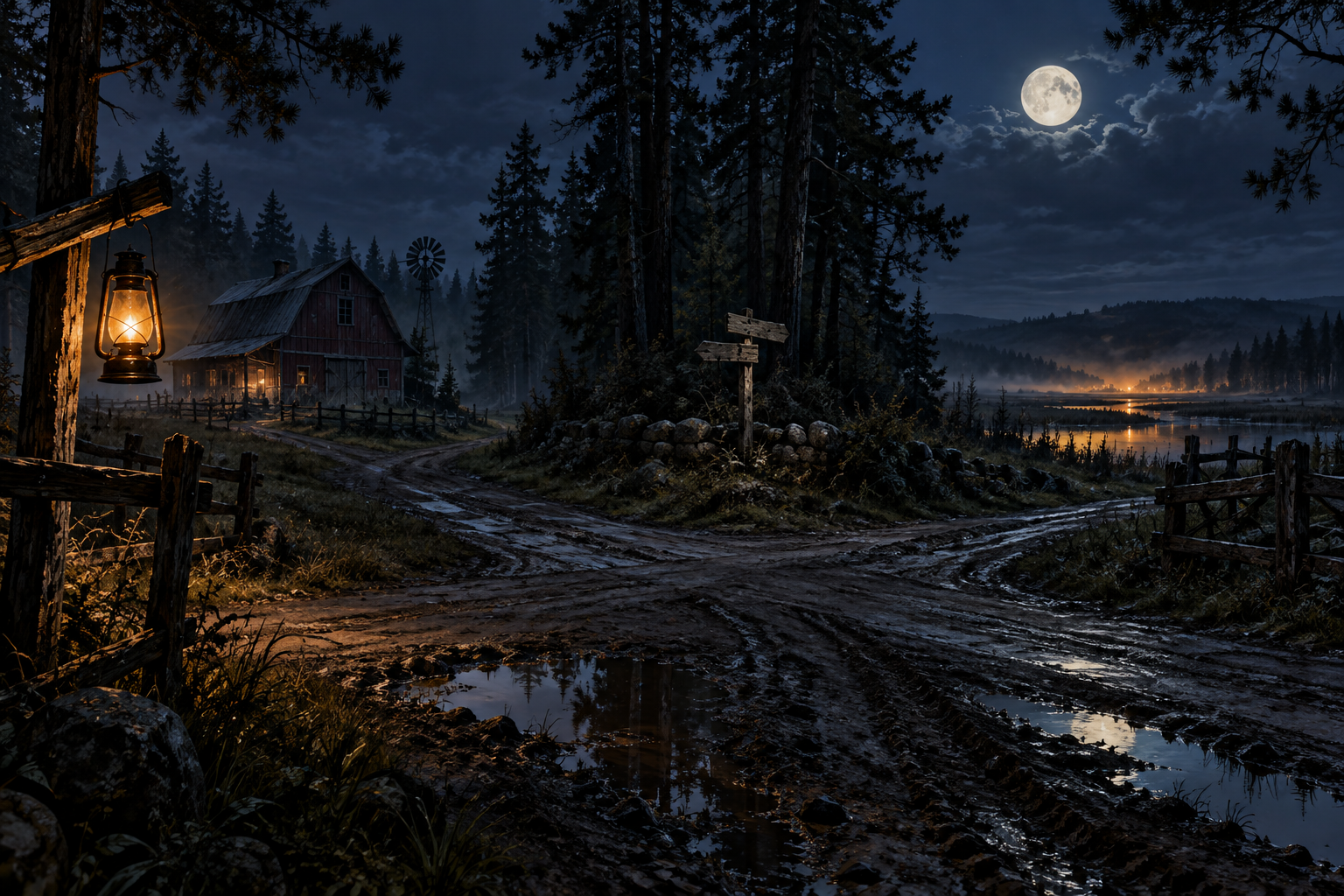
    A moonlit crossroads between pine woods and marsh, with hints of regional American monster tales

    An American folklore monsters list quickly becomes a map of different kinds of storytelling: something in a New Jersey pine barren, a creature reported off the Massachusetts coast, a lumber-camp exaggeration that grew teeth in print. Bigfoot dominates the souvenir shop, but it is only one branch of a much stranger family tree.

    The useful question is not whether every creature was “real.” Folklore records how communities explain danger, landscape, work, migration, and the pleasure of being frightened together. Some of the figures below are old regional tales; others are modern cryptids or deliberate tall-tale inventions. Keeping those categories distinct makes the stories better, not less magical.

    A quick guide to reading monster lore

    An old story is not automatically an ancient one. A newspaper may be the earliest surviving evidence, not the origin. A creature’s name may have been attached to a place long after the underlying warning existed. And a modern legend can still be meaningful without pretending it came from colonial America.

    Here are thirteen places to start.

    1. The Jersey Devil — New Jersey Pine Barrens

    The Jersey Devil is the region’s great shape-shifter: commonly described with wings, hooves, a horse-like head, or an inhuman cry. Later versions connect it to the Leeds family, but the legend has changed repeatedly through pamphlets, newspapers, civic rivalry, tourism, and horror culture. The Pine Barrens matter as much as the creature: a vast, sandy landscape can make a night sound travel farther than it should.

    For a fictional route through that terrain, see The Pine Barrens Incident.

    2. The Hodag — Rhinelander, Wisconsin

    The hodag is one of the most entertaining American examples of a monster becoming local identity. A black, horned, spined beast was promoted in nineteenth-century Wisconsin by Eugene Simeon Shepard, who staged photographs and a captured specimen. It is not an ancient woodland being, but a superb lesson in how a hoax can become folklore when a town adopts it with affection.

    3. The Wampus Cat — Appalachia and the Southeast

    “Wampus cat” has been used for different large-cat and boogeyman stories across the American South and Appalachia. That variety is the point: the name travels. It can mean an animal at the edge of the porch light, a warning for children, or a creature given a later fixed origin by retellings. Avoid reducing its many regional uses to one neat, supposedly authoritative myth.

    4. The Snallygaster — Maryland

    The snallygaster’s name is often connected to German-speaking settlers in Maryland, though the monster as most people know it was amplified through nineteenth-century newspaper stories. It was said to swoop down on livestock and people. The legend demonstrates the productive collision of immigrant language, local landscape, and newspaper spectacle.

    5. The Snallygaster — Maryland

    The snallygaster is a winged creature of Maryland lore whose reported shape has changed as stories passed through newspapers and local telling. The Library of Congress traces an especially important complication: versions of the legend were exploited for racist voter suppression. That history should be named, not turned into a harmless bit of monster trivia. The creature shows how a legend can be both an entertaining regional symbol and a tool used by real people for harm.

    An archival-style illustrated map of American monster regions

    6. The Hidebehind — North American logging lore

    The hidebehind is said to stay just out of sight behind the trunk you are about to inspect. It is an elegant forest monster because its rule is visual: you never see it directly. Whether invented for lumber-camp storytelling or adopted from older oral patterns, it turns a real workplace hazard—being alone in dense woods—into a creature with perfect tactics.

    7. The Squonk — Pennsylvania

    The squonk is the melancholy member of the lumberjack bestiary, a creature so ashamed of its appearance that it weeps constantly. Stories say it can dissolve into tears when captured. It is comic, but its endurance shows that monster lore does not always operate through aggression. Sometimes a region preserves a creature because it is odd, tender, and impossible to forget.

    8. The Mothman — Point Pleasant, West Virginia

    The Mothman reports of the 1960s belong to modern legend rather than old folk belief. Witnesses described a winged, red-eyed figure before the Silver Bridge collapse, and later writers assembled those reports into a larger omen narrative. Treat the tragedy and the witnesses with care: the creature’s cultural life is real, while claims of supernatural causation remain claims.

    9. The Flatwoods Monster — West Virginia

    In 1952, residents near Flatwoods reported a frightening figure after seeing an object cross the sky. Explanations have ranged from an owl and misperception to extraterrestrial encounter. Whatever happened, the episode shows how quickly a shared night, unusual light, local testimony, and national anxieties can become a durable monster.

    10. The Loveland Frog — Ohio

    The Loveland Frog is a modern roadside cryptid associated with Ohio reports of a large, upright frog-like figure. It belongs to a broad family of “the thing seen near a road at night” legends. Those stories work because a car gives a witness speed but not certainty: the sight is gone before the mind can arrange it.

    11. The Beast of Bladenboro — North Carolina

    In 1954, reports of animal attacks around Bladenboro drew press attention and a wave of hunting. The “beast” became larger and more mysterious in retelling. The historical record is a useful reminder that predation, fear, headlines, and community attention often enlarge one another.

    12. The Gloucester sea serpent — Massachusetts

    Nineteenth-century observers reported a long, sinuous creature off the Massachusetts coast, and the reports became a lively argument about what witnesses had seen. The Library of Congress recounts how sea-serpent reports intersected with a period when people hoped science might identify unfamiliar animals. Here the monster is also an information problem: a surface glimpse of an animal in moving water can resist confident identification.

    13. The sidehill gouger — lumber-camp tall tales

    The sidehill gouger is said to have legs shorter on one side, making it perfectly adapted to circle steep hills but hopeless on level ground. It belongs to the “fearsome critters” invented and retold around North American lumber camps. The joke is wonderfully practical: a strange slope becomes a creature’s entire anatomy. Like the hidebehind and squonk, it reminds us that a monster need not be solemn to be memorable. Workers could use absurdity to entertain one another and make an unfamiliar landscape feel narratable.

    A lantern at the edge of a deserted lumber camp in dark woods

    Folklore, fakelore, and cryptids are not enemies

    “Fakelore” describes traditions presented as old or authentic when their origins are known to be recent or manufactured. That does not mean they are worthless. The hodag is still meaningful to Rhinelander. A modern cryptid can still shape a town’s imagination. The key is honesty: say what is documented, say what is later, and let the story earn its own strangeness.

    For more regional dossiers, explore the Lost Boundary Archive and the broader There Be Monsters series.

    Frequently asked questions

    What is the most famous American folklore monster after Bigfoot?

    The Jersey Devil is among the best known because its legend has remained strongly tied to a specific region, the New Jersey Pine Barrens, while continually changing through print and popular culture.

    Are cryptids the same as folklore monsters?

    Not exactly. A cryptid is generally proposed as an undiscovered animal, while folklore monsters may be supernatural, symbolic, comic, or openly invented. The categories overlap in modern storytelling.

    Why did lumber camps invent so many monsters?

    Camp stories entertained workers, explained the strangeness of unfamiliar woods, and turned dangerous or lonely work into shared lore.

    Want one original warning for every night of October? October 31 is available on Amazon. For new lore, story announcements, and the free illustrated Dead Ship, join The Grimbard Press.

    Sources and further reading

    • Library of Congress: American cryptids and how their stories spread

    • Library of Congress: the great American sea serpent

    • Contemporary and archival reporting on Point Pleasant, Flatwoods, and Bladenboro; distinguish reports from supernatural conclusions
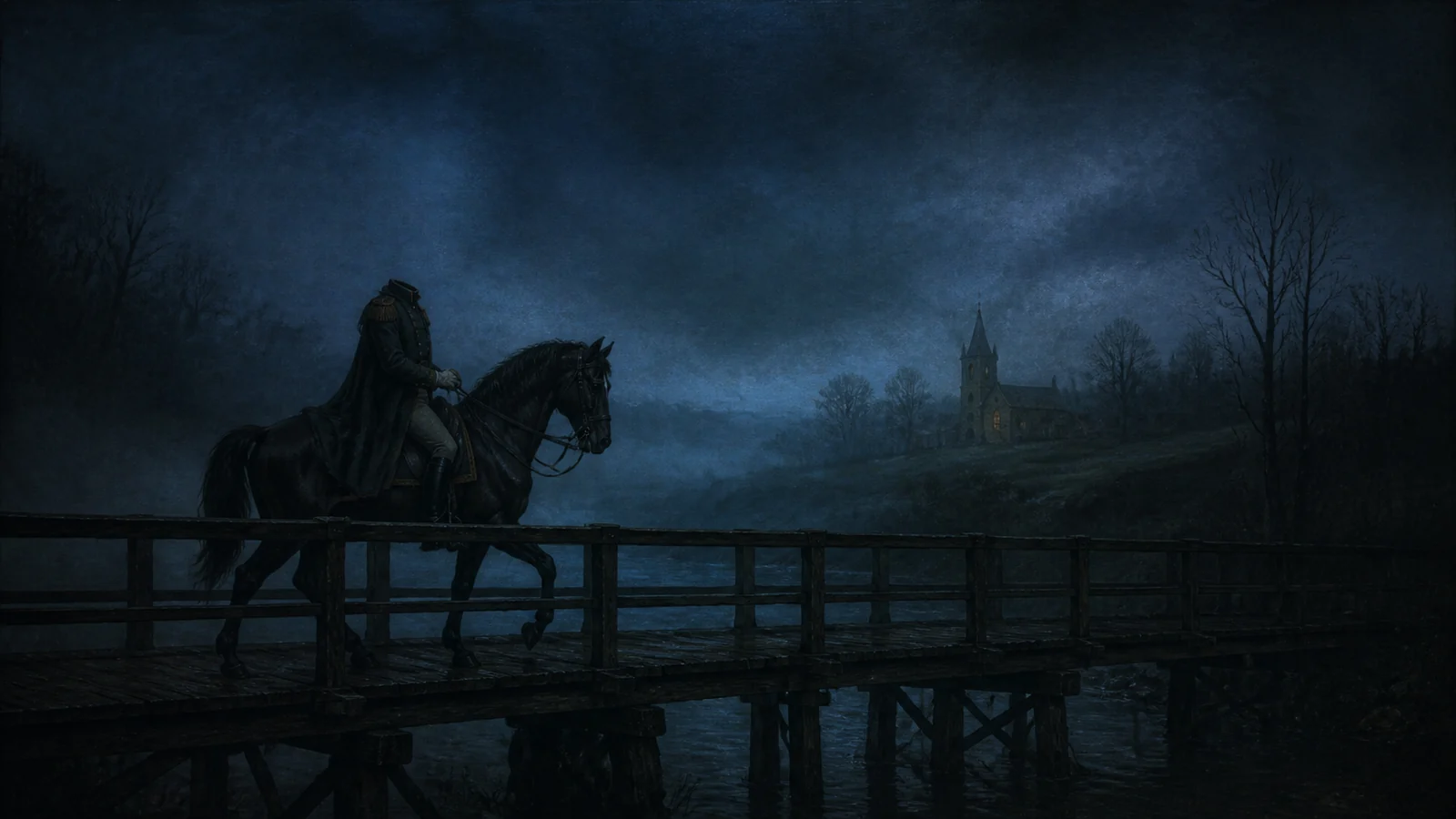
  • The Headless Horseman: Origins of the Legend Behind Sleepy Hollow

    The Headless Horseman: Origins of the Legend Behind Sleepy Hollow

    The Horseman did not begin with a flaming pumpkin.

    He began with a missing head, a road through the Hudson Valley, a dead soldier borrowed by local memory, and a storyteller who never tells us whether the ghost arrived at all.

    The best-known Headless Horseman comes from Washington Irving's “The Legend of Sleepy Hollow,” published in 1820. Irving describes the rider as the ghost of a Hessian soldier killed by a cannonball during the American Revolution. The figure also draws on older European traditions of headless riders and on Hudson Valley places and stories. Most importantly, Irving leaves open a practical explanation: Brom Bones may have disguised himself and chased Ichabod Crane with a pumpkin.

    The monster popular culture remembers is literal.

    Irving's is a question on horseback.

    Who is the Headless Horseman in “The Legend of Sleepy Hollow”?

    Sleepy Hollow's residents tell of a mounted Hessian whose head was carried away by a cannonball during “some nameless battle” of the Revolution. His body was buried in the churchyard. At night, he rides out in search of the missing head and must return before daybreak.

    That is the local explanation.

    The story reaches us through Washington Irving's layered narrator, Diedrich Knickerbocker, who collects community history, hearsay, jokes, and superstition without promising that every item belongs in the same file. Ichabod Crane then enters the Hollow already eager to believe frightening stories.

    Ichabod is a schoolmaster, outsider, singer, reader, and opportunistic suitor. He wants Katrina Van Tassel and imagines the abundance of her father's farm becoming his. His rival, Brom Van Brunt—Brom Bones—is local, confident, physically capable, and known for practical jokes.

    After a party at the Van Tassel farm, Ichabod rides home alone. The stories he heard earlier alter the road. A tree becomes dangerous because someone named its history. The churchyard becomes the Horseman's route. A dark mounted figure appears and pursues him toward the bridge.

    The rider throws his “head.” Ichabod is struck. By morning, he is gone.

    His hat lies near a shattered pumpkin.

    Was the Horseman a real Hessian soldier?

    Hessian soldiers were real. The term commonly refers to German troops hired by the British during the American Revolution, many from the state of Hesse-Cassel. They fought in campaigns across the colonies, including New York.

    Irving's story uses that history. It does not identify a verifiable individual.

    The headless soldier belongs to a landscape carrying the remains and memory of war. Roads, trees, farms, and churchyards are not empty background. They preserve stories about violence that newcomers do not fully understand.

    The Smithsonian's account of the real places behind the story notes the Hudson Valley setting, the Old Dutch Church, and nearby Revolutionary history. The tale draws geography tightly enough that readers can still visit places associated with it.

    That makes the rider historically grounded.

    It does not make him a documented ghost.

    Claims that one named soldier “was” the Headless Horseman should be treated cautiously unless supported by a clear chain of evidence from Irving or contemporary records. A candidate discovered after a character becomes famous is not automatically the source of the character.

    What does Hessian mean in the story?

    The Horseman is not simply a random dead soldier. To Irving's early American readers, a Hessian belonged to a recent war and to a force hired by Britain.

    He is foreign and local at once.

    His body lies in American ground, but his missing head leaves him incomplete. He rides through a Dutch-descended community remembered by an American author. The figure brings European warfare, colonial history, and local storytelling together in one body that cannot stay buried.

    The missing head also removes speech and identity. A named dead man can be mourned. A headless uniform becomes a role that any rumor can occupy.

    The Black Dog changed as stories crossed the Atlantic. The Horseman makes a related crossing. Old-world supernatural forms enter a new-world landscape carrying a recent American wound.

    Did Washington Irving invent the Headless Horseman?

    Irving created the version that became central to American popular culture. He did not invent the idea of a headless rider from nothing.

    European folklore and literature contained headless revenants, spectral hunts, and riders before “Sleepy Hollow.” Scholars have also discussed the influence of Sir Walter Scott, whom Irving read and knew. Scott's work helped preserve and literary-shape supernatural material from Britain and Europe.

    The responsible answer avoids a single-source trick.

    Stories are rarely built like patent applications. Irving could draw on literary reading, oral tales, local landmarks, Revolutionary memory, and the needs of his own comic ghost story at the same time.

    Ingredient What it contributes
    Older headless-rider traditions A supernatural form already recognizable to audiences
    Revolutionary history A recent conflict capable of leaving an unnamed dead soldier
    Hudson Valley geography The churchyard, bridge, roads, farms, and enclosed Hollow
    Dutch community storytelling A local culture through which history becomes legend
    Brom Bones A rational suspect with motive, skill, and a taste for pranks
    Irving's narration Enough distance and irony to keep every explanation unstable

    No ingredient works alone.

    Why Sleepy Hollow?

    Irving first visited the Tarrytown area as a teenager in 1798 while his family sought distance from yellow fever in New York City. A Smithsonian history connects that experience to the story's language of atmosphere and contagion.

    Irving's Hollow does not merely contain supernatural beliefs. It produces them. The place seems to place residents and visitors under a “drowsy, dreamy influence.” Tales circulate until a newcomer begins to see the road through them.

    Ichabod is especially vulnerable because he enjoys frightening material. He feeds on local stories, then pays for them during the ride home. Every landmark has been preloaded with a threat.

    This is how monsters become guardians of boundaries. The Horseman belongs to a line between local and outsider, past and present, churchyard and road, story and evidence.

    Ichabod crosses all of them after dark.

    Follow the old road into the Archive: Join The Grimbard Press and receive Dead Ship, a free illustrated Subscriber Archive Edition.

    An illustrated arrangement of Revolutionary-era maps, a churchyard sketch, a hat, and a shattered pumpkin from the Sleepy Hollow story.
    Illustrated comparison of Irving's story ingredients; not a historical artifact.

    Did the Headless Horseman carry a pumpkin?

    This is the detail popular memory repairs too neatly.

    In Irving's story, the pursuing figure appears to carry its head on the saddle. During the chase, it rises in the stirrups and throws the head at Ichabod. The next morning, searchers find Ichabod's hat and a shattered pumpkin.

    The pumpkin is evidence for the prank explanation.

    Irving does not present the rider cruising through Sleepy Hollow with a flaming jack-o'-lantern installed where a head should be. Later illustration, seasonal imagery, animation, film, and Halloween culture fused the pumpkin with the body until it became the monster's face.

    That change improves the silhouette. A pumpkin head is visible, marketable, and instantly seasonal. Ambiguity is more difficult to place on a poster.

    The adaptation replaces evidence with anatomy.

    Did Brom Bones chase Ichabod?

    Probably is not the same as proven.

    Brom has motive. He wants Katrina. He has the horsemanship to perform the chase. He is known for jokes. After Ichabod disappears, Brom reportedly looks especially knowing whenever the pumpkin is mentioned.

    The rational explanation fits.

    But Irving does not close the case. Reports later place Ichabod alive elsewhere, having left the region and entered another career. The old women of the neighborhood maintain that he was carried away supernaturally. The schoolhouse becomes haunted by his voice.

    Even if Brom staged the Horseman, the community continues producing ghosts.

    That is the deeper joke. Solving the chase does not cure Sleepy Hollow of storytelling.

    Why the Horseman survives adaptation

    The figure has three durable advantages.

    First, he is recognizable without a face. Horse, cloak, sword, missing head: the silhouette survives radical changes in costume and period.

    Second, he is always moving. Many ghosts wait in a room. The Horseman pursues. His legend arrives with a built-in sequence: sighting, recognition, race, bridge, thrown object.

    Third, he contains both answers. He can be a murdered soldier unable to rest or a living rival using local belief as a weapon.

    Adaptations often choose the literal monster because action requires a visible opponent. Irving's story remains stronger for refusing to choose completely.

    The Horseman is frightening.

    The possibility that a man built the Horseman out of a frightened person's favorite stories is frightening in another direction.

    Story versus popular image

    In Irving's 1820 tale In common later imagery
    A Hessian ghost from the Revolution Often a timeless demonic rider
    A carried “head” that leaves a smashed pumpkin A flaming jack-o'-lantern permanently replaces the head
    A chase that may be Brom Bones's prank A visibly supernatural attack
    No Halloween setting Strongly associated with Halloween
    An ambiguous disappearance Often a confirmed killing or supernatural abduction

    The later Horseman is not wrong as adaptation.

    It is a different creature.

    Frequently asked questions

    Is the Headless Horseman based on a true story?

    The character is grounded in real Revolutionary history, real Hessian troops, Hudson Valley places, and older supernatural traditions. No single historical soldier has been proven to be Irving's ghost.

    When was “The Legend of Sleepy Hollow” published?

    It first appeared in 1820 as part of Washington Irving's The Sketch Book of Geoffrey Crayon, Gent.

    Is Sleepy Hollow a real place?

    Yes. The story is associated with the Tarrytown area of New York's Hudson Valley. North Tarrytown officially adopted the name Sleepy Hollow in 1996, and landmarks connected with Irving and the tale remain.

    Did the Horseman have a pumpkin head in the original?

    No. The rider appears to carry a head, and a shattered pumpkin is found after the chase. Irving leaves the pumpkin as evidence that a human prank may explain the encounter.

    Was Brom Bones the Headless Horseman?

    The story strongly suggests that possibility but never confirms it outright. Brom has motive and ability, and his reaction to the pumpkin is suspicious.

    Is the story set on Halloween?

    No. Irving does not set the tale on Halloween. Later culture attached the Horseman closely to the holiday.

    Keep riding through the Archive

    There Be Monsters: Then and Now follows old warnings into the new landscapes and audiences that keep changing them. The Headless Horseman survives because every generation gives him the head it needs.

    Explore the collection or join The Grimbard Press and receive Dead Ship free.

    Sources and further reading

  • What Is the Real Story of the Jersey Devil?

    What Is the Real Story of the Jersey Devil?

    The Pine Barrens do not look empty. They look withheld.

    The roads run between pitch pine, cedar swamp, pale sand, and water darkened by iron and cedar tannins. Settlements appear, disappear, and leave names behind. The ground is close to Philadelphia and the Jersey Shore, yet a short turn can remove the ordinary landmarks that prove where you are.

    It is the right country for a creature assembled from partial evidence.

    The real story of the Jersey Devil has at least three layers. A documented Leeds family became notorious through religious and political disputes and competing almanacs. A later legend gave “Mother Leeds” a cursed thirteenth child in 1735. Then newspapers, promoters, sightings, and hoaxes—especially during the 1909 outbreak—helped fix the winged, hoofed creature now associated with the Pine Barrens. The folklore is real. Evidence for a supernatural animal is not.

    Before Mother Leeds, there was a Leeds problem

    Daniel Leeds was not a witch hiding in a cabin. He was a colonial writer, surveyor, political figure, and almanac publisher whose work made enemies.

    Leeds began publishing an almanac in the late seventeenth century. His use of astrology and his increasingly esoteric religious writing brought him into conflict with fellow Quakers. Political loyalties deepened the hostility. Leeds supported the Crown and served in official roles while his opponents attacked his beliefs and reputation.

    That paper trail matters because historians Brian Regal and Frank J. Esposito locate the Jersey Devil’s roots not in a monster birth record but in pamphlets, almanacs, satire, religious conflict, and political insult. Their work, summarized in an open-access article hosted by New Jersey Studies, notes that colonial and early national newspapers do not document the familiar monster story. The Leeds family, however, appears repeatedly in print controversy.

    Daniel’s son Titan Leeds inherited the almanac business and became a rival of Benjamin Franklin. In Poor Richard’s Almanack, Franklin jokingly predicted Titan’s death and later treated the still-living publisher as an impostor, insisting the real Titan must already be dead. The satire turned a business rival into a ghost who could not prove his own existence.

    There is another visual piece. A wyvern appeared on the Leeds family crest used in the almanac tradition—a winged, dragonlike figure standing on two legs. It would be too simple to call that image the single source of the modern creature, but the resemblance belongs in the history.

    Long before a hoofprint appeared in the snow, the Leeds name had been associated with forbidden knowledge, devils, political treachery, ghosts, and a winged emblem.

    The monster inherited a reputation before it inherited a body.

    Mother Leeds arrives later

    The version most people know is set in 1735. A woman called Mother Leeds discovers she is pregnant for the thirteenth time. In anger or despair, she curses the unborn child. The baby is born human and transforms—or is born monstrous—then grows wings, hooves, a long tail, and a grotesque head before escaping up the chimney into the Pines.

    Every important detail has alternatives.

    The mother is a witch in one telling and an exhausted woman in another. The child changes before witnesses or is born already deformed. It kills the midwife, attacks the family, or simply flees. The home moves around South Jersey. Later versions add a storm because storms improve births of monsters.

    New Jersey’s official summary acknowledges several competing origins, including a curse attached to a woman who loved a British soldier and another involving food refused to a traveler. The Pinelands Commission presents the thirteenth-child narrative as legend, not a documented event.

    No contemporary 1735 record establishes the supernatural birth. That absence does not tell us exactly when every part of the oral story began. It does mean the familiar scene should not be presented as a newspaper report from the year it supposedly occurred.

    Folklore often backdates itself. Once a creature belongs to a landscape, the story creates the night it first arrived.

    Get the next field report: Join The Grimbard Press for Dead Ship, a free illustrated Subscriber Archive Edition, monster lore, recovered files, and book news.

    The creature gets a body

    Ask ten artists to draw the Jersey Devil and certain parts recur: batlike wings, hooves, a long neck, horns, a tail, and a head compared to a horse, dog, goat, or something that should not be attached to the rest.

    The disagreement is part of the creature’s history.

    Folklore does not require a stable field guide. A witness sees an outline, hears a scream, or finds tracks. A newspaper illustration completes the body. Later witnesses receive that picture before they receive their own glimpse.

    By the nineteenth and early twentieth centuries, published accounts gave the Leeds Devil wider circulation. The greatest surge came in January 1909, when newspapers in New Jersey and Pennsylvania reported tracks, screams, attacks, and sightings over a concentrated period. Reports multiplied faster than any one explanation could follow them.

    The 1909 outbreak is historically real as a media and social event. People reported encounters. Newspapers printed them. Fear, excitement, jokes, searches, and commercial promotion followed. That does not make every claimed event evidence of one animal.

    Possible explanations have included misidentified wildlife, tracks altered by snow, hoaxes, publicity, and stories encouraged by the attention already in circulation. The proper conclusion is not that every witness lied. It is that “people reported the Jersey Devil” and “a winged supernatural creature was present” are different claims.

    The outbreak helped turn a local Leeds Devil into the Jersey Devil: not merely one family’s supernatural shame, but a creature large enough to represent the state.

    The Pine Barrens is not an empty backdrop

    The phrase Pine Barrens encourages outsiders to imagine unused land. The region is nothing of the kind.

    The Pinelands contains distinctive ecology, water systems, working communities, historic villages, farms, bogs, and the remains of industries that rose and declined. Place-names record families, work, and stories. The landscape has been inhabited and changed for centuries.

    What it also contains is visual repetition. Pine, sand road, wetland, and low horizon can make distance hard to judge. Abandoned structures and former settlements allow human history to surface without explanation. The land sits near dense population but can still make a person feel removed from it.

    That combination is unusually good for folklore. A creature needs enough wilderness to escape confirmation and enough witnesses to keep returning.

    The Jersey Devil also became a form of regional ownership. Outsiders may ask whether the animal exists. Locals can use it as a shared reference, joke, warning, mascot, tourist draw, environmental guardian, or statement that South Jersey contains a history the rest of the state does not control.

    The Atlantic County account calls it an authentic folk legend. That phrase is exact. A legend can be authentic without its creature being zoologically verified. The authenticity belongs to the telling, the place, and the community’s relationship with it.

    What about the sightings?

    A historical article should not pretend to solve every noise or footprint reported over three centuries.

    Some claims are too poorly documented to evaluate. Others grew more precise with retelling. A famous person attached to a sighting can lend authority even when the earliest source is hard to find. Newspaper publication proves that an account circulated, not that the reporter verified a creature.

    This is why the evidence should be sorted before it is interpreted:

    • Documented history: the Leeds family, almanacs, religious conflict, political satire, the family crest, later newspaper publication, and the 1909 wave as a public event.
    • Folklore: Mother Leeds, the thirteenth birth, the chimney escape, the creature’s supernatural age, and variations attached to the Pines.
    • Reports: claimed encounters, tracks, screams, livestock incidents, and later sightings, each only as strong as its surviving documentation.
    • Interpretation: proposed links between the Leeds disputes and the later creature, possible animal identifications, hoaxes, and what the legend means to South Jersey.

    Keeping those categories separate does not weaken the story. It reveals how much work the story performed.

    The Mothman and the Bridge That Fell occupies a similar tension between a specific landscape, a period of reports, later tragedy, and the form popular culture gave the creature. The details are not interchangeable, but the method is: date the accounts, identify what was added later, and resist making coincidence carry more weight than it can bear.

    So what is the real Jersey Devil?

    If “real” means a verified species or supernatural being, the surviving evidence does not establish one.

    If “real” means a folklore tradition with documented historical roots, printed transformations, recurring reports, and a powerful connection to place, the Jersey Devil is abundantly real.

    It began before the modern monster had a stable name or anatomy. Religious enemies made Daniel Leeds dangerous. Benjamin Franklin made Titan Leeds dead on paper while he was still alive. A winged crest gave the family dispute a ready image. Mother Leeds gave the creature a birth. Newspapers gave it a body large enough to cross the state in a night. The Pine Barrens gave it somewhere not to be found.

    That final element matters most.

    What monsters represent in folklore often begins with a boundary. The Jersey Devil guards one between documented history and the story South Jersey tells about itself. Remove the creature and the history remains. Remove the history and the creature becomes a generic winged cryptid.

    Together, they make something no field guide can hold.

    Return to the Pines

    The Pine Barrens Incident does not ask the legend to sit still for a museum label. It returns the creature to the roads, wetlands, and withheld spaces that made it possible.

    Explore The Pine Barrens Incident, revisit why Appalachian horror makes landscape a witness, or join The Grimbard Press for the next field report.

    Sources and further reading

  • John Henry Died Beating the Machine. That’s Not the Cheerful Part.

    John Henry Died Beating the Machine. That’s Not the Cheerful Part.


    We hand these stories to children as if they’re fun. The giant lumberjack with the blue ox who dug the Grand Canyon by accident. The gentle wanderer scattering apple seeds across the frontier. The steel-driving man who raced a steam drill and won. Big, warm, national bedtime stories about how the continent got built.

    Read them as an adult and they’re something else entirely. They’re the propaganda of a conquest, and in at least one case they’re a death that the country decided to celebrate rather than mourn. American tall tales are not innocent. They’re the folklore a nation invents to feel good about what it did to get where it is, and the horror in them is right there on the surface once you stop reading them to a five-year-old.


    What the John Henry Ballad May Preserve

    Start with the darkest one, because it’s the one we’ve sanded smoothest. The John Henry ballad is sung as a triumph — the mighty man who took his hammer against the steam drill and drove more steel than the machine, proving flesh could beat the coming industrial age.

    He wins the race. And then he dies. “He laid down his hammer and he died.” That’s the ending. We sing it to kids as a victory and the victory is a corpse.

    There’s serious historical work — most notably Scott Reynolds Nelson’s — arguing that John Henry was a real man: likely a Black laborer, quite possibly a convict leased out under the brutal post-Civil-War system that worked prisoners to death on railroad and tunnel projects. The Big Bend Tunnel on the Chesapeake and Ohio line, in the 1870s, is the leading candidate for where he swung his hammer. Convict laborers in those tunnels died in numbers, from rockfalls, from accidents, and from silicosis — the lungs filling with rock dust from exactly the kind of drilling the ballad describes.

    An abandoned mine tunnel with old drilling machinery

    The steam drill didn’t need to beat John Henry. The tunnel killed the men whether they beat the machine or not.

    So the real story underneath the triumphant folk song is this: a Black man, possibly unfree, was worked against a machine in a lethal environment, and he may have won the contest and died of the winning, and America took that and turned it into a rousing anthem about the dignity of labor. The dignity of labor. He was leased convict labor in a tunnel that was eating men alive, and we made it a sing-along. That’s not folklore softening a hard truth. That’s folklore replacing a hard truth with its own opposite, which is a much more sinister thing for a story to do.


    Johnny Appleseed Was a Land Speculator’s Dream

    Now the gentle one. Johnny Appleseed — barefoot, saintly, wandering the wilderness scattering seeds so the frontier would bloom with fruit for the settlers to come. It’s the softest image in the whole American canon.

    The real John Chapman existed, and he really did plant apple trees across Ohio, Indiana, and Illinois. But he wasn’t scattering seeds for pies. Apples grown from seed are mostly inedible — sour, hard “spitters” good for one thing: hard cider and applejack. Chapman was, in effect, planting the alcohol supply of the frontier. And the deeper mechanism is the one the myth erases entirely: under frontier land law, planting an orchard was a way to establish an improvement claim on a piece of land. Chapman would move ahead of the settlement line, plant a nursery on land at the edge of what was being taken, and sell the trees — and sometimes the claim — to the settlers arriving behind him.

    Which means the barefoot saint was an advance agent of the settlement frontier itself. He walked ahead of the wave of dispossession, and the trees he planted were markers of the land changing hands, land that was being taken from the people who already lived on it. The apple trees were a frontier being staked. The myth turned an instrument of expansion into a children’s saint, and in doing so it made the whole process of taking the continent look like a man kindly planting fruit.


    Paul Bunyan Was Literally an Advertisement

    At least John Henry and Johnny Appleseed started with real men. Paul Bunyan barely did. There were scraps of genuine lumber-camp tall tales, but the Paul Bunyan we know — the giant, Babe the Blue Ox, the whole merchandised mythology — was substantially built by an ad man. William Laughead wrote him up in promotional pamphlets for the Red River Lumber Company starting in 1916. The folk hero of American logging is, to a significant degree, a corporate mascot, invented to sell an industry to itself and to the public.

    And what an industry to mythologize. The Bunyan stories are comedies of destruction: he clears whole forests in an afternoon, he flattens mountains, he creates lakes by dragging his tools. The joke is the scale of the devastation. We took the industrial-scale deforestation of the American continent — the erasure of the white pine forests of the upper Midwest, one of the largest ecological transformations in the country’s history — and we gave it a jolly giant and told it as a story about how big and strong and funny we were while we did it. Bunyan is the ecological catastrophe rewritten as a tall tale, with a corporation holding the pen.


    Why a Nation Builds These

    Here’s the argument, and it’s arguable, which is how you know it’s worth making. Every one of these tales performs the same operation: it takes a genuine horror of the expansion — worked-to-death labor, dispossession of native peoples, ecological annihilation — and reprocesses it into a folk story that makes the horror feel like a virtue. That’s not incidental. That’s the function. A conquering society needs a mythology that lets it not look directly at the conquest, and folklore is the softest, most durable, most transmissible form that mythology can take, because you install it in people before they’re old enough to ask questions.

    Manifest Destiny — the belief that the expansion across the continent was divinely ordained and inherently good — needed a folk canon to feel true at the level of the gut, not just the sermon. So it got one. The steel-driving man made the deadly labor heroic. The seed-planting saint made the land-taking gentle. The giant lumberjack made the deforestation a joke. Together they form a national bedtime story that lets the country sleep, and the fact that we still tell them to children mostly untroubled is evidence of how well the machinery worked.

    I’m not arguing we should stop telling them. I’m arguing we should tell them whole. John Henry is a far greater story when you know he might have been a convict dying of rock dust, because then his race against the machine becomes what it actually was — not a celebration of human strength but an indictment of a system that made a man prove his worth by killing himself faster than the drill could. That version is horror. It’s also true. And it respects him more than the sing-along ever did.


    The Postcolonial Turn

    The useful move — the one that makes this more than a debunking — is to ask who’s missing from each tale. In the John Henry story, it’s the other convicts, the ones who didn’t get a ballad, who just died. In Johnny Appleseed, it’s the native nations whose land the orchards were staking. In Paul Bunyan, it’s the forest itself and everything that lived in it. Every American tall tale is a photograph carefully cropped, and the horror is in what got cropped out of the frame to make the picture cheerful.

    A cropped, heroic frontier photograph of an explorer and railroad laborers

    That’s the same instinct that runs through everything I write: the belief that the true story is usually the one standing just outside the edge of the version we were handed, and that the folklore isn’t lying to us so much as arranging us, so we look at the strong man and never at the tunnel that killed him.

    Sing the ballad. But know that when John Henry laid down his hammer, the country picked it up and used it to build a story that let it stop grieving him. That’s the real American tall tale. It’s about how good we are at not looking.


    I write horror that goes looking for what got cropped out of the frame. Get the free story here — the true version’s usually standing just off to the side.

    The fiction this thinking feeds is There Be Monsters: Then and Now. For more strange stories that carry their history with them, The Collected Strange Stories is a good next shelf over.

  • Why Appalachian Horror Hits Different

    Why Appalachian Horror Hits Different


    There’s a scene I keep coming back to, not from any book or film, but from a conversation I had with an older man at a ghost tour in western North Carolina a few years back. He’d lived in the same holler his whole life. Someone on the tour asked him if he believed in the things we’d been hearing about — the lights in the woods, the shape that walked the ridge at night.

    He looked at them the way you look at someone who’s just asked if you believe in roads.

    “Believe in it,” he said. “I’ve seen it.”

    That exchange is, in miniature, what Appalachian horror is. Not atmosphere. Not aesthetic. Witness.


    The Geography Does Something

    Mountains do specific things to human psychology over generations. They cut off. They contain. They create what sociologists call “geographic isolation” but what feels, from inside it, more like the world forgetting you exist.

    The Appalachian range runs roughly 1,500 miles from Alabama to Newfoundland, with the densest cultural concentration in a band stretching from northern Georgia through West Virginia. The settlements that took hold there in the 18th and 19th centuries were often cut off from the nearest towns by terrain that made travel genuinely dangerous for significant portions of the year.

    That isolation does two things that matter for horror.

    First, it concentrates tradition. The oral histories, the rules, the stories that would have diluted over generations in more connected communities stayed intact. Practices that died elsewhere survived. Beliefs that modernized away in cities held their shape in places where modernity arrived late and partially.

    Second, it means the community becomes the authority. When there’s no external institution to appeal to — no sheriff an hour away, no hospital, no court — the community develops its own mechanisms for managing fear, conflict, and the things that happen in the dark that nobody has a good explanation for.

    Both of those conditions produce folklore with teeth.


    The Things That Live Here

    Appalachian folk horror has a specific creature catalog, and what’s striking about it is how local it is. The Wampus Cat. The Tailypo. The Bell Witch — not a ghost so much as a presence, a force, something that understood the Bell family well enough to hate them specifically. The Booger. The Raw Head. These aren’t imports. They’re not Greek mythology dressed in new clothes. They grew from this place.

    They’re also not uniform. The Tailypo legend varies significantly from county to county. What the creature wants, what it looks like, whether there’s any way to survive encountering it — these change based on who’s telling it and where. That variability is a sign of living tradition. Dead traditions calcify. Living ones adapt.

    The Wampus Cat is a good example. In some versions it’s a pre-contact shapeshifter, a woman transformed by the Cherokee as punishment for witnessing a sacred ceremony. In others it’s simply a mountain lion that has been wrong for too long, something that started natural and became something else by accumulation of wrongness. The two versions are doing different cultural work, but they share an anxiety: things here can change into what they are not, and you won’t know until it’s too late.


    What Hollywood Gets Wrong

    Most Appalachian horror films make the same mistake. They treat the mountains as backdrop for urban people to suffer in. The locals are either villains or props. The horror is generated by the gap between the sophistication of the protagonists and the otherness of the place.

    This is not Appalachian horror. It’s tourism horror — horror about what happens when you leave your comfort zone. The mountains are incidental.

    Real Appalachian horror is horror about the place — the way the land holds memory, the way communities deal with what they can’t explain, the way the isolation creates both tight bonds and the kind of silence that lets bad things persist. It’s the difference between a story set in the mountains and a story that could only be set in the mountains.

    The gold standard is still the oral tradition itself. Second to that, look at what writers like Ron Rash and Wiley Cash do with the region in their fiction — not explicitly horror, but working with the same raw material.


    Why It’s Having a Moment

    Appalachian horror has been mainstream-adjacent for a few years now, and I don’t think that’s coincidental. We’re in a cultural moment when a lot of people are asking questions about what gets preserved, what gets lost, what survives in communities that were cut off or overlooked, and what that survival cost.

    Appalachian folk tradition has answers to those questions. They’re not comfortable answers. They’re the kind of answers that involve the lights in the woods and the shape on the ridge and the old man who looks at you like you asked about roads.

    But they’re real answers, from people who were paying attention.

    That’s what the best horror has always been.


    My fiction lives in this territory — folk horror, creature stories, the kind of dark that grows in isolated places. There Be Monsters: Then and Now collects thirteen of them. Start there.

    For more folklore, regional legends, and the horror that feels like it came from somewhere — get on the list.


    Read Appalachian horror with care

    “Appalachian” is not a single voice, aesthetic, or belief system. The region spans many states, nations, communities, and family histories; a respectful story begins with a specific place and people rather than treating the mountains as a shortcut for isolation or menace. Folklore also changes as it moves between tellers, so it is worth asking who is telling a version, where they learned it, and what context may be missing.

    That precision is what gives regional horror its force. For a wider look at how place and inherited rules shape the genre, read what makes folk horror different. For a shorter fictional entry point, “Rabbit Season” uses a winter warning and family pressure rather than a generic “backwoods” stereotype.

    What makes a story Appalachian horror?

    • Specificity: a real sense of terrain, labor, weather, and community—not a borrowed mountain backdrop.
    • Living tradition: beliefs and stories with local roots, handled as culture rather than exotic decoration.
    • Consequences: the land, memory, and relationships shape what characters can ignore—and what they cannot.