
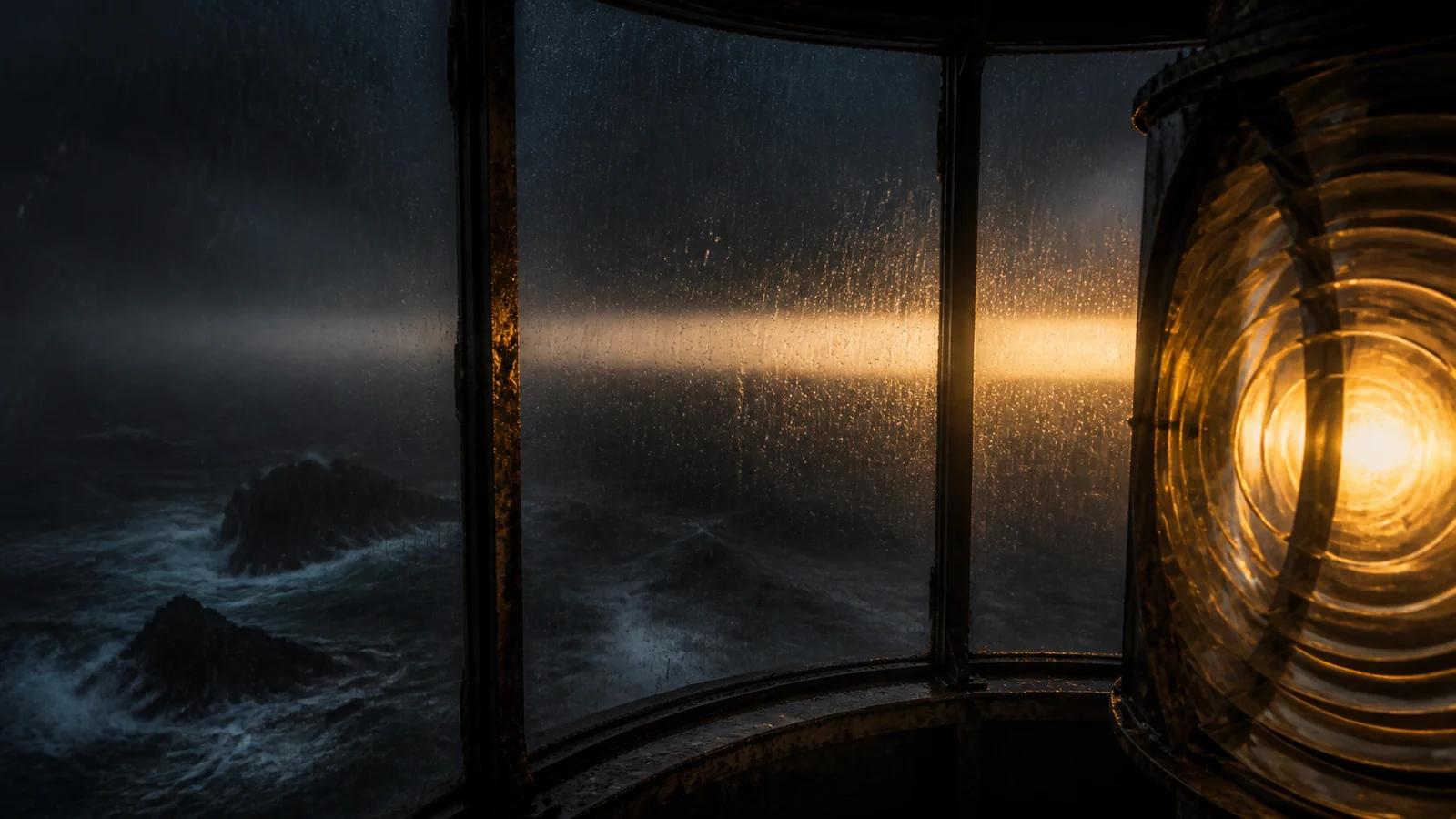
A lighthouse is a warning built in the place most likely to kill the person maintaining it.
The tower must stand where rock, shoal, fog, current, and storm make navigation dangerous. Its beam has to reach people who may never see the keeper. The light must continue whether the person tending it is lonely, exhausted, ill, or listening to something strike the rocks below.
Lighthouses feel frightening because they combine isolation, hazardous weather, repetitive night duty, limited escape, and responsibility for lives beyond the keeper's sight. The beam promises order to distant ships. Inside the tower, that order depends on a small number of people repeating exact tasks while darkness presses against every window.
The haunted house traps its occupants with a past.
The lighthouse traps them with a job.
A lighthouse begins as a boundary
Lighthouses do not mark comfortable places.
They identify a coast, reef, harbor entrance, or obstruction that a navigator needs to recognize before reaching it. A lighthouse says land is here, but the more urgent part of the message may be do not come closer.
That double meaning gives the structure its natural horror.
From the sea, the beam is reassurance. From the lantern room, it reveals how completely the tower is surrounded. Each sweep shows a portion of rock, water, fog, or rain and then removes it again. The light does not conquer the darkness. It visits one narrow section at a time.
The darkness has the longer shift.
This differs from why caves are frightening. A cave removes the entrance as a person goes deeper. A lighthouse keeps displaying the world outside, but offers no easy route into it. The keeper can see the storm. Seeing does not provide escape.
What did lighthouse keepers actually do?
The romantic image reduces the keeper to one melancholy man polishing a lens while the sea attempts to drive him mad.
The work was more practical and more demanding.
At Cape Hatteras, the National Park Service describes a principal keeper and two assistants who rotated four-hour night watches. Their duties included carrying fuel, tending the lamp, trimming wicks, polishing the lens and brass, maintaining the clockwork, keeping records, ordering supplies, painting buildings, watching shipping, and making repairs.
Point Reyes on the California coast provides an especially useful example. Its keepers had to wind the clockwork that rotated the Fresnel lens every two hours and twenty minutes through the night. The mechanism used a descending 170-pound weight. Daylight brought lens cleaning, brass polishing, repairs, and work on the fog signal.
The routine matters to horror because every task can fail.
A wick can burn poorly. A weight can stop. A lens can be damaged. A fog signal can go silent. A report can contain a time no one remembers writing. The building turns maintenance into ritual because the consequences of neglect exist somewhere beyond the visible circle.
Rules in folk horror create a boundary. Lighthouse duty creates a checklist.
Both become frightening when one item changes.
The keeper was not always alone
Many lighthouse stories depend on solitude. The historical record is less convenient.
The National Park Service notes that many keepers lived with families in attached or nearby quarters. Family members contributed to the work, and women sometimes inherited formal keeper positions after a husband or father died or became unable to serve. Some stations employed several keepers. African American workers served within lighthouse and lifesaving systems under changing and often unequal conditions before and after emancipation.
The solitary white man in a raincoat is an image, not a universal staffing model.
Correcting the image does not remove isolation. A family can be isolated together. Three keepers can still be days from help. A station may have company but no privacy, no reliable transport, and no refuge from the same machinery, weather, and sound.
Company also creates new forms of uncertainty.
Someone was supposed to wind the mechanism.
Someone was supposed to relieve the watch.
Someone is moving on the stairs, but everyone is already in the room.
Weather makes the building an instrument
At Point Reyes, fog can reduce visibility to hundreds of feet. The headlands project into a dangerous approach to San Francisco Bay. The lighthouse was built below the high fog line, 300 feet down a cliff, because the warning had to exist where ships might actually see it.
Wind, water, and metal do not remain quiet in such a place.
The tower hums. Windows rattle. Waves arrive as impacts without visible sources. Fog removes the horizon, leaving the keeper inside a white enclosure while the sea continues below. A fog signal repeats until it becomes part of the body, then stops suddenly enough to feel like an event.
Point Reyes recorded winds strong enough to force a keeper to crawl. The National Park Service lists a highest recorded speed of 133 miles per hour and notes that winds of 60 miles per hour are common. The station's isolation, work, wind, and fog made it an undesirable assignment.
Horror does not need to invent the pressure.
It only needs to wait until the familiar noise answers back.
**The light is still on aboard Dead Ship.** Join The Grimbard Press and receive the complete illustrated story free.

Responsibility reaches beyond the beam
A haunted-house story asks whether the occupants can save themselves.
A lighthouse story adds strangers.
The keeper may never know the names of the people relying on the signal. A ship passes beyond sight. Another fails to appear. Wreckage arrives later. The light can operate perfectly and still be unable to save everyone.
That imbalance is essential. The keeper has enormous responsibility and limited power.
At Point Reyes, lighthouses and fog signals warned ships, but wrecks continued. A lifesaving station was established on the beach in 1890. Patrols watched for disasters and survivors in cold, powerful water. The warning system did not eliminate the need to recover people after warning failed.
Sailors believed in sea monsters partly because the ocean delivered evidence without context. The keeper experiences the reverse. The context is everywhere—dangerous water, poor visibility, a missing vessel—but the evidence may never arrive.
The empty horizon can mean everyone passed safely.
It can mean no one is left to signal.
The beam proves that time is passing
A rotating lighthouse lens creates a characteristic pattern. Mariners identify a station by how its light flashes. At Point Reyes, the mechanism produced one flash every five seconds.
To a keeper, repetition measures the night.
The beam crosses the window. Darkness returns. The weight descends. The mechanism needs winding. The same stairs wait. The same glass needs attention. A shift ends only when another person arrives to continue the sequence.
Repetition is normally reassuring because it confirms that the system works.
Horror changes one interval.
The beam returns early.
The mechanism is still turning after the weight reaches the bottom.
The flash appears from the wrong side of the tower.
The keeper sees another light at sea matching the station's pattern exactly.
Those ideas work because lighthouse time is not decorative. It is operational. A wrong flash is a wrong message sent into darkness.
Automation left an empty tower still performing its duty
Lighthouse automation removed much of the need for resident keepers. A current National Park Service history notes that U.S. lighthouses had become automated by the end of the twentieth century; Boston Light retained a keeper under federal authorization until the last civilian keeper retired in 2023.
Automation creates a different unease.
The abandoned house is frightening because the system stopped. Dust settles. Pipes fail. Nature enters.
The automated lighthouse remains active after the people leave.
The light continues to turn. Electronic equipment monitors what no person is present to see. The building performs occupancy without an occupant.
That is close to the fear inside the warehouse ghost. Modern systems keep logging, scanning, and signaling after the human witness has gone home. A process does not need to be alive to outlast the people who understand it.
Why lighthouses feel haunted
Lighthouses gather several kinds of fear in one vertical structure:
| Element | What it promises | What horror changes |
|---|---|---|
| The beam | Orientation and warning | It illuminates something that should not be there |
| The tower | Refuge above dangerous water | It becomes a place with one narrow route out |
| The schedule | Reliable operation | One interval changes without explanation |
| The keeper | Human supervision | The duty continues after the watcher disappears |
| The fog signal | Identity when the light cannot be seen | Another signal answers from the wrong direction |
The structure is not frightening because it is old.
It is frightening because it has a purpose precise enough to fail.
Frequently asked questions
Did lighthouse keepers live alone?
Some experienced severe solitude, but many stations had assistants, families, or nearby quarters. Staffing varied by station and period. The lone-keeper image should not be treated as universal history.
Why did lighthouses need constant attention?
Before automation, lamps, fuel, wicks or mantles, lenses, clockwork, windows, fog signals, and buildings required regular operation and maintenance. Severe weather could make continuous monitoring especially important.
Are lighthouses still staffed?
Modern aids to navigation are generally automated. Historic sites may have rangers, caretakers, volunteers, museum staff, or other personnel, but not traditional resident keepers tending a flame through rotating watches.
Why does fog make a lighthouse scarier?
Fog removes distance and the horizon while preserving sound. The tower's warning may become audible rather than visible, and the keeper can know danger is near without being able to see it.
How is lighthouse horror different from haunted-house horror?
A haunted house usually contains a past intrusion. A lighthouse adds public duty: the person inside must keep the warning operating for people outside, even when staying becomes dangerous.
Sail beyond the light
Monsters of the Wine-Dark Sea follows the old fear that the water contains more than distance. The lighthouse marks the last fixed point before that uncertainty begins.
Explore the book or join The Grimbard Press and receive Dead Ship before it reaches shore.
Comments
One response to “Why Are Lighthouses Scary? Isolation, Storms, and the Unbroken Watch”
[…] are just a warehouse that won’t end follows the terror of architecture stripped of purpose; lighthouses make a useful contrast, built to remain awake on behalf of people far […]