Tag: liminal spaces

  • Why Abandoned Places Feel Haunted Before Anything Happens

    Why Abandoned Places Feel Haunted Before Anything Happens

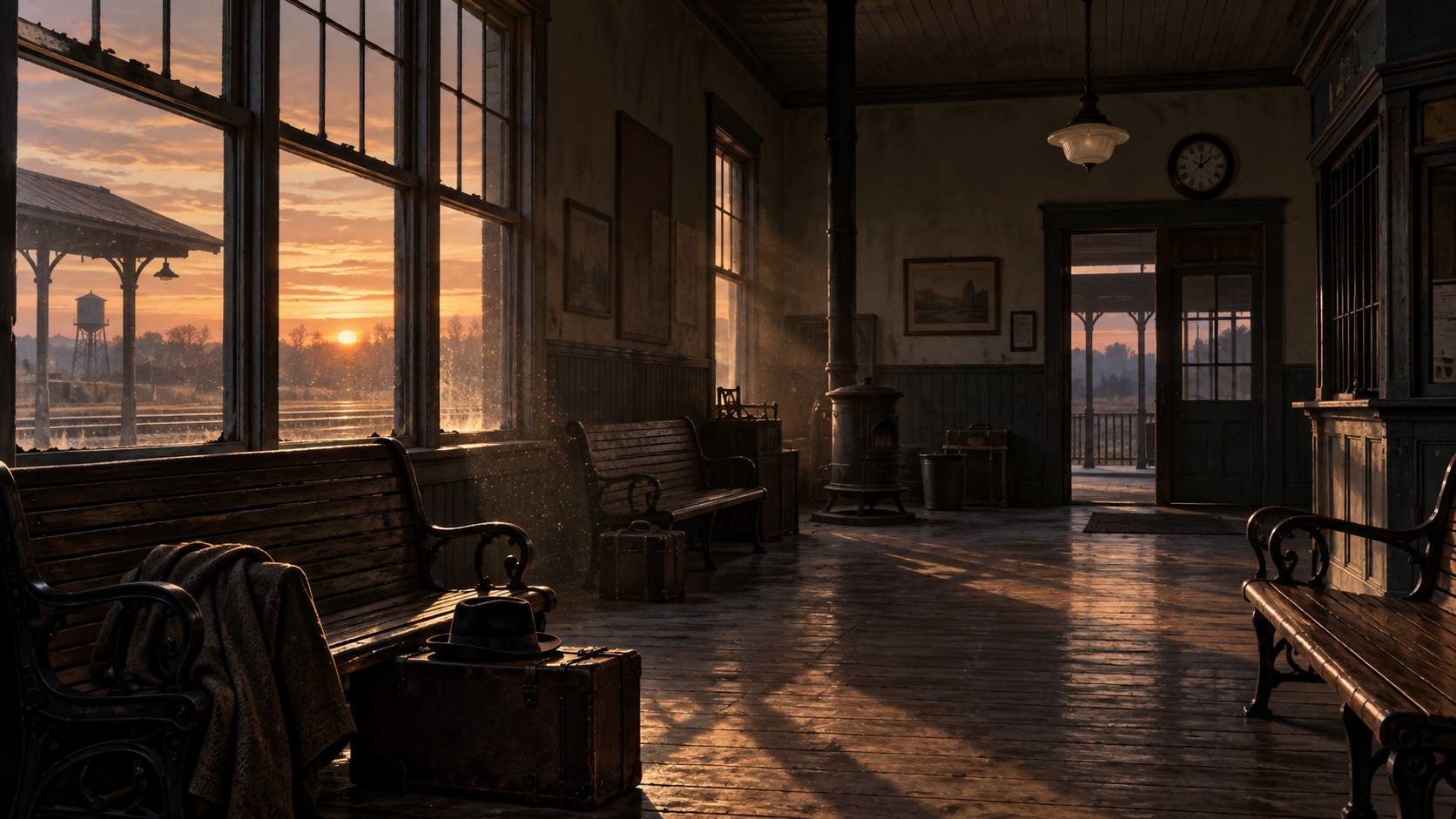
    A deserted railway waiting room at dusk, dust in the last window light

    Abandoned places feel haunted because they violate a familiar expectation: a room built for people is suddenly missing them, while the evidence of their presence remains. A chair faces a table. A calendar hangs where somebody once checked a date. Wind moves through a corridor that was designed to be quiet. Your mind supplies the absent occupants and begins asking why they left. No ghost has to appear for that question to feel urgent.

    This is not proof of a paranormal event, and there is no single scientific mechanism that explains every uneasy visit. It is a useful way to describe an experience many people recognize. Architecture gives us clues about human activity; decay scrambles them; uncertainty invites a story.

    The building still tells you what should be happening

    A school corridor implies bells, footsteps, and children changing rooms. A hotel desk implies a person ready to answer a question. An empty factory implies machinery that should be loud enough to drown out thought. When the building keeps its shape but loses its routine, expectation and reality no longer match.

    That mismatch is more effective than simple darkness. An empty field at night may be frightening, but it does not present the same precise absence. A place designed for occupancy seems to be waiting for someone. Even if you know its closure was ordinary—costs, relocation, redevelopment—the rooms can make the absence feel personal.

    This is why an abandoned site in a story should not be described only as “creepy.” What was it for? What behavior did it organize? Show the reader the missing action. A row of numbered hooks with no coats can do more work than a paragraph about shadowy energy.

    Traces make strangers feel almost present

    The most powerful objects are usually ordinary. A cup, a handwritten sign, a worn stair tread, or an outline left by a removed picture tells us somebody used the place repeatedly. These are traces, not messages. We do not know the person, but the object helps us imagine a gesture: the cup lifted, the stair climbed, the picture straightened.

    The temptation is to invent a complete biography from one clue. That is good fuel for fiction and poor historical method. A child’s shoe does not tell you why a building closed. An unmade bed does not prove a sudden flight. If you are writing about a real site, separate what records establish from what your imagination proposes. If you are writing fiction, use the gap deliberately; make the reader aware of how little the protagonist actually knows.

    A dusty table with one intact teacup and a square of unfaded wallpaper

    Silence changes the scale of small sounds

    People often describe an abandoned building as silent, but the silence is full of low-level activity. Water drips. Metal expands or contracts. Leaves scrape a broken pane. A distant vehicle sounds closer through open rooms. Because there is no ordinary human activity to absorb those noises, each one seems to ask for an explanation.

    In a horror scene, the strongest sequence is often simple: establish a repeated sound, let the character explain it, then change one part of the pattern. A drip stops when the character enters. A door taps three times after the wind dies. The reader is frightened by a failed explanation, not necessarily by volume.

    For another look at how stories exploit incomplete sensory evidence, read why forests feel scarier at night. The setting differs, but the practical question is the same: how much can you know from limited cues?

    Decay lets two times occupy one room

    A ruin is a visible disagreement between past purpose and present condition. Wallpaper still marks a home; moss now crosses the floor. A sign still promises a service; the business is gone. That double exposure makes it easy to imagine a past scene running underneath the present one. Gothic stories have relied on this effect for centuries, but modern offices, malls, and transit stations can produce it too.

    The effect is not merely nostalgia. A building can preserve evidence of exclusion, labor, failed promises, or environmental damage. The question “Who lived here?” should sometimes become “Who worked here?” or “Who was not allowed in?” History gives the atmosphere weight. A generic ruin can feel decorative; a place with a documented use can become morally difficult.

    Our Gothic reading path explores how fiction turns architecture into pressure. For a Grimbard route through places whose boundaries seem unreliable, browse the Lost Boundary Archive.

    A long empty hallway where daylight reveals layers of paint and water damage

    How to appreciate a ruin without entering it

    The romance of abandoned places must not obscure their real risks. The National Park Service warns that abandoned mine sites may contain unstable structures, hidden shafts, unsafe water, and dangerous air. Other derelict buildings can present different structural, environmental, or legal hazards. Do not enter a closed site for a photograph or a story prompt.

    There are safer ways to study the effect. Visit a publicly accessible historic site, take a guided tour, use a local archive’s photographs, or observe a building from a lawful public viewpoint. Read municipal or preservation records before deciding what happened there. The facts may be less sensational than a ghost story and more compelling.

    If you are a writer, make a field note in three columns: what you can see, what you can reasonably infer, and what you are inventing. That division protects real people’s histories while leaving plenty of room for fiction. It also gives your imagined haunting a stronger foundation: the reader senses where the evidence ends and dread begins.

    For readers, the same exercise changes how you look at photographs of deserted sites. Ask when the photograph was made, who owns the property, and what might have been moved out of frame. A dramatic image can be an invitation to research, but it is not a complete history. That little pause makes the eventual story you tell about the place more interesting and more honest.

    FAQ

    Does feeling haunted mean a place is paranormal? No. An uneasy feeling can arise from expectation, unfamiliar sounds, traces of former use, and uncertainty. It does not settle a supernatural question.

    Why are abandoned schools and hospitals especially unsettling? They are buildings with strong expectations of routine, care, and human presence. Their emptiness is therefore unusually legible.

    Is it safe to explore abandoned buildings? Do not assume so. Access may be prohibited, and deterioration can conceal serious hazards. Choose authorized visits and public archives instead.

    For more grounded explorations of eerie places, join The Grimbard Press. If you want the unsettling place to cross fully into fiction, explore the Grimbard books.

    Source: U.S. National Park Service, abandoned mineral lands hazards and safety. The article’s psychological framework is interpretive, not a clinical diagnosis.
  • The Backrooms Are Just a Warehouse That Won’t End

    The Backrooms Are Just a Warehouse That Won’t End


    The whole thing started with one photograph and one paragraph. In 2019, someone posted an image to a 4chan thread about unsettling places: an empty office space, yellowed wallpaper, damp carpet, fluorescent lights, no windows, no people.

    An eerie maze of empty yellow-lit corridors

    Anonymous captioned it. If you’re not careful and you noclip out of reality in the wrong areas, you’ll end up in the Backrooms — six hundred million square miles of empty rooms, the hum of the lights, the smell of old carpet, and the sound of something else moving around, far off, that has heard you.

    That’s it. No monster described. No exit. Just an infinite, uniform interior and the implication that you are not alone in it.

    It became one of the biggest horror franchises of the decade, and I think it’s because it accidentally described something we all already recognize but had never named: the dread of infrastructure that has outlived its purpose and kept running.


    The Old Fear Wore Stone

    The Backrooms feel new, but the bones are ancient. Go back to the oldest architectural horror we have: the Labyrinth. Daedalus built it for King Minos to hold the Minotaur — a maze so complex that its own designer barely escaped it, a structure whose entire function was to make sure that whoever went in could not find the way out. The horror of the Labyrinth was never really the bull-headed thing at the center. It was the walls. It was the certainty that the building itself was your adversary, that every corridor was a decision you’d get wrong, that the architecture was designed by an intelligence specifically to defeat yours.

    The Minotaur is what people remember, but the Minotaur is almost a mercy — at least it’s a thing you can fight, a center you can reach. The genuinely modern horror is the version with no center and no monster at all. Just the maze. Just the walls, going on past any reason for walls to go on, built by a logic that no longer has a purpose but hasn’t stopped executing.

    That’s the Backrooms. The Labyrinth with the Minotaur removed and the corridors set to infinite.


    Why Empty Infrastructure Reads as Threat

    There’s real cognitive science under the liminal-space aesthetic, and it’s worth naming because it explains why a photo of an empty hallway can raise your heart rate.

    Human environments carry implicit information about other humans. A hallway is for getting between rooms that people use. An office is for people working. A stairwell is for movement between floors. When you encounter one of these spaces completely emptied of the people it was built for — the school at 3 a.m., the mall after closing, the parking structure with no cars — your brain registers a mismatch. The space is shaped by human intention but contains no humans. And the oldest part of your threat-detection asks the obvious question: where did everyone go, and what’s the reason I shouldn’t be here?

    The fluorescent hum makes it worse. It’s the sound of a building that is still powered, still maintained, still running — for no one. The lights are on because a system somewhere decided the lights should be on, and that system doesn’t know or care that the people are gone. That’s the specific flavor of Backrooms dread: not abandonment, which at least implies release, but operation without occupancy. The machine is still going. It just isn’t going for you anymore. You’re inside it, and it has no setting for you.


    The Version That’s Already Real

    Here’s the reframe I actually care about. The Backrooms are described as a supernatural elsewhere you “noclip” into. But the aesthetic is drawn entirely from real places, and the real places are getting more numerous, not less.

    Walk through a modern automated distribution hub in the off-hours. Miles of racking under identical lighting, no windows, no clear sightline to an exit, aisles labeled in a coordinate system meaningful only to the routing software. It is a purpose-built maze whose organizing logic is not human-legible — you cannot navigate it by intuition, only by being told, node to node, where to go next. The lights and conveyors run on a schedule set by a model. If you were left in there after the shift ended, with no scanner telling you where to go, you would be, functionally, in the Backrooms: inside a vast, humming, uniform interior, built by intention but not for you, unable to find the edge.

    An expansive industrial warehouse storage aisle stretching into darkness

    Or consider the grid dead-zone — the growing set of places where the infrastructure of connectivity, navigation, and monitoring simply fails. The tunnel where GPS dies. The stretch of the megastructure where no signal reaches. We’ve wrapped ourselves so completely in systems that tell us where we are that the places those systems can’t see have become a new category of frightening. Not wilderness — wilderness is honest about being wild. Something worse: built environment that the network has forgotten, infrastructure that exists on no accessible map, corridors the routing software doesn’t route. You can be lost inside human construction now, which the Labyrinth understood was the deepest kind of lost.


    What the Monster Would Actually Be

    The Backrooms lore eventually did what all lore does and started adding monsters — “entities,” numbered and cataloged. Most of them are the weakest part of the mythos, because the moment you can see the thing hunting you, the infinite corridor becomes finite: a level with an enemy on it, a problem with a shape.

    If I were writing the true version, the monster wouldn’t have a body. It would be the building’s own logic. The thing that moves you deeper. The routing that never resolves to an exit because “exit” was never a state the system was designed to reach — only “next location.” The horror mechanism of a warehouse that won’t end isn’t a creature in the aisles. It’s that the aisles are the creature: a mechanical intelligence with no malice and no off state, that will keep assigning you a next node forever, because assigning next nodes is the only thing it knows how to do, and it has confused you for cargo.

    The Minotaur could be killed. The Labyrinth had a center. What we’ve built has neither. Just the hum, the carpet, and a system that will route you until you stop, and then route the next thing that noclips in.


    I write horror set in the spaces the map forgot — the humming interior that’s still running for no one. Get the free story here; I promise there’s an exit.

    The fiction this feeds is collected in There Be Monsters: Then and Now. The rest of the catalog lives at my Gumroad storefront and on my author page.

    Continue exploring Grimbard