Author: Grimbard

  • Why Appalachian Horror Hits Different

    Why Appalachian Horror Hits Different


    There’s a scene I keep coming back to, not from any book or film, but from a conversation I had with an older man at a ghost tour in western North Carolina a few years back. He’d lived in the same holler his whole life. Someone on the tour asked him if he believed in the things we’d been hearing about — the lights in the woods, the shape that walked the ridge at night.

    He looked at them the way you look at someone who’s just asked if you believe in roads.

    “Believe in it,” he said. “I’ve seen it.”

    That exchange is, in miniature, what Appalachian horror is. Not atmosphere. Not aesthetic. Witness.


    The Geography Does Something

    Mountains do specific things to human psychology over generations. They cut off. They contain. They create what sociologists call “geographic isolation” but what feels, from inside it, more like the world forgetting you exist.

    The Appalachian range runs roughly 1,500 miles from Alabama to Newfoundland, with the densest cultural concentration in a band stretching from northern Georgia through West Virginia. The settlements that took hold there in the 18th and 19th centuries were often cut off from the nearest towns by terrain that made travel genuinely dangerous for significant portions of the year.

    That isolation does two things that matter for horror.

    First, it concentrates tradition. The oral histories, the rules, the stories that would have diluted over generations in more connected communities stayed intact. Practices that died elsewhere survived. Beliefs that modernized away in cities held their shape in places where modernity arrived late and partially.

    Second, it means the community becomes the authority. When there’s no external institution to appeal to — no sheriff an hour away, no hospital, no court — the community develops its own mechanisms for managing fear, conflict, and the things that happen in the dark that nobody has a good explanation for.

    Both of those conditions produce folklore with teeth.


    The Things That Live Here

    Appalachian folk horror has a specific creature catalog, and what’s striking about it is how local it is. The Wampus Cat. The Tailypo. The Bell Witch — not a ghost so much as a presence, a force, something that understood the Bell family well enough to hate them specifically. The Booger. The Raw Head. These aren’t imports. They’re not Greek mythology dressed in new clothes. They grew from this place.

    They’re also not uniform. The Tailypo legend varies significantly from county to county. What the creature wants, what it looks like, whether there’s any way to survive encountering it — these change based on who’s telling it and where. That variability is a sign of living tradition. Dead traditions calcify. Living ones adapt.

    The Wampus Cat is a good example. In some versions it’s a pre-contact shapeshifter, a woman transformed by the Cherokee as punishment for witnessing a sacred ceremony. In others it’s simply a mountain lion that has been wrong for too long, something that started natural and became something else by accumulation of wrongness. The two versions are doing different cultural work, but they share an anxiety: things here can change into what they are not, and you won’t know until it’s too late.


    What Hollywood Gets Wrong

    Most Appalachian horror films make the same mistake. They treat the mountains as backdrop for urban people to suffer in. The locals are either villains or props. The horror is generated by the gap between the sophistication of the protagonists and the otherness of the place.

    This is not Appalachian horror. It’s tourism horror — horror about what happens when you leave your comfort zone. The mountains are incidental.

    Real Appalachian horror is horror about the place — the way the land holds memory, the way communities deal with what they can’t explain, the way the isolation creates both tight bonds and the kind of silence that lets bad things persist. It’s the difference between a story set in the mountains and a story that could only be set in the mountains.

    The gold standard is still the oral tradition itself. Second to that, look at what writers like Ron Rash and Wiley Cash do with the region in their fiction — not explicitly horror, but working with the same raw material.


    Why It’s Having a Moment

    Appalachian horror has been mainstream-adjacent for a few years now, and I don’t think that’s coincidental. We’re in a cultural moment when a lot of people are asking questions about what gets preserved, what gets lost, what survives in communities that were cut off or overlooked, and what that survival cost.

    Appalachian folk tradition has answers to those questions. They’re not comfortable answers. They’re the kind of answers that involve the lights in the woods and the shape on the ridge and the old man who looks at you like you asked about roads.

    But they’re real answers, from people who were paying attention.

    That’s what the best horror has always been.


    My fiction lives in this territory — folk horror, creature stories, the kind of dark that grows in isolated places. There Be Monsters: Then and Now collects thirteen of them. Start there.

    For more folklore, regional legends, and the horror that feels like it came from somewhere — get on the list.


    Read Appalachian horror with care

    “Appalachian” is not a single voice, aesthetic, or belief system. The region spans many states, nations, communities, and family histories; a respectful story begins with a specific place and people rather than treating the mountains as a shortcut for isolation or menace. Folklore also changes as it moves between tellers, so it is worth asking who is telling a version, where they learned it, and what context may be missing.

    That precision is what gives regional horror its force. For a wider look at how place and inherited rules shape the genre, read what makes folk horror different. For a shorter fictional entry point, “Rabbit Season” uses a winter warning and family pressure rather than a generic “backwoods” stereotype.

    What makes a story Appalachian horror?

    • Specificity: a real sense of terrain, labor, weather, and community—not a borrowed mountain backdrop.
    • Living tradition: beliefs and stories with local roots, handled as culture rather than exotic decoration.
    • Consequences: the land, memory, and relationships shape what characters can ignore—and what they cannot.
  • The Skinwalker: What the Navajo Legend Actually Warns Us About

    The Skinwalker: What the Navajo Legend Actually Warns Us About


    The version of the Skinwalker that lives on Reddit is a bipedal thing that chases cars on desert highways. A speed demon. Something you catch at the edge of your headlights doing something no human body should be able to do — running alongside you at seventy miles an hour, or crouched where it shouldn’t fit, or looking at you from the wrong direction in your mirror.

    That version is terrifying. It’s also about forty percent of the actual tradition, stripped of the part that makes it genuinely disturbing.

    The Skinwalker — yee naaldlooshii in Diné bizaad, which translates roughly as “by means of it, it goes on all fours” — is not primarily a speed story or a pursuit story. It is a transformation story. And the thing it transforms is the most frightening part of all.


    What Gets Made

    A yee naaldlooshii is a human being who has chosen to become something else.

    Not cursed. Not bitten. Not inherited. Chosen.

    In the Navajo tradition, a Skinwalker is a practitioner of ‘ánt’įįhnii — what outsiders translate as witchcraft — who has completed a specific, deliberate act of corruption. The nature of that act varies in specificity across accounts, but the consistent element is this: it involves the killing of a close family member. A sibling. A parent. A child.

    The Skinwalker does not become evil through supernatural contamination. The evil act is the threshold. You have to cross it yourself.

    This is what separates the yee naaldlooshii from almost every other monster in Western horror tradition. A werewolf is often a victim. A vampire was transformed by violence done to them. Even the ghost typically died in circumstances they didn’t choose. The Skinwalker chose — and what they received in exchange is not just speed or shapeshifting, but the removal of the constraint that had held them inside a human moral framework.

    The power is real. But the cost is your self.


    The Skin and What It Means

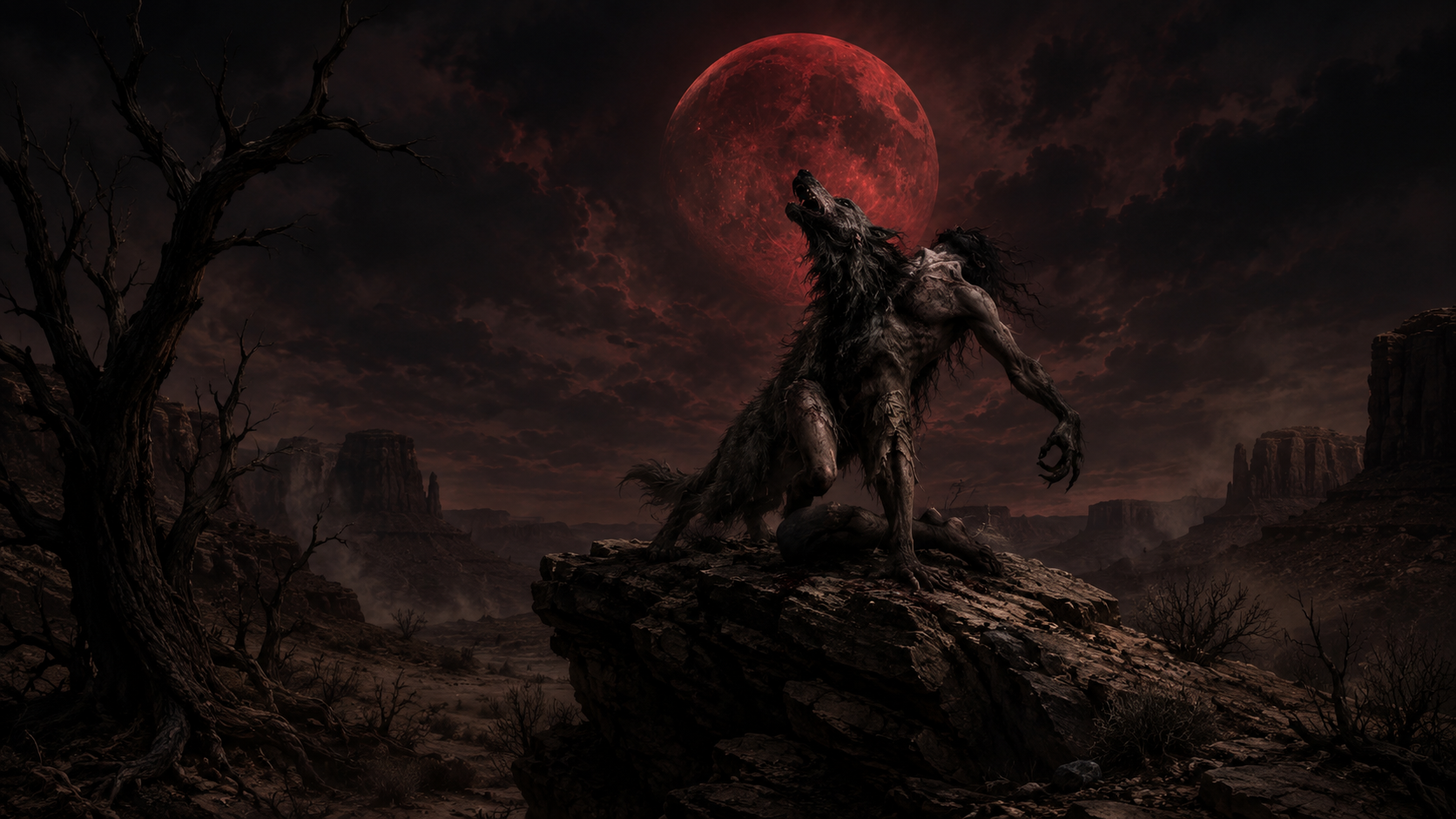
    The “skin” in Skinwalker is literal. The practitioner wears the pelt of an animal — typically coyote, wolf, fox, owl, or crow — to take on that creature’s form. This is where the highway encounters come from; a person wearing a wolf skin running faster than a vehicle, or a figure crouched impossibly in the road, is the physical expression of a human inside an animal body.

    But the specific animals matter. Every one of them carries weight in Navajo cosmology. Coyote is the trickster, the boundary-violator, the one who appears at the margins of order. Wolf is dangerous power. The owl — same as with the Wendigo tradition — carries the dead. These aren’t random choices. The practitioner isn’t just putting on a disguise; they’re wearing a relationship to the world.

    The closest thing in Western tradition might be the berserker — a Norse warrior who wore a bearskin and was said to fight in a state beyond human reckoning. But the berserker transformation was temporary. The yee naaldlooshii does not have an off switch. The boundary between the practitioner and the animal gets thinner with use. Eventually, some accounts suggest, there’s nothing left that remembers being human.


    The Skinwalker Ranch Problem

    In 1996, a Utah ranch became famous — notorious — as a hotspot for Skinwalker activity. Livestock mutilations. UFO sightings. Poltergeist phenomena. A series of books, a documentary, and eventually a cable television series followed.

    Here’s the problem: Skinwalker Ranch is in the Uintah Basin of northeastern Utah. The land is associated with the Ute people, not the Navajo. The Skinwalker is a specifically Navajo tradition. The two are not the same.

    The conflation is not harmless. When a piece of indigenous knowledge gets detached from its cultural origin and reapplied to a piece of land it has no historical connection to, what you get is not expanded understanding — you get a brand. The terror tourism around Skinwalker Ranch has generated considerable money. The Navajo Nation has generated approximately none of it. And the tradition gets used in ways that erase the context that makes it meaningful.

    I’m not saying the Uintah Basin doesn’t have strange history. It might. But whatever is happening there is probably better understood through Ute cosmology, if through any indigenous lens at all.

    The Skinwalker has been adopted by horror culture in ways that the community it came from has, repeatedly and explicitly, asked people to stop. When you see that pattern — a specific ask from a living culture to stop appropriating their spiritual tradition as entertainment — it’s worth pausing to ask what you actually gain by ignoring it.


    Why the Warning Still Matters

    Strip the cultural mechanics away entirely and the core of the Skinwalker legend is this: power is available to people who are willing to do the thing that cannot be undone. And the transformation that follows isn’t just physical. You don’t just get fast. You get outside the community that would hold you accountable. You become something that moves at the margins, that cannot come back into the firelight, that must keep moving because stopping means being seen for what you are.

    Every community has people who chose that trade.

    The Navajo had a name for them. That’s not superstition. That’s observation, compressed into a form that survives.


    Horror draws on traditions like this one because they’ve already done the work — they’ve looked at the dark thing directly and named it. I try to do the same in my fiction. If you want to see what that looks like, There Be Monsters: Then and Now is a good place to start.

    Want more folklore, creature features, and the kind of horror that came from somewhere real? Join the Grimbard list.

  • What Horror Knows About Fathers That Hallmark Never Will

    What Horror Knows About Fathers That Hallmark Never Will

    Father’s Day is a greeting card holiday pretending to be a human one.

    The cards show men grilling. Men fishing. Men asleep in recliners with the game on. The language is warm and rounded and careful, the way language gets when people are trying not to say the complicated thing. Best dad ever. My hero. The man, the myth, the legend. All of it true, maybe. None of it the whole picture.

    Horror knows the whole picture.

    The best horror fiction has always understood that fathers — really understood them — in a way that no greeting card company has the stomach to. The genre has given us Jack Torrance and his typewriter. Ray Molina sitting in a motel room at two in the morning, listening to his son sleep while something tapped from under the floor. Abel Crowder at a church table with his hands flat and his face the color of old lard, carrying sixty years of a dead man’s name — that last one from my own collection, There Be Monsters: Then and Now. Fathers who loved fiercely and held on too long. Fathers who sealed something up and told the children not to touch it. Fathers who stayed when every instinct told them to run — and fathers who ran when they had no other answer.

    That’s not a condemnation of fatherhood. That’s the truth of it. Fathers carry things. The good ones, the bad ones, the ones doing their best in a house that slopes and a life that costs more than they planned for. Horror just won’t let them put it down.

    This Father’s Day, we’re celebrating that.


    A Father’s Day Short Read — Out Today

    To mark the occasion, I’m releasing a brand new short horror story written specifically for Father’s Day. It’s the kind of story that gets at what the holiday actually is about: the things fathers protect their children from, the things they can’t, and the weight that passes between one generation and the next whether anyone meant it to or not.

    The Father’s Day Card is available right now on Gumroad.

    It’s a short read — written to finish in one sitting, ideally tonight. Consider it a different kind of Father’s Day gift. One that takes the holiday seriously.


    Gifts for the Horror Dad in Your Life

    If the father you’re celebrating has a shelf of paperbacks with broken spines and dog-eared pages, or a watchlist three seasons deep, or a habit of finding the one horror podcast nobody else has heard of yet — here’s what to get him.

    These are not the obvious picks. Skip the gift baskets.


    For the Dad Who Reads

    A collection he hasn’t found yet.

    The horror canon is deeper than most people go. Stephen King is the obvious entry. Shirley Jackson is the obvious next step. After that, things get interesting. If your dad has read The Haunting of Hill House and We Have Always Lived in the Castle and is looking for the next thing, point him toward Thomas Tryon’s The Other, which came out in 1971 and still has no business being as unsettling as it is. Or toward Robert Aickman’s strange stories, which are the closest thing to reading a half-remembered dream that the genre has ever produced.

    The Other by Thomas Tryon

    The Collected Strange Stories by Robert Aickman

    For the dad who prefers his horror American and rural and steeped in the kind of dread that comes from knowing a place too well, Laird Barron is the name most horror readers get to too late.

    The Beautiful Thing That Awaits Us All by Laird Barron

    And if he’s the kind of reader who wants something new rather than catching up on the canon — something he won’t find recommended everywhere else — my own collection There Be Monsters: Then and Now is linked horror stories set across generations of the same family. Abel Crowder, from the opening of this post, has his story here. It’s the kind of book that rewards a slow read and a quiet house.

    There Be Monsters: Then and Now by T. P. Grimbard


    For the Dad Who Watches

    Something he won’t forget.

    Before the screen: the right pair of headphones. Horror audiobooks and horror podcasts are a different experience through speakers than through something that actually isolates you. The Sony WH-1000XM5 is the standard recommendation for a reason — noise cancellation good enough to make the rest of the house disappear, sound detail that rewards a narrator who knows what they’re doing, thirty hours of battery so he’s not hunting for a cable halfway through something good.

    Sony WH-1000XM5 Wireless Noise-Canceling Headphones

    The Wailing (2016) is the best horror film of the last decade that most people outside the genre haven’t seen. A small-town detective, a sick daughter, a stranger in the woods. It runs two and a half hours and earns every minute. Your dad will be thinking about the ending for days and won’t be able to explain why he can’t stop.

    For something domestic and slower and deeply wrong in the way only the best slow-burn horror is, Hereditary holds up. If he hasn’t seen it, that’s the gift.

    If he has seen both and is looking for something older: Don’t Look Now (1973). Grief and fathers and the things we think we see when loss has rewired us. There’s a reason it’s still on every serious horror list fifty years later.


    For the Dad Who Has Everything

    A piece of the shelf.

    If your dad is a serious reader and collector, signed or limited editions from small press horror publishers are the gifts that end up displayed rather than buried in a pile. Cemetery Dance Publications puts out limited hardcovers of major titles with author signatures. Subterranean Press does the same. First editions of classic horror — real ones, not reprints — can be found through AbeBooks for less than people expect.

    Cemetery Dance Selected Fiction by Stephen King

    For something more affordable: a leather bookmark, a quality reading lamp, a Moleskine journal for a dad who writes in the margins of everything he reads. These are small things. The right small things matter.

    Moleskine Classic Hardcover Notebook

    BenQ e-Reading LED Desk Lamp


    For the Dad Who Creates

    Tools for the work.

    If your dad writes, or has a story he’s been meaning to get down, or keeps a notes app full of opening lines and goes quiet when you ask about it — get him something that treats the work seriously. A dedicated writing app license. A year of a craft newsletter. A copy of Stephen King’s On Writing, if he doesn’t have one, which remains the most honest book about writing that anyone has produced without meaning to write a book about writing.

    On Writing by Stephen King

    And if he’s ready to go from the notes app to the page, the single best thing you can give is time. Uninterrupted hours. The kids handled, the house quiet, the expectation removed. That’s free. It’s also the rarest thing most writing fathers have.


    The Part the Card Gets Wrong

    Father’s Day cards suggest that fatherhood is something you’ve already done. Past tense. A record to celebrate.

    Horror knows it’s ongoing. Something you carry into every room. Something that waits under the floor of wherever you are and taps until you deal with it, and the men who do well by their children are not the ones who sealed it up and put six screws in and hoped it would stay quiet. They’re the ones who eventually picked up the drill.

    Happy Father’s Day to the ones still holding it.


    The Father’s Day short story is available today only on Gumroad. Grab it here: The Father’s Day Card

    All book links are affiliate links. If you buy through them, a small commission comes back to support this site at no cost to you.

  • New Short Read: “Rabbit Season”

    New Short Read: “Rabbit Season”

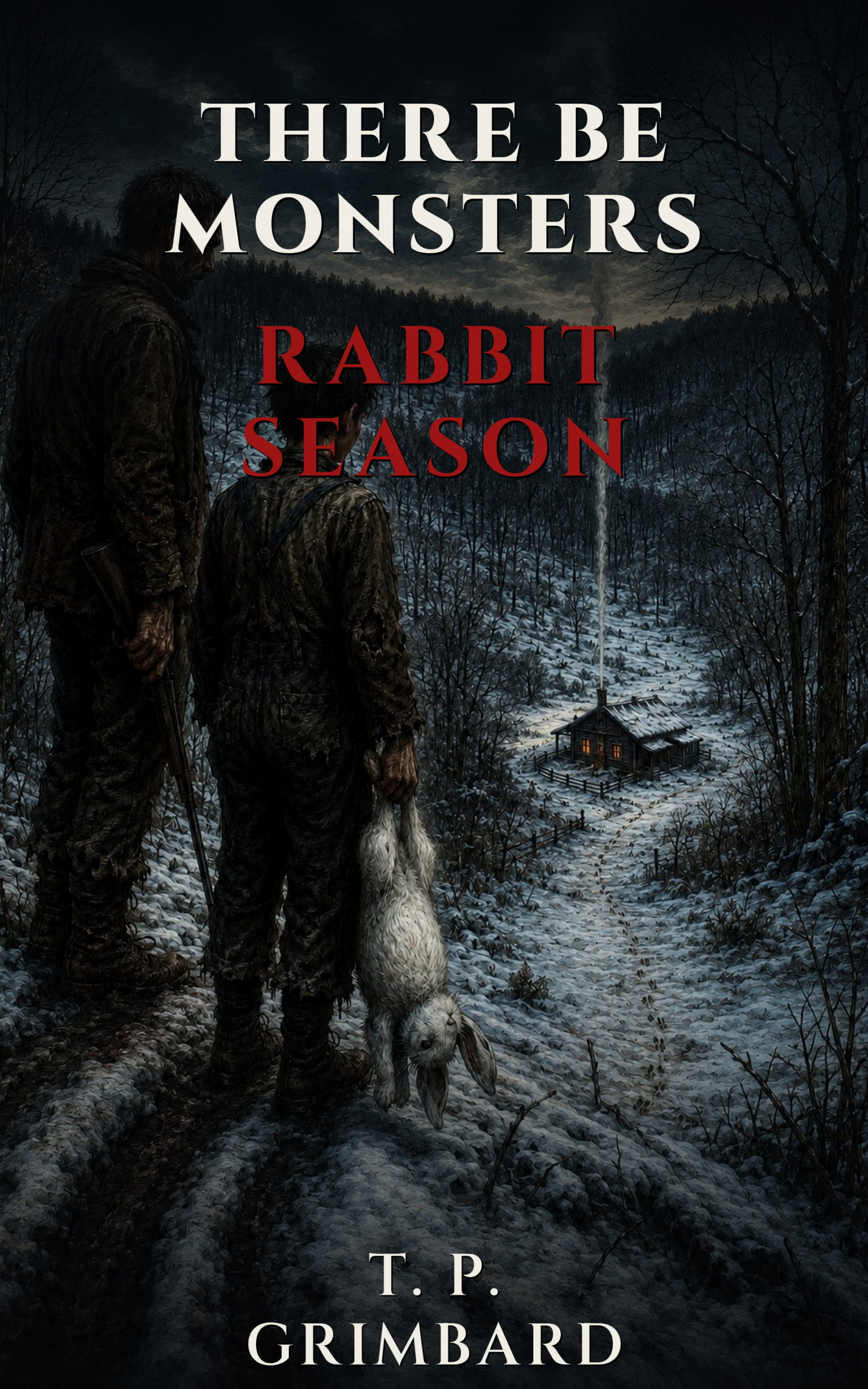
    There’s a rule carved into the inside of the old camp door, and Lee has read it his whole life.

    Don’t shoot the white ones in winter.

    It’s 1935. The snares have been empty for six days. The egg money stopped covering the lamp oil a month ago, and Lee’s father has gone quiet in the way a man goes quiet when he’s run out of everything except the next bad idea. So when a white rabbit sits out on the snow at thirty yards — not hiding, not bolting, the white of it wrong against the white of the weather — the rule loses.

    The rabbit comes home.

    What sits down to supper after that is the part I’ll let you read for yourself.

    “Rabbit Season” is live now as a standalone short read. It’s quiet, Depression-era folk horror — the kind built on an old warning, an empty woods, and a family hungry enough to ignore both. If you like your horror patient and your endings earned, this one’s for you.

    Read “Rabbit Season” on Kindle: https://a.co/d/0bnT7fuu

    It’s pulled from my anthology There Be Monsters: Then and Now — thirteen stories, each one its own bad idea. If “Rabbit Season” gets under your skin, the rest are waiting.

    Get the full collection: https://a.co/d/04jKPYNx

    And if you want a free story to start with, I’ll send you one — no charge, just a quiet place to begin.

    Grab your free story: https://preview.mailerlite.io/forms/2428558/192190473470740064/share

    Bank the fire before you sleep. And if you see a white one this winter, leave it where it sits.

    Continue exploring folk horror

    About this short read

    Rabbit Season is a compact Depression-era folk horror story about scarcity, inherited rules, and the terrible logic of a bad decision. It is drawn from There Be Monsters: Then and Now, but it is meant to be read as a complete, uneasy tale on its own.

    Is this story for you?

    • Choose it if you prefer quiet rural dread to graphic violence.
    • Expect an old warning, a winter landscape, and horror that arrives by degrees.
    • Start here if you enjoy historical or Appalachian-inflected folk horror and want a short first taste.