Author: Grimbard

  • Five Books That Taught Me to Be Afraid

    Five Books That Taught Me to Be Afraid


    I don’t know exactly when I became a horror person. I don’t think there was a single moment. There was a slope, and it started earlier than I usually admit.

    These are the books that built the slope.


    Scary Stories to Tell in the Dark — Alvin Schwartz

    I was probably too young for this book. That was the point.

    The stories in Scary Stories are short, sourced from actual American folklore, and they do not soften their endings. The heroine of one story peels her face off in the mirror. The man who thinks he’s been given a human head as a joke discovers he has. The book is not interested in teaching you that everything is okay.

    But what made it genuinely formative — what I only understood later — is that Schwartz sourced the material from actual folklore collections. Jan Harold Brunvand. Richard Dorson. The same folk horror researchers that serious academics cite. These stories weren’t invented; they were collected, shaped, and passed down through communities that needed them.

    The Stephen Gammell illustrations are a separate conversation. They are the most consistently disturbing illustrations in children’s publishing history and I will not accept pushback on this.

    Find it on Amazon (affiliate link)


    Goosebumps: Welcome to Dead House — R.L. Stine

    The first book in the original Goosebumps series, and still the one that works best as a horror novel rather than a scary-things-happen-to-kids novel.

    The family moves to a new town. The town is wrong. The kids who seem friendly are wrong. The house is wrong. The specific wrongness accumulates slowly through the first half of the book — Stine was genuinely good at this early, before the formula calcified — and by the time the reveal comes, the reader already knew something bad was true.

    What Welcome to Dead House taught me: the town as organism. The idea that a community could have a collective and malevolent purpose. That the neighbors’ friendliness might be a different kind of threat than their hostility.

    That’s folk horror logic, delivered to eight-year-olds.

    Find it on Amazon (affiliate link)


    In the Dark — Edited by Alberto Manguel

    This one doesn’t get cited enough.

    Manguel’s anthology collects ghost and horror stories with a genuine literary standard, and the result is a book that understands the difference between a story that scares you and a story that stays. M.R. James is here, doing what M.R. James does. Dickens is here, and the Dickens ghost story is better than anyone who knows Dickens from A Christmas Carol expects. There’s Borges, whose horror operates at the level of logic rather than event.

    What the anthology taught me: horror is not a thing that happens to characters. It is a quality of attention. The scariest stories in this collection barely have events. They have the sense that something is looking.


    The Haunting of Hill House — Shirley Jackson

    Probably the most technically accomplished horror novel in the American tradition, and the one that taught me the most about point of view as a horror device.

    Everything in Hill House is filtered through Eleanor’s perception, which is cracking from the first chapter in ways the reader can see but Eleanor can’t. By the time you reach the ending, you understand that the most frightening thing in the book isn’t the house. It’s the narrator.

    What it taught me: unreliability as horror. The idea that the monster might be the person telling you the story. That horror and interior damage are not separate categories but the same category from different angles.

    Every writer who works in psychological or atmospheric horror should read this book more than once.


    The Boxcar Children — Gertrude Chandler Warner

    I know. Hear me out.

    The Boxcar Children is not a horror novel. But it taught me something that ended up being essential to the horror I write, which is this: isolation plus community equals stakes.

    The Alden children are alone in the world. They have no parents, no safety net, and they’ve built everything they have from nothing in a disused boxcar in the woods. The stakes of their situation — the real possibility that it all goes wrong, that they’re genuinely without resources or protection — is what makes the resolution satisfying.

    Horror that works requires that the reader believe the threat is real and the characters have something to lose. I learned that early from four kids living in a boxcar, not from monsters. By the time I got to the monsters, I already understood that the anxiety underneath them had to be real.

    Find it on Amazon (affiliate link)


    What They Have in Common

    Rules. All five of them, in different ways, operate on rules. The rules of the house. The rules of the town. The rules of what a narrator is allowed to know. The rules of what happens when you break the wrong thing in the wrong place.

    I didn’t understand that when I was reading them. I was just scared. But the rules were there, doing the work, making the fear feel earned and real and anchored to something.

    That’s what I’m still trying to build.


    More folklore, creature features, and horror craft — join the Grimbard list.
    My own folklore horror: There Be Monsters: Then and Now


    Choose your next unsettling read

    • For folklore and a quick shock: Scary Stories to Tell in the Dark.
    • For a gateway novel: Welcome to Dead House.
    • For literary atmosphere: In the Dark or The Haunting of Hill House.
    • For a new folk-horror short read: try “Rabbit Season”, then explore what makes folk horror different.

    Disclosure: some links in this post are affiliate links. If you use one to make a purchase, Grimbard may earn a small commission at no extra cost to you.
  • The Scarab Is Out Today — T. P. Grimbard’s Debut Novel

    The Scarab Is Out Today — T. P. Grimbard’s Debut Novel

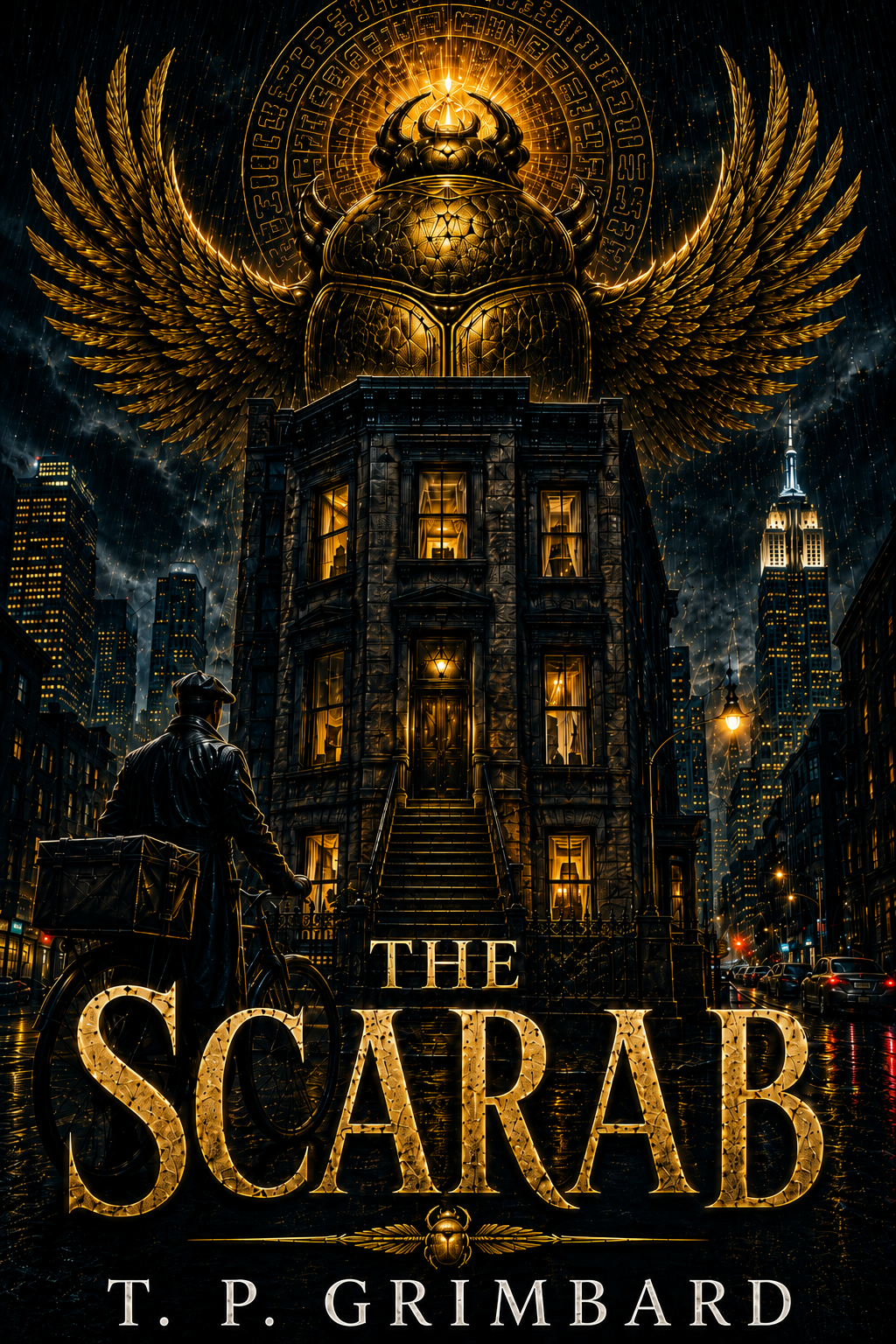
    The Scarab, T. P. Grimbard’s first novel, releases today on Amazon in Kindle ebook and 6×9 illustrated paperback.

    A courier ducks a storm and climbs through an open window into an old house in Flatbush. He leaves at dawn with no bruises, no memory of choosing to stay, and a certainty he can’t shake. Something old and patient has just decided he’s worth the wait.

    The Scarab hero banner artwork, a winged scarab motif

    What Is The Scarab About?

    The Scarab is a slow-burn occult horror novel told through fractured testimony — a courier, a private investigator, a hacker, and a handful of sources, each holding a piece of something none of them can prove and none of them can forget. No single narrator has the whole picture. That’s the structure the book runs on.

    Half a world from Flatbush, an archaeologist in Cairo dies under a wall that came down a little too conveniently — the same week she refused to let a corporation move faster than the truth. A private security firm starts asking questions it won’t explain. A woman in Manhattan with more power than she’s comfortable holding starts receiving things she never ordered. A fifty-five-year-old private investigator, sharper than the diagnosis she’s been ignoring, starts pulling a thread that was never meant to be found.

    Something has been keeping accounts for a very long time. It doesn’t take. It gives — hands its inheritance to whoever’s standing closest when the hour comes, whether they want it or not. Once you’re carrying it, there’s no putting it down.

    Illustration of the porch and open window where The Scarab begins

    Who Should Read The Scarab?

    The Scarab is built for readers who want dread that builds in silence and doesn’t explain itself, told across institutions instead of a single haunted house. If you liked the patient, testimony-driven horror of Silvia Moreno-Garcia’s Silver Nitrate or Tananarive Due’s The Reformatory, this book is aimed at the same reading experience.

    Three things define the book’s approach to horror:

    • Restraint over reveal. The threat is never fully explained on the page — the book trusts the reader to sit with what’s withheld.
    • Institutions as the real monster. The story is as much about what corporations, security firms, and private wealth do to bury the unbearable as it is about the entity at the center of it.
    • Colonial theft with a body count. The Cairo thread ties the supernatural inheritance directly to what gets looted, buried, and quietly re-buried by the people with the resources to make it disappear.

    Where Can You Buy The Scarab?

    The Scarab is available today on Amazon in Kindle ebook and 6×9 illustrated paperback, and it’s enrolled in Kindle Unlimited. Because it’s part of KDP Select, the ebook is Amazon-exclusive — it will not appear on Gumroad or any other storefront while enrolled.

    Format Where Price
    Kindle ebook Amazon $5.99
    6×9 illustrated paperback Amazon $16.99

    From Chapter One:

    “I stood in the front room with my back to the window I’d come through and waited for my eyes to adjust and listened the way you listen in a space when you need to know if it’s actually empty. There’s a quality to empty that isn’t just quiet — the air hasn’t had a reason to move recently. Apartments where nobody’s been for a while have it. This house had the opposite.”

    Who Is T. P. Grimbard?

    T. P. Grimbard writes horror and dark fiction for readers who like their dread slow and their explanations withheld. The name splits two instincts down the middle: the Bard, a lifelong tabletop storyteller who’s run more campaigns than can be counted, and the Grim, the part that can’t walk past a haunted house without going in. Research trips to genuinely unexplained places — cemeteries, ghost tours, one particularly bad night in Galveston — tend to end up in the work in ways that are only partly fiction.

    The Scarab is Grimbard’s first novel, following the short story collection There Be Monsters: Then and Now, its sequel There Be Monsters: Deep Down, and the standalone story Rabbit Season.

    If institutions quietly burying something unbearable is what hooked you, The Collected Strange Stories is a natural next read — a similar appetite for dread that comes from what a system chooses not to see.

    Get The Collected Strange Stories on Amazon

    New fiction, annotated classics, and a free welcome story land in your inbox when you sign up for the Grimbard newsletter.

  • What Makes Folk Horror Different From Regular Horror

    What Makes Folk Horror Different From Regular Horror


    The Wicker Man was released in 1973. It’s about a Scottish police officer who travels to a remote island to investigate a missing girl and finds a pagan community that practices ancient ritual. The ending is one of the most famous in horror cinema.

    It is also, by any conventional horror standard, almost free of scares. There are no jump cuts. The creature doesn’t appear. The violence, when it comes, is ritualized and communal rather than stalker-driven. For most of its runtime, it operates more like a mystery film than a horror film.

    And yet it is genuinely disturbing in a way that most horror films aren’t. The dread builds continuously and comes from somewhere that’s hard to name.

    That somewhere is the folk horror mechanism. Understanding it changes how you watch these films, how you read the fiction, and — if you write in the genre — how you build the thing.


    The Definition People Get Wrong

    Folk horror is not “horror set in a rural area.” That’s the most common misconception, and it produces bad readings of both what counts as folk horror and what the genre is actually doing.

    Horror set in rural areas can be any number of things — slasher film, creature feature, survival horror, hillbilly horror. Rural setting is a container. Folk horror is a specific content type within that container, and it can exist in urban settings if the conditions are met.

    What folk horror actually requires is this: a community with an internally coherent belief system or set of practices that an outsider does not share, whose beliefs turn out to be operative — meaning things work the way the community believes they do, not the way mainstream rational culture believes they do — and a collision between the outsider’s disbelief and the community’s knowledge.

    The horror in folk horror is not the monster. The horror is the revelation that the people you dismissed as backwards were right, and the framework you brought with you is insufficient, and you are now inside a system whose rules you don’t understand.


    The Visitor Is the Problem

    The structural move that almost all canonical folk horror makes is the same: an outsider enters a community, disbelieves the community’s practices, and pays for the disbelief.

    This structure is doing specific cultural work. It is not saying that all rural communities have secret rituals. It is saying something more uncomfortable: that mainstream modern culture has an arrogance about knowledge, a particular confidence that rational materialism has settled the questions that older traditions kept open, and that this confidence has costs.

    The visitor in The Wicker Man is a Christian who believes paganism is superstition. The horror is that the paganism works. The visitor in Midsommar is a grief-numbed American who believes she can observe Swedish folk practice as an anthropological curiosity. The horror is that the practice is not a curiosity.

    In both cases, the visitor’s certainty is not just wrong. It is the mechanism of their destruction. They cannot protect themselves against what they don’t believe in.


    The Community Is Not the Villain

    This is the distinction that separates good folk horror from exploitation horror wearing folk horror’s clothes.

    In genuine folk horror, the community is not acting out of malice toward the visitor, or not primarily. They are following their own logic, honoring their own obligations, operating within a coherent moral system that simply does not have a place for the visitor’s survival. The wickerman is not built out of cruelty. It is built out of need — agricultural necessity, the logic of sacrifice and reciprocation that the community has tested over generations and found to be real.

    The horror is not that these people are evil. The horror is that they are right by their own lights, and their lights illuminate something real, and the visitor could not see it.

    Exploitation films that use rural or folk settings to portray communities as simply barbaric or degenerately violent are not folk horror. They are using the aesthetic of folk horror to deliver a different, less interesting product: the fantasy of urban sophistication versus rural savagery, where the urban viewer never has to question their assumptions.

    Real folk horror asks the viewer to consider that the community’s assumptions might be the accurate ones.


    The Specific Dread It Generates

    Folk horror’s dread is epistemological, which is a fancy way of saying: it makes you uncertain about what is real.

    Most horror generates dread through threat. Something wants to hurt you. The threat is identifiable and external. Your survival depends on avoiding or defeating it.

    Folk horror generates dread through the possibility that your entire framework for understanding the world is wrong. Not that something dangerous is out there — but that you’ve been operating on false assumptions about what “out there” contains, and the people who live closer to it have always known better.

    This is a harder dread to shake because it doesn’t have a survival strategy. You can’t defeat it. You can’t outrun it. You can only revise everything you thought you knew.

    That’s what the best folk horror leaves you with. Not the image of something terrifying. The discomfort of uncertainty.


    Writing It

    If you’re writing folk horror, the single most important thing you can do is commit to the community’s logic. Not endorse it. Not explain it away. Commit to it — meaning, within the story’s reality, the community is right. The rules work. The practices produce the outcomes they’re designed to produce.

    The moment you equivocate — the moment you give the reader an out by suggesting maybe it’s all in the visitors’ heads, maybe it’s mass hysteria, maybe there’s a rational explanation — you’ve written a different story. You may have written a fine story. But you’ve left folk horror’s specific territory.

    The wicker burns. The ritual works. The visitor was wrong, and now they know it, and it’s too late.

    That’s the genre. Stay in it.


    If you’re reading this as a writer looking to work in the genre, some of my folk horror is in There Be Monsters: Then and Now — including “Rabbit Season,” which runs on exactly the rule-based logic described above.

    Join the Grimbard list for craft posts, folklore, and new fiction.

  • The Black Dog: Britain’s Deadliest Omen That Followed the Settlers

    The Black Dog: Britain’s Deadliest Omen That Followed the Settlers


    There’s a creature that made the Atlantic crossing intact.

    Folklore does not travel unchanged. Stories brought by immigrants met new landscapes, new neighbors, and new conditions; they were retold, translated, and sometimes folded into local traditions. Any account of that process needs care, especially where it touches distinct Indigenous traditions that should not be treated as a single backdrop for settler folklore.

    Black-dog stories are one recurring example: familiar British and Irish motifs appear in later North American storytelling, alongside local variations that deserve to be read on their own terms.

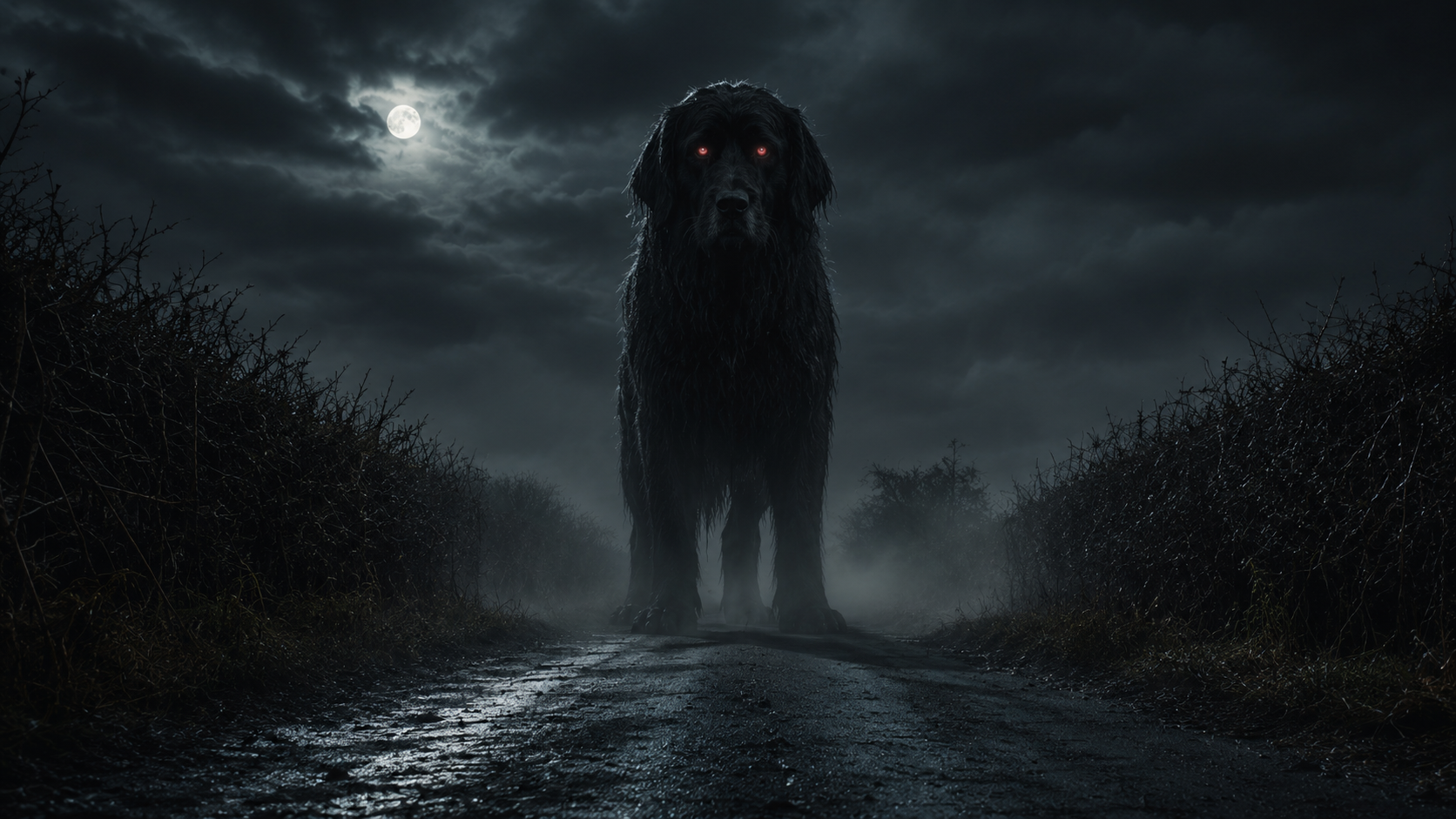
    It arrived in Appalachia looking exactly the way it had looked in Suffolk and Yorkshire and Wales. Large. Black. Eyes that were either red or yellow depending on the account, but always luminous. Moving silently on roads and lane-edges, appearing at crossroads and bridges, and meaning exactly one thing.

    Death is coming for someone you know.


    The British Originals

    The Black Dog tradition in Britain is ancient enough that establishing a single origin is probably impossible. What exists instead is a family of related regional beliefs, each with their own name and specific behavior, all sharing the central omen function.

    Black Shuck haunts the coastal areas of East Anglia. His name derives from the Old English scucca, meaning “demon” or “shadow creature.” He is enormous — descriptions range from the size of a calf to the size of a horse — and his appearances are concentrated on the lanes and shorelines of Norfolk and Suffolk. A detailed historical record of his appearance exists: on August 4, 1577, Black Shuck is said to have entered the churches at Bungay and Blythburgh during a violent thunderstorm, killing several people and leaving scorch marks on the church door at Blythburgh that are still visible.

    The scorch marks are genuinely there. They predate the legend’s first recorded appearance in print. I find this detail persistently interesting.

    The Grim is a variant that specifically haunts churchyards. In British tradition, the first person buried in a new churchyard would be obliged to haunt it and protect it from the devil — and a dog buried there in their place (a documented historical practice) would become the Grim instead. The Grim appears to those about to die. It does not cause the death. It announces it.

    In Wales, the Cwn Annwn — the Hounds of Annwn — are a pack rather than a single creature, the spectral hunting dogs of the underworld deity Arawn. Their appearance heralds death on a larger scale. In Devon, the Yeth Hounds perform the same function, sometimes ridden by headless horsemen for added context.

    The family resemblance is consistent across all of them: large, black, supernatural, ominous. Not evil in the conventional sense. Present.


    The Appalachian Persistence

    What’s remarkable about the Black Dog tradition in Appalachia is how completely it survived the transplant.

    Stories of spectral dogs appear in many North American regions, including parts of Appalachia. Some share details with British black-dog traditions—roads at night, crossroads, luminous eyes, and an encounter that feels ominous—while other versions differ in meaning and origin. A family resemblance is not proof of one uninterrupted tradition; oral stories change with every community that keeps them alive.

    In these accounts, the dog may accompany a traveler briefly, vanish, or be remembered as an omen after a loss. That retrospective connection is part of the folklore’s power, not a documented prediction.

    What I find genuinely interesting is that the Appalachian Black Dog almost never represents the traveler’s own death. It’s almost always a harbinger of death nearby. The creature is telling you something about someone else. It chose to show you. The question of why you were chosen is one the tradition doesn’t answer, which is part of what keeps it uncomfortable.


    The Dog That Watches

    There are two types of death-omen traditions in folklore, roughly speaking. The type that comes as an announcement — the banshee’s wail, the three knocks — and the type that comes as a witness.

    The Black Dog is a witness. It doesn’t perform grief. It doesn’t make noise. It simply appears and looks at you, with those luminous eyes, from the shoulder of the road.

    This is more disturbing than the announcement type, and I think it’s worth understanding why. The announcement implies a kind of relationship between the omen and the bereaved — you were specifically called to, warned, given information. The witness implies something different: that the death was already in motion, and something came to observe it, and you happened to be there.

    The witness doesn’t care about you. The witness is watching something you can’t see yet.


    Why the Crossing Mattered

    Most folklore scholars identify the Black Dog as one of the most geographically distributed supernatural traditions in Europe, appearing in some form across almost every regional tradition from Scandinavia through the British Isles and into the Iberian Peninsula. This distribution suggests the tradition is old enough that the individual national versions are regional expressions of a single archetype, not independent inventions.

    The fact that it survived the crossing to Appalachia intact, in communities that were otherwise highly adaptive with their imported folklore, suggests something specific about the Black Dog: it was too useful to change. Communities under stress need a way to talk about death’s approach. A creature that observes, that witnesses, that appears on the road between where you are and where the dead are going — that is a useful symbolic technology. It survived because it was doing real cultural work.

    It’s still doing it. Appalachian Black Dog accounts are still collected regularly in contemporary folklorist interviews. The creature hasn’t retired.

    If you’re driving the mountain roads after dark, keep your eyes on the roadside.

    If you see something large and black looking at you from the shoulder with luminous eyes, keep driving.

    And when you get home, call the people you love.


    Folklore deep dives like this one go into the research that feeds my fiction. If you want the stories themselves: There Be Monsters: Then and Now.

    For weekly folklore, dark tourism, and new horror fiction: join the Grimbard list.

  • Horror Belongs in Summer

    Horror Belongs in Summer


    Every October, the internet rediscovers horror. Watch parties. Recommendation threads. The seasonal horror content machine cranks up and runs for thirty-one days and then it’s November and everyone moves on.

    This is a problem.

    Not because October horror is bad — it isn’t, most of it is great — but because October is actually the second best season for horror, and we’ve collectively agreed to pretend the best one doesn’t exist.

    Summer is horror’s natural home. It always has been.


    The Evidence

    The original campfire story is a summer artifact. It happened because people were outside after dark, away from civilization, with nothing but firelight between them and the woods. The campfire story doesn’t exist in winter; in winter you go inside. The original horror experience is a summer experience.

    The modern slasher film was invented by summer. Camp Crystal Lake is in July. The beach in Jaws is Fourth of July weekend — not accidentally. Steven Spielberg understood that a holiday crowd on a summer beach is a specific kind of vulnerability: relaxed, exposed, nowhere to go, trusting the water the way you only trust it when the weather is good.

    The heat does something to the logic of horror that cold doesn’t. Cold is a direct threat — it kills you through the obvious mechanism of cold. Heat is stranger. It warps. Things that seem reasonable in seventy-degree weather become genuinely unstable in ninety-degree weather. The edges of things get soft. The sensible explanations feel less solid. People do things they would never do in October.

    There’s a reason the Gothic tradition has a whole sub-category of sun-drenched horror. The English countryside in summer is terrifying in ways the English countryside in winter is not.


    The Specific Texture of Summer Dread

    The horror that summer makes possible is different from the horror that autumn makes possible.

    Autumn horror is about endings — the dying of the light, the thinning of the veil, the approach of winter. It’s structurally melancholy. The threat comes from the dark.

    Summer horror is about the wrong thing happening in the light. The swimmer who doesn’t come back. The cabin that’s always been fine before. The trail you’ve hiked every year since you were a kid that feels, this year, different. The body at the bottom of the lake that the clear water makes visible.

    Seeing the threat is, in some ways, more disturbing than not seeing it. The darkness in October gives horror somewhere to hide. The July sun doesn’t. When something is wrong in summer, it’s wrong in full light. And that is a specific, underappreciated kind of awful.


    What to Read This Weekend

    If you’re looking for summer horror specifically — the kind that fits this particular season — here’s where I’d point you.

    Jaws the novel (not just the film) holds up. Peter Benchley was writing about a specific community in a specific summer, and the book has a texture the film, great as it is, doesn’t quite replicate.

    Shirley Jackson’s “The Lottery” is technically a June story, and rereading it in summer hits differently than reading it in October.

    For something more recent, anything by Paul Tremblay that happens outdoors. He understands what sunlight does to a threat.

    And if you want something short: find the campfire story someone in your family tells. The one that got passed down. The one that’s probably not entirely true but nobody can say for certain that it isn’t.

    Those are the best summer horror there is.


    The Campfire Is Still There

    I write horror the way the campfire story works: specificity, a rule that something violated, consequences that feel inevitable in retrospect. You can read them in October — plenty of people do. But I wrote most of them in the summer, sitting somewhere warm, thinking about the specific wrongness that the light reveals.

    The best horror seasons are the ones you’re actually in.

    This is one of them.


    There Be Monsters: Then and Now — thirteen creature and folk horror stories. Good for campfire. Good for the Fourth.

    Get on the Grimbard list for the folklore and fiction that feeds this corner of horror.


    Build a Better Summer Horror Reading List

    For a summer-horror stack, vary the setting as much as the monster: one lake or beach story, one rural folk-horror story, and one tale set on a trail, at a fair, or around a fire. The shared ingredient is exposure. Characters have fewer walls, fewer routines, and more reasons to insist that the warning is probably nothing.

    If the old rule is what interests you most, start with what makes folk horror different. For a shorter piece of rural unease, try “Rabbit Season”. Both take the campfire logic seriously: someone knows the rule, someone breaks it, and the consequence was waiting long before the story began.

    Continue exploring Grimbard

  • There Be Monsters: Deep Down Is Out Now — 13 Stories About What Waits Below

    There Be Monsters: Deep Down Is Out Now — 13 Stories About What Waits Below

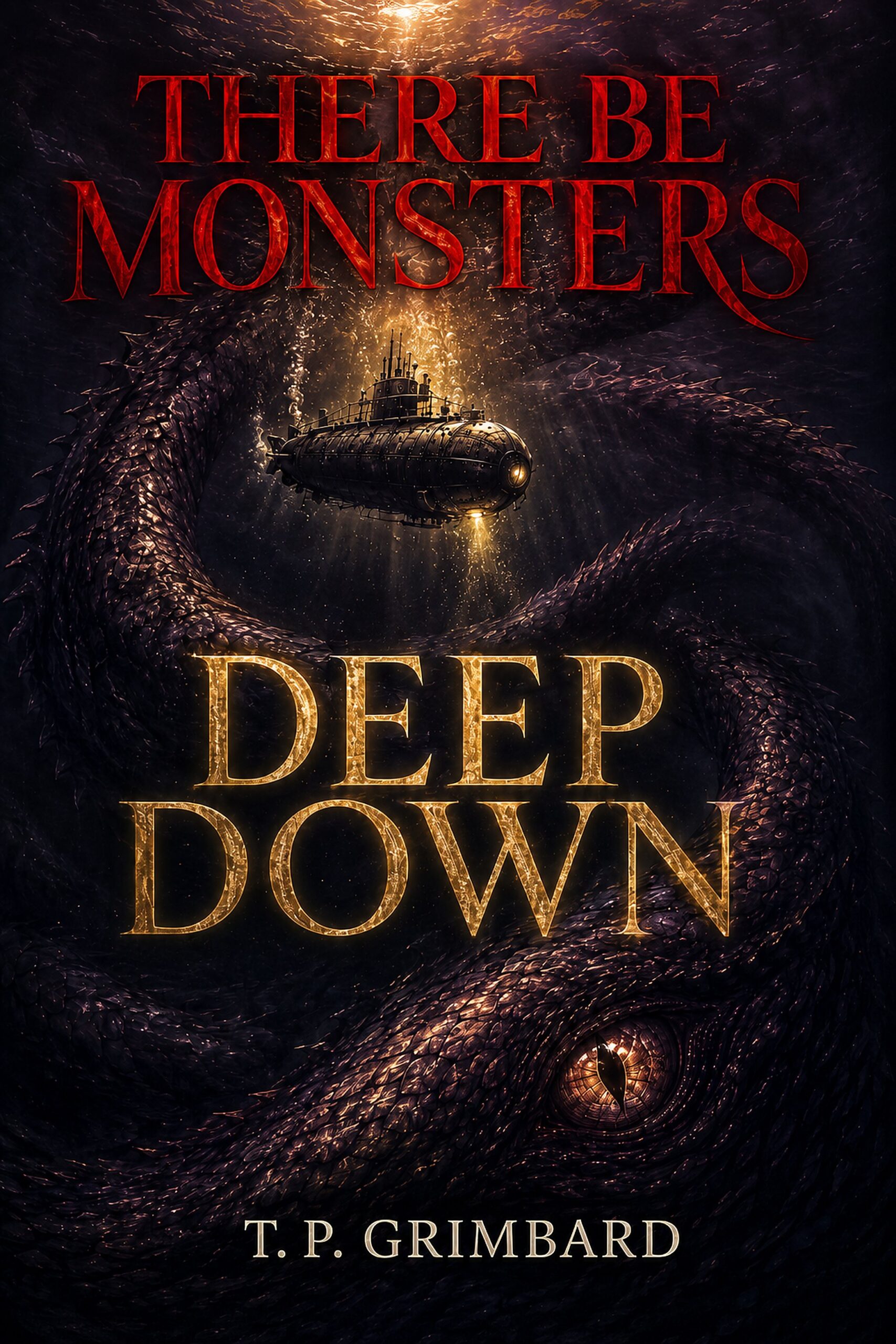
    There Be Monsters: Deep Down is available today on Amazon in Kindle ebook and 6×9 paperback — the second full collection in the There Be Monsters series.

    Thirteen stories. One direction: down. Into water, into rock, into the caves and drowned places built to keep people out, and into the parts of a person their own family never sees.

    What Is There Be Monsters: Deep Down About?

    Deep Down is a 13-story horror anthology about depth — what happens when people go looking for the bottom of something and find it’s occupied. Each story follows a different account of someone who ignored a warning that turned out to be true.

    Then and Now, the first collection in the series, kept its monsters close to the surface — in the familiar world, in places readers already had reasons to be. Deep Down goes further than that book did, into locations built to be entered once and not questioned.

    A sample of what’s waiting in the collection:

    • A sister recovers her drowned brother’s final dive footage and learns he wasn’t afraid of what took him.
    • A Navy SEAL team boards a drifting ship expecting pirates and finds eight hundred people who tore each other apart from the inside.
    • Below a Belizean blue hole, something older than the water waits exactly where the light gives out.
    Illustration of a diver discovering a sunken shipwreck in green water

    What Makes This Collection Different From Then and Now?

    Deep Down pushes further into an inhuman narrative voice — several stories are told from a perspective that experiences the world in a way that is internally coherent and externally wrong. That’s the collection’s core structural idea, and it’s what separates it from a standard monster anthology.

    The monstrous in these stories isn’t positioned as an outside threat opposing human characters. It functions as an extension of human nature — the part that the ordinary world has no category for, that has nowhere else to go, and that goes down instead. Three things carry that idea through the book:

    1. Every story is a recovered account, not a narrated legend — something that happened to a specific person who believed the warning didn’t apply to them.
    2. The horror predates the humans who find it. Nothing in this collection was summoned. It was already there, waiting in a place with no relationship to time the way people experience it.
    3. The archive format continues from Then and Now. Grimbard doesn’t appear in the stories — only collects and orders them, the way the There Be Monsters series has worked since the first book.
    Illustration of a diver descending into a Belizean blue hole

    Where Can You Buy There Be Monsters: Deep Down?

    There Be Monsters: Deep Down is available now on Amazon in Kindle ebook and paperback, and it’s enrolled in Kindle Unlimited. Because it’s part of KDP Select, the ebook is Amazon-exclusive for now — it won’t appear on Gumroad or any other storefront.

    Format Where Notes
    Kindle ebook Amazon Included with Kindle Unlimited
    6×9 paperback Amazon Same listing, print edition

    Who Is T. P. Grimbard?

    T. P. Grimbard collects warnings for a living — the kind that used to be posted at the edge of a map, before maps stopped admitting there was an edge. Every account in the There Be Monsters series is presented the way it was found: as something that happened to someone who thought the warning didn’t apply to them. The archive is always growing. It has never once gotten smaller.

    If you’re the type of reader who finishes a Deep Down story and immediately wants to know what else waits in dark water, Boxcar Children was many horror readers’ first taste of kids finding things adults had stopped looking for — and it holds up as a surprisingly good gateway into the genre.

    Get the Boxcar Children on Amazon

    New accounts, annotated classics, and a free welcome story land in your inbox when you sign up for the Grimbard newsletter.


    Pinned question for the comments: Which regional rule from your hometown do you still follow today — and do you know where it actually came from?

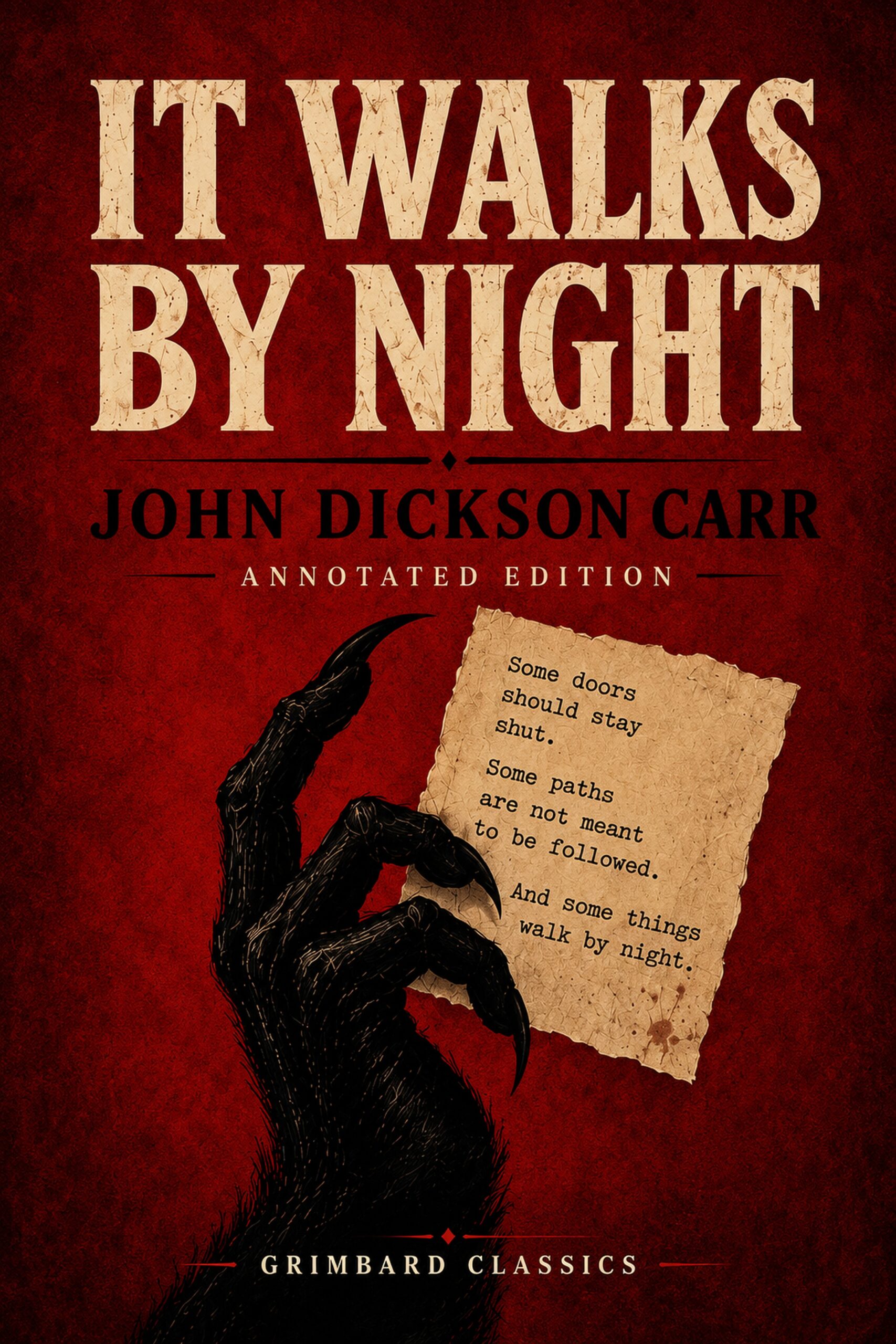
  • It Walks by Night (Annotated) Is Live — Grimbard Classics of Horror No. 2

    It Walks by Night (Annotated) Is Live — Grimbard Classics of Horror No. 2

    It Walks by Night is out now in an annotated Grimbard Press edition, available today on Amazon in ebook and paperback.

    John Dickson Carr’s 1930 locked-room horror-mystery just entered the U.S. public domain on January 1, 2026. Grimbard Press is the first imprint to reissue it with new editorial material built specifically for horror readers, not mystery collectors.

    What Is It Walks by Night About?

    It Walks by Night opens with a man’s severed head sitting upright in a sealed gambling-house card room, facing a door no one entered or left through. Detective Henri Bencolin has to explain the impossible before the killer decides someone else needs to disappear.

    The setting is Fenelli’s, a fashionable gambling house above the Seine in 1920s Paris. Two doors, one window, all three watched the entire time the murder happened. That is the puzzle Carr hands you on page one, and he does not soften it with reassurance that it will make sense later.

    Here’s what makes this one worth reading as horror and not just detective fiction:

    • The impossible crime, not the clever criminal, is the point. Carr wrote it as a 23-year-old obsessed with the idea that something could not have happened and then happened anyway.
    • Bencolin is closer to an exorcist than an inspector. His interrogations read like something out of Poe — the guilt in the room matters more than the evidence in it.
    • The book was born from theater, not crime fiction. Carr’s earlier draft, written at Haverford College, was titled Grand Guignol — a direct nod to the Parisian theater (1897–1962) that staged horror through graphic, clinical stagecraft rather than suggestion.
    Illustration of a shadowed Victorian hallway outside a locked card room

    What’s New in the Grimbard Press Edition?

    The Grimbard Press edition adds five pieces of original editorial content that don’t exist in any other current printing of the novel. The original 1930 text is untouched — everything new sits around it, not inside it.

    This is Grimbard Classics of Horror — No. 2, following The Beetle (1897) as the first title in the series. Each entry gets the same treatment: annotate a public-domain classic that belongs on a horror shelf, not just a mystery or literary-fiction one.

    New material in this edition:

    1. Editorial Introduction — “The Head in the Card Room” — context on Carr, the novel’s 1930 debut, and why it reads as horror wearing a mystery’s structure.
    2. Author Biography — John Dickson Carr’s life and his run as one of the defining voices of the locked-room subgenre.
    3. “About This Edition” — a note on the text, sourcing, and what Grimbard Press changed (nothing) and added (the surrounding material).
    4. “Edgar Allan Poe’s Shadow: Horror and the Locked Room” — an essay tracing the line from Poe’s “The Murders in the Rue Morgue” through Carr’s impossible crimes.
    5. Suggested Reading — where to go next if this is your entry point into locked-room horror.
    Illustration of a shadowed hand, one of the new interior illustrations in the Grimbard Press edition

    The edition also carries 26 new interior illustrations, available in both a full-color deluxe printing and a low-ink black-and-white edition for print-at-home readers.

    Where Can You Buy It Walks by Night?

    It Walks by Night (Annotated) is available now on Amazon in Kindle ebook and 6×9 paperback, and on Gumroad as a pay-what-you-want ebook and companion art pack.

    Format Where Notes
    Kindle ebook & paperback Amazon Live now
    Ebook — Deluxe (color) + Low-Ink (B&W) editions Gumroad Pay what you want, $2 minimum — both editions in one download
    Illustrated Art Pack — all 52 interior illustrations Gumroad Pay what you want, $7 minimum — full color + B&W sets

    Who Is T. P. Grimbard?

    T. P. Grimbard writes horror and dark fiction under a pen name built from two instincts: the Bard, a lifelong tabletop storyteller, and the Grim, the part that can’t walk past a haunted house without going in. Grimbard is also the author of There Be Monsters: Then and Now, There Be Monsters: Deep Down, the standalone story Rabbit Season, and the debut novel The Scarab.

    If a locked room with a severed head in it is your kind of opening chapter, the same instinct that built this annotated edition runs through The Other by Thomas Tryon — a slow-burn psychological horror novel about twin brothers and the kind of secret a small town keeps without meaning to.

    Get The Other on Amazon

    More annotated classics, new fiction, and a free welcome story land in your inbox when you sign up for the Grimbard newsletter.

  • The Craft of “Don’t Do X”: Why Rules Are the Most Powerful Tool in Folk Horror

    The Craft of “Don’t Do X”: Why Rules Are the Most Powerful Tool in Folk Horror

    ## The Craft of “Don’t Do X”: Why Rules Are the Most Powerful Tool in Folk Horror
    – **Post ID**: 754
    – **Status**: publish
    – **Type**: post
    – **Word Count**: 1004

    ### Content


    Three rules. That’s all the setup my story “Rabbit Season” needed.

    Bank the fire before you sleep.
    Don’t drink the spring water in May.
    Don’t shoot the white ones in winter.

    And underneath: DON’T BRING IT HOME. 1903.

    By the time a reader reaches the actual horror in that story, they’ve already done most of the work themselves. The rules told them something was out there. The rules implied a history of people who learned what they knew the hard way. And the rules established a logic — which means, in the reader’s mind, that violating them has consequences. The horror becomes almost secondary. The anticipation of violation does most of the damage.

    This is not an accident. Rules are the most powerful structural tool in folk horror, and I think about them more than almost anything else when I’m plotting.


    Why Rules Work

    The rule implies the failure.

    That’s it. That’s the whole mechanism. When you tell a reader “don’t open the door at midnight,” you have just created, in the reader’s imagination, a vivid image of someone opening the door at midnight. You’ve created the dread before the action. The rule functions as foreshadowing compressed into an imperative.

    What makes folk horror rules specifically effective — versus, say, rules in a haunted-house thriller — is that folk horror rules come attached to community. They were taught. Which means someone taught them for a reason. Which means someone, probably multiple someones, found out the hard way what happens when you don’t follow them.

    The rule is a compression of suffering. When a grandmother passes down “don’t look at the lights in the woods,” she is summarizing a trauma. The reader feels the weight of that compression even if they never see the original event. The rule carries the past with it.


    The Three Components of a Good Horror Rule

    After a lot of trial and error, I’ve landed on three things a horror rule needs to work.

    It has to be specific without explaining itself.

    “Don’t go into the woods at night” is weak. It’s too broad. It doesn’t have the texture of something real. “Don’t whistle after dark in October” is better. It’s specific enough to feel like it comes from somewhere — someone, at some point, whistled in October and received a consequence — but it doesn’t explain what. The specificity implies the knowledge. The silence implies the dread.

    It has to be possible to break.

    This sounds obvious but it’s the mistake most writers make. If the rule is impossible to violate in practice, it doesn’t generate tension. “Don’t fly to the moon” is a rule with no teeth in a contemporary setting. The rule has to be something a reasonable person could break under pressure, by accident, or because they don’t believe it. The more plausible the violation, the more the reader worries.

    It has to cost something visible when broken.

    The consequence doesn’t need to be immediate and it doesn’t need to be fully explained. But the reader has to sense that breaking the rule matters. This is often established through the rule itself — “don’t bring it home” implies that bringing something home has happened before and the result was bad enough that someone carved the warning into wood.


    The Rules Conversation as Exposition

    One technique I use repeatedly: the scene where an older character explains the rules to a younger one, and the younger one doesn’t fully believe them.

    This accomplishes three things simultaneously. It delivers the rules naturally, without the author simply listing them. It establishes the intergenerational structure of folk knowledge — the fact that someone who lived through the consequences is passing this down. And it creates dramatic irony: the reader understands the rules are real while watching the character who will eventually violate them dismiss them as superstition.

    The conversation also lets you calibrate the older character’s delivery. Are they frightened? Matter-of-fact? Resigned? The emotional register tells the reader how seriously to take the threat. The best folk horror rule deliveries are calm. Not dramatic. Not pleading. Calm and specific, the way you explain not to touch a hot stove — because the person explaining it has accepted that there’s no way to make someone understand until they’ve been burned, and they’re trying anyway.


    What Not to Do

    The mistake I see most often: explaining the rule.

    “Don’t open the cellar door because the thing in there will kill you” is not a rule. It’s a warning. It has already evacuated the mystery. The reader knows what’s in the cellar. The dread is gone.

    The rule should always know more than it says. The best rules feel like the summary of a longer story that the story itself never quite tells. You’re always building on implied history, never on explicit history.

    The second mistake: too many rules. If you have six rules in the first chapter, the reader can’t hold them all as live threats. Three is the traditional structure — it’s not arbitrary. Three is about the limit of what a reader can track simultaneously as specific sources of dread. If you need more, introduce them in sequence as the story goes deeper, not all at once at the front.


    Rules as Character

    There’s one more thing rules can do that I’ve been using more lately: they can characterize the community that made them.

    A community that has a rule against looking at the lights implies a community that believes the lights are watching back. A community that has a rule against naming certain things implies a community that believes names have power. A community that has a rule about the spring water in May implies a community that keeps records, that noticed a pattern, that did the work of encoding the survival knowledge in transmissible form.

    The rules, read carefully, tell you who these people were. What they feared and what they took seriously and what they refused to let die.

    That’s the part that keeps me coming back to this structure. The rules are a horror device. But they’re also a portrait.


    “Rabbit Season” is available now — find it on Amazon as part of There Be Monsters. More folk horror fiction coming soon.

    Join the Grimbard list for craft posts, creature features, and new fiction drops.

    ### Excerpt
    Three rules. That’s all the setup my story “Rabbit Season” needed.

    Continue exploring

  • The Mothman and the Bridge That Fell

    The Mothman and the Bridge That Fell


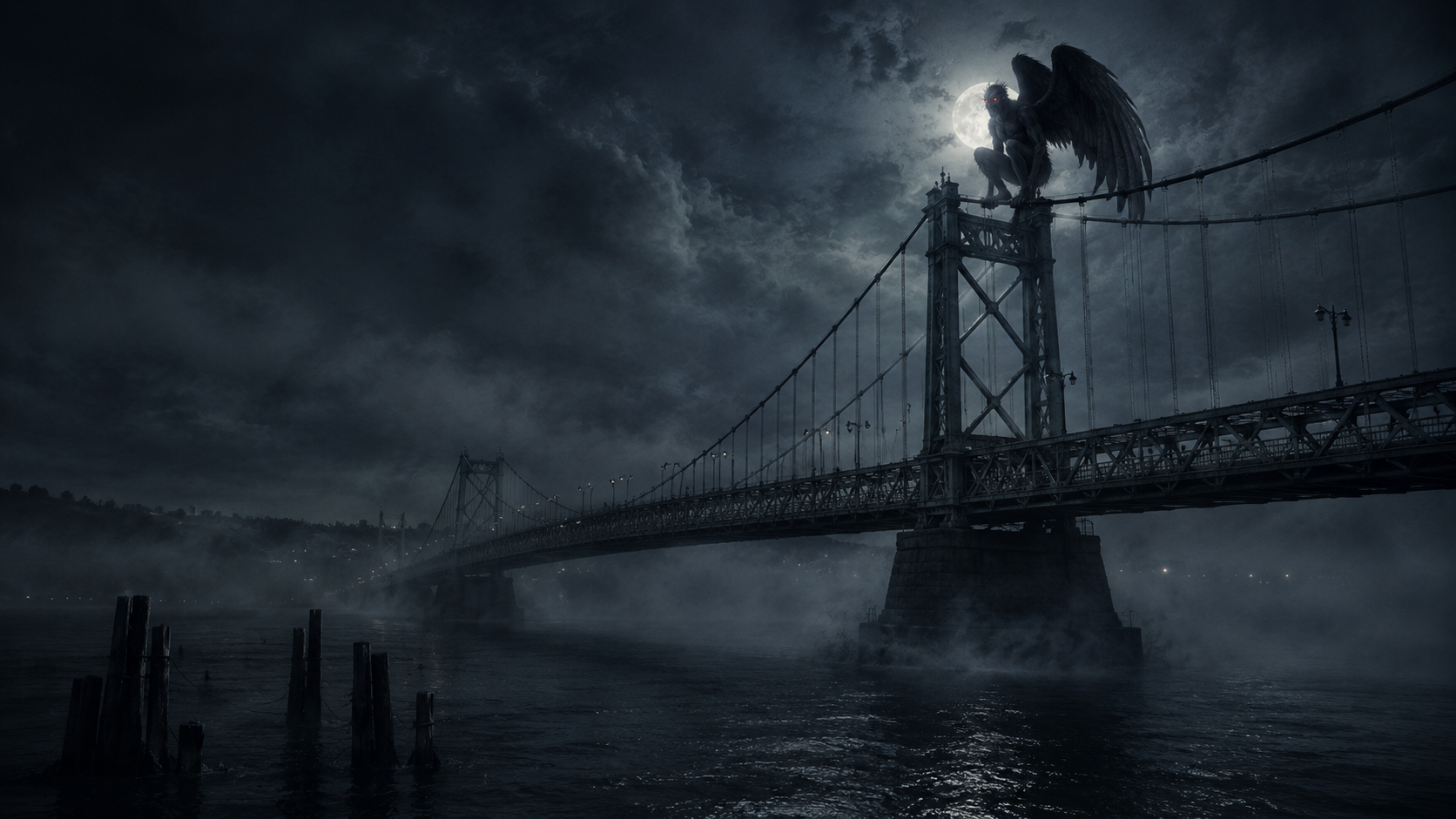
    Forty-six people died when the Silver Bridge collapsed on December 15, 1967.

    It was the evening rush hour in Point Pleasant, West Virginia. The bridge connected the town to Gallipolis, Ohio, across the Ohio River. A single corroded eyebar — one link in a suspension chain — failed first. The rest followed in under a minute. Thirty-one vehicles went into the river. The water was thirty-five feet deep. Many of the dead were still in their cars.

    The disaster was later attributed to a stress fracture in the eyebar that had been present since the bridge was manufactured in 1928. A manufacturing defect. It had been building toward failure for nearly forty years, and no inspection had caught it.

    This is the fact-record version of what happened at Point Pleasant.

    The other version begins thirteen months earlier, in November 1966, when a creature no one had a name for started appearing near the town.


    What People Saw

    The first widely reported sighting came from two couples driving near an abandoned munitions plant known locally as the TNT Area. They described a large humanoid figure, grey or brown, with wings folded against its back and eyes — the eyes are always the detail people lead with — eyes that were large, red, and reflective in headlights. The figure rose from the roadside, spread wings that witnesses estimated at ten to fifteen feet, and followed their car at speeds up to one hundred miles per hour without appearing to beat its wings.

    Over the following year, more than a hundred people in the Point Pleasant area reported seeing something similar. The accounts are not all consistent — some describe a creature closer to seven feet tall, some shorter; some report a distinct chest structure, some don’t. What stays consistent across nearly all accounts: the wings, the red eyes, and the unsettling quality of encountering something that was aware of being watched.

    Local newspaper reporter Mary Hyre documented many of the sightings. She also reported, in the same period, an increase in anomalous phenomena around the town — unusual telephone interference, Men in Black-type encounters, poltergeist activity. John Keel, the journalist and paranormal investigator whose work eventually became The Mothman Prophecies, arrived in 1967 and spent months in the area interviewing witnesses.

    And then the bridge fell, and the sightings stopped.


    The Harbinger Question

    The leap that popular culture made — Mothman as disaster prophet, a creature that appears before catastrophes to warn the unheeding — is more complicated than either believers or skeptics tend to present.

    The factual record is this: the Mothman sightings clustered in a thirteen-month period and ceased after the Silver Bridge collapse. Witnesses who claim to have seen it reported feeling dread, not danger. No one reported the creature pointing at the bridge. No one reported anything that could be interpreted as a specific warning.

    What happened was that the disaster arrived, the sightings stopped, and human pattern recognition did what human pattern recognition does: it connected the preceding anomaly to the tragedy that followed. This is called the clustering illusion and it’s one of the most consistent features of human cognition. We are extremely good at finding patterns and extremely unreliable at distinguishing real patterns from coincidental ones.

    And yet.

    Later retellings connect Mothman-like sightings to disasters far beyond Point Pleasant. Those claims are difficult to verify and should be treated as folklore, not as a documented warning system. The Point Pleasant pattern is the one with the clearest contemporary reporting: unusual sightings first, catastrophe later, and a community trying to make sense of both.

    That distinction matters. A legend can be meaningful without becoming proof. The enduring power of Mothman is not that it predicts disasters, but that it gives a visible shape to dread before anyone knows what the dread is about.


    What the Creature Might Actually Be

    Here’s where I find the Mothman legend genuinely interesting as a piece of cultural history: the biological explanations are more plausible than most people realize, and they don’t actually resolve the problem.

    The most credible naturalistic explanation is that witnesses encountered a Sandhill Crane — a large migratory bird with a wingspan of up to seven feet and eyes that reflect red in low light. This is not a bad explanation. The TNT Area is adjacent to wetlands that cranes use. The height of some witness descriptions matches a crane in flight at unusual angles.

    But it doesn’t explain the hundred-mile-per-hour pursuit. It doesn’t explain the consistent account of red eyes that were described as watching. It doesn’t explain the broader anomalous phenomenon period that Hyre and Keel both documented independently.

    The biological explanation handles the creature. It doesn’t handle the context.

    What I think the Mothman legend is — and this is purely my read — is a community under prolonged stress (Point Pleasant had significant industrial problems, economic decline, and several smaller-scale disasters in the preceding years) generating a meaningful symbol for anxiety it couldn’t otherwise articulate. The creature showed up when things were already wrong. The bridge confirmed what the appearance had suggested.

    Communities do this. They have always done this.

    The Mothman didn’t cause the bridge to fail. But it might have been the shape that the town’s dread took when it needed somewhere to live.


    Point Pleasant Now

    The town of Point Pleasant has fully embraced its most famous inhabitant. There’s a Mothman Museum on Main Street and a twelve-foot stainless steel statue that has become one of the more photographed roadside attractions in West Virginia. The annual Mothman Festival draws tens of thousands of people every September.

    This is not cynicism — I’ve been to roadside attraction towns and I’ve watched communities find dignity and economic purpose in owning their strange history. Point Pleasant does it well.

    The TNT Area is still there. The wetlands are still active. Sandhill cranes still migrate through.

    If you go in November, and you’re driving the back roads after dark, and something large rises from the roadside ahead of you and holds your headlights in its eyes —

    Well. You’ll know to pay attention to the bridges.


    Creature features, folklore deep dives, and the horror that lives in specific places — join the Grimbard list.

    If you want to read the fiction this research feeds: There Be Monsters: Then and Now


    What is established—and what remains folklore?

    • Established: the Silver Bridge collapsed on December 15, 1967, killing 46 people; investigators traced the failure to a defective eyebar.
    • Documented local legend: Point Pleasant residents and local reporter Mary Hyre recorded Mothman sightings during the preceding thirteen months.
    • Unresolved: what witnesses saw, and whether the sightings had any connection to the collapse. Neither the creature nor a predictive link is established by the historical record.

    For the larger question of why communities turn a frightening place into a story, read what makes folk horror different. For another creature legend handled with the same evidence-first approach, explore the Monster Lore archive.

  • What Visiting Haunted Places Actually Feels Like

    What Visiting Haunted Places Actually Feels Like


    My partner and I have a tradition when we travel. Before we book anything, we look up what died there.

    Not morbidly — or not only morbidly. It’s more that the historical weight of a place interests us, and that weight is usually attached to the bad things. The flood. The fire. The crime that nobody quite got to the bottom of. The building that used to be something else before it was what it is now.

    We’ve done ghost tours in a dozen cities. We’ve walked through cemeteries at hours that made the groundskeepers nervous. We’ve stood in rooms where, by every account we could find, something happened that the people who lived through it couldn’t explain.

    I want to tell you what that actually feels like — not what the tour guides say it feels like, and not what the skeptics say it feels like. What it actually feels like, from someone who pays attention for a living.


    The First Thing Is the Cold

    Not in the “cold spot” paranormal sense, though those are real enough. The first cold is the one you feel before you know why.

    We were in a 19th-century hotel in Savannah — I won’t name it because Savannah has so many haunted hotels that naming one feels like endorsing a TripAdvisor entry — when I walked into a hallway on the third floor and stopped. My partner, two steps behind me, also stopped.

    Neither of us said anything for a moment. Then she said, “Do you feel that?”

    I did. Something in the air pressure, maybe. Something in the way the light behaved. There was no visible reason for either of us to stop.

    The room at the end of that hallway, we found out later, was the one.

    I’m not making a supernatural claim. I’m making an observation: human beings have threat-detection systems that are very old and often accurate, and old buildings that held bad events have a way of triggering them in people who aren’t defended against them. Whether that’s atmospheric or architectural or something genuinely paranormal is a question I don’t have a confident answer to.

    What I do have is the memory of stopping in that hallway.


    What the Tour Guides Know

    Ghost tour guides are, almost universally, the most interesting people in any city.

    They are amateur historians who became professional storytellers through necessity — nobody hires you to just stand on a street corner and recite municipal history. You need the ghost. But to get the ghost right, you have to get the history right. The haunting is the hook; the history is the substance. The best guides understand that the history is scarier than the ghost.

    The guide who walked us through a preserved antebellum district in South Carolina didn’t dwell on the apparition sightings. She spent forty minutes on the documented history — the people who died there, the records that survive, the gap between what the official accounts say and what the oral tradition preserved. By the time she got to the story of what people claimed to see in the third-floor window, she didn’t need to sell it.

    The thing had weight.


    What the Skeptics Get Half Right

    Skeptics are correct that most people on ghost tours experience what they came expecting to experience. Priming is real. If you tell someone a room is haunted and then dim the lights, you will generate phenomenological reports of haunting. This is not controversial.

    What the pure debunking stance misses is that “you experienced what you came expecting to experience” doesn’t fully explain every account, and it doesn’t explain why the content of those accounts is so consistent across time, culture, and witness.

    Recurring stories deserve a second look, but they are not automatically proof of a haunting. A repeated account may reflect a well-known local narrative, a striking feature of a room, or details passed between visitors. The useful question is not “can this be proven supernatural?” but “what is documented, what is reported, and what might have shaped the report?”

    I hold those categories loosely. I can value an unexplained experience without treating it as evidence for a single explanation.


    Why We Keep Going

    The honest answer is that visiting these places is a form of paying attention to the dead.

    History has a way of becoming abstract — names and dates and events compressed into summaries that carry no weight. Standing in the room where something happened does something that reading about it does not. The scale comes back. The reality of it.

    I write horror about places. The specific texture of a room, a hallway, a ridge at dusk. I can’t generate that texture from research alone. I need to stand somewhere and let it do what it does.

    My partner comes because she finds history genuinely moving, and because she has, on two occasions, experienced things she hasn’t found a satisfying explanation for. She isn’t frightened by those experiences. She finds them interesting. It’s one of the things I like most about her.

    The cold in the hallway. The woman in gray. The man on the ghost tour who looked at you like you’d asked about roads.

    These are not the same kind of evidence. But they’re all evidence of something. The places hold what happened in them, one way or another.

    I’d rather go look than not.


    Writing about haunted places and folk horror — join the Grimbard list for creature features, dark tourism notes, and new fiction: Join the Grimbard list


    How to visit a haunted place well

    • Start with the documented history, not the ghost story. A good local museum, archive, or historical society is more useful than a viral list.
    • Respect the setting: cemeteries, memorials, private homes, and sites of violence are not props or after-hours attractions.
    • Notice conditions before interpreting them. Light, noise, suggestion, fatigue, and unfamiliar architecture can all change what a place feels like.
    • Leave room for uncertainty. “I do not know” is more interesting—and more honest—than forcing an experience into belief or disbelief.

    If you are drawn to the way history, place, and an old story reinforce each other, read what makes folk horror different and browse the Monster Lore archive.