
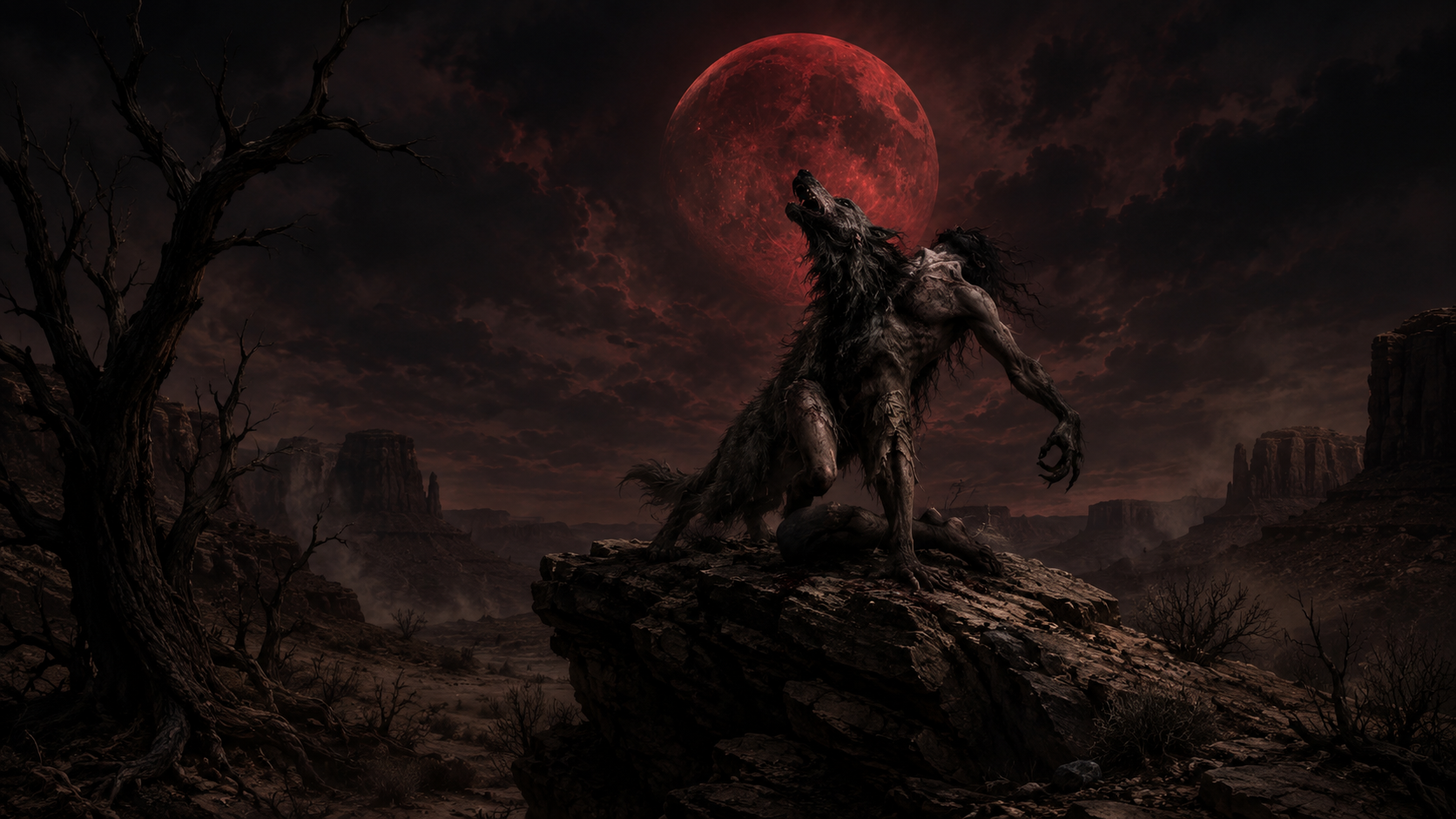
The version of the Skinwalker that lives on Reddit is a bipedal thing that chases cars on desert highways. A speed demon. Something you catch at the edge of your headlights doing something no human body should be able to do — running alongside you at seventy miles an hour, or crouched where it shouldn’t fit, or looking at you from the wrong direction in your mirror.
That version is terrifying. It’s also about forty percent of the actual tradition, stripped of the part that makes it genuinely disturbing.
The Skinwalker — yee naaldlooshii in Diné bizaad, which translates roughly as “by means of it, it goes on all fours” — is not primarily a speed story or a pursuit story. It is a transformation story. And the thing it transforms is the most frightening part of all.
What Gets Made
A yee naaldlooshii is a human being who has chosen to become something else.
Not cursed. Not bitten. Not inherited. Chosen.
In the Navajo tradition, a Skinwalker is a practitioner of ‘ánt’įįhnii — what outsiders translate as witchcraft — who has completed a specific, deliberate act of corruption. The nature of that act varies in specificity across accounts, but the consistent element is this: it involves the killing of a close family member. A sibling. A parent. A child.
The Skinwalker does not become evil through supernatural contamination. The evil act is the threshold. You have to cross it yourself.
This is what separates the yee naaldlooshii from almost every other monster in Western horror tradition. A werewolf is often a victim. A vampire was transformed by violence done to them. Even the ghost typically died in circumstances they didn’t choose. The Skinwalker chose — and what they received in exchange is not just speed or shapeshifting, but the removal of the constraint that had held them inside a human moral framework.
The power is real. But the cost is your self.
The Skin and What It Means
The “skin” in Skinwalker is literal. The practitioner wears the pelt of an animal — typically coyote, wolf, fox, owl, or crow — to take on that creature’s form. This is where the highway encounters come from; a person wearing a wolf skin running faster than a vehicle, or a figure crouched impossibly in the road, is the physical expression of a human inside an animal body.
But the specific animals matter. Every one of them carries weight in Navajo cosmology. Coyote is the trickster, the boundary-violator, the one who appears at the margins of order. Wolf is dangerous power. The owl — same as with the Wendigo tradition — carries the dead. These aren’t random choices. The practitioner isn’t just putting on a disguise; they’re wearing a relationship to the world.
The closest thing in Western tradition might be the berserker — a Norse warrior who wore a bearskin and was said to fight in a state beyond human reckoning. But the berserker transformation was temporary. The yee naaldlooshii does not have an off switch. The boundary between the practitioner and the animal gets thinner with use. Eventually, some accounts suggest, there’s nothing left that remembers being human.
The Skinwalker Ranch Problem
In 1996, a Utah ranch became famous — notorious — as a hotspot for Skinwalker activity. Livestock mutilations. UFO sightings. Poltergeist phenomena. A series of books, a documentary, and eventually a cable television series followed.
Here’s the problem: Skinwalker Ranch is in the Uintah Basin of northeastern Utah. The land is associated with the Ute people, not the Navajo. The Skinwalker is a specifically Navajo tradition. The two are not the same.
The conflation is not harmless. When a piece of indigenous knowledge gets detached from its cultural origin and reapplied to a piece of land it has no historical connection to, what you get is not expanded understanding — you get a brand. The terror tourism around Skinwalker Ranch has generated considerable money. The Navajo Nation has generated approximately none of it. And the tradition gets used in ways that erase the context that makes it meaningful.
I’m not saying the Uintah Basin doesn’t have strange history. It might. But whatever is happening there is probably better understood through Ute cosmology, if through any indigenous lens at all.
The Skinwalker has been adopted by horror culture in ways that the community it came from has, repeatedly and explicitly, asked people to stop. When you see that pattern — a specific ask from a living culture to stop appropriating their spiritual tradition as entertainment — it’s worth pausing to ask what you actually gain by ignoring it.
Why the Warning Still Matters
Strip the cultural mechanics away entirely and the core of the Skinwalker legend is this: power is available to people who are willing to do the thing that cannot be undone. And the transformation that follows isn’t just physical. You don’t just get fast. You get outside the community that would hold you accountable. You become something that moves at the margins, that cannot come back into the firelight, that must keep moving because stopping means being seen for what you are.
Every community has people who chose that trade.
The Navajo had a name for them. That’s not superstition. That’s observation, compressed into a form that survives.
Horror draws on traditions like this one because they’ve already done the work — they’ve looked at the dark thing directly and named it. I try to do the same in my fiction. If you want to see what that looks like, There Be Monsters: Then and Now is a good place to start.
Want more folklore, creature features, and the kind of horror that came from somewhere real? Join the Grimbard list.