
Why Is the Number 13 Unlucky? The History Behind Triskaidekaphobia
Thirteen is missing from elevator panels, hotel floors, airplane rows, and sometimes dinner-party plans. The fear even has a name: triskaidekaphobia, from Greek roots for thirteen and fear.
But the short answer to why 13 is unlucky is less tidy than the superstition itself. There is no single securely documented ancient moment when the world agreed that thirteen was cursed. What we have is a layered folk history: older symbolic habits, religious stories, nineteenth-century popularization, commercial avoidance, and the ordinary human urge to remember the bad day that confirmed a rule.
That does not make the belief trivial. A superstition can shape a building even if nobody can point to its first brick.
The trouble with the “one origin” story
Most quick explanations name one source: the Last Supper, a Norse myth, an old Babylonian law code, or the alleged fatality of the thirteenth guest at a table. These stories are attractive because they make the fear feel ancient and inevitable.
The record is messier. A number can carry different meanings in different places. Thirteen has been treated as lucky, sacred, ordinary, or ominous depending on culture and context. The specific Western association with bad luck did not arrive as one sealed package from antiquity.
One persistent claim deserves special caution: that the Code of Hammurabi skipped a thirteenth law because Babylonians feared the number. The apparent omission comes from modern editorial numbering, not a documented ancient superstition. It is exactly the kind of clean origin story folklore likes to invent after the fact.
Nathaniel Lachenmeyer’s history of the number tracks the belief through several strands rather than pretending there is one source to blame.[^1] That is the useful approach. Twelve often reads as complete—months, signs, hours, a jury, apostles. Thirteen can look like the figure that arrives after the pattern has closed. But symbolic discomfort is not the same thing as a universal rule of bad luck.

Illustration: superstition often begins where a familiar pattern appears to have one piece too many.
The Last Supper and the table for thirteen
Christian tradition is one important part of the later Western story. The Last Supper is commonly invoked because thirteen people are traditionally understood to have sat at the table: Jesus and the twelve apostles, with betrayal and crucifixion immediately following in the narrative.
That association helped make a dinner table of thirteen feel ominous in parts of Europe and North America. But it is not proof that the number was universally feared beforehand, nor does it explain every later custom. It is one powerful story among several.
Folklore often works this way. A memorable narrative attaches itself to a number, object, date, or gesture. The association becomes easier to repeat than the history that complicated it. Soon a hotelier can omit a floor without needing to know whether the customer is thinking about theology, a bad dinner guest, or a film franchise.
The number survives because it is portable. It can sit at a table, over an elevator door, on a calendar, or in the seat number you would rather not have on a long flight.
Friday the 13th is a later fusion
Fear of thirteen and fear of Friday are often treated as one ancient superstition. They are better understood as separate anxieties that became a powerful combined symbol relatively late.
Friday had accumulated associations with misfortune in some Christian contexts. Thirteen had its own bad-luck reputation. Literature, journalism, film, and seasonal repetition helped fuse them into the phrase everyone recognizes now: Friday the 13th.
That fusion is a useful reminder that popular culture does not merely repeat superstition. It manufactures its furniture. A novel, a headline, a movie poster, or a yearly warning can make a custom feel older than it is. Repetition gives the superstition a calendar appointment.
The fear is not the same everywhere. In some places, a different date carries the ominous weight; in others, thirteen is not especially unlucky at all. The variation is not a footnote. It is the point. Superstitions are local agreements about which patterns deserve attention.
That is also why figures such as the Black Dog can change from report to report without losing their grip. A legend stays useful when a community can keep adapting it to the anxiety nearest at hand.

Illustration: the number becomes ominous when an ordinary social arrangement gives it a story.
Why buildings still skip the thirteenth floor
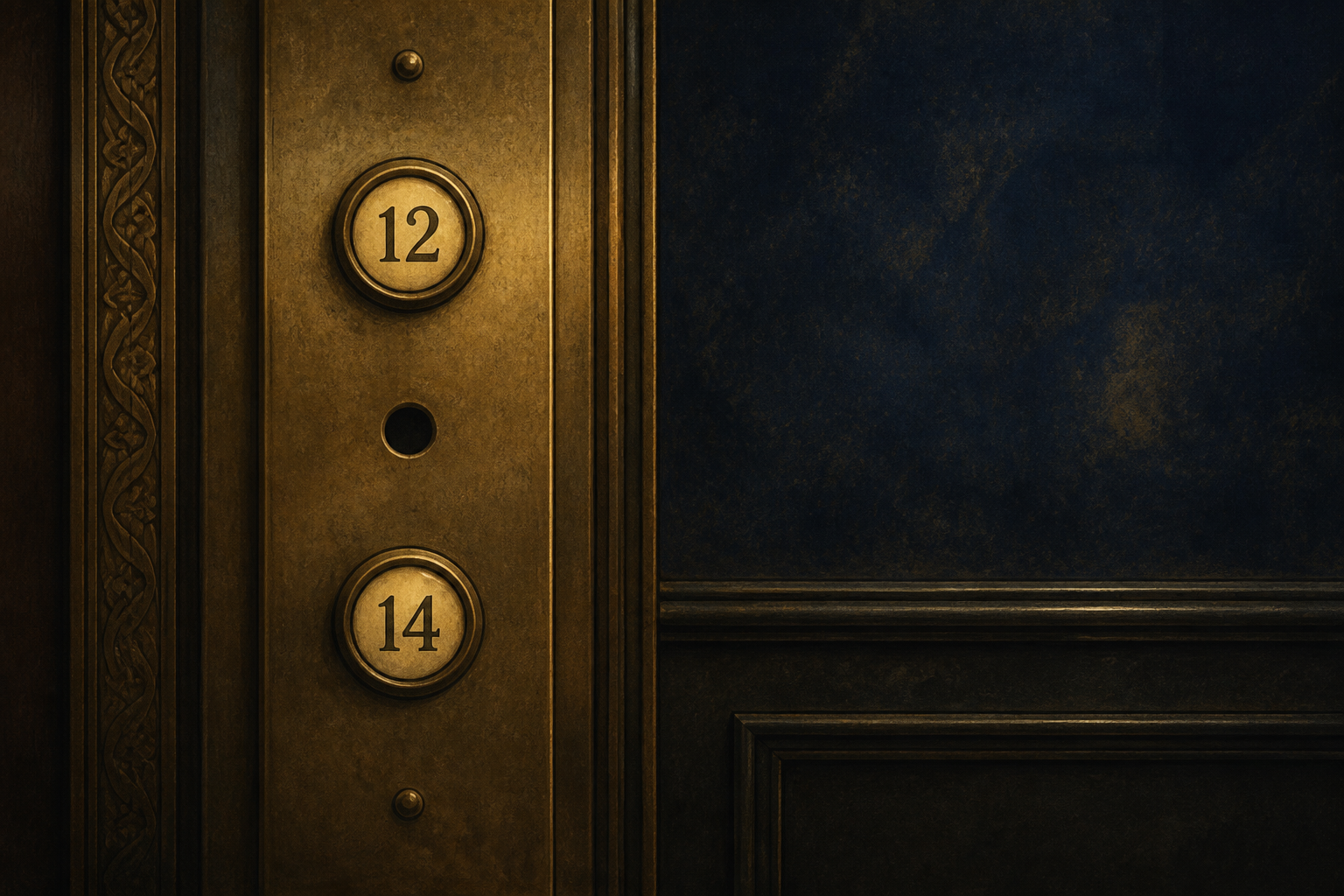
An elevator that jumps from 12 to 14 is not evidence that architects believe a number changes concrete. It is evidence that buildings are also businesses.
If a portion of guests, buyers, or tenants dislikes the number, omitting it can feel like inexpensive insurance. The choice then reinforces the belief for everyone else. A child sees no 13 button and learns that the absence must mean something. The superstition becomes part of the environment, not merely a story told about it.
That is why superstition deserves better than a smug dismissal. It is not always an individual conviction. It can be a system of small accommodations—one floor, one room number, one missing seat—that makes a shared anxiety visible.
The feeling has something in common with why a face can look strange in a dark mirror. Once you expect the pattern to be wrong, your attention begins doing work on its behalf. The missing number is an invitation to notice every bad thing that follows.
Why a superstition survives after people stop believing it
Most people who avoid a thirteenth floor do not think they are making a metaphysical claim. They may say they are only being cautious, honoring a preference, or sparing themselves an unnecessary moment of unease. That is exactly how a superstition gains durability. It no longer needs total belief; it needs only enough small acts of avoidance to keep appearing in the world.
The effect is self-reinforcing. A building omits 13 because people recognize the custom. Visitors then encounter the omission and treat it as proof that the custom matters. The missing label is a tiny piece of environmental storytelling: it establishes a rule without explaining the rule. Horror uses the same device when a character finds a hotel with no room 13, a street with no house 13, or a ledger that jumps over a number. The absence turns an ordinary system into a suspect one.
There is also a practical reason this particular fear is so memorable. Numbers feel objective. A locked door can be interpreted; a number seems to be simply there. When a culture makes one number feel contaminated, it gives anxiety an easy handle. You can count toward it, avoid it, and notice it anywhere. That portability is why thirteen has outlived many of the stories people use to explain it.
The Grimbard reading: thirteen is frightening because it is a loose thread
Horror does not need thirteen to have occult power. It needs the number to arrive after an orderly sequence and make someone wonder whether the order was ever secure.
Twelve shuts the door. Thirteen is the person still standing in the hall.
That is a much better use for the superstition than a list of fake ancient facts. Let the number remain what it has become: a cultural loose thread, pulled tight by stories until even an elevator panel looks like it is keeping a secret.
For more folklore that separates a good story from a good source, join The Grimbard Press and receive Dead Ship, a free illustrated Subscriber Archive Edition.
FAQs
What is triskaidekaphobia?
Triskaidekaphobia is the term commonly used for fear of the number thirteen or a strong belief that it brings bad luck.
Is 13 unlucky in every culture?
No. Number symbolism varies widely. Thirteen is not universally treated as unlucky, which is one reason a single-origin explanation is misleading.
Why do hotels skip the 13th floor?
Many hotels and buildings omit the label because some customers prefer to avoid it. The choice is usually a commercial accommodation, not a claim that the physical floor does not exist.
Did the Code of Hammurabi omit 13 because it was unlucky?
No reliable evidence supports that claim. The apparent missing number comes from later editorial numbering, not an established Babylonian taboo.
[^1]: Nathaniel Lachenmeyer, 13: The Story of the World’s Most Notorious Superstition, Smithsonian Institution catalog record.