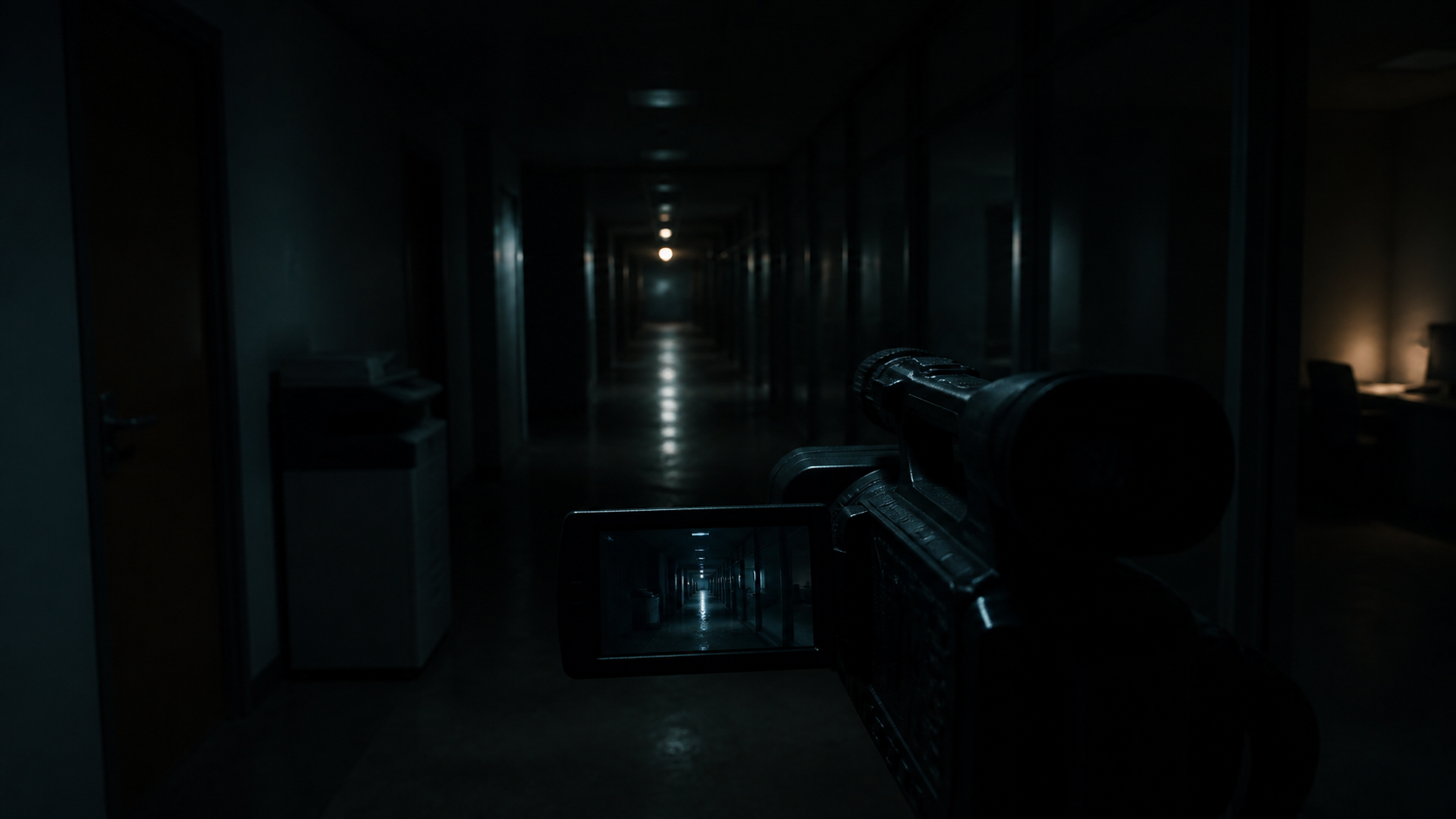
The camera shakes. Someone says they heard something downstairs. The image breaks apart at the exact moment you would like it to become useful.
Found-footage horror works because it does not present itself as a finished story. It presents itself as evidence with a hole in it. The viewer is not merely asked to watch a character make a mistake. The viewer is asked to inspect the record afterward, to notice the shadow at the edge of the frame, and to live with the fact that the camera stopped before it answered the only question that mattered.
Found footage feels real because the frame is restricted, the recorder is inside the danger, and the evidence arrives without an all-knowing narrator. It uses limitation as a source of dread. The audience has to supply the explanation, and audiences are exceptionally good at supplying a bad one.
The camera is a witness, not a window
In conventional film language, the camera is often invisible. It can be anywhere, cut away from danger, show us the threat, then show us the reaction. Found footage changes the contract. The camera belongs to someone in the story. It has a reason to be there, a person holding it, a battery that can fail, and blind spots created by fear.
That makes every decision about the frame meaningful. Why are they still recording? Why did they pan left? Why did they not look behind them? The camera does not have to be realistic in a documentary sense to be effective, but it has to have a story role. A device held by a character is a promise that somebody may later find what it recorded.
The promise is cruel. It turns survival into an editing question.
Evidence is scarier when it is incomplete
Illustration: found-footage horror turns evidence, limitation, and refusal into tension.
The form’s best trick is refusing to show enough. A sound occurs offscreen. A face appears for two frames. A message is interrupted. The viewer receives a piece of information that demands interpretation but cannot support a stable one.
This is different from withholding information because a story has not decided what it means. Good found footage withholds with precision. The gap has shape. We know what kind of answer is missing: who opened the door, what was moving in the treeline, why the speaker suddenly stops using a name.
That is close to the power of a folk-horror rule. In the craft of “don’t do X”, a prohibition is frightening because it reveals a system without fully explaining it. Found footage turns the system into a damaged file. The rule may be written in the margins, and the person who knew it is already gone.
The frame forces the viewer to participate
A wide, polished horror shot can be beautiful. A found-footage shot is often narrow, badly lit, and late to the important thing. That inconvenience is not a flaw when the film understands it. The viewer starts scanning the edges of the image, listening for a sound beneath dialogue, and doubting whether a glitch was an accident.
The audience becomes a co-investigator. It performs the labor normally done by exposition: matching timestamps, reading background objects, wondering whether the narrator is reliable. The form creates fear by making attention feel necessary. If you stop looking, you might miss the clue. If you keep looking, you may see it.
Writers can borrow this without copying a handheld-camera aesthetic. A recovered voicemail, an incident report with redactions, a security log, or an email thread can all behave like found footage. The key is not distortion. The key is evidence that has a point of view and a limit.
Glitches are punctuation, not plot
Illustration: frame edges and offscreen space create found-footage tension.
Bad found footage mistakes technical noise for dread. A corrupted image is not automatically frightening. It becomes frightening when corruption takes something specific away.
Let the audio fail after a name is spoken. Let a camera drop its signal during the one moment a witness turns toward the door. Let the automatic timestamp continue after everyone has left the room. Each interruption should sharpen the question rather than decorate the scene.
This is where the form resembles a room that feels wrong. The reader does not need to be told that the atmosphere is uncanny. Give them the bad detail: the security camera has a blind spot exactly where the employee badge reader is; the footage restarts with the door open; the report’s author has crossed out their own name.
Evidence, limitation, refusal
My working framework for found-footage horror has three parts.
Evidence: The file contains something the audience can examine. It must be concrete enough to invite judgment.
Limitation: The file cannot see, hear, or preserve everything. The limitation should arise from the device or narrator, not from the author hiding behind fog.
Refusal: The story denies total closure. It leaves a remaining fact that cannot be reconciled without making the horror smaller.
That last part is the hardest. A refusal is not a random ending. It is an ending that understands exactly what answer it is withholding and why an answer would betray the form. The best final image does not say, “Nothing was explained.” It says, “This was all the explanation anyone got.”
The file stays open
Found footage is not realistic because cameras make things true. It is realistic because cameras make people believe there ought to be an answer. We trust the recording, then discover the recording has needs, blind spots, and fear of its own.
The final terror is not that the footage is fake. It is that it may be genuine and still useless when you need it most.
For after-hours horror built from ordinary systems that refuse to behave, On the Clock, After Dark is the next file to open. Join The Grimbard Press for Dead Ship, a free illustrated Subscriber Archive Edition, and more stories that leave just enough evidence behind.
FAQs
Why does found-footage horror feel more realistic than ordinary horror?
It frames events as incomplete evidence recorded by someone inside the story. Limited vision, imperfect sound, and missing context make viewers actively interpret what they see.
Does found footage need a shaky camera?
No. The defining feature is a story-world recording with limits and a reason to exist. Security footage, voice notes, screen recordings, and recovered documents can use the same principle.
What makes a found-footage glitch scary?
A glitch works when it removes or distorts a meaningful piece of evidence. Random static becomes repetitive quickly; an interruption at the wrong moment creates a specific unanswered question.
How can writers use found-footage techniques in prose?
Use a document or recording with a clear author, purpose, and limitation. Let its omissions arise naturally, then leave one crucial fact unresolved rather than explaining every anomaly.
Sources and further reading
This is a craft analysis. Verify all credits, dates, and plot details against the original film or its distributor before naming a specific work in the published version.