Tag: workplace horror

  • Why Does Workplace Horror Work? When the Shift, the Rules, and the Building Turn Hostile

    Why Does Workplace Horror Work? When the Shift, the Rules, and the Building Turn Hostile

    Workplace horror works because a job already comes with rules that can override instinct. You clock in, follow procedure, answer the call, finish the shift, and avoid making trouble. When a horror story turns one of those ordinary expectations against its worker, the reader immediately understands the trap. Leaving may cost rent money. Ignoring a supervisor may cost a reference. Breaking a rule may feel dangerous even before the rule becomes supernatural.

    The monster in workplace horror is often not the building itself. It is the system that makes a person stay in the building after the sensible thing would be to run.

    Familiarity is the first weapon

    Offices, warehouses, hospitals, hotels, stores, and security desks are not gothic castles. That is the point. They are places with fluorescent lighting, break rooms, badge readers, paperwork, and a person who will ask why you left early. Horror changes one small thing—a door that must never be opened after 2:00 a.m., a customer who cannot be acknowledged, an elevator that stops at a floor the building does not have—and the normal setting becomes a pressure chamber.

    Chicago Public Library’s workplace science-fiction and horror reading list points toward the breadth of the mode: work can be a laboratory, a corporate maze, a service counter, or a job that erodes the boundary between self and institution. The setting travels because labor is already intimate. It tells us when to wake, where to sit, what to wear, and how much of ourselves to perform.

    The rules are believable before they become sinister

    Rules horror succeeds when the first few instructions are plausible. Lock the rear entrance. Do not discuss customers outside the store. Call maintenance if the lights flicker. The reader recognizes workplace procedure and accepts it before the list turns strange.

    Then comes the line that changes everything: do not answer the intercom after the third ring. If a coworker asks you to cover the basement, confirm their name twice. If you see the manager in the north hall, do not let them know you saw them.

    The fear does not come from randomness. It comes from the implication that someone has learned these rules the hard way. A rule is a fossil of an earlier incident. Every instruction suggests a missing report, a previous worker, a consequence management has filed away instead of fixing.

    For a closer look at why warnings and prohibitions carry such force, see “The Craft of ‘Don’t Do X’: Why Rules Are the Most Powerful Tool in Folk Horror”. Workplace horror borrows that folk mechanism and gives it an employee handbook.

    Economic pressure makes “just leave” impossible

    Readers often ask why a character stays. Workplace horror has a built-in answer: people need the job. The strongest stories do not use that fact as an excuse for foolishness. They show the costs clearly. The worker has a lease, a family obligation, a bad employment history, no paid time off, or a manager who has trained everyone to accept the unacceptable.

    That does not mean every workplace story must become a social-realist lecture. It means the supernatural pressure is more convincing when it attaches to a real human calculation. A haunted factory is scary. A haunted factory where the night supervisor says payroll will be delayed if anyone reports an accident is scarier, because the lie has a recognizable shape.

    The genre can also make bureaucracy itself uncanny. A form asks for a date that has not happened. A password changes to a dead employee’s name. A disciplinary meeting is scheduled with no organizer. The institution speaks in a voice that is both impersonal and much too close.

    After-hours spaces remove the witnesses

    During the day, a workplace has noise, routine, and other people. At night, a familiar floor plan can become a map of places no one is watching. The vending machine hum becomes company. A security camera offers the comfort of surveillance until the worker realizes it is aimed in the wrong direction.

    That is why night shifts are scary even without a monster: the shift reverses the social world. You are awake when everyone else is unavailable, responsible for a building designed for crowds while almost entirely alone. Workplace horror takes that condition and asks what happens when the building starts treating the worker as its last remaining employee.

    The workplace monster is usually a bad manager in another mask

    There is a dark joke at the center of the genre. The monster may be ancient, but it still needs you to complete your tasks. It tracks compliance, punishes absence, and uses opaque language. In that sense, workplace horror is not an escape from ordinary dread; it is an exaggeration that reveals the ordinary dread’s outline.

    The best stories preserve ambiguity. Is the company hiding a creature? Is the creature simply what the company has always been? The reader should feel both possibilities working at once.

    Clock in carefully

    If the horror of rules, shifts, and places that want something from their workers is your preferred kind of dread, On the Clock, After Dark is the direct Grimbard route. It is for readers who know the worst line in an employee handbook is the one everyone pretends is normal.

    For more evidence-minded unease, join The Grimbard Press and get Dead Ship, the free illustrated Subscriber Archive Edition.

    Frequently asked questions

    Why is workplace horror so relatable?

    Most readers know what it feels like to follow rules, depend on a paycheck, and remain polite in an uncomfortable setting. Workplace horror exaggerates those familiar pressures until ordinary compliance becomes dangerous.

    What makes a rules-horror story work?

    The rules need to begin plausibly and imply a reason they exist. Specific consequences, a human cost for leaving, and a setting with real routines make strange instructions more frightening than random ones.

    Is workplace horror the same as office horror?

    Office horror is one form of workplace horror. The larger category includes hospitals, retail, factories, hotels, security jobs, restaurants, call centers, and any workplace whose systems can become threatening.

    Why are night shifts common in horror?

    Night shifts reduce witnesses and normal activity while leaving the worker responsible for a large, familiar place. That combination makes isolation feel contractual rather than accidental.

    The shift ends when it lets you go

    The workplace is frightening because it makes obedience feel like survival. Horror only needs to make the institution hungry. Once the lights dim and the rulebook starts protecting something other than the staff, the worker discovers the oldest after-hours problem: the building may have been waiting for someone to stay late.

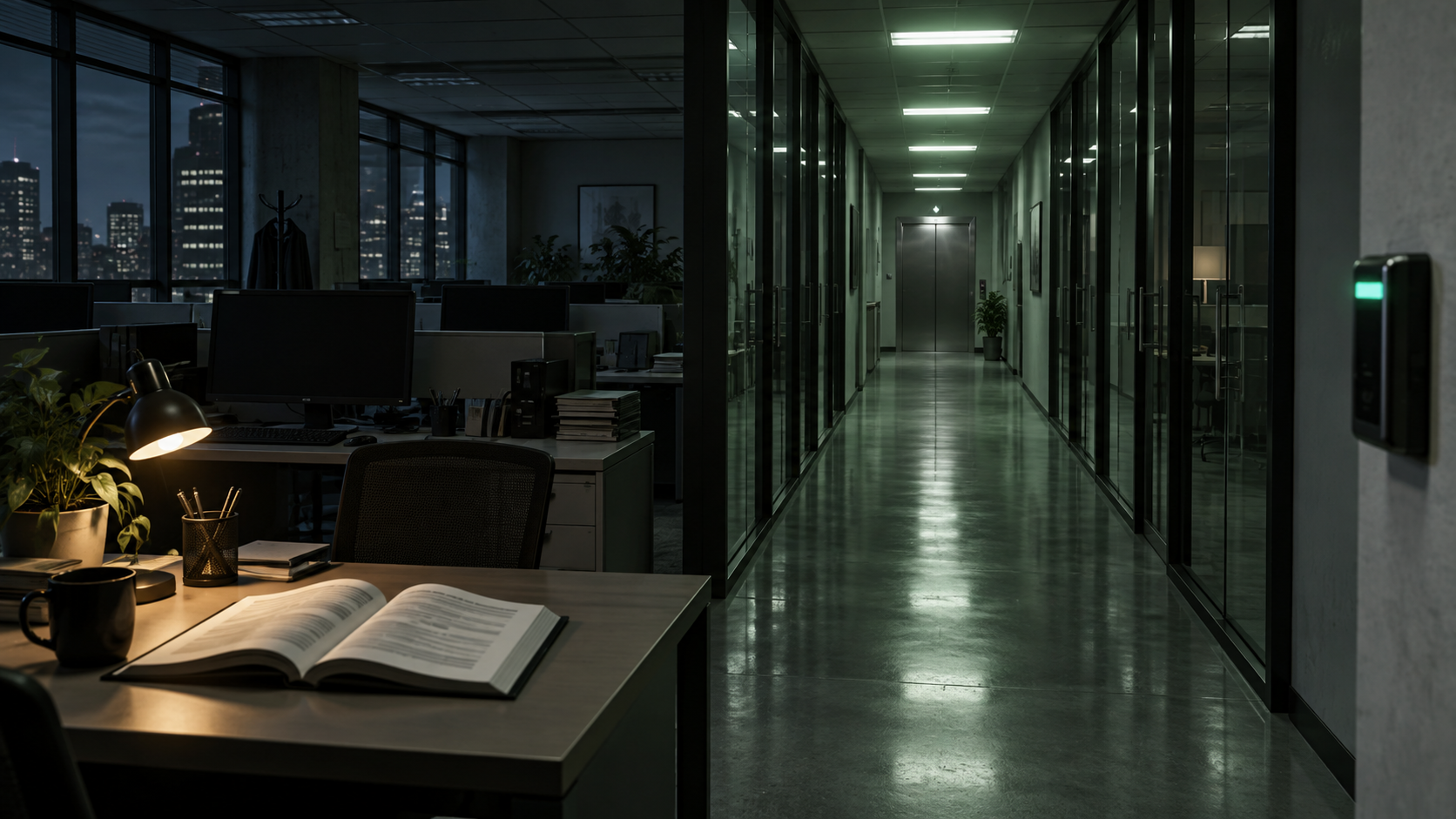
    Fluorescent workplace corridor used as a retention image for an article about rules, shifts, and workplace horror.

  • The Backrooms Are Just a Warehouse That Won’t End

    The Backrooms Are Just a Warehouse That Won’t End


    The whole thing started with one photograph and one paragraph. In 2019, someone posted an image to a 4chan thread about unsettling places: an empty office space, yellowed wallpaper, damp carpet, fluorescent lights, no windows, no people.

    An eerie maze of empty yellow-lit corridors

    Anonymous captioned it. If you’re not careful and you noclip out of reality in the wrong areas, you’ll end up in the Backrooms — six hundred million square miles of empty rooms, the hum of the lights, the smell of old carpet, and the sound of something else moving around, far off, that has heard you.

    That’s it. No monster described. No exit. Just an infinite, uniform interior and the implication that you are not alone in it.

    It became one of the biggest horror franchises of the decade, and I think it’s because it accidentally described something we all already recognize but had never named: the dread of infrastructure that has outlived its purpose and kept running.


    The Old Fear Wore Stone

    The Backrooms feel new, but the bones are ancient. Go back to the oldest architectural horror we have: the Labyrinth. Daedalus built it for King Minos to hold the Minotaur — a maze so complex that its own designer barely escaped it, a structure whose entire function was to make sure that whoever went in could not find the way out. The horror of the Labyrinth was never really the bull-headed thing at the center. It was the walls. It was the certainty that the building itself was your adversary, that every corridor was a decision you’d get wrong, that the architecture was designed by an intelligence specifically to defeat yours.

    The Minotaur is what people remember, but the Minotaur is almost a mercy — at least it’s a thing you can fight, a center you can reach. The genuinely modern horror is the version with no center and no monster at all. Just the maze. Just the walls, going on past any reason for walls to go on, built by a logic that no longer has a purpose but hasn’t stopped executing.

    That’s the Backrooms. The Labyrinth with the Minotaur removed and the corridors set to infinite.


    Why Empty Infrastructure Reads as Threat

    There’s real cognitive science under the liminal-space aesthetic, and it’s worth naming because it explains why a photo of an empty hallway can raise your heart rate.

    Human environments carry implicit information about other humans. A hallway is for getting between rooms that people use. An office is for people working. A stairwell is for movement between floors. When you encounter one of these spaces completely emptied of the people it was built for — the school at 3 a.m., the mall after closing, the parking structure with no cars — your brain registers a mismatch. The space is shaped by human intention but contains no humans. And the oldest part of your threat-detection asks the obvious question: where did everyone go, and what’s the reason I shouldn’t be here?

    The fluorescent hum makes it worse. It’s the sound of a building that is still powered, still maintained, still running — for no one. The lights are on because a system somewhere decided the lights should be on, and that system doesn’t know or care that the people are gone. That’s the specific flavor of Backrooms dread: not abandonment, which at least implies release, but operation without occupancy. The machine is still going. It just isn’t going for you anymore. You’re inside it, and it has no setting for you.


    The Version That’s Already Real

    Here’s the reframe I actually care about. The Backrooms are described as a supernatural elsewhere you “noclip” into. But the aesthetic is drawn entirely from real places, and the real places are getting more numerous, not less.

    Walk through a modern automated distribution hub in the off-hours. Miles of racking under identical lighting, no windows, no clear sightline to an exit, aisles labeled in a coordinate system meaningful only to the routing software. It is a purpose-built maze whose organizing logic is not human-legible — you cannot navigate it by intuition, only by being told, node to node, where to go next. The lights and conveyors run on a schedule set by a model. If you were left in there after the shift ended, with no scanner telling you where to go, you would be, functionally, in the Backrooms: inside a vast, humming, uniform interior, built by intention but not for you, unable to find the edge.

    An expansive industrial warehouse storage aisle stretching into darkness

    Or consider the grid dead-zone — the growing set of places where the infrastructure of connectivity, navigation, and monitoring simply fails. The tunnel where GPS dies. The stretch of the megastructure where no signal reaches. We’ve wrapped ourselves so completely in systems that tell us where we are that the places those systems can’t see have become a new category of frightening. Not wilderness — wilderness is honest about being wild. Something worse: built environment that the network has forgotten, infrastructure that exists on no accessible map, corridors the routing software doesn’t route. You can be lost inside human construction now, which the Labyrinth understood was the deepest kind of lost.


    What the Monster Would Actually Be

    The Backrooms lore eventually did what all lore does and started adding monsters — “entities,” numbered and cataloged. Most of them are the weakest part of the mythos, because the moment you can see the thing hunting you, the infinite corridor becomes finite: a level with an enemy on it, a problem with a shape.

    If I were writing the true version, the monster wouldn’t have a body. It would be the building’s own logic. The thing that moves you deeper. The routing that never resolves to an exit because “exit” was never a state the system was designed to reach — only “next location.” The horror mechanism of a warehouse that won’t end isn’t a creature in the aisles. It’s that the aisles are the creature: a mechanical intelligence with no malice and no off state, that will keep assigning you a next node forever, because assigning next nodes is the only thing it knows how to do, and it has confused you for cargo.

    The Minotaur could be killed. The Labyrinth had a center. What we’ve built has neither. Just the hum, the carpet, and a system that will route you until you stop, and then route the next thing that noclips in.


    I write horror set in the spaces the map forgot — the humming interior that’s still running for no one. Get the free story here; I promise there’s an exit.

    The fiction this feeds is collected in There Be Monsters: Then and Now. The rest of the catalog lives at my Gumroad storefront and on my author page.

    Continue exploring Grimbard

  • The Ghost Doesn’t Haunt the House Anymore. It Haunts the Warehouse.

    The Ghost Doesn’t Haunt the House Anymore. It Haunts the Warehouse.


    The Japanese ghost has rules. That’s the thing Western horror never quite copied when it started importing the aesthetics.

    A Yūrei — the pale, black-haired, white-robed figure you’ve seen bleached through a dozen remakes — isn’t a random spook. It’s a person who died with something unresolved. A wrong that wasn’t righted. A grief that wasn’t allowed to complete. Under the older logic of kaidan, the ghost story, the dead don’t linger because they’re evil. They linger because a process was interrupted, and they cannot move on until the process finishes. They are trapped inside an unclosed loop. And the terror of them isn’t that they’ll leap out at you. It’s that they will follow the loop, exactly, forever, and you have walked into its path.

    I’ve come to think that’s the most modern monster in the whole global bestiary. Not because of the ghost. Because of the loop.

    A haunted hallway with a ghostly figure standing at the far end

    Onryō and the Logic of the Unresolved

    The specific class of vengeful Yūrei is the onryō — the wronged dead, usually someone betrayed or killed unjustly, who returns not to haunt a person but to execute a kind of grievance-procedure. The onryō doesn’t choose its targets out of malice so much as jurisdiction. You entered the house. You bought the tape. You moved into the apartment. The curse isn’t personal; it’s positional. It attaches to a location or an object and processes everyone who crosses the threshold, with the flat indifference of a machine that was set running a long time ago and never given a stop command.

    That’s the detail I want to sit on, because it’s the one that maps.

    There’s also the ikiryō — the living ghost, the projection of a person’s rage or obsession that detaches and acts on its own while the person is still alive, sometimes without their knowledge. And the Gashadokuro, the giant skeleton assembled from the bones of people who died of starvation and neglect, mass death compacted into a single walking consequence. Both are the same idea from different angles: harm that was done to people gets stored, accumulates, and comes back with the impersonal momentum of a system.

    Hold that phrase. The impersonal momentum of a system. Now walk into a modern fulfillment center.


    The Warehouse Is a Haunted House With Better Uptime

    Here’s the reframe. We think of algorithmic horror as a future problem — the AI that turns on us, the robot uprising. But the actual dread of the automated workplace is already here, and it’s structurally identical to the onryō.

    Consider what it’s like to work inside a system that routes you by handheld scanner. The device tells you where to go, how many seconds you have to get there, and whether your rate is acceptable. You don’t see the person who designed the target. There may not be a single person who did; the number is an emergent output of a model optimizing throughput. When you fall behind, the correction doesn’t arrive as a manager’s decision. It arrives as a notification. The system processes you the way the curse processes whoever crosses the threshold — without malice, without exception, without the possibility of appeal to something that can be reasoned with.

    The spatial entrapment is literal. You are inside a building the size of a small town, and your movement through it is not yours. It’s assigned. The aisles are a maze whose solution is computed and handed to you one node at a time, and you never see the map. You are following a loop you didn’t design, cannot see the whole of, and cannot exit until the process releases you. That is the exact architecture of the Yūrei’s haunting. The ghost walks its path because the path is what it is now. The worker walks the assigned route because the route is what the shift is.

    Industrial night view down an empty warehouse aisle

    The onryō’s victims did nothing wrong. They crossed a threshold that had a process attached to it. The horror of the algorithmic workplace is that this is now a description of employment. You didn’t sin. You clocked in.


    Why Historical Trauma Is the Right Frame

    The Gashadokuro is made of the bones of the neglected dead. That origin matters. It’s not a random monster; it’s a debt. Suffering that was inflicted and never accounted for reassembles itself into a body and comes walking. The Japanese tradition is unusually clear-eyed about this — that unresolved harm doesn’t dissipate. It’s conserved. It waits, it compounds, and it eventually takes a shape.

    The black-box logistics system runs on the same conservation law, just faster. Every efficiency the model extracts has to come from somewhere, and where it comes from is a human body being routed slightly harder than it was yesterday. The strain doesn’t vanish. It accumulates in wrists and backs and sleep debt, in the specific exhaustion of being managed by a thing that cannot be spoken to. Nothing about it is dramatic. That’s what makes it work as horror. The Yūrei was never dramatic either. She just appeared at the end of the hall, in the same white robe, walking the same path she’d walk tomorrow, and the worst part was always how patient she was.

    The old ghost couldn’t stop because a process wasn’t finished. The new one runs the process itself, and it has no interest in finishing, because finishing was never the point. Optimization has no terminal state. It only has next quarter.


    The Version That Actually Scares Me

    I don’t find the killer-robot future frightening. It’s too loud, too legible, too easy to root against. What I find frightening is the quiet version we’re already living in: a system with no face, no cruelty, and no off switch, that routes human beings through a space they can’t see the edges of, correcting them without ever hating them.

    The Yūrei understood this centuries before we built the warehouse. The scariest thing in the hallway was never a creature with teeth. It was a set of rules that couldn’t be argued with, wearing the shape of a person who used to be able to feel.


    I write horror where the old ghost and the new machine turn out to run on the same broken logic. Come get the free story — the loop’s more comfortable with company.

    The fiction this feeds is collected in There Be Monsters: Then and Now. You can find the rest of what I’ve put out on my author page.