
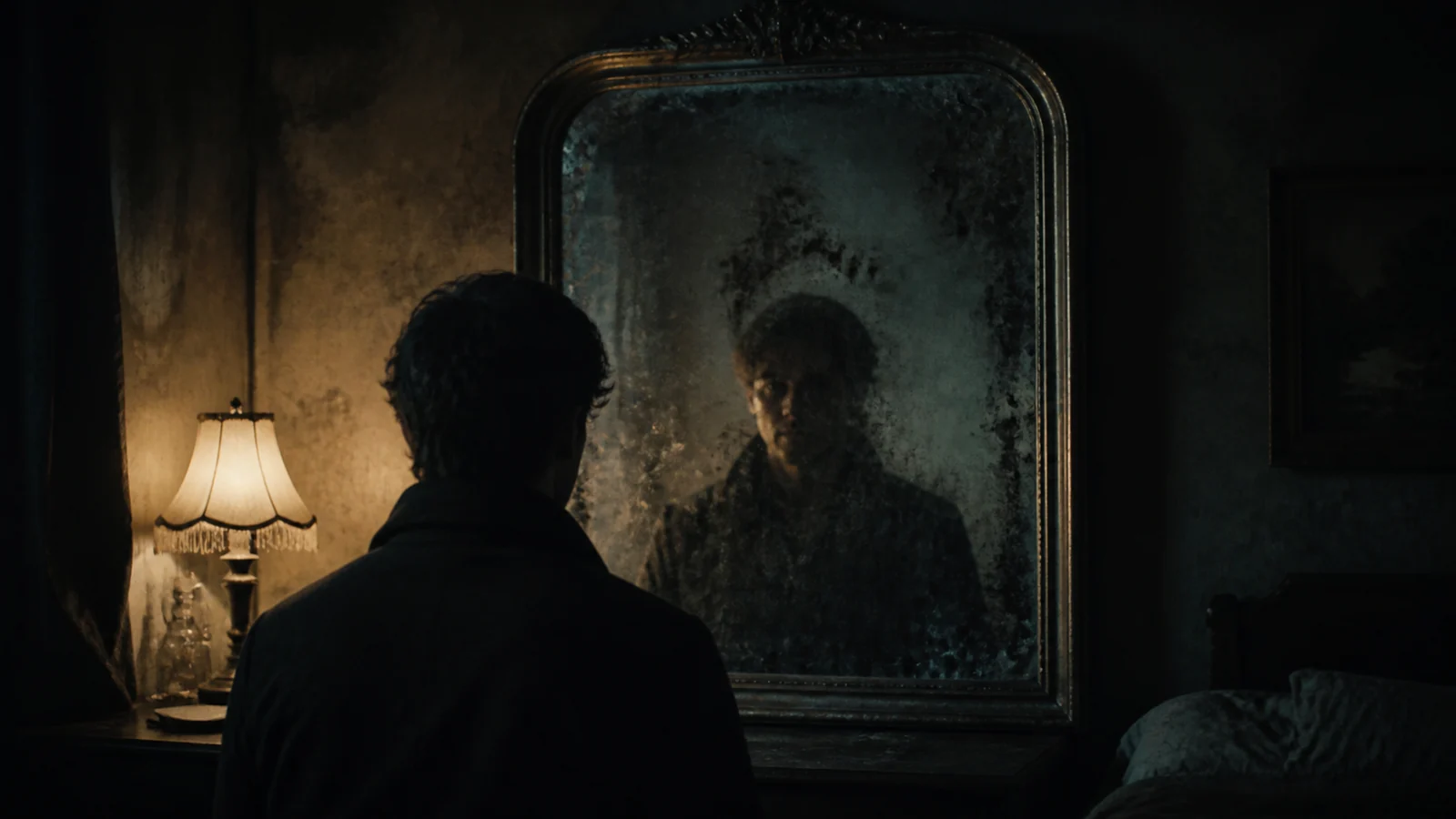
Stay in front of a dim mirror long enough and the face may begin to borrow features you did not bring with you.
The mouth loses its edges. One eye darkens. The skin changes color. For a moment, the reflection resembles a relative, an animal, a stranger, or something with no useful name.
Then you move, and your face returns.
In low light, prolonged fixation on a face can produce what researchers call a strange-face illusion. Features may seem distorted, fade, or appear to become another identity. A 2023 systematic review found that low illumination, face stimuli, and sustained fixation were important conditions, while also warning that study quality affected reported rates and that the mechanism remains unsettled.
The effect is real enough to study.
That does not make every explanation of it equally secure.
What is the strange-face-in-the-mirror illusion?
The term describes visual distortions reported when people gaze at their own reflection under low illumination for an extended period. Experimental reports have included changes in color or brightness, deformation of facial features, the impression of another identity, and—in some studies—animal or monstrous faces.
The mirror does not physically change the face. The visual experience changes while the external stimulus remains relatively stable.
That places the phenomenon among visual illusions, but the experience is more personal than a line appearing longer than an equal line. A face is not merely a shape. It is the visual anchor of identity.
When the reflection changes, the person does not simply see a distorted object.
They see me become not me.
What has research actually found?
The effect became widely discussed through experiments led by psychologist Giovanni Caputo. Participants gazed at faces under dim illumination and reported a range of strange transformations. The work expanded from mirror gazing to pairs of people looking at each other in low light.
Those early results were striking. Striking results need careful review.
In 2023, researchers published a systematic review and quality analysis of strange-face studies. They concluded that the illusions reliably appeared across mirror-gazing and interpersonal-gazing paradigms. They also found that higher-quality studies reported lower rates, and that reduced light, facial stimuli, and prolonged fixation mattered.
That produces a responsible two-part conclusion:
- Strange-face illusions are a documented perceptual phenomenon.
- The prevalence, strength, and mechanism should not be described with more confidence than the evidence supports.
| What the research supports | What remains uncertain |
|---|---|
| Some observers report facial distortion under dim, prolonged fixation | How common strong identity changes are in ordinary settings |
| Low light and face stimuli are important conditions | One complete mechanism explaining every reported form |
| Study quality changes reported rates | Whether all folklore or ritual mirror experiences belong to this effect |
| The effect can occur in nonclinical participants | What any single experience means about an individual person |
That final distinction deserves emphasis. A brief visual illusion under unusual viewing conditions should not be converted into an amateur diagnosis.
Why dim light matters
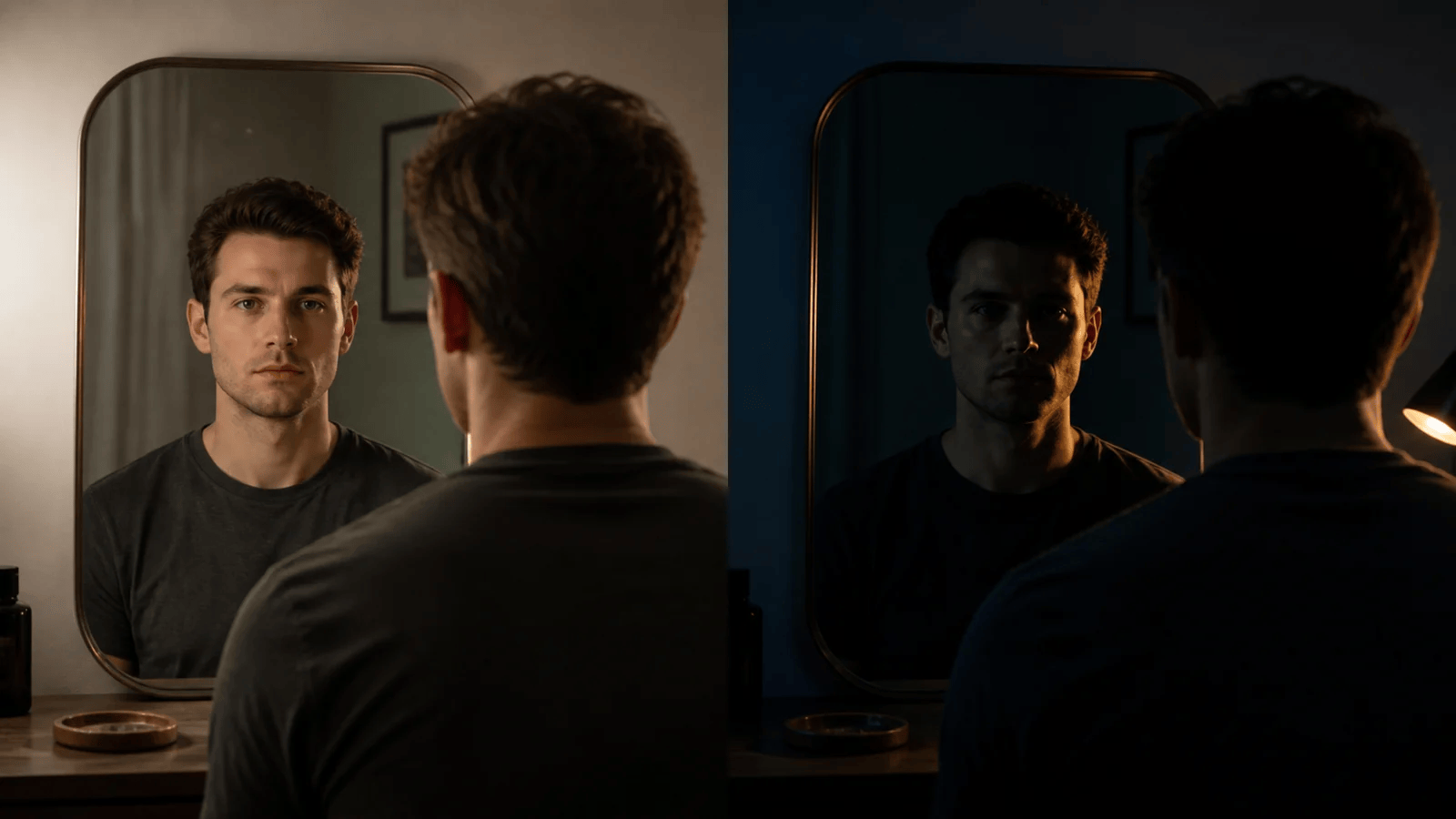
A face contains many small contrasts: the boundary of the lips, the whites of the eyes, the edges of nostrils, the shadow under the brow, the curve of cheek against background.
Dim light weakens those details.
When a person holds their gaze in one area, visual adaptation can make stable features fade or change in salience. Tiny eye movements, shifting shadows, asymmetry, and incomplete information give the visual system a face it cannot process in the usual lively way.
The result may involve several processes rather than one magic switch. Researchers have discussed perceptual adaptation, face processing, dissociation, identity representation, and other mechanisms. The systematic review's caution matters here: the existence of the illusion is clearer than a complete explanation of why it takes every reported form.
This is related to, but not identical with, seeing faces in ambiguous objects. Pareidolia finds a face where no face exists. The mirror illusion begins with a real face and makes its features unstable.
One constructs identity.
The other erodes it.
Why mirrors make the effect worse
A photograph shows a past face. A mirror appears to show a present one.
It responds immediately to movement. That responsiveness teaches the viewer to treat the image as trustworthy. Raise a hand, and the reflection raises one. Lean closer, and it approaches. The system seems perfectly coupled.
Horror needs only one apparent failure.
The reflection smiles late.
It keeps looking at the doorway after you turn back.
It appears tired when you are not.
Those fictional events violate the mirror's central promise: exact obedience.
The strange-face illusion is subtler. The reflection continues obeying movement while its identity becomes unstable. You retain control over the image and lose confidence in the person inside it.
Do not wait for the second face. Join The Grimbard Press and receive Dead Ship, a free illustrated Subscriber Archive Edition.
Mirrors already had rules before the laboratory
Mirror folklore did not wait for experimental psychology.
Mirrors have been treated as tools of divination, thresholds, traps for souls, signs of vanity, and vulnerable objects to cover after a death. The practices differ across culture and period. They should not be collapsed into one universal belief that “ancient people thought mirrors were portals.”
What many mirror traditions share is structure.
The participant changes the ordinary conditions of looking. The room becomes dark. A candle replaces general light. A phrase is repeated. A particular hour matters. The person waits for an image that should not be present.
The modern Bloody Mary ritual uses exactly that architecture. Versions vary, but the familiar form places a person before a dim mirror, requires repetition, and makes expectation part of the viewing condition.
The ritual does not need a supernatural result to produce fear. It prevents the viewer from glancing casually. They must keep looking while their vision becomes less reliable.
The rule against doing one specific thing creates the desire to test it. The mirror adds a witness who looks exactly like the person breaking the rule.
A scientific effect does not solve every mirror story
It would be convenient to file all mirror apparitions under low-light illusion and close the cabinet.
That would repeat the mistake of using one plausible mechanism as a universal explanation.
Some reports occur under different conditions. Some are memories shaped by fear. Some are folklore told as experience. Some involve reflections, sleep loss, suggestion, grief, substances, medical conditions, or details no outside reader can evaluate. A blog article cannot retroactively reproduce the scene.
The strange-face literature gives us one documented route by which a normal face can become visually unfamiliar.
It does not give us jurisdiction over every mirror.
That restraint is part of what visiting haunted places actually feels like. The responsible observer records the conditions, tests ordinary causes, and resists declaring victory in either direction when the evidence runs out.
Why horror keeps returning to the mirror
The mirror is inexpensive, universal, and intimate. It brings the impossible into a private room without requiring a creature to enter through a door.
It can produce four fears at once:
- Duplication: another version of the self exists within reach.
- Disobedience: the image stops matching the body.
- Addition: someone or something appears behind the viewer.
- Replacement: the face remains, but identity changes.
Most horror objects must be carried into the scene. The mirror is already mounted on the wall.
Every reader has practiced trusting it.
Frequently asked questions
Why does my face look distorted in a dark mirror?
Low illumination removes facial detail, and prolonged fixation can make stable features fade or change in salience. The visual system may then produce a strange-face illusion in which the reflection appears distorted or unfamiliar.
Is the strange-face illusion normal?
It has been reported in nonclinical research participants under unusual viewing conditions. One brief illusion does not, by itself, establish a disorder or diagnosis.
Does the mirror-gazing effect happen to everyone?
No. Reported rates vary considerably, and a systematic review found that study quality influenced them. The phenomenon should not be presented as guaranteed.
Does science prove the Bloody Mary legend?
No. Research helps explain why dim, prolonged mirror gazing can produce unsettling visual changes. It does not prove a supernatural figure appears or establish the origin of every ritual variant.
Why does moving make my face look normal again?
Movement changes the visual information, interrupts fixation, restores edges and contrast, and confirms the ordinary link between body and reflection.
The object beyond the reflection
The Scarab begins where a modern hand acquires an object carrying an older interpretation of reality. A mirror makes the same offer: trust the object, then discover the rules were never yours.
Explore The Scarab or join The Grimbard Press and receive Dead Ship free.
Sources and further reading
- Mash et al., “Strange Face Illusions: A Systematic Review and Quality Analysis”, Consciousness and Cognition, 2023.
- Caputo, “Strange-Face Illusions During Inter-Subjective Gazing”, Consciousness and Cognition, 2013.
- Fonseca-Pedrero et al., “Strange-Face-in-the-Mirror Illusion and Schizotypy During Adolescence”, Schizophrenia Bulletin, 2015.