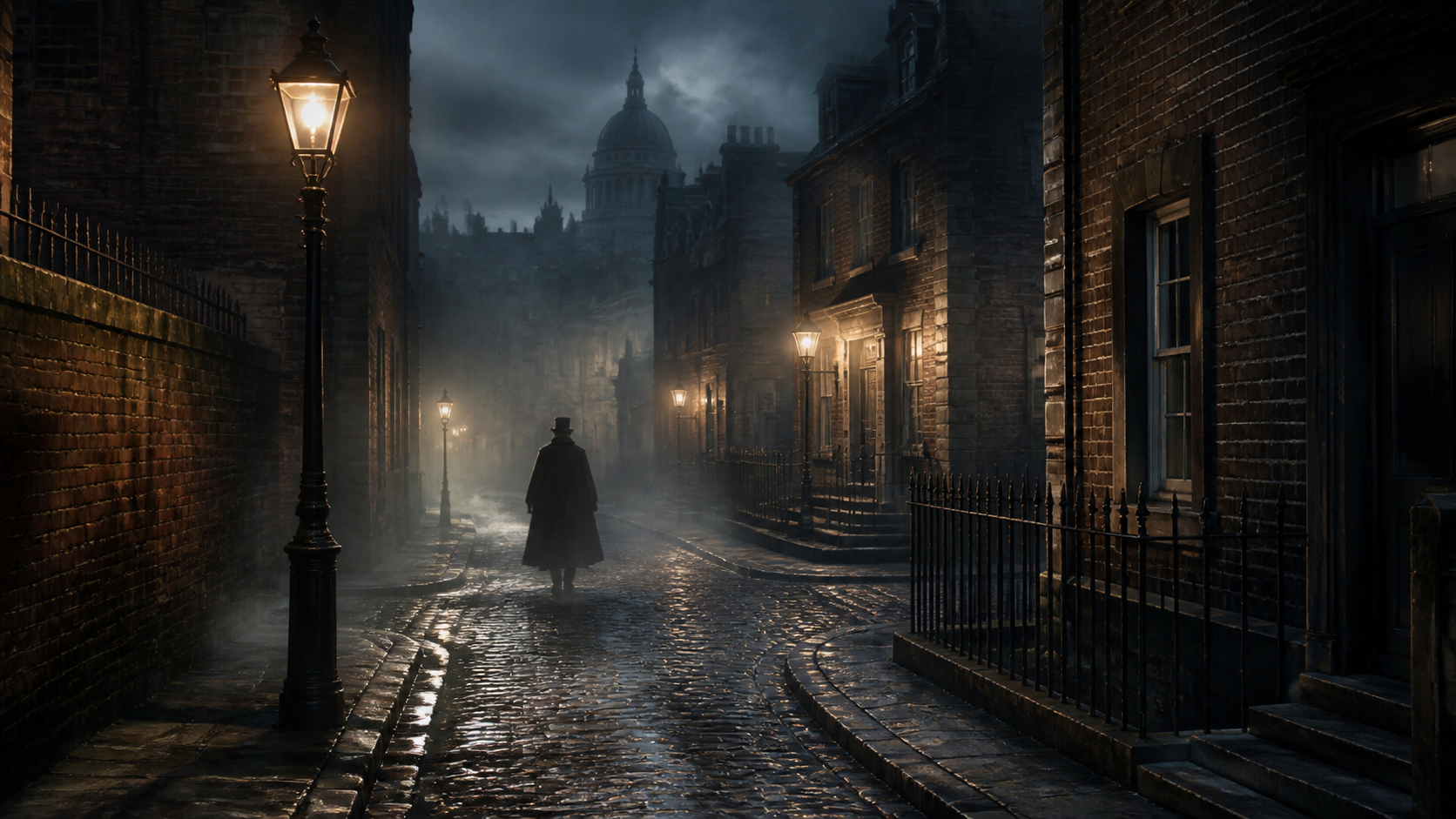
Spring-Heeled Jack: The Victorian Terror That Kept Leaping
London did not wake up one morning to find a monster on its roofs. It woke up to letters, rumours, complaints, newspapers, and a name that could travel faster than any person wearing claws.
Spring-Heeled Jack is often described as a Victorian demon: a tall figure who attacked people, breathed fire, and escaped by jumping impossible walls. The safer historical answer is more interesting. The legend emerged from a cluster of reports and public alarm in London in 1838, then changed through newspaper repetition, later sightings, popular fiction, and the appetite for a villain who could appear wherever a dark street needed one.
The record supports a real public scare and reports of assaults. It does not establish a supernatural creature, a single culprit, or a tidy solution. Spring-Heeled Jack is a useful lesson in how an urban legend becomes durable: it does not need one stable body. It needs a city ready to recognize the same fear under new clothes.
The first thing to establish is the date
A scholarly study, The Legend of Spring-Heeled Jack: Victorian Urban Folklore and Popular Cultures, identifies 9 January 1838 as a crucial public moment. At a Mansion House session, the Lord Mayor of London addressed a complaint about a figure alarming women in suburban districts. Contemporary reporting and later retellings quickly made the story larger than any single letter.
That sequence matters. The earliest evidence is not a photograph of a leaping devil. It is a civic response to reports. The city was being asked to decide whether a set of frightening stories pointed to a criminal, a prank, a panic, or something stranger. The answer was never settled in a way that could close the file.
It is tempting to begin with the most cinematic details: luminous eyes, claws, a mouthful of flame. Resist that temptation. Such details became part of the legend, but the responsible question is always: which report says this, when was it printed, and how far is it from the alleged event?
Reports are evidence of fear, not automatic proof of every detail
Illustration: contemporaneous reports and later retellings carry different evidentiary weight.
In February 1838, newspapers reported alleged attacks associated with the name Spring-Heeled Jack, including the widely repeated account involving Jane Alsop. The British Newspaper Archive preserves searchable records for contemporary coverage, including March 1838 reporting that used the name. Those papers are invaluable, but they should be read as newspapers: documents of what was alleged, believed, sensationalized, and argued in public.
That does not make the people named in reports disposable. An allegation of assault is not a campfire accessory. It is a claim about harm. The legend has often swallowed the human scale of those reports because the monster is easier to remember than the frightened person at the door.
There may have been imitators. There may have been more than one offender. There may have been exaggeration, misidentification, or journalists improving a story to make it travel. A confident article has to leave room for all of those possibilities rather than choosing the most theatrical one as fact.
Why a leaping figure fit Victorian London
Spring-Heeled Jack belongs to a city of expanding suburbs, gaslit streets, crowded print, and uneven information. A stranger could be close enough to touch and still be impossible to identify. News could spread faster than verification. A creature who crossed walls and vanished at the edge of a lamp’s light gave those conditions a face.
The name itself does narrative work. “Jack” is familiar, almost casual. “Spring-heeled” is physical. It gives the unknown a method of escape. The figure can be pursued in every retelling because he is designed to get away.
That is different from an older monster rooted in one wood, cave, or churchyard. Spring-Heeled Jack is portable. He can be moved from London to another town, from a report to a penny dreadful, from a possible attacker to a mask for every attacker who comes after. The legend’s mobility is its survival mechanism.
The monster outlived the suspect
Illustration: the legend spread through reports, newspapers, and later fiction.
Popular retellings have tried to give Jack a title, an aristocratic identity, a mechanical explanation, or a supernatural anatomy. None has settled the history. A research bibliography compiled by Mike Dash is valuable mainly as a map of the many sources and claims that accumulated around the case; it is not permission to choose the flashiest claim and call it the answer.
The uncertainty did not weaken the story. It made it adaptable. A solved criminal case ends with a name and a sentence. An unresolved figure can reappear whenever a newspaper needs a fright, a writer needs a villain, or a neighbourhood needs a warning about the dark.
Modern folklore operates the same way. Slender Man’s birth in a Photoshop thread was unusually well documented, yet the character spread because different people could add their own fragments. Spring-Heeled Jack had nineteenth-century versions of that network: letters, papers, gossip, and cheap print.
An evidence ladder for Jack
The story becomes clearer if we sort its ingredients instead of blending them.
Documented public record: a January 1838 civic response; contemporary press coverage; reports made under the name Spring-Heeled Jack.
Reported events: individual encounters and alleged assaults described by witnesses or newspapers. These deserve careful language: “reported,” “alleged,” and “according to the account.”
Later legend: a fixed visual design, impossible leaps, particular identities, and a single continuous career extending across decades. Some parts may have roots in earlier reporting; none should be treated as one verified biography.
That ladder does not drain the story of dread. It restores the thing that makes it effective. The monster is not powerful because he can jump a wall. He is powerful because everyone is already looking over it.
The street is the monster’s natural habitat
There is a difference between a ghost that haunts one address and a figure who makes the walk home feel unstable. Spring-Heeled Jack transforms the ordinary route: the front door, the lane, the edge of a streetlamp. He makes the city’s promise of visibility fail at exactly the point where people rely on it.
That is why he belongs beside the Headless Horseman, though their landscapes differ. Both figures turn travel into an encounter with a story that arrives before the rider does. But Jack is sharper and more modern. He is the monster of a city learning that public information can make danger larger without making it clearer.
For legends that mutate with every generation, There Be Monsters: Then and Now follows the creatures that change because we need them to. And for future evidence-minded monster files, join The Grimbard Press and receive Dead Ship, a free illustrated Subscriber Archive Edition.
FAQs
Was Spring-Heeled Jack real?
The historical record shows real reports, public concern, and newspaper coverage in 1838. It does not prove that a supernatural being existed or identify one confirmed person behind every report.
When did the Spring-Heeled Jack legend begin?
The London public scare is closely associated with January 1838, when the Lord Mayor addressed complaints about a frightening figure. Reports and retellings grew rapidly afterward.
Did Spring-Heeled Jack really breathe fire?
Flame-like effects appear in later and contemporary descriptions, but the claim comes through reports and folklore rather than verified physical evidence. It should be presented as a reported detail, not a settled fact.
Why did the legend last so long?
The figure could be adapted to new streets, new newspapers, and new fears. Its uncertainty made it more reusable than a fully solved crime or a monster tied to one location.