
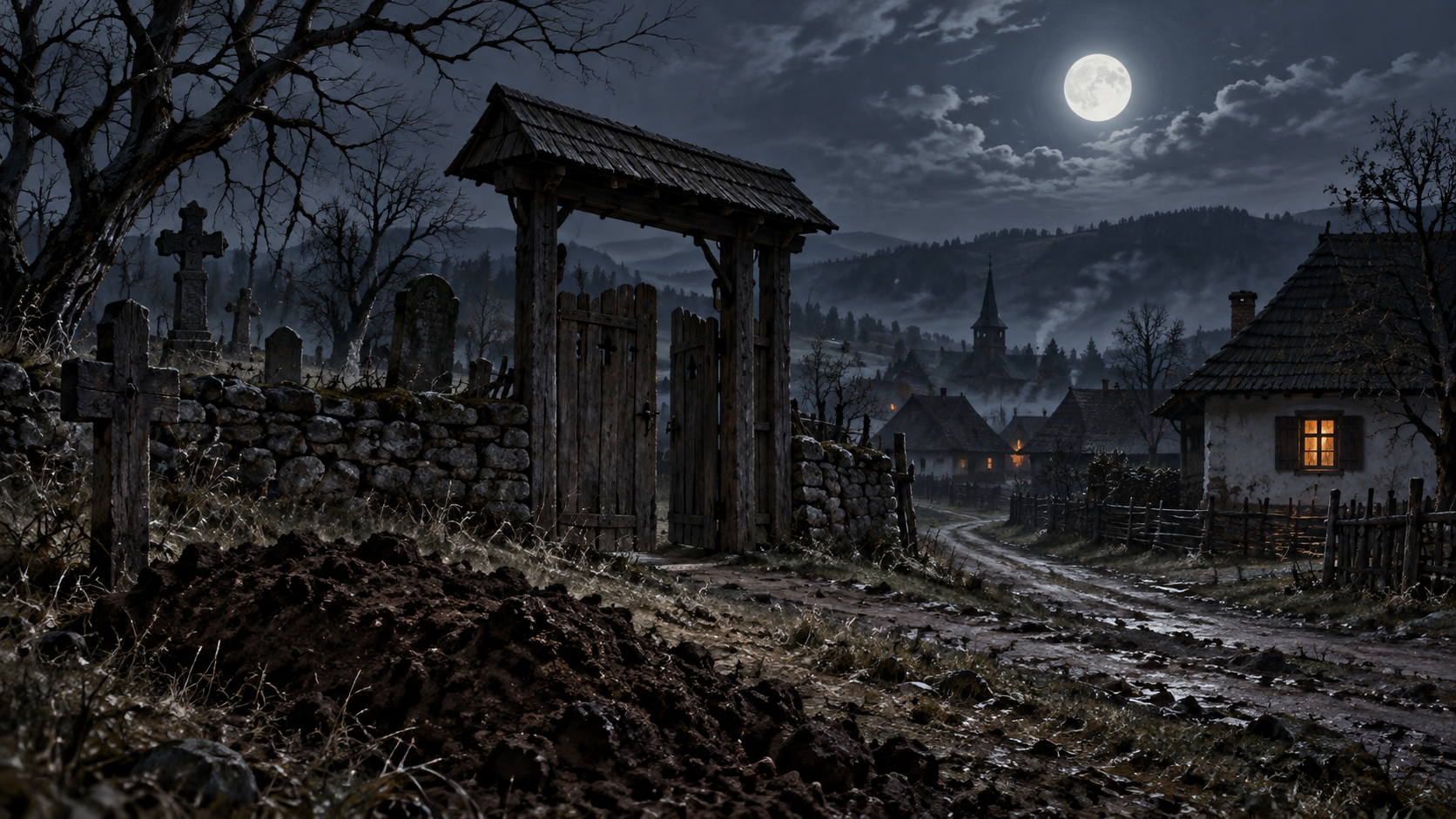

Dracula was published in 1897. The beliefs behind it are centuries older, they belonged to farming villages in the Carpathians, and almost nothing in them looks like the count in the cape.
The Romanian dead who won’t stay dead are called strigoi. They aren’t aristocrats. They’re your neighbors.
The dead who come home
Start with what a strigoi actually does in the older accounts. It doesn’t move to a castle or seduce anyone in a drawing room. It goes back to its own house.
It comes to the family first. A widow hears her husband on the stair. Livestock sicken. Children waste. Milk won’t come. The strigoi is a local problem, and it works its way outward from the people who loved it, which is what makes the belief so much worse than the films. The thing coming for you isn’t a stranger. It knows which door sticks.
There are also strigoi vii, the living strigoi: people said to have the trait while still alive, who wander at night in spirit and become one of the restless dead after they die. A related word, moroi, turns up in many regions, and the exact meaning shifts village to village. Folklore isn’t a filing system. It’s what people in one valley told each other, and the valley over might use the words differently.
The signs people watched for
The old accounts list what marks a person as likely to rise. Depending on the region:
- Being born with a caul, the membrane still over the face.
- Being born with a tail or an extra nipple, or with red hair and blue eyes in a dark-haired family.
- Being the seventh child of the same sex.
- Dying unbaptized, unmarried, or unconfessed.
- Dying violently, or by suicide.
- Being buried badly, or having an animal jump over the body before burial.
Look at that list again. Most of it is ordinary bad luck, and much of it is a matter of what happened to your body in the hours after you died. That is the frightening part. Some of the qualifications are things a person can’t control at all.
What was done about it

The precautions fall into two groups: the ones you take before the funeral, and the ones you take when the funeral didn’t work.
Before. Garlic, on the body and around the room. Thorn or hazel laid in the coffin. A sickle set above the grave, or a needle or iron driven somewhere it would matter. Seeds scattered in the coffin to occupy the dead with counting. In places, the body was buried face-down so that if it started digging it would go the wrong way.
After. If the deaths kept on, the grave was opened. What villagers reported finding is consistent across Europe: a body less decayed than expected, with a flushed face, fresh-looking blood at the mouth, and hair and nails that appeared to have grown. We now know these are ordinary stages of decomposition, which varies enormously with soil, cold and coffin. To a village that had already buried three people that winter, it was proof.
Then came the part nobody wrote down gently. The heart was removed and burned. The ashes were sometimes mixed with water and given to the sick to drink. The body was staked, or beheaded, or turned over. The point was practical. This was not revenge on the dead. It was medicine for the living.
These exhumations were not only a medieval habit. In 2004, a case in a Romanian village, in which relatives exhumed a man’s body and burned his heart, brought criminal charges and international coverage. The belief had outlasted the century everyone assumed it had died in.
How the strigoi became Dracula
Bram Stoker never went to Romania. He read about it. One of his sources was Emily Gerard’s 1885 essay “Transylvanian Superstitions,” which described local beliefs about the undead for an English audience, including the term nosferatu, whose origin scholars still argue about.
What Stoker did was take a village terror and give it a title, a castle and manners. That was a brilliant piece of fiction and a bad piece of folklore. The village version has no glamour in it at all. It’s about a family that has to decide, by lamplight, whether to open a grave.
The story in October 31
“In a Hand the Clerk Can Read” is the first story in October 31.
> October 31st, 1897 — a farmhouse in the Carpathian foothills.
A boy throws stones at Dr. Emil Coțofană’s shutters until one splits. A bride will not wake right, and her husband is tearing the house apart looking for somebody who knows what to do.
Emil trained in Vienna. He carries carbolic in his bag and has never once opened it here, because nobody in the valley trusts a wound cleaned with anything that doesn’t smell of church. On his way out he glances at the calendar without meaning to, and the word that arrives isn’t a physician’s word.
Again.
The valley has an autumn order nobody wrote down: herds down off the high pasture, hazel over the byre door, garlic braided and hung. Emil has spent nine years not asking what the order is for.
It’s the first story in the book and the one Amazon’s Look Inside opens on, so you can read the beginning for free and see whether the rest is for you.
—
In a Hand the Clerk Can Read is Night 1 of 31 in October 31, thirty-one folk horror stories set on Halloween night across six centuries. Read it on Amazon → · Free with Kindle Unlimited.
Take the 31 Nights challenge. One story a night through October, with a free printable calendar. Get the calendar →
Tomorrow night: Doppelgängers and the Fetch: Why Seeing Your Double Meant Death