
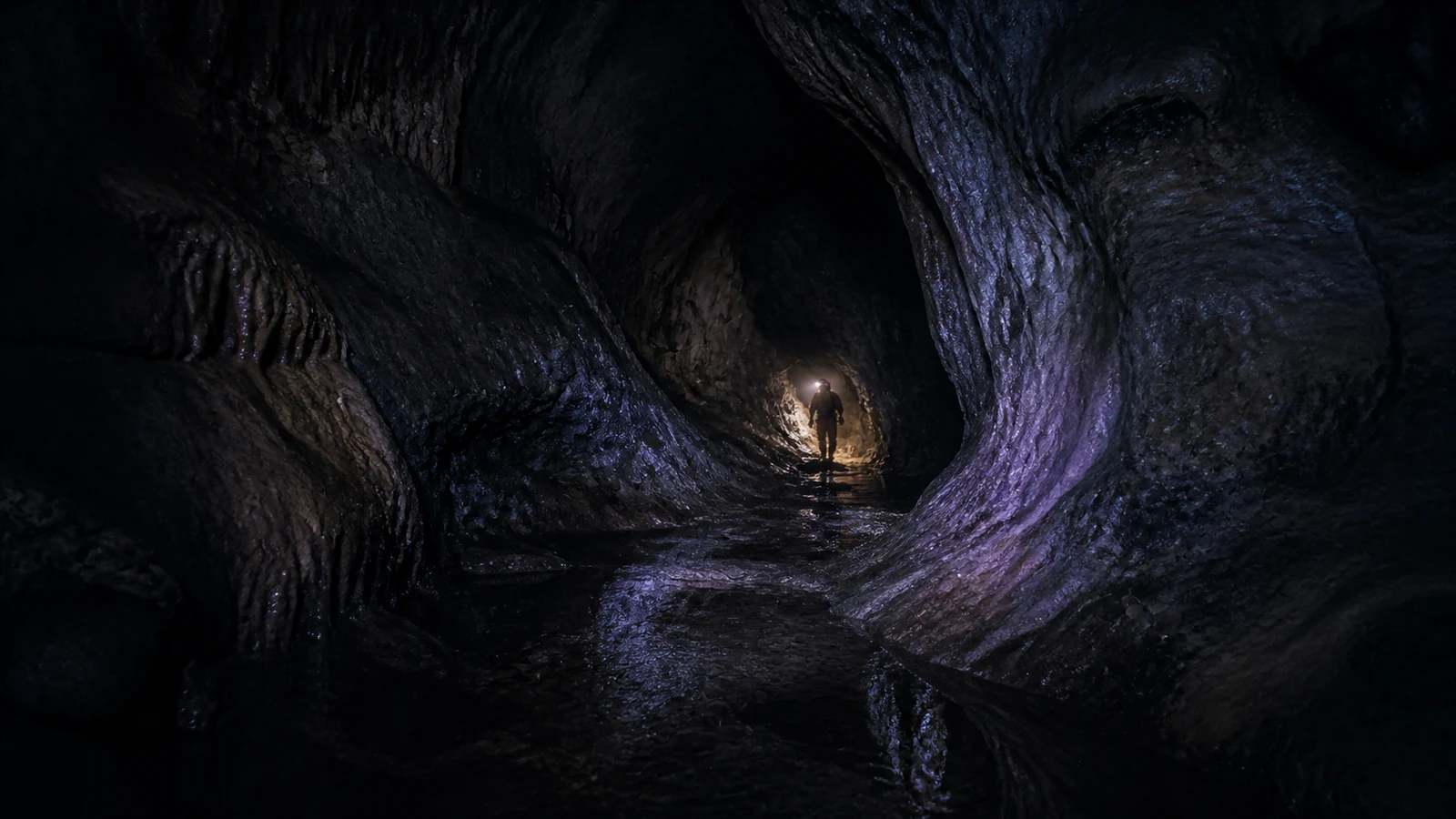
The entrance is the last generous thing a cave gives you.
It frames the daylight. It shows you where the surface is. For a while, you can turn around and see the exact shape of your escape. Then the passage bends. The entrance disappears, and every direction becomes a version of deeper.
That is when a cave stops being a hole in the ground and becomes a world.
Caves are frightening because they remove the senses and choices people use to feel safe. Natural darkness erases distance. Stone limits movement and escape. Sound behaves strangely, landmarks repeat, and the route home can depend on a light small enough to hold in one hand. Underground horror takes those real conditions and adds one question: what if the cave is not empty?
A cave breaks the ordinary agreement between you and a room
Most human spaces tell us how to leave them.
Doors have handles. Hallways lead somewhere. Windows prove that an outside still exists. Even a basement belongs to a building whose shape we understand. A natural cave makes no such promise. Its passages were not designed for a human body, and its walls do not care whether the route feels sensible.
That indifference is the first source of dread.
A corridor made by people suggests intention. Someone decided its width, its height, and where it would end. In a cave, the passage may narrow without warning or open into a chamber too large for your light to explain. It can split. It can descend. It can circle back through rock that looks almost—but not quite—the same.
Horror depends on the gap between what a character can perceive and what the audience imagines. A cave creates that gap naturally. The headlamp reveals ten feet of wet stone. The mind supplies everything beyond it.
This is one reason underground horror does not require an elaborate creature. The setting already behaves like an antagonist. It controls sight, movement, time, and information. Put something alive inside it and the thing inherits every advantage.
Darkness becomes physical underground
Night outdoors is rarely absolute. There may be stars, reflected city light, a pale road, or the silhouette of a tree against the sky. Cave darkness is different. Beyond the entrance zone, switch off every light and there may be no visual information at all.
Not very little. None.
In that darkness, a flashlight does not restore the normal world. It creates a small temporary one. Whatever sits inside the beam exists. Everything else becomes possibility.
That makes light more than a tool in cave horror. It is a clock.
A battery has a life. A bulb can fail. A dropped lamp can fall where a hand cannot reach it. The National Park Service advises cave visitors to carry multiple independent light sources; some park guidance specifies three. That is practical safety advice, but it reads like the first rule in a horror story because it makes the danger measurable. Three lights mean there are three chances for the dark to win.
Sound does not compensate cleanly. Water drips out of sight. A scrape travels through stone. Echoes make distance unreliable. The noise behind a person may be falling gravel, another member of the group, or an animal that has already learned the passage.
The eye wants to confirm. The cave refuses.
Confinement is about escape, not square footage
People often describe cave fear as claustrophobia, but the words should not be treated as interchangeable. A person can find a cave frightening without having a clinical phobia, and a vast cavern can feel imprisoning despite its size.
The common element is escape.
The National Library of Medicine’s clinical overview defines claustrophobia as a fear of enclosed spaces and notes that people may fear what could happen there—restriction, loss of control, or the possibility of not getting enough air. The feeling is not determined only by how close the walls are. A locked aircraft cabin is larger than an elevator. It can still produce the same intolerable fact: leaving is not immediately possible.
A cave multiplies that fact. The exit may be physically open and still be hours away. A person can stand in a chamber the size of a cathedral while knowing that every route to the surface passes through one narrow crawl.
Underground horror uses this distinction well. A tight passage creates immediate pressure. A huge chamber creates scale without freedom. One says, your body may not fit. The other says, your body does not matter.
Go farther underground: Join The Grimbard Press for Dead Ship, a free illustrated Subscriber Archive Edition, new monster lore, and recovered files from beyond the safe boundary.
The danger is not imaginary
Caves are not frightening merely because people misunderstand them. They are environments with real hazards, and responsible caving depends on preparation rather than bravado.
National Park Service cave-safety guidance warns visitors about uneven surfaces, low ceilings, fragile formations, and the need to tell someone where they are going. El Malpais National Monument emphasizes cold conditions, difficult footing, route-finding, proper equipment, and redundant light. These are not proofs that every cave is a death trap. They are reminders that underground mistakes are harder to correct.
On the surface, a twisted ankle is an injury. Deep in a cave, it also changes the problem of distance. A storm above can alter water below. Cold drains energy. A familiar passage looks different on the return trip. The person who says, “I remember this turn,” may be wrong by only one opening.
Horror takes that chain of ordinary consequences and tightens it. The monster need not attack. It can wait while fatigue, cold, and uncertainty do the work.
This matters because the best cave horror does not use the underground as a painted backdrop. The cave determines what decisions are available. It makes rescue slow. It makes separation plausible. It turns every extra pound of equipment into a negotiation and every noise into a reason to stop moving.
The setting does not simply contain the story. It writes the rules.
The underworld was crowded long before modern horror
Humans have been telling stories about descents below the earth for a very long time. The details differ radically across cultures, and “the underworld” is not one universal place. Still, caves and openings in the ground repeatedly serve as thresholds because they make an invisible realm physically imaginable.
In Greek myth, entrances to the realm of the dead could be located in the living landscape. Odysseus approaches the dead through ritual at the edge of Ocean in Book 11 of The Odyssey. Orpheus descends and is given a rule for returning: do not look back. The story makes the journey upward as dangerous as the descent. Escape fails at the point when proof becomes irresistible.
Other cave traditions treat underground spaces as sacred, ancestral, protective, dangerous, or all of these at once. Calling them merely “creepy” can strip away the beliefs that give the place meaning. A horror article should not collect sacred caves from around the world as set decoration.
What can be said carefully is that a cave makes a powerful threshold. It is an actual opening into an unseen world. It changes temperature, light, sound, and direction within a few steps. It gives the storyteller a door that did not need to be built.
Once the dead, a god, an animal, or a forbidden people are placed beyond that door, the cave acquires another danger: entering may change the person who returns.
Underground horror takes away the horizon
Consider what disappears when a story goes underground.
There is no weather to read at a glance. No sun to measure direction. No distant landmark. The horizon—the line that tells us the world continues—vanishes completely.
That loss changes narrative time. A character cannot look out a window and discover morning. Minutes stretch because nothing in the setting moves except the people, the water, and whatever may be following them. A dead watch becomes plausible. A missed turn can consume an hour without covering much distance.
The cave also reverses the usual meaning of progress. In most journeys, forward movement approaches a destination. Underground, every step forward may increase the cost of retreat. Discovery and danger become the same direction.
This is where cave horror earns its dread. The characters do not merely wonder what lies ahead. They calculate what remains behind them: two lights, half the water, one injured knee, four hours to the entrance.
The arithmetic is scarier than a growl.
“Stop Telling Me the Room Felt Wrong—Show Me the Man Checking the Locks” argues that fear becomes convincing through behavior. Cave horror offers behavior everywhere: testing a rope twice, marking a wall, counting batteries, turning sideways to breathe, listening for the missing person who was supposed to be directly behind you.
The setting gives fear something to do.
What waits below does not need to chase you
The simplest cave monster is the one adapted to the place better than you are.
It does not need a lamp. It knows which passage narrows. It hears movement through stone. It may be slow because there is nowhere else for its prey to go.
That imbalance is the heart of underground creature horror. On the surface, people can run in several directions. In a cave, escape becomes a single route that must remain open. The creature only needs to stand between a person and daylight.
Sometimes the cave itself fills that role. A collapse closes the mouth. Water rises through the floor. The map becomes wrong. A chamber that should connect to the surface does not. The difference between “trapped with a monster” and “trapped inside one” grows very small.
The entrance was generous because it let you believe leaving would be the same journey in reverse.
It rarely is.
Read deeper
There Be Monsters: Deep Down contains thirteen stories about buried places, narrowing choices, and what waits where daylight cannot follow.
You can also read the release note and story overview or return to what monsters represent in folklore before the next descent.
Explore There Be Monsters: Deep Down or enter The Grimbard Press.
Sources and further reading
- National Library of Medicine, “Claustrophobia,” StatPearls, updated February 8, 2023.
- National Park Service, “Cave Safely, Cave Softly,” Lava Beds National Monument.
- National Park Service, “Caving,” El Malpais National Monument.
- National Park Service, Wind Cave tour safety information.