
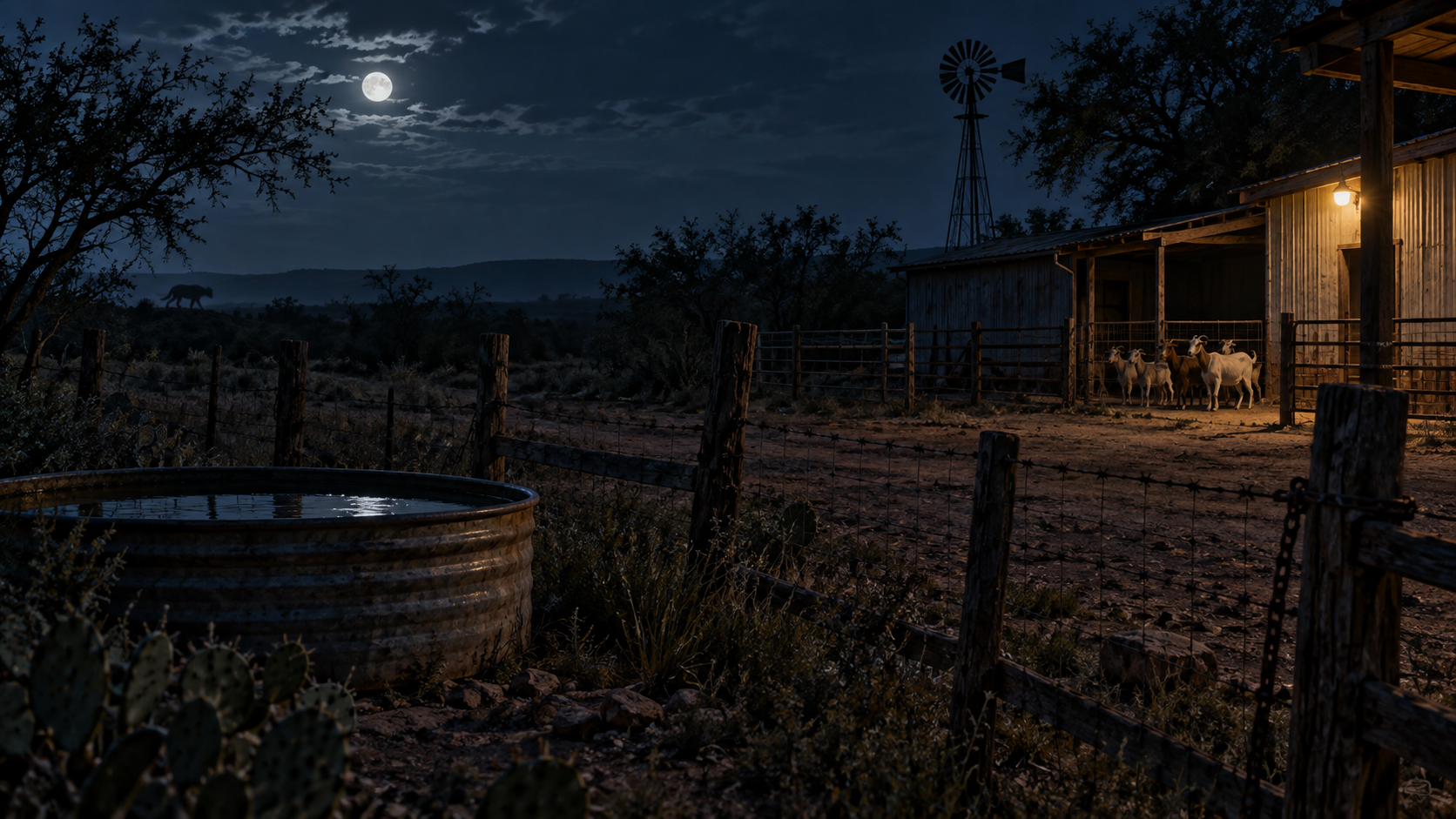

Most monsters in folklore are centuries old. The chupacabra is younger than the Macarena.
It has an exact birthplace, Puerto Rico in 1995, and within a year it had crossed the Caribbean, gone viral on Spanish-language television, and turned up on ranches in Mexico, Florida, and South Texas. It is one of the few folk monsters whose whole life we can watch in the record. And it may be the best example we have of how a legend forms in real time.
Puerto Rico, 1995
In the spring and summer of 1995, farmers in Puerto Rico began finding livestock dead: goats, sheep, chickens, rabbits. What made the deaths strange was how they were killed. Reports described small puncture wounds, often in the neck, and animals that seemed to have been drained of blood. There was little sign of feeding.
The island had seen something like it before. In the 1970s, a wave of livestock deaths around the town of Moca had been blamed on a creature the papers called el vampiro de Moca. But 1995 was bigger, and it happened in the television age.
In August 1995, a woman in Canóvanas named Madelyne Tolentino described seeing the creature. Her account became the template: an upright thing about four feet tall, with large dark eyes, spines or quills down its back, and a way of hopping or moving like a kangaroo. A local comedian, Silverio Pérez, is generally credited with the name that stuck: chupacabras, the goat-sucker.
Years later, the researcher Benjamin Radford traced the sighting and noticed that Tolentino’s description closely resembled the alien in the science-fiction film Species, which had been released that summer and which she had seen. That doesn’t mean she was lying. It means that when people meet something they can’t explain, they reach for the nearest shape they already have.
1996: the goat-sucker goes north

Through late 1995 and 1996, the chupacabra moved through the Spanish-speaking world at the speed of broadcast. Talk shows and news programs covered it. Reports came in from the Dominican Republic, from across Mexico, and from Central and South America. In March 1996, a series of animal deaths in Sweetwater, near Miami, was blamed on the creature. And along the Texas border, where ranching families watched the same broadcasts as their relatives in Mexico, the word began to come up whenever an animal was found dead and nobody could say what did it.
To understand why it caught on in ranch country, forget the monster for a moment and think about the goat.
On a small ranch, livestock isn’t background. It’s money, and sometimes it’s the margin between keeping the place and losing it. A predator that kills without eating is a disaster twice: you lose the animal, and you lose any way of understanding the threat. Coyotes you know. Feral dogs you know. Something that leaves the carcass whole with two holes in the neck is a problem you can’t budget for.
The chupacabra filled that gap. It gave the loss a name.
What the Texas chupacabras turned out to be
The chupacabra also changed shape on the way north. By the 2000s the Texas version no longer looked like Tolentino’s spiny biped. It was four-legged, dog-like, hairless, with grey leathery skin and a pronounced spine. Ranchers shot them, hit them with trucks, and found them dead by the road. In 2007 a rancher near Cuero, Texas, found a carcass she believed was the animal that had been killing her chickens, and the story went national.
This time there were bodies to test. Again and again, the Texas chupacabras came back as coyotes, dogs, or coyote-dog hybrids suffering from severe sarcoptic mange. Mange strips the fur, thickens and darkens the skin, and makes the spine and ribs stand out. It also weakens the animal, which is why a mangy coyote goes after easy prey near houses, chickens and penned goats, instead of hunting in the open.
So the ranchers weren’t wrong. Something was coming in close and killing their animals. It was sick, it was desperate, and it looked like nothing they’d seen. The legend was a real observation with the wrong explanation attached.
Before the chupacabra
The chupacabra wasn’t the first livestock panic in the Americas, and it helps to see where it fits.
In the 1970s, ranchers across the western United States reported cattle mutilations: carcasses found with organs, eyes, or tongues missing and the cuts described as surgically clean. Explanations ranged from cults to government experiments to aliens. Investigations by law enforcement and veterinarians mostly concluded that the wounds were consistent with scavengers and normal decomposition, which soften and retract tissue in ways that can look like precise cuts. The panic faded, and the theories never did.
Puerto Rico’s own vampiro de Moca in the mid-1970s followed the same pattern: animals found dead with puncture wounds, a creature no one could catch, and an explanation the community reached for before the evidence was in.
The chupacabra inherited all of that. It arrived at a moment when satellite television and talk shows could move a story across a whole language in weeks, and it became the first livestock monster of the media age.
The chupacabra in popular culture
It didn’t take long for the chupacabra to leave the ranch. In 1997 The X-Files built an episode around it. It turned up in cartoons, video games, beer labels, and B-movies. In Texas especially it became a kind of mascot: a monster people half-believe in and half-own, the way the Pacific Northwest owns Bigfoot.
That affection is part of the story too. A monster that started as a real fear, a family watching its livelihood die in a pen, became a joke within a decade. For the ranchers who lived through the first wave, those two things never quite fit together.
Why the word matters
Here is what I find most interesting about the chupacabra, and what the story in October 31 is built on. For a stretch in the mid-1990s, saying the word out loud meant something. Saying it to the sheriff’s office meant you were willing to be laughed at. Saying it in front of your kids meant you’d decided they needed to be afraid.
A legend isn’t only a creature. It’s a social decision: the moment someone chooses to use the frightening explanation instead of the reasonable one.
The story in October 31
“Ground Worth More Than Food” is the nineteenth story in October 31.
> October 31st, 1996 — a ranch, South Texas.
The third goat came up dead on the tank dam, and that was the one that got the sheriff’s office to send a deputy. Refugio Aguirre had called twice by then. On the second call he used the word.
His daughter Araceli heard it through the screen door.
That’s where the story starts: with a family that has already decided which explanation it’s going to say out loud, and a girl on the other side of the screen door who heard it. I won’t tell you what’s out past the tank dam.
—
Ground Worth More Than Food is Night 19 of 31 in October 31, thirty-one folk horror stories set on Halloween night across six centuries. Read it on Amazon → · Free with Kindle Unlimited.
Take the 31 Nights challenge. One story a night through October, with a free printable calendar. Get the calendar →
Previous: Witches’ Familiars: Cats, Courts, and Massachusetts Before Salem · Next: Haunted Dolls: Why We Keep Bringing Them Home from Estate Sales