
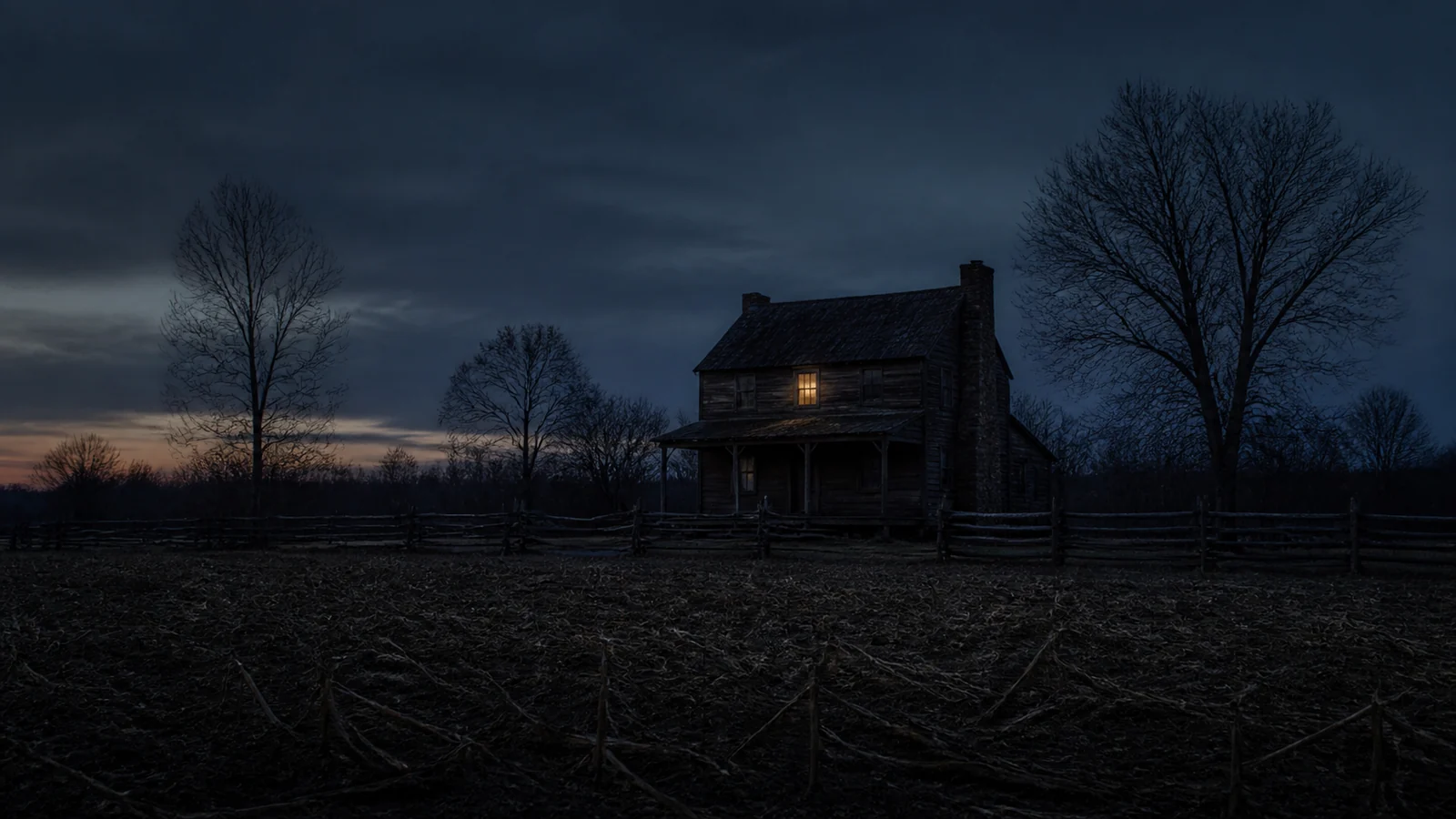
Tennessee's most famous witch was not a witch at all.
Not at first.
It was a knocking under the floor. An animal that vanished before it could be named. A voice in a farmhouse. A family story repeated until an unseen presence acquired a personality, a grievance, and the familiar name Kate.
Then print got hold of it.
The Bell Witch is a haunting legend associated with John and Lucy Bell's family near present-day Adams, Tennessee, beginning around 1816 or 1817. The story says an invisible entity struck family members, spoke in different voices, tormented John Bell, and claimed responsibility for his death in 1820. What survives most clearly, however, is not contemporary proof of a supernatural attack. It is the history of a legend growing through oral tradition, later books, newspapers, radio, stage performances, tourism, and repeated attempts to make the Witch return on schedule.
The ghost is difficult to verify.
Its publication history is not.
Who were the Bell family?
John Bell and Lucy Williams Bell moved from North Carolina to Robertson County, Tennessee, in 1804. According to the Tennessee Encyclopedia, they established a prosperous farm along the Red River and spent more than a decade living an apparently ordinary frontier life.
The place matters. Early nineteenth-century Middle Tennessee was not the empty wilderness later versions sometimes require. It was a growing agricultural region shaped by migration, churches, family networks, enslaved labor, and the difficult transformation of Indigenous land into American property. The Bell story emerged inside a community where reputation traveled person to person before it reached a printing press.
The reported disturbances began around 1816. Strange animals appeared. Knocking and scraping sounds entered the house. Bedcovers were pulled away. Members of the family were allegedly slapped or pinched. The activity concentrated increasingly around John Bell and his daughter Betsy.
Eventually, the presence spoke.
That is the turn that separates the Bell Witch from a house with unexplained noises. A voice can answer questions. It can repeat gossip. It can choose favorites. It can become cruel to one person and affectionate toward another. The Tennessee Encyclopedia describes the spirit as kind to Lucy Bell while tormenting other members of the household.
An unexplained sound is an event.
A voice is a character.
Why is it called the Bell Witch?
The entity came to be called “Kate,” often connected in later accounts to a neighbor named Kate Batts. Versions of the story assign her a land dispute or other grievance against John Bell. The details vary, and the temptation to turn one living woman into the solved identity of the ghost exceeds the documentation.
The word witch also misleads modern readers. The Bell Witch was not primarily described as a woman practicing magic in the familiar trial-era sense. It behaved more like a talking spirit or what later audiences would call a poltergeist. Even a Library of Congress dramatization made the distinction directly: the Bell Witch was “not a witch at all but a haunt, a spirit.”
Names make stories portable. “The Bell family disturbances” require explanation. “The Bell Witch” arrives already shaped.
Once the presence had a name, every noise could belong to it.
What was the Witch said to do?
The mature legend gives Kate an extraordinary range.
She could knock, scratch, sing hymns, quote Scripture, repeat sermons heard in distant churches, imitate local voices, reveal private conversations, predict events, attack Betsy Bell, and debate visitors. She supposedly interfered with Betsy's relationship with Joshua Gardner. She tormented John Bell as his health failed.
When Bell died on December 20, 1820, the story attached his death to a mysterious vial found in the house. The entity allegedly claimed it had poisoned him. A small amount of the liquid was said to have been tested on a cat, which died.
Those are elements of the legend. The language must remain precise.
A later account saying that a supernatural voice confessed to murder is not equivalent to a contemporary medical record establishing poison. A reported animal test is not a preserved toxicology result. The difference is not pedantry. It is the line between examining folklore and laundering it into history.
That same line matters in the history of the Jersey Devil. A claim can be culturally important even when the surviving evidence cannot carry the literal event.
Did Andrew Jackson visit the Bell farm?
The most famous visitor is Andrew Jackson.
The popular episode sends Jackson and several men to investigate. Their wagon stops on the road as if held by an invisible force. The Witch announces itself from the brush and allows them to proceed. During the visit, one boastful “witch layer” is allegedly beaten or tormented. Jackson leaves impressed enough to prefer fighting the British again over facing the Bell Witch.
It is a magnificent scene.
It is also not established merely because it has been repeated often.
The historical Andrew Jackson lived in Tennessee and knew prominent families across the region. That makes a visit possible. Possibility is not documentation. The episode belongs to the legend unless a traceable contemporary source can be produced. Its vivid dialogue and perfect comic structure should increase caution, not reduce it.
Later stories often recruit famous witnesses because fame transfers authority. A local ghost becomes harder to dismiss once a president-to-be has supposedly met it.
Receive the next recovered file: Join The Grimbard Press and receive Dead Ship, a free illustrated Subscriber Archive Edition.
When did the story enter print?
This is where the evidence ladder becomes useful.
| Date | Event or source | What it establishes |
|---|---|---|
| 1804 | The Bells move from North Carolina to Tennessee | Historical family and geographic setting |
| c. 1816–1820 | Traditional period of the disturbances | The dates attached to the oral legend |
| 1820 | John Bell dies | A historical death later interpreted within the legend |
| 1894 | Martin V. Ingram publishes An Authenticated History of the Famous Bell Witch | The first major full-length printed version commonly cited by later tellers |
| 1934 | Charles Bailey Bell publishes a family account | Renewed public attention from a descendant |
| 1937 | Newspapers, radio, and stage productions promote a predicted return | A documented revival that shows media actively reshaping the legend |
The distance between the alleged events and the fullest printed narratives does not prove that nothing happened. Oral traditions can preserve real memories. It does mean every polished scene must be dated by its source rather than quietly carried backward to 1817.
Martin V. Ingram's 1894 book is central to the familiar story. It gathered family tradition, testimony attributed to earlier participants, and narrative detail into an “authenticated” history. The title makes a claim about reliability; it does not settle that claim.
By the time later writers inherited the Witch, they inherited Ingram too.

The Witch learned how to return
A good ghost never needs to return physically if a newspaper can do it on her behalf.
The Tennessee Historical Society's account of 1937 shows exactly how this works. Journalist T. H. Alexander publicized a prediction that the Bell Witch would return that year. The arithmetic itself was unstable. Different versions placed the spirit's departure and promised return on different dates.
Alexander was skeptical, but he understood the market for a ghost story.
The publicity produced new reports: noises near the cave, household disturbances, blackouts, missing corn, scattered feathers, and a supposed sighting that turned out to be a stone. A magician planned an investigation. Nashville radio station WSM aired a dramatization with a large cast. A stage production followed on Halloween.
People in Adams did not respond as one superstitious crowd. Some feared the Witch. Some enjoyed the attention. Others objected. A descendant of Betsy Bell asked the newspaper to stop publishing what he called rubbish.
By December, the promised return had supplied no proof of a supernatural visitor.
It had supplied stories, audiences, and tickets.
The Bell Witch had returned through distribution.
What about the Bell Witch Cave?
The cave near Adams is now inseparable from the public legend. It gives visitors a place to enter, photograph, and remember. A haunting attached to a vanished or altered farmhouse needs a surviving threshold, and the cave provides one.
That does not make the cave the original cause of the disturbances. Later geography can become more important than early geography because it remains accessible. The site belongs to the legend's continuing cultural life, but claims about specific supernatural events inside it should be sourced individually.
This is common in place-based folklore. Mothman became bound to a bridge and its later tragedy. The Jersey Devil became inseparable from the Pine Barrens even though the legend's print history is more complicated than a creature born cleanly in the woods.
A place gives a story somewhere to wait.
Was the Bell Witch real?
If real means that the surviving record proves an invisible intelligence poisoned John Bell, attacked his daughter, stopped Andrew Jackson's wagon, and returned according to schedule, the evidence does not establish that conclusion.
If real means a Tennessee legend with identifiable people, a specific landscape, a long publication history, family conflict over its telling, recurring public revivals, and the power to shape the identity of Adams, the Bell Witch is real in abundance.
The most responsible answer keeps four categories separate:
- Documented: the Bell family, Robertson County setting, John Bell's death, later books, articles, broadcasts, performances, markers, and tourism.
- Traditional: the disturbances dated to the late 1810s, the speaking spirit, Kate's attacks, prophecies, and return promises.
- Reported: statements attributed to family members, neighbors, and visitors, filtered through later preservation.
- Unverified: a supernatural cause, poison administered by an entity, and famous dialogue repeated without a contemporary record.
Keeping the files separate does not kill the Witch.
It shows how she survived.
Frequently asked questions
Was the Bell Witch a real woman?
The entity was sometimes connected to a neighbor named Kate Batts, but the legend's “Kate” should not be treated as a proven identification of a living woman. The Bell Witch behaves primarily as a spirit in the story.
Did the Bell Witch kill John Bell?
John Bell died in 1820. The legend says the entity confessed to poisoning him, but surviving evidence does not establish supernatural murder or provide a verifiable toxicology record.
Did Andrew Jackson investigate the Bell Witch?
The visit is one of the legend's best-known episodes, but it is not securely established by contemporary documentation. Present it as a popular traditional account, not a settled event.
Is the Bell Witch Cave the original haunted site?
The Bell farm and household are central to the early legend. The nearby cave became an important physical destination in the tradition's later life, but that does not prove it caused the original reports.
Why is the Bell Witch important?
The story is one of Tennessee's best-known haunting traditions. It shows how family memory, oral storytelling, print, mass media, tourism, and skepticism can all participate in keeping a ghost alive.
Open the next case file
The Pine Barrens Incident takes another regional legend out of the souvenir case and returns it to roads, wetlands, reports, and people who cannot agree on what the evidence means.
Enter Case #001 or join The Grimbard Press for Dead Ship and the next recovered file.
Sources and further reading
- William T. Turner, “Bell Witch,” Tennessee Encyclopedia.
- Skyler Gordon, “Year of the Witch: 1937 and the Return of the Bell Witch,” Tennessee Historical Society.
- Martin V. Ingram, An Authenticated History of the Famous Bell Witch (1894), available in digitized public-domain editions.
- “The Legend of the Bell Witch,” Library of Congress reader's-theater script, adapted from archival radio material.