Tag: T.P. Grimbard

  • The Scarab Is Out Today — T. P. Grimbard’s Debut Novel

    The Scarab Is Out Today — T. P. Grimbard’s Debut Novel

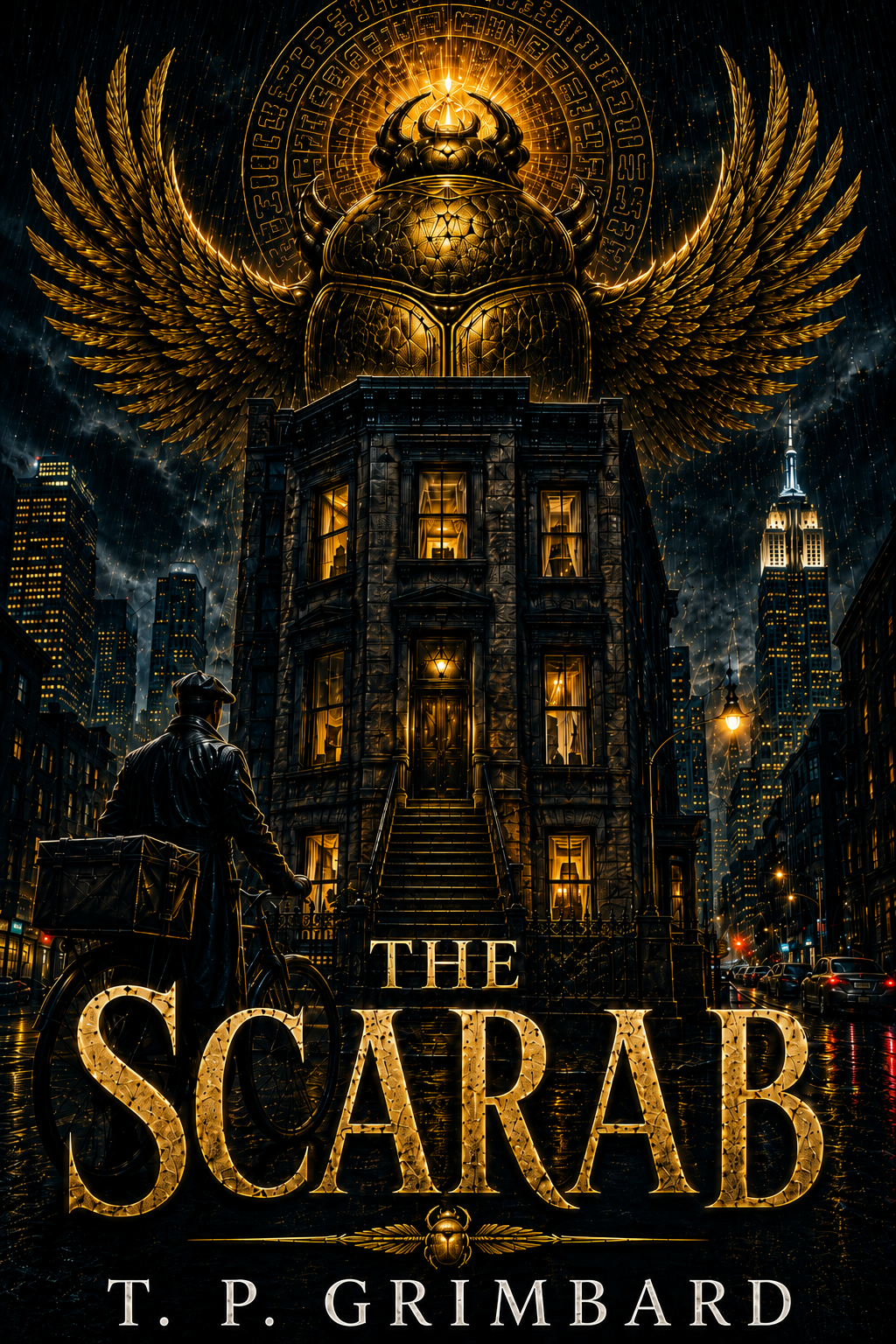
    The Scarab, T. P. Grimbard’s first novel, releases today on Amazon in Kindle ebook and 6×9 illustrated paperback.

    A courier ducks a storm and climbs through an open window into an old house in Flatbush. He leaves at dawn with no bruises, no memory of choosing to stay, and a certainty he can’t shake. Something old and patient has just decided he’s worth the wait.

    The Scarab hero banner artwork, a winged scarab motif

    What Is The Scarab About?

    The Scarab is a slow-burn occult horror novel told through fractured testimony — a courier, a private investigator, a hacker, and a handful of sources, each holding a piece of something none of them can prove and none of them can forget. No single narrator has the whole picture. That’s the structure the book runs on.

    Half a world from Flatbush, an archaeologist in Cairo dies under a wall that came down a little too conveniently — the same week she refused to let a corporation move faster than the truth. A private security firm starts asking questions it won’t explain. A woman in Manhattan with more power than she’s comfortable holding starts receiving things she never ordered. A fifty-five-year-old private investigator, sharper than the diagnosis she’s been ignoring, starts pulling a thread that was never meant to be found.

    Something has been keeping accounts for a very long time. It doesn’t take. It gives — hands its inheritance to whoever’s standing closest when the hour comes, whether they want it or not. Once you’re carrying it, there’s no putting it down.

    Illustration of the porch and open window where The Scarab begins

    Who Should Read The Scarab?

    The Scarab is built for readers who want dread that builds in silence and doesn’t explain itself, told across institutions instead of a single haunted house. If you liked the patient, testimony-driven horror of Silvia Moreno-Garcia’s Silver Nitrate or Tananarive Due’s The Reformatory, this book is aimed at the same reading experience.

    Three things define the book’s approach to horror:

    • Restraint over reveal. The threat is never fully explained on the page — the book trusts the reader to sit with what’s withheld.
    • Institutions as the real monster. The story is as much about what corporations, security firms, and private wealth do to bury the unbearable as it is about the entity at the center of it.
    • Colonial theft with a body count. The Cairo thread ties the supernatural inheritance directly to what gets looted, buried, and quietly re-buried by the people with the resources to make it disappear.

    Where Can You Buy The Scarab?

    The Scarab is available today on Amazon in Kindle ebook and 6×9 illustrated paperback, and it’s enrolled in Kindle Unlimited. Because it’s part of KDP Select, the ebook is Amazon-exclusive — it will not appear on Gumroad or any other storefront while enrolled.

    Format Where Price
    Kindle ebook Amazon $5.99
    6×9 illustrated paperback Amazon $16.99

    From Chapter One:

    “I stood in the front room with my back to the window I’d come through and waited for my eyes to adjust and listened the way you listen in a space when you need to know if it’s actually empty. There’s a quality to empty that isn’t just quiet — the air hasn’t had a reason to move recently. Apartments where nobody’s been for a while have it. This house had the opposite.”

    Who Is T. P. Grimbard?

    T. P. Grimbard writes horror and dark fiction for readers who like their dread slow and their explanations withheld. The name splits two instincts down the middle: the Bard, a lifelong tabletop storyteller who’s run more campaigns than can be counted, and the Grim, the part that can’t walk past a haunted house without going in. Research trips to genuinely unexplained places — cemeteries, ghost tours, one particularly bad night in Galveston — tend to end up in the work in ways that are only partly fiction.

    The Scarab is Grimbard’s first novel, following the short story collection There Be Monsters: Then and Now, its sequel There Be Monsters: Deep Down, and the standalone story Rabbit Season.

    If institutions quietly burying something unbearable is what hooked you, The Collected Strange Stories is a natural next read — a similar appetite for dread that comes from what a system chooses not to see.

    Get The Collected Strange Stories on Amazon

    New fiction, annotated classics, and a free welcome story land in your inbox when you sign up for the Grimbard newsletter.
  • There Be Monsters: Deep Down Is Out Now — 13 Stories About What Waits Below

    There Be Monsters: Deep Down Is Out Now — 13 Stories About What Waits Below

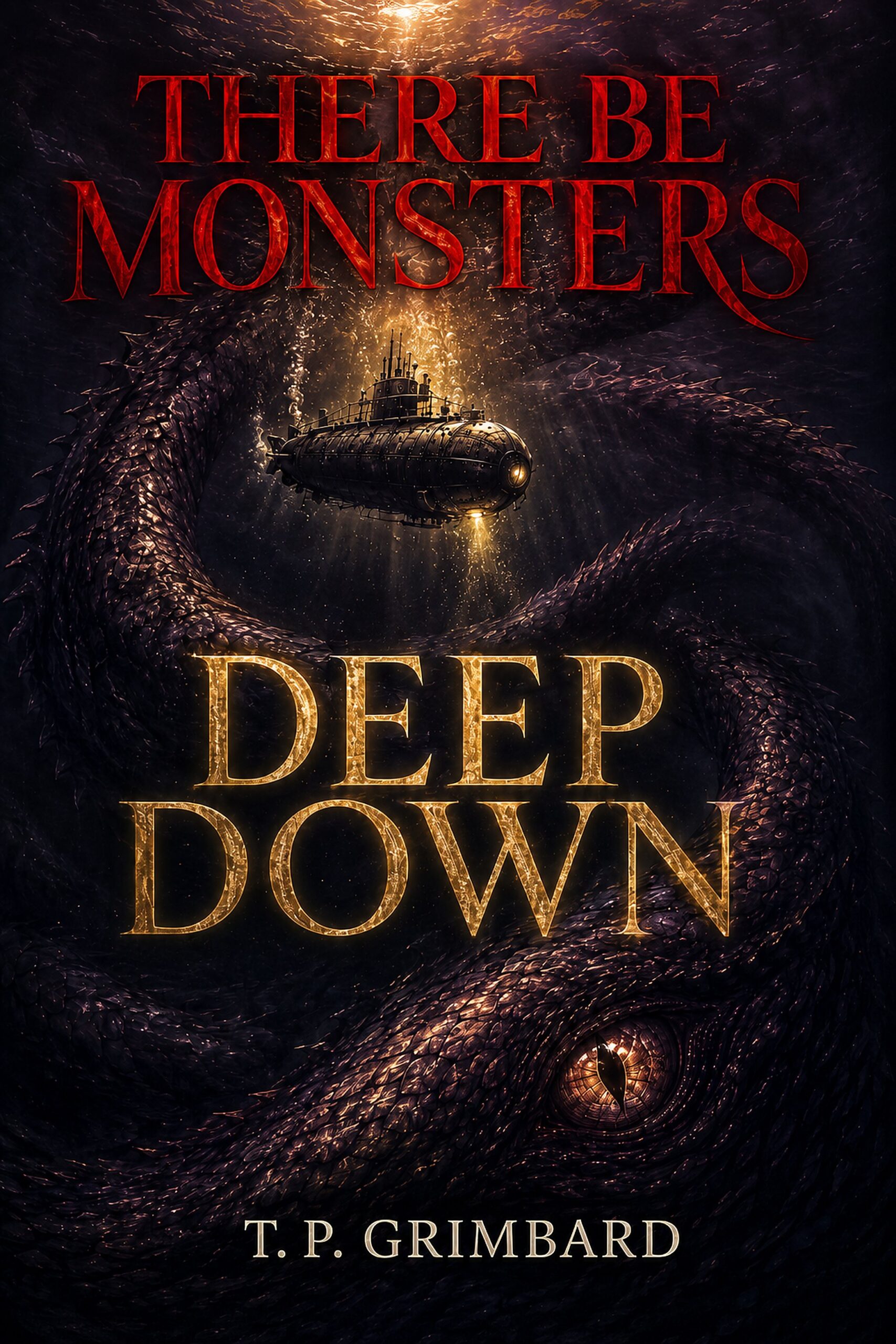
    There Be Monsters: Deep Down is available today on Amazon in Kindle ebook and 6×9 paperback — the second full collection in the There Be Monsters series.

    Thirteen stories. One direction: down. Into water, into rock, into the caves and drowned places built to keep people out, and into the parts of a person their own family never sees.

    What Is There Be Monsters: Deep Down About?

    Deep Down is a 13-story horror anthology about depth — what happens when people go looking for the bottom of something and find it’s occupied. Each story follows a different account of someone who ignored a warning that turned out to be true.

    Then and Now, the first collection in the series, kept its monsters close to the surface — in the familiar world, in places readers already had reasons to be. Deep Down goes further than that book did, into locations built to be entered once and not questioned.

    A sample of what’s waiting in the collection:

    • A sister recovers her drowned brother’s final dive footage and learns he wasn’t afraid of what took him.
    • A Navy SEAL team boards a drifting ship expecting pirates and finds eight hundred people who tore each other apart from the inside.
    • Below a Belizean blue hole, something older than the water waits exactly where the light gives out.
    Illustration of a diver discovering a sunken shipwreck in green water

    What Makes This Collection Different From Then and Now?

    Deep Down pushes further into an inhuman narrative voice — several stories are told from a perspective that experiences the world in a way that is internally coherent and externally wrong. That’s the collection’s core structural idea, and it’s what separates it from a standard monster anthology.

    The monstrous in these stories isn’t positioned as an outside threat opposing human characters. It functions as an extension of human nature — the part that the ordinary world has no category for, that has nowhere else to go, and that goes down instead. Three things carry that idea through the book:

    1. Every story is a recovered account, not a narrated legend — something that happened to a specific person who believed the warning didn’t apply to them.
    2. The horror predates the humans who find it. Nothing in this collection was summoned. It was already there, waiting in a place with no relationship to time the way people experience it.
    3. The archive format continues from Then and Now. Grimbard doesn’t appear in the stories — only collects and orders them, the way the There Be Monsters series has worked since the first book.
    Illustration of a diver descending into a Belizean blue hole

    Where Can You Buy There Be Monsters: Deep Down?

    There Be Monsters: Deep Down is available now on Amazon in Kindle ebook and paperback, and it’s enrolled in Kindle Unlimited. Because it’s part of KDP Select, the ebook is Amazon-exclusive for now — it won’t appear on Gumroad or any other storefront.

    Format Where Notes
    Kindle ebook Amazon Included with Kindle Unlimited
    6×9 paperback Amazon Same listing, print edition

    Who Is T. P. Grimbard?

    T. P. Grimbard collects warnings for a living — the kind that used to be posted at the edge of a map, before maps stopped admitting there was an edge. Every account in the There Be Monsters series is presented the way it was found: as something that happened to someone who thought the warning didn’t apply to them. The archive is always growing. It has never once gotten smaller.

    If you’re the type of reader who finishes a Deep Down story and immediately wants to know what else waits in dark water, Boxcar Children was many horror readers’ first taste of kids finding things adults had stopped looking for — and it holds up as a surprisingly good gateway into the genre.

    Get the Boxcar Children on Amazon

    New accounts, annotated classics, and a free welcome story land in your inbox when you sign up for the Grimbard newsletter.


    Pinned question for the comments: Which regional rule from your hometown do you still follow today — and do you know where it actually came from?

  • What Visiting Haunted Places Actually Feels Like

    What Visiting Haunted Places Actually Feels Like


    My partner and I have a tradition when we travel. Before we book anything, we look up what died there.

    Not morbidly — or not only morbidly. It’s more that the historical weight of a place interests us, and that weight is usually attached to the bad things. The flood. The fire. The crime that nobody quite got to the bottom of. The building that used to be something else before it was what it is now.

    We’ve done ghost tours in a dozen cities. We’ve walked through cemeteries at hours that made the groundskeepers nervous. We’ve stood in rooms where, by every account we could find, something happened that the people who lived through it couldn’t explain.

    I want to tell you what that actually feels like — not what the tour guides say it feels like, and not what the skeptics say it feels like. What it actually feels like, from someone who pays attention for a living.


    The First Thing Is the Cold

    Not in the “cold spot” paranormal sense, though those are real enough. The first cold is the one you feel before you know why.

    We were in a 19th-century hotel in Savannah — I won’t name it because Savannah has so many haunted hotels that naming one feels like endorsing a TripAdvisor entry — when I walked into a hallway on the third floor and stopped. My partner, two steps behind me, also stopped.

    Neither of us said anything for a moment. Then she said, “Do you feel that?”

    I did. Something in the air pressure, maybe. Something in the way the light behaved. There was no visible reason for either of us to stop.

    The room at the end of that hallway, we found out later, was the one.

    I’m not making a supernatural claim. I’m making an observation: human beings have threat-detection systems that are very old and often accurate, and old buildings that held bad events have a way of triggering them in people who aren’t defended against them. Whether that’s atmospheric or architectural or something genuinely paranormal is a question I don’t have a confident answer to.

    What I do have is the memory of stopping in that hallway.


    What the Tour Guides Know

    Ghost tour guides are, almost universally, the most interesting people in any city.

    They are amateur historians who became professional storytellers through necessity — nobody hires you to just stand on a street corner and recite municipal history. You need the ghost. But to get the ghost right, you have to get the history right. The haunting is the hook; the history is the substance. The best guides understand that the history is scarier than the ghost.

    The guide who walked us through a preserved antebellum district in South Carolina didn’t dwell on the apparition sightings. She spent forty minutes on the documented history — the people who died there, the records that survive, the gap between what the official accounts say and what the oral tradition preserved. By the time she got to the story of what people claimed to see in the third-floor window, she didn’t need to sell it.

    The thing had weight.


    What the Skeptics Get Half Right

    Skeptics are correct that most people on ghost tours experience what they came expecting to experience. Priming is real. If you tell someone a room is haunted and then dim the lights, you will generate phenomenological reports of haunting. This is not controversial.

    What the pure debunking stance misses is that “you experienced what you came expecting to experience” doesn’t fully explain every account, and it doesn’t explain why the content of those accounts is so consistent across time, culture, and witness.

    If a room has been generating reports of a woman in gray standing in the corner for one hundred and fifty years — reports from people who didn’t know each other, who visited in different eras, who described the same gray woman in the same corner — pure priming doesn’t actually account for that. Priming explains individual suggestibility. It doesn’t explain the anchor.

    I hold these things loosely. I am not a true believer. But I am also not someone who finds pure materialism a satisfying explanation for everything I’ve personally stood in front of.


    Why We Keep Going

    The honest answer is that visiting these places is a form of paying attention to the dead.

    History has a way of becoming abstract — names and dates and events compressed into summaries that carry no weight. Standing in the room where something happened does something that reading about it does not. The scale comes back. The reality of it.

    I write horror about places. The specific texture of a room, a hallway, a ridge at dusk. I can’t generate that texture from research alone. I need to stand somewhere and let it do what it does.

    My partner comes because she finds history genuinely moving, and because she has, on two occasions, experienced things she hasn’t found a satisfying explanation for. She isn’t frightened by those experiences. She finds them interesting. It’s one of the things I like most about her.

    The cold in the hallway. The woman in gray. The man on the ghost tour who looked at you like you’d asked about roads.

    These are not the same kind of evidence. But they’re all evidence of something. The places hold what happened in them, one way or another.

    I’d rather go look than not.


    Writing about haunted places and folk horror — join the Grimbard list for creature features, dark tourism notes, and new fiction: Join the Grimbard list

  • New Short Read: “Rabbit Season”

    New Short Read: “Rabbit Season”

    There’s a rule carved into the inside of the old camp door, and Lee has read it his whole life.

    Don’t shoot the white ones in winter.

    It’s 1935. The snares have been empty for six days. The egg money stopped covering the lamp oil a month ago, and Lee’s father has gone quiet in the way a man goes quiet when he’s run out of everything except the next bad idea. So when a white rabbit sits out on the snow at thirty yards — not hiding, not bolting, the white of it wrong against the white of the weather — the rule loses.

    The rabbit comes home.

    What sits down to supper after that is the part I’ll let you read for yourself.

    “Rabbit Season” is live now as a standalone short read. It’s quiet, Depression-era folk horror — the kind built on an old warning, an empty woods, and a family hungry enough to ignore both. If you like your horror patient and your endings earned, this one’s for you.

    Read “Rabbit Season” on Kindle: https://a.co/d/0bnT7fuu

    It’s pulled from my anthology There Be Monsters: Then and Now — thirteen stories, each one its own bad idea. If “Rabbit Season” gets under your skin, the rest are waiting.

    Get the full collection: https://a.co/d/04jKPYNx

    And if you want a free story to start with, I’ll send you one — no charge, just a quiet place to begin.

    Grab your free story: https://preview.mailerlite.io/forms/2428558/192190473470740064/share

    Bank the fire before you sleep. And if you see a white one this winter, leave it where it sits.