
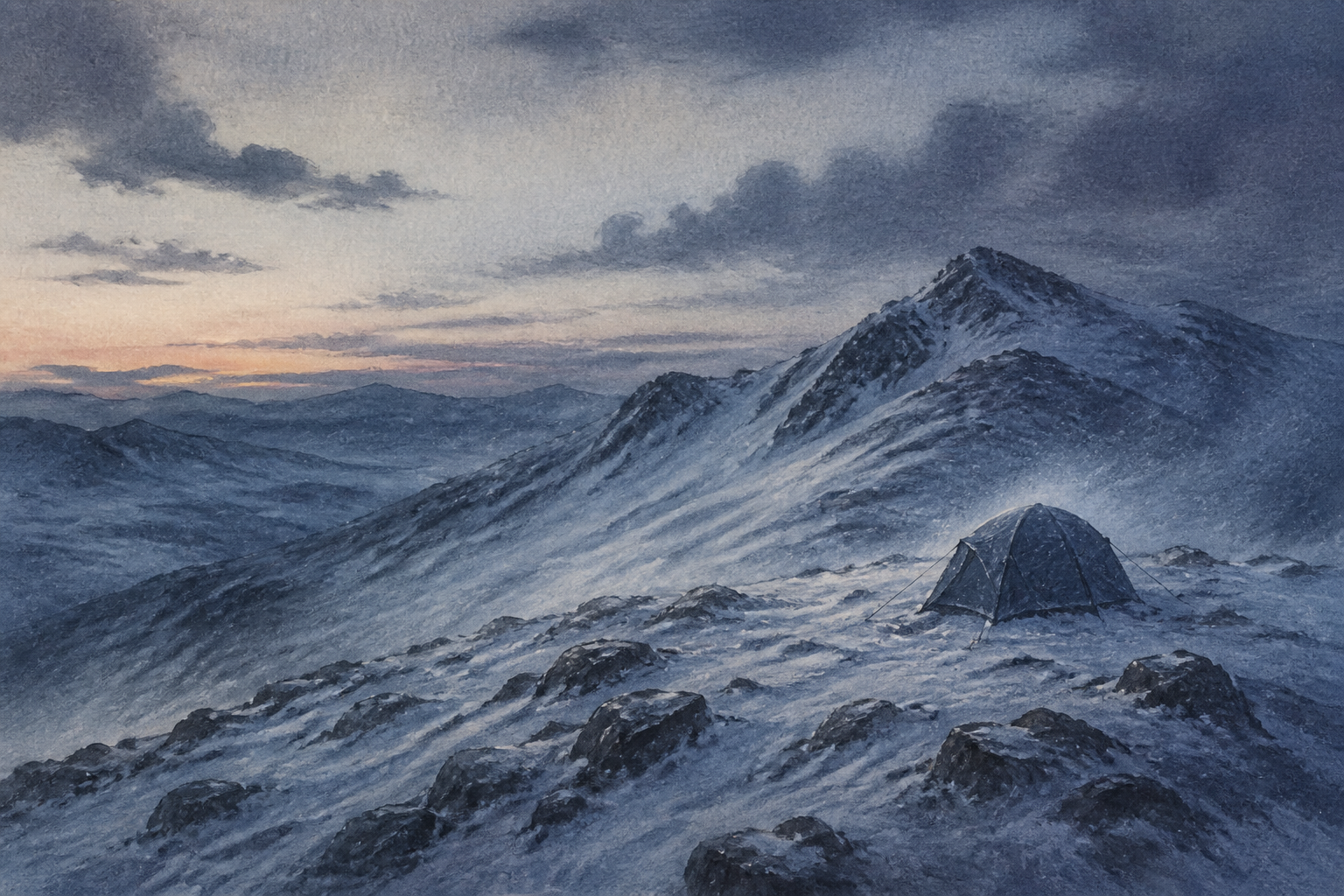
The Dyatlov Pass Incident Explained: What the Evidence Supports
In February 1959, nine experienced young hikers died on the eastern slope of Kholat Syakhl in the northern Urals. Their tent had been cut open from inside. They left it inadequately dressed for severe winter conditions. Searchers later found bodies at different locations down the slope and near a cedar tree.
The Dyatlov Pass incident is often sold as proof that something impossible happened: a military secret, a UFO, a monster, an attack, a sonic weapon, or a curse. The evidence supports a harder and more human account. A dangerous snow event, brutal weather, darkness, injury, disorientation, and the failure of rescue can explain much of what made the case look supernatural. But “explained” should not mean every minute of that night has been reconstructed with certainty.
The best-supported modern physical model examines a delayed slab avalanche. Researchers Johan Gaume and Alexander Puzrin showed how a small but dangerous snow-slab release could plausibly have developed after the hikers cut into the slope to pitch their tent, and how such an event could account for the urgent exit and some of the severe injuries.[^1]
That is not a tidy ending. It is a disciplined one.
What happened at Dyatlov Pass?
The group was led by Igor Dyatlov, a student from the Ural Polytechnical Institute. After one member turned back earlier because of illness, nine hikers continued into the northern Urals. They made camp on a slope on the night of February 1, 1959, rather than reaching more sheltered woods.
When they did not return, a search began. Investigators found the tent damaged and partially buried in snow. The hikers’ tracks led away from it. Several bodies were found between the tent and the forest; others were found later near a ravine. The cause of death for several was hypothermia, while others had serious chest or head injuries.
Those facts are frightening without embellishment. A tent is supposed to be the smallest possible shelter from a winter landscape. Leaving it without adequate clothing is not mysterious because people are irrational. It is mysterious because the people had a reason to believe staying was worse.

Illustration: a physical explanation can be incomplete without being weak.
Why the cut tent matters
The tent is one of the case’s strongest pieces of evidence because it records urgency. If the group cut their way out from inside, they were not calmly packing up to investigate a noise. Something made the normal exit feel unavailable, too slow, or unsafe.
An avalanche explanation has often been dismissed with a simple objection: no huge avalanche scar was visible when searchers arrived. But the 2021 model does not require a cinematic wall of snow. It examines how a delayed slab release on the altered slope could have occurred and then become difficult to identify after wind and later snowfall changed the scene.[^1]
The model is not a time machine. It cannot tell us who cut the tent, what every person believed, or exactly when each injury occurred. It does demonstrate that a snow-slab mechanism is physically plausible in terrain that earlier popular accounts treated as unsuitable for an avalanche.
That is an important correction. “No visible giant avalanche” is not the same as “no possible snow event.”
The cold did the work horror likes to assign to monsters
Once the hikers were outside, the conditions became lethal. They were on an exposed mountain slope at night, in extreme cold and wind, with limited clothing and a damaged shelter above them. Reaching the forest may have seemed like the best available move because trees offered some protection from wind and materials for a fire.
But a decision can be reasonable at the instant it is made and still lead toward disaster. Hypothermia alters judgment. Darkness makes distance and slope difficult to read. Injuries reduce mobility. A separated group loses the ability to share heat, information, and help.
This is why the incident needs no paranormal addition. The terror is procedural. First, shelter becomes unsafe. Then the replacement shelter is too far away. Then every small task—lighting a fire, finding a companion, returning uphill, deciding whether to split up—costs more than the body can afford.
There is a temptation to turn the case into a puzzle box because the evidence is fragmented. But real winter emergencies are often fragmented. The landscape preserves some objects, hides others, and leaves investigators with decisions rather than a clean narrative.

Illustration: the case concerns a failed shelter and nine lives, not a supernatural stage set.
What about the injuries and the stranger claims?
Serious injuries have fueled some of the wilder theories. The slab-avalanche model specifically addresses how snow loading and terrain could produce significant trauma without the kind of visible external damage people expect from an assault.[^1] It does not erase every uncertainty; it gives a material mechanism worth considering before inventing a hidden attacker.
Other famous details need context. Reports about missing soft tissue on some bodies are often repeated as if they were an occult clue. Bodies discovered later in a stream environment and exposed to decomposition, water movement, scavenging, and time will not look like bodies found immediately after death. A responsible article should rely on forensic documentation rather than turning those details into decoration.
The claim that local Mansi people attacked the group is especially irresponsible. It has circulated for decades despite a lack of evidence and despite the broader tendency of mystery stories to blame the nearest Indigenous community when investigators need a villain. The case does not justify that prejudice. Do not use it as a colorful “theory.”
Nor does the case demonstrate a UFO, a secret weapon, infrasound panic, or a creature on the mountain. These ideas persist because they are narratively efficient. They give the hikers an enemy. The available evidence is more difficult: weather, snow physics, exposure, human effort, and a situation that became unrecoverable.
What remains uncertain
A sober explanation still leaves questions. Researchers cannot reconstruct the exact timing of every move. We do not know each person’s perception of the threat. We cannot fully restore the snowpack, wind, visibility, equipment state, and physical condition minute by minute.
That is the same discipline needed when we ask why emergency broadcasts can feel frightening: the evidence can create dread on its own. A missing final explanation is not a blank check for supernatural ones.
Uncertainty is not an invitation to make anything possible. It is an instruction to rank explanations by evidence. The slab-avalanche work is valuable because it tests a physical scenario against terrain and snow mechanics. It does more than declare an opinion.
That approach belongs to the same family as the H. H. Holmes “Murder Castle” myth. A missing final explanation can be honest without becoming supernatural. The record is allowed to have gaps. The task is to keep the gaps from being filled by whatever story sells the strongest poster.
The Grimbard reading: the mountain did not need an evil intention
The Dyatlov Pass incident is horrifying because ordinary survival logic broke down under extraordinary conditions. The tent became dangerous. The forest became necessary. The return became impossible. Nine people were caught in a sequence where every remaining choice was worse than the choice before it.
That is enough. It is more than enough.
For more Archive files that separate the documented event from the version horror culture prefers to tell, join The Grimbard Press and receive Dead Ship, a free illustrated Subscriber Archive Edition.
FAQs
What happened at Dyatlov Pass?
Nine hikers died in the northern Urals in 1959 after leaving their tent during severe winter conditions. The exact sequence remains incomplete, but modern research supports a plausible snow-slab avalanche scenario combined with exposure and injury.
Was Dyatlov Pass caused by an avalanche?
A 2021 study found that a delayed slab avalanche could plausibly explain key parts of the incident. It is a strong physical explanation, but it does not recreate every detail of the night with certainty.
Did a UFO or secret weapon cause the Dyatlov Pass deaths?
No reliable evidence establishes either claim. Such theories are more speculative than the weather, terrain, and snow-physics explanations supported by available evidence.
Did local Mansi people attack the hikers?
There is no evidence supporting that claim. It should not be repeated as a colorful mystery theory or used to blame an Indigenous community for an event investigators could not fully reconstruct.
[^1]: Johan Gaume and Alexander Puzrin, “Mechanisms of slab avalanche release and impact in the Dyatlov Pass incident in 1959”, Communications Earth & Environment 2, 10 (2021).