
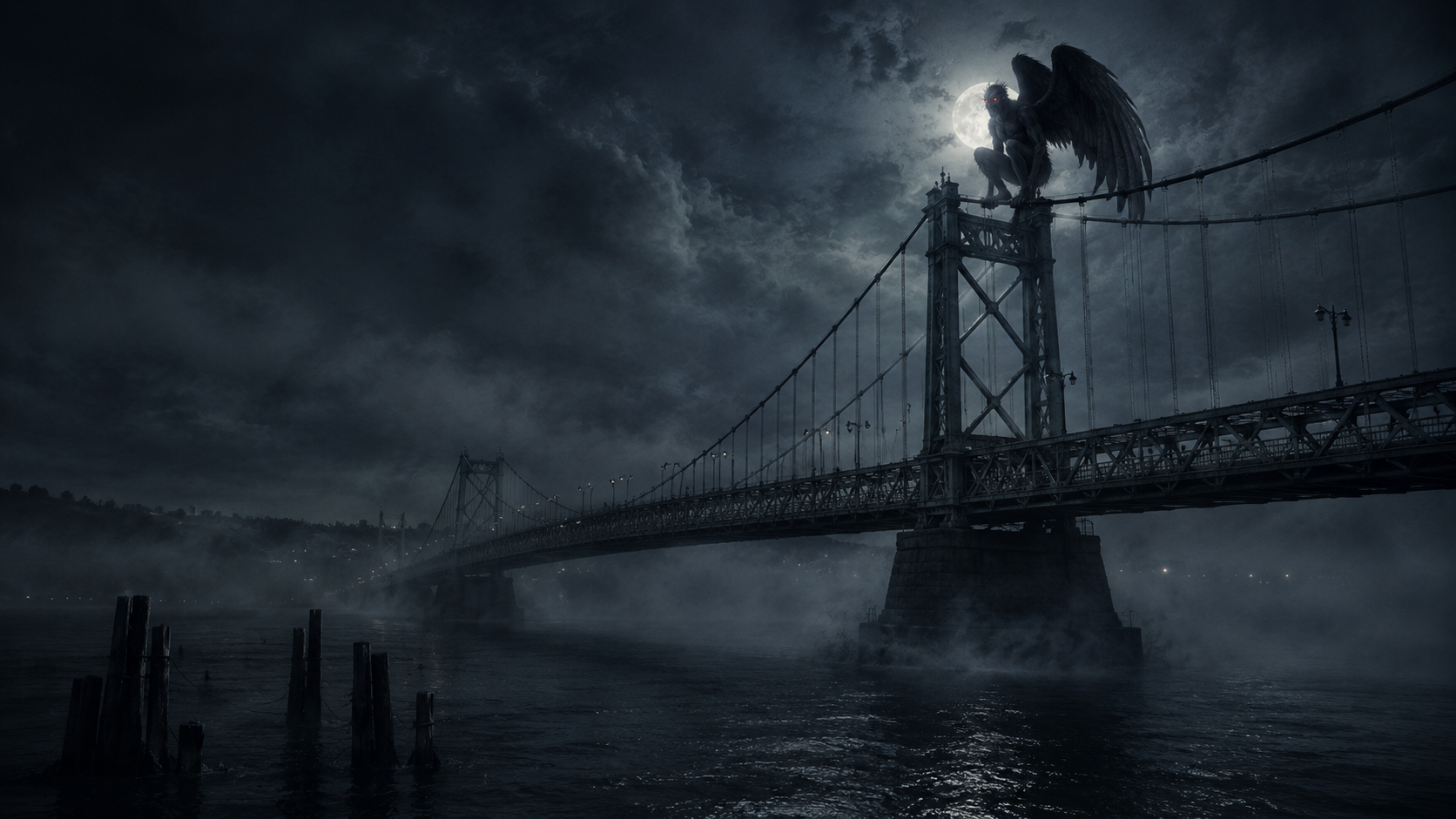
Forty-six people died when the Silver Bridge collapsed on December 15, 1967.
It was the evening rush hour in Point Pleasant, West Virginia. The bridge connected the town to Gallipolis, Ohio, across the Ohio River. A single corroded eyebar — one link in a suspension chain — failed first. The rest followed in under a minute. Thirty-one vehicles went into the river. The water was thirty-five feet deep. Many of the dead were still in their cars.
The disaster was later attributed to a stress fracture in the eyebar that had been present since the bridge was manufactured in 1928. A manufacturing defect. It had been building toward failure for nearly forty years, and no inspection had caught it.
This is the fact-record version of what happened at Point Pleasant.
The other version begins thirteen months earlier, in November 1966, when a creature no one had a name for started appearing near the town.
What People Saw
The first widely reported sighting came from two couples driving near an abandoned munitions plant known locally as the TNT Area. They described a large humanoid figure, grey or brown, with wings folded against its back and eyes — the eyes are always the detail people lead with — eyes that were large, red, and reflective in headlights. The figure rose from the roadside, spread wings that witnesses estimated at ten to fifteen feet, and followed their car at speeds up to one hundred miles per hour without appearing to beat its wings.
Over the following year, more than a hundred people in the Point Pleasant area reported seeing something similar. The accounts are not all consistent — some describe a creature closer to seven feet tall, some shorter; some report a distinct chest structure, some don’t. What stays consistent across nearly all accounts: the wings, the red eyes, and the unsettling quality of encountering something that was aware of being watched.
Local newspaper reporter Mary Hyre documented many of the sightings. She also reported, in the same period, an increase in anomalous phenomena around the town — unusual telephone interference, Men in Black-type encounters, poltergeist activity. John Keel, the journalist and paranormal investigator whose work eventually became The Mothman Prophecies, arrived in 1967 and spent months in the area interviewing witnesses.
And then the bridge fell, and the sightings stopped.
The Harbinger Question
The leap that popular culture made — Mothman as disaster prophet, a creature that appears before catastrophes to warn the unheeding — is more complicated than either believers or skeptics tend to present.
The factual record is this: the Mothman sightings clustered in a thirteen-month period and ceased after the Silver Bridge collapse. Witnesses who claim to have seen it reported feeling dread, not danger. No one reported the creature pointing at the bridge. No one reported anything that could be interpreted as a specific warning.
What happened was that the disaster arrived, the sightings stopped, and human pattern recognition did what human pattern recognition does: it connected the preceding anomaly to the tragedy that followed. This is called the clustering illusion and it’s one of the most consistent features of human cognition. We are extremely good at finding patterns and extremely unreliable at distinguishing real patterns from coincidental ones.
And yet.
Later retellings connect Mothman-like sightings to disasters far beyond Point Pleasant. Those claims are difficult to verify and should be treated as folklore, not as a documented warning system. The Point Pleasant pattern is the one with the clearest contemporary reporting: unusual sightings first, catastrophe later, and a community trying to make sense of both.
That distinction matters. A legend can be meaningful without becoming proof. The enduring power of Mothman is not that it predicts disasters, but that it gives a visible shape to dread before anyone knows what the dread is about.
What the Creature Might Actually Be
Here’s where I find the Mothman legend genuinely interesting as a piece of cultural history: the biological explanations are more plausible than most people realize, and they don’t actually resolve the problem.
The most credible naturalistic explanation is that witnesses encountered a Sandhill Crane — a large migratory bird with a wingspan of up to seven feet and eyes that reflect red in low light. This is not a bad explanation. The TNT Area is adjacent to wetlands that cranes use. The height of some witness descriptions matches a crane in flight at unusual angles.
But it doesn’t explain the hundred-mile-per-hour pursuit. It doesn’t explain the consistent account of red eyes that were described as watching. It doesn’t explain the broader anomalous phenomenon period that Hyre and Keel both documented independently.
The biological explanation handles the creature. It doesn’t handle the context.
What I think the Mothman legend is — and this is purely my read — is a community under prolonged stress (Point Pleasant had significant industrial problems, economic decline, and several smaller-scale disasters in the preceding years) generating a meaningful symbol for anxiety it couldn’t otherwise articulate. The creature showed up when things were already wrong. The bridge confirmed what the appearance had suggested.
Communities do this. They have always done this.
The Mothman didn’t cause the bridge to fail. But it might have been the shape that the town’s dread took when it needed somewhere to live.
Point Pleasant Now
The town of Point Pleasant has fully embraced its most famous inhabitant. There’s a Mothman Museum on Main Street and a twelve-foot stainless steel statue that has become one of the more photographed roadside attractions in West Virginia. The annual Mothman Festival draws tens of thousands of people every September.
This is not cynicism — I’ve been to roadside attraction towns and I’ve watched communities find dignity and economic purpose in owning their strange history. Point Pleasant does it well.
The TNT Area is still there. The wetlands are still active. Sandhill cranes still migrate through.
If you go in November, and you’re driving the back roads after dark, and something large rises from the roadside ahead of you and holds your headlights in its eyes —
Well. You’ll know to pay attention to the bridges.
Creature features, folklore deep dives, and the horror that lives in specific places — join the Grimbard list.
If you want to read the fiction this research feeds: There Be Monsters: Then and Now
What is established—and what remains folklore?
- Established: the Silver Bridge collapsed on December 15, 1967, killing 46 people; investigators traced the failure to a defective eyebar.
- Documented local legend: Point Pleasant residents and local reporter Mary Hyre recorded Mothman sightings during the preceding thirteen months.
- Unresolved: what witnesses saw, and whether the sightings had any connection to the collapse. Neither the creature nor a predictive link is established by the historical record.
For the larger question of why communities turn a frightening place into a story, read what makes folk horror different. For another creature legend handled with the same evidence-first approach, explore the Monster Lore archive.