
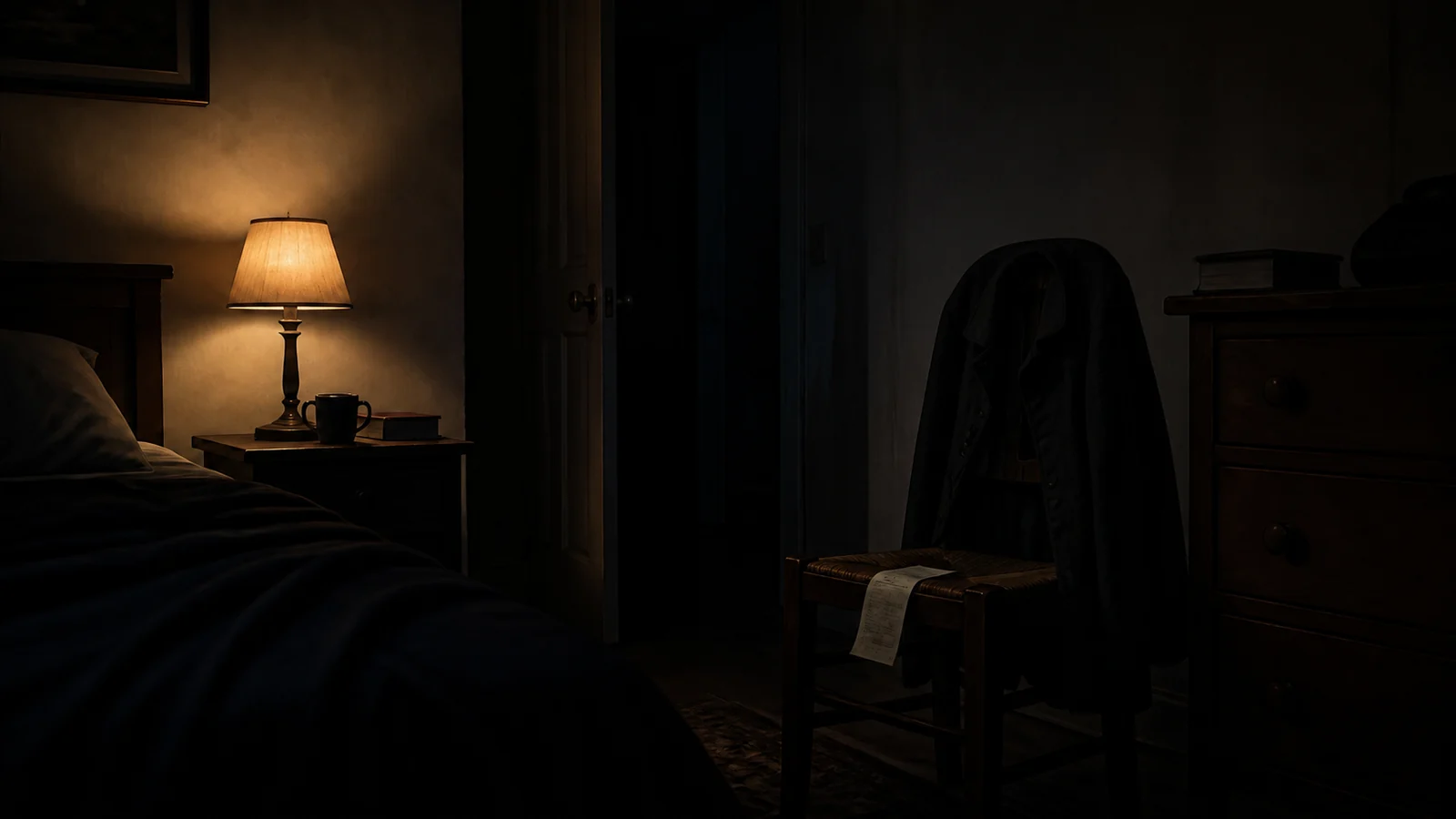
The coat on the chair becomes a person after the lights go out.
Nothing has moved. The sleeves still hang where you left them. The pale shape above the collar is still a receipt on the dresser behind it. In daylight, the scene contains fabric, furniture, and the mild evidence of a room that needs cleaning.
At 2:13 a.m., it contains shoulders and a face.
We see faces in the dark because the human visual system is unusually ready to detect them, even in incomplete or ambiguous patterns. That false perception is called face pareidolia. Low light strips away detail, leaving coarse arrangements of shadow and contrast for the brain to interpret. Sometimes it chooses the most socially important possibility first: someone is there.
The explanation is ordinary. The experience is not.
What is face pareidolia?
Pareidolia occurs when a meaningful shape appears in random or ambiguous visual information. A face in a cloud is the familiar example. So are the “eyes” of a wall outlet, a tree trunk that seems to scowl, or two lit windows above a dark doorway.
Face pareidolia is the face-specific version of that effect. The object is real. The face is an interpretation.
That distinction matters because people often use pareidolia, illusion, and hallucination as though they describe the same event. They do not.
| Experience | What is present | What happens |
|---|---|---|
| Pareidolia | An ambiguous real pattern | The pattern is interpreted as something meaningful, such as a face |
| Visual illusion | A real visual stimulus | Its size, shape, color, position, or identity is misperceived |
| Hallucination | No corresponding external stimulus is required | A person has a sensory experience that is not caused by an object currently present |
A curtain crease mistaken for a profile is pareidolia. A shadow that makes a stationary object appear to move is an illusion. Neither event, by itself, says anything alarming about the person who noticed it.
The brain is not failing when it finds a face where none exists. It is making a fast decision with bad evidence.
Your brain gives faces priority
Faces are not ordinary objects to a social animal.
A face can reveal identity, attention, emotion, health, age, and possible intent. It tells us whether someone has noticed us. It may tell us whether to approach, answer, comfort, submit, or run. A visual system that treats faces as important is not indulging a hobby. It is monitoring other minds.
Research on face pareidolia suggests that face-like objects recruit parts of the visual system also involved in processing actual faces. A study available through the National Library of Medicine describes activity in occipito-temporal regions, including the fusiform face area, when people view real faces and face-like nonface images. Other work has found that pareidolic faces can receive prioritized attention.
The practical consequence appears whenever three marks arrange themselves in roughly the correct order: two above, one below. The arrangement does not need skin. It does not need a head. It does not even need to be symmetrical. It only needs to pass the first crude inspection.
That is why a house can look surprised.
It is also why the shape at the end of a hallway can become a person before you can name the objects forming it.
Darkness removes the evidence that would correct you
In good light, the coat loses quickly.
You see the weave of the fabric, the empty space beneath the sleeve, the chair leg, and the receipt. Each detail argues against a body. The scene becomes easy to classify because the eye has enough information to test its first impression.
Darkness removes those corrections.
Edges soften. Color becomes less dependable. Depth is harder to judge. Small objects disappear into larger masses. The scene does not become completely invisible; it becomes incomplete. That may be worse.
The visual system has to assemble a useful world from limited evidence. It draws on familiar shapes and expectations. If you woke because you heard a noise, the expectation has already changed. You are no longer asking, “What objects are in my bedroom?” You are asking, “Is someone in here?”
The same shadows now sit inside a different question.
This is one reason showing fear through behavior is more convincing than merely announcing that a room feels wrong. A frightened person turns on the lamp, checks the corner, counts the windows, and looks twice at the coat. The action reveals that the first glance did not settle the matter.

A false alarm can be cheaper than a missed face
It is tempting to explain pareidolia with a neat evolutionary sentence: humans see faces everywhere because missing a real watcher would have been more costly than inventing one.
That idea is plausible. It is also broader than the evidence allows us to prove in one clean story.
What research supports more directly is that face detection is fast, faces attract attention, and very simple face-like configurations can activate face-processing responses. The evolutionary reason for that sensitivity is an interpretation built around those findings, not a fossilized record of one ancestral decision.
Still, the false-alarm logic is useful.
Suppose the shape beside the tree is only a broken branch. Looking again costs a second. Suppose it is a person standing motionless beyond the yard. Refusing to look again could cost more.
The brain does not need certainty to request another glance.
Horror lives inside that request.
Follow what appears next: Join The Grimbard Press and receive Dead Ship, a free illustrated Subscriber Archive Edition, followed by new monster lore and recovered files.
Why the face often feels like a watcher
A face in a toaster may be funny. A face in an upstairs window is not.
The difference is not only visual. It is narrative.
Location supplies intent. A face-like pattern above a church door belongs to architecture. The same pattern half-hidden behind a curtain occupies a place where a conscious observer could stand. The brain does not merely detect two eyes and a mouth. It places the possible face inside a situation.
Distance contributes too. Nearby objects can be inspected. Faraway shapes resist correction. Glass adds reflections. Fog weakens edges. A dark tree line offers more candidate faces than a blank wall because it contains endless partial arrangements and few decisive details.
Once the pattern becomes a watcher, every moment of stillness begins to mean something.
Why has it not moved?
Why is it facing this way?
How long was it there before you noticed?
The visual error takes less than a second. The story arrives immediately afterward.
Folklore gives the uncertain shape a name
Pareidolia does not explain monsters away.
It explains one of the ways an uncertain shape can enter human attention. Culture still decides what the shape means.
A dark figure beside a road may become a ghost, an omen, a trespasser, a saint, a witch, or a cryptid depending on who sees it and which stories are available. Monsters in folklore do more than provide anatomy. They preserve rules about places, dangers, strangers, weather, illness, and forbidden behavior.
The eye supplies a candidate. The local tradition supplies a file.
That is why similar shadows do not produce identical stories everywhere. The human tendency to detect faces may be widespread. The Black Dog, the watcher at the window, and the figure in the corn are not interchangeable cultural decorations. Each belongs to a different landscape and history.
Modern internet monsters use the same machinery at a different speed. Slender Man began in a manipulated-image forum thread, but the image worked because an elongated figure half-seen behind children felt as if it had been discovered rather than placed. The visual uncertainty gave the fiction room to masquerade as evidence.
Horror keeps the second look from resolving the first
In ordinary life, the lamp turns on and the watcher collapses into laundry.
Horror delays that relief.
The light switch fails. The figure is gone when the character looks back. The photograph shows a shape no one noticed at the time. The window reflects the room but includes one face too many. Each device prevents inspection from closing the case.
The most effective version does not show the monster more clearly with every look. It changes the quality of the uncertainty.
First, the character thinks the shape may be a person.
Then they prove it is a coat.
Then the coat is hanging somewhere else.
The fear no longer comes from misidentifying an object. It comes from discovering that the ordinary explanation has been moved.
This is the bridge from perception into story. A real cognitive tendency opens the door, but fiction decides what walks through it.
Knowing the effect does not make you immune
You can know the word pareidolia and still turn on the lamp.
Knowledge arrives after detection. The first impression can be fast, bodily, and unpleasant. Your explanation then competes with the shape instead of preventing it from appearing.
That does not mean instinct has defeated reason. Turning on the lamp is reason. Looking again is how the nervous system gathers better evidence.
The important question is not whether you can force yourself to stop seeing a face. It is whether the face survives inspection.
Usually, it does not.
The room returns. The receipt becomes paper. The sleeve becomes cloth. You may even laugh at the arrangement once the false person is gone.
But for one moment, before the evidence arrived, the room contained somebody else.
That moment is enough for horror.
Frequently asked questions
Is face pareidolia normal?
Yes. Seeing face-like patterns in objects, buildings, shadows, or natural forms is a common feature of human perception. An isolated experience of pareidolia is not the same as a hallucination or diagnosis.
Why do I see faces more often at night?
Low light reduces detail and makes edges, depth, and color less reliable. Ambiguous shapes leave more room for the visual system to complete a familiar pattern, especially when you are already alert for another person.
Why are the faces sometimes frightening?
Context matters. A face-like outlet is harmless because its source is obvious. A vague face in a window could belong to a watcher. Uncertainty about animacy, attention, and intent gives the pattern social danger.
Is pareidolia the same as seeing ghosts?
Pareidolia can explain some misidentified shapes in photographs or dark places, but it cannot evaluate every reported ghost experience. It describes a perceptual mechanism, not a universal verdict about every account.
Can writers use pareidolia without explaining it?
Absolutely. Let the character notice an arrangement that almost resolves into a person, then give them a practical reason to look again. The explanation becomes more frightening when it works once—and fails the next time.
The next shape in the Archive
There Be Monsters: Then and Now follows creatures that survive by changing with the people who see them. Pareidolia supplies one way a shape is noticed. Warning, memory, and retelling decide whether it becomes a monster.
Enter the book or join The Grimbard Press to receive Dead Ship and the next recovered file.
Sources and further reading
- Hadjikhani et al., “Face Pareidolia in the Brain: Impact of Gender and Orientation”, PLOS ONE, 2020.
- Caruana and Seymour, “Pareidolic Faces Receive Prioritized Attention in the Dot-Probe Task”, Attention, Perception, & Psychophysics, 2023.
- Mash et al., “Strange Face Illusions: A Systematic Review and Quality Analysis”, Consciousness and Cognition, 2023.