
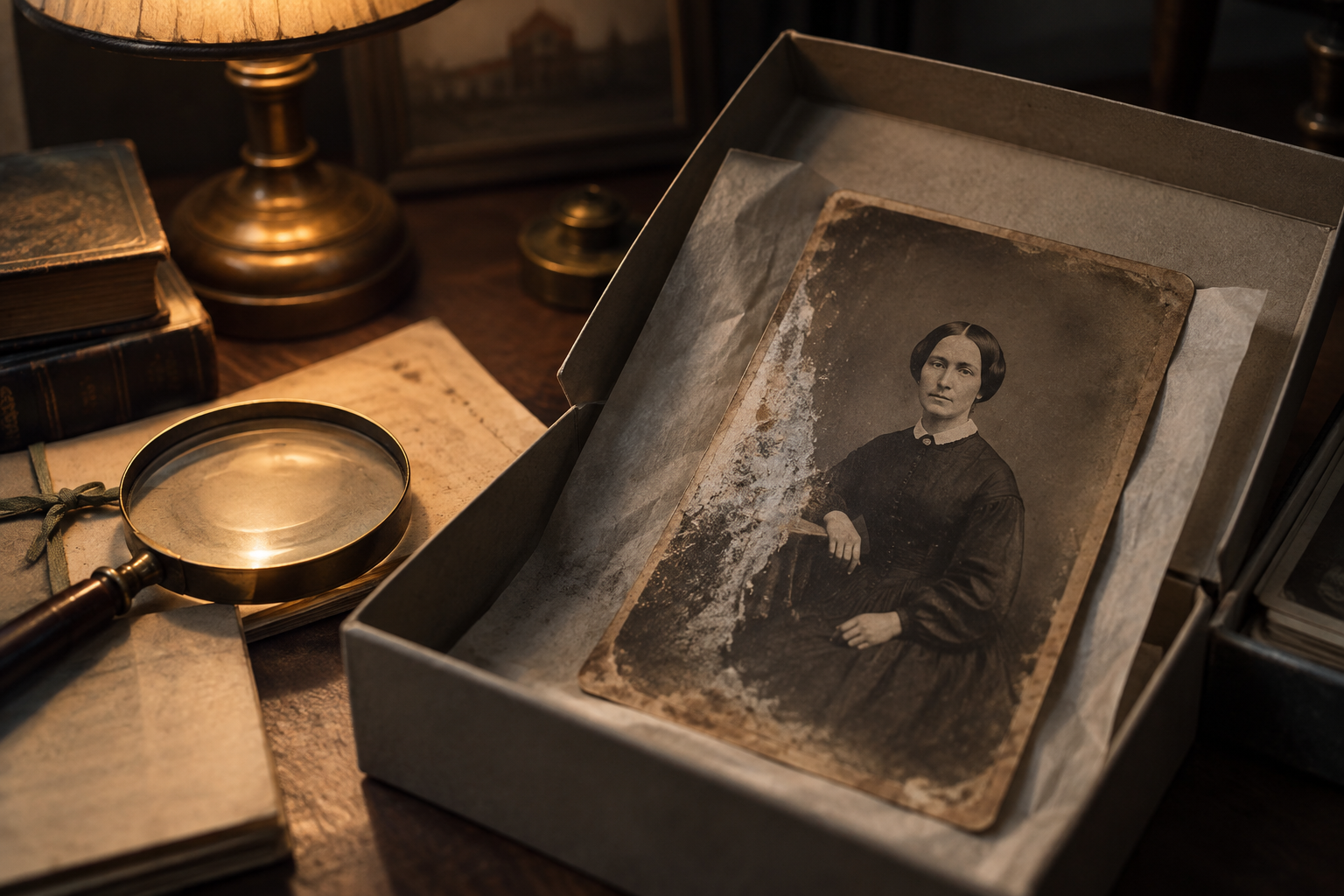

Old photographs can look creepy because they combine unfamiliar visual conventions with physical damage and missing context. A sitter holds an expression longer than we expect. A face has faded more quickly than a coat. A child is slightly blurred while the furniture remains sharp. We see the result without seeing the camera, the room, the photographer’s directions, or the years of handling that followed.
The unsettling feeling is real. It is not evidence that the photograph recorded a ghost. The pleasure of looking closely lies in recognizing how a seemingly direct record was made—and how a century can edit it after the shutter closes.
Why are the faces so serious?
The familiar explanation says nobody smiled because early exposure times were too long. There is some truth in the technical part: early processes often required a subject to keep still. But it is too simple as a universal account. Camera technology changed throughout the nineteenth century, and expressions also followed the social conventions of portraiture. A formal photograph was an occasion; people did not necessarily want to perform the broad smile expected in today’s phone camera.
The Metropolitan Museum of Art’s account of early portrait photography shows how photography widened access to likenesses. A portrait could be a treasured object made for family, not a casual record of an afternoon. Seriousness may signal dignity, concentration, or the conventions of the studio. It need not signal sorrow.
This matters because the modern viewer often supplies a story to a face before learning its name. We meet an unknown person without their voice. The photograph feels intimate and inaccessible at the same time.
Long exposure leaves strange evidence
Movement during an exposure can blur a hand or face, especially in early photographs and particular artistic processes. A person who stepped into a scene briefly could leave a faint figure. The camera made a real record of light over time, not a single perfect instant. The Library of Congress explains that such effects could also be produced deliberately with composite images and double exposures.
An uncanny figure in a photograph therefore requires investigation. What process was used? Is the image an original plate, a print, or a later scan? Has it been retouched? Is there a second negative or a known studio practice? The right answer may be technical, accidental, fraudulent, or still uncertain. “I cannot explain it from this copy” is a more honest conclusion than “therefore a spirit.”
Damage makes familiar features unfamiliar
Photographs are objects. Prints crease, silver images deteriorate, paper discolors, and albums expose some surfaces to light while sheltering others. A scratch through the eyes can give a face an impossible expression. Uneven fading can separate a head from its shoulders. The people who held the original may have seen an ordinary family likeness; we see a damaged survivor.

The damage is not meaningless, though. It records use. Someone carried the image, placed it in an album, moved house with it, or stored it badly. The mark that frightens us may be evidence that the photograph mattered enough to survive.
The frame withholds almost everything
A photograph seems precise because it preserves details. It is also a ruthless crop. We may know what a person wore and nothing about what they said after the sitting. We do not see the friend outside the frame, the props just behind the backdrop, or the ordinary morning waiting outside the studio. The less context we have, the more easily we convert an unfamiliar expression into a sinister one.
That is why unlabeled flea-market photographs are such efficient horror objects. The image still proves that a person stood before a camera. It does not tell us why the photograph ended up among strangers. The gap invites fiction.
Spirit photography was a real practice
Nineteenth-century spiritualism gave some photographers a market for portraits with apparent apparitions. The Library of Congress notes that ghostly composites and double exposures were known techniques even while some viewers treated the resulting pictures as evidence of contact with the dead. The history is a mixture of technology, belief, grief, performance, and sometimes deception. It deserves more care than a quick “Victorians believed everything” joke.
The Met’s exhibition on manipulated photography also makes a useful point: altering photographs did not begin with digital software. The camera’s reputation for truth and the photographer’s power to arrange an image have been in tension from the beginning.

How to examine a “haunted” photograph
Begin with provenance. Where did the image come from, and is there a dated original? Then inspect the physical process: paper, plate, negative, or digital copy. Look for repeated shapes, edge artifacts, signs of movement, and later retouching. Search for the same image in a museum, library, or historical collection before trusting a caption that appears only on social media.
If the image depicts a dead person or a grieving family, resist turning them into a prop for a convenient shiver. Many supposed “postmortem photographs” circulated online are ordinary portraits with speculative labels. An unnamed sitter cannot correct us. The least we can do is separate what the image shows from what we imagine.
For more on why familiar objects become unsettling, see why dolls feel creepy and our guide to horror without gore. If photographs make you wonder what the dead leave behind, Among the Dead takes that question into fiction.
Frequently asked questions
Did people never smile in Victorian photographs?
They sometimes did. Exposure times, studio practice, and portrait conventions all affected expression. The claim that smiling was impossible is too broad.
Can a double exposure create a ghostly figure?
Yes. A second exposure or a person moving through a long exposure can create an apparition-like form. That explains a photographic effect, not every individual image without examination.
Are all “spirit photographs” deliberate frauds?
No single judgment covers every image or every participant. Some effects were staged; some may reflect accidents or later misreadings; viewers could sincerely believe in what they saw. Investigate the specific object and its history.
The next time a face in an album appears to stare past you, turn the photograph over. A date, an address, or a penciled name may change the story more than the shadow did. For new dispatches on haunted history and a free illustrated story, join The Grimbard Press.
Sources
• Library of Congress: A Ghostly Image