
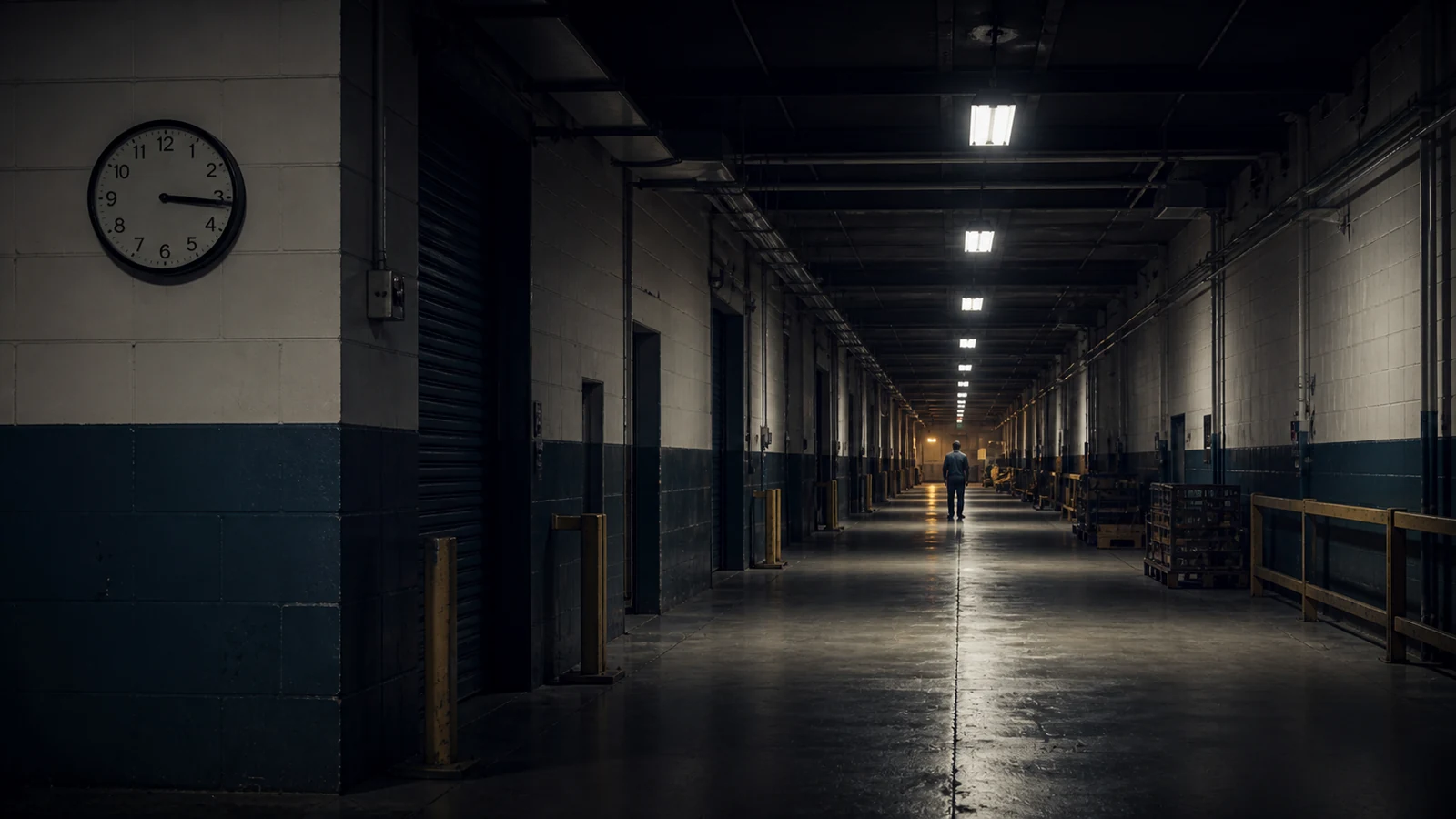
At 3:17 a.m., the building makes a sound it has never made before.
Not a crash. Nothing useful. A small metal complaint comes from beyond the fluorescent light, somewhere near the loading bay or the locked room beside it. The security monitor shows four empty angles. The checklist says the doors were tested at 2:00.
There is still almost half a shift left.
Night shifts are frightening because ordinary places lose the people and daylight that make them feel ordinary. Darkness limits what can be checked. Fatigue makes uncertainty harder to dismiss. Empty rooms amplify mechanical sounds, and the worker cannot simply leave without abandoning the job. Workplace horror turns that obligation into a trap: the rules remain after the witnesses go home.
Daylight is full of witnesses
A store, hospital, office, plant, warehouse, or hotel contains more than walls during the day. It contains social proof.
People move through the halls. Someone laughs behind a door. A phone rings and is answered. If a sound comes from the stockroom, three other people may hear it. If a light turns off, someone knows which switch was used.
The crowd continuously confirms that the building is behaving normally.
At night, the structure remains while the explanation thins out. The same refrigeration system cycles on. Pipes knock. Metal contracts. Elevators answer automated instructions. A building can be mechanically active while appearing socially dead.
That distinction is perfect for horror. The worker knows that most noises have ordinary causes. The worker may even know exactly which machine produces which hum. Fear begins when one sound fails to match the catalog.
It is not loud enough to demand an emergency response. It is only wrong enough to require attention.
Workplace horror lives in that requirement. A character in a haunted house may choose not to inspect the basement. A night employee may be responsible for whatever is down there.
Night and darkness are not quite the same fear
Darkness removes visual information. Night adds time, expectation, and the knowledge that the larger human schedule has moved elsewhere.
A 2015 study indexed by PubMed examined night and darkness as distinct influences on fearful responses. Its results suggested that both environmental darkness and the biological day-night cycle matter in fear-related processing. That does not mean everyone becomes irrational after sunset. It means a dark room at noon and the same dark room at midnight are not necessarily experienced as identical.
Night carries a social meaning. Most offices are supposed to be empty. Most schools are supposed to be silent. The locked storefront tells the street that no one is available inside.
This makes the night worker visible and isolated at the same time. The lit booth, register, nurse’s station, or guard desk becomes a small occupied island. Anyone approaching can see the worker before the worker can identify them.
Artificial light does not abolish the dark. It draws a border around it.
The body is working against the clock
Night work is ordinary, necessary labor. It is also labor performed against cues that shape sleep and alertness.
The National Heart, Lung, and Blood Institute explains that the body’s circadian rhythm is influenced by light, darkness, and other environmental signals. Sleep pressure also builds the longer a person remains awake. A schedule can require attention at the same hours when the body expects something else.
That mismatch has measurable effects. A NIOSH analysis of 6,338 U.S. workers found sleep problems across schedules, with night-shift workers showing the highest risks in the study. The researchers reported higher prevalence of short sleep, difficulty falling asleep, poor sleep quality, excessive daytime sleepiness, and insomnia among night workers than day workers on several measures.
Those findings should not be used to dismiss a worker’s perception. “You were tired” is not proof that a sound, person, or hazard was imaginary. Fatigue can coexist with a real threat.
For horror, the uncertainty is more useful than hallucination. A small experimental study of sleep deprivation and fear conditioning found increased subjective threat expectations after a sleepless night, while some physiological measures did not change in the same way. The authors urged caution in interpreting the results. The valuable narrative point is simple: after lost sleep, previously safe signals may be harder to trust.
The exit alarm has always chirped once before resetting.
Tonight it chirped twice.
Read the next after-hours dispatch: Join The Grimbard Press for Dead Ship, a free illustrated Subscriber Archive Edition, recovered files, monster lore, and book news.
Artificial light creates islands
Daylight fills a space. Workplace lighting divides it.
Fluorescent fixtures illuminate the aisle but not the steel behind the shelves. A parking-lot lamp creates a circle and leaves every parked vehicle with a dark side. A security monitor offers several bright rectangles while proving how many corners the cameras do not cover.
The employee works from island to island.
That movement gives night-shift horror its visual grammar: leave the booth, cross the dark floor, reach the next switch. The character may control the light and still be unable to illuminate everything at once. Turning on one zone can make the windows reflective. Looking into a bright monitor reduces awareness of the room behind it.
Technology adds information without guaranteeing reassurance. Motion sensors announce movement but not its cause. Cameras show an empty hallway a few seconds after something was heard there. A digital access log records that a door opened under a credential belonging to the person reading the log.
The old haunted house had candles. The modern workplace has diagnostics.
Both fail at the exact moment proof is needed.
Every job has rules that can become horror rules
Do not leave the register unattended. Walk the floor once an hour. Never prop open the fire door. Record every temperature. Answer the room call. Check the animal enclosure. Confirm the freezer alarm in person.
Ordinary rules create extraordinary pressure when followed at night.
The rule tells the character where to go. It removes “stay somewhere safe” as an option. More importantly, a written procedure implies that the situation has happened before. If the checklist contains an instruction that makes no sense, someone had a reason to add it.
This is why rules horror fits the workplace so naturally. Employment already contains explicit duties, restricted areas, chains of authority, uniforms, badges, incident reports, and consequences for leaving. The supernatural does not need to invent control. It only needs to enter the existing system.
The craft of “Don’t Do X” explains why a prohibition creates fear before it is broken. Workplace horror adds the paycheck. The character may believe the warning is ridiculous and still need the job badly enough to obey it.
The best rule is not “do not summon the demon.” It is something almost reasonable:
If the north stairwell door is open after 2:00 a.m., close it without looking inside.
Now the building has a history. Management knows part of it. The worker knows less.
Different workplaces create different ghosts
A warehouse offers distance, repetition, stacked concealment, and machinery large enough to move without looking alive. The ghost has left the house for the warehouse because the modern logistics building can hide an entire event behind identical doors.
A hospital never truly sleeps. Its night fear comes from partial occupancy: care continues while administrative layers vanish. Empty waiting rooms sit beside urgent rooms. Elevators connect public floors to service spaces most visitors never see.
A hotel has strangers asleep behind numbered doors and an employee expected to answer when one of those rooms calls. A convenience store is all window, making the clerk visible from the parking lot. A school after hours preserves evidence of daytime life—names, drawings, small chairs—without the people who gave it scale.
An office becomes uncanny through repetition. Every cubicle is almost the same. The Backrooms resemble a warehouse that refuses to end because repetition destroys proof of progress. Walk far enough and the familiar becomes an accusation: you have passed this place before.
Each setting produces its own monster because each job creates its own kind of vulnerability.
The worker cannot simply leave
“Why don’t they get out?” ruins many horror stories because the answer is not strong enough.
Night-shift horror begins with the answer already clocked in.
Leaving may mean abandoning a patient, animal, coworker, security post, or process that cannot safely stop. It may mean losing a job. The doors may be locked against outsiders in a way that also slows escape. A supervisor may be asleep, unreachable, or unwilling to believe a report that contains no obvious emergency.
Responsibility holds the character in place before any supernatural force needs to.
This gives the workplace ghost an advantage the traditional ghost may lack. It does not have to seal the exits. It only has to make the employee choose between danger and duty.
“Stop Telling Me the Room Felt Wrong” makes fear visible through action. The night worker supplies those actions naturally: recount the keys, check the feed, call the supervisor, write the time in the log, return to the door that should not be open.
At 3:17 a.m., the sound comes again.
The checklist has a blank line waiting for it.
Stay on the clock
On the Clock, After Dark is built from the moment an ordinary duty becomes the rule keeping someone inside. The book is available from Amazon and is not currently enrolled in KDP Select, so this article should not use Kindle Unlimited language.
Readers who want the dead closer can continue into There Be Monsters: Among the Dead or read what visiting haunted places actually feels like.
Read On the Clock, After Dark or join The Grimbard Press before the next shift begins.
Sources and further reading
- CDC/NIOSH, “Shift Work and Sleep”, October 5, 2016.
- National Heart, Lung, and Blood Institute, “What Makes You Sleep?”.
- Li et al., “Night or Darkness, Which Intensifies the Feeling of Fear?”, International Journal of Psychophysiology, 2015.
- Feng et al., “Sleep Deprivation Increases Threat Beliefs in Human Fear Conditioning”, Journal of Sleep Research, 2020.