
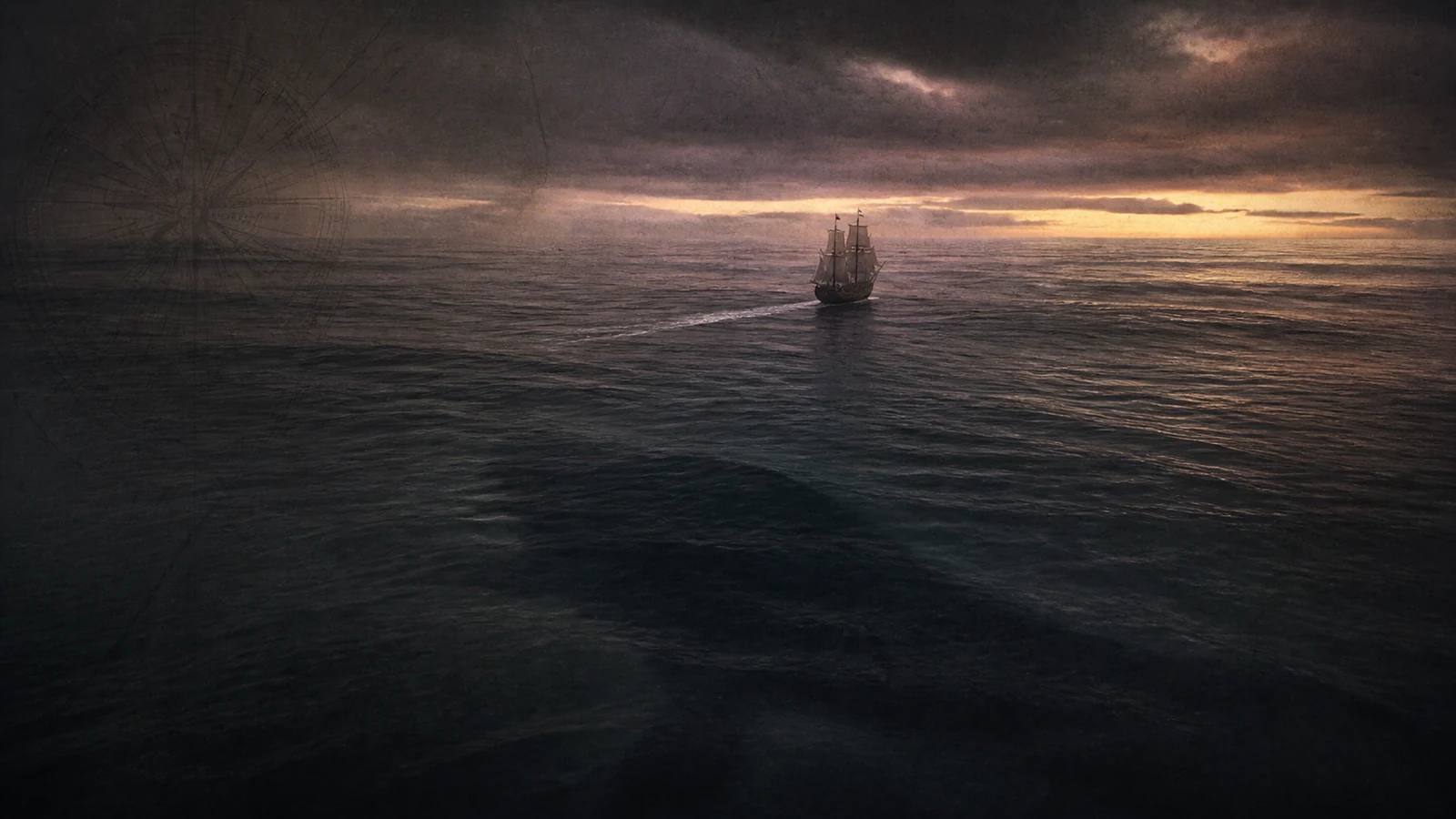
First comes the back.
It rises where no land should be, black and shining through the weather. The sailor sees only part of it before the swell cuts across his view. There is no clean outline, no familiar object beside it for scale. The back seems longer than the boat. Then it rolls, the water erupts, and whatever surfaced is gone.
By the time the ship reaches port, the glimpse has acquired a head.
Sailors believed in sea monsters because the ocean gave them real observations without enough context to interpret them. Whales, giant squid, oarfish, unfamiliar carcasses, bad weather, distance, exhaustion, and inherited natural histories all contributed. Old maps then gave uncertain reports visible form. The monsters were not simply lies or decoration; they occupied the moving border between what people had seen and what they thought the sea could contain.
The sea ruins a good look
On land, an animal usually appears against something. Trees, buildings, roads, and other animals provide scale. Its feet may be visible. Even when it runs away, the ground explains the direction.
The sea removes those conveniences.
Most of an animal remains underwater. Waves interrupt the view. Distance is hard to judge when the background is another moving surface. A body seen from a low wooden deck may appear, vanish, and reappear at a different angle before anyone understands that the pieces belong together.
Then there is weather. Fog erases the horizon. Storms reduce visibility and force sailors to divide their attention between watching and surviving. A sighting made under those conditions is not worthless, but it is incomplete.
Incomplete evidence invites the mind to finish the animal.
One line of humps could be a single long body or several dolphins surfacing in sequence. A whale’s back can suggest an island until it moves. Meanwhile, a floating carcass loses the features that made the living animal recognizable. Even a damaged giant squid does not resemble the streamlined creature that moved through deep water.
The sailor does not need to be foolish. The observation only needs to be brief.
Real animals arrived already distorted
The border between animal and monster was never clean.
Whales are the clearest example. To someone who knows them from photographs and documentaries, a whale is a known category. To a sailor working before modern zoology, the sudden appearance of an animal longer than the vessel could confirm almost anything written about the ocean.
European maps and natural histories often depicted whales with tusks, fangs, beastlike heads, or a willingness to attack ships. Smithsonian Ocean’s survey of medieval and Renaissance map monsters notes that even relatively familiar animals could become visually monstrous. The illustrator might never have seen the creature. Instead, a description could pass from sailor to writer to engraver, changing at every hand.
Likewise, the giant squid followed a similar route from encounter to explanation. A tentacle or damaged body offered proof of an enormous animal without showing how it lived. Oarfish—long, silver, and red-finned—look capable of starting a sea-serpent report even when seen clearly. A decomposed shark or whale can lose its jaw, skin, and familiar proportions until it resembles no cataloged animal at all.
No one can solve every report from a distance of centuries. Nor should we reduce every sea monster to “probably an oarfish.” The useful point is narrower: real marine life repeatedly supplied shapes stranger than the standard animals people knew on land.
The ocean did not need to invent monsters. It only needed to reveal an animal one piece at a time.
The old maps were not failed nautical charts
One of the easiest mistakes is to imagine a frightened captain steering around an illustrated dragon because it appeared on his navigation map.
Some decorated maps were not practical charts carried on working ships. They were expensive objects made for display, education, prestige, and wonder. Their sea creatures could fill open water, entertain a wealthy viewer, communicate danger, illustrate religious material, or present what the cartographer believed natural history had established.
That last purpose matters. According to Smithsonian Ocean, many apparently whimsical creatures came from sources considered authoritative in their time. A cartographer copying a strange marine animal was not necessarily adding fantasy. He could believe he was improving the map’s account of the world.
Northern creatures crowd Olaus Magnus’s 1539 Carta Marina. Its whales threaten ships. Meanwhile, the “polypus” image and description do not align neatly with one modern species. The map’s sea swine carries moral and religious associations as well as animal features. The map preserves not one kind of knowledge but several layered together: reports, classical inheritance, Christian symbolism, visual drama, and claims about nature.
That is more interesting than calling the mapmakers gullible.
They were trying to picture an environment most readers would never see. The blank ocean was not blank to the sailors who crossed it, but their experiences arrived on land as fragments. The monster gave those fragments a body.
Follow what surfaces next: Join The Grimbard Press for Dead Ship, a free illustrated Subscriber Archive Edition, new monster lore, and recovered files.
Reports became more certain as they traveled
A strange sight at sea might begin with honest uncertainty: I saw something large.
Retelling rewards different details. How large? Larger than the boat. What kind of head? Like a horse, perhaps, or a dog. Did it follow? For a time. Did it attack? It came close enough that the distinction stopped mattering.
This does not require a deliberate liar. People reconstruct memory, and stories become easier to tell when events have shape. A creature with a name is more portable than a minute of confused water.
Authority then works backward. Once a respected book or map pictures the monster, a later witness has something with which to identify a new sighting. The image created from earlier reports helps produce the language of the next report.
The loop is familiar. A witness gives an artist fragments. The artist gives the public a complete creature. The next witness sees the complete creature in the fragments.
This is also how monsters survive correction. Identifying one carcass does not erase the category. The sea serpent moves to the next wake. The kraken leaves a stranded squid and returns to deeper water.
What monsters represent in folklore depends partly on where people place them. Sea monsters occupy the largest boundary available: the surface between the human world and a depth no sailor can inspect from the deck.
Better navigation changed the page
As European knowledge of marine life expanded and mapmaking conventions changed, monsters became less common on maps. Coastlines improved. Instruments improved. Practical charts focused on the information sailors needed. Natural history and cartography separated into more specialized forms.
The creatures did not disappear from culture. They moved.
Sea monsters passed into newspapers, novels, museum displays, film, and cryptozoology. The illustrated map lost its whale with a wolf’s head, but readers gained Moby-Dick, Twenty Thousand Leagues Under the Seas, and generations of cinematic tentacles.
The modern version often reverses the old one. Earlier cartographers placed a creature on the map as an attempt to show what might inhabit the water. Modern horror starts with a scientific map and asks what it missed.
That question still has room to work.
How much of the ocean is actually unexplored?
The familiar claim that “we have explored only five percent of the ocean” is too blunt to be useful. Exploration, mapping, observation, and biological description are not the same task.
NOAA Ocean Exploration reported in April 2026 that the entire seafloor has broad satellite-derived coverage, but only 28.7 percent had been mapped to modern high-resolution standards. NOAA also reported that humans and cameras had directly seen less than 0.001 percent of the deep-ocean seafloor.
Those two figures describe different kinds of knowledge. A high-resolution map can reveal a seamount or wreck. It cannot inventory every animal in the water above it or show how organisms behave across seasons. A remotely operated vehicle can inspect a tiny area directly and still leave the surrounding miles unseen.
None of this proves that medieval monsters are waiting below. Unknown does not mean anything imagined is equally likely. It means the ocean remains a place where new species, unfamiliar behavior, and unexpected forms are still documented.
The honest facts are eerie enough. They do not need the old 95-percent line.
Why the sea monster still works
A forest monster may be hidden behind the next tree. A sea monster is hidden beneath the surface on which the characters must remain.
That arrangement gives creature horror a permanent advantage. The boat is a small lit room with no foundation. Water touches every side. As a result, the crew cannot examine the threat without entering the medium in which it is strongest.
Scale becomes unstable too. A fin offers no proof of the body below. A sound against the hull can be an object, an animal, or the first test. The monster can leave before anyone defeats it and return from any direction.
Most importantly, the surface conceals action. On land, distance gives warning. At sea, the creature can cross the last hundred feet where no one can see it.
This is why the best sea monsters are not shown too early. The old sailor’s problem remains the reader’s problem: a real observation without enough context.
First comes the back.
Everything else grows below it.
Sail beyond the margin
Monsters of the Wine-Dark Sea returns to the oldest waters, where the route home runs through creatures, gods, and the dangerous space between report and belief.
Readers who want the ancient voyage with its horror brought back to the surface can also enter The Odyssey Annotated: A Horror Reader’s Edition.
Explore Monsters of the Wine-Dark Sea or join The Grimbard Press for the next dispatch.
Sources and further reading
- Hannah Waters, “The Enchanting Sea Monsters on Medieval Maps,” Smithsonian Ocean.
- NOAA Ocean Exploration, “How much of the ocean has been explored?”, updated April 20, 2026.
- Chet Van Duzer, Sea Monsters on Medieval and Renaissance Maps, British Library, 2013.