
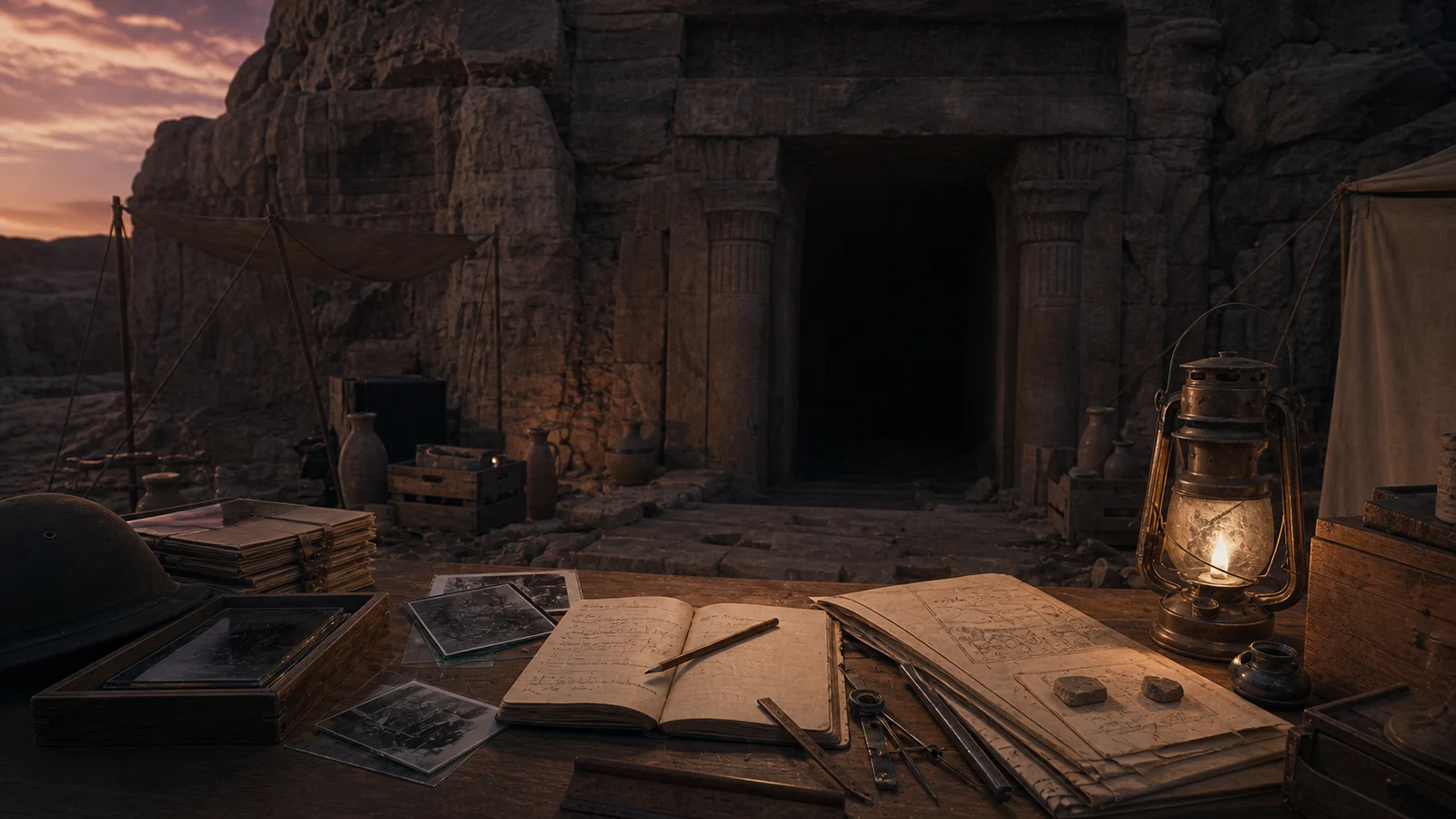
The curse has a perfect first victim.
George Herbert, the fifth Earl of Carnarvon, helped finance Howard Carter’s search for the tomb of Tutankhamun. The burial chamber was opened in February 1923. Carnarvon died in Cairo that April. A mosquito bite had become infected; blood poisoning followed. The sponsor was dead, the tomb was open, and newspapers had the shape of a story before the excavators had finished clearing the rooms.
The mummy’s curse was not real in the supernatural sense. No evidence shows that opening Tutankhamun’s tomb caused a chain of deaths, and no inscription in that tomb promised death to everyone who entered. But the legend was not invented from nothing in 1923. Ancient warnings against tomb violation, a century of European mummy entertainment and fiction, colonial anxiety, and sensational reporting were already waiting. Carnarvon’s death made them look like one story.
The victim came after the plot
Howard Carter found the first step leading to Tutankhamun’s tomb in November 1922. By the end of that month, he had made a small opening and looked into an antechamber crowded with objects. The formal opening of the burial chamber followed on February 16, 1923.
Then Carnarvon died.
The cause was not mysterious. Contemporary and later accounts identify blood poisoning after an infected mosquito bite. The timing, however, was irresistible. A wealthy Englishman had entered the sealed resting place of a king and died within weeks. The facts arrived already arranged like gothic fiction.
Later lists expanded the curse’s reach. Anyone who visited the tomb, handled an object, knew Carter, or died unexpectedly could be added. Survivors were less interesting. Carter—the man most closely associated with opening and excavating the tomb—lived until 1939.
That selective accounting matters. A 2002 survival study summarized by HISTORY compared Westerners present for openings or examinations with others connected to the excavation and found no significant association between supposed exposure and survival. National Geographic notes that only six of the 26 people present when the tomb was opened died within the next decade.
The curse survives by counting the dead and treating the living as irrelevant evidence.
Mummies were frightening Europeans before Tutankhamun
The discovery did not teach Europe to fear a mummy’s revenge. It gave an existing story the most famous tomb in the world.
For centuries, Egyptian human remains had been collected, traded, ground into supposed medicine, publicly unwrapped, displayed, and written into European fantasies. That history is stranger and uglier than the movie version. The mummy did not begin as a bandaged actor walking with both arms extended. It began as a dead person removed from a culture and made into an object.
Nineteenth-century entertainment helped turn that object into an avenger. Egyptologist Dominic Montserrat traced the popular curse concept to theatrical and literary traditions that predated Carter’s discovery by decades. Louisa May Alcott published “Lost in a Pyramid; or, The Mummy’s Curse” in 1869. Arthur Conan Doyle’s “Lot No. 249,” published in 1892, presented an Oxford student suspected of using a mummy against his enemies.
Those stories established the machinery: an ancient body is disturbed, an object is removed, and the past reaches into the present to collect a debt.
By 1922, readers did not need a newspaper to explain how a mummy curse worked. They needed names and dates that made the familiar plot appear to have happened.
Receive the next recovered file: Join The Grimbard Press for Dead Ship, a free illustrated Subscriber Archive Edition, new monster lore, and book news.
Ancient warnings were not the modern curse
There were ancient Egyptian texts that threatened tomb violators. That fact is sometimes presented as proof that the movie curse came directly from pharaonic religion. The connection is not so clean.
Some tomb inscriptions warned that a person who desecrated the burial or approached in an impure state could face divine judgment or violent death. National Geographic cites Egyptologist Salima Ikram’s description of threats involving gods and dangerous animals. Such language can be understood as protection against robbery and desecration.
That is not the same as the modern Tutankhamun legend.
No curse inscription promising death to the excavators was found in Tutankhamun’s tomb. Ancient warnings attached to particular tombs and offenses should not be blended into a universal spell that kills any archaeologist associated with any mummy. The modern version often works like a contagious plot: touch the relic, enter the room, or accept the invitation, and the curse places your name on a list.
The distinction does not make the ancient warnings unimportant. It reveals what later storytellers changed. A text meant to protect a specific burial becomes the voice of an entire civilization. “Do not rob this tomb” becomes “Egypt punishes those who enter.”
That transformation tells us more about modern Europe than ancient Egypt.
The newspapers found a story they already understood
The excavation was a media event before Carnarvon died. Tutankhamun’s tomb was unusually rich and comparatively intact. Photographs and reports offered readers gold, secrecy, royalty, and a room closed for more than three thousand years.
The coverage also emerged from a colonial world. British figures controlled much of the international story about an Egyptian king’s burial. Ancient Egyptian lives and bodies had long been treated as material Europeans could possess, interpret, and exhibit. The curse introduced a satisfying reversal: the plundered dead could answer back.
It answered anxieties that factual excavation reports could not. What if the past was not passive? What if ownership did not erase trespass? What if the dead retained jurisdiction over the room?
Carnarvon’s death allowed speculation to pass as pattern. Arthur Conan Doyle publicly suggested that an elemental spirit associated with the tomb might have caused it. Newspapers could attach later deaths to the same supernatural cause, even when the connections and timelines differed.
This does not mean every reporter conspired to fabricate a curse. A legend grows because many people add what the story appears to require. One paper repeats a rumor. Another adds an allegedly ominous inscription. A later retelling removes the word allegedly. Soon the curse seems to have been discovered at the same moment as the tomb.
The process resembles the press-built “Murder Castle” surrounding H. H. Holmes. A documented crime or death provides the foundation. Reporters, promoters, and later storytellers build the architecture readers remember.
Coincidence becomes evidence when the list has no edge
Suppose everyone connected to an excavation is potentially cursed.
How close must the connection be? Present at the opening? Present in Egypt? A visitor later? A relative? Someone who received an object? If the category can expand after every death, it can never fail.
This is the curse’s cleverest feature. It is not limited by a stated number of victims or a deadline. A death two months later looks immediate. A death ten years later proves patience. A survivor is merely someone the curse has not reached yet.
Attempts to replace the supernatural cause with a biological one preserve the shape of the story. Mold and bacteria can exist in enclosed environments, and archaeological work has real occupational hazards. But that does not make a tomb pathogen responsible for Carnarvon’s infected mosquito bite or produce evidence of a fatal Tutankhamun cluster. A scientific-sounding explanation should still be required to explain the actual cases.
The curse does not win by proving its cause. It wins by making unrelated deaths feel narrated.
That is the same mechanism examined in the Blood Countess legend. Once a sensational version becomes the organizing story, every detail is asked how it supports the legend. Details that do not cooperate are discarded.
Why the legend refuses burial
The mummy’s curse has survived because it solves several emotional problems at once.
It turns archaeology into trespass. It gives the dead agency. It punishes greed without requiring a court. It converts coincidence into design. It also relieves the audience of deciding how to feel about the removal and display of human remains: the dead make the judgment themselves.
Most of all, it seals the story.
A man enters a tomb and dies. Cause and consequence sit close enough that the imagination can lock them together. Blood poisoning is an accident. A curse is an ending.
The legend has also been visually perfected by a century of fiction. The mummy became a recognizable monster, the scarab became an instrument of menace, and hieroglyphs became shorthand for a warning the characters would ignore. Ancient Egypt was reduced to a room full of traps waiting for Europeans.
Good modern horror can use that inheritance without repeating its laziness. The tomb is frightening not because an unfamiliar culture is inherently occult. It is frightening because a burial was closed, someone with power opened it, and the dead cannot consent to what happens next.
What monsters represent in folklore often depends on the boundary they guard. The mummy’s boundary is unmistakable. A sealed door says the living world ends here.
The curse begins when someone decides the door applies to other people.
The scarab after the curse
The mummy’s curse was not real, but it became a real tradition in horror—a machine built from history, appropriation, guilt, wonder, and the fear that possession is not the same thing as permission.
That machine is still running.
The Scarab enters the same dark inheritance: an ancient object, a modern hand, and a debt that does not recognize the transfer of ownership. Readers interested in the wider gothic tradition can continue into The Beetle: A Mystery—Annotated.
Read how The Scarab began, explore the book, or join The Grimbard Press for the next recovered file.
Sources and further reading
- Brian Handwerk, “Curse of the Mummy,” National Geographic.
- HISTORY, “Is the Curse of King Tut Real?”, updated March 2, 2025.
- National Geographic, “Unmasking Howard Carter—the Man Who Found Tutankhamun”.
- Mark R. Nelson, “The Mummy’s Curse: Historical Cohort Study,” BMJ, 2002.