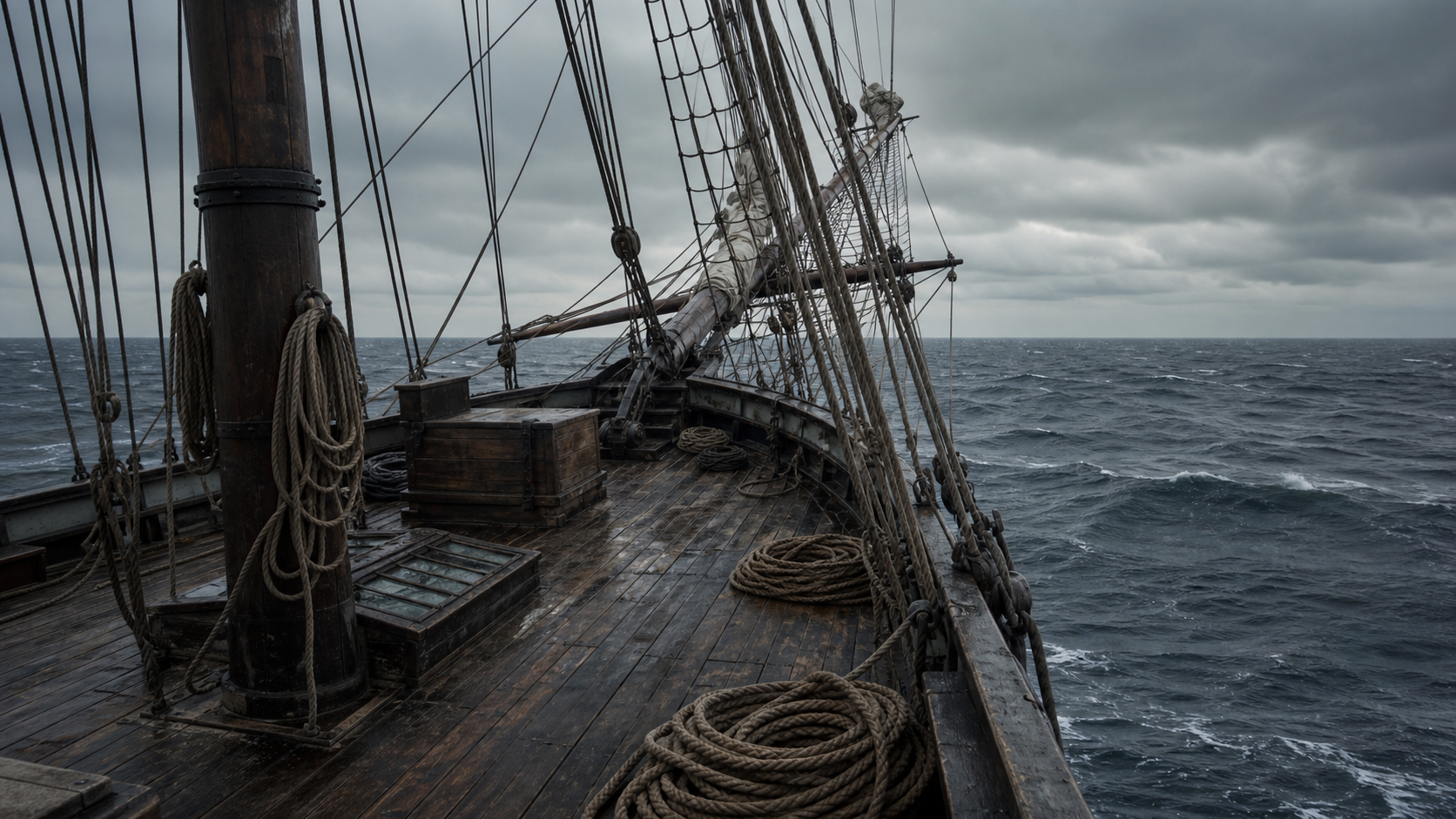
The Mary Celeste Mystery: What We Know About the Empty Ship
An empty ship makes a particular demand on the imagination. A house can be left because its occupants moved. A vessel at sea is a smaller world with fewer exits. When the people are gone and the ship remains, the question is not simply where they went. It is what convinced them to leave the one thing keeping them alive.
The Mary Celeste was found adrift near the Azores in December 1872 by the crew of the Dei Gratia. Its captain, his family, and crew were absent. The ship’s abandonment was real; a final certain explanation is not. The mystery has gathered a thick skin of ghost-ship details over the years, so the responsible version starts by separating the historical record from the story people wish it told.
The discovery was documented
Royal Museums Greenwich reports that the Dei Gratia sighted the brigantine adrift in the Atlantic near the Azores on 4 December 1872. The ship had departed New York for Genoa the previous month. The Historical Association’s account places the abandonment sometime between 25 November and 4 December and notes a damaged or disordered deck, open hatches, and worn rigging.
Those facts are already enough. A commercial vessel was found without the people who had been aboard it. The rescue vessel had to decide what it was seeing, how to bring the ship in, and how to account for a situation that would become a salvage inquiry.
The word mystery does not mean no evidence exists. It means the evidence does not force one conclusion.
The popular story has added furniture
Illustration: documented facts and unproven Mary Celeste theories should remain separate.
You may have heard that the Mary Celeste carried a hot meal left on the table, a cat alive below deck, or every possession intact as though the crew had stepped away for a minute. Those images are good fiction. They should not be treated as the core historical record without a source from the investigation or a reliable maritime archive.
This is the trouble with a famous absence. It invites props. Every added detail makes the room more theatrical and the mystery more certain-looking. But a properly told Mary Celeste story is not a locked-room puzzle with one missing clue. It is an incomplete maritime record whose missing people cannot clarify it.
That incompleteness is the entire engine.
Why would anyone leave a seaworthy ship?
Any explanation has to reckon with the basic terror of the decision. The sea is not an empty road. A lifeboat or small boat is a worse shelter than a brigantine unless the people aboard believe remaining is immediately more dangerous.
Several ideas have been proposed: fear of weather, problems with navigation or pumps, a temporary evacuation, concerns about alcohol vapour from the cargo, or some combination of pressure and misjudgment. None becomes fact merely by being plausible. A hypothesis may explain one feature of the scene and fail another.
The best article therefore ranks, rather than crowns. A weather-based explanation is a reconstruction of conditions. A cargo-vapour theory is a reconstruction of perceived danger. Fraud and violence are claims that require stronger evidence than their melodrama supplies. Supernatural explanations are part of the legend’s afterlife, not evidence from the ship.
Before publication, every specific statement about the lifeboat, cargo, chronometer, pump, logbook, and salvage hearing should be checked against an archival or court source. The point is not to make the story less readable. It is to stop readability from borrowing the authority of a document we have not inspected.
Ghost ships are machines for making absence visible
Illustration: the voyage, discovery, and Gibraltar salvage inquiry form the documented timeline.
A sea monster gives fear a body. A ghost ship gives fear a vacancy.
That distinction explains why sailors’ sea-monster beliefs and the Mary Celeste sit beside one another without being the same story. The monster is something seen at the edge of knowledge. The empty ship is a record of people who saw something—or feared something, or made a choice—and are not available to tell us which.
The ship itself becomes a witness with no language. Its deck, rigging, cargo, and log offer fragments. They can show condition. They cannot report motive. Horror understands this instinctively. The more an object appears to know, the more unbearable it is when the object cannot speak.
Why no final answer is the honest ending
The Mary Celeste has lasted because it refuses the kind of ending readers often demand. We want a culprit, a wave, a leak, a betrayal, a creature. The record gives us competing reconstructions instead.
That does not make all explanations equal. It means the final sentence must stay proportionate to the evidence. The crew disappeared. The ship was found. The rest is argument.
That is enough to make the vessel frightening. A ship is built around collective dependence. Ten people can endure bad weather, bad food, cramped quarters, and fear because the ship gives them a shared task: keep it afloat. The Mary Celeste is the nightmare of finding the task still in progress after the people have vanished.
An unsolved history is not an invitation to invent whatever answer fits the mood. It raises the standard for every detail we retain. A strong account marks the boundary between document and inference, then leaves that boundary visible. On a dark sea, certainty is not improved by shouting into it.
For maritime myth and the monsters people imagined beyond the chart’s edge, Monsters of the Wine-Dark Sea is the natural next voyage. For an original story about a vessel that keeps perfect time without its passengers, join The Grimbard Press and receive Dead Ship, the free illustrated Subscriber Archive Edition.
FAQs
When was the Mary Celeste found?
The Dei Gratia sighted the Mary Celeste adrift near the Azores on 4 December 1872.
Was the Mary Celeste completely undamaged?
No simple version is accurate. Historical accounts describe a vessel that could be brought in but also record signs of disorder and weathering. Specific conditions should be traced to the salvage record.
What happened to the Mary Celeste crew?
No definitive explanation has been established. Proposed explanations include weather, navigation problems, perceived danger from cargo, and temporary evacuation.
Is the Mary Celeste a true ghost ship?
It is often called a ghost ship because it was found abandoned, but there is no evidence that a supernatural event caused the disappearance.