
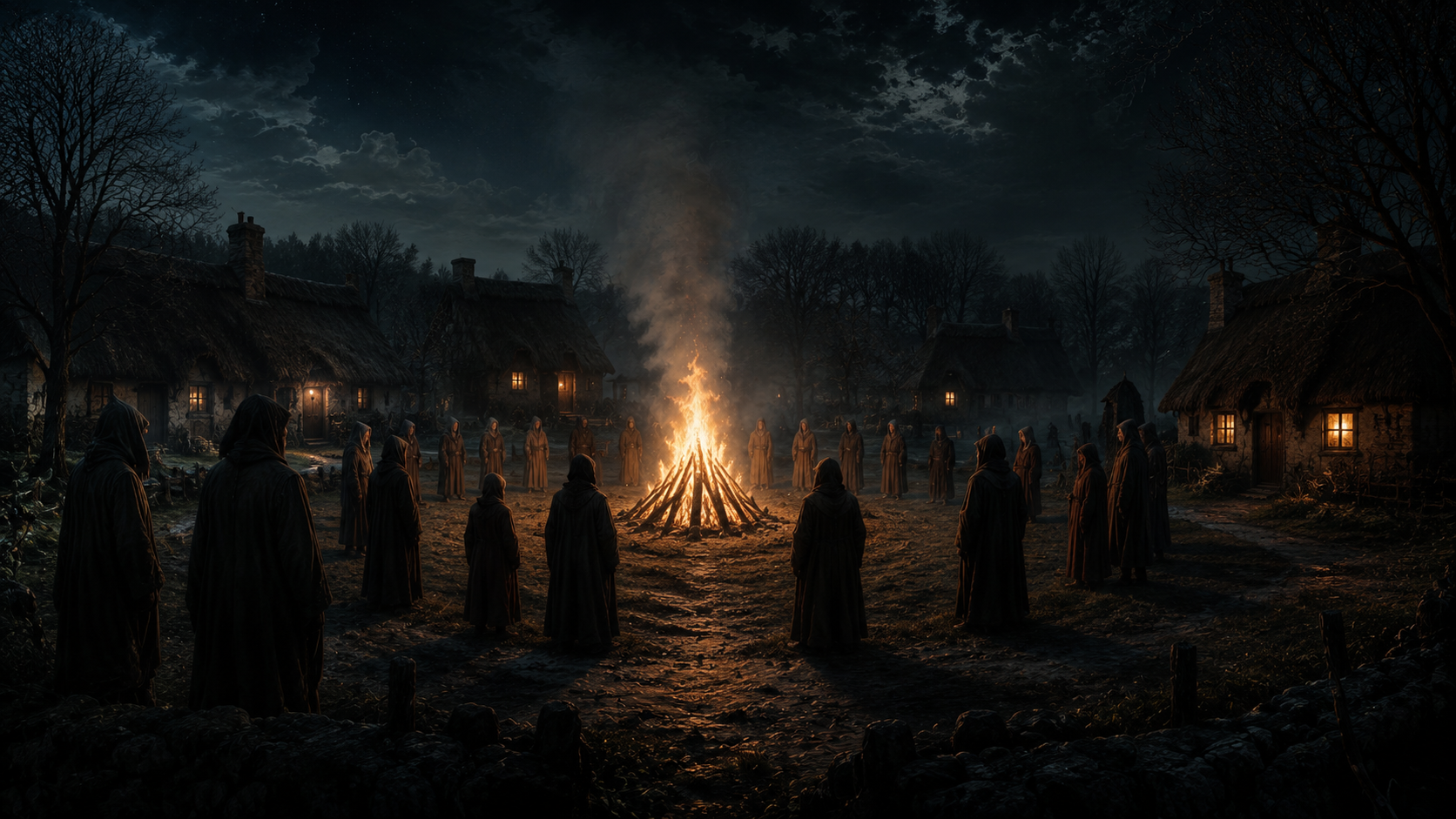
The Wicker Man was released in 1973. It’s about a Scottish police officer who travels to a remote island to investigate a missing girl and finds a pagan community that practices ancient ritual. The ending is one of the most famous in horror cinema.
It is also, by any conventional horror standard, almost free of scares. There are no jump cuts. The creature doesn’t appear. The violence, when it comes, is ritualized and communal rather than stalker-driven. For most of its runtime, it operates more like a mystery film than a horror film.
And yet it is genuinely disturbing in a way that most horror films aren’t. The dread builds continuously and comes from somewhere that’s hard to name.
That somewhere is the folk horror mechanism. Understanding it changes how you watch these films, how you read the fiction, and — if you write in the genre — how you build the thing.
The Definition People Get Wrong
Folk horror is not “horror set in a rural area.” That’s the most common misconception, and it produces bad readings of both what counts as folk horror and what the genre is actually doing.
Horror set in rural areas can be any number of things — slasher film, creature feature, survival horror, hillbilly horror. Rural setting is a container. Folk horror is a specific content type within that container, and it can exist in urban settings if the conditions are met.
What folk horror actually requires is this: a community with an internally coherent belief system or set of practices that an outsider does not share, whose beliefs turn out to be operative — meaning things work the way the community believes they do, not the way mainstream rational culture believes they do — and a collision between the outsider’s disbelief and the community’s knowledge.
The horror in folk horror is not the monster. The horror is the revelation that the people you dismissed as backwards were right, and the framework you brought with you is insufficient, and you are now inside a system whose rules you don’t understand.
The Visitor Is the Problem
The structural move that almost all canonical folk horror makes is the same: an outsider enters a community, disbelieves the community’s practices, and pays for the disbelief.
This structure is doing specific cultural work. It is not saying that all rural communities have secret rituals. It is saying something more uncomfortable: that mainstream modern culture has an arrogance about knowledge, a particular confidence that rational materialism has settled the questions that older traditions kept open, and that this confidence has costs.
The visitor in The Wicker Man is a Christian who believes paganism is superstition. The horror is that the paganism works. The visitor in Midsommar is a grief-numbed American who believes she can observe Swedish folk practice as an anthropological curiosity. The horror is that the practice is not a curiosity.
In both cases, the visitor’s certainty is not just wrong. It is the mechanism of their destruction. They cannot protect themselves against what they don’t believe in.
The Community Is Not the Villain
This is the distinction that separates good folk horror from exploitation horror wearing folk horror’s clothes.
In genuine folk horror, the community is not acting out of malice toward the visitor, or not primarily. They are following their own logic, honoring their own obligations, operating within a coherent moral system that simply does not have a place for the visitor’s survival. The wickerman is not built out of cruelty. It is built out of need — agricultural necessity, the logic of sacrifice and reciprocation that the community has tested over generations and found to be real.
The horror is not that these people are evil. The horror is that they are right by their own lights, and their lights illuminate something real, and the visitor could not see it.
Exploitation films that use rural or folk settings to portray communities as simply barbaric or degenerately violent are not folk horror. They are using the aesthetic of folk horror to deliver a different, less interesting product: the fantasy of urban sophistication versus rural savagery, where the urban viewer never has to question their assumptions.
Real folk horror asks the viewer to consider that the community’s assumptions might be the accurate ones.
The Specific Dread It Generates
Folk horror’s dread is epistemological, which is a fancy way of saying: it makes you uncertain about what is real.
Most horror generates dread through threat. Something wants to hurt you. The threat is identifiable and external. Your survival depends on avoiding or defeating it.
Folk horror generates dread through the possibility that your entire framework for understanding the world is wrong. Not that something dangerous is out there — but that you’ve been operating on false assumptions about what “out there” contains, and the people who live closer to it have always known better.
This is a harder dread to shake because it doesn’t have a survival strategy. You can’t defeat it. You can’t outrun it. You can only revise everything you thought you knew.
That’s what the best folk horror leaves you with. Not the image of something terrifying. The discomfort of uncertainty.
Writing It
If you’re writing folk horror, the single most important thing you can do is commit to the community’s logic. Not endorse it. Not explain it away. Commit to it — meaning, within the story’s reality, the community is right. The rules work. The practices produce the outcomes they’re designed to produce.
The moment you equivocate — the moment you give the reader an out by suggesting maybe it’s all in the visitors’ heads, maybe it’s mass hysteria, maybe there’s a rational explanation — you’ve written a different story. You may have written a fine story. But you’ve left folk horror’s specific territory.
The wicker burns. The ritual works. The visitor was wrong, and now they know it, and it’s too late.
That’s the genre. Stay in it.
If you’re reading this as a writer looking to work in the genre, some of my folk horror is in There Be Monsters: Then and Now — including “Rabbit Season,” which runs on exactly the rule-based logic described above.
Join the Grimbard list for craft posts, folklore, and new fiction.