
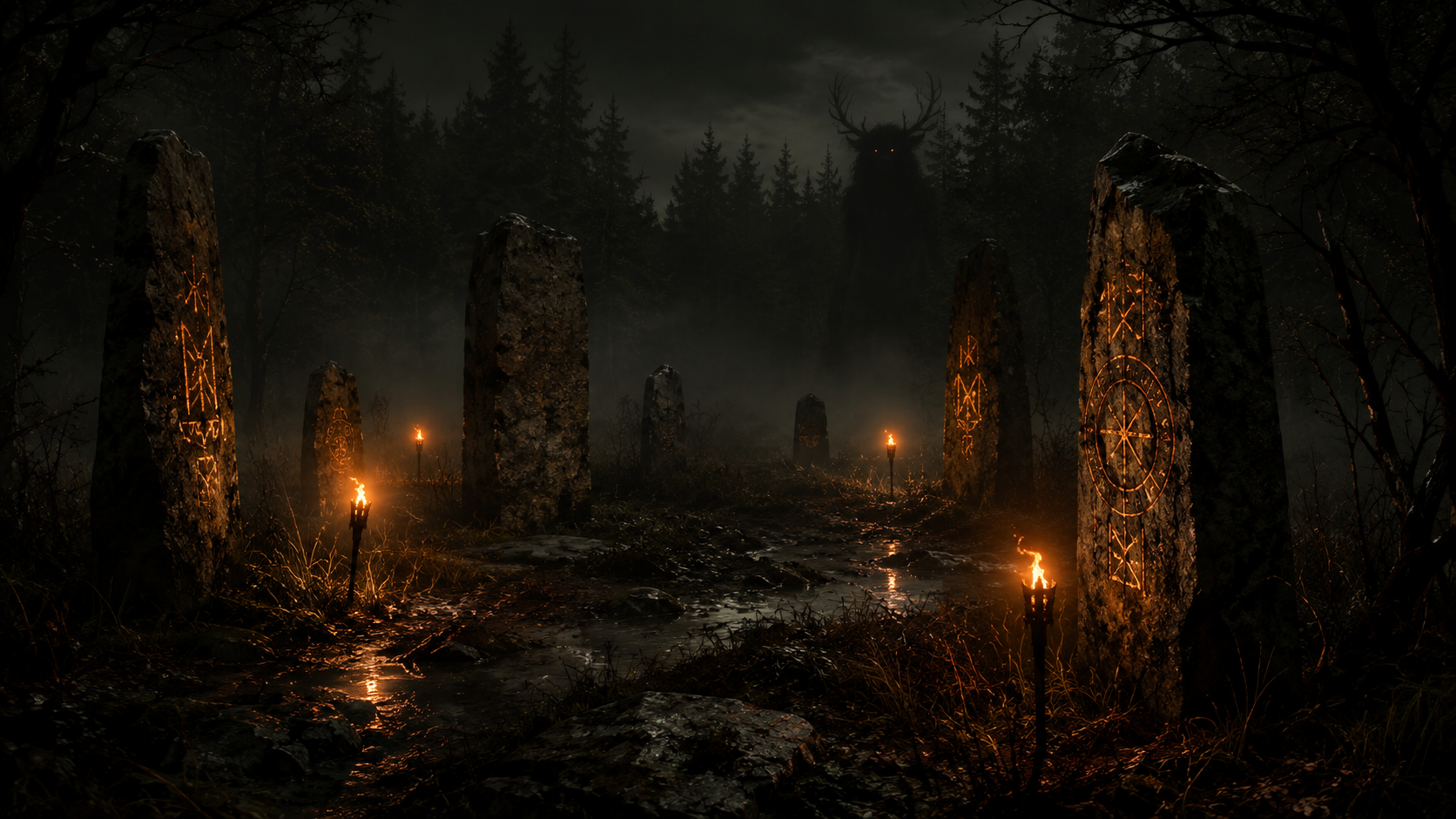
Three rules. That’s all the setup my story “Rabbit Season” needed.
Bank the fire before you sleep.
Don’t drink the spring water in May.
Don’t shoot the white ones in winter.
And underneath: DON’T BRING IT HOME. 1903.
By the time a reader reaches the actual horror in that story, they’ve already done most of the work themselves. The rules told them something was out there. The rules implied a history of people who learned what they knew the hard way. And the rules established a logic — which means, in the reader’s mind, that violating them has consequences. The horror becomes almost secondary. The anticipation of violation does most of the damage.
This is not an accident. Rules are the most powerful structural tool in folk horror, and I think about them more than almost anything else when I’m plotting.
Why Rules Work
The rule implies the failure.
That’s it. That’s the whole mechanism. When you tell a reader “don’t open the door at midnight,” you have just created, in the reader’s imagination, a vivid image of someone opening the door at midnight. You’ve created the dread before the action. The rule functions as foreshadowing compressed into an imperative.
What makes folk horror rules specifically effective — versus, say, rules in a haunted-house thriller — is that folk horror rules come attached to community. They were taught. Which means someone taught them for a reason. Which means someone, probably multiple someones, found out the hard way what happens when you don’t follow them.
The rule is a compression of suffering. When a grandmother passes down “don’t look at the lights in the woods,” she is summarizing a trauma. The reader feels the weight of that compression even if they never see the original event. The rule carries the past with it.
The Three Components of a Good Horror Rule
After a lot of trial and error, I’ve landed on three things a horror rule needs to work.
It has to be specific without explaining itself.
“Don’t go into the woods at night” is weak. It’s too broad. It doesn’t have the texture of something real. “Don’t whistle after dark in October” is better. It’s specific enough to feel like it comes from somewhere — someone, at some point, whistled in October and received a consequence — but it doesn’t explain what. The specificity implies the knowledge. The silence implies the dread.
It has to be possible to break.
This sounds obvious but it’s the mistake most writers make. If the rule is impossible to violate in practice, it doesn’t generate tension. “Don’t fly to the moon” is a rule with no teeth in a contemporary setting. The rule has to be something a reasonable person could break under pressure, by accident, or because they don’t believe it. The more plausible the violation, the more the reader worries.
It has to cost something visible when broken.
The consequence doesn’t need to be immediate and it doesn’t need to be fully explained. But the reader has to sense that breaking the rule matters. This is often established through the rule itself — “don’t bring it home” implies that bringing something home has happened before and the result was bad enough that someone carved the warning into wood.
The Rules Conversation as Exposition
One technique I use repeatedly: the scene where an older character explains the rules to a younger one, and the younger one doesn’t fully believe them.
This accomplishes three things simultaneously. It delivers the rules naturally, without the author simply listing them. It establishes the intergenerational structure of folk knowledge — the fact that someone who lived through the consequences is passing this down. And it creates dramatic irony: the reader understands the rules are real while watching the character who will eventually violate them dismiss them as superstition.
The conversation also lets you calibrate the older character’s delivery. Are they frightened? Matter-of-fact? Resigned? The emotional register tells the reader how seriously to take the threat. The best folk horror rule deliveries are calm. Not dramatic. Not pleading. Calm and specific, the way you explain not to touch a hot stove — because the person explaining it has accepted that there’s no way to make someone understand until they’ve been burned, and they’re trying anyway.
What Not to Do
The mistake I see most often: explaining the rule.
“Don’t open the cellar door because the thing in there will kill you” is not a rule. It’s a warning. It has already evacuated the mystery. The reader knows what’s in the cellar. The dread is gone.
The rule should always know more than it says. The best rules feel like the summary of a longer story that the story itself never quite tells. You’re always building on implied history, never on explicit history.
The second mistake: too many rules. If you have six rules in the first chapter, the reader can’t hold them all as live threats. Three is the traditional structure — it’s not arbitrary. Three is about the limit of what a reader can track simultaneously as specific sources of dread. If you need more, introduce them in sequence as the story goes deeper, not all at once at the front.
Rules as Character
There’s one more thing rules can do that I’ve been using more lately: they can characterize the community that made them.
A community that has a rule against looking at the lights implies a community that believes the lights are watching back. A community that has a rule against naming certain things implies a community that believes names have power. A community that has a rule about the spring water in May implies a community that keeps records, that noticed a pattern, that did the work of encoding the survival knowledge in transmissible form.
The rules, read carefully, tell you who these people were. What they feared and what they took seriously and what they refused to let die.
That’s the part that keeps me coming back to this structure. The rules are a horror device. But they’re also a portrait.
“Rabbit Season” is available now — find it on Amazon as part of There Be Monsters. More folk horror fiction coming soon.
Join the Grimbard list for craft posts, creature features, and new fiction drops.