
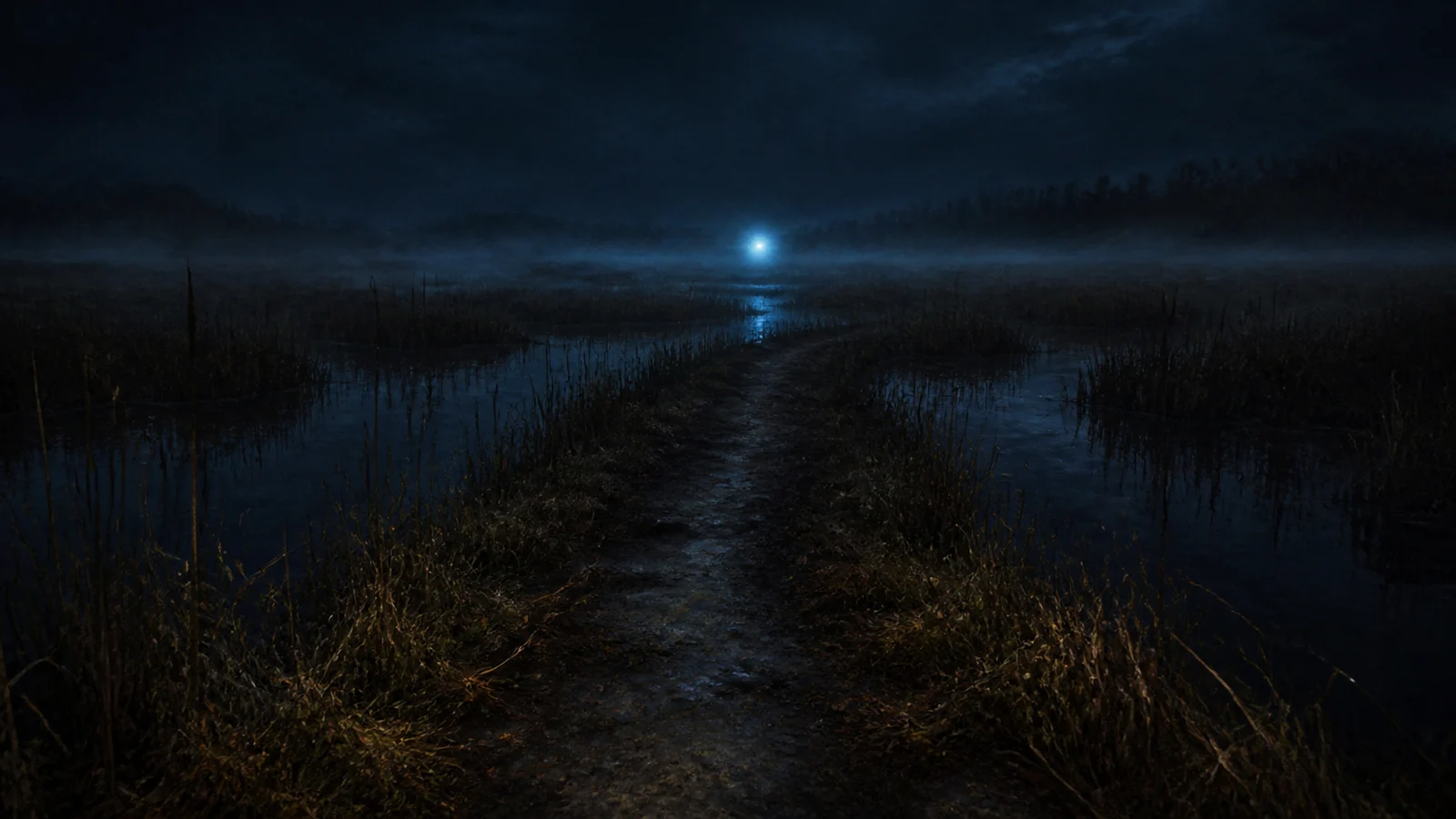
The light does not need to hate you.
It only needs to appear one safe step beyond the last patch of solid ground.
A will-o'-the-wisp is a legendary wandering light associated especially with marshes, bogs, wetlands, and graveyards. In folklore, it may be a spirit, soul, trickster, warning, or lure that leads travelers away from the road. Natural explanations have included distant lamps, bioluminescence, chemiluminescence, and gases produced by decay. A 2025 laboratory study added a new possibility: tiny electrical discharges between methane bubbles may provide the missing spark for a cool blue glow.
That result is exciting.
It is not a receipt proving what every frightened traveler saw.
What does “will-o'-the-wisp” mean?
The name imagines a person carrying a small burning bundle—a “Will” with a wisp of flame. It belongs to a family of names that turn an uncertain light into an agent.
The Latin phrase ignis fatuus means foolish fire. English traditions also use names such as jack-o'-lantern or friar's lantern. Other regions have their own lights, meanings, and beings.
Names that sound similar do not automatically identify one universal creature.
A light associated with treasure is not exactly the same warning as a light associated with an unquiet dead person. A corpse candle tied to death omens does different cultural work than a marsh trickster. A folklorist has to preserve those distinctions even when a modern encyclopedia places every entry on one page.
What repeats is the scene.
Night. Poor ground. A small light at a distance. The urge to follow.
Why does the wisp lead people off the path?
The most powerful part of the legend is not the light. It is movement.
A fixed glow can mark a house, fire, star, or lamp. A light that seems to retreat when approached becomes intentional. It is not merely over there. It is maintaining distance.
Human depth perception becomes less reliable at night when familiar scale and surface detail disappear. A small nearby light and a larger distant light can be difficult to distinguish. Fog scatters brightness. Uneven terrain changes the viewer's height. A traveler moves while the light's background shifts.
None of that proves a specific report was an illusion. It explains why distance itself can become uncertain.
Wetlands make that uncertainty dangerous. The safest route may be narrow, remembered rather than visible. Water reflects and duplicates light. Reeds conceal channels. Ground that appears solid can give way. A traveler who leaves the known path to reach a light may create the exact disaster the legend warned against.
Folklore turns landscape safety into a character:
Do not follow the light.
The rule survives even when the explanation changes.
What were wisps believed to be?
Will-o'-the-wisp traditions vary across place and time, but several broad interpretations recur.
- The misleading dead: a wandering soul or spirit draws the living toward danger.
- A trickster or fairy being: the light tests, mocks, or punishes the traveler.
- A death sign: the light predicts a death or marks a route associated with burial.
- Hidden treasure: the flame reveals where something valuable lies, often with rules that make claiming it dangerous.
- A natural flame: observers describe a luminous event without assigning it a supernatural identity.
These categories overlap. They should not be forced into equivalence.
The same warning can take different shapes because monsters preserve boundaries. A wetland community does not need a chemistry lesson to know that leaving the path at night is a poor decision. A moving spirit gives the bad decision a face and motive.
The marsh-gas explanation had a missing step
Decaying organic material in oxygen-poor wet environments can produce methane and other gases. For centuries, writers and scientists proposed that these gases might cause ghostly lights.
The idea had a problem.
Methane does not simply decide to ignite at wetland temperatures. Explanations involving phosphine or related compounds attempted to supply ignition, but laboratory results and eyewitness descriptions did not always agree. Some experiments produced smoke, odor, or colors unlike traditional accounts. Other possibilities—luminous organisms, reflections, distant artificial lights—may explain some sightings but not a single unified phenomenon.
The honest position remained open: “swamp gas” named a possible ingredient more easily than it explained a self-starting flame.
That gap allowed the wisps to keep their fire.
Follow the safe light instead: Join The Grimbard Press and receive Dead Ship, a free illustrated Subscriber Archive Edition.
A new proposal: microlightning between bubbles
In 2025, a team led by Stanford chemist Richard Zare published laboratory research on electrical discharge between methane microbubbles in water.
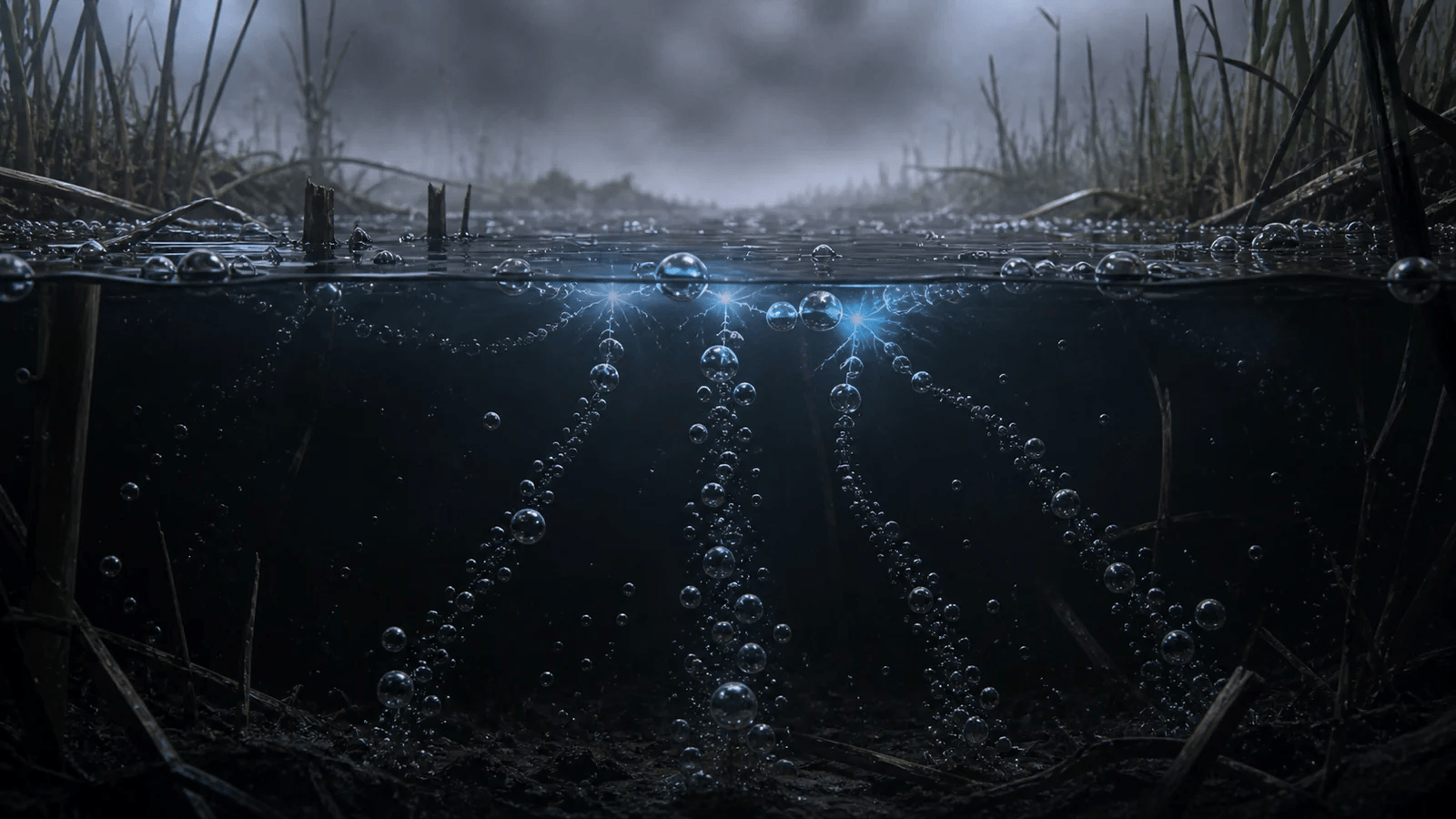
The researchers were not originally building a machine to summon folklore. They were studying unusual chemistry at the boundary between water and air. In dense bubbling conditions, high-speed imaging captured tiny flashes. Measurements indicated that bubbles could separate charge as they moved, merged, and split. Oppositely charged bubbles produced small electrical discharges—“microlightning”—that initiated nonthermal methane oxidation.
The Stanford Chemistry account describes cool blue light resembling traditional will-o'-the-wisp reports. The research appeared in the Proceedings of the National Academy of Sciences.
The proposal answers an important chemical question: where might the ignition come from?
It does not establish that every historical report involved methane bubbles. The experiment demonstrates a mechanism under laboratory conditions. Connecting that mechanism to a traveler in a particular marsh requires environmental evidence the old account usually does not preserve.
Folklore says; evidence allows
| Claim | Responsible conclusion |
|---|---|
| A light appeared over wet ground | Possible, but the description alone does not identify its cause |
| The light moved away when followed | Perceived distance, viewer movement, atmospheric effects, or a moving source could contribute |
| Marsh gas caused every wisp | Unsupported as a universal claim |
| Methane bubbles can produce tiny electrical discharges | Demonstrated in recent laboratory research under studied conditions |
| The new mechanism solves every legend | No; it offers a plausible ignition pathway for some natural luminous events |
| The folklore is “false” if a chemical process exists | No; the warning, meaning, and tradition remain cultural facts |
Science and folklore are answering different questions.
Chemistry asks how a glow could form.
Folklore asks why the light wants you to leave the path.
Why are will-o'-the-wisps rarely photographed?
Historical descriptions refer to brief, weak, unpredictable lights in dark wet places. Those are difficult conditions for observation, much less photography. Wetlands have also been drained, developed, channelized, and illuminated by artificial light, changing both the environment and the darkness in which a faint event would be visible.
The absence of a definitive image is not proof that no natural glow occurs. It does make overconfident identification difficult.
Modern “orb” photographs usually introduce a different problem. Flash can illuminate dust, insects, moisture, or objects close to a camera and make them appear as bright circles. Calling every orb a will-o'-the-wisp does not strengthen either category.
A useful report would need location, weather, duration, color, apparent movement, camera settings, distance estimates, nearby light sources, and ideally independent observation.
Old folklore rarely arrives with metadata.
Why one explanation cannot own every ghost light
The phrase ghost light gathers phenomena that may have nothing in common beyond being luminous and unexplained to the observer.
Possible sources include distant human lights, vehicles, trains, boats, atmospheric distortion, reflections, insects, fungi, electrical phenomena, combustion, deliberate hoaxes, memory error, and events not reconstructable from the report.
Ball lightning is not automatically a will-o'-the-wisp. A railway ghost light is not automatically marsh gas. A culturally specific spirit light is not merely a European wisp with a translated name.
The method used in the investigation of poisoned-water folklore applies here: compare the old warning with the modern mechanism without pretending the legend predicted a technical result.
The connection becomes meaningful when both point toward the same boundary.
The marsh can kill a person who follows the wrong light.
The chemistry does not make that rule less true.
Why the wisp remains frightening
Most monsters approach.
The will-o'-the-wisp makes the victim approach it.
That reversal preserves curiosity inside the fear. The traveler is not attacked while obeying the road. They choose the next step because the light promises rescue, treasure, company, or an answer.
The wisp also remains incomplete. It has no required body. No stable face. No footprint. It can become smaller as it moves away until the watcher cannot tell whether it vanished or simply crossed the limit of vision.
The creature is distance itself.
Frequently asked questions
Are will-o'-the-wisps real?
People have reported unusual lights over wetlands and similar places for centuries. Folklore gives those lights supernatural identities. Natural luminous phenomena are physically possible, but individual historical sightings often lack enough evidence to identify a cause.
Is a will-o'-the-wisp just swamp gas?
“Swamp gas” is an incomplete shortcut. Methane can be produced in wetlands, but ignition was a long-standing problem. Recent research proposes microlightning between bubbles as one possible ignition mechanism; that does not prove every report had that cause.
Are will-o'-the-wisps dangerous?
The light itself may not be the main danger. Following any uncertain light away from a known route in a marsh, bog, or other difficult terrain can be dangerous.
Is a will-o'-the-wisp the same as ball lightning?
No. They are separate categories with different typical descriptions and proposed mechanisms, though old reports may be too vague to classify confidently.
Why are they connected to graveyards?
Graveyards contributed associations with souls and death, and older burial grounds could be damp or poorly lit. Folklore also carried names and meanings between marshes, churchyards, and other liminal places.
The road ends in the wetlands
The Pine Barrens Incident follows a case into sand roads, dark water, partial evidence, and a landscape that does not need to move to make a person lost.
Open the case file or join The Grimbard Press and receive Dead Ship free.
Sources and further reading
- Annie Roth, “Will-o'-the-Wisps' Mysterious Origins Explained by Chemistry,” Stanford Chemistry, 2025.
- Li et al., “Spontaneous Electricity from Methane Microbubbles,” Proceedings of the National Academy of Sciences, 2025, DOI: 10.1073/pnas.2521255122.
- “Will-o'-the-Wisp: Monstrous Flame or Scientific Phenomenon?” PBS Monstrum.
- “The Ignis Fatuus or Will o' the Wisp,” Royal Society of Chemistry.