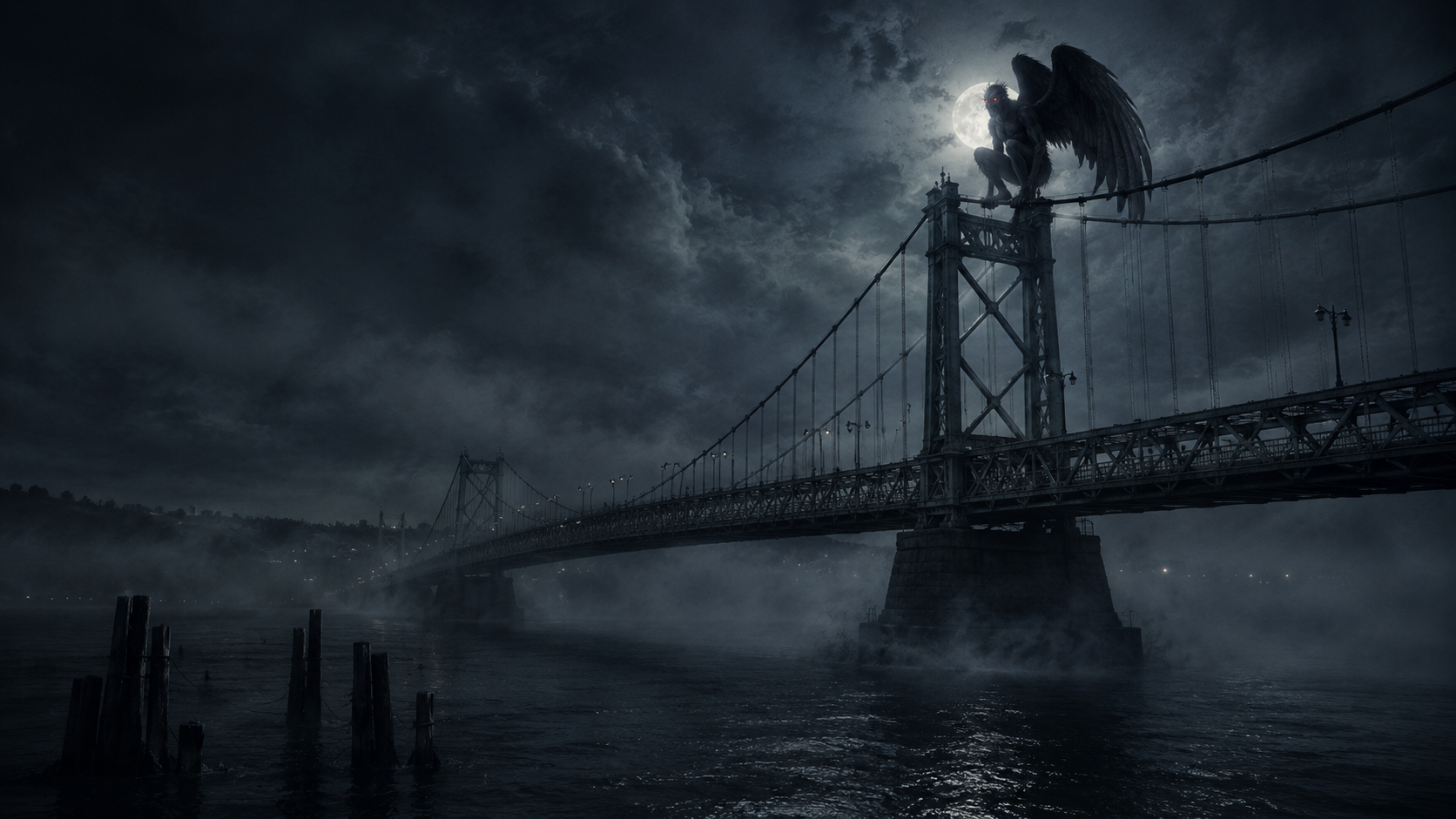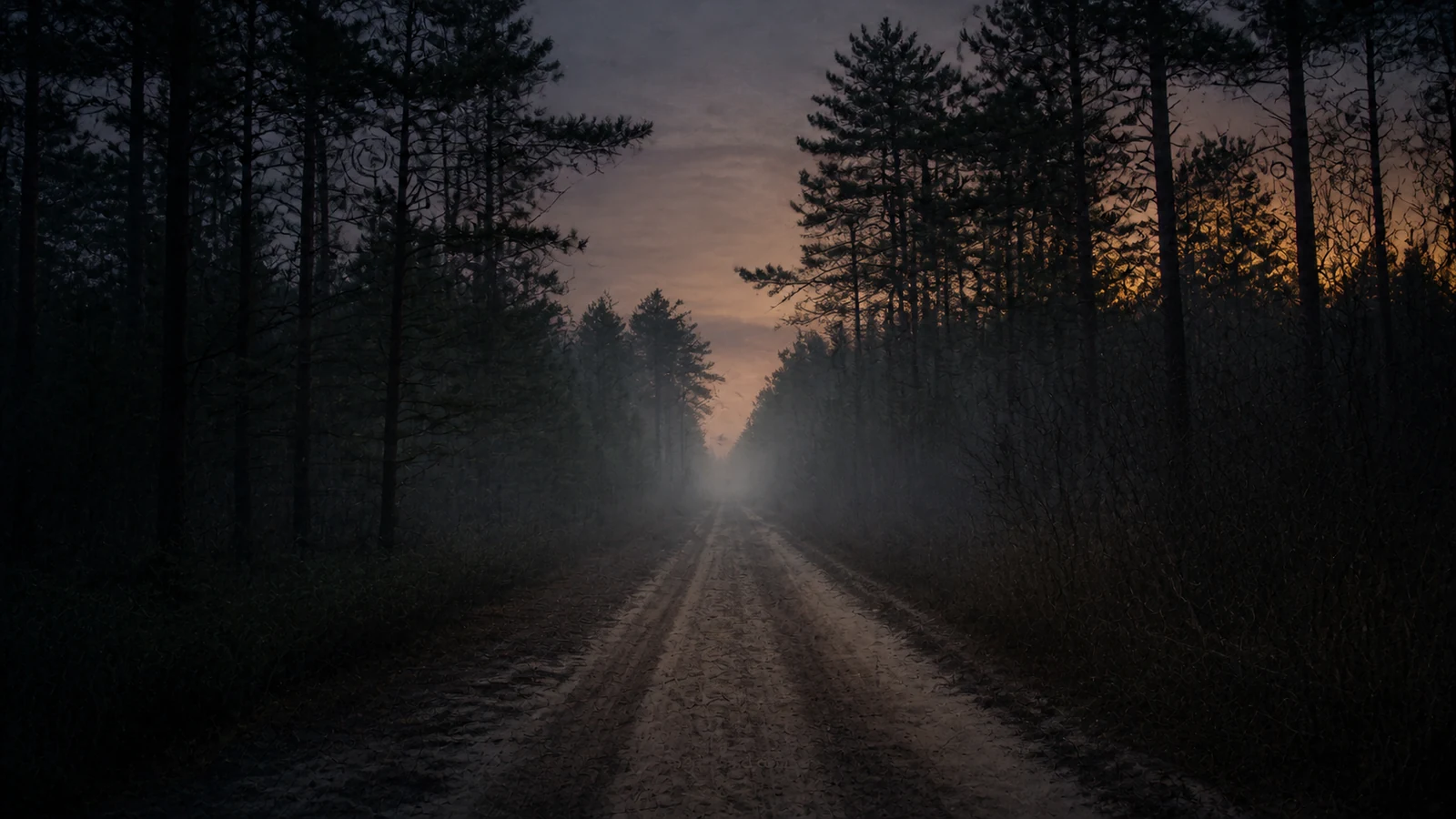
The Pine Barrens do not look empty. They look withheld.
The roads run between pitch pine, cedar swamp, pale sand, and water darkened by iron and cedar tannins. Settlements appear, disappear, and leave names behind. The ground is close to Philadelphia and the Jersey Shore, yet a short turn can remove the ordinary landmarks that prove where you are.
It is the right country for a creature assembled from partial evidence.
The real story of the Jersey Devil has at least three layers. A documented Leeds family became notorious through religious and political disputes and competing almanacs. A later legend gave “Mother Leeds” a cursed thirteenth child in 1735. Then newspapers, promoters, sightings, and hoaxes—especially during the 1909 outbreak—helped fix the winged, hoofed creature now associated with the Pine Barrens. The folklore is real. Evidence for a supernatural animal is not.
Before Mother Leeds, there was a Leeds problem
Daniel Leeds was not a witch hiding in a cabin. He was a colonial writer, surveyor, political figure, and almanac publisher whose work made enemies.
Leeds began publishing an almanac in the late seventeenth century. His use of astrology and his increasingly esoteric religious writing brought him into conflict with fellow Quakers. Political loyalties deepened the hostility. Leeds supported the Crown and served in official roles while his opponents attacked his beliefs and reputation.
That paper trail matters because historians Brian Regal and Frank J. Esposito locate the Jersey Devil’s roots not in a monster birth record but in pamphlets, almanacs, satire, religious conflict, and political insult. Their work, summarized in an open-access article hosted by New Jersey Studies, notes that colonial and early national newspapers do not document the familiar monster story. The Leeds family, however, appears repeatedly in print controversy.
Daniel’s son Titan Leeds inherited the almanac business and became a rival of Benjamin Franklin. In Poor Richard’s Almanack, Franklin jokingly predicted Titan’s death and later treated the still-living publisher as an impostor, insisting the real Titan must already be dead. The satire turned a business rival into a ghost who could not prove his own existence.
There is another visual piece. A wyvern appeared on the Leeds family crest used in the almanac tradition—a winged, dragonlike figure standing on two legs. It would be too simple to call that image the single source of the modern creature, but the resemblance belongs in the history.
Long before a hoofprint appeared in the snow, the Leeds name had been associated with forbidden knowledge, devils, political treachery, ghosts, and a winged emblem.
The monster inherited a reputation before it inherited a body.
Mother Leeds arrives later
The version most people know is set in 1735. A woman called Mother Leeds discovers she is pregnant for the thirteenth time. In anger or despair, she curses the unborn child. The baby is born human and transforms—or is born monstrous—then grows wings, hooves, a long tail, and a grotesque head before escaping up the chimney into the Pines.
Every important detail has alternatives.
The mother is a witch in one telling and an exhausted woman in another. The child changes before witnesses or is born already deformed. It kills the midwife, attacks the family, or simply flees. The home moves around South Jersey. Later versions add a storm because storms improve births of monsters.
New Jersey’s official summary acknowledges several competing origins, including a curse attached to a woman who loved a British soldier and another involving food refused to a traveler. The Pinelands Commission presents the thirteenth-child narrative as legend, not a documented event.
No contemporary 1735 record establishes the supernatural birth. That absence does not tell us exactly when every part of the oral story began. It does mean the familiar scene should not be presented as a newspaper report from the year it supposedly occurred.
Folklore often backdates itself. Once a creature belongs to a landscape, the story creates the night it first arrived.
Get the next field report: Join The Grimbard Press for Dead Ship, a free illustrated Subscriber Archive Edition, monster lore, recovered files, and book news.
The creature gets a body
Ask ten artists to draw the Jersey Devil and certain parts recur: batlike wings, hooves, a long neck, horns, a tail, and a head compared to a horse, dog, goat, or something that should not be attached to the rest.
The disagreement is part of the creature’s history.
Folklore does not require a stable field guide. A witness sees an outline, hears a scream, or finds tracks. A newspaper illustration completes the body. Later witnesses receive that picture before they receive their own glimpse.
By the nineteenth and early twentieth centuries, published accounts gave the Leeds Devil wider circulation. The greatest surge came in January 1909, when newspapers in New Jersey and Pennsylvania reported tracks, screams, attacks, and sightings over a concentrated period. Reports multiplied faster than any one explanation could follow them.
The 1909 outbreak is historically real as a media and social event. People reported encounters. Newspapers printed them. Fear, excitement, jokes, searches, and commercial promotion followed. That does not make every claimed event evidence of one animal.
Possible explanations have included misidentified wildlife, tracks altered by snow, hoaxes, publicity, and stories encouraged by the attention already in circulation. The proper conclusion is not that every witness lied. It is that “people reported the Jersey Devil” and “a winged supernatural creature was present” are different claims.
The outbreak helped turn a local Leeds Devil into the Jersey Devil: not merely one family’s supernatural shame, but a creature large enough to represent the state.
The Pine Barrens is not an empty backdrop
The phrase Pine Barrens encourages outsiders to imagine unused land. The region is nothing of the kind.
The Pinelands contains distinctive ecology, water systems, working communities, historic villages, farms, bogs, and the remains of industries that rose and declined. Place-names record families, work, and stories. The landscape has been inhabited and changed for centuries.
What it also contains is visual repetition. Pine, sand road, wetland, and low horizon can make distance hard to judge. Abandoned structures and former settlements allow human history to surface without explanation. The land sits near dense population but can still make a person feel removed from it.
That combination is unusually good for folklore. A creature needs enough wilderness to escape confirmation and enough witnesses to keep returning.
The Jersey Devil also became a form of regional ownership. Outsiders may ask whether the animal exists. Locals can use it as a shared reference, joke, warning, mascot, tourist draw, environmental guardian, or statement that South Jersey contains a history the rest of the state does not control.
The Atlantic County account calls it an authentic folk legend. That phrase is exact. A legend can be authentic without its creature being zoologically verified. The authenticity belongs to the telling, the place, and the community’s relationship with it.
What about the sightings?
A historical article should not pretend to solve every noise or footprint reported over three centuries.
Some claims are too poorly documented to evaluate. Others grew more precise with retelling. A famous person attached to a sighting can lend authority even when the earliest source is hard to find. Newspaper publication proves that an account circulated, not that the reporter verified a creature.
This is why the evidence should be sorted before it is interpreted:
- Documented history: the Leeds family, almanacs, religious conflict, political satire, the family crest, later newspaper publication, and the 1909 wave as a public event.
- Folklore: Mother Leeds, the thirteenth birth, the chimney escape, the creature’s supernatural age, and variations attached to the Pines.
- Reports: claimed encounters, tracks, screams, livestock incidents, and later sightings, each only as strong as its surviving documentation.
- Interpretation: proposed links between the Leeds disputes and the later creature, possible animal identifications, hoaxes, and what the legend means to South Jersey.
Keeping those categories separate does not weaken the story. It reveals how much work the story performed.
The Mothman and the Bridge That Fell occupies a similar tension between a specific landscape, a period of reports, later tragedy, and the form popular culture gave the creature. The details are not interchangeable, but the method is: date the accounts, identify what was added later, and resist making coincidence carry more weight than it can bear.
So what is the real Jersey Devil?
If “real” means a verified species or supernatural being, the surviving evidence does not establish one.
If “real” means a folklore tradition with documented historical roots, printed transformations, recurring reports, and a powerful connection to place, the Jersey Devil is abundantly real.
It began before the modern monster had a stable name or anatomy. Religious enemies made Daniel Leeds dangerous. Benjamin Franklin made Titan Leeds dead on paper while he was still alive. A winged crest gave the family dispute a ready image. Mother Leeds gave the creature a birth. Newspapers gave it a body large enough to cross the state in a night. The Pine Barrens gave it somewhere not to be found.
That final element matters most.
What monsters represent in folklore often begins with a boundary. The Jersey Devil guards one between documented history and the story South Jersey tells about itself. Remove the creature and the history remains. Remove the history and the creature becomes a generic winged cryptid.
Together, they make something no field guide can hold.
Return to the Pines
The Pine Barrens Incident does not ask the legend to sit still for a museum label. It returns the creature to the roads, wetlands, and withheld spaces that made it possible.
Explore The Pine Barrens Incident, revisit why Appalachian horror makes landscape a witness, or join The Grimbard Press for the next field report.
Sources and further reading
- Brian Regal and Frank J. Esposito, The Secret History of the Jersey Devil: How Quakers, Hucksters, and Benjamin Franklin Created a Monster, Johns Hopkins University Press, 2018. Publisher overview.
- Brian Regal, “The Jersey Devil: The Real Story,” New Jersey Studies, Summer 2015.
- New Jersey Pinelands Commission: Jersey Devil.
- Atlantic County: “Jersey Devil—Fact or Fiction?”.
- New Jersey Historical Society: “Legend of the New Jersey Devil”.